Thermal Underwear Manufacturing: Which Fabric Layering Techniques Actually Work?
You pick a heavier fabric, thinking it means warmer product. Your customers wear it once and return it. Sound familiar? The problem isn’t the weight — it’s the structure.
Thermal underwear performance depends on how fabric layers are engineered together, not on GSM alone. The right approach separates moisture-wicking inner layers from heat-retaining outer shells, matches knit structure to fiber function, and aligns every material decision with a specific use-case scenario.
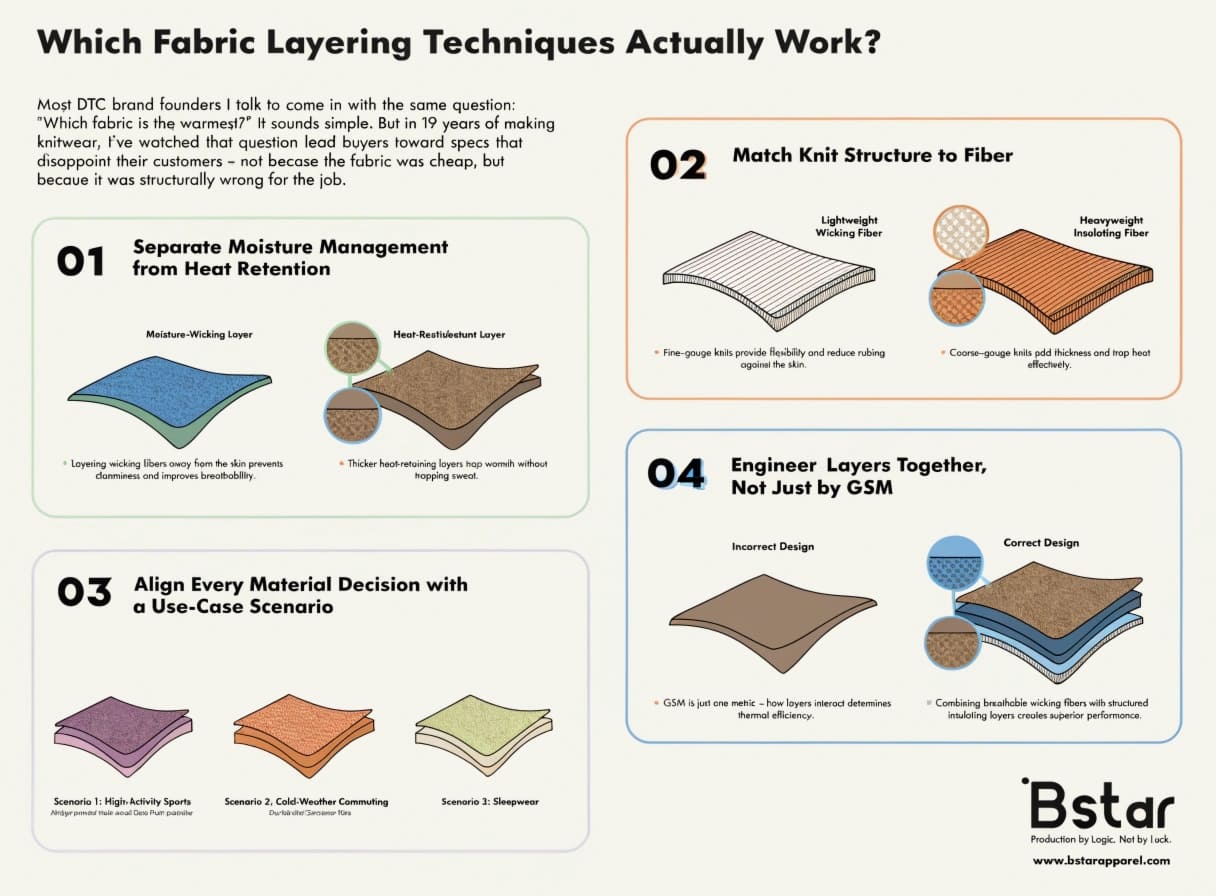
Most DTC brand founders I talk to come in with the same question: "Which fabric is the warmest?" It sounds simple. But in 19 years of making knitwear, I’ve watched that question lead buyers toward specs that disappoint their customers — not because the fabric was cheap, but because it was structurally wrong for the job. This article breaks down four core techniques we use in thermal underwear production. Each one addresses a real failure point I’ve seen in client projects.
Bi-Component Knit Engineering: Are You Confusing Your Base Layer With Your Mid-Layer?
A lot of buyers spec one fabric to do everything — wick moisture, trap heat, feel soft. That fabric doesn’t exist. When you force one layer to do both jobs, it fails at both.
A base layer must move moisture away from skin fast. A mid-layer must trap still air to retain heat. These are structurally opposite functions. A fine-gauge interlock or single-jersey construction with hydrophobic fibers handles the base. A brushed or looped-face fabric handles the mid. Mixing them up is the most common spec mistake we see.
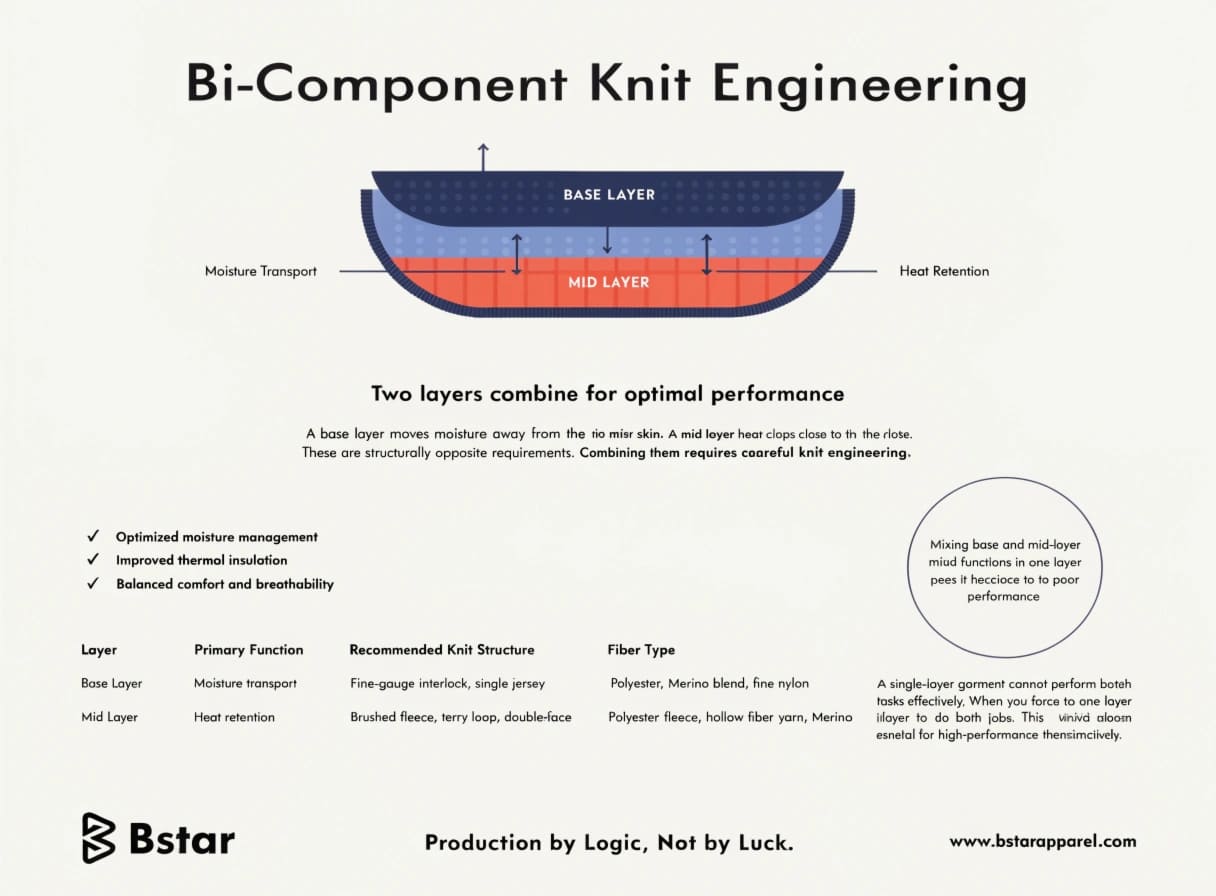
Here’s why this matters at the fiber level. Moisture-wicking requires capillary action — the fabric needs open channels between fibers to pull sweat outward. A dense, high-GSM knit blocks those channels. The moisture sits against the skin. The wearer feels cold and wet, even in a 300 GSM garment. We had a client launching a Nordic skiing base layer who came to us with a heavy double-knit spec. It looked warm on paper. We tested the moisture transport and flagged the problem early. After switching to a fine-gauge polyester-Merino blend with a open-knit face, the product’s next-to-skin feel improved significantly — and the return rate on their previous version stopped repeating.
| Layer | Primary Function | Recommended Knit Structure | Fiber Type |
|---|---|---|---|
| Base Layer | Moisture transport | Fine-gauge interlock, single jersey | Polyester, Merino blend, fine nylon |
| Mid Layer | Heat retention | Brushed fleece, terry loop, double-face | Polyester fleece, hollow fiber yarn, Merino |
The rule is simple: don’t ask one layer to do two jobs.
Advanced Lamination Techniques: Does Bonding a Membrane Actually Help, or Just Add Cost?
Windproof membranes sound impressive in a product brief. But bonded wrong, they kill breathability and turn a performance garment into a sauna.
Laminating a breathable membrane — like a microporous film — to a knit textile creates a windproof barrier without sealing moisture inside. The membrane blocks air movement while allowing water vapor to escape. The result is effective only when the bonding process preserves the membrane’s pore structure and the knit’s stretch recovery.
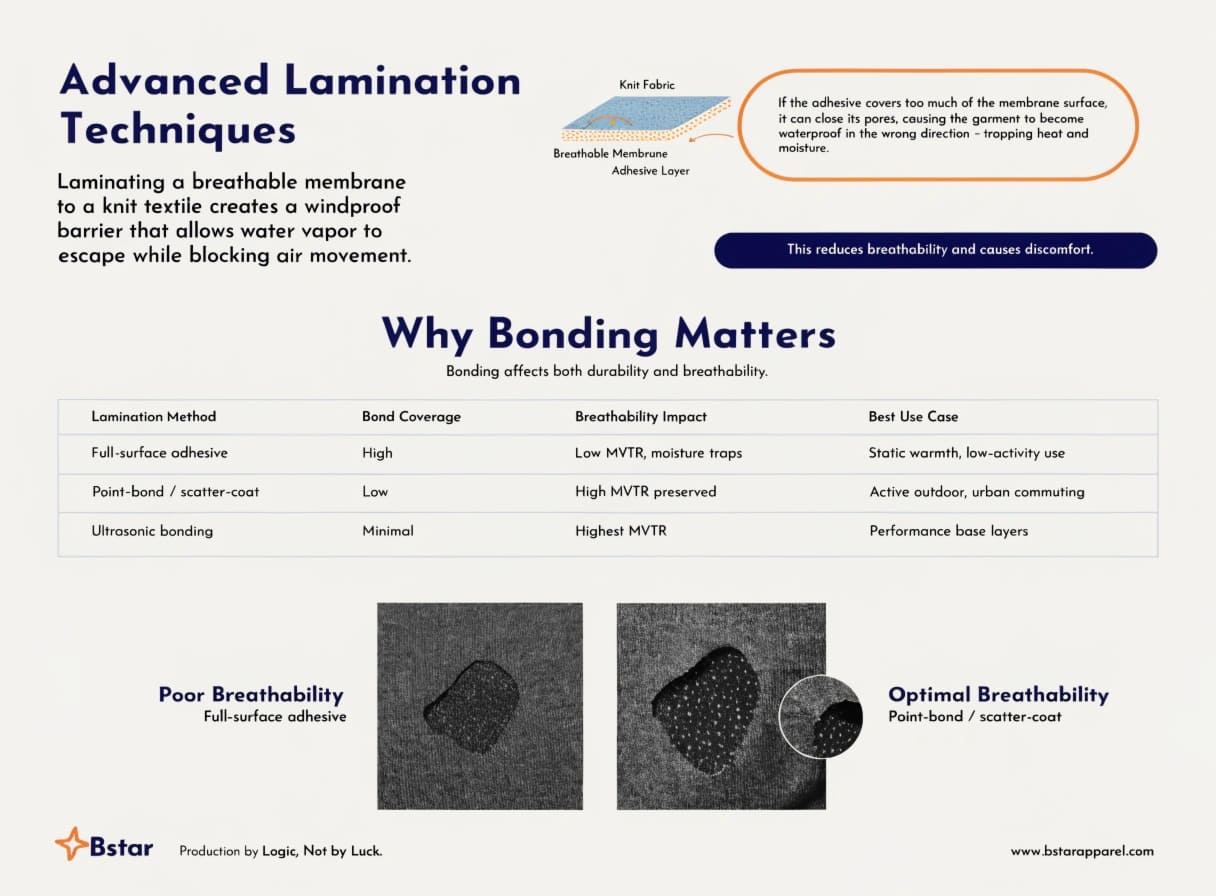
The failure mode is straightforward. If the adhesive covers too much of the membrane surface during bonding, the pores close. The garment becomes waterproof in the wrong direction — it keeps heat in but also traps moisture. We’ve seen this with clients who sourced laminated fabric from suppliers who prioritized bond strength over breathability. The fabric passed peel tests but failed in wear.
The technique that works is point-bonding or scatter-coating — applying adhesive in a dot pattern that leaves the majority of the membrane surface open. This preserves the moisture vapor transmission rate (MVTR) while keeping the bond durable through repeated washing.
| Lamination Method | Bond Coverage | Breathability Impact | Best Use Case |
|---|---|---|---|
| Full-surface adhesive | High | Low MVTR, moisture traps | Static warmth, low-activity use |
| Point-bond / scatter-coat | Low | High MVTR preserved | Active outdoor, urban commuting |
| Ultrasonic bonding | Minimal | Highest breathability | Performance base layers |
For urban commuting in wet-cold conditions, this layer matters most. The wind chill is real, and a functional membrane makes a measurable difference in comfort.
Multi-Layer Thermoforming: Can Hot-Press Molding Replace Seam Construction?
Seams in thermal underwear cause two problems: pressure points and heat loss. Hot-press molding solves both — but only if the fabric layers are compatible with the process.
Multi-layer thermoforming uses heat and pressure to fuse fabric layers into a seamless, 3D structure. This eliminates stitch-based seams at high-wear zones, reduces heat loss through seam gaps, and creates a closer body fit. The technique requires thermoplastic-compatible materials in at least one layer of the construction.
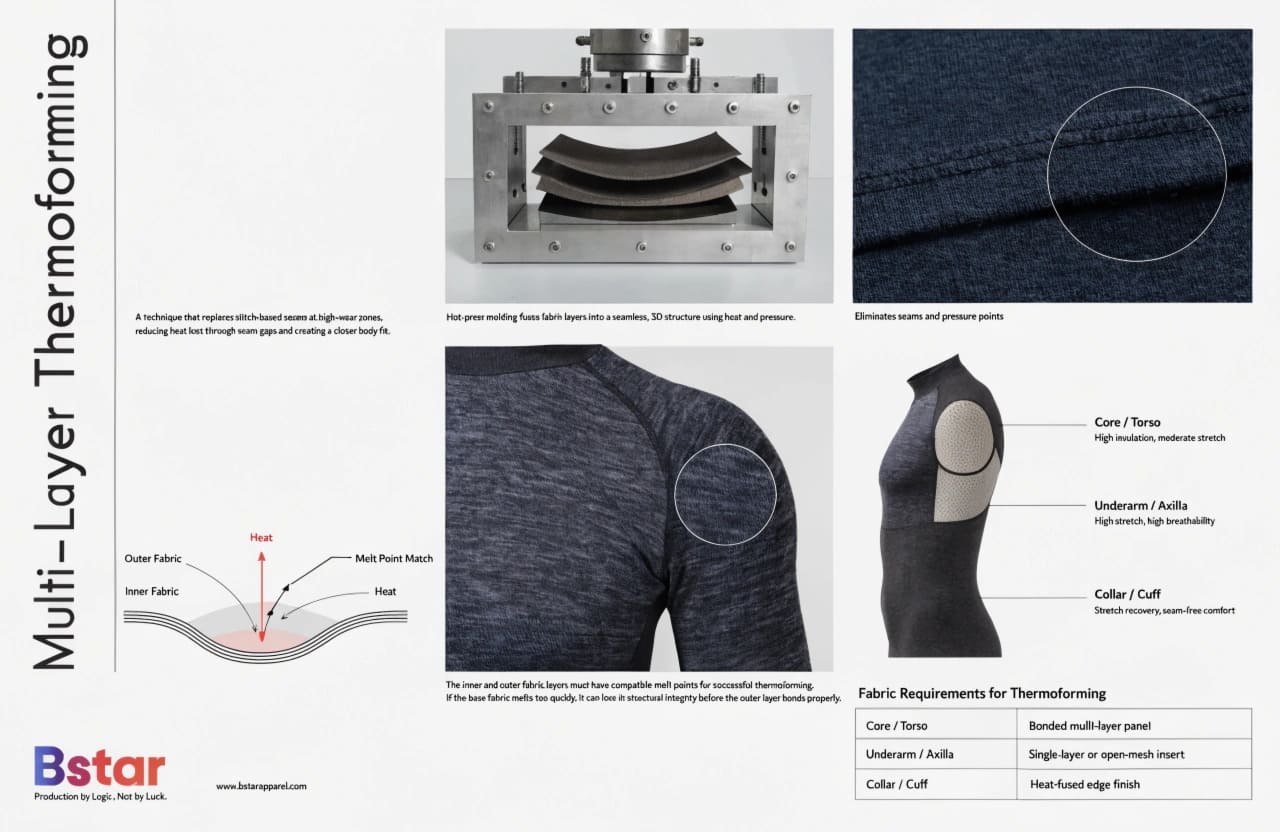
The structural logic here is about body mapping. Different zones of the body need different fabric behavior — the torso needs more insulation, the underarm needs more stretch and breathability. Thermoforming allows us to bond zone-specific panels without sewing them together. The joint is part of the fabric structure, not added on top of it.
For this to work, the inner and outer fabric layers need to have compatible melt points. If the base fabric melts before the outer layer bonds properly, the structure fails. We pre-test all fabric combinations for thermal compatibility before committing to a molded construction.
| Zone | Fabric Requirement | Thermoforming Application |
|---|---|---|
| Core / Torso | High insulation, moderate stretch | Bonded multi-layer panel |
| Underarm / Axilla | High stretch, high breathability | Single-layer or open-mesh insert |
| Collar / Cuff | Stretch recovery, seam-free comfort | Heat-fused edge finish |
One thing worth saying directly: thermoforming adds production complexity and cost. It’s not always the right call. For DTC brands positioning in performance outdoor or premium base layer categories, it justifies the investment. For entry-level basics, standard flatlock seaming is fine.
Yarn-Level Thermal Innovations: Do Moisture-Absorbing Heating Fibers Live Up to the Claims?
"Self-heating fabric" is a phrase that shows up in a lot of supplier decks. Some of it is marketing. Some of it is real. Knowing the difference matters before you build a product line around it.
Moisture-absorbing heating fibers — such as exothermic polyacrylate blends — generate a small, measurable heat output when they absorb water vapor from the skin. This is a real physical process, not a marketing claim. The warmth is modest and temporary, but at the yarn level, it contributes to sustained comfort during low-to-moderate activity in cold conditions.
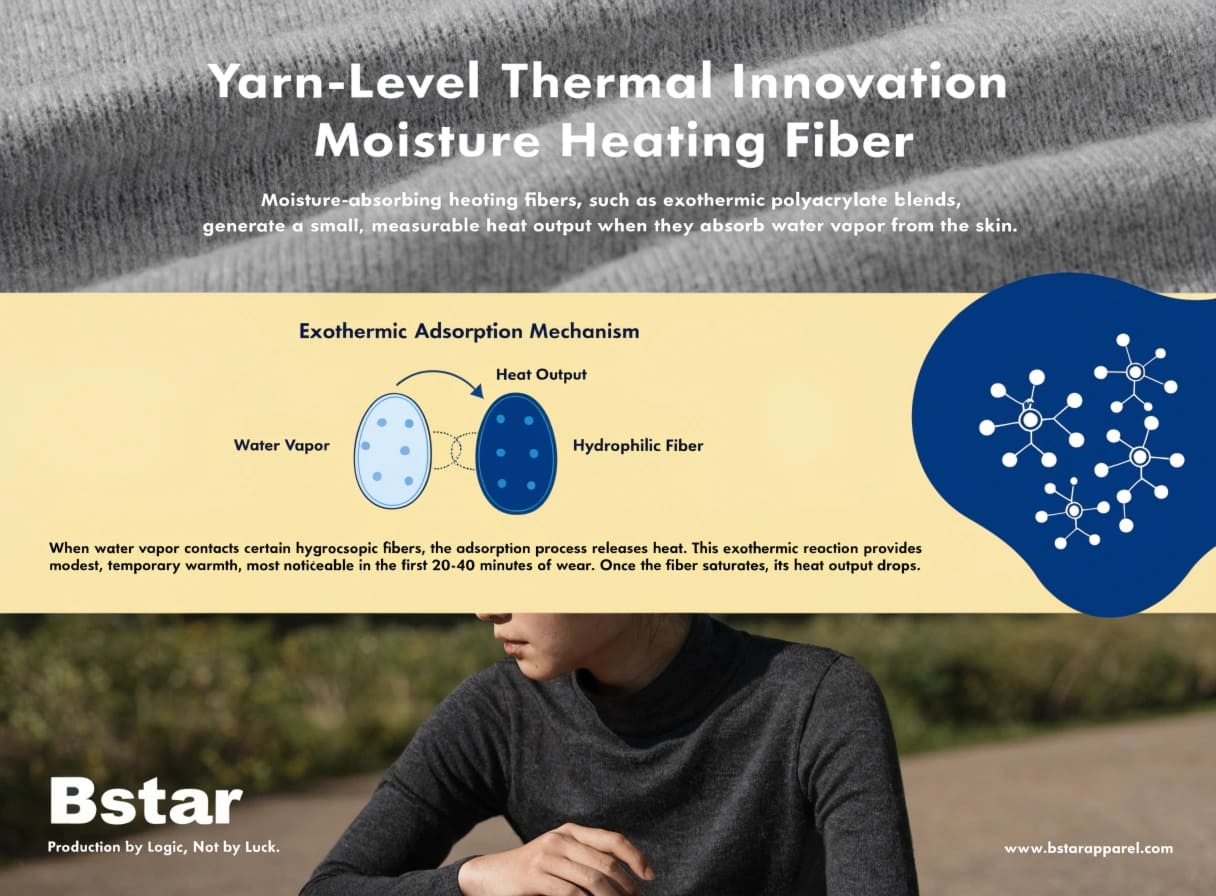
The mechanism is exothermic adsorption. When water vapor contacts certain hygroscopic fibers, the adsorption process releases heat. The effect is most noticeable in the first 20–40 minutes of wear. After that, the fiber saturates and the heat output drops. This is why these fibers work well in dry-cold conditions — like Nordic skiing or mountain hiking — where sweat is intermittent and the fiber keeps recycling.
They are less effective in wet-cold urban commuting, where sustained moisture output keeps the fiber saturated. In that scenario, a fast-wicking synthetic base layer performs better than a heating-fiber construction.
We’ve worked with brands who wanted to use heating fibers for all their thermal SKUs. We pushed back on the ones positioned for city use. The honest answer is that yarn innovation is scenario-specific.
| Fiber Type | Heat Mechanism | Best Scenario | Limitation |
|---|---|---|---|
| Exothermic polyacrylate blend | Moisture adsorption | Dry-cold, intermittent activity | Saturates in sustained wet conditions |
| Far-infrared ceramic blend | Reflects body radiation | Static warmth, sleep/lounge | Limited effect during active movement |
| Hollow-core polyester | Air entrapment insulation | Lightweight active layering | No active heat generation |
Fiber innovation is real, but it doesn’t override structural decisions. A heating fiber in a poorly constructed knit still underperforms a standard fiber in a well-engineered one.
Conclusion
Thermal performance comes from matching fabric structure to layer function and use case — not from chasing higher GSM or premium fiber labels alone.
If you’re currently developing a thermal line and want a second opinion on your fabric spec, tell us your target use case — we’ll tell you where the structure holds up and where it doesn’t.