
Why Do Underwear Waistbands Roll or Fold?
Underwear waistband rolling is one of the most frustrating product failures a DTC brand can face — because it shows up after you’ve committed to inventory. You tested samples, everything looked great, and then returns start coming in with the same complaint. If you’re trying to figure out why it keeps happening, the answer is rarely simple.
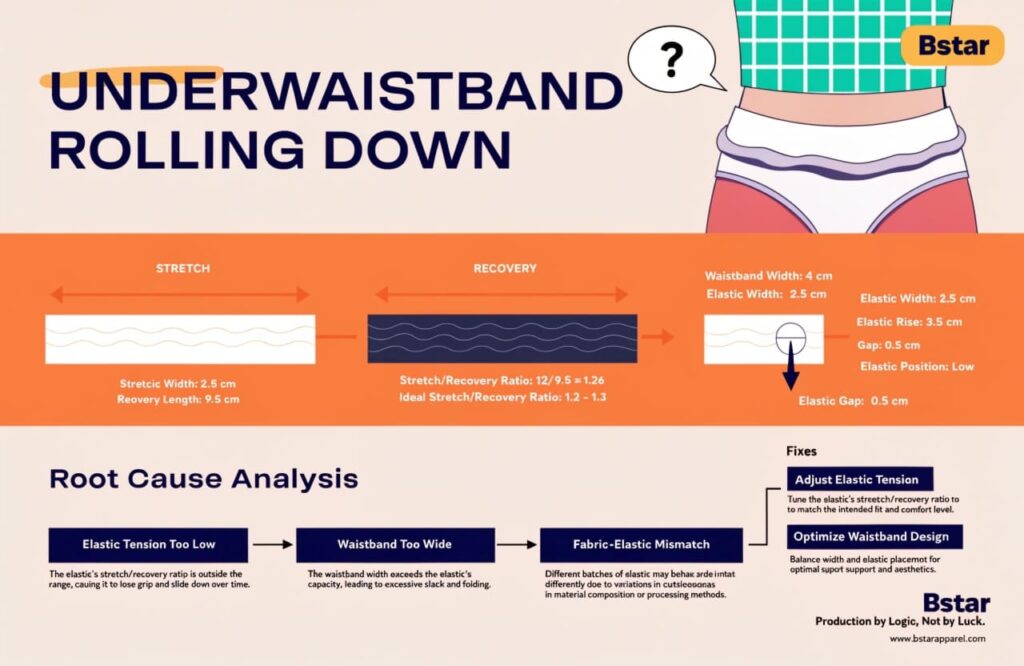
An underwear waistband can roll or fold because of the fit, elastic behavior, waistband width, garment rise or the way the band is attached. Start by recording what actually happens: does the whole waistband slide down, does an edge fold over, or does the elastic twist inside its casing? Then compare the approved sample and affected garment under the same conditions. The symptom alone does not identify the cause.
That answer sounds technical, but it has a very practical implication: if you walk into your next supplier conversation asking for "better elastic," you might be solving the wrong problem. Let me break down each variable so you can ask the right questions.
This guide focuses on finding and correcting a rolling problem in the finished garment. The BSTAR Underwear Lab connects that review with related material, wash and construction checks.
How to Keep Underwear Waistband from Rolling?
You’ve already had the waistband problem. Now you want to prevent it from happening again in the next production run. But if you don’t know which variable caused it, you can’t reliably prevent it.
To help prevent an underwear waistband from rolling, review the elastic, fabric, attachment settings and fit as one assembled system. Define the intended waist position, specify the waistband dimensions for each size, and agree which sizes and wear conditions will be checked before bulk approval. A flat sample on the table is only part of that decision.
This is where a good-looking prototype can leave a gap. The sample size fits beautifully. The waistband sits flat, looks clean, and photographs well. Then production feedback raises a question that the original approval never answered: was the same fit reviewed in the other sizes?
The Size Range Problem Nobody Talks About
When we work with clients on waistband specs, one of the first things I ask is: which size did you approve the sample in? In the projects behind this observation, the answer was often S or M. Approving that size was not the mistake; treating it as evidence for every other size was.
A size label does not tell you how much strain the waistband experiences. Elastic length and garment dimensions should be graded for the intended bodies. A larger size is not automatically the same length of elastic stretched further.
- Check the size chart against the actual waistband. Record the intended body measurements, relaxed finished circumference, elastic cut length and joining allowance for each reviewed size. Do not assume a universal S-to-XL increment.
- Compare extension under defined conditions. Fabric stretch, elastic force and residual extension after recovery are different measurements. Research on plated knitted fabrics shows that elastane content can affect their elastic behavior under cyclic loading; it does not establish a universal fabric-to-elastic ratio that prevents waistband rolling.1
- Check the assembled layers. An encased waistband includes fabric around the elastic. Review whether those layers, the casing dimensions and the attachment behave as intended on the actual garment, rather than inferring the result from body size alone.
What to Confirm Before You Lock Specs
| Variable | What to Ask Your Supplier |
|---|---|
| Elastic behavior | "Which elastic reference is this, and what force, extension and residual extension were measured under the agreed loading and recovery conditions?" |
| Fabric stretch and recovery | "Which direction and specimen state were checked, and was the same method used for the approved and proposed materials?" |
| Waistband construction | "Can we confirm the cross-section, finished width, elastic position and attachment on this sample?" |
| Sewing settings | "Have stitch formation, tension, feed and handling been checked for this fabric-elastic combination?" |
| Size and wear validation | "Which sizes, body measurements and movements are included in the approval plan, and what remains unchecked?" |
The goal isn’t to get perfect answers to every question. It’s to understand which variables your supplier has actually controlled versus which ones they assumed would carry over from the proto.
For the measurement side, use the separate waistband stretch recovery testing guide. Pulling elastic to an undefined "full extension" is not a reproducible specification. Here, the next question is whether the measured component works in the finished garment.
Why Does the Waistband of My Underwear Roll Down?
You’re wearing the underwear and the waistband keeps rolling down. It’s a complaint we encounter in customer feedback. But buyers may use "rolling down" to describe several different things.
Separate sliding, folding and twisting before choosing a fix. Sliding means the band changes position on the body. Folding means part of the band bends over itself. Twisting means the elastic rotates inside a casing. More than one can happen together, and none proves that the elastic is simply too weak.
Breaking Down the "Rolling Down" Failure
Ask the wearer where the problem starts and when it appears: standing, sitting, bending, walking, or after washing. A photo of the same garment before and after that movement is more useful than a return note saying only "bad waistband."
Here’s how I break down the discussion when a client comes to us with this complaint:
Scenario 1: Complaints are concentrated in part of the size range.
If customers in some sizes report rolling while others do not, compare the finished measurements, elastic lengths, intended fit and actual wearer measurements. Check material identity and attachment as well. This pattern gives you a place to investigate; it does not prove a grading error or rule out a material issue.
Scenario 2: The waistband width and garment shape need reviewing together.
A wider waistband can look clean in a product photo. That does not tell you how it behaves when the wearer sits or bends. We’ve seen clients spec a 4 cm waistband on a low-rise brief and wonder why it won’t sit flat. That project question belongs in a review of the width, rise, band position, elastic and attachment together. It does not mean every 4 cm waistband is incompatible with a low-rise brief.
Scenario 3: A material change appears between sampling and production.
We’ve also seen the sample-to-bulk problem where the approved sample used Elastic Lot A and production used Lot B. The nominal width and color matched, but the stretch and recovery behavior differed. Keep that material change in the investigation rather than assuming a visual match is enough.
When clients come to us with this problem, the first thing we ask is: "Did the fabric or elastic supplier change between sampling and bulk production?"
The answer needs checking against the sample and production records. Record the approved supplier and material reference, identify the incoming lot, and confirm how any substitution will be reviewed. A new lot is not automatically defective, and every lot does not automatically require the same external testing; the control plan should reflect the product risk and order requirements.
Sewing can change the result too. A&E’s technical guidance discusses stitch balance, differential feed and handling when sewing stretch knits.2 These are useful checks at the attachment seam, not proof that a particular rolling complaint has a sewing cause.
For custom men’s underwear, make the review style-specific. A boxer brief and a low-rise brief should not share a waistband approval merely because the elastic looks the same.
Is It Better to Roll or Fold Underwear?
This question has two completely different meanings depending on whether you’re asking about storage or construction. Keep them separate when discussing a production complaint.
Rolling underwear for storage is not the same as a waistband rolling during wear. For construction, use a cross-section or physical sample to distinguish encased elastic, fold-over elastic and exposed elastic; "folded" and "sewn-in" alone are too ambiguous for a specification.
Storage: Roll vs. Fold
From a consumer perspective, this is mostly a personal preference question. Neither method diagnoses a rolling problem during wear.
| Method | Practical Use | Consideration |
|---|---|---|
| Rolling | Compact storage or travel organization | Avoid forcing the waistband into a tight roll or storing it under stretch |
| Folding | Flat storage and visibility in a drawer | Avoid repeatedly forcing a hard crease through the band; follow product care guidance |
Do not assume that every knitted fabric or elastic will recover identically from compression. If you suspect packaging or storage, compare an affected garment with an unpacked reference after the same agreed relaxation period.
Construction: Encased, Fold-Over and Exposed Elastic
This is where the real product decision lives. Here’s what I want clarified when working with brands on the waistband specification:
Encased elastic sits inside a fabric casing, which may be formed from the garment edge or a separate fabric band. This matches the casing terminology used in New Mexico State University’s general waistband guide.3 In the underwear sample, identify the casing dimensions and how the elastic is secured; do not assume "covered" describes all of that.
Fold-over elastic is an elastic binding that folds around a fabric edge. The elastic itself folds; this is different from fabric enclosing a separate elastic strip. The Sewing & Craft Alliance guide illustrates that construction.4 Confirm the finished bound width and attachment rather than using the term for any turned-over waistband.
Exposed elastic forms a visible waistband attached to the garment edge. Its surface, edge, join and attachment need their own fit and wear review. It is not automatically stronger or less comfortable than a covered alternative.
The choice isn’t about which is "better." It’s about which construction is right for your specific waist rise, size range, and aesthetic direction. Compare the actual samples rather than ranking one construction as universally more stable or more premium. The fit and construction section of our manufacturing guide puts these decisions into the wider sample-approval process.
How to Stop a Waistband from Rolling?
You’re mid-production, or post-production, and you need to intervene. This is the hardest position to be in — but it’s also where understanding the multi-variable nature of the problem pays off, because it tells you where to look first.
To stop a waistband from rolling, reproduce the complaint, compare it with the approved reference, and test a controlled revision. Review the revised garment in the affected sizes and conditions before approving the change. Simply tightening the elastic or widening the band can change the fit without resolving the original problem.
A Practical Diagnostic Framework
When clients come to us after a production run with rolling issues, I walk them through this sequence:
Step 1: Identify the pattern.
- Does the rolling happen in all reviewed sizes, or only some?
- Does it happen at the front, back, sides, or all the way around?
- Is the band sliding, folding, twisting, or doing more than one?
- Which movement starts it, and does it remain after the movement stops?
- Did it happen in sampling, only in bulk, or only after washing?
Record the style, size, sample version, material references and wearer measurements with those observations. Use the intended wearing position, not a different position chosen just to keep the band flat.
Step 2: Match the pattern to the next checks.
| Pattern | What to Check Next |
|---|---|
| Only some sizes roll | Graded garment dimensions, elastic cut lengths, intended body measurements and fit in those sizes |
| Rolling appeared in bulk but not in sampling | Material and lot records, finished measurements, attachment settings and any sample-to-bulk substitution |
| Rolling only at the front | Front rise, intended waistband position, local fit and attachment during the movement that triggers it |
| Folding or twisting around the band | Casing dimensions where applicable, elastic position, join, attachment and sewing consistency |
| Rolling across all reviewed sizes | Shared material, construction, fit assumptions and review conditions; no single cause is established by this pattern |
Use the table to choose comparisons, not to declare a root cause from the complaint alone.
Step 3: Change one variable at a time.
This is critical. If you change the elastic spec and the construction method and the stitch tension simultaneously, you won’t know what actually solved it. Lock your other variables and test one change at a time. This costs more in sampling time, but it prevents you from repeating the same diagnostic confusion in the next product.
If several changes are necessary together, record them as a new version and do not attribute the result to only one. Compare the old and revised samples under the same wear and wash conditions.
Step 4: Validate across the agreed size and use plan.
Include the affected sizes and relevant size extremes, plus any sizes where the grading or construction changes. Record the coverage of that plan. An XL pass does not prove an S, M or every other size will pass, and a fit form cannot reproduce wearer movement.
Check whether the revision introduces digging, slippage, restricted movement or a different fold. If washing is part of the complaint or approval requirement, repeat the comparison after the agreed care procedure and recovery period. Use the sampling and prototyping process to keep revision comments, physical references and approval versions connected.
What Should the Approval Record Contain?
The following is a practical project record, not a universal test standard or pass threshold:
| Record | What to Keep | Why It Matters |
|---|---|---|
| Sample identity | Style, size, version, fabric and elastic references, lot where relevant | Links the decision to a physical garment |
| Conditions | Wearer measurements, intended position, movements, review duration and new/washed state | Makes the comparison repeatable |
| Observed problem | Location, type of rolling, when it starts and photographs | Separates the complaint from the proposed cause |
| Controlled change | Revised variable, settings or dimensions, plus everything held constant | Shows what the comparison can and cannot establish |
| Recheck | Sizes and conditions reviewed, observations and remaining issues | Defines the actual extent of validation |
| Bulk decision | Approved reference version, reviewer/date, written criteria and production checks | Gives the production team a usable approval |
Do not release a revised waistband to bulk on the strength of an improved photograph alone. Keep the sample and written decision together, including any unreviewed conditions.
Frequently Asked Questions
Why does my underwear waistband roll down after washing?
Compare the garment before and after the actual care procedure. Check changes in finished circumference, casing or band appearance, elastic behavior and attachment, using the same relaxation and review conditions. Do not assume washing always reduces recovery: a study of cotton and cotton/spandex knitted fabrics reported no influence on dynamic work recovery and stress at the specific extension examined under its laundering conditions.5 That finding is not a guarantee for all waistband elastics or finished underwear. Our underwear wash test checklist helps organize the garment-level comparison.
Can waistband rolling be fixed without changing the construction?
Sometimes. A controlled change to elastic length, material or attachment settings may resolve a sample-specific problem without changing the construction type. First establish which change helps, then check comfort and the other approved sizes and conditions. If the shape or band position remains unsuitable, a pattern or construction revision may be needed.
How do I know if my waistband spec is correct before bulk production?
Agree on measurable dimensions and a fit-review plan, then review the identified samples in the relevant sizes and conditions. Keep an approved physical reference, material identity, revision history and written acceptance criteria. A component recovery result, a flat photograph or a single-size fit does not approve every aspect of the finished waistband.
What is the most common waistband mistake DTC brands make?
I cannot rank the whole industry without survey data. A recurring issue in the projects discussed here is approving one sample size and assuming the rest of the range is covered. Another is leaving the approved elastic or a later material substitution insufficiently identified. Both are worth resolving before the next order.
Does waistband width affect rolling?
Width is one variable to evaluate alongside elastic construction, garment rise, finished circumference, attachment and the wearer’s movement. A wider band is not automatically more stable, and a narrower one is not automatically a fix. Compare revisions on the actual garment; there is no universal width or width-to-rise ratio established by the sources cited here.
Conclusion
Underwear waistband rolling isn’t a single problem with a single fix. It’s a multi-variable outcome shaped by fit, elastic and fabric behavior, construction, and how those interact during wear across the reviewed size range. The useful question is which variable is off — not just what’s the fix.
Before your next production run, take one concrete diagnostic step: ask which sizes and conditions the waistband approval actually covers, and how the production elastic relates to the material used in the approved sample. Then use the complaint pattern to plan a controlled comparison, rather than prescribing stronger elastic before seeing the evidence.
We work with DTC brands at exactly this stage — when the spec needs to be right before bulk commitment. If you’re developing or improving an underwear waistband and want a second set of eyes on the construction spec, discuss your waistband project with our team. Start with the affected sample, intended fit and what changes during wear.
-
Tea Jovanović, Željko Penava and Zlatko Vrljičak. “Impact of the Elastane Percentage on the Elastic Properties of Knitted Fabrics under Cyclic Loading.” Materials, 2022, 15(19), 6512. Research article. DOI: 10.3390/ma15196512. The study concerns plated knitted fabrics under defined cyclic loading; it does not test finished underwear waistband rolling or establish a universal component-matching ratio. ↩
-
American & Efird. Sewing Stretch Knit Fabrics, technical bulletin. Supports reviewing stitch balance, feed and handling for stretch-knit seams; not a waistband-rolling test standard or a universal machine-setting specification. ↩
-
New Mexico State University, College of Agricultural, Consumer and Environmental Sciences. Waistbands Made Easy, Guide C-234, revised by Robin C. Mack-Haynes. Used for general casing terminology and the need to relate waistband construction to fit. Its skirt/pant construction dimensions are not adopted here as underwear specifications. ↩
-
Sewing & Craft Alliance. Working with Fold-over Elastic, Guideline 11.221. Illustrates elastic binding folded around a fabric edge, distinct from separate elastic enclosed by a fabric casing. ↩
-
Mani Senthilkumar and N. Anbumani. “Effect of Laundering on Dynamic Elastic Behavior of Cotton and Cotton/Spandex Knitted Fabrics.” Journal of Textile and Apparel, Technology and Management, 2012, 7(4), published October 19, 2012. Journal article and abstract. Its reported result concerns the fabrics, laundering conditions and dynamic measurements studied; it does not demonstrate universal deterioration of waistband elastic after washing. ↩
Discussion & questions 0 comments