
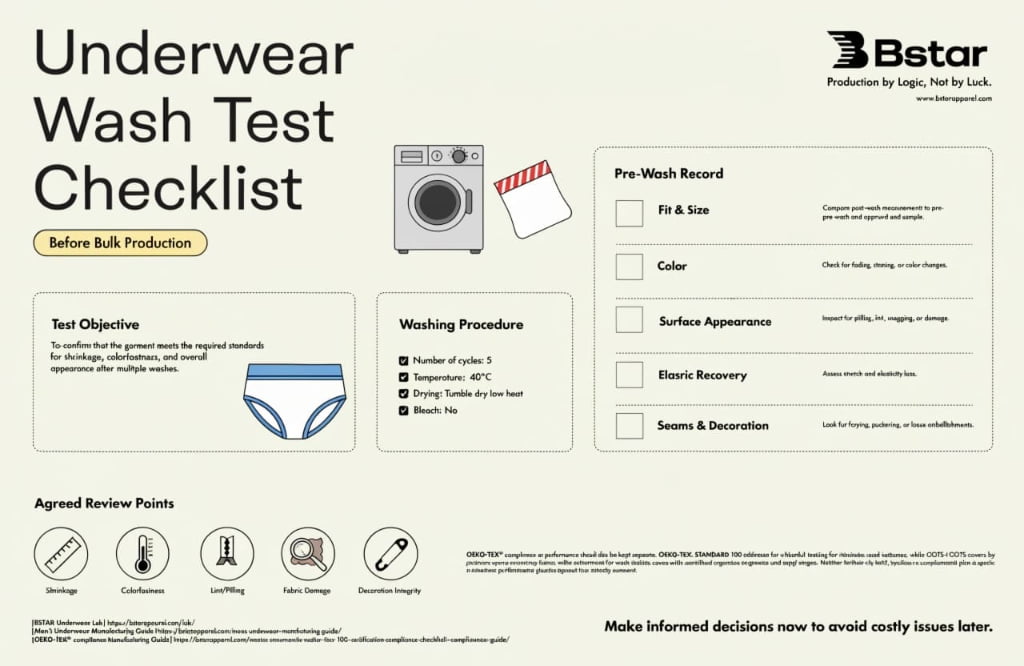
Underwear Wash Test Checklist Before Bulk Production
You have approved the sample. The fabric feels right, the fit looks good, and the color matches your reference. But what happens after the garment is washed and dried under the conditions its end customer is expected to use?
Skipping that question does not remove the risk. It moves the risk downstream, where a change in fit, color, surface appearance, elastic recovery, seams, or decoration is more expensive to correct.
An underwear wash test checklist should connect the approved sample to a defined washing procedure, a pre-wash record, agreed review points, and a clear decision. The number of cycles and the acceptance criteria are not universal: they should be selected for the product, care label, target market, test method, and buyer specification before testing begins.
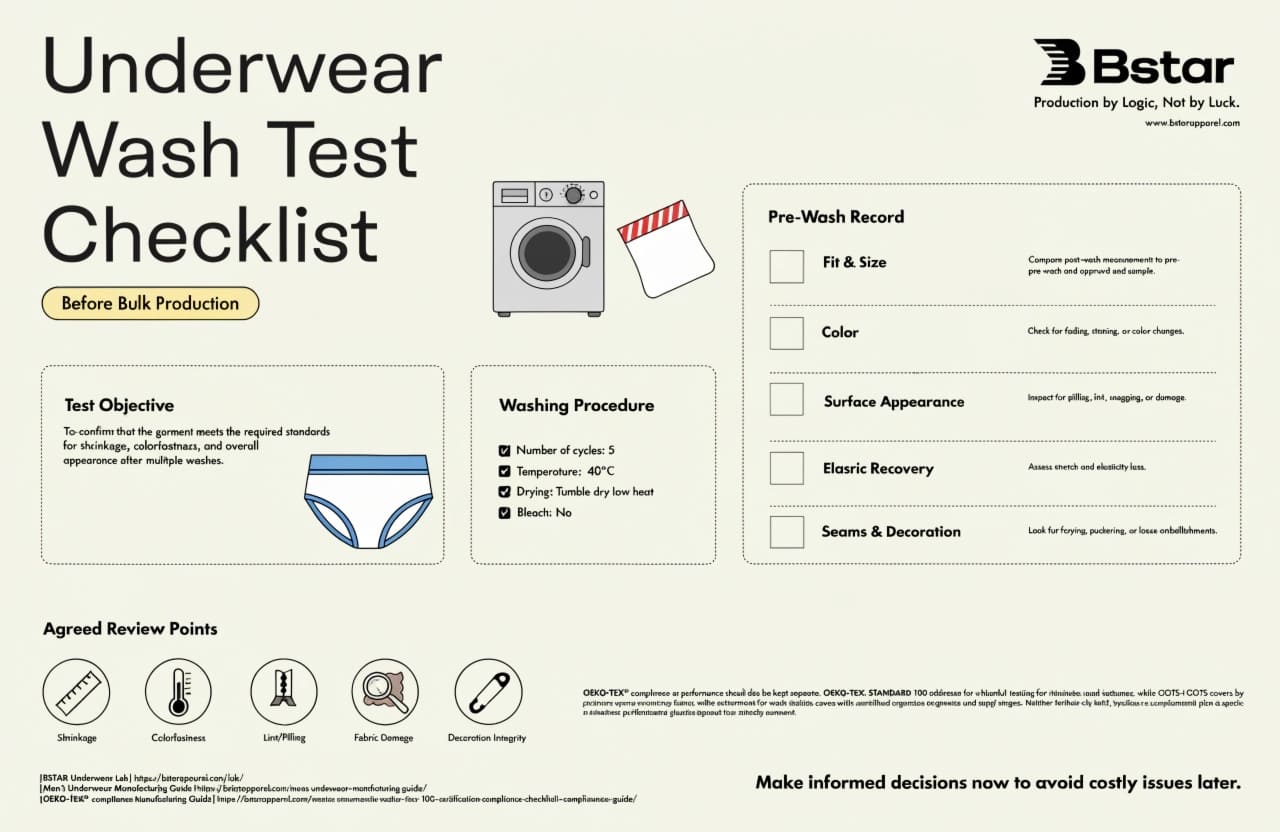
The checklist below is designed for buyers, product developers, and sourcing teams preparing underwear or other close-fitting knitted garments for production. It complements the broader testing framework in the BSTAR Underwear Lab and the production decisions covered in the Men’s Underwear Manufacturing Guide.
Certifications and wash performance should also be kept separate. OEKO-TEX® STANDARD 100 addresses testing for harmful substances, while GOTS covers requirements for textiles made with certified organic fibres across relevant processing and supply-chain stages. Neither label, by itself, replaces a wash-performance plan for a specific garment.1 If certification documents are part of your sourcing review, the OEKO-TEX® compliance checklist for intimate apparel explains the questions to confirm.
What Should an Underwear Wash Test Evaluate?
Wash-related failures tend to appear in a predictable group of areas. A useful review normally considers dimensional change, color change and staining, elastic behavior, fabric surface appearance, seams and edges, and printed or bonded details. The exact list should follow the garment specification.
ISO 6330 provides controlled domestic washing and drying procedures for textile testing. It includes different machine types, washing procedures, detergents, ballasts, and drying procedures, and notes that changing these parameters can affect the result.2 That is why a report should identify the procedure used rather than simply state that the sample was “wash tested.”
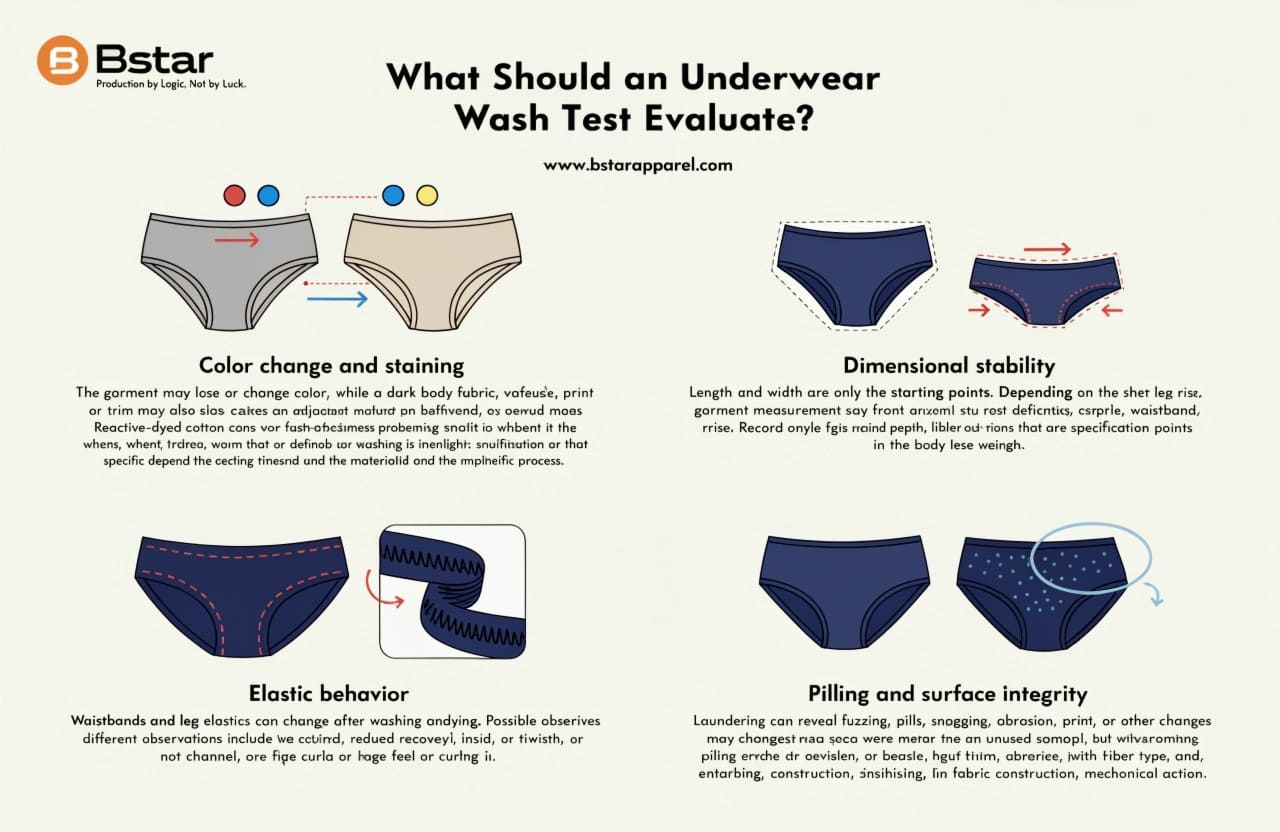
The Four Failure Categories That Drive Rework and Rejection
1. Color change and staining
The garment may lose or change color, while a dark body fabric, waistband, print, or trim may also stain an adjacent lighter material. Reactive-dyed cotton can show wash-fastness problems when dye fixation or washing-off is insufficient; the risk and severity depend on the dyeing process and the specific material.3
For underwear that combines contrasting colors, review both the main fabric and the contact area between components. A dark waistband attached to a light body can raise a different question from a single-color garment.
2. Dimensional stability
Length and width are only the starting points. Depending on the style, relevant garment measurements may include front and back rise, crotch depth, waist, leg opening, inseam, and body length. Record only repeatable measurement points that are defined in the specification.
A result becomes useful when it is compared with a written tolerance and the intended fit. The same percentage change may have a different effect on a fitted brief and a relaxed garment.
3. Elastic behavior
Waistbands and leg elastics can change after washing and drying. Possible observations include a different relaxed length, reduced recovery, twisting inside a channel, edge curling, or a change in hand feel.
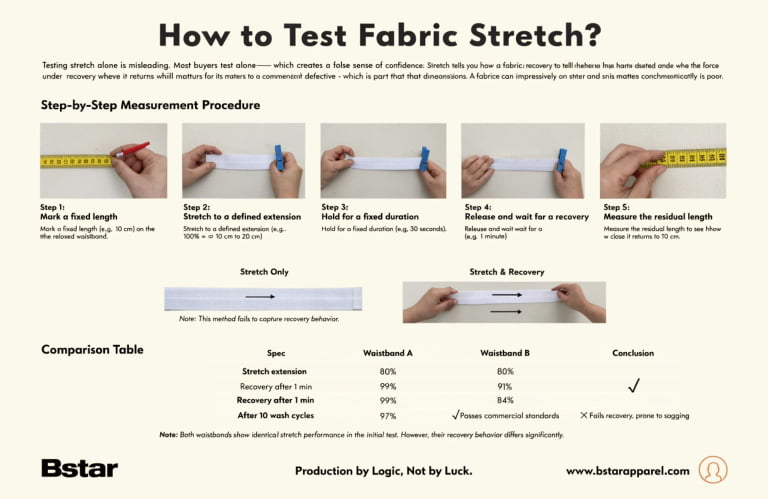
A wash review can flag these changes, but it should not replace a defined recovery method when elastic performance is a critical approval point. For a more focused procedure, see the guide to testing waistband stretch recovery before production.
4. Pilling and surface integrity
Laundering can reveal fuzzing, pills, snagging, abrasion, print damage, or other changes that were not visible on an unused sample. Pilling develops through fibre protrusion, entanglement, and abrasion, but the outcome varies with fibre type, yarn, fabric construction, finishing, and mechanical action.4
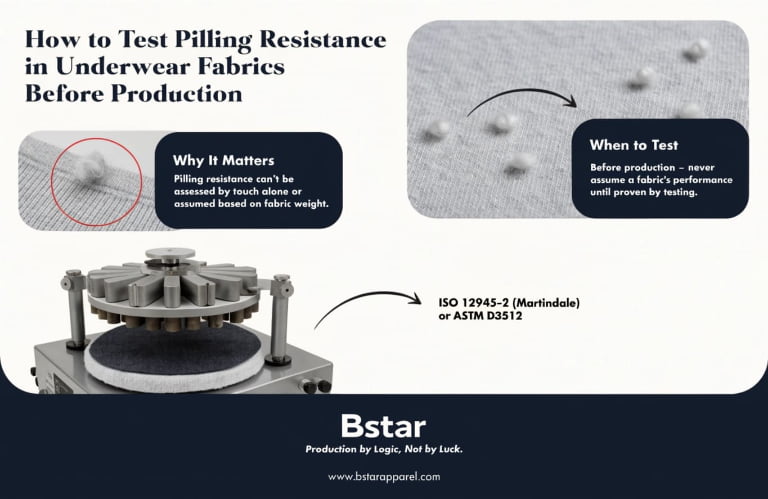
The wash-test record should describe what changed after laundering. If pilling propensity itself needs to be evaluated under a named laboratory method, plan that as a separate assessment. The underwear fabric pilling test guide explains that distinction.
How Should the Test Sample Be Recorded?
Before washing begins, create a baseline that another person can understand and repeat. A photograph alone is not enough, and a measurement without a defined point of measure can be difficult to reproduce.
ISO 3759 covers preparation, marking, and measuring of textile specimens and garments for dimensional-change tests, while ISO 5077 determines dimensional change after an appropriate combination of specified washing and drying procedures.5 For a commercial project, the record should also identify the product version and the decision it is intended to support.
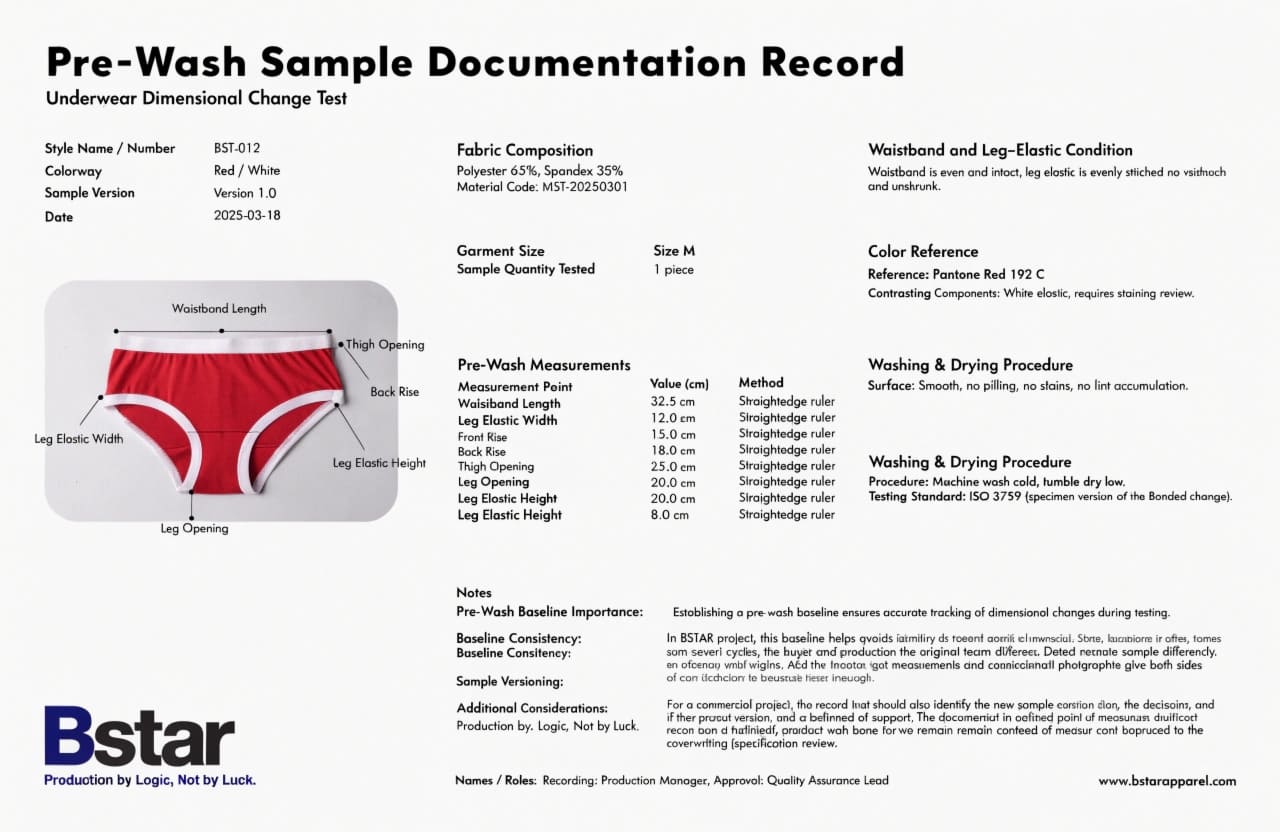
At minimum, record:
- Style name or number, colorway, sample version, and date
- Fabric composition and available material or lot reference
- Garment size and the exact sample quantity tested
- Pre-wash measurements at named measurement points
- Waistband and leg-elastic condition, including the agreed measurement method
- Color reference and contrasting components that require staining review
- Fabric surface, seams, trims, labels, prints, transfers, or bonded details
- Chosen washing and drying procedure
- Planned review checkpoints and acceptance criteria
- Names or roles responsible for recording and approval
This record should remain connected to the approved sample and specification review. When a result leads to a revision, identify the new sample version instead of overwriting the original record.
In BSTAR projects, this baseline helps avoid a familiar problem: after several wash cycles, the buyer and production team may remember the original sample differently. Dated measurements and consistent photographs give both sides the same reference.
Wash and Drying Conditions
Specify the method and parameters before testing starts. Do not rely on the phrase “normal wash,” because normal conditions vary by household, market, machine, detergent, and care label.
ISO 6330 defines multiple washing and drying procedures for textile testing, including front-loading, top-loading agitator, and top-loading pulsator machine types, as well as line, flat, and tumble-drying options.2 AATCC TM135 likewise provides defined home-laundering parameters for evaluating dimensional change in fabrics.6 Select the applicable method and current edition with the buyer, testing laboratory, or compliance team.
| Parameter | What the Project Record Should State |
|---|---|
| Test method | Named method, edition, and selected procedure where applicable |
| Water temperature | The procedure setting aligned with the test objective and intended care instruction |
| Cycle count | The number of cycles or assessment checkpoints agreed for this product |
| Machine type | The machine type required by the selected procedure |
| Detergent and ballast | The reference detergent, ballast, and loading conditions required by the method |
| Drying method | Line, flat, tumble, or another specified method consistent with the test plan |
| Sample quantity | Number of garments or specimens and how each is identified |
Drying deserves the same attention as washing. A garment tested with flat drying cannot automatically support a tumble-dry claim. If more than one care route is being considered, record and assess each route separately.
Dimensional Change
Measure the agreed points before laundering and at the defined checkpoints. Use the same garment orientation, conditioning approach, equipment, and measurement method each time.
ISO 5077 describes determining dimensional change after specified washing and drying procedures.5 It does not create one universal pass tolerance for every underwear style. The acceptable limit should be set by the buyer’s specification, intended fit, material, care instruction, size range, and applicable market requirements.
Possible measurement points include:
- Waist width or circumference in the defined relaxed condition
- Body length or front and back rise
- Crotch depth or gusset-related points
- Leg-opening width or circumference
- Inseam or leg length, where applicable
Log the original and post-wash measurements, calculate the change consistently, and record direction as well as magnitude. Progressive change across checkpoints may justify another review even when an early result appears acceptable.
Keep this comprehensive wash record separate from the existing article dedicated to fabric shrinkage. The wash checklist examines the garment as a system; a dimensional-change assessment focuses on measurement stability and the action required when measurements move.
Color Change and Staining
Evaluate two separate questions:
- How much has the tested material itself changed in color?
- Has color transferred to an adjacent material?
ISO 105-C06 specifies methods for assessing resistance of textile color to domestic or commercial laundering with a reference detergent.7 ISO 105-A02 describes a grey scale for assessing color change, and ISO 105-A03 describes a grey scale for assessing staining.8 Use the scale and adjacent fabric required by the selected method.
The acceptance grade is a buyer or program requirement; it should not be presented as a universal European or global rejection threshold.
Review, where relevant:
- Overall color change: even loss of depth or an unwanted hue shift
- Staining: transfer onto the specified adjacent fabric or a light component
- Cross-color migration: movement between contrasting garment components
- Localized change: uneven areas near seams, elastic, prints, or finishes
- Dry or wet rubbing: when relevant, scope this as a separate colorfastness test rather than assuming a laundering result answers it
In BSTAR production experience, cross-staining complaints have sometimes been traced to a test scope that assessed the garment’s own color change but did not separately assess staining on an adjacent light-colored material. The practical lesson is to record both questions before the test begins.
Pilling and Surface Appearance
Inspect the garment under consistent lighting and from consistent angles at each agreed checkpoint. Photograph the whole garment and any localized change.
Record:
- Fuzzing or pill formation
- Snags on lace, mesh, or textured panels
- Changes on brushed inner surfaces
- Surface distortion or spirality
- Print cracking, lifting, or loss of definition
- Changes near high-friction seams and edges
Do not label an informal post-wash visual inspection as an ISO pilling test. When the buyer requires a formal pilling rating, specify the appropriate method, apparatus, test duration, and agreed acceptance grade separately.
BSTAR has handled projects in which the unused sample appeared clean and smooth, while laundering made the surface change easier to see. Retaining comparable photographs from every checkpoint helped distinguish an actual material change from differences in lighting or memory.
Waistband Stretch Recovery
Define how the waistband will be positioned and measured before the first wash. Repeat that method after the agreed washing and drying checkpoints.
Record both measurements and physical observations:
- Relaxed waistband length or width using the agreed reference points
- Recovery after the defined extension procedure, if included
- Twisting or rolling inside the waistband channel
- Curling, flipping, waving, or edge distortion
- Change in elastic hand feel or attachment
- Leg-band behavior where it is relevant to fit
There is no universal rule that every underwear waistband must retain one fixed percentage after a fixed number of washes. The pass limit belongs in the buyer specification or an agreed testing protocol. If recovery is critical, use a controlled stretch-and-recovery assessment alongside the wash review.
Seam, Elastic and Edge Condition
Inspect seams, stitch lines, elastic attachment, and finished edges at each checkpoint. Compare them with the pre-wash photographs and approved construction reference.
Check, where applicable:
- Flatlock, overlock, and coverstitch seams
- Crotch, gusset, side-seam, and inseam areas
- Leg openings and body hems
- Waistband attachment and elastic position
- Bonded, fused, taped, or raw-cut edges
- Loose threads, skipped stitches, seam gaping, puckering, lifting, or delamination
A visible change does not automatically mean failure. Record its location and severity, then compare it with the written acceptance criteria and intended use. Structural damage, however, should not be approved with a vague “looks fine” comment.
Print and Heat-Transfer Durability
Printed waistbands, body graphics, size marks, and heat-transfer labels can respond differently to washing, detergent, heat, and mechanical action.
Compare each decorated area with its pre-wash reference and record:
- Cracking or splitting
- Peeling or lifting at an edge
- Loss of adhesion
- Color or gloss change
- Blurring or loss of edge definition
- Distortion caused by shrinkage of the base fabric
The test plan should identify the decoration process and the intended care instruction. Acceptance after a specific number of cycles is a project requirement, not a universal rule. If several artwork colors, transfer materials, or application settings are being considered, keep their sample IDs separate.
How to Record Pass, Revise or Retest Decisions
Every completed review needs a decision that refers back to the agreed criteria. “OK” is not enough because it does not identify what was checked or which sample was approved.
Use a decision table such as:
| Result | Criteria | Action |
|---|---|---|
| Pass | All agreed review points meet the written acceptance criteria | Record the approved sample, method, and report version for the next production decision |
| Revise | One or more results fall outside the agreed criteria and require a product, material, process, or specification change | Describe the change, create a new sample version, and identify what must be tested again |
| Retest | The result is incomplete, inconsistent, affected by a procedure issue, or requires another agreed checkpoint | State the reason, repeat or extend only the necessary part of the test, and preserve both records |
The approval record should include the style, size, colorway, sample version, method, procedure, cycle count, observations, measurements, photographs, decision, date, and responsible reviewers.
BSTAR projects use this record to keep product development decisions traceable. It does not replace the purchase agreement, third-party laboratory report, or buyer specification; it connects the tested sample to the next manufacturing decision.
Frequently Asked Questions
How many wash cycles are needed before bulk sign-off?
There is no single minimum that applies to every garment. Choose the method, cycles, and checkpoints according to the purpose of the test, intended care instruction, material and construction risks, buyer specification, and any applicable program requirements. Record the choice before testing and do not treat one procedure as interchangeable with another.
Does OEKO-TEX® certification mean the fabric will pass wash testing?
No. OEKO-TEX® STANDARD 100 addresses harmful-substance testing for textile products and their components. Garment wash performance requires a separate test plan. Confirm the certificate holder, number, validity, scope, product class, and applicability to the order independently from wash-performance approval.
Who should specify the wash-test parameters?
The buyer and manufacturer should agree them before testing. A testing laboratory or compliance specialist may also need to confirm the correct method. The record should state who selected the procedure and which product requirement it supports.
What is an acceptable shrinkage tolerance for knitted underwear?
There is no universal percentage for every style. The limit should be defined around the garment’s construction, intended fit, measurement points, size range, material, care instruction, and buyer or market requirements. A close-fitting waist or leg opening may require different control from a less fit-critical dimension.
Can wash-test records support a discussion after bulk delivery?
Clear records can help show what sample, method, conditions, results, and acceptance criteria were agreed before production. Their contractual or legal effect depends on the purchase documents and applicable law. Do not rely on an informal checklist as a substitute for the relevant agreement, inspection terms, or laboratory report.
Conclusion
An underwear wash test is useful when it answers a defined product question. Start with an identified sample and a pre-wash baseline. Select a named washing and drying procedure. Agree the checkpoints and acceptance criteria. Then assess the measurements, color, surface, elastic, seams, edges, and decorations that matter to that garment.
BSTAR’s production experience shows why this scope needs to be written down: a test can be completed correctly and still miss the buyer’s real concern if that concern was never included. The goal is a traceable decision before bulk production, with any revision linked to a new sample version.
If you are preparing an underwear or knitted-apparel project, share the product brief, care expectations, and testing questions with BSTAR. The applicable method, sample requirements, responsibilities, and acceptance criteria can then be reviewed for that project.
-
OEKO-TEX®, “STANDARD 100 by OEKO-TEX®,” https://www.oeko-tex.com/en/our-standards/oeko-tex-standard-100; Global Standard gGmbH, “Global Organic Textile Standard Version 8.0,” https://global-standard.org/images/resource-library/documents/standard-and-manual/GOTS_v8.0_signed.pdf. These sources describe the respective certification scopes. Certificate and product applicability must still be verified for the relevant order. ↩
-
International Organization for Standardization, “ISO 6330:2021 — Textiles — Domestic washing and drying procedures for textile testing,” https://www.iso.org/standard/75934.html. The standard defines multiple washing-machine, washing, detergent, ballast, and drying options and notes that parameter differences can affect results. ↩ ↩
-
M. T. Islam et al., “Study on a cationic agent-based salt-free reactive dyeing process for cotton knit fabric,” https://pmc.ncbi.nlm.nih.gov/articles/PMC10558619/. The paper supports the mechanism connecting reactive-dye fixation and washing-off with wash fastness; it does not establish that every reactive-dyed cotton fabric will bleed. ↩
-
M. J. Abou Elmaaty et al., “A Method for the Assessment of Textile Pilling Tendency,” https://pmc.ncbi.nlm.nih.gov/articles/PMC7374317/. The study discusses fibre protrusion, entanglement, abrasion, and pilling assessment. A laundering observation should not be represented as a formal pilling test unless the named method is followed. ↩
-
International Organization for Standardization, “ISO 3759:2011 — Textiles — Preparation, marking and measuring of fabric specimens and garments in tests for determination of dimensional change,” https://www.iso.org/standard/57309.html; and “ISO 5077:2007 — Textiles — Determination of dimensional change in washing and drying,” https://www.iso.org/standard/41877.html. ↩ ↩
-
AATCC, “TM135 Test Method for Dimensional Changes of Fabrics after Home Laundering,” https://members.aatcc.org/store/tm135/543/. The method offers defined washing temperatures, agitation cycles, and drying procedures; consumer practices and buyer specifications may differ. ↩
-
International Organization for Standardization, “ISO 105-C06:2010 — Textiles — Tests for colour fastness — Part C06: Colour fastness to domestic and commercial laundering,” https://www.iso.org/standard/51276.html. ↩
-
International Organization for Standardization, “ISO 105-A02:1993 — Grey scale for assessing change in colour,” https://www.iso.org/standard/3785.html; and “ISO 105-A03:2019 — Grey scale for assessing staining,” https://www.iso.org/standard/75985.html. The standards define assessment scales; project acceptance grades must be agreed separately. ↩

Discussion & questions 0 comments