
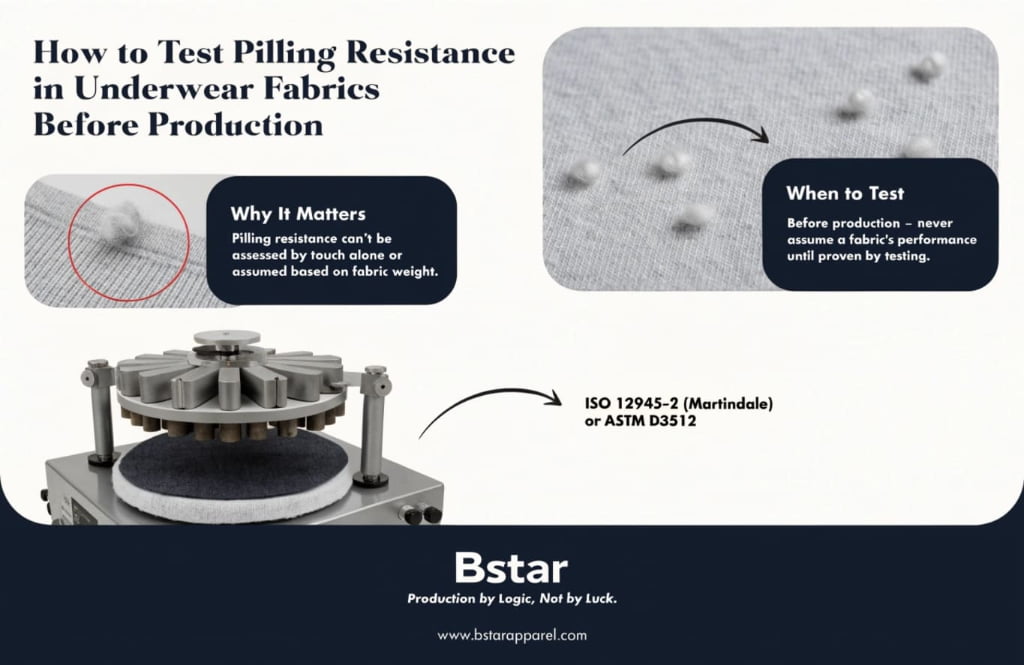
How to Test Pilling Resistance in Underwear Fabrics Before Production
You have approved a fabric sample. It feels soft, the weight is right, and the colour matches the brief. After repeated wear and washing, however, the surface may begin to fuzz or form small pills.
Pilling resistance cannot be confirmed by touch, fibre name or GSM alone. A useful underwear fabric pilling test identifies the exact material, test method, specimen condition, test stage and acceptance requirement before bulk production. ISO 12945-2 uses a modified Martindale method, while ASTM D3512 uses a random tumble pilling tester; results from different methods should not be treated as interchangeable.12
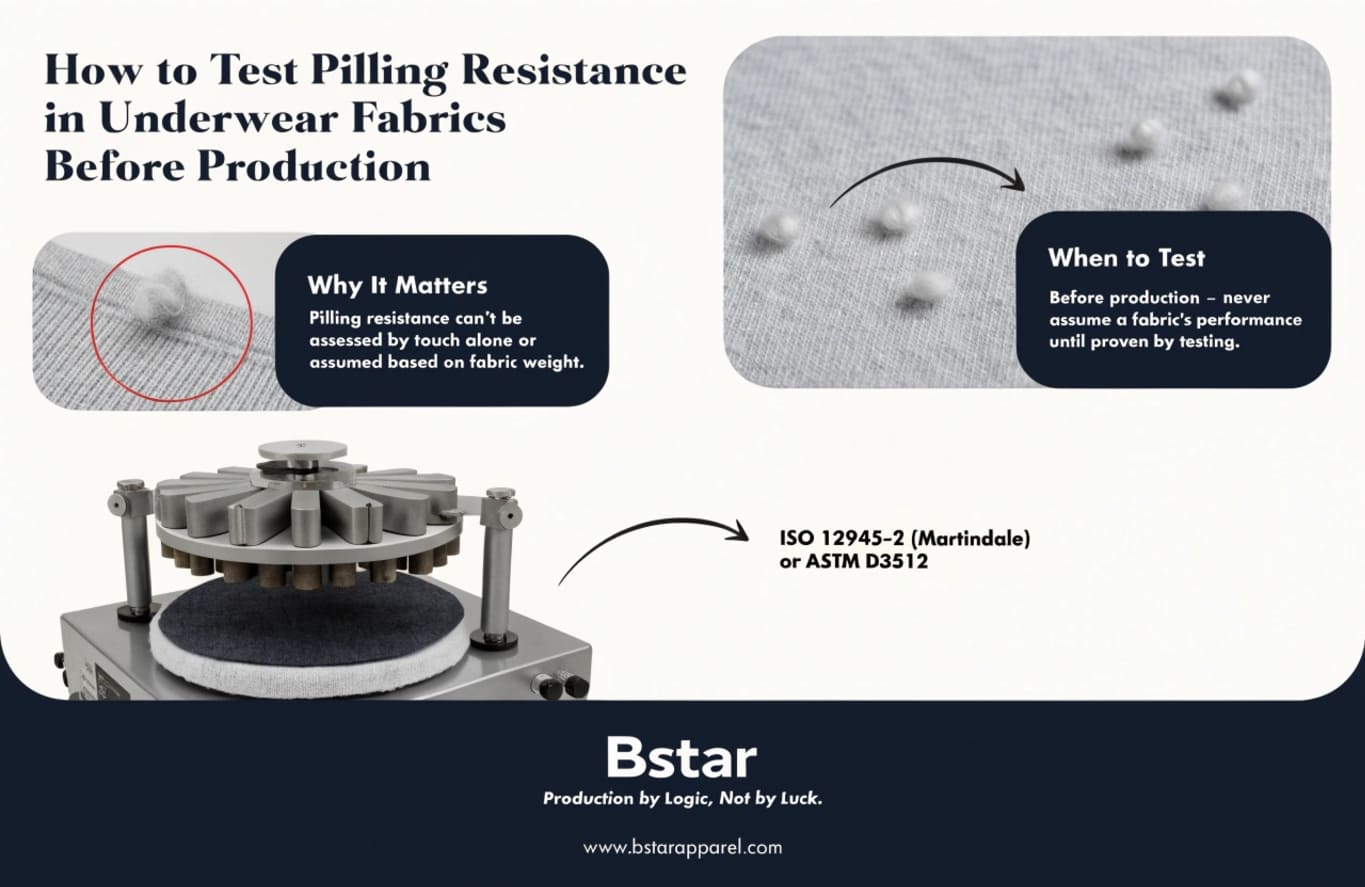
Understanding why pilling happens, how a report should be read and when the fabric should be tested gives buyers a more useful approval process. The sections below follow those decisions in the order they normally arise.
How to Test Fabric for Pilling?
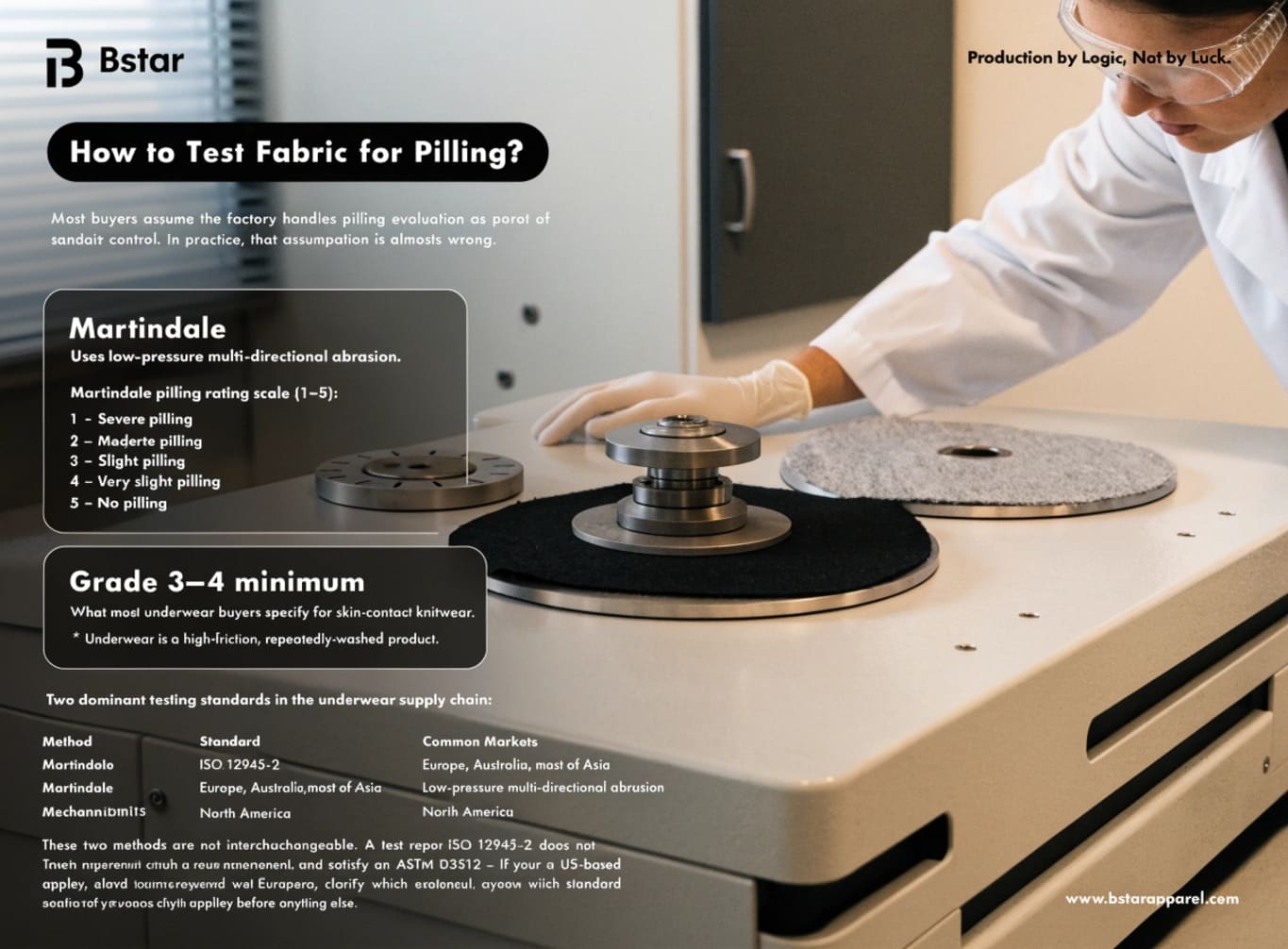
Fabric pilling is evaluated by exposing conditioned specimens to controlled mechanical action and then assessing the resulting surface change against the selected method. The report should state the material identity, method, test stage, specimen condition and result.
Standardised methods often use a visual scale in which a higher grade represents less surface change. Under ASTM D4970, the general direction runs from Grade 5, no pilling, to Grade 1, very severe pilling.3 That scale explains how results are reported; it does not create a universal pass grade for every underwear product.
The Methods You May Encounter
| Method | Standard | What the method identifies |
|---|---|---|
| Modified Martindale | ISO 12945-2 | Propensity to surface pilling, fuzzing or matting using a modified Martindale procedure |
| Random Tumble | ASTM D3512/D3512M | Pilling resistance and related surface changes using a random tumble pilling tester |
| Martindale Tester | ASTM D4970/D4970M | Pilling resistance and related surface changes using a Martindale tester |
These methods are separate procedures. The applicable one may come from a buyer specification, retailer protocol, laboratory plan or agreed project requirement. A result obtained under one method should not automatically be substituted for a result required under another.12
Do not confuse a Martindale pilling method with a Martindale abrasion-resistance method. ASTM lists D4970 for pilling and D4966 for abrasion as different standards measuring different properties.2
Why the Specimen Condition Matters
Testing only the new, unwashed fabric may not answer every product question. Washing and finishing can change the surface, dimensions and exposure of loose fibres, but there is no universal rule requiring every underwear fabric to be washed a fixed number of times before pilling testing.
ASTM D4970 allows the parties to agree whether fabrics are tested as received, after laundering or dry cleaning, or in more than one state; the tested state must be reported.3 If post-wash appearance matters, define the wash temperature, detergent, drying method, number of cycles and conditioning procedure instead of writing only “after wash.”
A practical development plan may compare:
- the production-intent fabric as received;
- the same material after an agreed care procedure;
- the completed garment after a defined wash or wear review;
- the sample material with the actual bulk fabric lot.
What to Write Into the Product Specification
Before fabric approval, record:
- Material identity: composition, knit construction, supplier reference, colour and lot or sample version.
- Test method: the complete standard and edition or buyer protocol.
- Specimen state: as received, conditioned, pre-washed or tested after an agreed care procedure.
- Test stage: the method-specific test duration, cycle count or assessment interval.
- Acceptance requirement: the agreed grade or other decision rule for that project.
- Testing party: factory, supplier, in-house team or third-party laboratory, according to the evidence required.
- Action for non-conformance: re-sampling, material review, retesting or another term agreed between buyer and supplier.
Avoid copying a Grade 3 or Grade 4 requirement from an unrelated product. The pass level should reflect the selected method, fabric, end use, colour, product position and any retailer requirement. Use the Men’s Underwear Manufacturing Guide to connect the material test with the rest of the product specification.
Will 60% Cotton and 40% Polyester Pill?
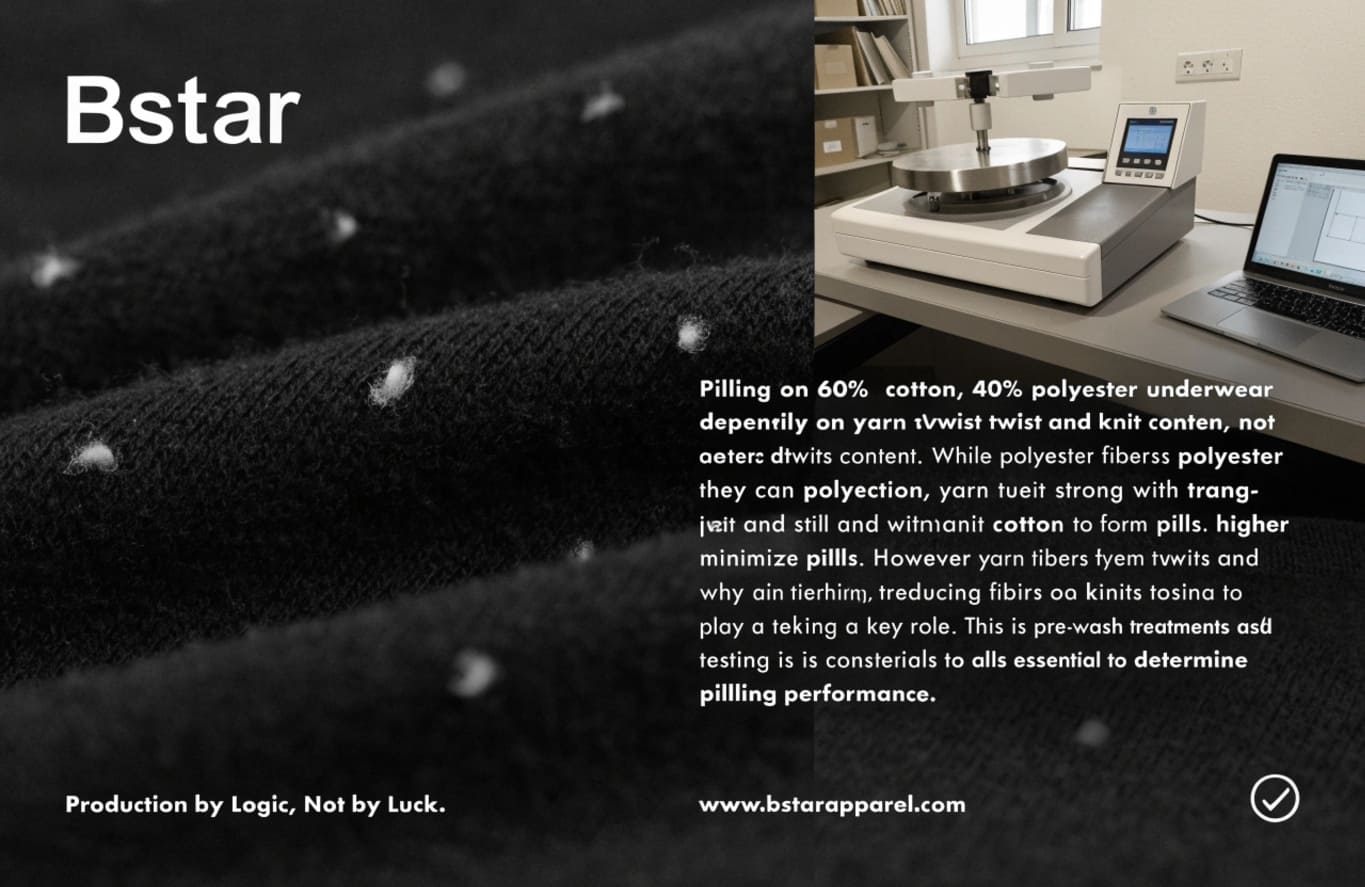
A 60/40 cotton-polyester blend can pill. The blend ratio alone cannot predict the result.
Pilling develops when fibres migrate to the surface, become entangled through rubbing and remain attached to the fabric. Fibre properties matter, but so do yarn structure, knit construction, finishing, garment fit and care conditions. ASTM describes pilling as a complex property influenced by the fibre or blend, fibre dimensions, yarn and fabric construction, finishing and actual conditions of use.3
What Actually Drives Pilling in Blended Fabrics
- Yarn construction and twist: tighter fibre control can reduce the opportunity for loose ends to reach the surface, but the actual effect depends on the yarn and fabric system.
- Knit structure and loop length: a more exposed or unstable surface can behave differently from a compact construction.
- GSM and density: greater weight does not automatically mean better pilling resistance. Review the underwear fabric GSM guide for the difference between weight and finished performance.
- Finishing: brushing, softening and anti-pilling treatments can change initial performance. Their durability must be assessed under relevant care conditions.
- Colour and contrast: pills and fuzz may be more visually obvious on some shades even when the physical surface change is similar.
- Garment use: close fit and repeated friction at the inner thigh or seat can create different wear conditions from a relaxed boxer.
Research on specific knitted-fabric systems confirms that yarn and finishing changes can influence pilling, but results from one fibre or treatment should not be presented as a universal prediction for every cotton-polyester blend.4
The useful buying question is therefore not “Will 60/40 pill?” It is “How does this exact 60/40 construction perform under the agreed method and care condition?”
The “It Feels Strong” Trap
A fabric may feel thick and strong and still develop surface pills. Tensile strength, abrasion resistance and pilling resistance are separate properties with separate test methods. ASTM’s textile standards list them independently for that reason.2
Touch remains useful for approving hand feel, but it cannot replace a documented pilling assessment.
Is 100% Cotton Prone to Pilling?
Yes, 100% cotton can pill or develop surface fuzz. “Natural fibre” does not mean “pilling-proof.”
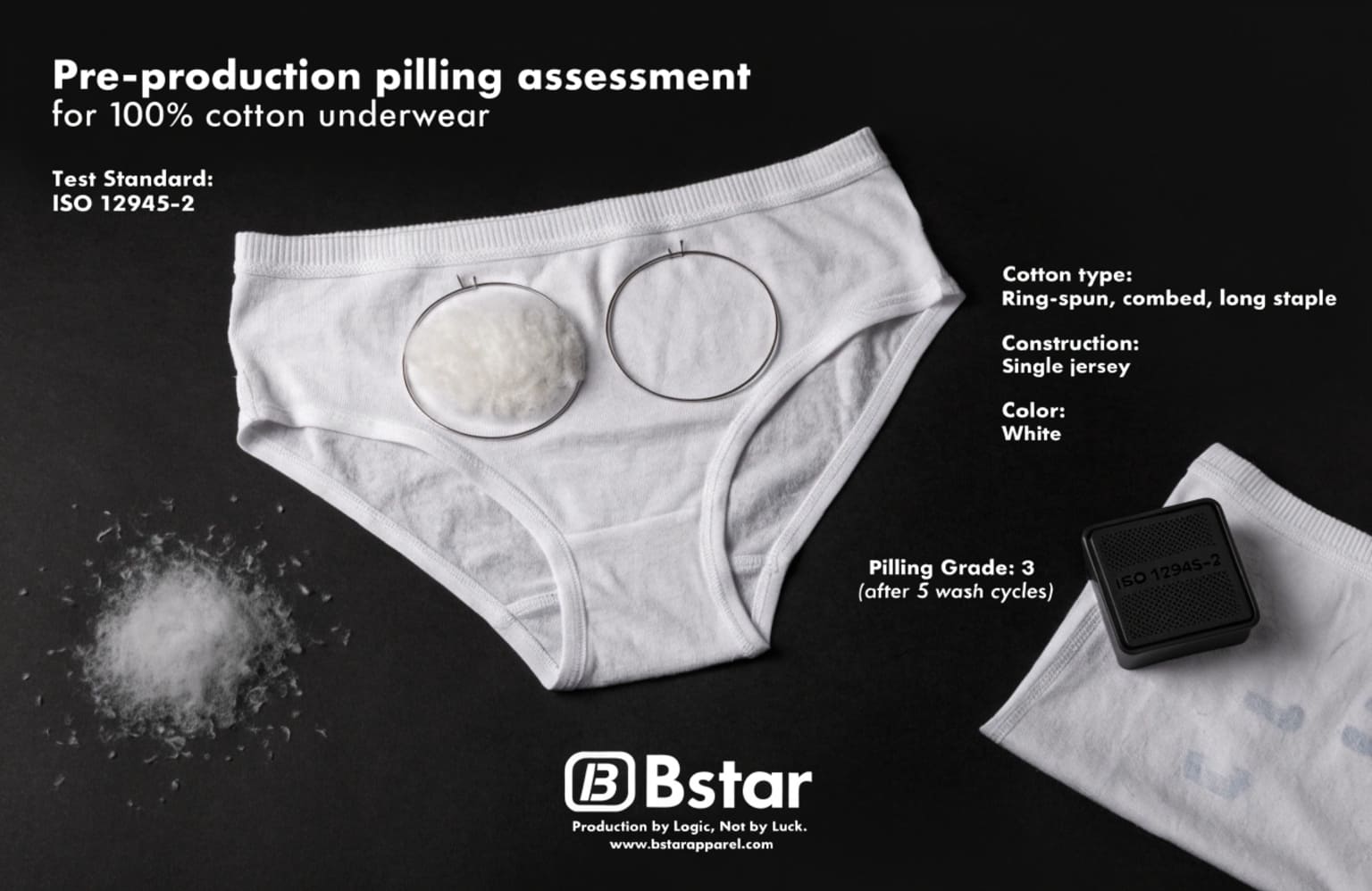
The result depends on the cotton fibre, yarn system, knit structure, finishing and care conditions. Cotton pills may also look different from pills on a blend, but no blanket statement should replace testing of the production-intent material.
Cotton and Yarn Details Still Matter
Buyers may encounter descriptions such as combed cotton, ring-spun cotton, compact yarn or long-staple cotton. These terms can help identify the material direction, but none of them proves a finished pilling grade by itself.
For cotton underwear, record at least:
- the legally correct fibre composition;
- the yarn or supplier reference where available;
- the knit construction;
- target GSM and agreed tolerance;
- surface and finishing reference;
- care procedure;
- required pilling method and acceptance condition.
If a supplier changes the yarn, finish, knit density or fabric source after sample approval, decide whether the earlier report still represents the new material.
How to Set the Requirement for Cotton Underwear
Do not assume that all cotton underwear should pass the same grade after the same number of washes. A relaxed boxer, fitted brief and ribbed thermal base layer use the surface differently.
Set the requirement by answering:
- Where will friction occur during intended wear?
- Is the product sold as a basic, premium or performance style?
- Does the buyer or retailer already prescribe a method?
- Should the material be assessed as received, after washing or in both states?
- Which approved swatch and garment sample will serve as the physical reference?
These decisions should be resolved during Sampling & Prototyping, before a material change becomes expensive.
Does Pilling Mean Low Quality?
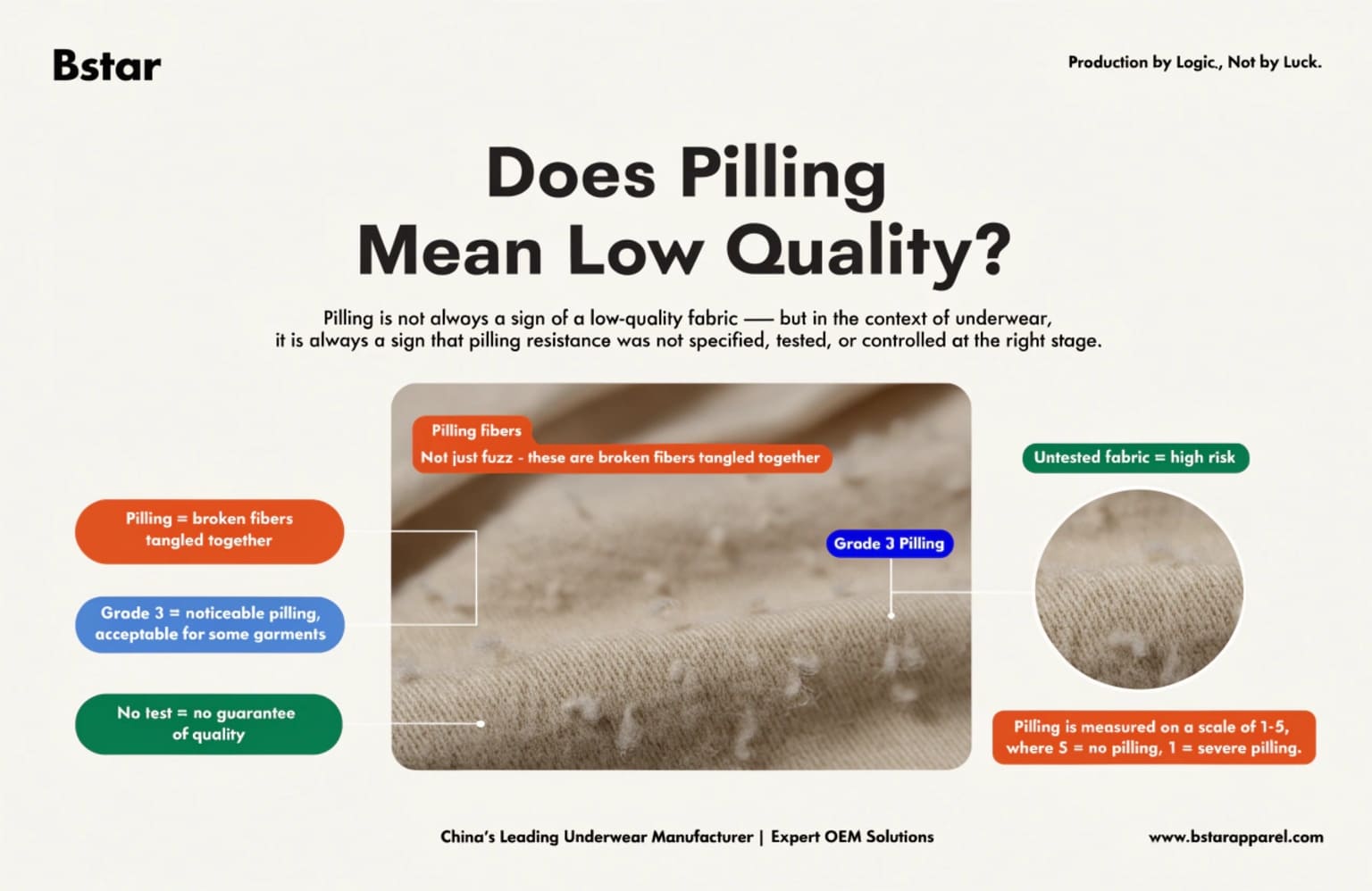
Not automatically. Pilling is a surface-performance result, and the result must be interpreted against the intended product and agreed requirement.
A fabric can show some surface change under a demanding laboratory method and still be suitable for a particular use. Another fabric can feel luxurious when new but be unsuitable because its appearance changes faster than the brand or customer expects.
Why Specification and Traceability Matter
Problems become difficult to resolve when the approved fabric is described only as “soft cotton,” “premium modal” or “anti-pilling.”
A useful record connects:
- the tested fabric reference;
- the approved colour and finish;
- the laboratory or testing party;
- the method and specimen condition;
- individual and final results;
- the buyer’s acceptance requirement;
- the approved sample version;
- any later material substitution.
A report from another colour, supplier, construction or earlier fabric version may not represent the fabric used in production.
BSTAR’s Underwear Lab provides a framework for recording material and test questions. It does not replace an applicable laboratory report or create one universal passing standard.
What “Quality” Means in Fabric Approval
For procurement, quality means that the production-intent material meets the agreed specification and is supported by appropriate evidence. Hand feel, appearance, composition, weight, stretch, recovery, shrinkage, colourfastness and pilling may all matter, but they answer different questions.
A pilling report is therefore one part of the approval package, not proof of total fabric quality.
Frequently Asked Questions
What pilling grade should I require for underwear?
There is no universal grade for all underwear. Confirm the test method, test stage, specimen condition, intended use and buyer or retailer requirement first. Then document the agreed acceptance grade before receiving the result.
Can a factory-issued pilling test report be used?
It can be useful if it identifies the exact fabric and provides the method, parameters, specimen condition and results required by the project. Where an independent or accredited report is required by the buyer, retailer or claim, confirm that requirement before testing.
How many wash cycles should be completed before testing?
There is no universal number. The agreed care procedure should reflect the product question and applicable method or buyer protocol. Record the temperature, detergent, drying method, number of cycles and conditioning state.
Are ISO 12945-2 and ASTM D3512 equivalent?
No. ISO 12945-2 specifies a modified Martindale method, while ASTM D3512 uses a random tumble pilling tester. Do not compare or substitute their results without an agreed technical basis.12
When should pilling be tested?
Evaluate candidate materials early enough to influence selection. Confirm the production-intent fabric before bulk approval, and review whether retesting is required if the yarn, construction, colour, finish, supplier or material lot changes.
Conclusion
Pilling resistance cannot be confirmed by touch, inferred from GSM or assumed from a fibre name. The decision needs an identified fabric, a named test method, a defined specimen condition and an acceptance requirement agreed before bulk production.
Use the same procedure when comparing candidate materials, connect the report to the approved sample and document any later fabric change. This turns pilling from a vague quality complaint into a controlled sourcing decision.
If you are preparing a custom underwear style, review the men’s underwear manufacturing options and contact BSTAR with the product type, material direction, target market and any buyer-required testing protocol.
-
International Organization for Standardization, “ISO 12945-2:2020 — Textiles — Determination of fabric propensity to surface pilling, fuzzing or matting — Part 2: Modified Martindale method.” ISO states that the document specifies a modified Martindale method for assessing resistance to pilling, fuzzing and matting. ↩ ↩ ↩
-
ASTM International, “Textile Performance Testing Methods.” ASTM lists D3512 for random-tumble pilling, D4970 for Martindale pilling and D4966 for Martindale abrasion as separate textile test methods. ↩ ↩ ↩ ↩ ↩
-
ASTM International, “ASTM D4970/D4970M — Standard Test Method for Pilling Resistance and Other Related Surface Changes of Textile Fabrics: Martindale Tester.” ASTM describes the variables affecting pilling, the importance of reporting specimen state, limits on acceptance-testing comparisons and the general 5-to-1 visual scale. ↩ ↩ ↩
-
R. Rajkumar and others, “Enhancing anti-pilling performance of wool knitted fabrics via eco-friendly treatments.” This study illustrates how yarn and finishing variables can affect pilling in the tested wool-knit system; it does not establish a universal result for cotton, polyester or underwear fabrics. ↩
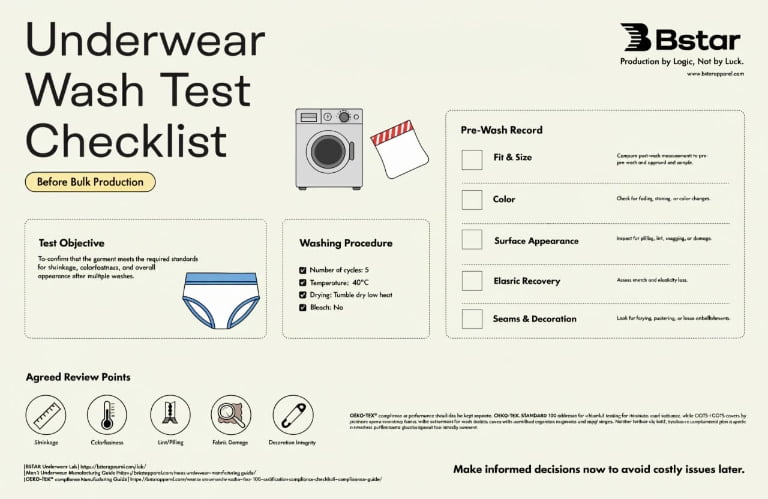
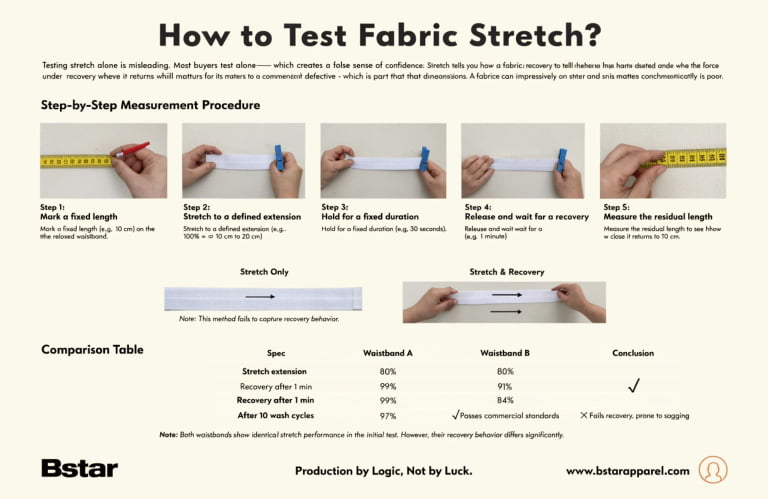
[…] procedure. Surface appearance can be reviewed at the same development stage; the separate guide on underwear fabric pilling testing explains why its method and grading criteria must also be […]
[…] needs to be evaluated under a named laboratory method, plan that as a separate assessment. The underwear fabric pilling test guide explains that […]