
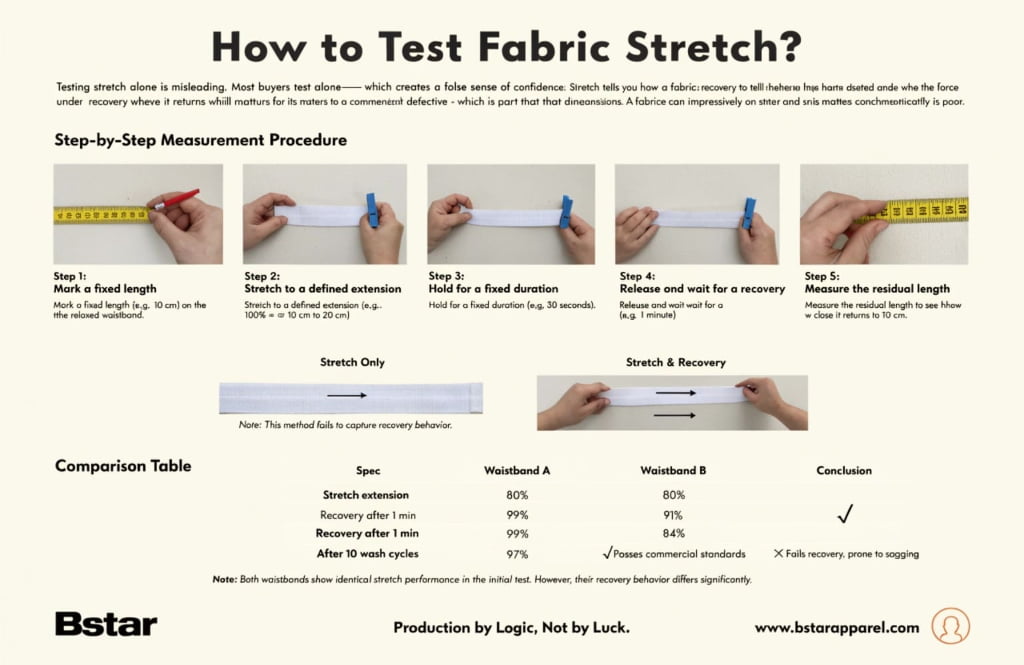
How to Test Waistband Stretch Recovery in Underwear Before Production
Waistband stretch recovery is easy to overlook during underwear development and difficult to correct after bulk production. Buyers often check how far a waistband stretches, but extension alone does not show whether the band will return close to its starting dimensions or maintain the intended tension after wear and laundering.
A useful waistband review records both extension and what happens after the load is removed. Before testing, define the specimen, starting length, load or extension, hold time, number of cycles, recovery interval, laundering condition and acceptance criteria. Test the finished waistband as well as any component specimen required by the agreed method. ASTM distinguishes methods for low-power knitted fabrics, elastic fabrics and narrow elastic fabrics, so the correct protocol depends on what is being evaluated.123
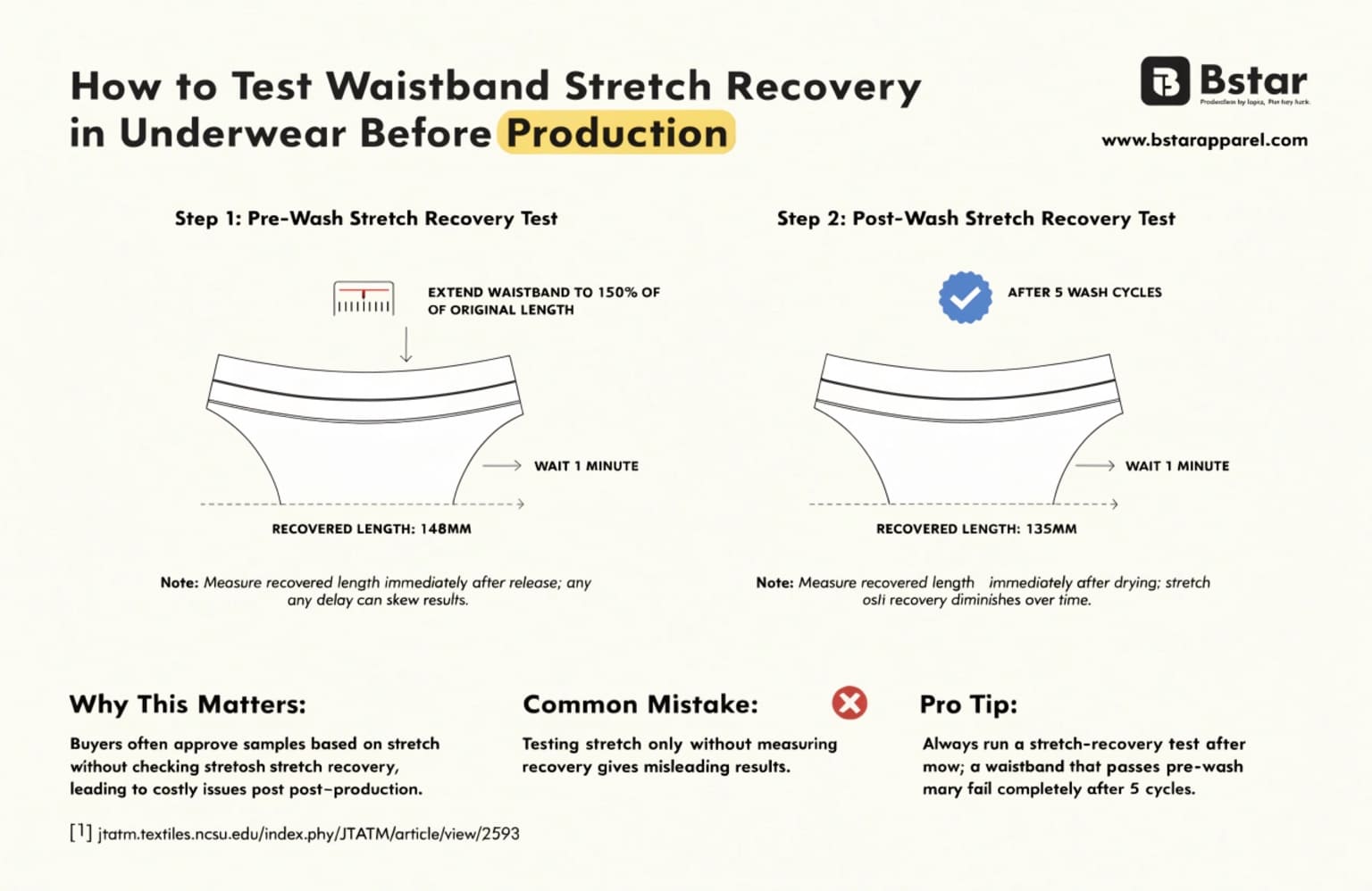
This article explains how to turn a vague request such as “good stretch” into a test record that a buyer, developer and manufacturer can review. It also connects the result with the wider evidence framework in the BSTAR Underwear Lab.
How to Test Fabric Stretch?
Fabric stretch testing sounds straightforward, but different methods can produce different numbers. Pulling a specimen by hand may help during an early comparison, but it does not create a result that can be repeated unless the sample and test conditions are recorded.
Stretch describes extension under a defined force or to a defined length. Recovery or growth describes what remains after that force or extension is removed. A material can extend easily and still leave more residual growth than the project allows. ASTM D2594 covers stretch and growth in low-power knitted fabrics, while ASTM D4964 covers tension and elongation of wide or narrow elastic fabrics using a constant-rate-of-extension machine.23
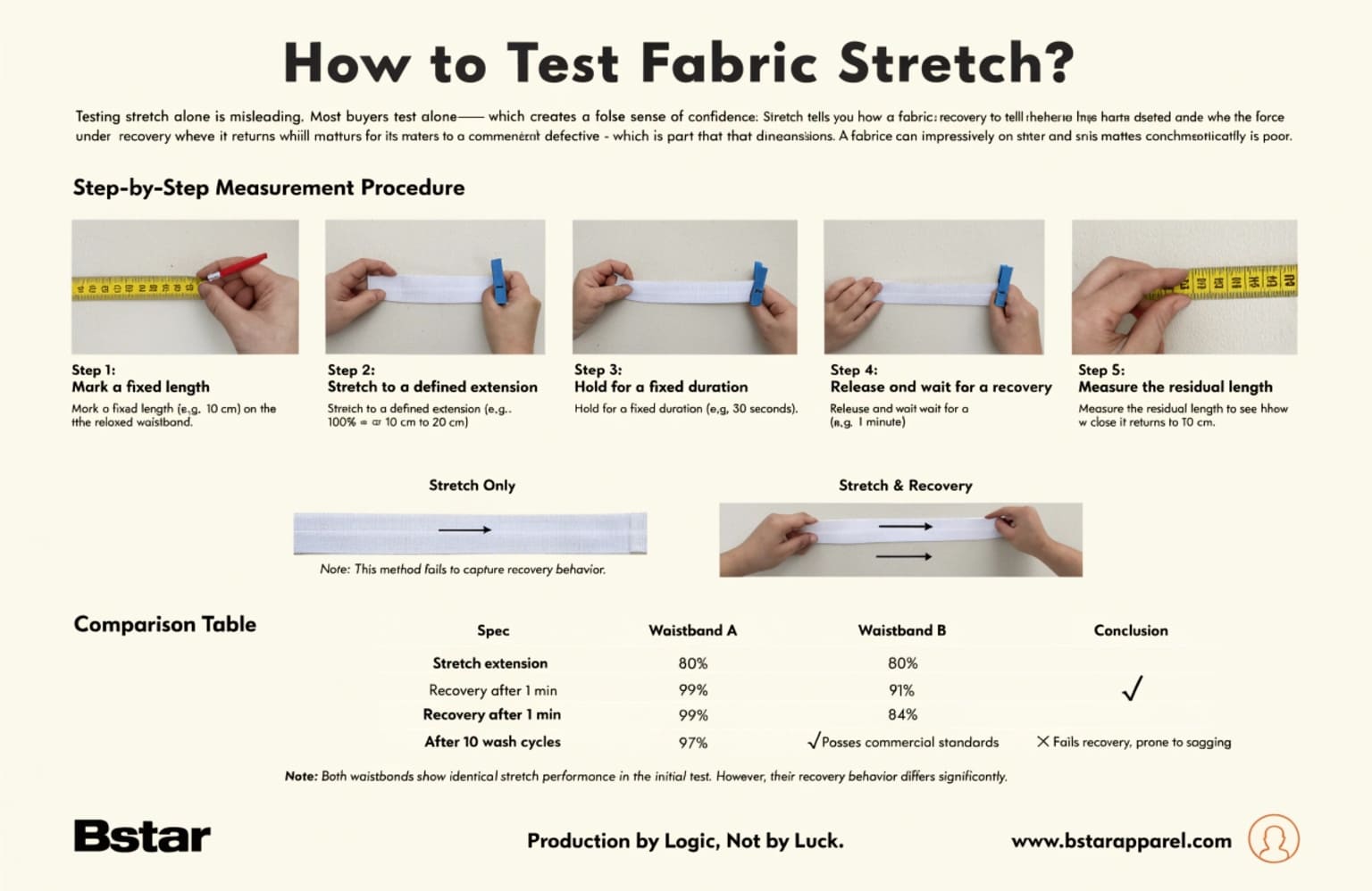
A Practical Stretch and Recovery Comparison
For a factory comparison during sampling, record these fields before starting:
- Identify the specimen. State whether it is body fabric, narrow elastic, a cut waistband component or a finished garment waistband.
- Mark the starting gauge length. Record the relaxed measurement and the direction being tested.
- Define the load or extension. Use the applicable standard, buyer protocol or an agreed project method. Do not change this value between samples.
- Define the loading sequence. Record the hold time, number of loading cycles and release procedure.
- Define the recovery interval. Measure each specimen after the same agreed period.
- Record residual change and tension. Note the recovered length and, where the method requires it, the force at the specified extension.
- Repeat after the agreed laundering treatment. Keep the temperature, cycle count, detergent, drying route and conditioning consistent.
This kind of internal comparison is useful for product development, but it should not be presented as an ASTM result unless the applicable standard is followed with the required equipment and reporting. The Men’s Underwear Manufacturing Guide explains how fabric, elastic, seams and fit decisions connect inside the finished product.
Why Stretch Percentage Alone Can Mislead
Consider two illustrative waistband records:
| Recorded field | Waistband A | Waistband B |
|---|---|---|
| Extension used for comparison | 80% | 80% |
| Length recovery after the agreed interval | 99% | 91% |
| Length recovery after the agreed wash treatment | 97% | 84% |
Both bands reached the same extension, yet their recorded recovery differed. These figures are an illustration of how a comparison sheet can be structured; they are not BSTAR production data or universal pass levels. A real specification must name the method, specimen, conditions and project-specific acceptance criteria.
How to Loosen Elastic Waistband on Underwear?
Consumer advice about loosening a finished waistband does not solve the manufacturing question. If a sample feels too tight, the development team needs to identify whether the cause is elastic tension, waistband length, attachment ratio, seam restriction, garment dimensions or the intended fit.
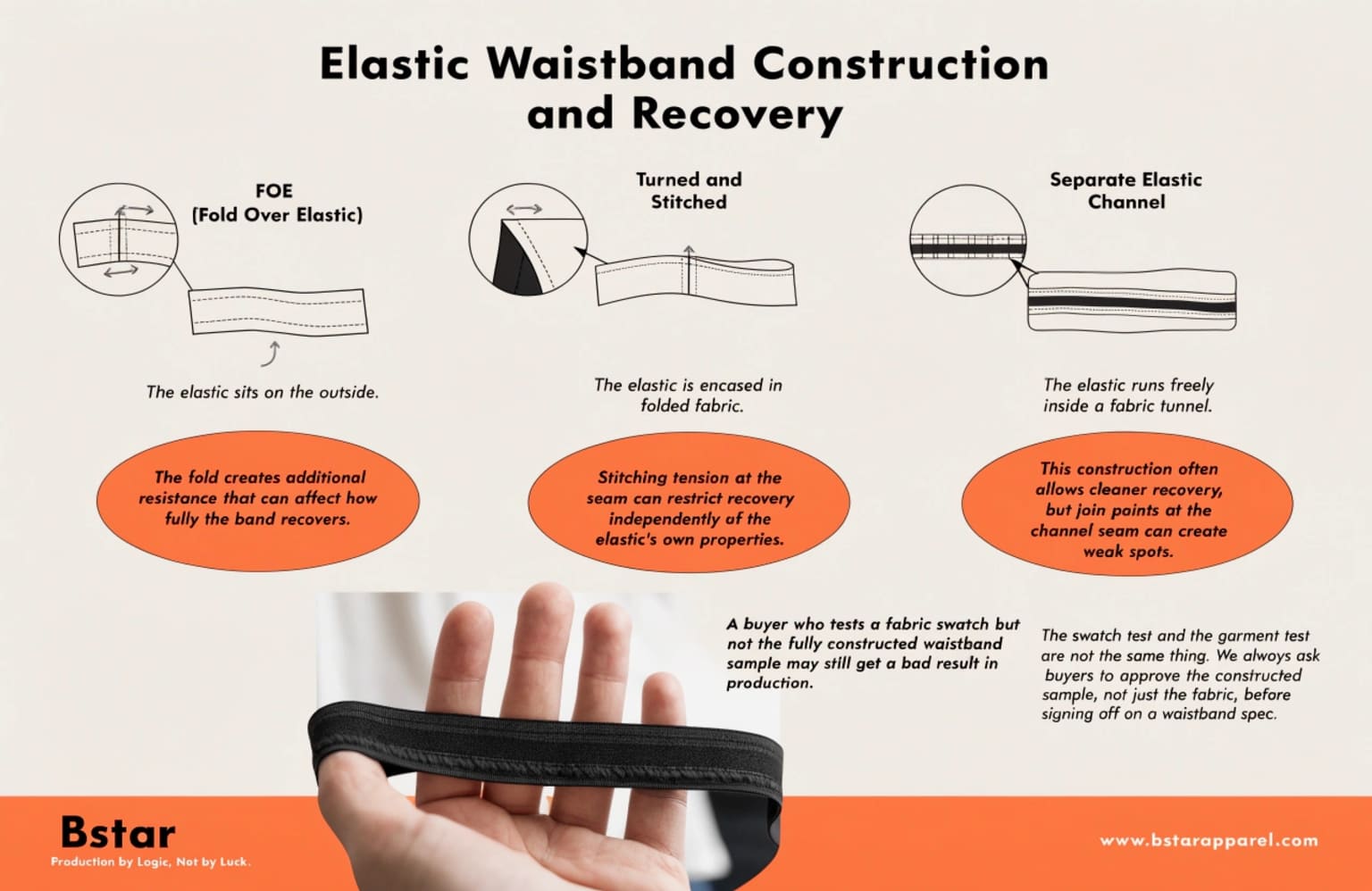
Elastic performance also changes after the component is sewn into the garment. The elastic, fabric layers, stitch type, seam tension, join and attachment ratio work as one assembly.
Seam Construction Changes the Finished Result
Common constructions create different conditions around the elastic:
- Fold-over elastic: the elastic wraps the garment edge, so fold position, feeding and stitch tension can affect the finished measurement and feel.
- Turned and stitched waistband: elastic is enclosed by folded fabric; the fabric layer and stitching can restrict or redistribute extension.
- Elastic in a channel: elastic sits inside a fabric casing; channel dimensions, join construction and internal movement need to be checked.
A body-fabric swatch, a loose elastic component and a finished waistband answer different questions. Approve the constructed garment sample against named measurement points and fit comments during Sampling & Prototyping. If the sample feels too tight, adjust the relevant specification and make another controlled sample rather than assuming wear will correct it.
How to Test Fabric for Shrinkage?
Shrinkage and elastic recovery are related to laundering, but they are not the same measurement. Dimensional change describes how the garment or fabric dimensions change after treatment. Elastic testing describes the response of the waistband or elastic component under an agreed load or extension.
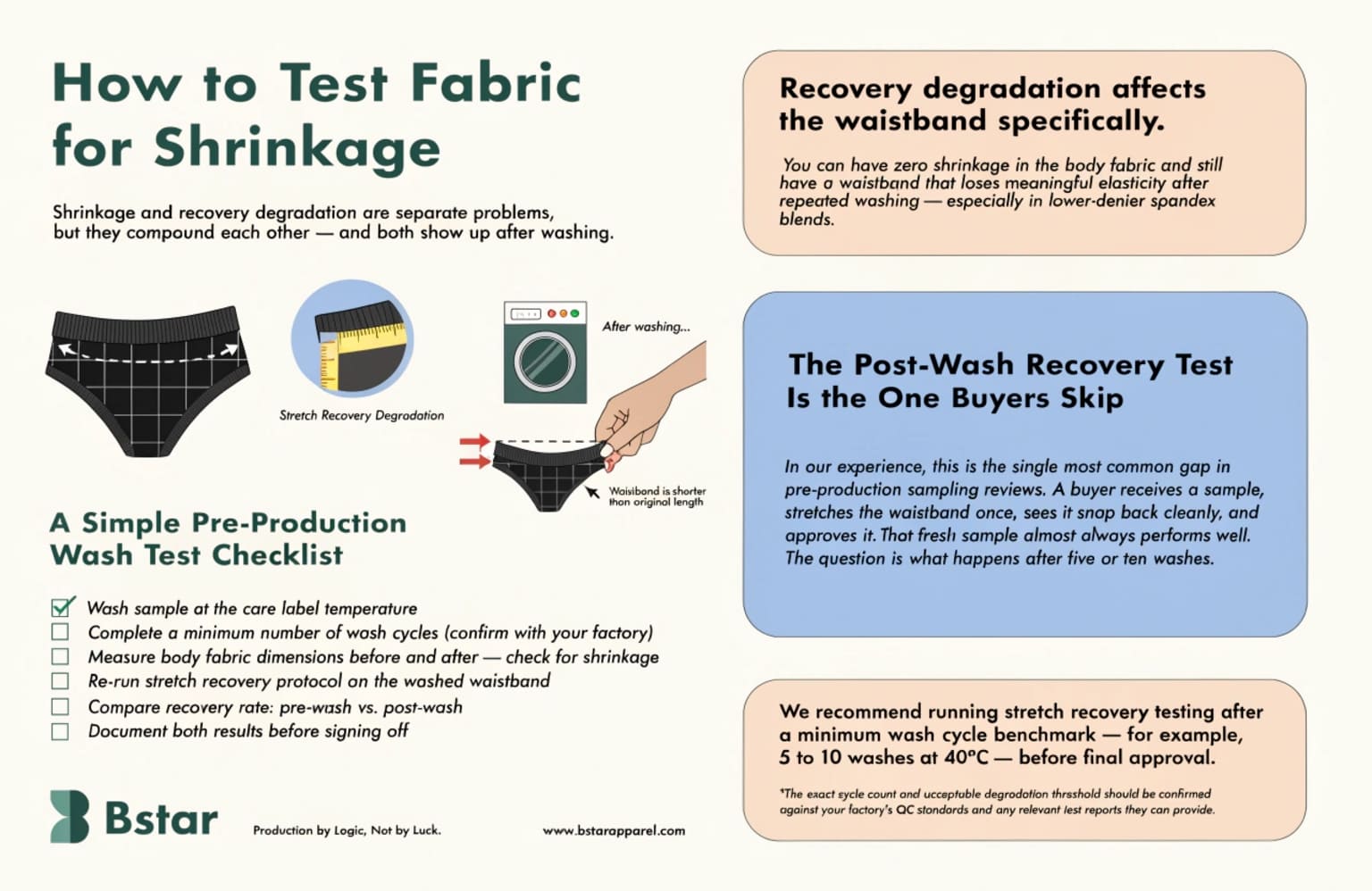
Where the test plan permits, use the same identified garment specimens to record body dimensions and waistband behaviour before and after laundering. Keep the measurement points and conditioning consistent. Research on cotton and cotton/spandex knitted fabrics also shows that laundering conditions can change dynamic elastic behaviour, but the size and direction of the change depend on the tested material and procedure.4
The Wash Protocol Must Be Agreed Before Testing
There is no universal requirement to wash every underwear waistband five or ten times at 40°C. ASTM D5278/D5278M-26a specifies three washing and drying cycles under the referenced AATCC laboratory procedures for its narrow-elastic method. ASTM D4964 instead requires the parties to agree on the laundering temperature and number of washing and drying cycles.12
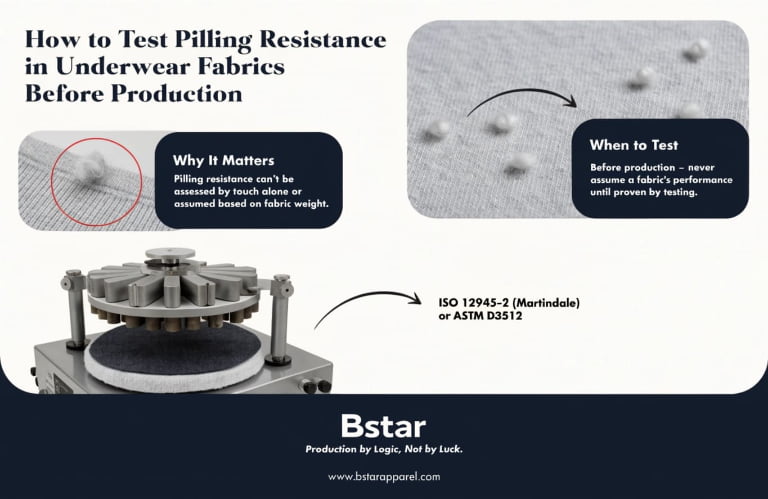
Use the method required by the buyer, market or laboratory. If the project uses an internal comparison instead, label it clearly and record the complete procedure. Surface appearance can be reviewed at the same development stage; the separate guide on underwear fabric pilling testing explains why its method and grading criteria must also be specified.
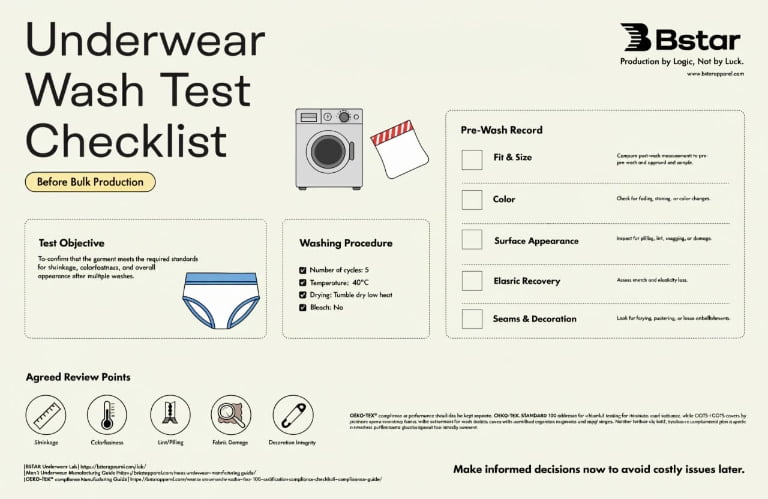
Pre-Production Wash and Recovery Checklist
- Identify the garment, elastic lot, sample version and size.
- Record body and waistband measurement points before treatment.
- Name the laundering method or buyer protocol.
- Record temperature, detergent, cycle count and drying route.
- Condition the sample as required before final measurement.
- Re-run the agreed waistband test using the same load or extension.
- Compare the pre-wash and post-wash records against the agreed criteria.
- Keep photographs, raw measurements and the approval decision together.
The test record should show what was tested and how. A simple statement that a waistband “passed washing” is not enough to reproduce or interpret the result.
Is 4% Spandex a Lot of Stretch?
Four percent spandex does not, by itself, tell a buyer how far a fabric will stretch or how well it will recover. It describes fibre content, while performance also depends on yarn form, elastane linear density, knit structure, fabric density, finishing, direction of test and loading history.
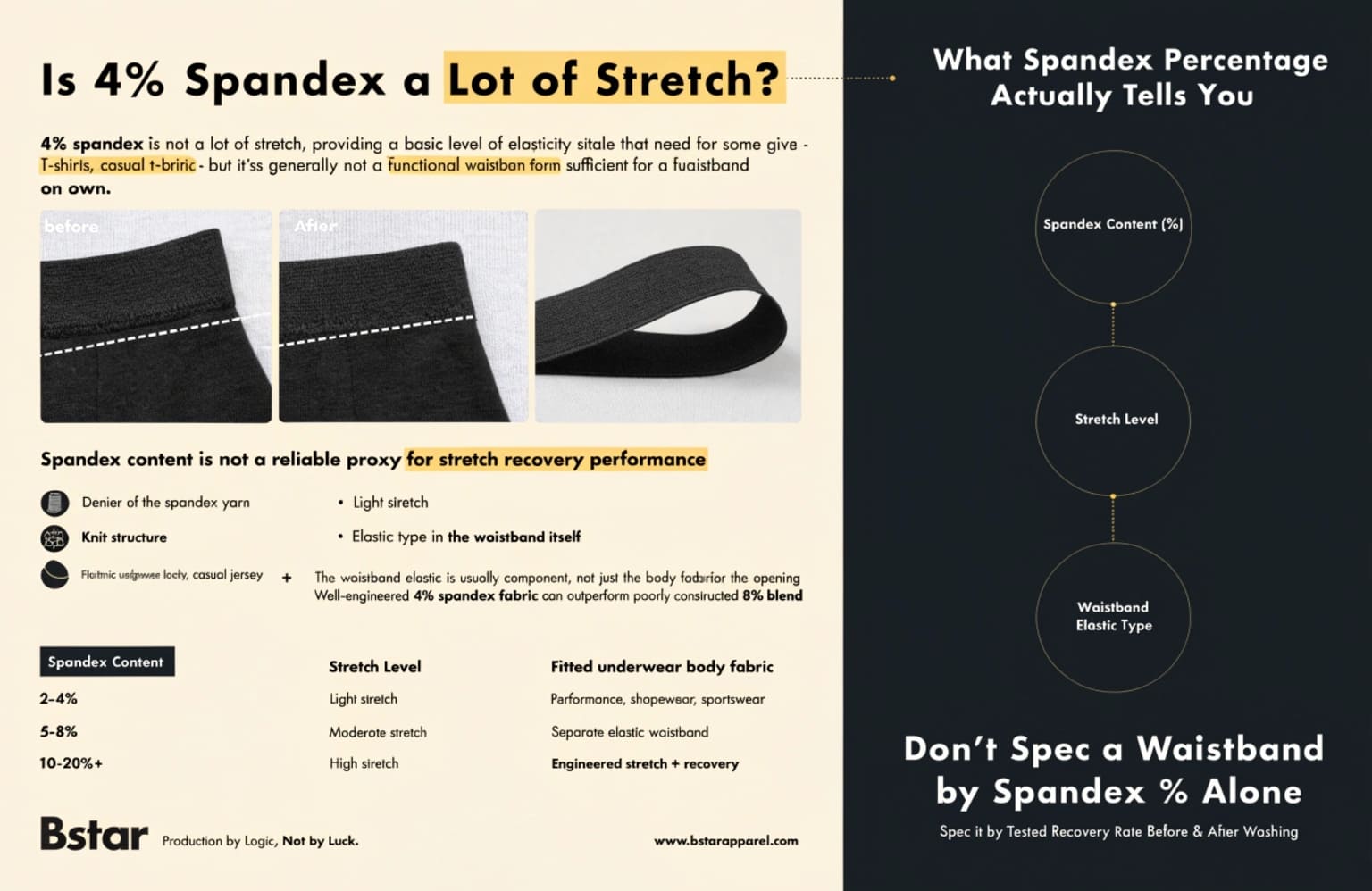
Research on specific plated weft-knitted fabrics found that elastane percentage affected the size of the elastic region, while it did not affect every measured property in the same way. The study used particular polyamide and elastane yarn combinations with elastane contents from 0% to 43%, so its results should not be converted into a universal percentage rule for cotton underwear or finished waistbands.5
What the Material Specification Can and Cannot Tell You
| Specification item | What it helps identify | What still requires testing |
|---|---|---|
| 4% spandex in body fabric | Fibre composition of the tested fabric | Extension, growth, recovery, feel and wash response |
| Higher spandex percentage | A change in material formulation | The actual elastic range, tension and residual deformation |
| Separate waistband elastic | A dedicated elastic component | Load–extension behaviour before and after construction |
| Finished waistband | The complete fabric, elastic and seam assembly | Fit, tension, recovery and post-wash change under the agreed protocol |
Many underwear styles use a separate knitted or woven elastic waistband, so the spandex percentage printed for the body fabric may not describe the waistband component at all. Review both the fabric specification and the finished garment. The custom men’s underwear page shows where waistband, fit and construction choices enter the product brief.
Frequently Asked Questions
What is an acceptable recovery rate for an underwear waistband?
There is no universal 95% pass level for every waistband. The acceptable result depends on the test method, starting specimen, extension or load, recovery interval, waistband construction, intended fit and buyer requirement. Record the acceptance criterion before testing and apply it consistently to the approved sample and relevant production checks.
How many wash cycles should I test before approving a waistband sample?
Use the applicable standard, buyer protocol and care instructions. ASTM D5278/D5278M-26a specifies three washing and drying cycles under its referenced procedure, while ASTM D4964 requires agreement on temperature and cycle counts.12 An internal durability program may use another sequence, but it should be documented as a project method rather than described as a universal standard.
Can seam construction affect waistband recovery even if the elastic is suitable?
Yes. The attachment ratio, stitch type, stitch tension, fabric layers and join can change the behaviour and feel of the finished assembly. Test the elastic component when relevant, then verify the fully constructed waistband on the garment sample.
Is OEKO-TEX certification relevant to waistband stretch performance?
OEKO-TEX® STANDARD 100 is a label for textiles tested for harmful substances. Its requirements become stricter with more intensive skin contact, but it does not certify mechanical properties such as waistband stretch recovery.6 Chemical-safety documentation and mechanical-performance testing answer different questions.
Conclusion
Waistband approval should not depend on a single hand stretch or on spandex percentage alone. A useful record identifies the specimen and method, controls the load or extension, measures recovery under the same conditions, and repeats the agreed review after laundering when required.
The component result and the finished garment result should remain separate but connected. That makes it easier to identify whether a problem comes from the elastic, fabric, construction, wash treatment or fit specification before bulk production begins.
If you are preparing an underwear sample, contact BSTAR with the product type, waistband construction, material information, target fit, care instructions and any buyer-required test method. The review scope and evidence needed can then be confirmed for the specific project.
-
ASTM International, “ASTM D5278/D5278M-26a — Standard Test Method for Elongation of Narrow Elastic Fabrics (Static-Load Testing).” The scope covers narrow elastic fabrics tested before or after laundering and requires selection or agreement on the effective static load. Its laundering procedure references three washing and drying cycles under AATCC LP1 or LP5. ↩ ↩ ↩
-
ASTM International, “ASTM D4964-96(2020) — Standard Test Method for Tension and Elongation of Elastic Fabrics.” The method covers wide or narrow elastic fabrics using a constant-rate-of-extension machine and requires comparable machine settings and mutual agreement on laundering temperature and cycle counts. ↩ ↩ ↩ ↩
-
ASTM International, “ASTM D2594/D2594M-21 — Standard Test Method for Stretch Properties of Knitted Fabrics Having Low Power.” The method measures fabric stretch under a known load and fabric growth after a known extension is removed; it also notes limitations for support applications and commercial acceptance testing. ↩ ↩
-
M. Gorjanc and others, “Effect of Laundering on Dynamic Elastic Behavior of Cotton and Cotton/Spandex Knitted Fabrics.” The study supports the narrower point that laundering conditions can affect the dynamic elastic behaviour of the tested knitted fabrics; it does not establish one failure cycle or result for every waistband. ↩
-
T. Jovanović, Ž. Penava and Z. Vrljičak, “Impact of the Elastane Percentage on the Elastic Properties of Knitted Fabrics under Cyclic Loading.” The study examined specific plated weft-knitted fabrics and found that elastane percentage affected the elastic region but did not determine every measured property in the same way. ↩
-
OEKO-TEX®, “OEKO-TEX® STANDARD 100.” The official page defines STANDARD 100 as a label for textiles tested for harmful substances and explains that requirements depend on intended use and skin contact. ↩
Discussion & questions 0 comments