
Bamboo Underwear Manufacturer: The Ultimate B2B Sourcing Guide for Sustainable Men’s Brands
A bamboo underwear manufacturer can help a men’s brand build a softer, more sustainable-feeling product line, but the wrong supplier can also create problems fast. Poor shrinkage control, vague material claims, and unstable bulk quality hurt repeat purchases. The solution is to evaluate bamboo underwear as a full sourcing decision, not just a fabric trend.
A reliable bamboo underwear manufacturer should help you verify the bamboo material type, certification scope, fabric performance, fit structure, dyeing quality, MOQ, production control, and pre-shipment inspection process. For sustainable men’s brands, the best supplier is not simply the cheapest one. It is the one that can protect your product promise from sample development to bulk delivery.
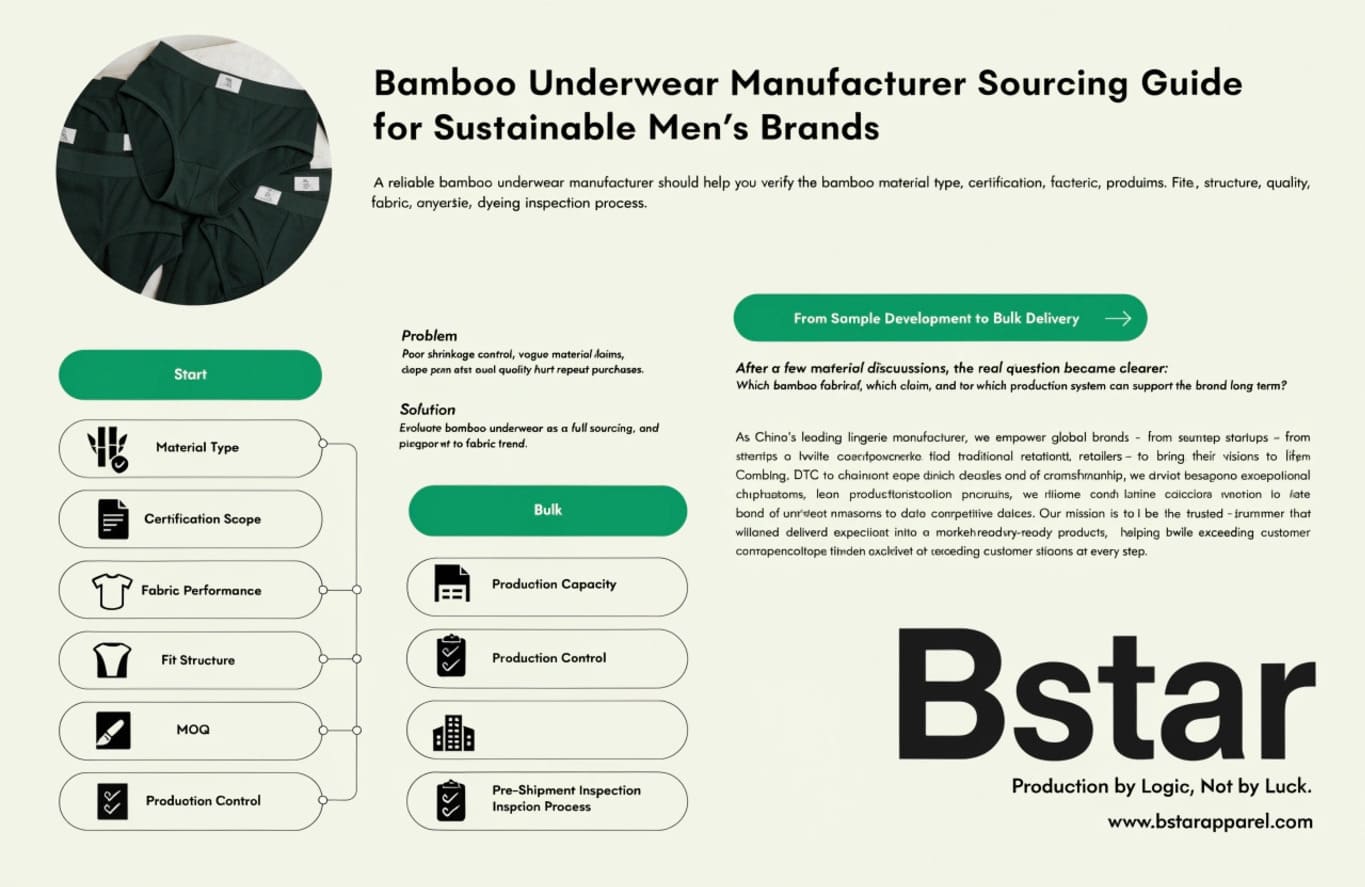
I have worked with overseas underwear brands that started with one simple request: “We want bamboo underwear.” After a few material discussions, the real question became clearer: Which bamboo fabric, which claim, which fit, and which production control system can support the brand long term?
Why Is Bamboo Fabric Taking Over the Men’s Premium Underwear Market?
Bamboo fabric is popular because men’s underwear buyers want softness, breathability, and a more responsible product story. But the market is crowded, and many claims sound the same. If a brand does not define its fabric standard clearly, the final product may not match customer expectations.
Bamboo-based fabrics are growing in premium men’s underwear because they often offer a soft handfeel, smooth drape, good moisture comfort, and strong marketing appeal. However, brands should compare bamboo viscose, bamboo lyocell, and blends carefully because performance, cost, durability, and sustainability claims can vary widely.
Why buyers like bamboo in men’s underwear
In my daily sourcing conversations, I see three main reasons brands ask for bamboo:
- Soft touch: Bamboo viscose and bamboo lyocell can feel smooth against the skin.
- Premium positioning: Many DTC brands use bamboo to move above basic cotton underwear.
- Sustainability direction: Bamboo can support a better material story when the source and processing are properly verified.
For men’s underwear, comfort is not a small feature. It decides whether customers reorder. A buyer may win the first purchase with branding, but the second purchase depends on fit, wash stability, waistband comfort, and fabric recovery.
Where the sourcing risk begins
The word “bamboo” is not enough. Buyers should ask:
- Is the fabric bamboo viscose, bamboo rayon, bamboo lyocell, or a blend?
- What is the fiber composition?
- Is spandex included for stretch and recovery?
- Does the fabric have valid supporting documents?
- Has the supplier tested shrinkage, pilling, and color fastness?
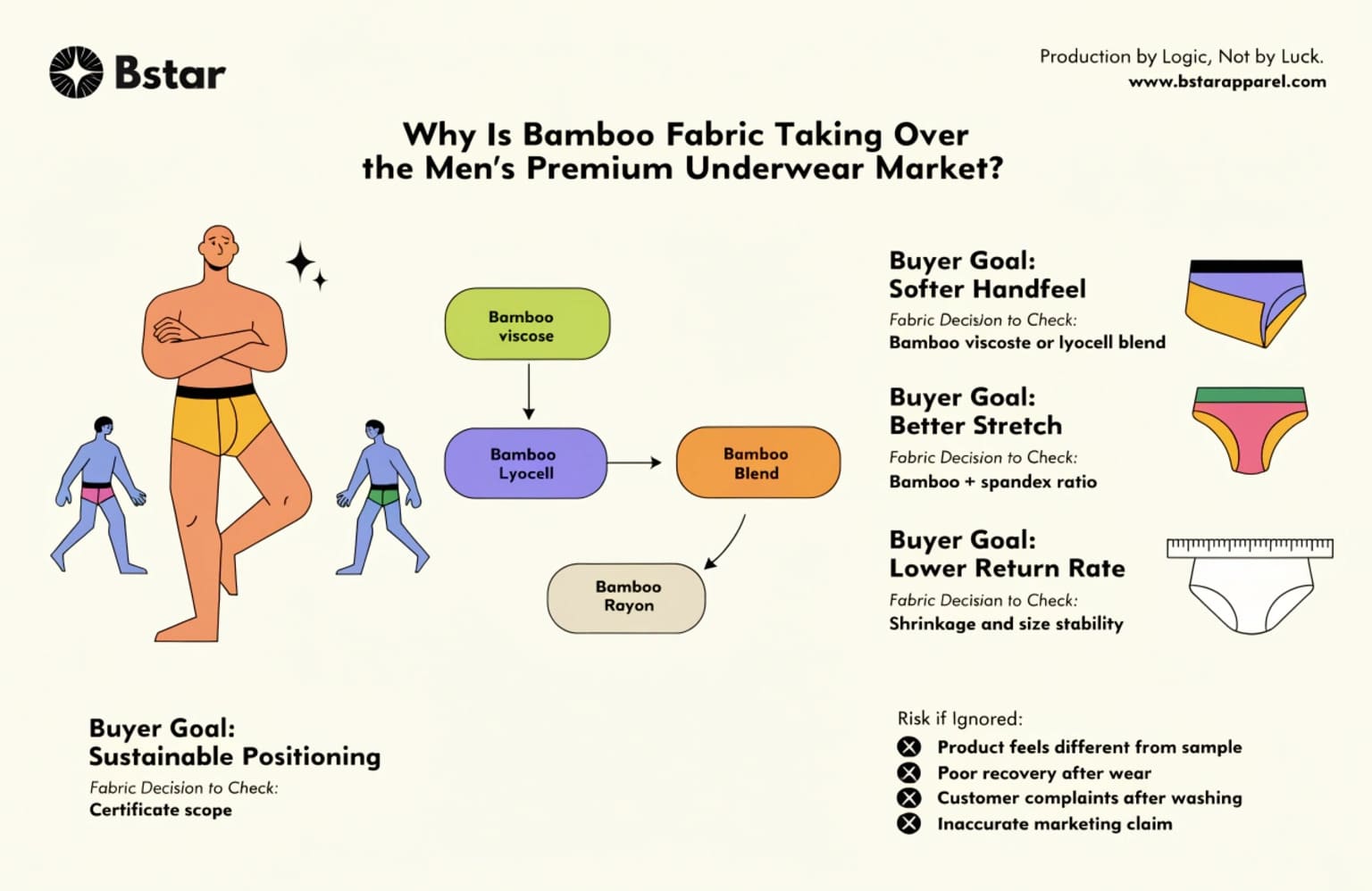
| Buyer goal | Fabric decision to check | Risk if ignored |
|---|---|---|
| Softer handfeel | Bamboo viscose or lyocell blend | Product feels different from sample |
| Better stretch | Bamboo + spandex ratio | Poor recovery after wear |
| Lower return rate | Shrinkage and size stability | Customer complaints after washing |
| Sustainable positioning | Certificate scope | Inaccurate marketing claim |
A capable bamboo underwear manufacturer should guide this discussion before quoting bulk production. A fast quote is useful, but clear material advice is more valuable.
Bamboo Underwear Manufacturer Comparison: Bamboo Viscose vs. Bamboo Rayon vs. Organic Bamboo?
Many buyers use bamboo viscose, bamboo rayon, and organic bamboo as if they mean the same thing. That creates confusion. If your product page, hangtag, and supplier documents use different terms, your brand may face claim risks and customer trust issues.
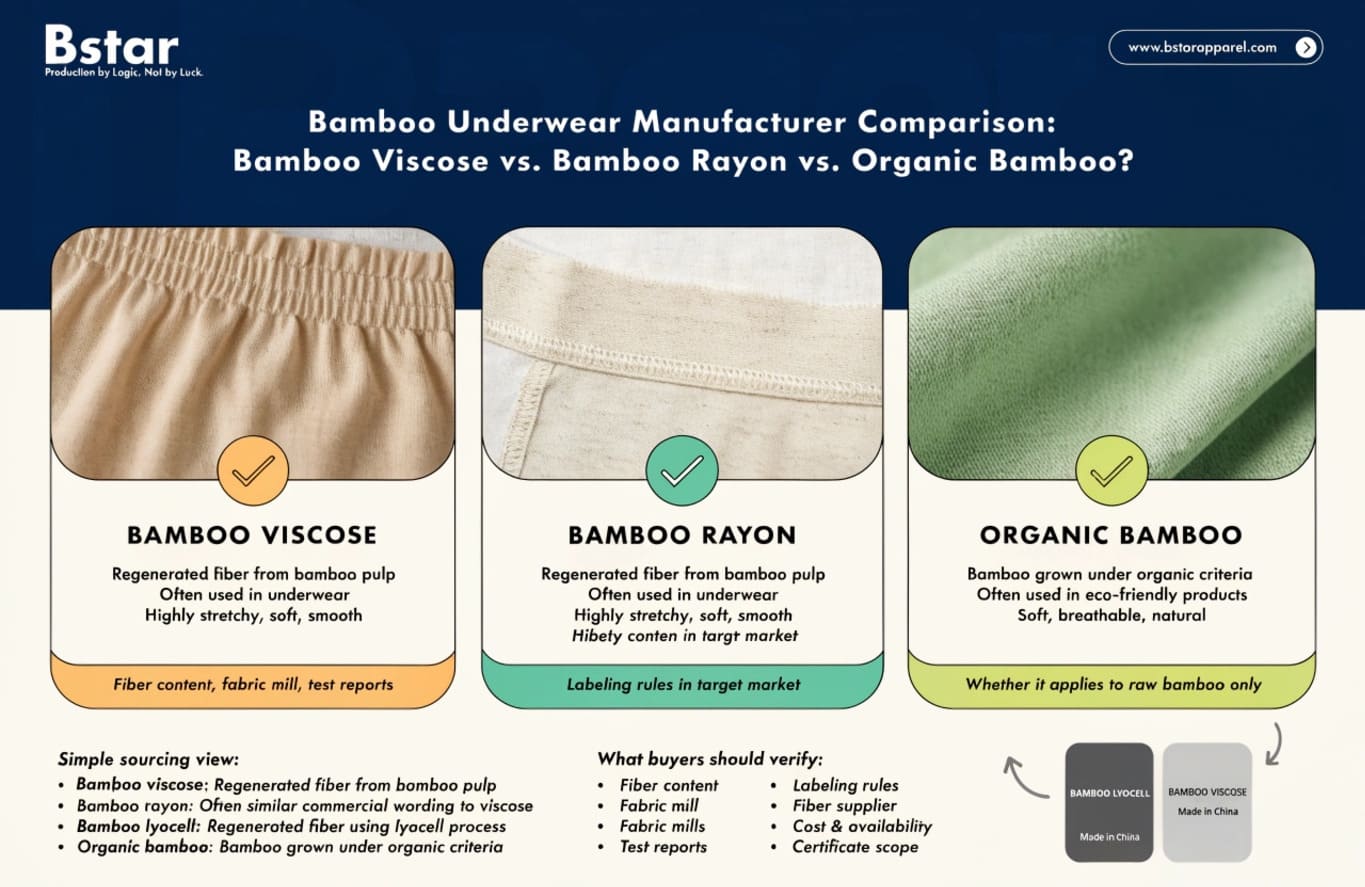
Bamboo viscose and bamboo rayon are often used to describe regenerated cellulose fibers made from bamboo pulp, while bamboo lyocell uses a different production process. “Organic bamboo” usually refers to the agricultural source, not automatically to the finished fabric. Buyers should verify fiber content, processing type, and certificate scope.
The terms buyers should separate
Here is the simple sourcing view I usually share with new underwear customers:
| Term | What it usually means in sourcing | What buyers should verify |
|---|---|---|
| Bamboo viscose | Regenerated fiber from bamboo pulp | Fiber content, fabric mill, test reports |
| Bamboo rayon | Often similar commercial wording to viscose | Labeling rules in target market |
| Bamboo lyocell | Regenerated fiber using lyocell process | Fiber supplier, cost, availability |
| Organic bamboo | Bamboo grown under organic criteria | Whether it applies to raw bamboo only |
I do not recommend using broad environmental claims unless your documents support them. For example, a fabric may contain bamboo-origin fiber, but that does not automatically prove the full garment is organic, low-impact, or certified.
Common blend options for men’s underwear
Most men’s bamboo underwear is not 100% bamboo fiber. Brands often use blends to improve stretch and shape retention.
Common options include:
- 95% bamboo viscose / 5% spandex
- 92% bamboo viscose / 8% spandex
- Bamboo viscose + cotton + spandex
- Bamboo lyocell + spandex
- Bamboo blend with recycled elastane or other fibers, where available
The best option depends on the product. Boxer briefs usually need better recovery at the pouch, leg opening, and waistband area. Trunks may need stronger anti-ride-up performance. Briefs may need lighter fabric and cleaner binding.
A professional bamboo underwear manufacturer should not push one fabric blindly. The supplier should connect the fabric choice to fit, cost, dyeing behavior, handfeel, and wash durability.
What Certifications Should a Bamboo Underwear Manufacturer Help Buyers Verify?
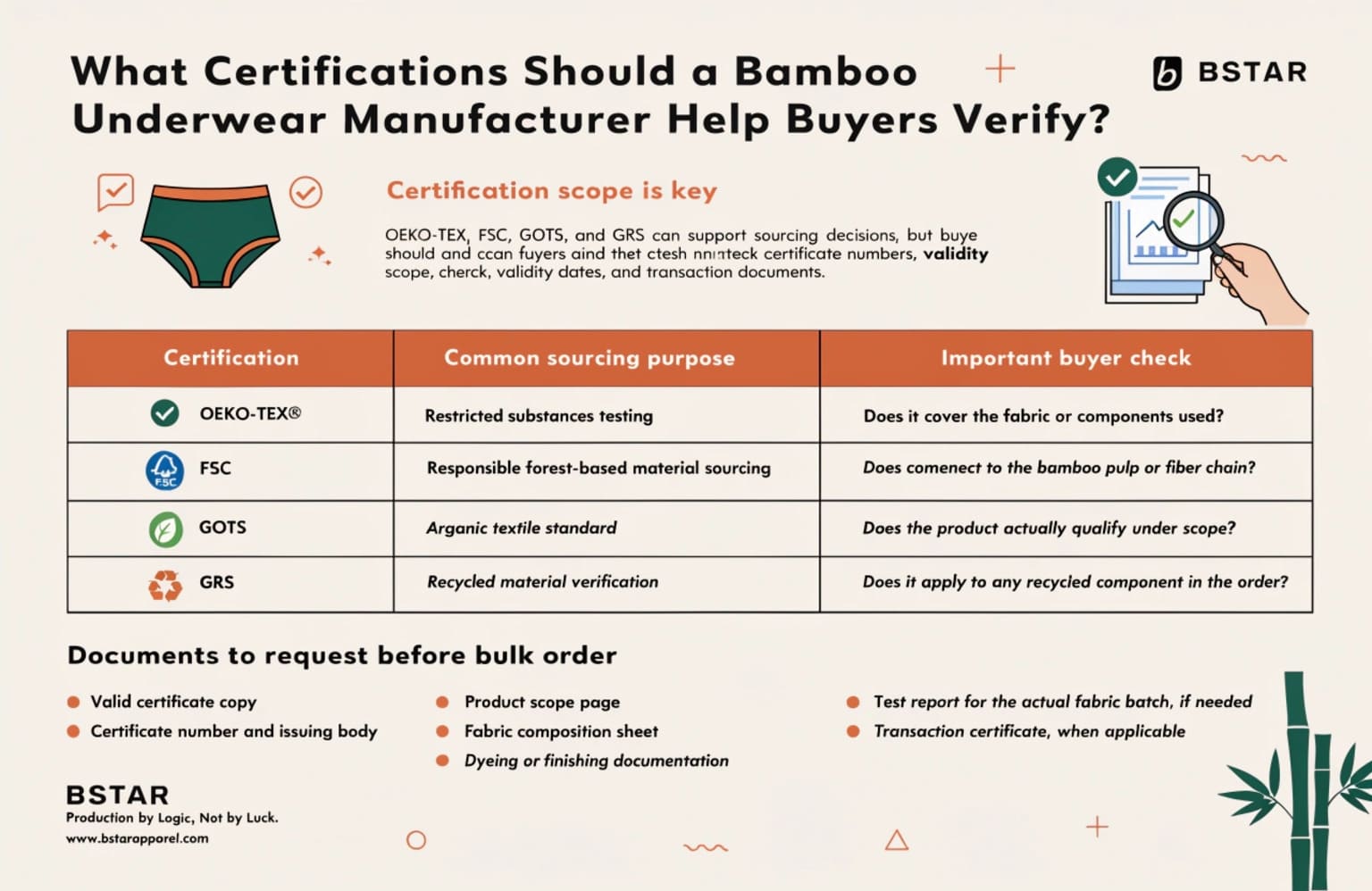
Sustainable underwear brands often ask for OEKO-TEX, FSC, GOTS, and GRS. These are useful procurement signals, but they are not magic labels. If a certificate does not match the ordered material, supplier, or process, it may not support your claim.
A bamboo underwear manufacturer should help buyers verify whether certifications apply to the raw material, yarn, fabric, dyeing process, factory, or finished garment. OEKO-TEX, FSC, GOTS, and GRS can support sourcing decisions, but buyers should check certificate numbers, validity dates, product scope, and transaction documents.
How I explain certification scope to buyers
When a customer sends me a certification request, I first ask what claim they want to make. Then I check which document can support it. This step matters because certificates can apply to different levels.
| Certification | Common sourcing purpose | Important buyer check |
|---|---|---|
| OEKO-TEX® | Restricted substances testing | Does it cover the fabric or components used? |
| FSC | Responsible forest-based material sourcing | Does it connect to the bamboo pulp or fiber chain? |
| GOTS | Organic textile standard | Does the product actually qualify under scope? |
| GRS | Recycled material verification | Does it apply to any recycled component in the order? |
BSTAR’s business context includes experience communicating with overseas buyers about certified materials such as FSC, OEKO-TEX®, GOTS, and GRS. Still, buyers should always verify the certificate scope for their actual purchase order.
Documents to request before bulk order
A careful buyer can ask for:
- Valid certificate copy
- Certificate number and issuing body
- Product scope page
- Fabric composition sheet
- Dyeing or finishing documentation
- Test report for the actual fabric batch, if needed
- Transaction certificate, when applicable
My practical advice is simple: do not build your product claim only from a supplier’s sales message. Build it from documents that match the order.
A trustworthy bamboo underwear manufacturer should be comfortable with this process. If a supplier avoids certificate questions, that is a warning sign.
How Can a Bamboo Underwear Manufacturer Solve Shrinkage, Pilling, and Color Fastness?
Bamboo underwear feels great at first touch, but customers judge it after washing. If shrinkage changes the fit, pilling makes it look old, or dark colors bleed, your brand receives complaints. These issues must be controlled before bulk production.
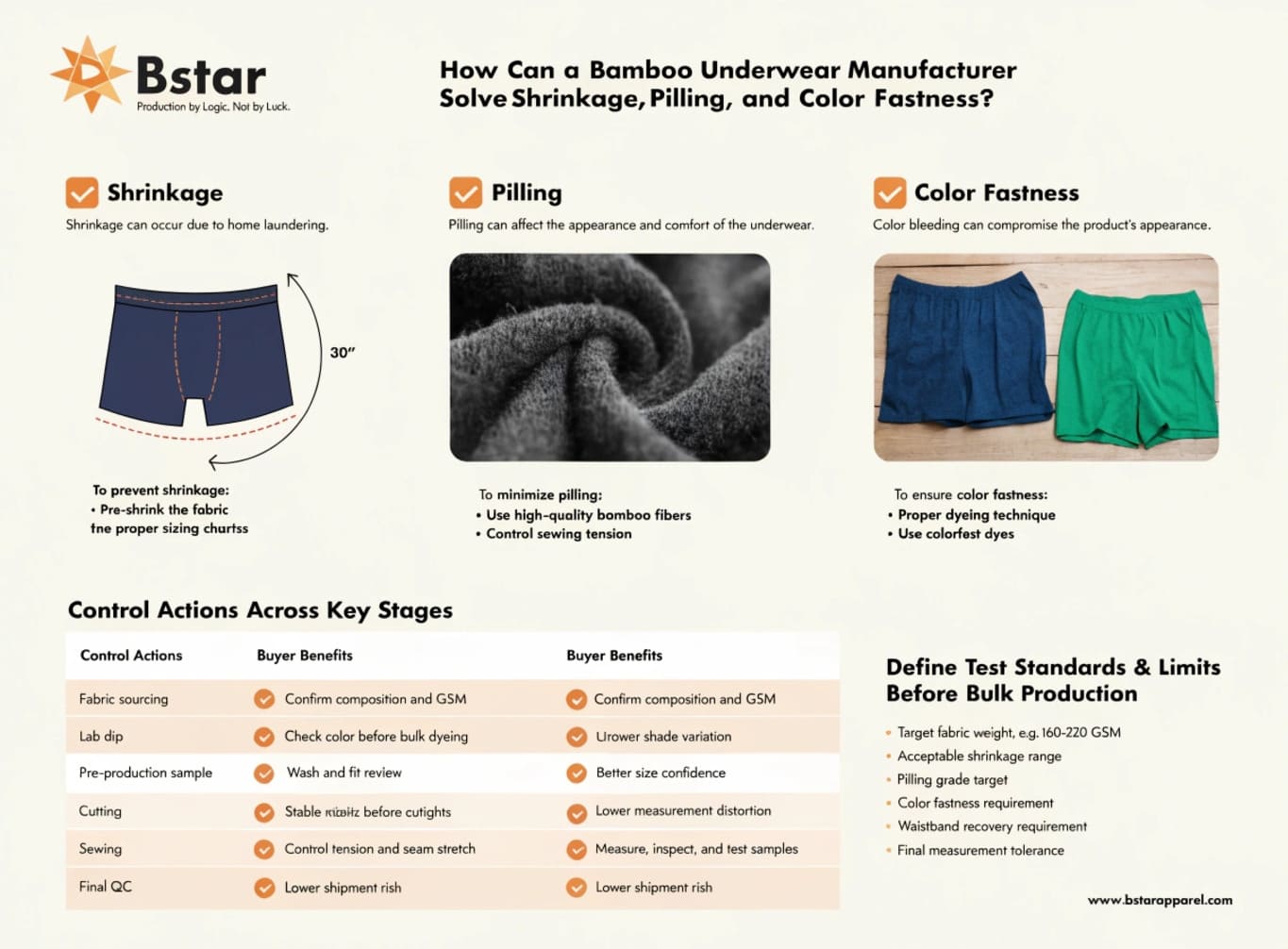
A bamboo underwear manufacturer can reduce shrinkage, pilling, and color fastness risks through fabric pre-testing, controlled dyeing, pre-shrinking, correct sewing tension, approved washing instructions, in-line checks, and final inspection. Buyers should confirm test standards and acceptable limits before approving bulk production.
The three performance risks I watch closely
For men’s underwear, I usually focus on these issues during sampling:
- Shrinkage: Does the size change after home laundering?
- Pilling: Does the surface become fuzzy after rubbing and washing?
- Color fastness: Does the color transfer to skin, labels, or other garments?
- Elastic recovery: Does the pouch and leg opening keep shape?
- Size stability: Does the garment still match the approved size chart?
Practical control points
A good bamboo underwear manufacturer should control performance at several stages:
| Stage | Control action | Buyer benefit |
|---|---|---|
| Fabric sourcing | Confirm composition and GSM | Stable handfeel and weight |
| Lab dip | Check color before bulk dyeing | Lower shade variation |
| Pre-production sample | Wash and fit review | Better size confidence |
| Cutting | Relax fabric before cutting | Lower measurement distortion |
| Sewing | Control tension and seam stretch | Better comfort |
| Final QC | Measure, inspect, and test samples | Lower shipment risk |
In our production discussions, I often remind buyers that underwear is a repeat-purchase product. A small unit-price saving can become expensive if the garment fails after three washes.
What buyers should define early
Before bulk production, define:
- Target fabric weight, such as 160–220 GSM, depending on style.
- Acceptable shrinkage range after washing.
- Pilling grade target based on market expectations.
- Color fastness requirement for dark colors.
- Waistband recovery requirement.
- Final measurement tolerance.
These numbers should be confirmed with a qualified lab or professional testing partner when the application requires it. The supplier can help prepare samples and production controls, but product-specific decisions should be verified properly.
What Customization Options Should a Bamboo Underwear Manufacturer Offer?
Premium men’s underwear needs more than soft fabric. The waistband, pouch, leg opening, stitching, and dyeing choices all affect comfort and brand identity. If customization is treated only as decoration, the product may look good but perform poorly.
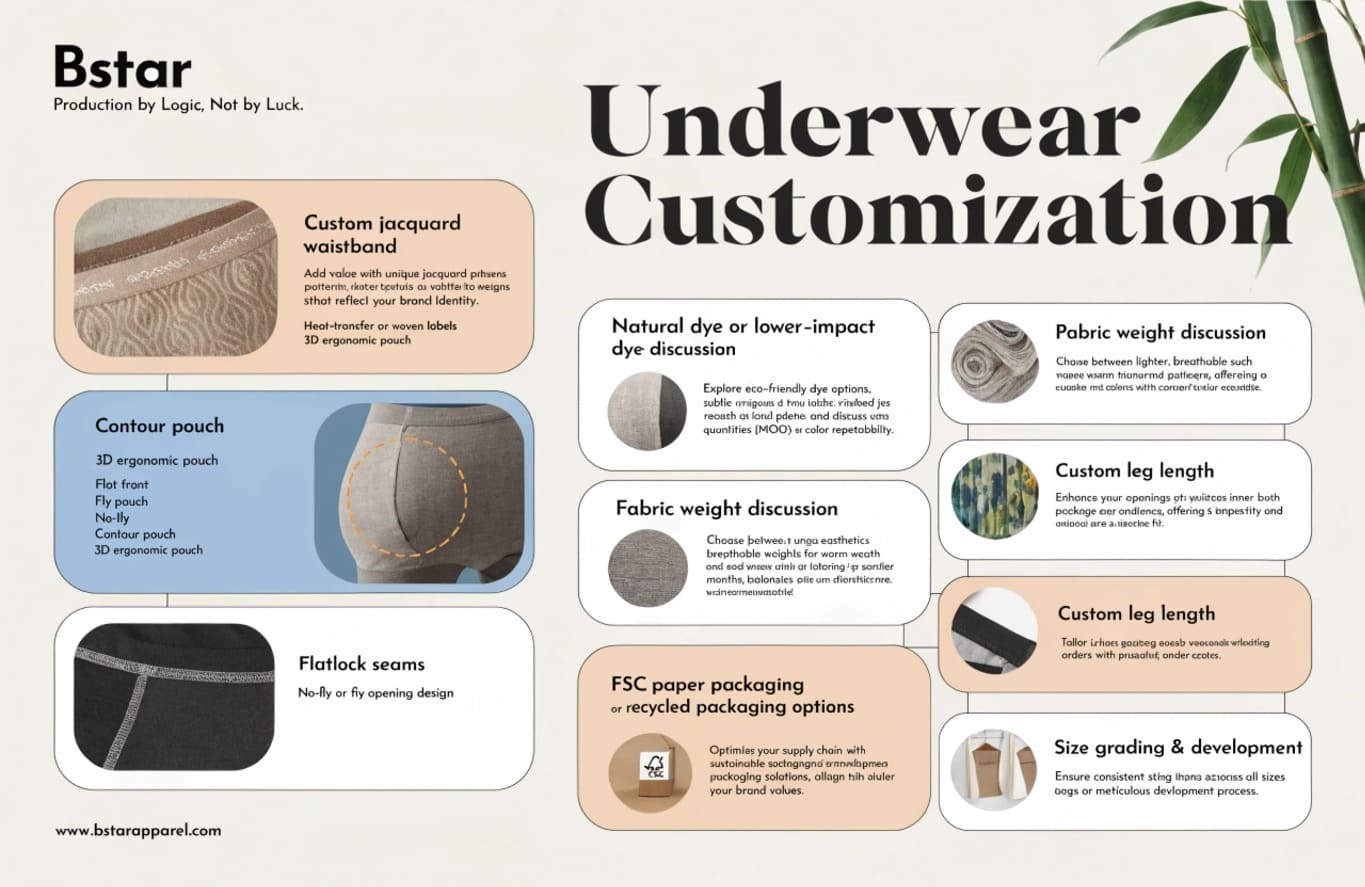
A bamboo underwear manufacturer should offer custom waistbands, ergonomic pouch construction, natural or low-impact dyeing discussions, fabric weight options, trims, labels, packaging, and size grading. The best customization plan balances comfort, brand image, MOQ, cost, and production stability.
Key custom options for men’s bamboo underwear
Most brands ask about logos first. I understand that. But I usually suggest checking the structure first.
Important options include:
- Custom jacquard waistband
- Heat-transfer or woven labels
- 3D pouch or contour pouch
- Flatlock seams
- No-fly or fly opening design
- Natural dye or lower-impact dye discussion
- Custom leg length
- Printed inner waistband
- FSC paper packaging or recycled packaging options
Pouch design matters more than many buyers expect
The pouch decides comfort. For men’s underwear, this is one of the biggest fit differences between a basic product and a premium product.
| Pouch type | Best for | Buyer note |
|---|---|---|
| Flat front | Basic briefs or low-cost styles | Lower development complexity |
| Contour pouch | Everyday boxer briefs | Better shape and comfort |
| 3D ergonomic pouch | Premium DTC products | Needs careful fit testing |
| Fly pouch | Traditional market preference | More sewing steps |
A skilled bamboo underwear manufacturer should help adjust pouch depth, front rise, back rise, inseam, and leg opening. During sampling, we often revise these areas after the first fitting because body shape expectations differ between Europe, North America, and Australia.
Natural dyes and color planning
Natural dyeing can sound attractive, but buyers should check:
- Color consistency
- Color fastness
- MOQ
- Cost
- Repeatability in reorder production
For commercial underwear, color repeatability is critical. If your hero color changes from batch to batch, customers notice. A practical supplier will help you balance sustainability story and repeatable production.
MOQ and Fabric Dyeing Costs: How Can Brands Launch Without Inventory Overload?
Many sustainable underwear startups worry about inventory. They want premium bamboo fabric, custom colors, and branded waistbands, but they do not want thousands of units sitting in a warehouse. The challenge is to launch small without creating an impossible cost structure.
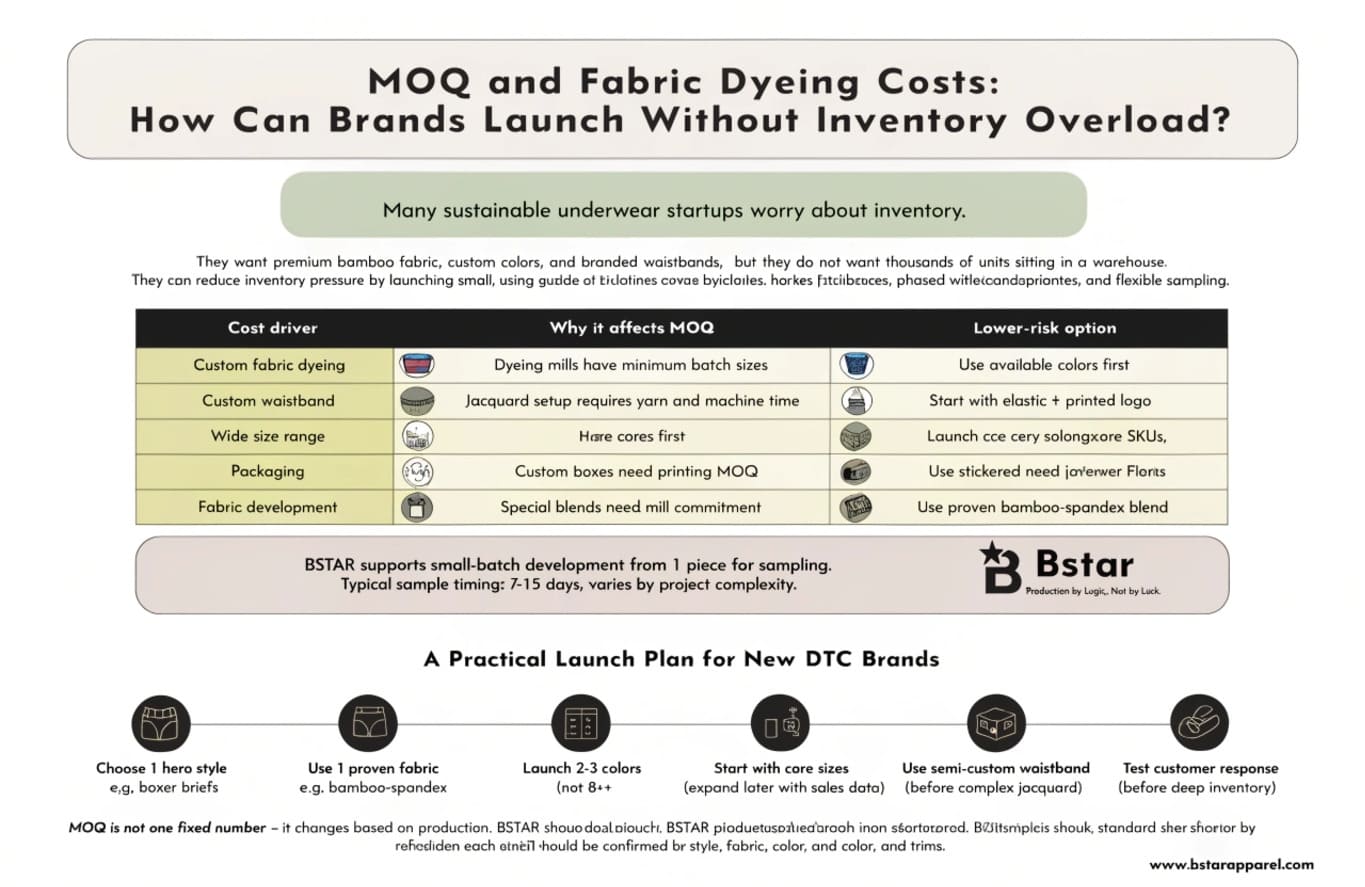
Brands can reduce inventory pressure by starting with stock fabric colors, limited core SKUs, shared fabric bases, phased color launches, and flexible sampling. MOQ depends on fabric dyeing, waistband customization, size range, and packaging. A bamboo underwear manufacturer should explain each MOQ driver clearly before order placement.
What usually drives MOQ?
MOQ is not one fixed number. It changes based on production inputs.
| Cost driver | Why it affects MOQ | Lower-risk option |
|---|---|---|
| Custom fabric dyeing | Dyeing mills have minimum batch sizes | Use available colors first |
| Custom waistband | Jacquard setup requires yarn and machine time | Start with elastic + printed logo |
| Wide size range | More cutting and inventory spread | Launch core sizes first |
| Packaging | Custom boxes need printing MOQ | Use stickered standard packaging |
| Fabric development | Special blends need mill commitment | Use proven bamboo-spandex blend |
BSTAR supports small-batch development from 1 piece for sampling, with typical sample timing around 7–15 days, based on project complexity. For bulk production, MOQ should be confirmed by style, fabric, color, and trims.
A practical launch plan
For a new DTC brand, I often suggest this structure:
- Choose one hero style, such as boxer briefs.
- Use one proven bamboo-spandex fabric.
- Launch 2–3 colors, not 8.
- Start with core sizes, then expand after sales data.
- Use a semi-custom waistband before investing in complex jacquard.
- Test customer response before deep inventory.
A reliable bamboo underwear manufacturer should not force the biggest order possible. The supplier should help you protect cash flow while keeping product quality stable.
How Should a Bamboo Underwear Manufacturer Assess Production Capacity, Lead Times, and AQL 2.5 QC?
A beautiful sample is not enough. Many problems appear when production moves from 5 pieces to 5,000 pieces. If the factory lacks process control, the approved sample can slowly drift in fabric feel, measurement, stitching, and packaging.
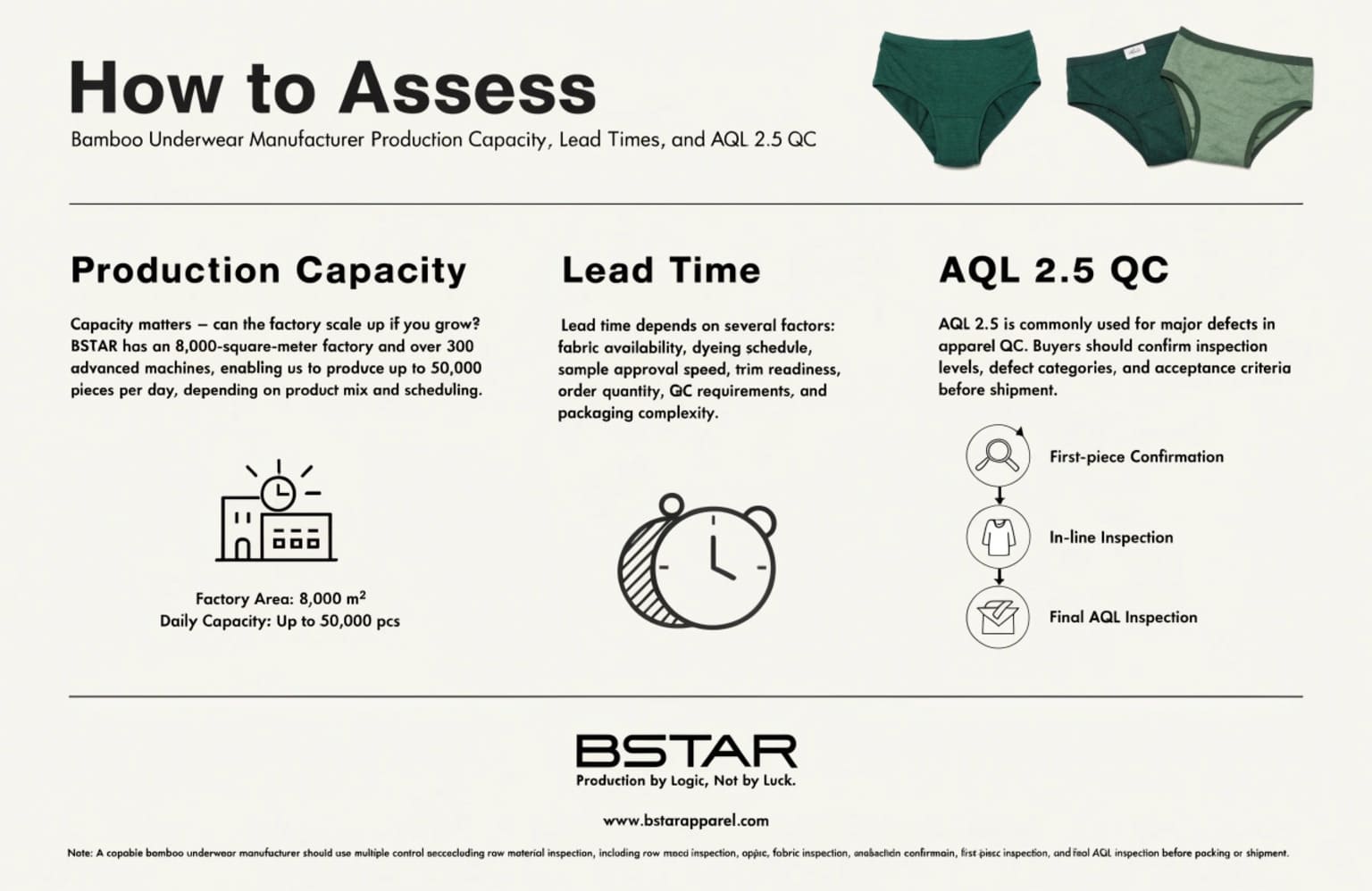
A bamboo underwear manufacturer should prove production capacity, realistic lead times, first-piece approval, in-line inspection, and final AQL inspection. AQL 2.5 is commonly used for major defects in apparel QC, but buyers should confirm inspection levels, defect categories, and acceptance criteria before shipment.
Capacity should match your growth plan
BSTAR operates as a China-based OEM/ODM knitwear manufacturer with an 8,000-square-meter factory, 300+ advanced machines, and daily capacity that can reach 50,000 pieces, depending on product mix and scheduling. These numbers help larger brands plan, but each order still needs a production calendar.
Lead time depends on:
- Fabric availability
- Dyeing schedule
- Sample approval speed
- Trim readiness
- Order quantity
- QC requirements
- Packaging complexity
What AQL 2.5 means in buyer language
AQL stands for Acceptable Quality Limit. In apparel, AQL 2.5 is often used as a reference for major defects during final inspection. It does not mean every unit is perfect. It means the shipment is inspected through a sampling plan with defined accept/reject rules.
Common underwear defects include:
- Wrong measurement
- Open seam
- Dirty mark
- Color shade issue
- Twisted waistband
- Poor elastic recovery
- Label error
- Packaging mismatch
QC checkpoints I expect in serious production
A capable bamboo underwear manufacturer should use multiple control points:
- Raw material inspection
- Fabric inspection
- Pre-production sample approval
- First-piece confirmation
- In-line inspection
- Final inspection before packing or shipment
BSTAR’s quality system includes AQL-based inspection and six quality control nodes from incoming material to final packaging. Buyers should still define their own inspection standard and, when needed, use third-party inspection for added confidence.
How Can You Partner with Us as Your OEM/ODM Bamboo Underwear Supplier?
Choosing a supplier can feel risky when you are working across time zones. You need fast answers, but you also need technical honesty. A good partnership should make development smoother, not create more uncertainty.
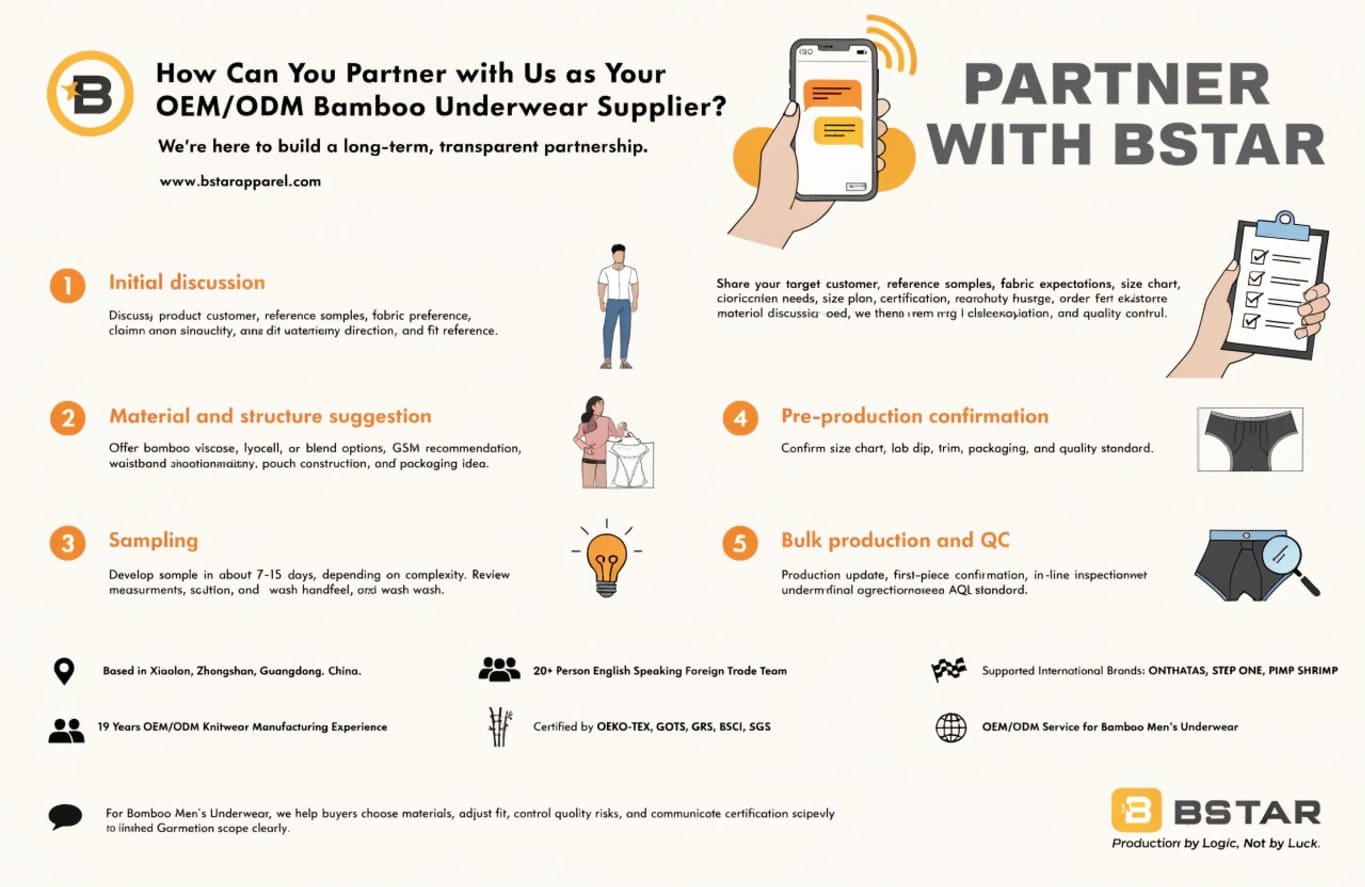
You can partner with BSTAR as your OEM/ODM bamboo underwear supplier by sharing your target customer, reference samples, fabric expectations, size chart, certification needs, order plan, and launch timeline. We then support material discussion, sampling, fit adjustment, cost review, production tracking, and quality control.
How our development process usually works
When a brand contacts us, I like to start with the product goal, not only the tech pack. This helps us avoid wrong fabric and construction choices.
A typical process looks like this:
-
Initial discussion
- Target market
- Price range
- Fabric preference
- Sustainability claim direction
- Fit reference
-
Material and structure suggestion
- Bamboo viscose, lyocell, or blend options
- GSM recommendation
- Waistband solution
- Pouch construction
- Packaging idea
-
Sampling
- Sample development in about 7–15 days, depending on complexity
- Fit and measurement review
- Fabric handfeel and wash feedback
-
Pre-production confirmation
- Size chart approval
- Lab dip approval
- Trim and packaging approval
- Quality standard confirmation
-
Bulk production and QC
- Production updates
- First-piece confirmation
- In-line inspection
- Final inspection under agreed AQL standard
Why brands work with us
BSTAR is based in Xiaolan, Zhongshan, Guangdong, China. We have 19 years of OEM/ODM knitwear manufacturing experience, a 20+ person English-speaking foreign trade team, and full-chain support from raw material sourcing to finished garment delivery.
We have supported international brands such as ONTHATASS, STEP ONE, and PIMP SHRIMP in apparel development and production. For bamboo men’s underwear, our role is practical: we help buyers choose materials, adjust fit, control quality risks, and communicate certification scope clearly.
A good bamboo underwear manufacturer should help your brand focus on the market while the factory protects delivery.
Frequently Asked Questions
Is bamboo underwear always sustainable?
No. Bamboo underwear is not automatically sustainable. Buyers should verify the fiber source, processing method, dyeing process, and certification scope. Claims should match real documents for the ordered fabric or garment. A supplier can support the process, but brands should review claims carefully.
What is the best bamboo fabric blend for men’s boxer briefs?
Many brands use bamboo viscose or bamboo lyocell blended with spandex, often around 5–8% spandex. The best blend depends on target handfeel, stretch recovery, price, and wash durability. I recommend testing fit and shrinkage before bulk approval.
What certifications should I ask a bamboo underwear manufacturer for?
You can ask for OEKO-TEX®, FSC, GOTS, or GRS documents depending on your product claim. However, you should check whether each certificate applies to the raw material, fabric, process, factory, or finished goods. The certificate scope matters more than the logo.
What causes bamboo underwear to shrink?
Shrinkage can come from fabric construction, finishing, washing conditions, cutting tension, or poor pre-production control. A supplier should test fabric and garment shrinkage before bulk production. Buyers should confirm washing instructions and acceptable tolerance early.
Can I start a bamboo underwear brand with low MOQ?
Yes, but you need a focused launch plan. You can reduce MOQ pressure by using proven fabrics, limited colors, simple packaging, and phased SKU expansion. Custom dyeing and jacquard waistbands usually increase MOQ and cost.
Conclusion
Choosing a bamboo underwear manufacturer is not just about finding someone who can sew bamboo fabric. It is about verifying material type, certification scope, fit performance, shrinkage control, color fastness, MOQ, lead time, and AQL-based production quality. If you are building a sustainable men’s underwear brand, I recommend starting with a clear product brief and a realistic launch plan. Contact BSTAR to discuss your OEM/ODM bamboo underwear project, and we will help you move from concept to controlled production.
I appreciate the detailed insights on sustainable sourcing practices highlighted in the guide. Understanding the importance of eco-friendly materials like bamboo is crucial for brands aiming to make a positive impact. I often refer to an online sustainability forum for additional tips on ethical manufacturing.
I appreciate the detailed breakdown of how bamboo fibers contribute to sustainability in the underwear industry. It’s interesting to consider the environmental impact of materials when sourcing. I often refer to a sustainability report that helps me stay informed about eco-friendly practices.
I appreciated the insights on how to vet bamboo underwear manufacturers effectively. The tips about checking sustainability certifications were particularly informative. It’s crucial for brands to align with ethical production practices. I also find industry reports to be a helpful free resource for deeper insights.
I found the section on sustainable sourcing practices particularly insightful. It’s refreshing to see a focus on eco-friendly materials in the realm of men’s underwear. I also appreciate the tips on how to choose the right manufacturer to align with those values. A helpful free resource I use for this is industry comparison charts.
I found the section on eco-friendly materials particularly insightful, especially how bamboo’s breathability can enhance comfort. It’s interesting to see how sustainable practices are shaping the future of men’s underwear manufacturing. I’ve been using industry reports for more information on trends in sustainable textiles.