

Understanding GSM in Underwear Fabrics: Weight and Quality?
If you’ve ever received a bulk order that felt different from your approved sample, GSM shift might be the reason nobody told you about.
GSM stands for grams per square meter. It measures how much a fabric weighs per unit area. In underwear, it affects feel, stretch recovery, breathability, and cost. But it is not a quality score. The right GSM depends on your garment type, fabric blend, and target market — not on which number is highest.
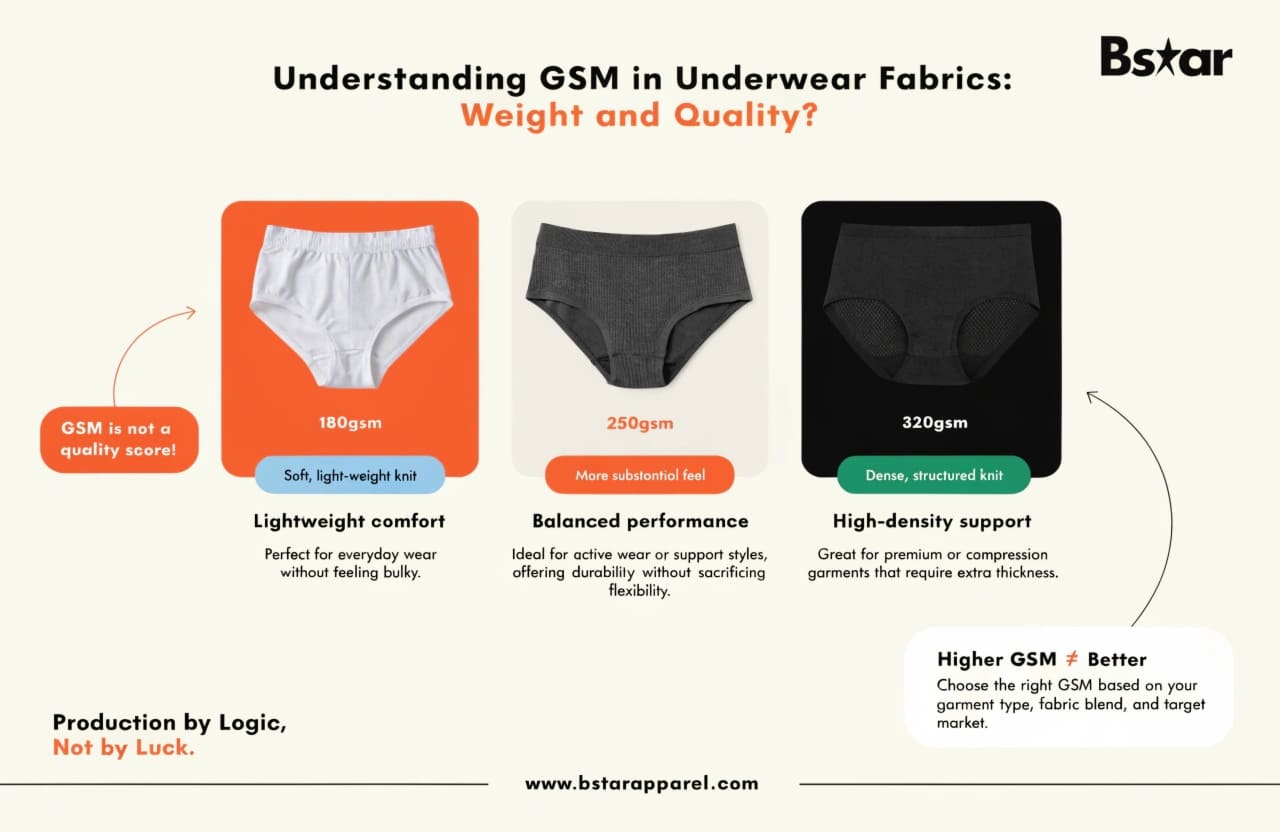
Most brand founders I talk to come in with one assumption: heavier means better. That assumption costs them money and leads to specs that fight against the garment they’re actually trying to make. Let me break down what GSM really means when you’re developing underwear — and how to use it as a tool instead of a guessing game.
Defining GSM: The Core Metric for Fabric Weight, Density, and Material Cost?
You’ve seen the number on a fabric swatch. But do you know what it’s actually telling you?
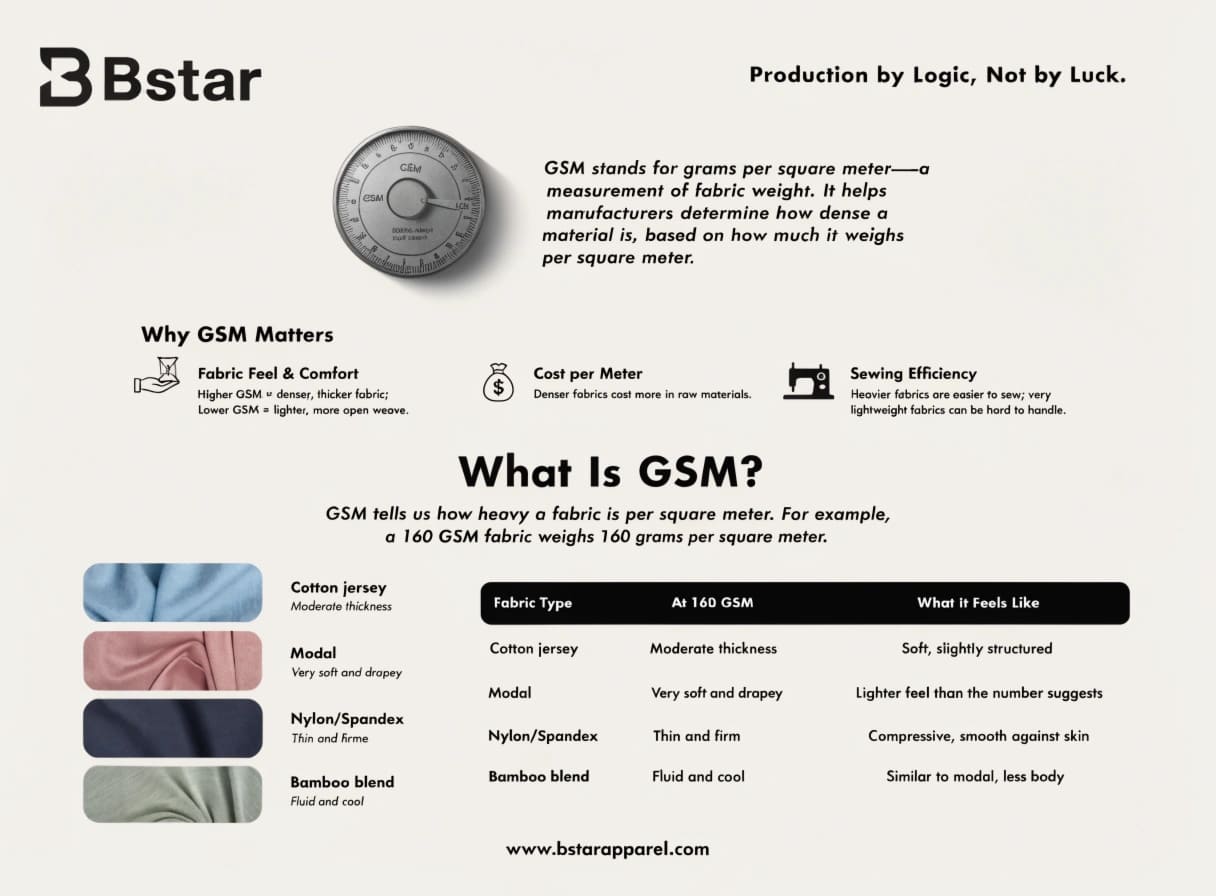
GSM tells you how densely a fabric is constructed. A higher GSM means more yarn per square meter — which usually means thicker, heavier fabric1. A lower GSM means fewer yarns packed together, giving you something lighter and more open. That’s the full definition. Everything else is context.
Here’s where it gets practical for your spec sheet.
GSM affects three things directly: how the fabric feels against skin, how much it costs per meter, and how it behaves during cutting and sewing. Denser fabrics cost more in raw material. They also behave differently on a sewing line — some lightweight fabrics are harder to handle and require slower production speeds, which affects lead time and price per unit2.
When we work with new brands on their first brief or bralette, the GSM conversation always comes back to three questions.
What fabric are you using?
The same GSM number means completely different things across different fibers. Here’s a simple comparison:
| Fabric Type | At 160 GSM | What It Feels Like |
|---|---|---|
| Cotton jersey | Moderate thickness | Soft, slightly structured |
| Modal | Very soft and drapey | Lighter feel than the number suggests |
| Nylon/Spandex | Thin and firm | Compressive, smooth against skin |
| Bamboo blend | Fluid and cool | Similar to modal, less body |
A 160 GSM modal fabric will feel much lighter and softer than a 160 GSM cotton jersey3. If your spec only says "160 GSM" without naming the blend, you and your factory may be imagining two different garments.
What is the garment for?
A seamless sports bra needs to hold shape under load. A lightweight modal brief needs to move with the body and not bunch. These are opposite functional requirements, and chasing the same GSM for both will cause at least one of them to fail.
What does your target customer expect?
If you’re selling into Australia or California, your customer is in warm weather most of the year. They want something that doesn’t trap heat. If you’re selling into Northern Europe or Canada, your customer may want something that feels more substantial. Same category, different weight zone.
Weight vs. Quality: Debunking the Myth That Higher GSM Always Equals Superior Performance?
I hear this constantly from new clients: "Make it heavier so it feels premium."
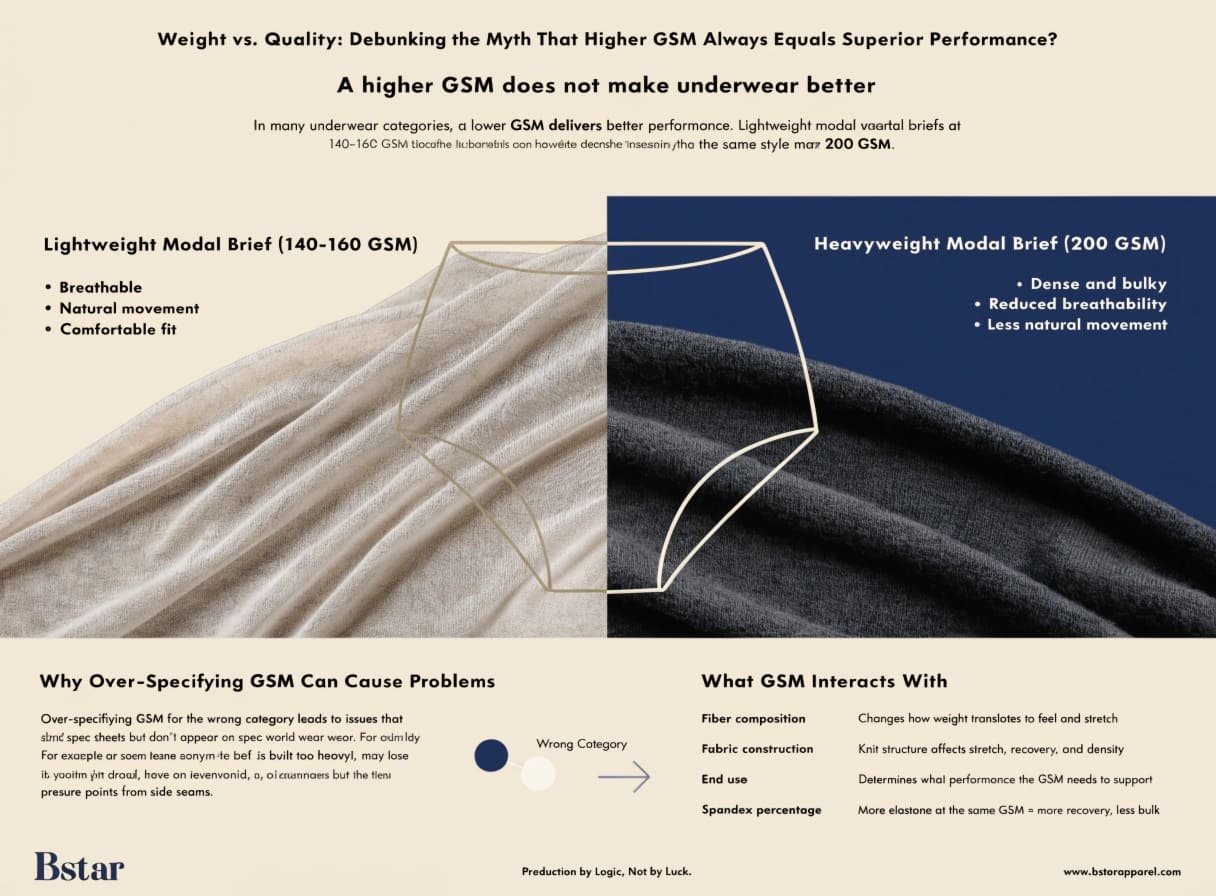
A higher GSM does not make underwear better. In many underwear categories, a lower GSM delivers better performance. Lightweight modal briefs at 140–160 GSM breathe better and move more naturally than the same style at 200 GSM4. Quality comes from the combination of GSM, fiber quality, and how the fabric is constructed — not from the number alone.
Here’s what actually happens when brands over-specify weight for the wrong category.
The over-spec problem
When a brief is built too heavy, it loses drape. The waistband doesn’t lie flat. Side seams create pressure points. The fabric doesn’t recover as cleanly after stretching. None of those problems show up on a spec sheet that just reads "200 GSM." They show up when a customer puts the garment on.
I’ve seen brands spec a high GSM because a competitor’s product felt thick and premium in hand. But that competitor was making a lounge short, not a brief. The end use was different. The weight that worked for one garment created problems in the other.
What GSM interacts with
To judge whether a GSM is right, you need to look at it alongside at least two other things:
| Variable | Why It Matters Alongside GSM |
|---|---|
| Fiber composition | Changes how weight translates to feel and stretch |
| Fabric construction | Knit structure affects stretch, recovery, and density5 |
| End use | Determines what performance the GSM needs to support |
| Spandex percentage | More elastane at the same GSM = more recovery, less bulk |
A 180 GSM nylon/spandex fabric with 20% elastane will perform very differently from a 180 GSM cotton jersey with 5% elastane — even though they share the same weight. Specs that ignore this cause misaligned samples.
Seasonal and Functional Matching: Selecting Lightweight, Mid-Weight, and Heavyweight Fabrics for Target Markets?
The question isn’t "what GSM is best for underwear." The question is "what GSM is right for this specific garment, for this specific customer, in this specific climate?"
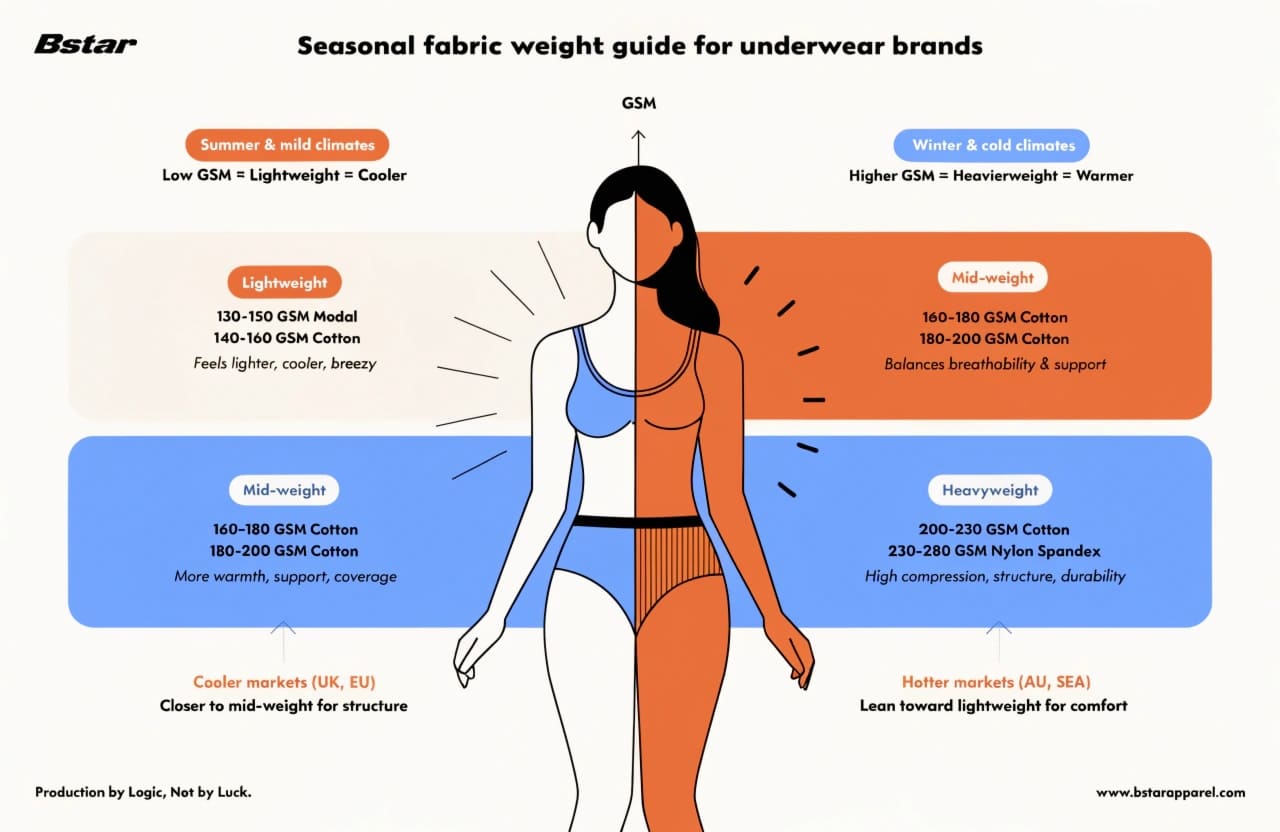
For underwear, GSM ranges roughly break down by category and function. Everyday briefs and bralettes typically work between 140–180 GSM. Shapewear and high-impact sports bras often run 200–280 GSM6. Lightweight lounge and modal styles perform best at 130–160 GSM. These are estimates — final choice depends on fiber blend and target market.
Let me walk through how this plays out in real category decisions.
By garment type
| Category | Typical GSM Range | Key Consideration |
|---|---|---|
| Everyday brief (cotton) | 150–180 GSM | Comfort and durability balance |
| Everyday brief (modal) | 130–160 GSM | Lower GSM still feels substantial in modal |
| Bralette | 150–180 GSM | Needs some structure without underwire |
| Sports bra (low-impact) | 170–210 GSM | Light compression, breathable |
| Sports bra (high-impact) | 220–280 GSM | Holds shape under movement load |
| Shapewear | 230–280 GSM | Compression is the core function |
| Lounge short or boxer | 160–200 GSM | Comfort over compression |
By target market climate
Clients I work with selling into Australia and Southeast Asia consistently prefer fabrics at the lower end of the range for their category7. The garment needs to stay cool. A 180 GSM cotton brief that sells well in Germany may feel too heavy to that Australian customer in January.
Clients targeting UK, Northern Europe, or Canada often want something that feels more grounded and substantial. The same style spec’d at 170–190 GSM can feel "right" to that customer in a way a 150 GSM version doesn’t.
This doesn’t mean one market is right and one is wrong. It means GSM is a market positioning tool, not just a production spec.
Precision Measurement and Sourcing: Using GSM to Ensure Consistency and Value in Bulk Manufacturing?
Here’s the part most brand guides skip. Getting the right GSM on your spec sheet is only half the job. Making sure what you approved in sampling is what you receive in bulk — that’s where most problems actually happen.
GSM can shift between sampling and bulk production, and again after washing. Fabric shrinks when washed, which increases GSM8. Repeated stretching can reduce it9. Brands that don’t account for this in their QC process often receive goods that feel different from the approved sample — not because the factory made an error, but because the spec didn’t include a tolerance range.
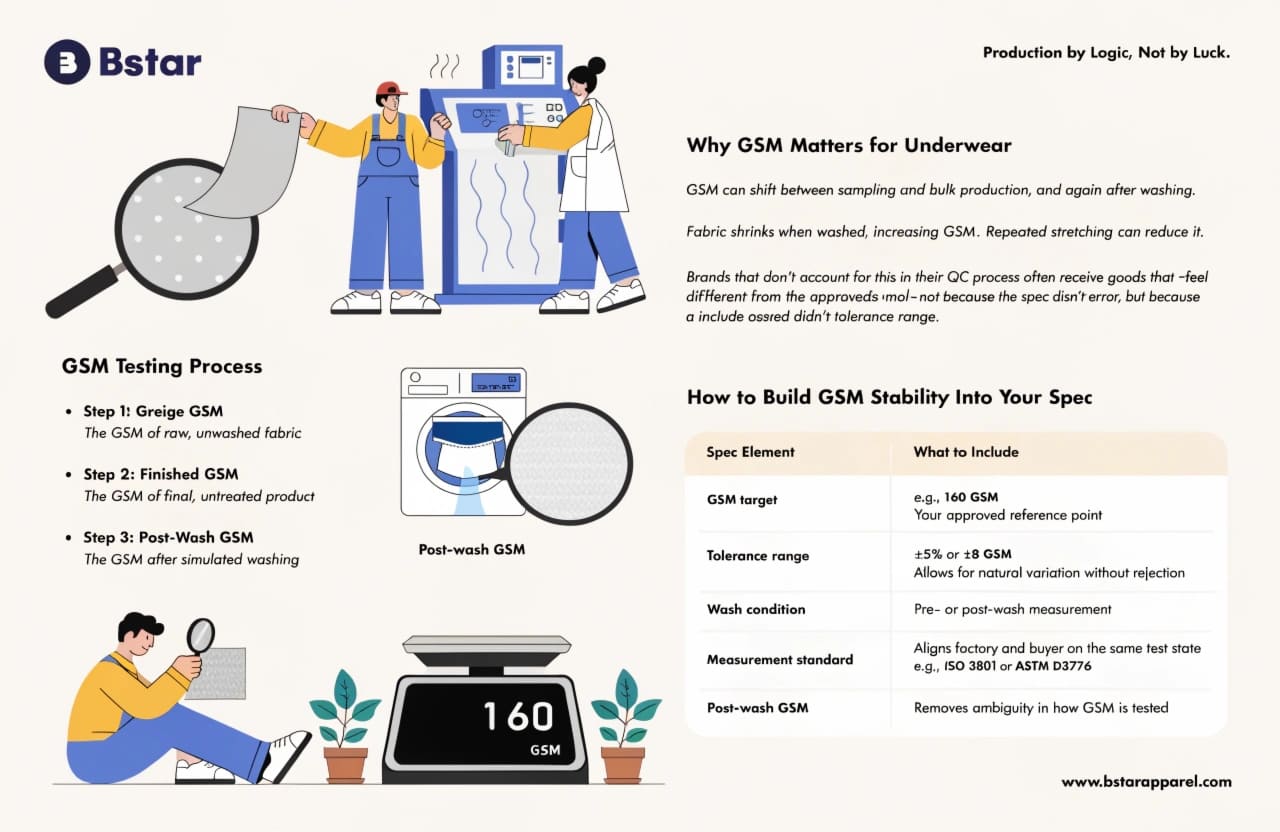
How to build GSM stability into your spec
The three things that protect you in bulk production are a tolerance range, a wash test requirement, and a measurement standard.
| Spec Element | What to Include | Why It Matters |
|---|---|---|
| GSM target | e.g., 160 GSM | Your approved reference point |
| Tolerance range | ±5% or ±8 GSM | Allows for natural variation without rejection |
| Wash condition | Pre- or post-wash measurement | Aligns factory and buyer on the same test state |
| Measurement standard | e.g., ISO 3801 or ASTM D377610 | Removes ambiguity in how GSM is tested |
In our sampling process, we typically ask clients to confirm whether their GSM spec is based on greige fabric, finished fabric, or post-wash fabric — because those three measurements can differ by 10–15 GSM for the same material11. If you approve a sample without knowing which stage was measured, your bulk comparison will never be apples to apples.
What to ask your factory
If you’re developing your first style and working with a new manufacturer, these are the three questions worth asking before you lock a GSM spec:
- At what stage do you measure GSM — greige, finished, or after washing?
- What tolerance range do you hold to for bulk production?
- Can you show me the fabric test report for the material used in my sample?
A factory that can answer all three clearly is a factory that takes spec alignment seriously. One that can’t is a factory that may deliver goods that feel different from your sample — and won’t be able to explain why.
Conclusion
GSM is a useful tool, but only when it’s tied to fiber, function, and market. Use it as a range, not a target number, and build wash and tolerance conditions into every spec you write.
-
"Grammage – Wikipedia", https://en.wikipedia.org/wiki/Grammage. GSM, or grams per square meter, is the standard metric unit used in textile manufacturing to express fabric weight; a higher GSM value indicates greater mass per unit area, which generally corresponds to a denser or thicker fabric construction. Evidence role: definition; source type: encyclopedia. Supports: GSM (grams per square meter) as the standard unit for measuring fabric weight and density in textile manufacturing. Scope note: General textile references confirm the unit definition but may not address how GSM translates to perceived thickness across different fiber types. ↩
-
"[PDF] The effects of different fabric types and seam designs on the seams …", https://commons.emich.edu/cgi/viewcontent.cgi?article=1052&context=honors. Research in apparel manufacturing engineering has documented that low-weight fabrics exhibit reduced dimensional stability during handling, which can necessitate reduced machine speeds and additional operator intervention, thereby increasing production time per unit. Evidence role: mechanism; source type: research. Supports: That lightweight or low-GSM fabrics present handling challenges in industrial sewing operations, potentially reducing throughput and increasing per-unit cost. Scope note: Published studies on this topic typically address specific fabric categories or machinery types; direct quantification of speed reduction by GSM range may not be available in open literature. ↩
-
"(DOC) INTRODUCTION OF MODAL FABRIC – Academia.edu", https://www.academia.edu/43043353/INTRODUCTION_OF_MODAL_FABRIC. Modal is a type of rayon produced from beech tree pulp; its finer fiber diameter and smoother surface morphology relative to conventional cotton contribute to a softer hand feel and greater drape at equivalent fabric weights, as documented in fiber characterization studies. Evidence role: mechanism; source type: institution. Supports: That modal fiber’s finer diameter and smoother surface structure produce a softer, more drapey hand feel compared to cotton at equivalent fabric weights. Scope note: Perceived softness is partly subjective; controlled sensory studies comparing modal and cotton at identical GSM values are limited in publicly available literature. ↩
-
"Correlation of Air Permeability to Other Breathability Parameters of …", https://pmc.ncbi.nlm.nih.gov/articles/PMC8747439/. Textile engineering studies have established a general inverse relationship between fabric areal density (GSM) and air permeability in knit structures, with lower-weight fabrics exhibiting greater porosity and, in stretch constructions, reduced resistance to extension. Evidence role: mechanism; source type: research. Supports: That lower fabric weight (GSM) is associated with higher air permeability and greater fabric extensibility, contributing to improved breathability and freedom of movement in knit garments. Scope note: The relationship between GSM and breathability is also influenced by knit structure and fiber type; GSM alone is not a complete predictor of air permeability. ↩
-
"Impact of yarn compositions, loop length, and float stitches on … – PMC", https://pmc.ncbi.nlm.nih.gov/articles/PMC10407213/. In knit fabric engineering, the geometric arrangement of yarn loops, including stitch length, course and wale density, and the type of knit structure (e.g., single jersey, interlock, rib), determines the fabric’s extensibility and recovery characteristics; two fabrics with identical GSM values but different knit architectures can exhibit substantially different mechanical behavior. Evidence role: mechanism; source type: education. Supports: That knit fabric construction — including loop geometry, stitch density, and yarn interlacing pattern — independently influences stretch, elastic recovery, and perceived density beyond what GSM alone can predict. Scope note: The interaction between knit structure and GSM is complex and fiber-dependent; simplified rules about structure and stretch may not hold across all yarn and construction combinations. ↩
-
"Compression Garments for Medical Therapy and Sports – PMC", https://pmc.ncbi.nlm.nih.gov/articles/PMC6404358/. Industry technical references for compression and performance innerwear generally indicate that garments requiring sustained compressive force, such as shapewear and high-impact sports bras, are constructed from higher-density fabrics to maintain structural integrity under repeated mechanical stress. Evidence role: general_support; source type: institution. Supports: That compression-oriented garments such as shapewear and high-impact sports bras require higher fabric weights to deliver the structural support and shape retention expected by consumers. Scope note: Specific GSM ranges for these categories are not uniformly codified in public standards; the ranges cited in the article reflect common manufacturing practice rather than a formally published specification. ↩
-
"How perceived sustainability influences consumers’ clothing … – PMC", https://pmc.ncbi.nlm.nih.gov/articles/PMC11576948/. Research on thermal comfort in apparel has established that ambient temperature and humidity significantly influence consumer preferences for fabric weight and air permeability, with studies in warm and humid climates consistently identifying lightweight, breathable fabrics as preferred for next-to-skin garments. Evidence role: general_support; source type: research. Supports: That ambient climate conditions influence consumer preferences for fabric weight and thermal properties in apparel, with warmer climates associated with preference for lighter, more breathable textiles. Scope note: Published consumer studies on this topic tend to address thermal comfort broadly rather than underwear GSM preferences specifically; the article’s regional generalizations are directionally supported but not precisely confirmed by available research. ↩
-
"Fabric GSM (Grams per Square Meter) – Indicates the weight …", https://www.facebook.com/garirclinicbd/posts/-understanding-fabric-gsm-vs-fabric-shrinkage-two-key-factors-in-garment-quality/749151048081151/. When a fabric undergoes dimensional shrinkage during laundering, its surface area decreases while its mass remains constant; because GSM is calculated as mass divided by area, a reduction in area produces a higher GSM reading for the same fabric sample. Evidence role: mechanism; source type: education. Supports: That laundering causes dimensional shrinkage in woven and knit fabrics, reducing the area over which a fixed mass is distributed and thereby increasing the measured GSM value. Scope note: The magnitude of GSM increase after washing varies significantly by fiber type, fabric construction, and wash conditions; the article’s implied range of 10–15 GSM is not universally applicable. ↩
-
"Evaluation of physical and mechanical characteristics of three … – PMC", https://pmc.ncbi.nlm.nih.gov/articles/PMC10685180/. Cyclic mechanical loading of knit fabrics can induce irreversible deformation in yarn loops and fiber crimp, resulting in a net increase in fabric surface area; because GSM is calculated as mass per unit area, an increase in area without a corresponding increase in mass produces a lower GSM reading after repeated stretching. Evidence role: mechanism; source type: research. Supports: That repeated mechanical extension of knit fabrics can cause permanent dimensional change, increasing the fabric’s surface area and thereby reducing its measured GSM. Scope note: The extent of GSM reduction from repeated stretching depends heavily on fiber elasticity, elastane content, and the magnitude of applied strain; the effect may be negligible in high-elastane fabrics designed for repeated extension. ↩
-
"Standard Test Method for Mass Per Unit Area (Weight) of Fabric 1", https://www.academia.edu/40943182/Standard_Test_Method_for_Mass_Per_Unit_Area_Weight_of_Fabric_1. ISO 3801 specifies a method for determining the mass per unit area of woven fabrics, while ASTM D3776 covers standard test methods for mass per unit area (weight) of fabric; both are widely referenced in textile quality control specifications as the basis for GSM measurement. Evidence role: definition; source type: institution. Supports: That ISO 3801 and ASTM D3776 are internationally recognized test methods for determining the mass per unit area (GSM) of textile fabrics. Scope note: Access to the full text of these standards requires purchase from ISO or ASTM; publicly available summaries may not capture all procedural details relevant to underwear fabric testing. ↩
-
"Greige goods – Wikipedia", https://en.wikipedia.org/wiki/Greige_goods. Textile processing stages including scouring, dyeing, and finishing can alter fabric dimensions and moisture content, resulting in measurable differences in GSM between greige and finished states; additional dimensional change occurs upon laundering, with the cumulative variation dependent on fiber type and process conditions. Evidence role: statistic; source type: research. Supports: That fabric GSM can change measurably between greige, finished, and post-wash states due to shrinkage, finishing treatments, and moisture absorption. Scope note: The article’s specific claim of a 10–15 GSM difference is not directly verified by a cited source; actual variation ranges differ by fiber, construction, and finishing method. ↩