
How to Design a Comfortable Pouch for Men’s Underwear?
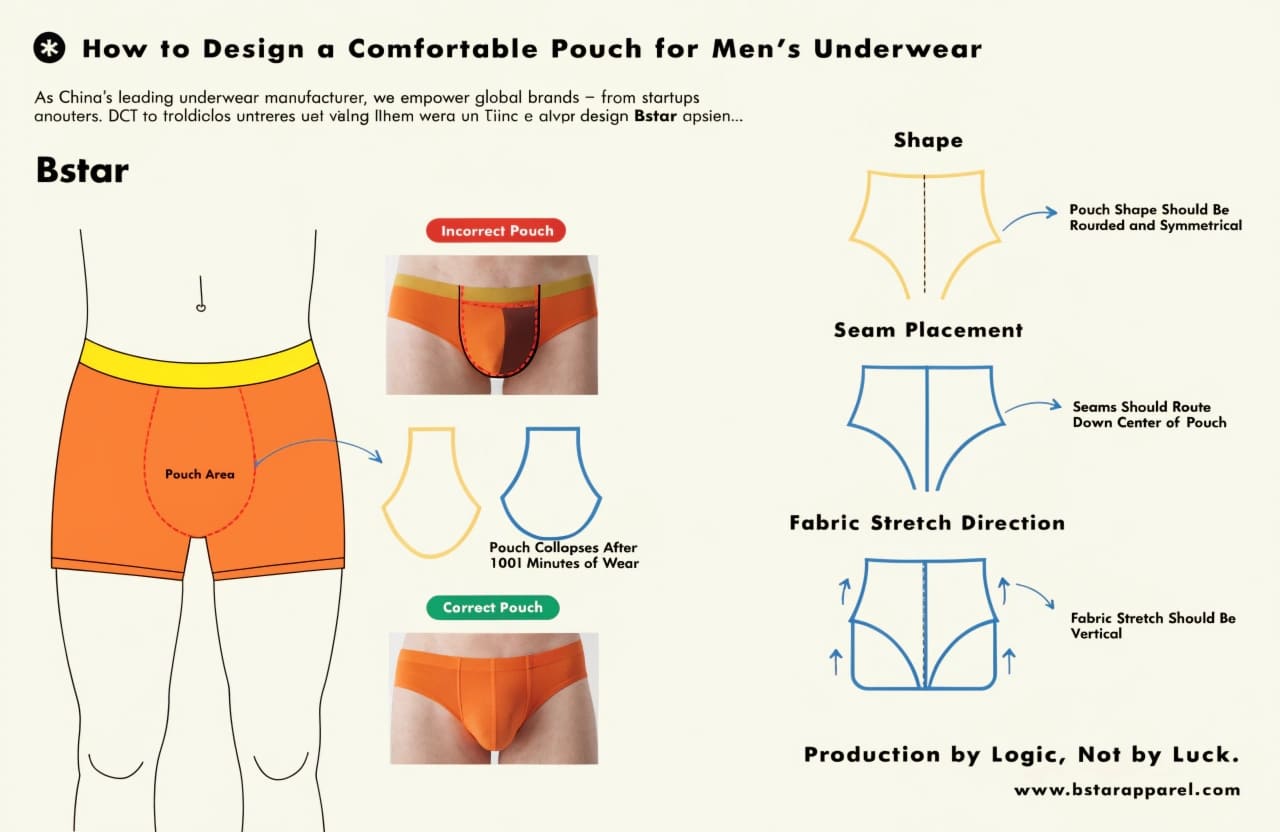
A client once sent us a reference pair from a well-known European brand. The first sample came back with a front panel that collapsed after ten minutes of wear. The brief looked complete on paper. It wasn’t.
Designing a comfortable men’s underwear pouch means making a series of structural decisions before you ever contact a manufacturer. The shape, seam placement, fabric stretch direction, and visual silhouette all interact. Get one wrong, and you don’t get a minor fit issue — you get a sampling loop that costs you weeks and budget.
Most DTC founders treat the pouch as a sewing detail. It isn’t. It’s a set of interdependent construction decisions. Each section below covers one of those decisions — and what you need to lock in before you send a brief to your manufacturer.
Ergonomic Anatomy and Support: Engineering U-Shaped and 3D Pouches for Natural Lift and Separation?
A lot of first-time briefs we receive describe the pouch shape in vague terms. "Supportive." "Lifted." "Roomier than a standard cut." These words don’t translate into a pattern. What does translate is a clear choice between two construction types.
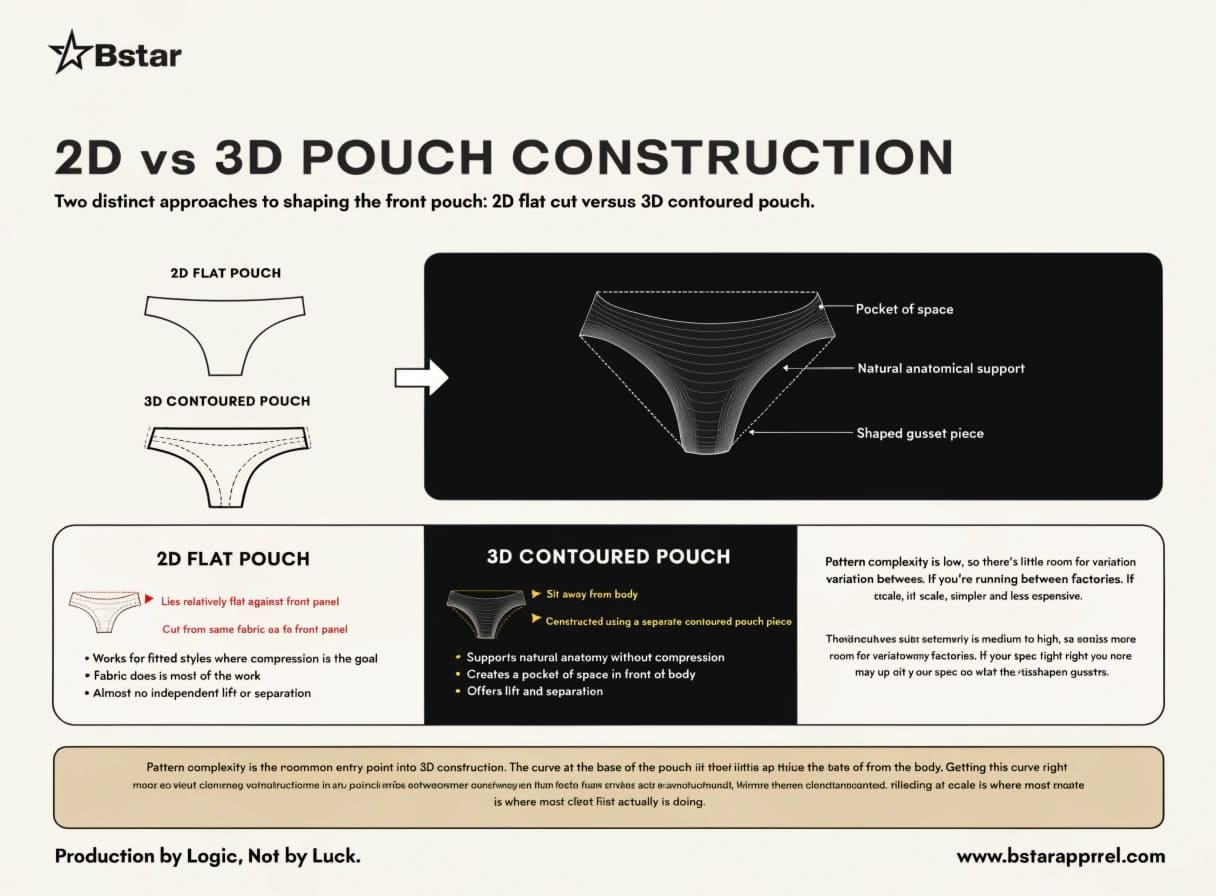
A 2D flat pouch is cut from the same fabric plane as the front panel. A 3D contoured pouch uses a separate piece, shaped to create forward volume. These are not style options — they are structural commitments with different support geometry, different manufacturing steps, and different unit costs.
Here’s what this looks like in practice. When a client references a competitor product and asks us to "match the feel," the first thing we do is identify which construction type the reference uses. Most clients don’t realize the reference has already made this choice for them — and that copying the external silhouette without replicating the internal structure produces a completely different result.
2D vs. 3D: What Each Construction Actually Does
A 2D pouch lies relatively flat against the front panel. It works for fitted styles where compression is the goal. The fabric does most of the work. Because there’s no separate contoured piece, it’s simpler to produce and less expensive at scale — but it provides almost no independent lift or separation.
A 3D pouch uses a shaped gusset piece that sits away from the body. It creates a pocket of space in front of the body. This supports natural anatomy without compression. It also adds pattern complexity, which means more room for variation between factories if the spec isn’t tight.
| Feature | 2D Flat Pouch | 3D Contoured Pouch |
|---|---|---|
| Volume source | Fabric stretch | Shaped gusset piece |
| Support type | Compression | Lift and separation |
| Pattern complexity | Low | Medium to high |
| Unit cost | Lower | Higher |
| Common failure | Sagging under wear | Misshapen gusset if spec is loose |
The U-shaped cut is the most common entry point into 3D construction. The curve at the base of the pouch piece determines how far the front sits from the body. Getting this curve right typically takes more than one sample round. In our experience, the second sample is where most clients first feel what the construction is actually doing.
Pattern Engineering and Seam Placement: Eliminating Chafing Through Strategic Stitching and Gusset Design?
Seam placement is probably the most underestimated variable in a pouch brief. Most clients focus on the shape of the pouch and leave seam position to the manufacturer’s default. That default is often calibrated for a different body than your customer’s.
Where a seam sits determines where pressure lands against the body during movement. A front-center seam, a side seam, and a bottom seam each create a different pressure point. If your customer is a Western male body and your manufacturer’s default pattern is built around an Asian fit standard, you will feel this mismatch in the first sample.
This is something we flag early when a new client comes to us without a detailed seam spec. It’s not a criticism of the manufacturer — it’s just a pattern library issue. Asian manufacturers who primarily produce for domestic or East Asian markets build their base patterns around those body proportions. The pouch sits lower, the front panel is narrower, and the seam placement reflects a different center-of-gravity for the fit.
Where Seams Go Wrong for Western Fit
The three seam positions that come up most often in our revision rounds are:
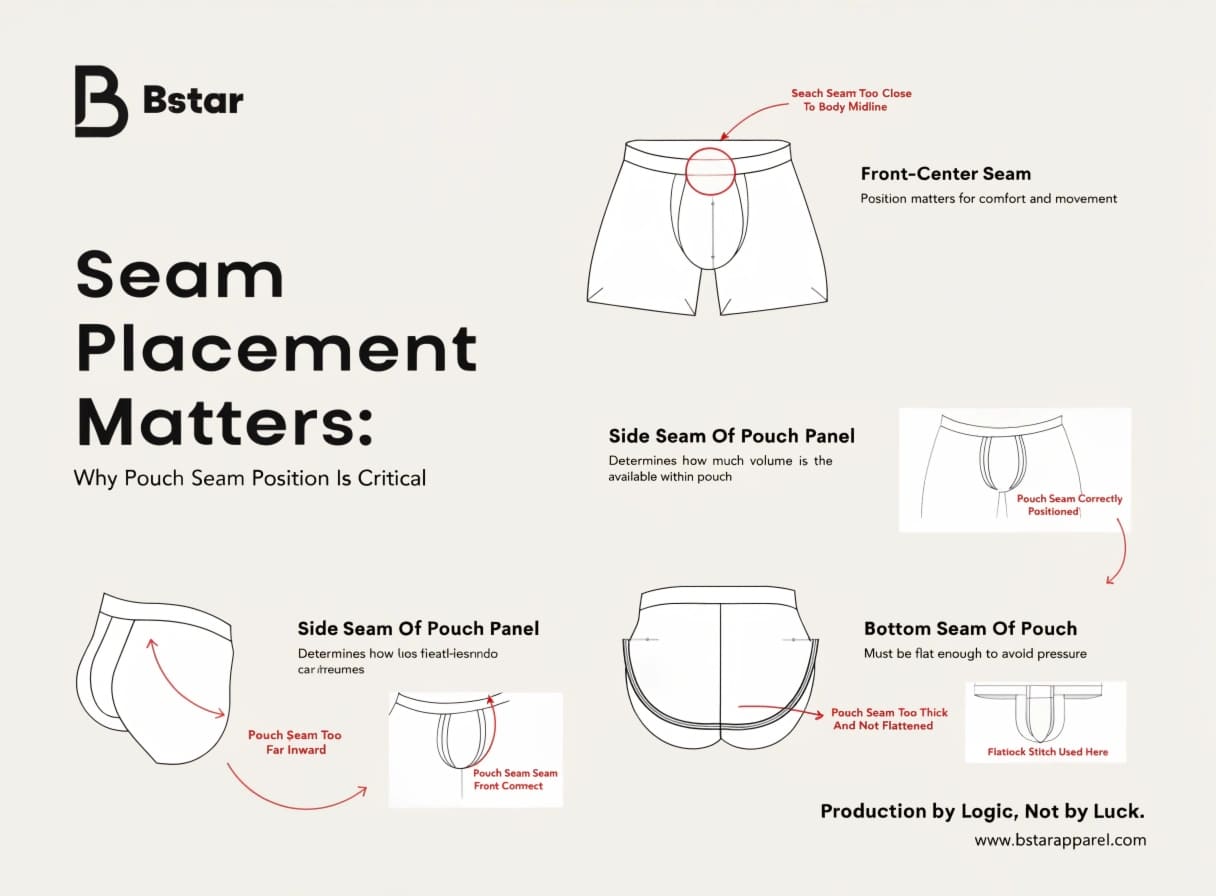
Front-center seam. Some brands want a clean, seamless front. Others use a center seam to define the pouch boundary. When a center seam is placed too close to the body midline, it creates direct pressure during movement. This is almost always a revision note we receive from European and American clients after a first wear test.
Side seam of the pouch panel. The side seam connects the pouch piece to the main front panel. If this seam sits too far inward, it restricts the volume of the pouch. If it sits too far outward, the pouch loses its defined shape. The exact position depends on the width of your target customer’s hip-to-groin geometry.
Bottom seam of the pouch. This seam sits directly below the body. A seam allowance that isn’t properly flattened here becomes a pressure ridge under wear. We typically use a flatlock stitch here for this reason — not for aesthetics, but because it’s the one seam position where a standard seam allowance causes immediate discomfort.
Getting seam placement right usually means providing your manufacturer with a body form reference or a target body measurement set. "European male, 32-inch waist" is a start, but it’s not a spec. A fit mannequin or a detailed measurement sheet is what actually moves the needle.
Fabric Selection and Elasticity: Balancing Breathability, Moisture Management, and Dynamic Stretch?
The fabric conversation comes up early in most briefs. Clients want something soft, breathable, moisture-wicking, and stretchy. Those are reasonable goals. The problem is that stretch direction is almost never in the brief — and it’s the variable that most directly affects whether the pouch holds its shape.
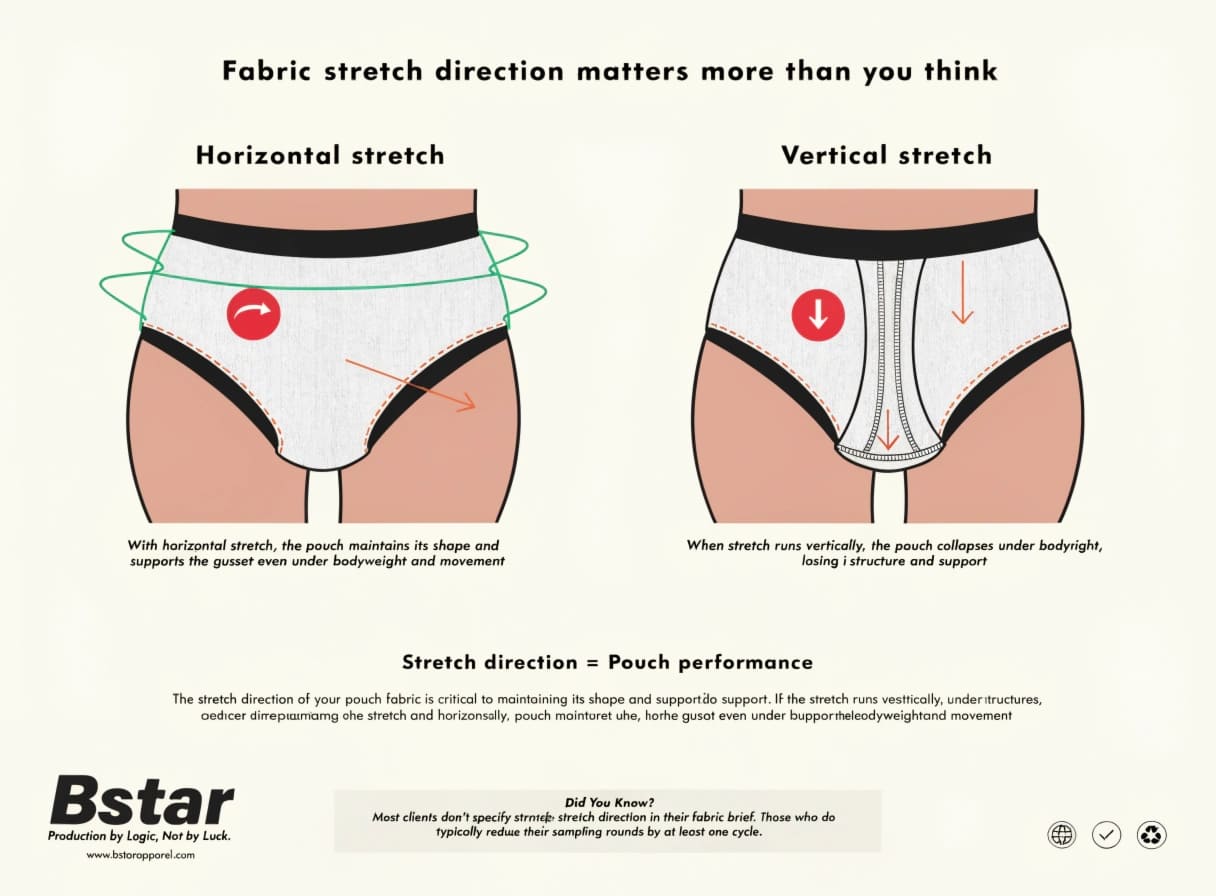
If the main stretch in your pouch fabric runs vertically instead of horizontally, the pouch collapses under bodyweight and movement. After ten minutes of wear, the structure you built in the pattern simply stops working. The fix is not a bigger pouch — it’s reorienting the fabric cut direction.
We see this issue regularly when clients select a fabric for its hand feel during a showroom visit, then approve it for production without checking how it performs in the actual cut direction the pattern requires. The fabric feels great off the roll. It fails in the garment.
What We Evaluate During Sampling
There is no single stretch percentage we recommend for all pouch constructions. What we do during sampling is evaluate how the fabric behaves in the specific direction the pattern demands, under the load conditions the style creates.
For a 3D contoured pouch, the horizontal stretch across the pouch piece needs to accommodate movement without distorting the shaped gusset. Too little horizontal stretch, and the pouch pulls inward. Too much, and the gusset loses its forward projection.
For breathability and moisture management, we look at fiber composition and fabric weight together. A fabric that’s too heavy for the construction traps heat. A fabric that’s too light for a 3D pouch doesn’t hold the shape between wears. These are judgment calls made during sample review — not decisions we can make from a fabric swatch alone.
| Evaluation Point | What We Look For |
|---|---|
| Stretch direction | Does horizontal stretch match pattern demand? |
| Recovery | Does fabric return to shape after tension? |
| Weight vs. construction | Is the fabric too heavy or too light for a 3D cut? |
| Moisture behavior | Does fabric wick or hold moisture against the body? |
| Durability under wash | Does stretch geometry hold after repeated laundering? |
The main takeaway: specify stretch direction in your fabric brief. Most clients don’t. Those who do typically reduce their sampling rounds by at least one cycle.
Aesthetic Shaping and Consumer Appeal: Enhancing Visual Contour Without Compromising Physiological Comfort?
There’s a real tension between what looks good in a product photo and what feels good after an hour of wear. We see this tension most clearly in briefs that prioritize a bold front silhouette.
"More room" is the most common piece of customer feedback DTC brands bring into their briefs. But an oversized pouch without structural support doesn’t solve a room problem — it creates a sagging problem. The pouch shifts, loses position, and the customer ends up less comfortable than they were with the original fit.
This is a specific failure mode we’ve seen multiple times. A brand reads reviews that say "needs more room" and responds by scaling up the pouch dimensions. The next sample has more volume, but no additional structural support to hold that volume in place. The result moves around under wear and customers return it for different reasons.
Separating Visual Projection from Structural Support
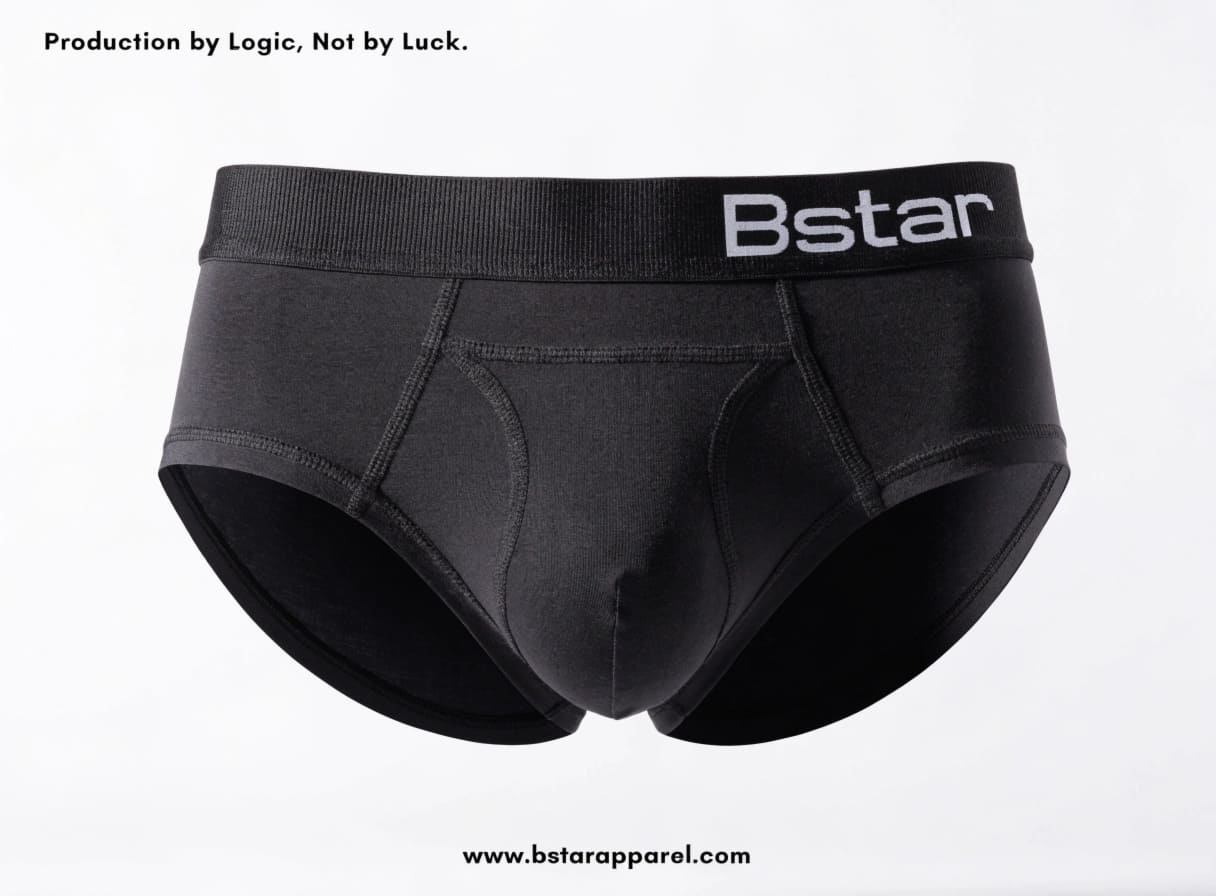
Visual projection — how the pouch looks from the front — comes from the shape of the gusset and the fabric’s ability to hold that shape. Structural support — how the pouch stays in position during movement — comes from seam placement, fabric recovery, and the tension relationship between the pouch piece and the front panel.
You can have both. But they require separate decisions. A brand that wants a bold visual silhouette needs to build in the structural support first, then optimize the visual shape on top of that foundation. Doing it the other way around is why so many aesthetically strong underwear samples fail their first wear test.
The other thing worth naming: what reads as "lifted" on a product photo depends partly on fabric sheen, waistband width, and how the front panel is photographed. Some of that visual appeal comes from styling, not construction. It’s worth being clear in your brief about which part you’re asking your manufacturer to build — and which part you’ll handle in post.
Conclusion
A comfortable men’s underwear pouch comes down to four decisions: construction type, seam placement, fabric stretch direction, and the separation between visual shape and structural support. Lock these in before you brief your manufacturer, and your sampling process gets a lot shorter.