
Understanding Underwear Pattern Making and Grading: What DTC Founders Actually Need to Know?
If your first underwear sample came back fitting wrong, you’re not alone. Most DTC founders don’t realize the real problem until they’ve already paid for three rounds of samples.
Underwear pattern making and grading for stretch fabrics is not the same as standard apparel construction. The fabric’s elasticity changes how patterns are drafted, how seam allowances are calculated, and how sizes are scaled. Getting this wrong means your size M fits beautifully but your size XL gaps at the gusset.
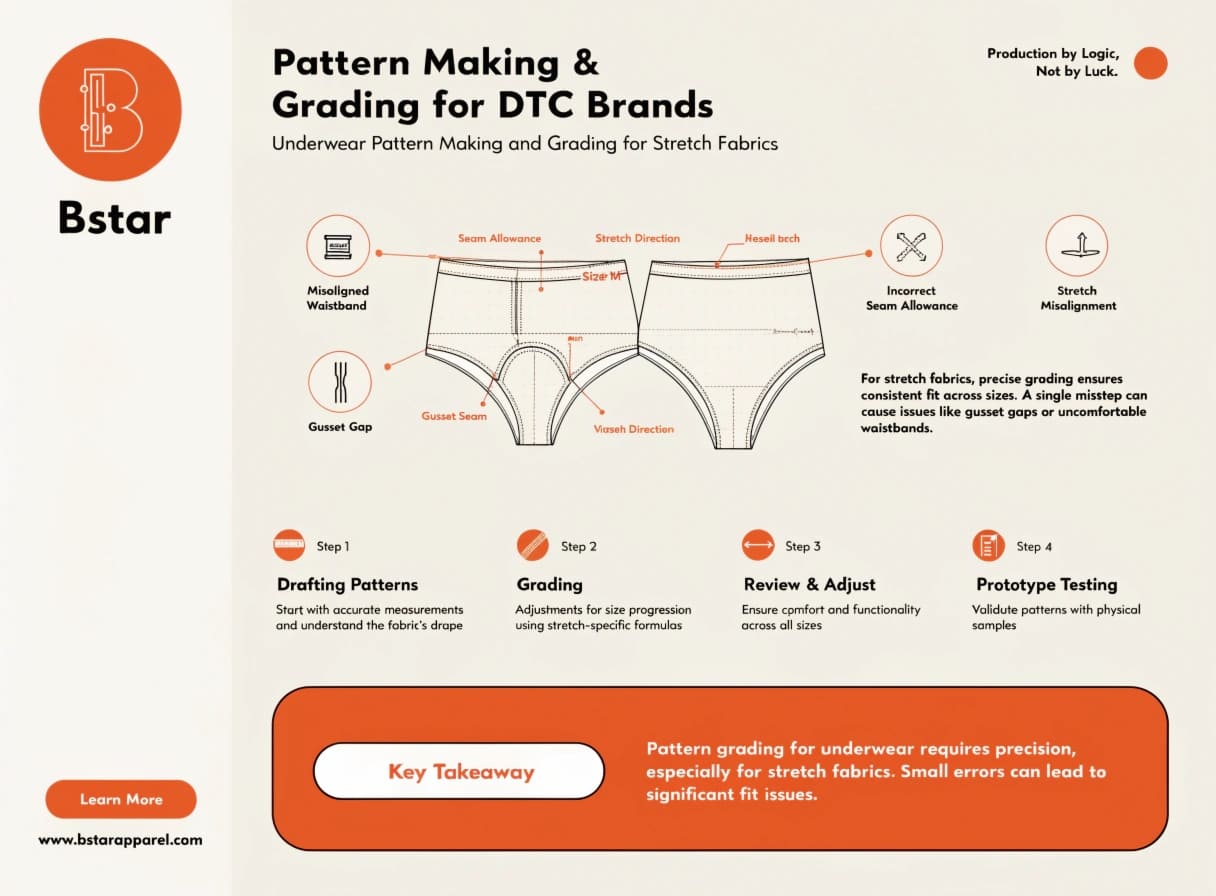
Most DTC founders come into their first underwear development with a clear vision for the product. What they don’t have is a clear picture of what happens inside the factory before the sample gets made. That gap is where most first-sample failures live. This article walks through the four areas where pattern and grading decisions directly affect your product outcome — and what to watch for when you’re evaluating a factory.
Mastering the Foundation: Are You Starting With the Right Measurements?
A lot of first-time founders hand over a reference garment and expect the factory to reverse-engineer it. That works sometimes. But when it doesn’t, the failure usually traces back to one thing: the factory didn’t account for how the reference fabric behaves differently from the production fabric1.
Underwear patterns are built around key anatomical measurements — waist, hip, rise, and gusset length — but these numbers only mean something when paired with the fabric’s stretch percentage and recovery rate. A measurement taken from a reference garment in 80% nylon / 20% spandex won’t translate directly to a pattern cut in a different blend with a different stretch ratio.
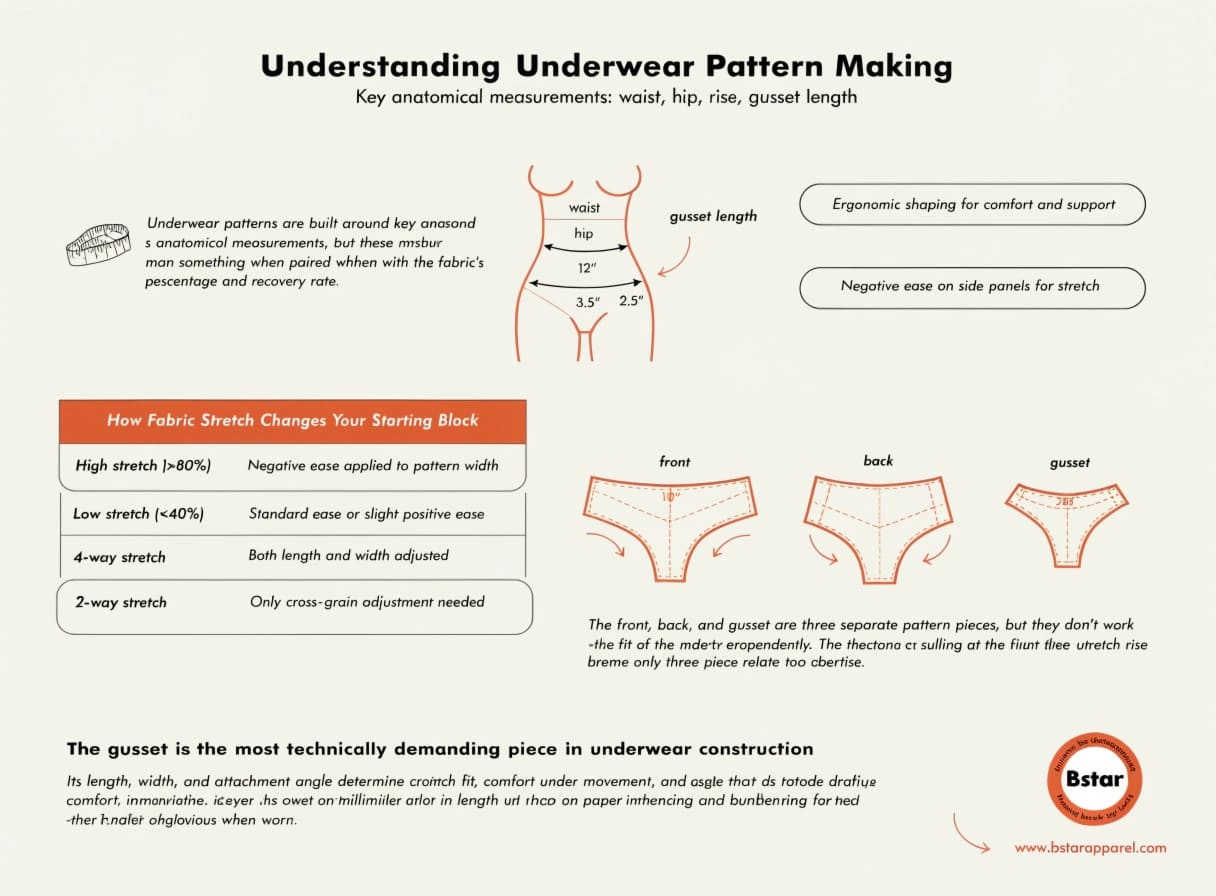
In our experience, the first question we ask any client before touching measurements is: what fabric are you using? Not the color. Not the weight. The stretch percentage, the recovery rate, and whether it’s 2-way or 4-way stretch2.
Here’s why this matters practically:
How Fabric Stretch Changes Your Starting Block
| Fabric Behavior | Pattern Adjustment Needed |
|---|---|
| High stretch (>80%), fast recovery | Negative ease applied to pattern width3 |
| Low stretch (<40%), slow recovery | Standard ease or slight positive ease |
| 4-way stretch | Both length and width adjusted |
| 2-way stretch | Only cross-grain adjustment needed |
When a factory skips this step and drafts a pattern from measurements alone, the garment might look fine flat on a table. But once it’s on a body under tension, the proportions shift. The gusset pulls forward. The waistband rolls4. The leg openings gap or bind. These are not fit problems you can fix with a small adjustment. They’re structural problems that trace back to the first decision made at the drafting table.
If you’re evaluating a factory, ask them directly: what information do you need from me before you start the pattern? If their answer doesn’t include fabric specs, that’s a clear signal to dig deeper.
Drafting the Perfect Fit: How Do Front, Back, and Gusset Blocks Actually Work Together?
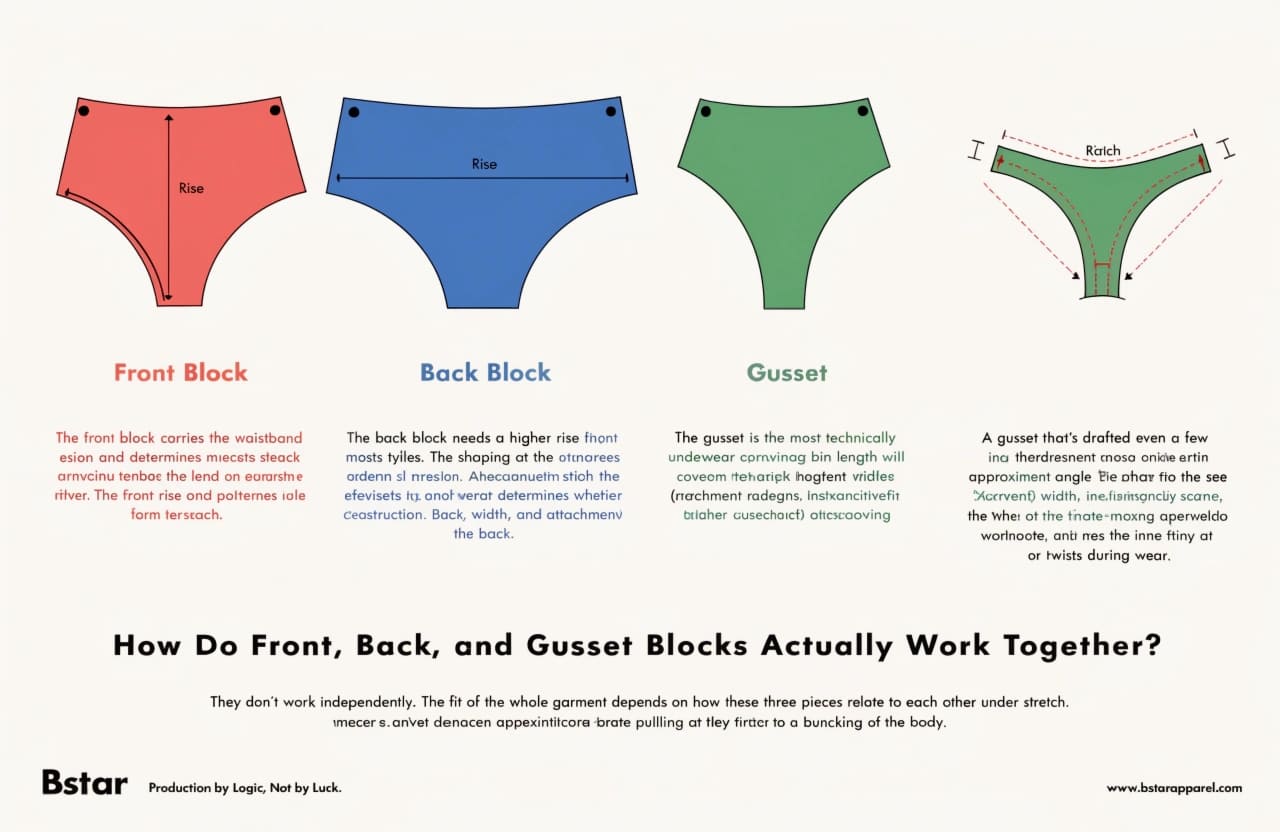
The front, back, and gusset are three separate pattern pieces. But they don’t work independently. The fit of the whole garment depends on how these three pieces relate to each other under stretch.
The gusset is the most technically demanding piece in underwear construction5. Its length, width, and attachment angle determine crotch fit, comfort under movement, and coverage. A gusset that’s drafted even a few millimeters off in length will create pulling at the front rise or bunching at the back — problems that feel minor on paper but are immediately obvious when worn.
We see this mistake repeatedly with clients who come to us after a first sample failure at another factory. The gusset was drafted based on visual reference rather than calculated from the rise measurements of the front and back blocks. The result looks approximately right but doesn’t sit correctly on the body.
What a Properly Drafted Block Set Looks Like
Front block carries the waistband tension and determines how the garment sits at the hip. It needs to account for how much the fabric will pull inward once the elastic is attached.
Back block needs a higher rise than the front in most styles, and the shaping at the seat determines whether the garment rides up or stays in place. This is where proportional assumptions break down — a fuller seat needs more structural shaping, not just a larger pattern piece6.
Gusset connects both. Its effective length has to match the combined front and back crotch seam. Its width has to provide coverage without adding bulk at the inner thigh. And its attachment angle affects whether it lays flat or twists during wear.
These three decisions are made before a single stitch is sewn. A factory that gets these proportions right on the first pass saves you at least one full sample cycle. A factory that guesses costs you time, shipping fees, and a delayed launch.
The Science of Grading: Why Doesn’t Your XS or XL Fit the Same as Your Medium?
This is the most misunderstood part of underwear development for DTC founders. Grading sounds like simple math. You take the base size and scale it up or down by a fixed amount at each size break. In woven garments, that logic mostly holds. In stretch knit underwear, it breaks down fast.
Grading elastic underwear means adjusting the structural tension at each size, not just resizing the shape7. At the extremes of a size run — XS and XL — the stretch ratio of the fabric behaves differently against the body. If you grade by simple proportional scaling, the XS will feel too tight and the XL will feel loose and unsupported, even if the measurements technically add up8.
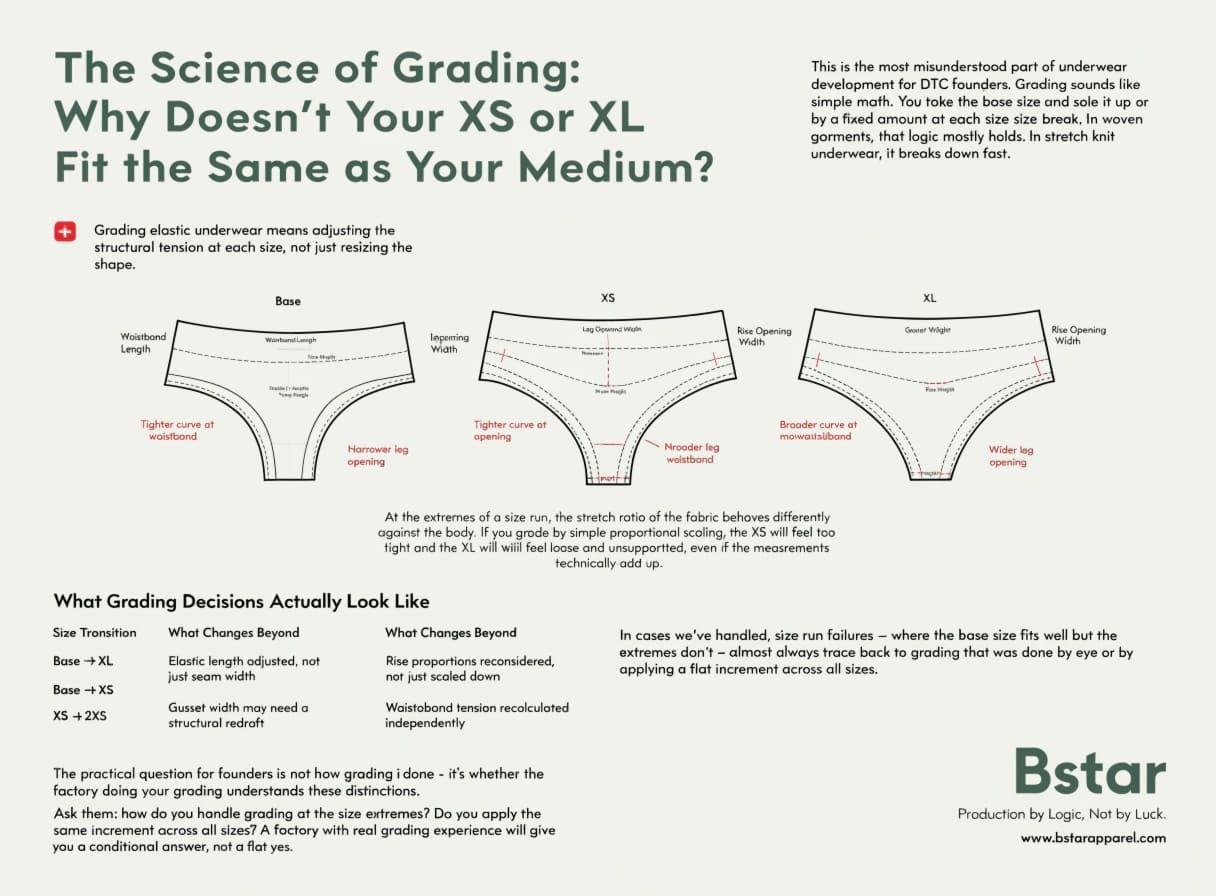
In cases we’ve handled, size run failures — where the base size fits well but the extremes don’t — almost always trace back to grading that was done by eye or by applying a flat increment across all sizes.
What Grading Decisions Actually Look Like
| Size Transition | What Changes Beyond Measurements |
|---|---|
| Base → XL | Elastic length adjusted, not just seam width |
| Base → XS | Rise proportions reconsidered, not just scaled down |
| XL → 2XL | Gusset width may need a structural redraft |
| XS → XXS | Waistband tension recalculated independently9 |
The practical question for founders is not how grading is done — it’s whether the factory doing your grading understands these distinctions. Ask them: how do you handle grading at the size extremes? Do you apply the same increment across all sizes? A factory with real grading experience will give you a conditional answer, not a flat yes.
From Paper to Production: What Happens to Your Pattern Before It Gets Cut?
Between a finished pattern and a cut garment, three things can quietly change your fit: seam allowances, fabric shrinkage, and how the pattern is transferred into the cutting system.
Seam allowances on stretch knit underwear are smaller than on woven garments — typically 6mm to 10mm10 — because the fabric doesn’t fray and the seam needs to flex with the body. But if a factory applies standard woven seam allowances, the finished garment is smaller than intended. If they forget to account for shrinkage in the wash, the delivered product is smaller still.

Shrinkage is especially relevant for high-spandex fabrics. In our experience, fabrics with higher elastane content can shrink 5–10% after first wash11. That has to be built into the pattern before cutting — not corrected after the fact.
The Three Production-Stage Pattern Risks
Seam allowance mismatch — if the sample was made with hand-cut pieces and the production pattern was digitized without confirming seam allowances were added, the production run comes out smaller.
Shrinkage not pre-compensated — the sample passes inspection before washing, then fails after. This is a painful discovery when it happens at the production stage.
CAD transfer errors — when patterns are digitized from paper into a CAD system, small distortions can enter the data12. A proper process includes a verification step where a physical test cut is checked against the original before bulk cutting begins.
If a factory is handling your CAD work internally, ask whether they do a pre-production verification cut before bulk. That single step catches most transfer errors before they become your problem.
Conclusion
Pattern making and grading for stretch underwear is where most first-product failures start. The right factory catches these problems before cutting — the wrong one charges you to find them the hard way.
-
"Grading stretch knit patterns pt.2 – Fashion-Incubator", https://fashion-incubator.com/grading-stretch-knit-patterns-pt-2/. Textile and apparel engineering literature documents that pattern blocks for stretch knit garments are calibrated to specific fabric stretch percentages; transferring a pattern to a fabric with a different stretch ratio without recalculation introduces systematic fit deviation across all dimensions. Evidence role: mechanism; source type: education. Supports: That fabric stretch properties must be matched when transferring patterns between fabrics, and that substituting a different fabric without adjustment produces fit errors.. Scope note: Most academic sources address this principle in the context of pattern drafting methodology rather than factory reverse-engineering workflows specifically. ↩
-
"Stretch and Recovery of Jersey and Interlock Knits – Gavin Publishers", https://www.gavinpublishers.com/article/view/stretch-and-recovery-of-jersey-and-interlock-knits. ASTM International standard D2594 defines stretch and recovery properties for knitted fabrics, establishing stretch percentage and recovery rate as quantifiable characteristics that vary by fiber content and fabric construction, with directionality determined by the knit structure. Evidence role: definition; source type: institution. Supports: The technical definitions of stretch percentage, recovery rate, and stretch directionality as measurable fabric properties relevant to garment construction.. Scope note: The standard addresses measurement methodology; its direct application to pattern drafting decisions requires inference from apparel engineering sources. ↩
-
"Pattern Drafting, Knits and Ease, especially negative ease", https://sewing.patternreview.com/SewingDiscussions/topic/118227. Apparel pattern making references define negative ease as a deliberate reduction of pattern dimensions below body measurements, applied in stretch knit construction to account for fabric elongation under wear; the degree of reduction is proportional to the fabric’s stretch percentage. Evidence role: definition; source type: education. Supports: That negative ease — where the pattern dimensions are smaller than the body measurement — is the standard drafting approach for high-stretch recovery fabrics.. Scope note: Specific ease values for underwear categories vary by style and are not universally standardized across industry references. ↩
-
"Does anyone else have a problem with their underwear elastic …", https://www.reddit.com/r/bigmenfashionadvice/comments/1orwghq/does_anyone_else_have_a_problem_with_their/. Garment construction references identify waistband rolling as a symptom of tension imbalance between the elastic and the fabric panel to which it is attached; when the waistband seam allowance, elastic stretch ratio, or attachment angle is miscalculated at the drafting stage, the resulting torque causes the waistband to fold inward or outward under wear. Evidence role: mechanism; source type: education. Supports: That waistband rolling in knit underwear results from structural imbalances in the pattern — particularly mismatches between elastic tension, fabric stretch, and waistband attachment geometry — rather than from minor fit adjustments.. Scope note: Technical literature on this specific failure mode in underwear is sparse; most detailed treatment appears in swimwear and activewear construction guides, which share relevant structural principles. ↩
-
"Sizing and Fit of Men’s Underwear – NC State Repository", https://repository.lib.ncsu.edu/items/fc851c49-fb39-4cb2-87ab-103b5f719acb. Intimate apparel pattern making literature identifies the crotch gusset as a structurally critical component whose dimensional accuracy directly affects garment positioning under dynamic movement, with errors in length or attachment angle producing forward pull or posterior bunching. Evidence role: expert_consensus; source type: education. Supports: That gusset geometry — including length, width, and seam angle — is a primary determinant of crotch fit and comfort in close-fitting knit garments.. Scope note: Comparative claims about relative complexity across pattern pieces are qualitative and not formally ranked in standard technical references. ↩
-
"Pants Fitting Adjustments: Best Tips for Perfectly Fitting Pants!", https://blog.closetcorepatterns.com/pants-fitting-adjustments-best-tips-for-pants-fitting/. Pattern making references for fitted knit garments distinguish between size grading — which scales linear dimensions — and shape grading, which modifies contour lines to reflect anatomical variation; the back seat is identified as a region where contour adjustment is necessary to maintain fit across body shape differences. Evidence role: mechanism; source type: education. Supports: That variations in seat curvature require contour adjustments to the back block rather than uniform scaling, because proportional enlargement does not replicate the three-dimensional shape of a fuller seat.. Scope note: Published guidance on this distinction is more developed for woven trousers than for knit underwear specifically. ↩
-
"Evaluation of physical and mechanical characteristics of three … – PMC", https://pmc.ncbi.nlm.nih.gov/articles/PMC10685180/. Apparel grading literature notes that in stretch knit construction, the relationship between pattern dimensions and body fit is mediated by fabric elongation; uniform incremental grading without recalibrating elastic length and structural ease produces divergent fit at size extremes, where the fabric’s stretch-to-body ratio departs from the base size calibration. Evidence role: mechanism; source type: education. Supports: That grading stretch knit garments requires adjustments to elastic tension and structural proportions at size extremes, not only linear scaling of pattern dimensions.. Scope note: Quantitative grading rules for underwear are proprietary to manufacturers and not widely published in open academic literature. ↩
-
"Sizing and Fit of Men’s Underwear – NC State Repository", https://repository.lib.ncsu.edu/items/fc851c49-fb39-4cb2-87ab-103b5f719acb. Research on fit consistency across size runs in stretch knit garments indicates that consumer-reported fit dissatisfaction is disproportionately concentrated at size extremes, a pattern attributed in part to grading methods that do not account for the non-linear relationship between body dimensions and fabric tension at larger and smaller sizes. Evidence role: general_support; source type: research. Supports: That fit satisfaction in stretch garments declines at size extremes when grading is applied as uniform proportional scaling without adjustment for fabric behavior.. Scope note: Published consumer fit studies specific to underwear size runs are limited; broader findings from activewear and hosiery research are more available and may not transfer directly. ↩
-
"Waistbands Made Easy – BE BOLD. Shape the Future.", https://pubs.nmsu.edu/_c/C234/index.html. Elastic application guides in apparel construction specify that the ratio of elastic length to garment opening is not constant across sizes; at smaller circumferences, the same proportional reduction in elastic length produces disproportionately higher tension against the body, necessitating independent calculation of elastic length rather than scaled derivation from a base size. Evidence role: mechanism; source type: education. Supports: That elastic waistband length cannot be derived by proportional scaling at very small sizes because the ratio of elastic stretch to body circumference changes non-linearly, requiring independent calculation.. Scope note: Quantitative thresholds at which proportional scaling becomes inadequate are not standardized and depend on elastic type, fabric weight, and style. ↩
-
"What are standard seam allowances for stretch and woven tops and …", https://www.facebook.com/groups/372271129951964/posts/2236586263520432/. Pattern making references for knit and stretch garments specify reduced seam allowances relative to woven construction, citing the absence of fraying in knit fabrics and the need for seam flexibility under stretch; allowances in the 6–10mm range are cited for close-fitting knit categories including underwear and swimwear. Evidence role: definition; source type: education. Supports: That seam allowances for stretch knit garments are narrower than those for woven fabrics, with a typical range in the 6–10mm band for underwear construction.. Scope note: Exact allowance specifications vary by seam type, finishing method, and factory equipment, and no single universal standard governs this range. ↩
-
"[PDF] Effect of Laundering on Dynamic Elastic Behavior of Cotton and …", https://jtatm.textiles.ncsu.edu/index.php/JTATM/article/viewFile/2593/1790. Textile testing studies on elastane-containing knit fabrics report dimensional change after laundering that varies by fiber blend, knit structure, and finishing treatment; shrinkage values in the 5–10% range have been recorded for high-elastane blends under standard domestic wash conditions, though the range is sensitive to specific fabric construction. Evidence role: statistic; source type: research. Supports: That fabrics with significant elastane content undergo measurable dimensional change after laundering, with shrinkage in the range of 5–10% documented for certain blends.. Scope note: Published shrinkage data for specific nylon/spandex blends used in underwear is often proprietary to fabric mills; the 5–10% figure represents a reported range rather than a universal constant. ↩
-
"How To Digitise Paper Sewing Patterns With A Phone … – YouTube", https://www.youtube.com/watch?v=l5YVoua7YsU. Research on apparel CAD digitization accuracy identifies sources of dimensional error including paper stretching or shrinkage, digitizer tablet calibration drift, and operator-introduced curve approximation; these errors, while individually small, can accumulate to produce measurable deviations in finished garment dimensions. Evidence role: mechanism; source type: research. Supports: That the process of digitizing physical patterns into CAD systems can introduce dimensional inaccuracies due to operator technique, equipment calibration, and paper distortion.. Scope note: Studies on digitization error are more common in the context of industrial pattern making broadly and may not address underwear-specific tolerances directly. ↩