

8 Common Mistakes to Avoid When Choosing a Boxer Underwear Manufacturer?
Choosing a boxer underwear manufacturer looks simple until the first order starts costing more than expected. A low quote feels safe at first, but fabric issues, weak seams, unclear MOQ terms, and late shipments can quickly eat your margin. I have seen founders avoid most of this by asking better questions before they pay a deposit.
The biggest mistake when choosing a boxer underwear manufacturer is judging the factory by unit price alone. A reliable supplier should prove fabric quality, fit development, stitching durability, certifications, MOQ flexibility, sampling accuracy, quality control, and delivery planning before bulk production starts. The cheapest quote often becomes expensive when rework, delays, and overstock appear.
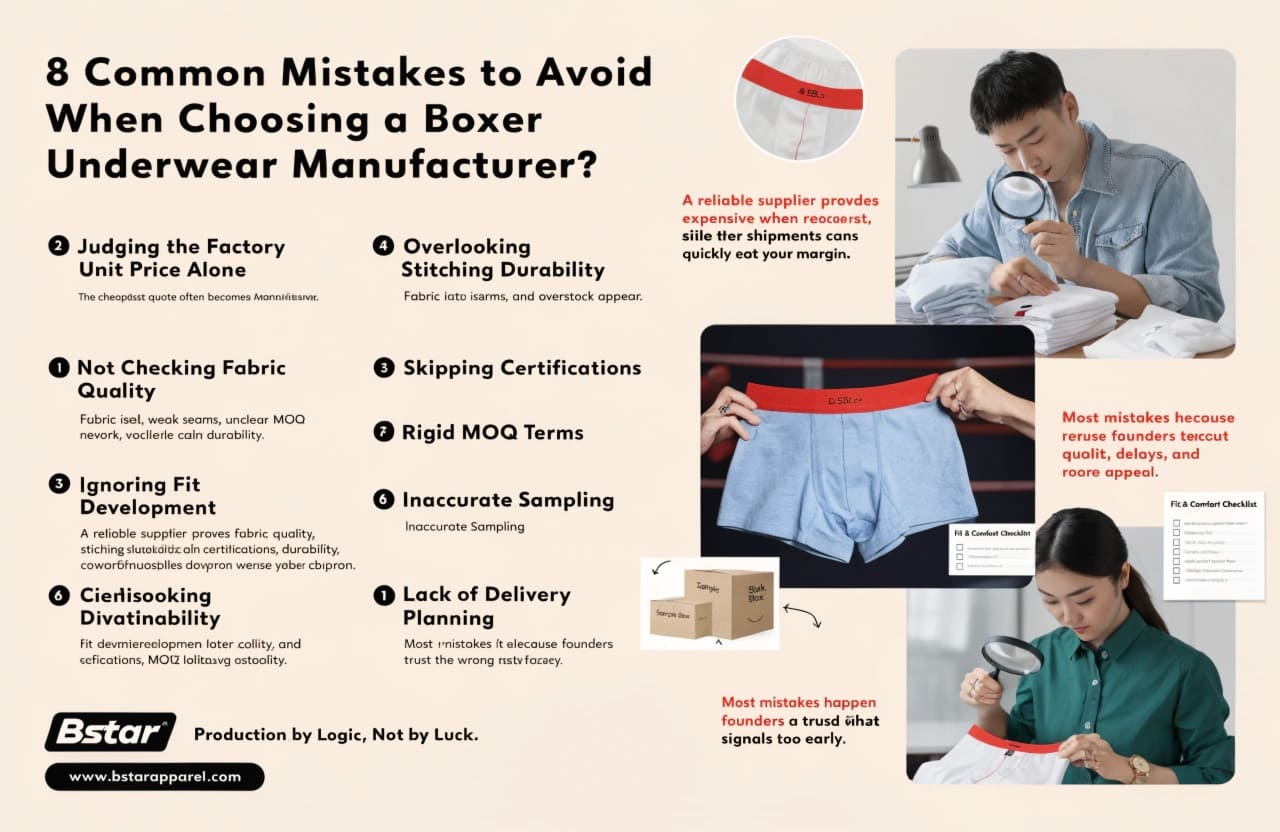
I work with DTC and retail buyers who often come to China with a clear product idea but limited sourcing experience. Most do not fail because they lack information. They fail because they trust the wrong signals too early.
Mistake 1: Does a Boxer Underwear Manufacturer’s “Low Cost” Hide Fabric Quality and Breathability Problems?
Low price feels like a win when you are launching your first boxer line. But underwear is worn directly on the skin, all day. If the fabric feels hot, rough, or unstable after washing, customers will not blame the price. They will blame your brand1.
A good boxer underwear manufacturer should explain fabric composition, GSM, stretch recovery, breathability, shrinkage, dyeing method, and certification status before quoting bulk production. If a quote is much lower than others, you should ask what fabric, yarn, finishing, and testing assumptions sit behind that number.
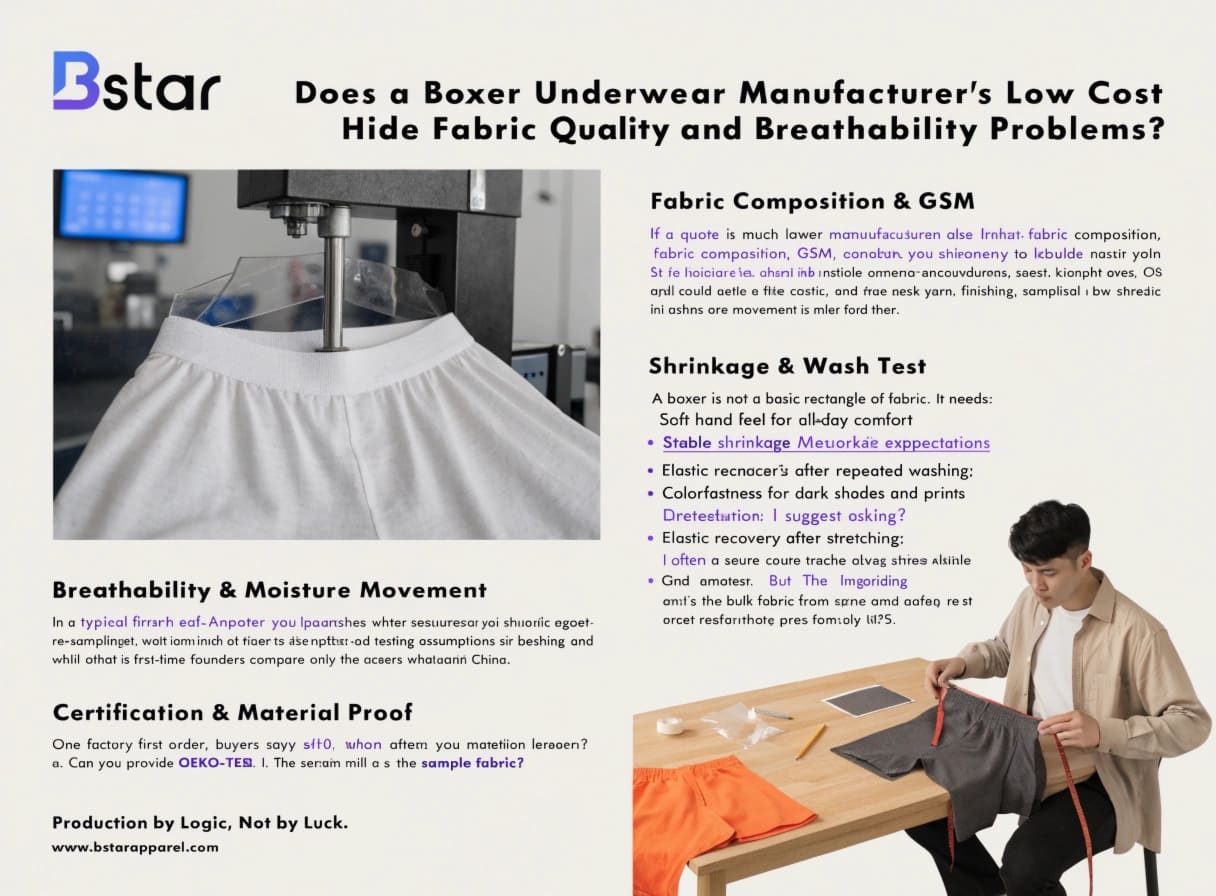
Why “cheap fabric” becomes expensive fast
I often see first-time founders compare only the ex-factory unit price. One factory says $2.10. Another says $2.60. The cheaper option looks better on a spreadsheet. But the spreadsheet usually misses the real cost of fabric problems.
A boxer is not a basic rectangle of fabric. It needs:
- Soft hand feel for all-day comfort
- Good moisture movement for active wearers
- Stable shrinkage after repeated washing
- Colorfastness for dark shades and prints
- Elastic recovery after stretching
- Safe materials that pass market expectations
In a typical first order, buyers may also face extra costs for re-sampling, fabric replacement, urgent air freight, discounting slow-moving inventory, or customer refunds. That is why the cheapest quote can become the most expensive order.
Questions I suggest asking
You do not need to be a textile engineer. You just need to ask direct questions:
- What is the exact fabric composition?
- What is the GSM?
- What shrinkage rate do you control after washing?
- Can you provide OEKO-TEX®, GOTS, FSC, or GRS material proof where relevant?
- Is the bulk fabric from the same mill as the sample fabric?
- Can I wash-test the sample before approval?
At BSTAR, where I work with knit underwear OEM/ODM projects, we often discuss these points before the buyer even confirms the style. That early fabric conversation prevents many later arguments.
The right question is not “How cheap can you make it?”
The right question is “What quality am I actually buying at this price?”
Mistake 2: Are You Ignoring Ergonomic Pattern Making and Elasticity in the Fly and Pouch?
A boxer can look perfect in a flat product photo and still feel terrible on the body. This mistake hurts repeat purchase rates. If the fly, pouch, rise, and leg opening are not engineered well, customers feel pulling, rolling, or compression in the wrong places.
You should choose a supplier that understands ergonomic pattern making, not just cutting and sewing. The best boxer briefs balance support, stretch, recovery, and movement. The fly and pouch should match your target wearer, size range, fabric elasticity, and brand positioning.
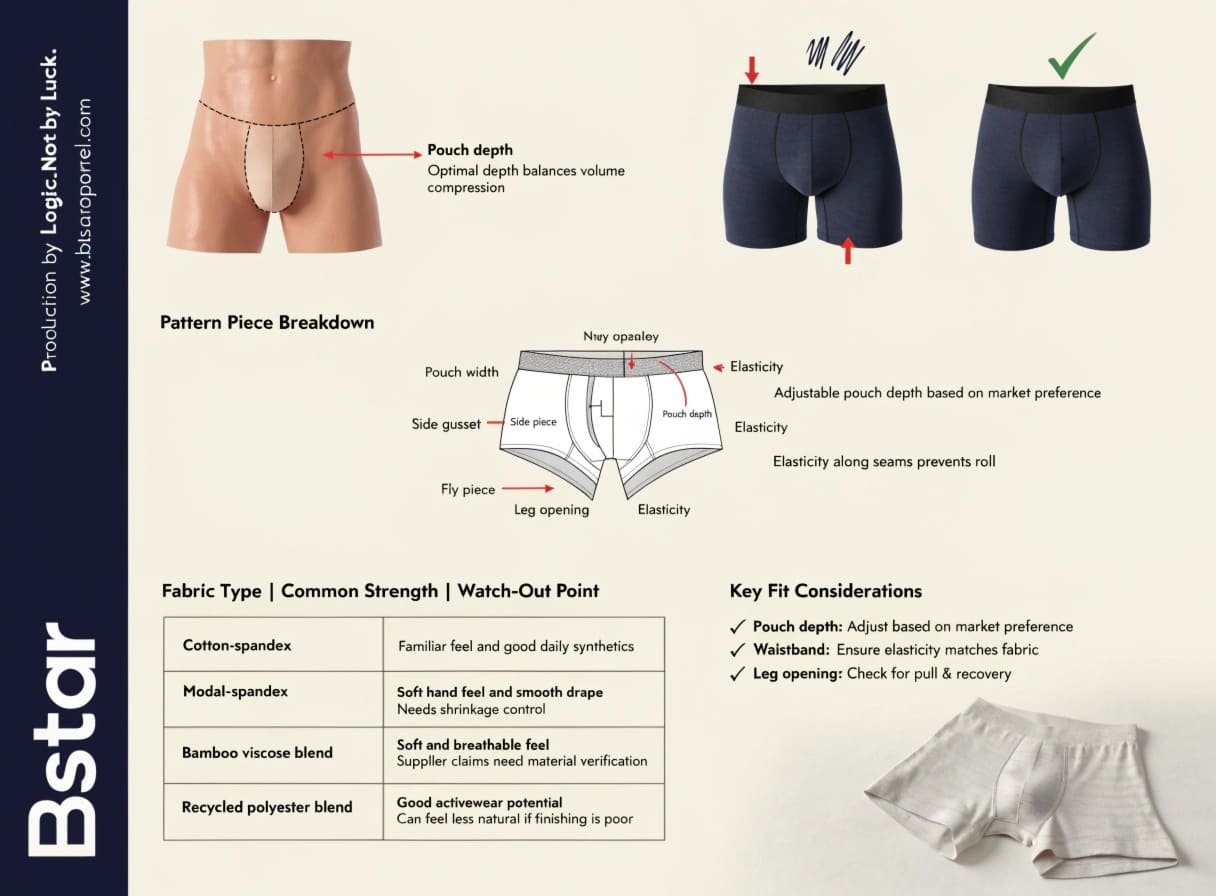
The “fly and pouch” trap
Many new brands focus on waistband logos and packaging first. I understand why. Those details are visible. But the hidden pattern is what customers feel after two hours of wear.
The common fit problems include:
- The pouch is too flat, so the garment feels tight.
- The pouch is too deep, so it looks bulky.
- The fly opening gaps after movement.
- The front rise is too low for larger sizes.
- The leg opening rides up because elasticity is wrong.
- The waistband pulls because the body fabric has poor recovery.
Fabric stretch and pattern must work together
A pattern cannot be judged alone. The fabric decides how the pattern behaves. A cotton-spandex jersey, bamboo viscose blend, modal-spandex fabric, and recycled polyester blend will all stretch and recover differently.
Here is a simple comparison I often use in sourcing conversations:
| Fabric Type | Common Strength | Watch-Out Point |
|---|---|---|
| Cotton-spandex | Familiar feel and good daily comfort | May retain moisture more than synthetics |
| Modal-spandex | Soft hand feel and smooth drape | Needs shrinkage control |
| Bamboo viscose blend | Soft and breathable feel | Supplier claims need material verification |
| Recycled polyester blend | Good activewear potential | Can feel less natural if finishing is poor |
Questions to ask before approving fit
You should ask:
- Who creates the pattern?
- Can you adjust pouch volume by market fit preference?
- Do you grade the pouch differently across sizes?
- Is the sample made in the final bulk fabric?
- Can I test movement, sitting, squatting, and washing before approval?
A nice sample on a table does not prove a good boxer. A good boxer proves itself when a real person moves in it.
Mistake 3: Can a Boxer Underwear Manufacturer Prove Flatlock Stitching and Seam Durability?
Seams are easy to ignore until customers complain. A weak seam can open after washing, and a bulky seam can rub against the skin. For underwear, seam comfort is not a small detail. It is part of the product promise.
A reliable boxer underwear manufacturer should explain which seams use flatlock stitching, overlock stitching, coverstitching, or binding. The factory should also show seam tension control, needle selection, thread quality, and durability checks before bulk shipment.
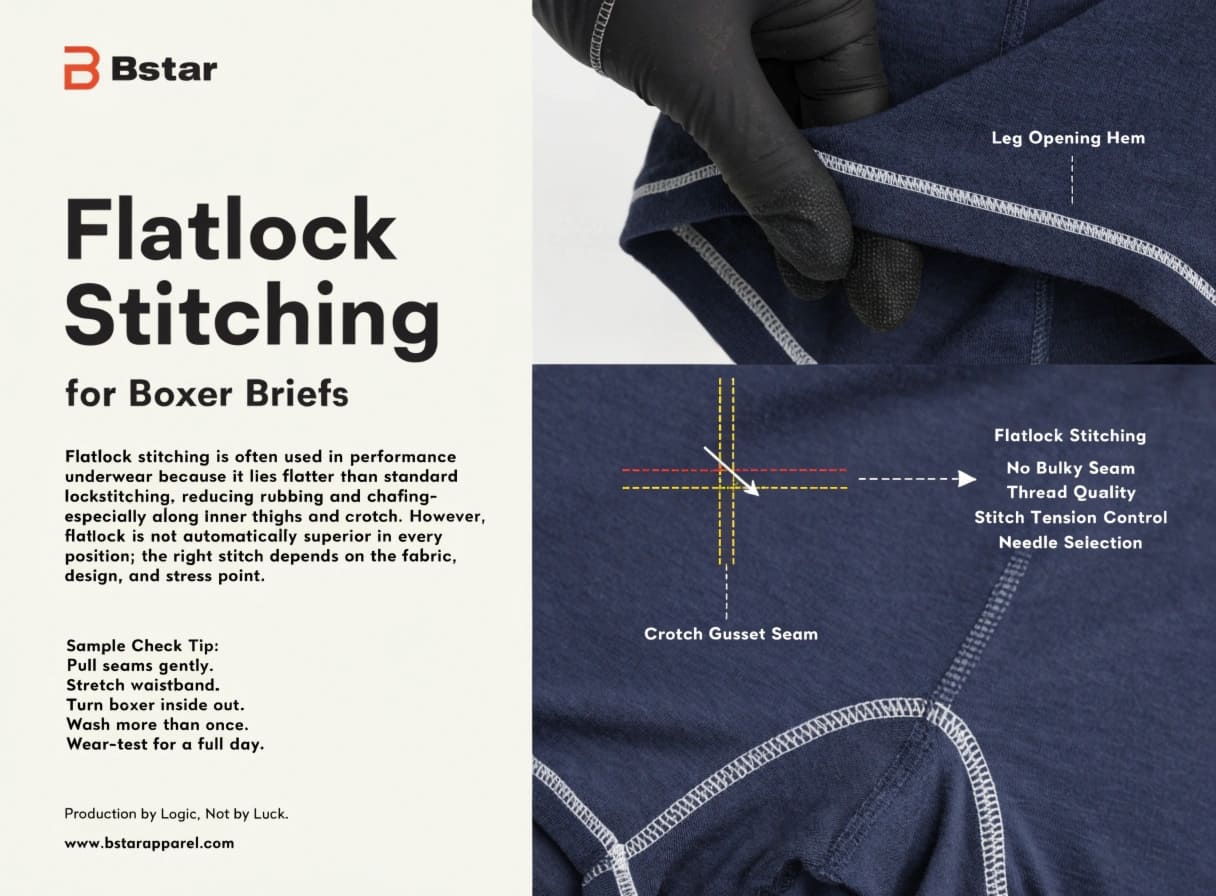
Why stitching quality matters so much
Flatlock stitching is popular in performance underwear because it creates a flatter seam. That can reduce rubbing, especially in the inner thigh area2. However, flatlock is not automatically better in every position. The right stitch depends on the fabric, design, and stress point.
I have seen buyers approve samples based on color and logo placement, then notice seam irritation only after wear testing. That is a painful discovery because seam construction is harder to change once production planning starts.
Key seam areas to inspect
You should check these areas carefully:
- Crotch gusset seams
- Inner thigh seams
- Waistband attachment
- Leg opening hems
- Fly edge stitching
- Label or heat-transfer placement
What to ask the factory
A factory should be able to answer these questions clearly:
- Which stitch type do you recommend for each seam?
- What thread do you use?
- How do you control seam tension?
- How do you prevent skipped stitches on stretch fabric?
- Do you perform stretch recovery checks after sewing?
- Can I see photos or videos from similar bulk production?
Sample check tip
When you receive a sample, do not only look at it. Pull the seams gently. Stretch the waistband. Turn the boxer inside out. Wash it more than once. Wear-test it for a full day if possible.
If a seam already looks stressed in a sample, bulk production will not magically fix it. It usually gets worse when thousands of pieces are produced under time pressure.
Mistake 4: Are You Skipping Boxer Underwear Manufacturer Audit and OEM/ODM Certification Checks?
Certifications sound reassuring, but a verbal claim is not evidence. Some buyers hear “we have OEKO-TEX®” or “we passed BSCI” and stop asking questions. That creates unnecessary risk, especially when your brand sells into Europe or North America.
A professional boxer underwear manufacturer should provide certificate numbers, issuing bodies, expiry dates, company names, and material scope. You should verify these details directly where possible. This step does not show distrust. It shows that your brand takes compliance seriously.
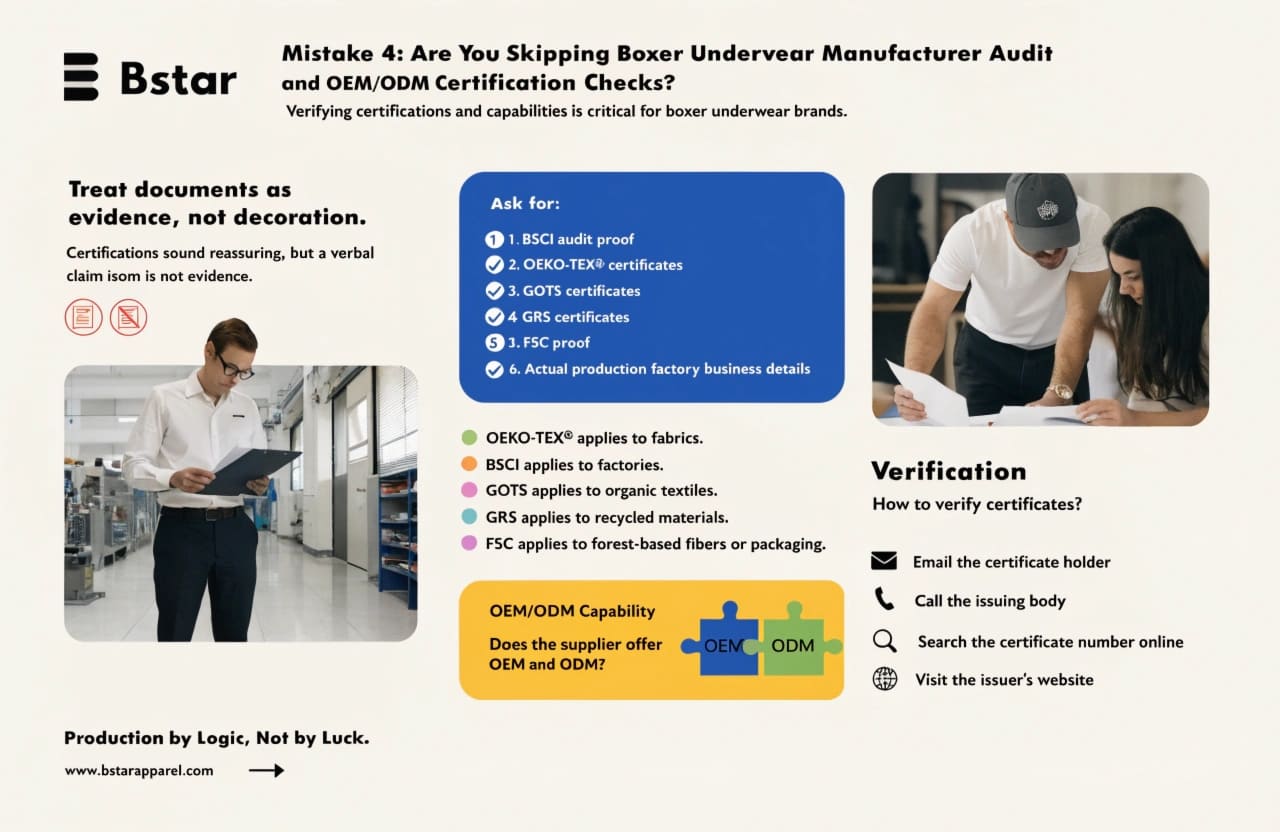
Treat documents as evidence, not decoration
I have sat in many first-order conversations where founders ask, “Do you have certificates?” That question is too broad. The better question is, “Can you send the current certificate with number, expiry date, issuing body, and product scope?”
This matters because certifications can apply to different things:
- The factory’s social responsibility system
- The fabric mill’s material process
- The dyeing process
- A specific yarn or fiber
- A trading company, not the actual factory
What to verify
You should ask for:
- BSCI audit proof if social compliance matters to your channel
- OEKO-TEX® certificates for fabric safety claims
- GOTS certificates for organic textile claims
- GRS certificates for recycled material claims
- FSC proof for forest-based fibers or packaging where relevant
- The actual production factory’s business details
OEM/ODM capability also needs proof
OEM means the factory produces your design. ODM means the factory can help develop design, fit, and materials. Many suppliers say they do both. You should ask what that means in practice.
Ask:
- Do you have an in-house pattern team?
- Do you suggest fabric alternatives?
- Can you support size grading?
- Can you help reduce cost without damaging fit?
- Can you develop private-label packaging?
- Have you produced for DTC underwear brands before?
Verification usually takes one email and five minutes. Skipping it can cost months if a marketplace, retailer, or customs process later asks for proof.
Mistake 5: Are You Failing to Clarify Low MOQ Limits and Tiered Pricing Terms?
MOQ conversations can be confusing. Some founders assume professional factories only accept huge orders. Others hear a low MOQ and assume the unit price will stay low at every quantity. Both assumptions can damage cash flow.
You should ask about sample MOQ, color MOQ, size breakdown, fabric MOQ, waistband MOQ, packaging MOQ, and tiered pricing. The real question is not only “What is your MOQ?” The real question is “What triggers cost changes?”
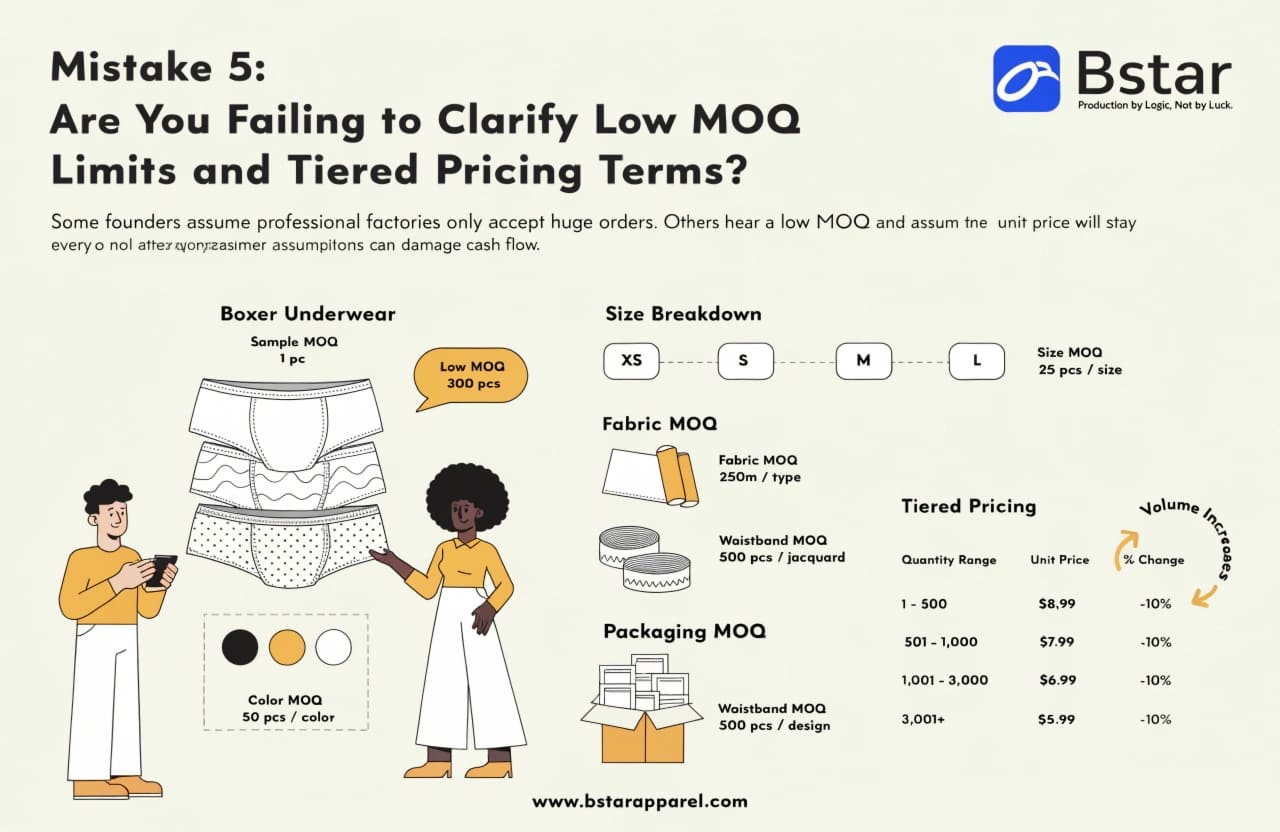
MOQ is not one number
A factory may support a low order quantity for cut-and-sew production, but the fabric mill may require a higher dyeing quantity. The waistband supplier may have a minimum order for jacquard elastic. The packaging supplier may price custom boxes differently at 500, 1,000, or 3,000 pieces.
That is why the sentence “Our MOQ is 300 pieces” does not tell the full story.
MOQ terms you should separate
You should clarify:
- Sample quantity
- Bulk order quantity
- MOQ per style
- MOQ per color
- MOQ per size
- MOQ per fabric
- MOQ for custom waistband
- MOQ for printed packaging
- MOQ for private labels
Tiered pricing questions
You should ask for price levels such as:
| Quantity Level | What You Should Ask |
|---|---|
| Sample stage | What fees are refundable after bulk order? |
| Small trial run | What materials are available without special dyeing? |
| Growth order | What price changes at 1,000 or 3,000 pieces? |
| Scale order | What costs reduce when materials are purchased in bulk? |
I see many DTC founders self-eliminate too early. They assume a real factory will demand tens of thousands of units. That is not always true. Some integrated manufacturers can schedule small initial runs, especially when the buyer is flexible on fabric availability, color selection, and packaging complexity.
A small order is not automatically unprofessional. An unclear small order is the problem.
Mistake 6: Are You Underestimating Tech Pack Communication and Sample Pre-Production?
A beautiful idea can become a poor sample if the tech pack is vague. This mistake often appears when a founder sends inspiration photos but no measurements, fabric targets, construction notes, or packaging details. The factory then guesses, and every guess creates risk.
You should treat tech pack communication as the first production test. A strong supplier will ask clarifying questions, confirm measurements, discuss tolerances, and explain sample timing. Good communication before sampling usually predicts smoother bulk production.
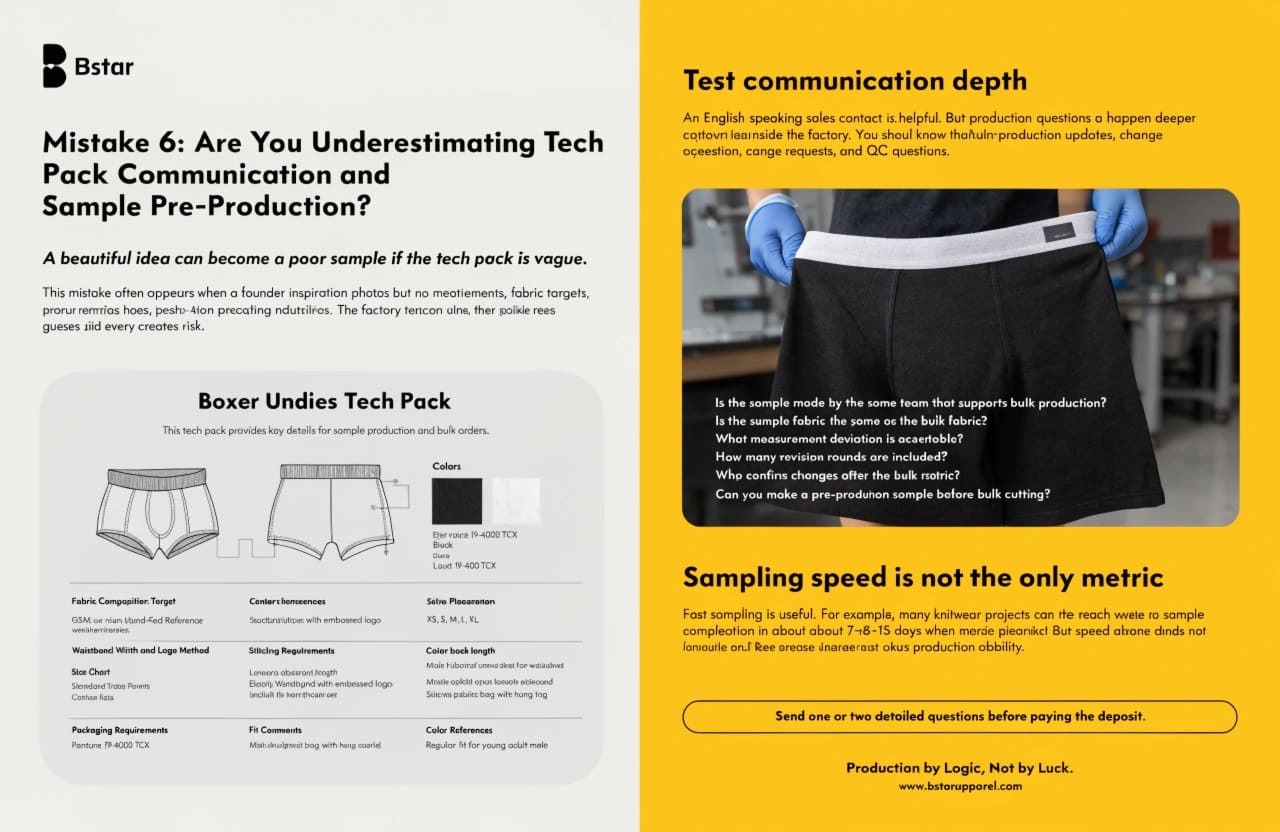
A tech pack does not need to be perfect
Many first-time founders worry that they need a luxury-brand technical file before speaking with a factory. You do not. But you do need enough information to reduce guessing.
A practical boxer underwear tech pack should include:
- Front and back sketches or reference photos
- Fabric composition target
- GSM or hand-feel reference
- Waistband width and logo method
- Size chart
- Measurement points
- Stitching requirements
- Label placement
- Packaging requirements
- Color references, preferably Pantone codes
- Fit comments for the target customer
Sampling speed is not the only metric
Fast sampling is useful. For example, many knitwear projects can reach sample completion in about 7–15 days when materials and requirements are clear3. But speed alone does not prove production ability.
You should ask:
- Is the sample made by the same team that supports bulk production?
- Is the sample fabric the same as the bulk fabric?
- What measurement deviation is acceptable?
- How many revision rounds are included?
- Who confirms changes after the first sample?
- Can you make a pre-production sample before bulk cutting?
Test communication depth
An English-speaking sales contact is helpful. But production questions happen deeper inside the factory. You should know who handles mid-production updates, change requests, and QC questions.
I suggest sending one or two detailed questions before paying the deposit. For example: “If I change the waistband logo after sample approval, how will your team control old and new versions internally?” The answer will reveal how the supplier manages real production communication.
Mistake 7: Is Your Boxer Underwear Manufacturer Using AQL Quality Control Before Final Shipment?
Quality problems are much harder to fix after goods leave the factory. Some buyers only inspect the final cartons or skip inspection entirely to save time. That can be risky because underwear defects may hide inside size mixes, stitching areas, elastic tension, or packaging details.
A dependable boxer underwear manufacturer should use AQL standards and clear inspection checkpoints. Quality control should cover raw materials, cutting, sewing, semi-finished goods, measurements, packaging, and final random inspection before shipment approval.
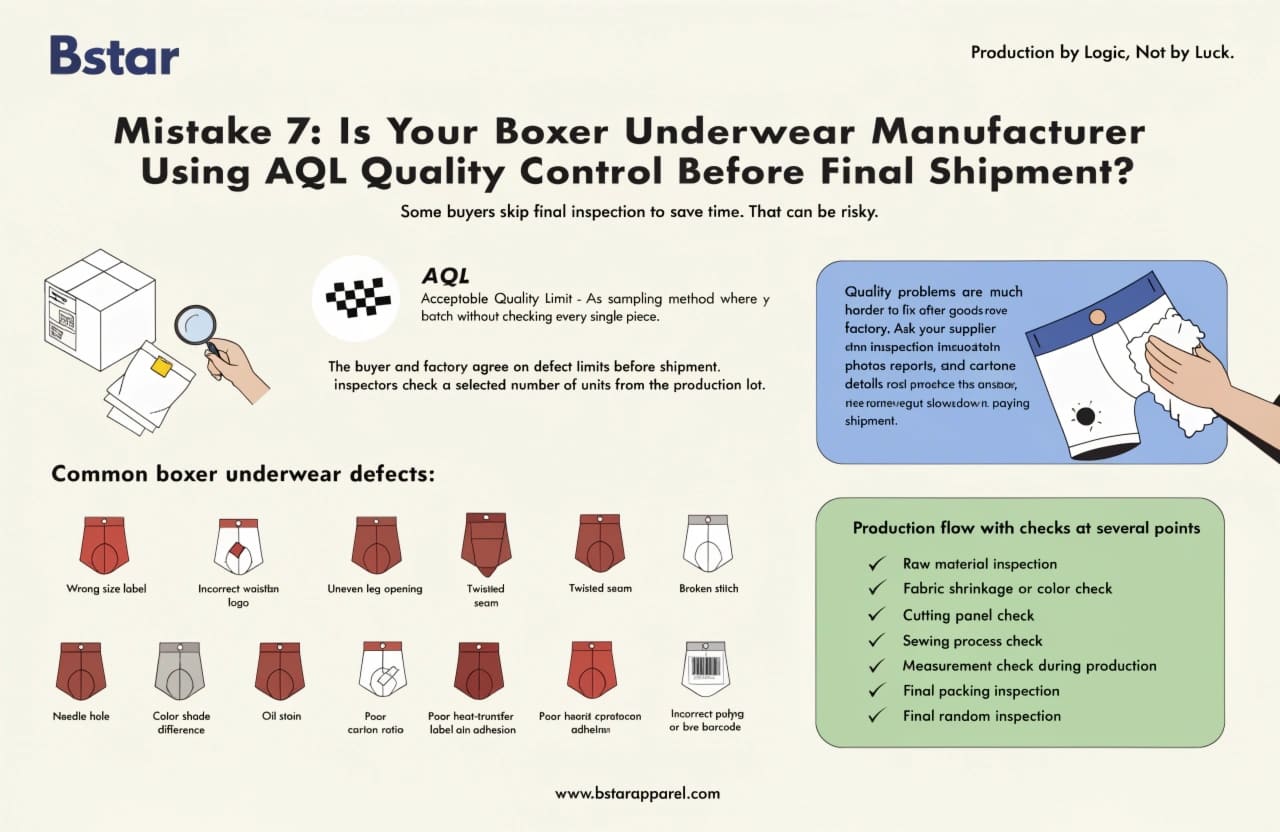
What AQL means in simple terms
AQL stands for Acceptable Quality Limit. It is a sampling method used to inspect a batch without checking every single piece4. The buyer and factory agree on defect limits before shipment. Then inspectors check a selected number of units from the production lot.
You do not need to memorize the full AQL table. You do need to agree on what counts as a critical, major, or minor defect.
Common boxer underwear defects
You should define these before production:
- Wrong size label
- Incorrect waistband logo
- Uneven leg opening
- Twisted seam
- Broken stitch
- Needle hole
- Color shade difference
- Oil stain
- Wrong carton ratio
- Poor heat-transfer label adhesion
- Incorrect polybag or barcode
Inspection should happen before the final day
A final inspection is important, but it should not be the only quality checkpoint. I prefer a production flow with checks at several points:
- Raw material inspection
- Fabric shrinkage or color check
- Cutting panel check
- Sewing process check
- Measurement check during production
- Final packing inspection
This is especially important for DTC brands because one wrong barcode or size ratio can create warehouse problems. Your customers may never see the factory defect, but they will see late fulfillment, wrong sizes, and returns.
Ask your supplier to send inspection photos, measurement reports, and carton details before shipment. If the answer is vague, slow down before paying the balance.
Mistake 8: Can Your Boxer Underwear Manufacturer Handle Peak Season Lead Times and Logistics Delays?
A product launch calendar can fall apart when production and shipping are planned too late. Many new brands calculate only sewing time. They forget fabric lead time, accessory lead time, sample revisions, inspection, booking space, customs documents, and holiday congestion.
A capable boxer underwear manufacturer should help you plan backward from your launch date. You should confirm sampling time, material preparation, bulk production time, inspection timing, shipping method, and buffer days before you announce a launch.
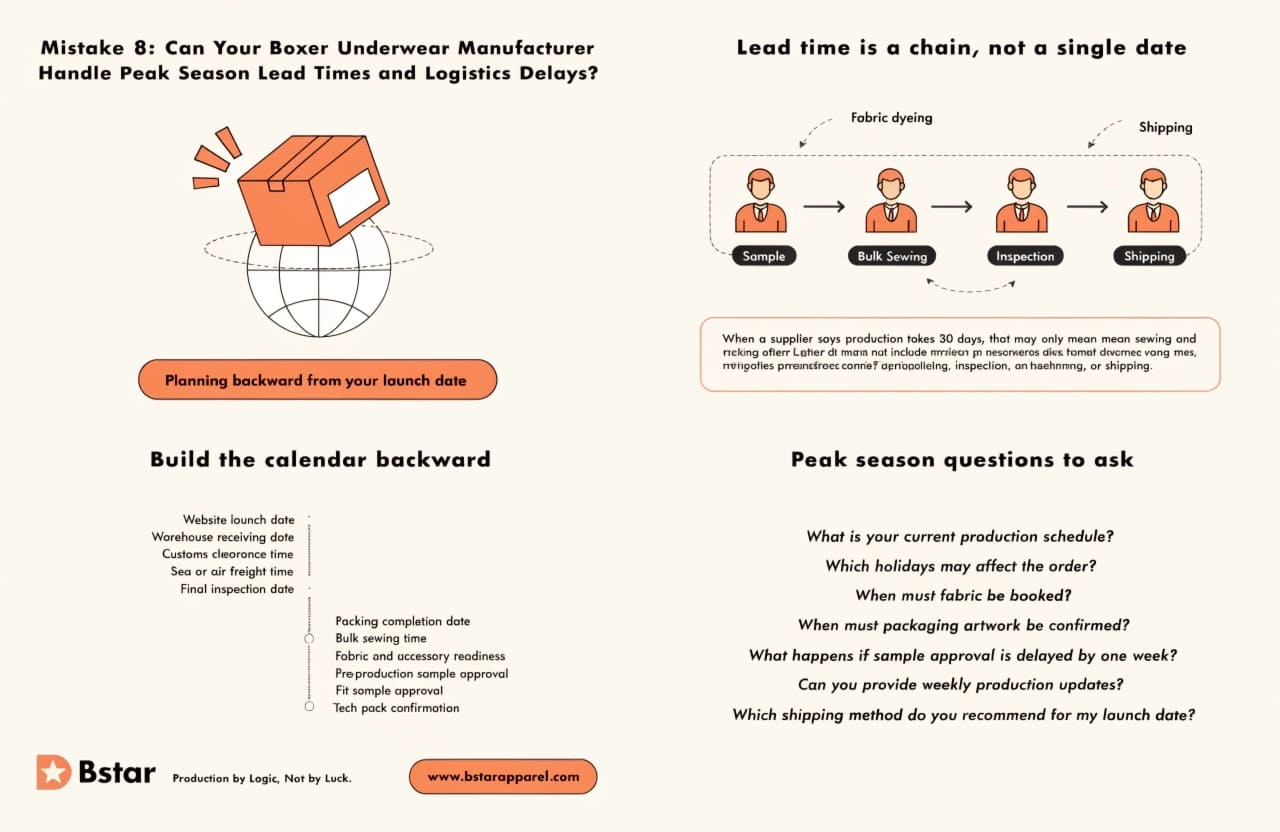
Lead time is a chain, not a single date
When a supplier says production takes 30 days, that may only mean sewing and packing after all materials are ready. It may not include sample revisions, fabric dyeing, waistband production, hangtags, packaging, inspection, or shipping.
I have seen founders create launch pages before confirming the real production calendar. That creates pressure on everyone. The factory rushes. The buyer worries. The freight option becomes more expensive. The brand may need air freight to protect a launch date, and air freight can erase margin fast5.
Build the calendar backward
You should start with your target selling date and work backward:
- Website launch date
- Warehouse receiving date
- Customs clearance time
- Sea or air freight time
- Final inspection date
- Packing completion date
- Bulk sewing time
- Fabric and accessory readiness
- Pre-production sample approval
- Fit sample approval
- Tech pack confirmation
Peak season questions to ask
Before placing the order, ask:
- What is your current production schedule?
- Which holidays may affect the order?
- When must fabric be booked?
- When must packaging artwork be confirmed?
- What happens if sample approval is delayed by one week?
- Can you provide weekly production updates?
- Which shipping method do you recommend for my launch date?
For China production, buyers should pay special attention to periods around Chinese New Year, major shopping seasons, and year-end shipping congestion6. Planning early does not remove every delay, but it gives you more options than panic shipping.
Frequently Asked Questions
How do I choose the right boxer underwear manufacturer for a first order?
You should choose a boxer underwear manufacturer that answers technical questions clearly, supports sampling, verifies certifications, explains MOQ terms, and uses documented quality control. You should also test communication before paying a deposit. The best supplier reduces uncertainty, not just unit price.
What is a reasonable MOQ for custom boxer underwear?
MOQ depends on fabric, color, waistband, packaging, and production structure. Some factories can support small trial runs, while custom-dyed fabric or jacquard waistbands may require higher quantities. You should ask for MOQ by style, color, size, fabric, elastic, and packaging.
Should I use OEM or ODM for boxer underwear?
You should use OEM if you already have a complete design and tech pack. You should use ODM if you need help with fabric selection, fit development, pattern adjustment, or cost optimization. Many DTC startups benefit from ODM support during their first few orders.
How many samples should I make before bulk production?
You should usually expect at least one fit sample and one pre-production sample. Complex designs may need more rounds. The key is not the number of samples. The key is whether the approved sample uses final fabric, final measurements, final trims, and final construction.
What should I inspect before boxer underwear shipment?
You should inspect measurements, stitching, waistband tension, labels, color, stains, size ratios, packaging, barcodes, and carton markings. You should also confirm AQL inspection results before paying the balance. Final shipment approval should be based on evidence, not trust alone.
Conclusion
Choosing a boxer underwear manufacturer is not just a price decision. It is a risk decision. You protect your brand by checking fabric quality, fit engineering, seam durability, certifications, MOQ terms, sample accuracy, AQL inspection, and lead time planning. I have seen small questions save buyers from expensive mistakes. If you are preparing your first boxer underwear order, contact my team with your tech pack or product idea, and we can help you turn it into a production-ready plan.
-
"Consumers blame both manufacturer and retailer when products fail …", https://mendoza.nd.edu/news/consumers-blame-when-products-fail/. Research in consumer behavior indicates that product failures are frequently attributed to the brand rather than to price or situational factors, with negative experiences disproportionately affecting brand trust and repurchase intention (see, e.g., studies on brand attribution theory and product failure). Evidence role: general_support; source type: research. Supports: Consumers tend to attribute product failures to the brand rather than to price or external factors, affecting brand loyalty and repurchase intent. Scope note: Direct evidence specific to underwear or apparel categories may be limited; general consumer attribution findings are applied contextually here. ↩
-
"The Future of Functional Clothing for an Improved Skin and Textile …", https://pmc.ncbi.nlm.nih.gov/articles/PMC8226598/. Textile and apparel construction references describe flatlock stitching as a seam type in which fabric edges are joined to lie flat against the skin, reducing the seam profile and associated friction compared with raised seam constructions such as overlock stitching. Evidence role: mechanism; source type: education. Supports: Flatlock stitching produces a low-profile seam by joining fabric edges so they lie flat, which is documented in textile and apparel construction literature as reducing friction and skin irritation in close-fitting garments. Scope note: Quantitative evidence on friction reduction specific to underwear inner-thigh seams is limited in publicly available literature; the claim is supported by general seam construction principles. ↩
-
"Apparel Manufacturing MOQ & Lead Time Guide", https://www.aprilsu.com/blogs/sustainable-apparel-manufacturer-news/apparel-manufacturing-moq-and-lead-time-benchmarks?srsltid=AfmBOoogCRiGIXFBkxrU-bUUjez9W3S-IHV_-Vt7K_tdzd5f3QgcNMbw. Industry sourcing guides and apparel manufacturing references generally indicate that sample lead times for knitwear products in established facilities range from approximately one to three weeks, contingent on the availability of required materials and the completeness of technical specifications provided by the buyer. Evidence role: general_support; source type: institution. Supports: Sample lead times for knitwear garments in established manufacturing facilities typically range from one to three weeks depending on material availability and specification clarity. Scope note: Actual sampling timelines vary significantly by factory capacity, material sourcing requirements, and design complexity; the 7–15 day figure reflects favorable conditions and may not represent all supplier contexts. ↩
-
"Acceptable Quality Level, AQL Sampling Chart and Calculator", https://www.qima.com/aql-acceptable-quality-limit. The term Acceptable Quality Limit (AQL) is formally defined in ISO 2859-1 (Sampling procedures for inspection by attributes) as the quality level that is the worst tolerable process average for acceptance sampling purposes, providing a statistically grounded method for inspecting batches without 100% unit examination. Evidence role: definition; source type: institution. Supports: AQL (Acceptable Quality Limit) is defined under ISO 2859-1 and equivalent standards as the quality level that is the worst tolerable process average when a continuing series of lots is submitted for acceptance sampling. ↩
-
"Sea Freight vs Air Freight Cost: 2026 Comparison Guide – Rush Order", https://rushorder.com/blog/sea-freight-vs-air-freight-cost. Freight industry data consistently shows that air freight rates per kilogram are several times higher than equivalent ocean freight rates; for apparel products with typical gross margins, the incremental cost of air freight relative to sea freight can represent a material reduction in per-unit profitability, particularly for high-volume or heavy shipments. Evidence role: statistic; source type: institution. Supports: Air freight rates per kilogram are substantially higher than ocean freight rates, and for low-margin goods such as apparel, the cost differential can significantly reduce or eliminate product margins. Scope note: Exact cost differentials fluctuate with fuel prices, capacity, and trade lane; the margin impact depends on the specific product’s unit cost and selling price. ↩
-
"Chinese New Year and its Impact on Global Supply Chain", https://ctl.mit.edu/news/chinese-new-year-and-its-impact-global-supply-chain. Supply chain and logistics institutions, including freight industry bodies and trade associations, document that Chinese New Year factory closures typically last two to four weeks and that associated pre-holiday production surges and post-holiday restarts create measurable delays in manufacturing and export shipping schedules. Evidence role: general_support; source type: institution. Supports: Chinese New Year and peak shipping seasons are documented causes of production and logistics delays in China-based manufacturing supply chains. Scope note: The duration and severity of delays vary by year, industry sector, and specific factory location; general patterns may not apply uniformly to all suppliers. ↩
It’s interesting how you’ve highlighted the importance of evaluating the manufacturer’s production capacity. Ensuring they can meet demand is crucial for any budding business. related tool
It’s interesting how the article highlights the importance of checking the manufacturer’s certifications. This is something many overlook, yet it can make a huge difference in quality. this one
I found the section on evaluating the manufacturer’s quality control processes particularly helpful. It really clarified why taking this step is crucial for choosing the right partner. related tool