
How to Handle Customs Clearance for Textile Imports?
Customs delays cost real money. One held shipment can wipe out your launch timeline, your margin, and your customer trust — all at once.
Customs clearance for textile imports works as a split responsibility between your supplier and you as the importer. Your supplier prepares export documents. You, or your licensed customs broker, handle the import filing, duty payment, and destination-country compliance. Getting this wrong is one of the most common first-order mistakes we see.
Every week, buyers contact us asking some version of the same question: "Can you handle all the paperwork for us?" The honest answer is — some of it, yes. All of it, no. Before your shipment leaves our factory floor, you need to understand exactly where our responsibility ends and yours begins. That line is more important than any single document on the list.
Pick the wrong HS code and you could pay the wrong duty rate — or trigger a compliance flag that holds your cargo.
HS codes are 6-digit international product classification numbers.1 For knitwear, common chapters are 61 (knitted apparel) and 62 (woven apparel).2 The first 6 digits are standardized globally, but destination countries often extend them to 8 or 10 digits with country-specific duty rates attached.3
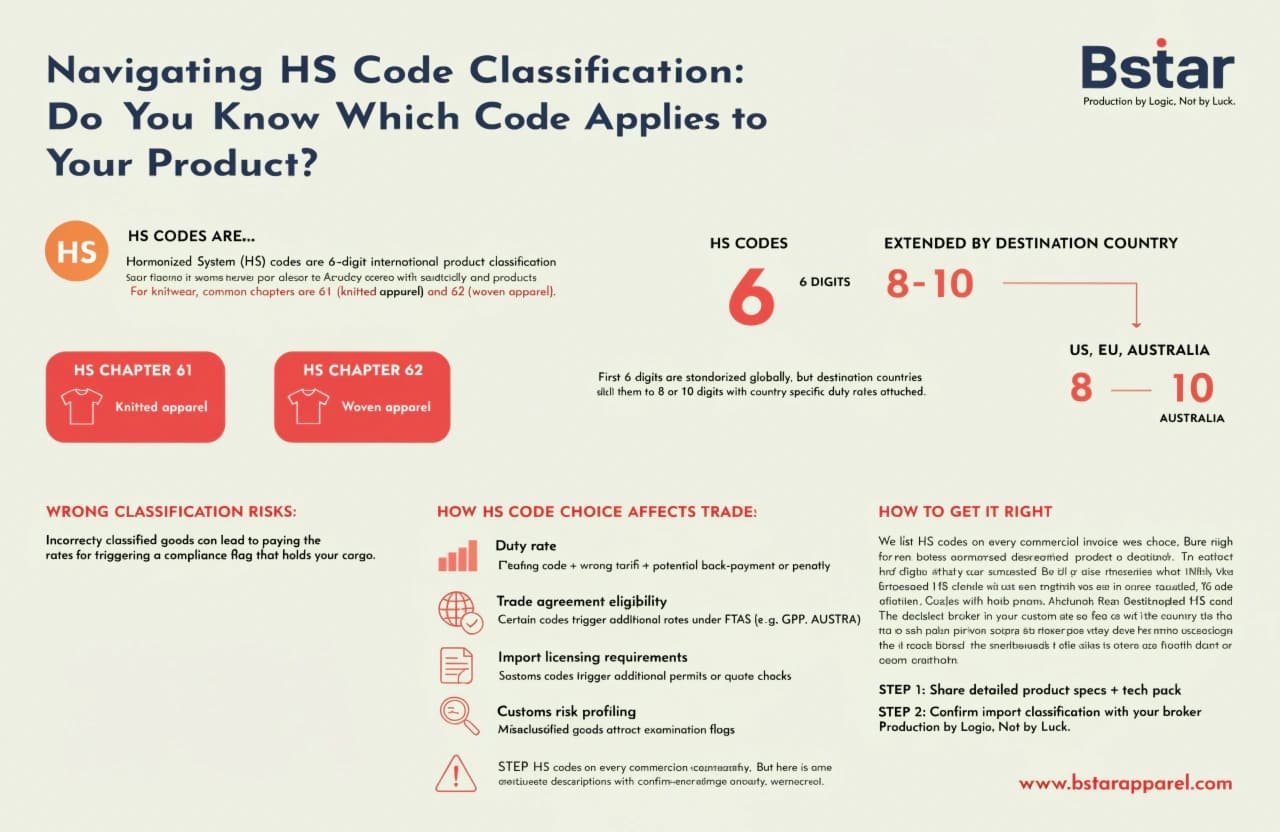
We list HS codes on every commercial invoice we produce. But here is what buyers often miss: the code we use on the export side in China is not always the same code your broker uses on the import side in your country.4 The US, EU, and Australia each extend the base 6 digits differently. Your customs broker in your destination country is the right person to confirm the correct import classification — not us.
Why HS Code Choice Actually Matters
| What It Affects | Why It Matters |
|---|---|
| Duty rate | Wrong code = wrong tariff = potential back-payment or penalty |
| Trade agreement eligibility | Some codes qualify for reduced rates under FTAs (e.g., GSP, AUSFTA)5 |
| Import licensing requirements | Certain codes trigger additional permits or quota checks6 |
| Customs risk profiling | Misclassified goods attract examination flags |
The decision logic here is simple. We give you accurate product descriptions and our suggested HS codes based on 19 years of China export experience. You take that information to your local broker and confirm the import-side classification. This takes one conversation before your order ships. It costs nothing. Skipping it can cost thousands.
Two things that help classification go smoothly: a detailed tech pack from us with fiber content percentages and construction method, and your broker on the call before we print the commercial invoice. We have had buyers in the Netherlands and Australia align on codes in under 30 minutes this way.
Mandatory Labeling and Compliance: What Does Your Destination Country Actually Require?
Fiber content labeling rules are not the same in every country. Assume they are, and your product may fail at import — or worse, after it hits the market.
Most major markets require garments to carry a label showing fiber content by percentage, country of origin, and care instructions.7 The US (FTC), EU, and Australia each have their own labeling standards and language requirements.8 These rules apply at the retail level — but customs can flag non-compliant products at the border too.9
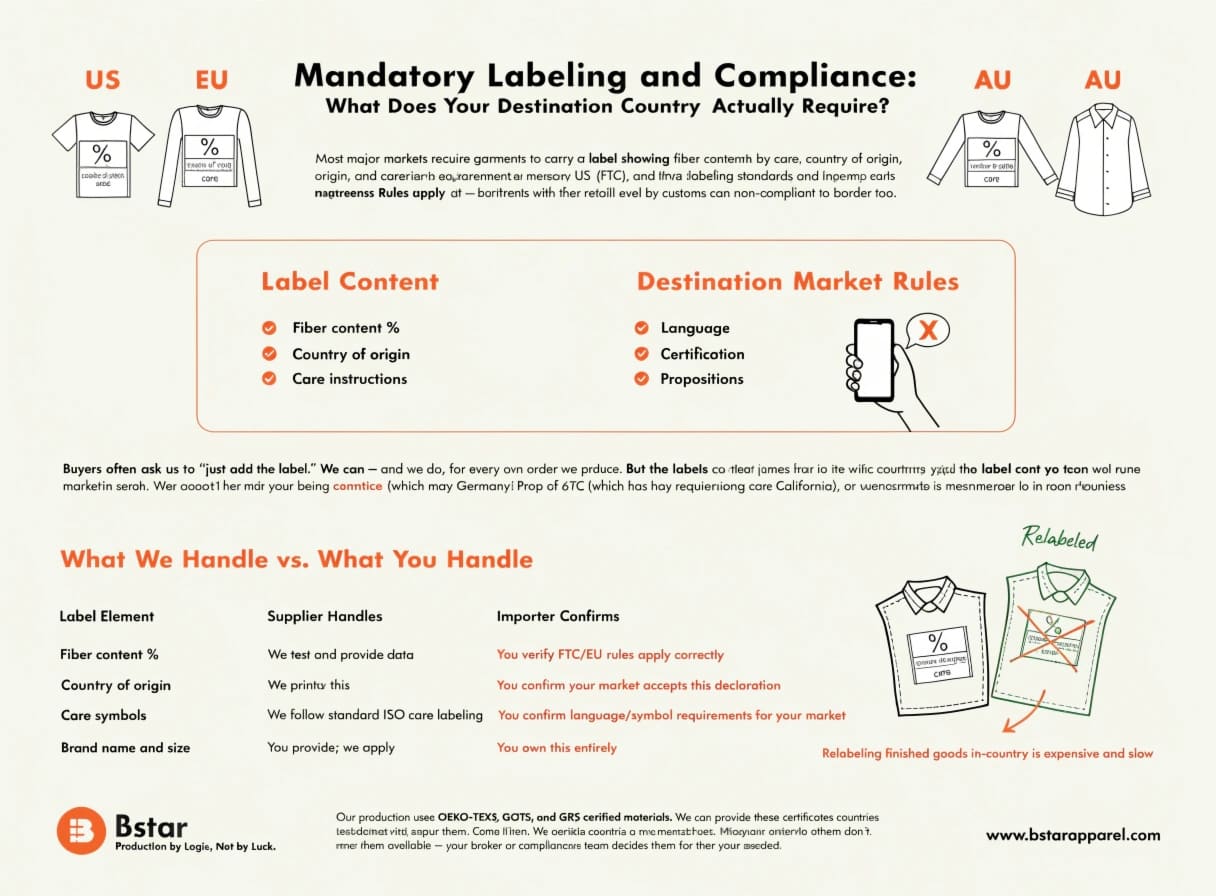
Buyers often ask us to "just add the label." We can — and we do, for every order we produce. But the label content has to come from you, verified against your destination market rules. We don’t know if your product is being sold in California (which has Prop 65 requirements), or in Germany (which may require German-language care instructions).
What We Handle vs. What You Handle
| Label Element | Supplier Handles | Importer Confirms |
|---|---|---|
| Fiber content % | We test and provide data | You verify FTC/EU rules apply correctly |
| Country of origin ("Made in China") | We print this | You confirm your market accepts this declaration |
| Care symbols | We follow standard ISO care labeling | You confirm language/symbol requirements for your market |
| Brand name and size | You provide; we apply | You own this entirely |
Our production uses OEKO-TEX®, GOTS, and GRS certified materials. We can provide these certificates with your order. Some destination countries or retail channels require them. Others don’t. We make them available — your broker or compliance team decides if they are needed for your specific import.
The practical rule: send us your label spec before sampling starts, not after the bulk run. Relabeling finished goods in-country is expensive and slow.
Essential Documentation: What Papers Does Your Shipment Actually Need?
Missing one document can hold a shipment for days. Sending the wrong document can hold it for weeks.
The standard export document set from a China supplier includes a commercial invoice, packing list, and bill of lading or airway bill.10 For textile shipments, you often also need a certificate of origin. Some markets and product types require additional documents — your freight forwarder and customs broker should give you the full list before your first shipment.
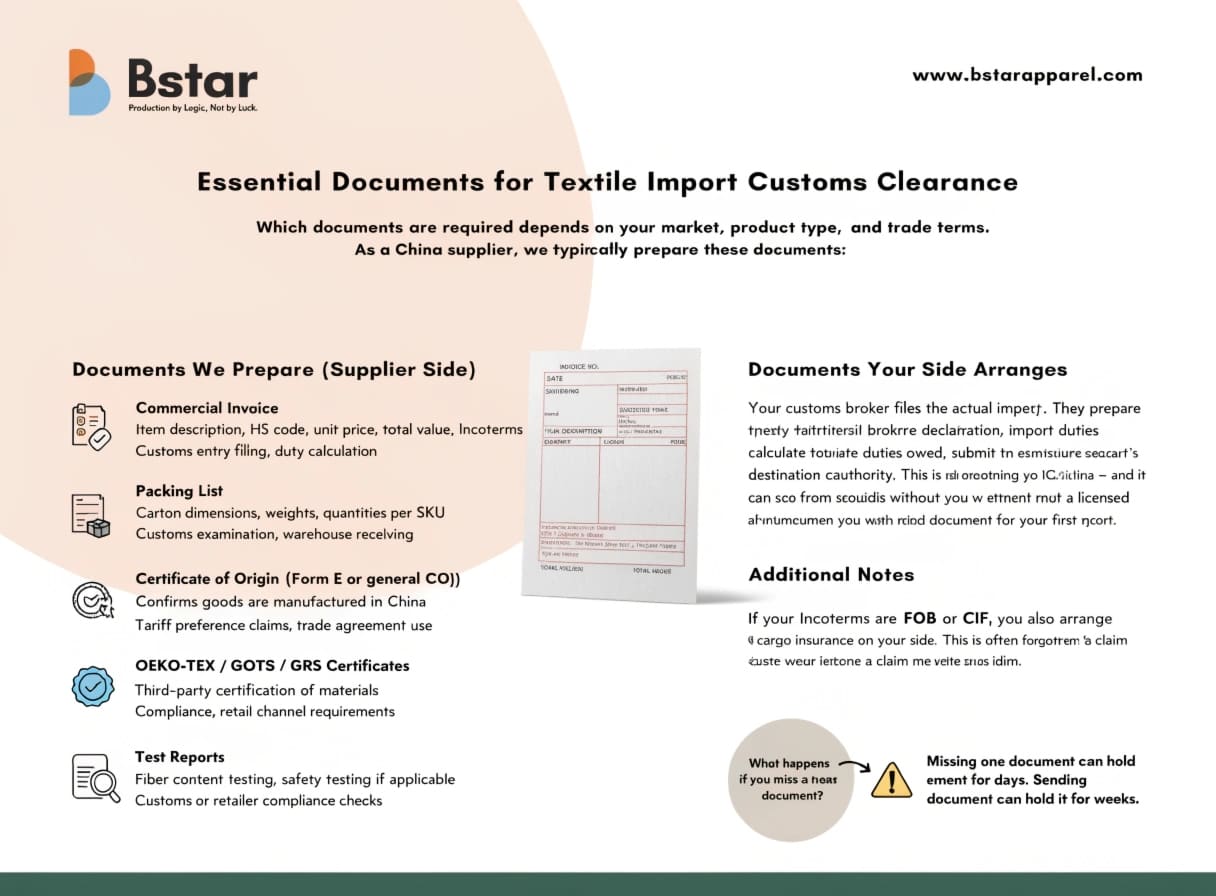
Here is the document split as we handle it on our end:
Documents We Prepare (Supplier Side)
| Document | What It Contains | Who Uses It |
|---|---|---|
| Commercial Invoice | Item description, HS code, unit price, total value, Incoterms | Customs entry filing, duty calculation |
| Packing List | Carton dimensions, weights, quantities per SKU | Customs examination, warehouse receiving |
| Certificate of Origin (Form E or general CO) | Confirms goods are manufactured in China | Tariff preference claims, trade agreement use |
| OEKO-TEX / GOTS / GRS Certificates | Third-party certification of materials | Compliance, retail channel requirements |
| Test Reports | Fiber content testing, safety testing if applicable | Customs or retailer compliance checks |
Documents Your Side Arranges
Your customs broker files the actual import entry. They prepare the import declaration, calculate duties owed, and submit to the destination country’s customs authority. This is not something we can do from China — and it is not something you should attempt without a licensed broker for your first import.
One more thing: if your Incoterms are FOB or CIF, you also arrange marine cargo insurance on your side. This is often forgotten until a claim is needed.
Managing Inspections and Audits: What Happens If Customs Wants to Look Inside the Box?
Customs examinations are not rare for textile imports from China. Being prepared is not optional — it is just smart logistics.
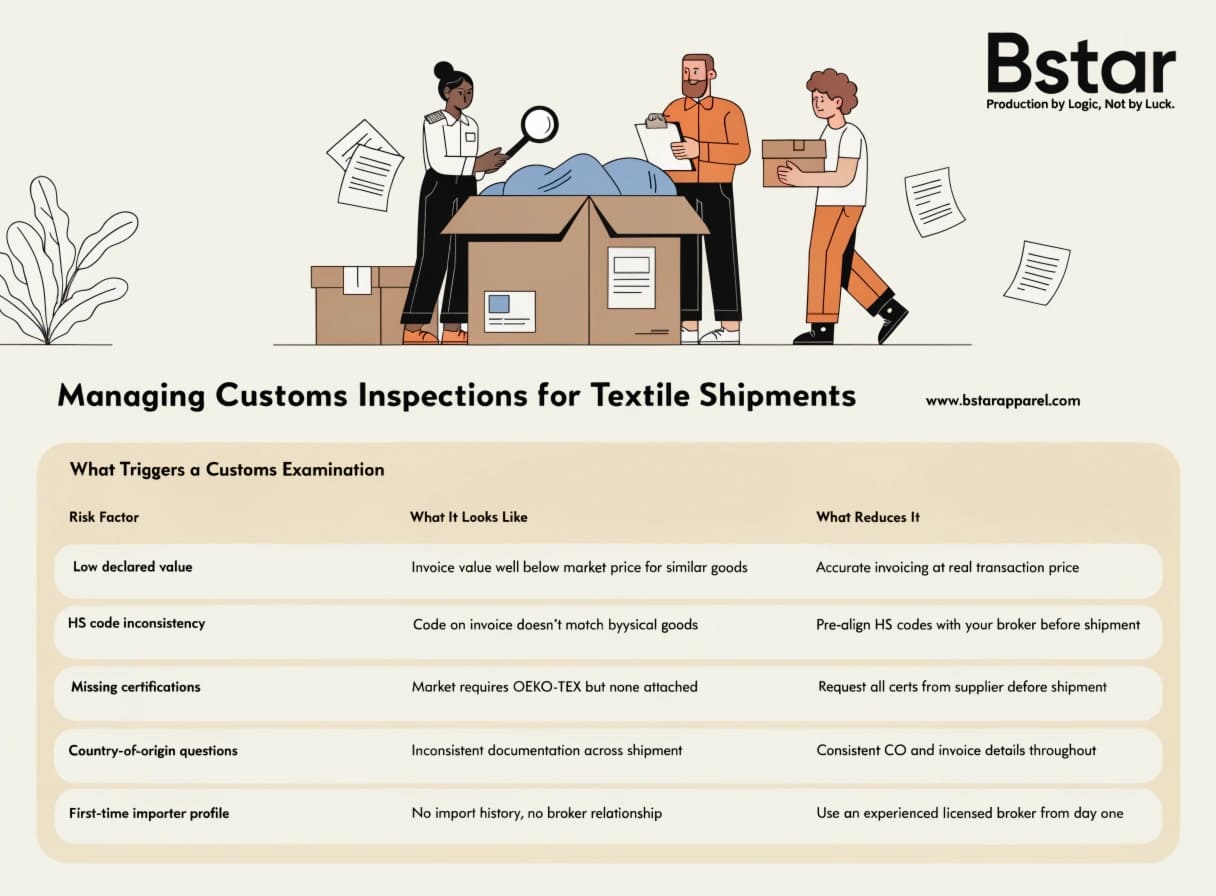
Customs may select any shipment for physical examination, document review, or valuation audit.11 For textile imports from China, common triggers include low declared values, HS code mismatches, missing certifications, and random selection. A well-prepared document set and accurate valuation reduce your risk — but cannot eliminate it.
Buyers sometimes ask us to under-declare invoice values to lower duty costs. We don’t do this. Customs valuation fraud is illegal in every destination market, and the penalty — seizure, fines, import bans — is far worse than the duty saved.12 We invoice at actual transaction value, and we recommend you do not work with any supplier who offers otherwise.
What Triggers a Customs Examination
| Risk Factor | What It Looks Like | What Reduces It |
|---|---|---|
| Low declared value | Invoice value well below market price for similar goods | Accurate invoicing at real transaction price |
| HS code inconsistency | Code on invoice doesn’t match physical goods | Pre-align HS codes with your broker before shipment |
| Missing certifications | Market requires OEKO-TEX but none attached | Request all certs from supplier before shipment |
| Country-of-origin questions | Inconsistent documentation across shipment | Consistent CO and invoice details throughout |
| First-time importer profile | No import history, no broker relationship | Use an experienced licensed broker from day one |
One thing we tell buyers before every first order: brief your customs broker before the goods ship, not after they arrive at the port. Share our full document package — invoice, packing list, CO, and certifications — at least 3–5 days before vessel departure. Your broker may spot a gap that takes us one day to fix here, but would take two weeks to resolve once cargo is in transit.
We have handled orders for brands in the Netherlands, Australia, and the US. The buyers who clear customs fastest are the ones who locked down their Incoterms, confirmed their document requirements, and had a broker ready before they placed the purchase order. The ones who struggle are the ones who assumed their supplier would handle it.
Conclusion
Customs clearance is a shared job. Know your Incoterms, confirm your document requirements early, and work with a licensed local broker — before your shipment leaves China.
-
"Harmonized Tariff Schedule of the United States – Wikipedia", https://en.wikipedia.org/wiki/Harmonized_Tariff_Schedule_of_the_United_States. World Customs Organization materials describe the Harmonized System as an international nomenclature for classifying traded goods at the six-digit level. Evidence role: definition; source type: institution. Supports: The source should define the Harmonized System as an international product nomenclature using six-digit codes.. ↩
-
"[PDF] HTS CHAPTER 62 ARTICLES OF APPAREL AND CLOTHING …", https://www.usitc.gov/publications/docs/tata/hts/bychapter/1000c62.pdf. Official tariff schedules classify articles of apparel and clothing accessories knitted or crocheted under Chapter 61 and articles not knitted or crocheted under Chapter 62. Evidence role: definition; source type: government. Supports: The source should show that Chapter 61 is for knitted or crocheted apparel and Chapter 62 is for apparel not knitted or crocheted.. ↩
-
"Harmonized System (HS) Codes – International Trade Administration", https://www.trade.gov/harmonized-system-hs-codes. International customs guidance explains that HS subheadings are harmonized through six digits, while national and regional tariff schedules may add additional digits for statistical, regulatory, or duty-rate purposes. Evidence role: mechanism; source type: institution. Supports: The source should explain that HS headings and subheadings are harmonized internationally through six digits and that national or regional systems add further digits.. ↩
-
"Harmonized Tariff Schedule", https://hts.usitc.gov/. Customs authorities generally place responsibility for import classification under the importing country’s tariff schedule, which may include national subdivisions beyond the international six-digit HS code. Evidence role: general_support; source type: government. Supports: The source should support that importers classify goods under the destination country’s tariff schedule and that national subdivisions can differ.. Scope note: This supports the mechanism for export/import code divergence, but it may not document every country pair or every textile product. ↩
-
"GSP-Eligible Products | United States Trade Representative", https://ustr.gov/issue-areas/trade-development/preference-programs/generalized-system-preferences-gsp/gsp-program-i-0. Trade-agreement and preference-program guidance ties eligibility for reduced tariffs to the product’s tariff classification and satisfaction of applicable rules of origin. Evidence role: mechanism; source type: institution. Supports: The source should show that preferential tariff treatment is assessed by product classification and origin rules under trade agreements or preference programs.. Scope note: This is contextual support; eligibility depends on the specific agreement, product, origin, and current legal status of the preference program. ↩
-
"Are My Goods Subject to Quota? | U.S. Customs and Border Protection", https://www.cbp.gov/trade/quota/quota-restrict. International trade and customs systems commonly administer non-tariff measures, including licensing and quotas, by reference to tariff classifications. Evidence role: mechanism; source type: institution. Supports: The source should explain that trade measures such as licensing, quotas, or restrictions are often administered by tariff classification.. Scope note: This supports the general mechanism, but whether a permit or quota applies depends on the destination country and exact commodity code. ↩
-
"[PDF] Threading Your Way Through the Labeling Requirements Under the …", https://www.govinfo.gov/content/pkg/GOVPUB-FT-PURL-LPS86207/pdf/GOVPUB-FT-PURL-LPS86207.pdf. Regulatory guidance in major apparel markets requires textile products to provide consumer-facing information such as fiber composition, country of origin, and care instructions, although the exact content and format vary by jurisdiction. Evidence role: expert_consensus; source type: government. Supports: The source should document that official rules in major markets require textile or apparel labels to disclose fiber composition and other consumer information such as origin or care instructions.. Scope note: This is comparative contextual support; no single regulation covers all major markets uniformly. ↩
-
"[PDF] Threading Your Way Through the Labeling Requirements Under the …", https://www.govinfo.gov/content/pkg/GOVPUB-FT-PURL-LPS86207/pdf/GOVPUB-FT-PURL-LPS86207.pdf. Official US, EU, and Australian consumer-product rules establish separate textile-labeling obligations, including requirements for fiber disclosure and jurisdiction-specific presentation or language rules. Evidence role: general_support; source type: government. Supports: The source should show that the US, EU, and Australia regulate textile labeling through distinct rules, including language or presentation requirements.. Scope note: This supports the comparison at a regulatory level; the applicable rule still depends on product type and sales channel. ↩
-
"Threading Your Way Through the Labeling Requirements Under the …", https://www.ftc.gov/business-guidance/resources/threading-your-way-through-labeling-requirements-under-textile-wool-acts. Customs and product-compliance guidance indicates that imported textile goods may be subject to border review or detention when mandatory labeling or regulatory information is deficient. Evidence role: mechanism; source type: government. Supports: The source should support that imported textile products can be checked or held by customs or market-surveillance authorities when required labeling or compliance information is missing.. Scope note: This is jurisdiction-dependent; the precise enforcement authority and procedure vary by country. ↩
-
"Common Export Documents – International Trade Administration", https://www.trade.gov/common-export-documents. Government export-documentation guidance identifies commercial invoices, packing lists, and transport documents such as bills of lading or air waybills as standard records used in international shipment and customs processes. Evidence role: general_support; source type: government. Supports: The source should identify commercial invoices, packing lists, and bills of lading or airway bills as common international shipping or customs documents.. Scope note: This supports the general document set; additional documents may be required depending on destination, product, and mode of transport. ↩
-
"Cargo Examination – U.S. Customs and Border Protection", https://www.cbp.gov/border-security/ports-entry/cargo-security/examination. Customs enforcement guidance recognizes that import authorities may examine shipments, review entry documentation, and verify declared customs value as part of import control. Evidence role: mechanism; source type: government. Supports: The source should establish that customs authorities may examine cargo, review documents, and scrutinize declared value.. Scope note: This supports the general authority; selection criteria and audit procedures differ among customs administrations. ↩
-
"Penalties Program – U.S. Customs and Border Protection", https://www.cbp.gov/trade/programs-administration/penalties. The WTO Customs Valuation Agreement and national customs enforcement guidance require declared customs values to be based on legally accepted valuation methods, and false undervaluation may expose importers to penalties such as fines, seizure, or other enforcement actions. Evidence role: mechanism; source type: institution. Supports: The source should support that customs value is legally regulated and that false undervaluation can result in enforcement penalties.. Scope note: This supports the legal risk of undervaluation generally; exact penalties and terminology vary by jurisdiction. ↩