
Pantone Color Matching in Underwear Production: A Complete Guide?
Ordering underwear from an overseas factory and expecting the color to match your brand swatch exactly? That expectation has cost more than a few DTC founders a full resample round and weeks of delay.
Pantone color matching in underwear production means using a standardized color reference system — specifically the FHI or TCX range — to guide fabric dyeing. But a Pantone code is a starting point, not a guaranteed result. Fabric type, dye method, lighting conditions, and your approval process all determine the final color you receive.
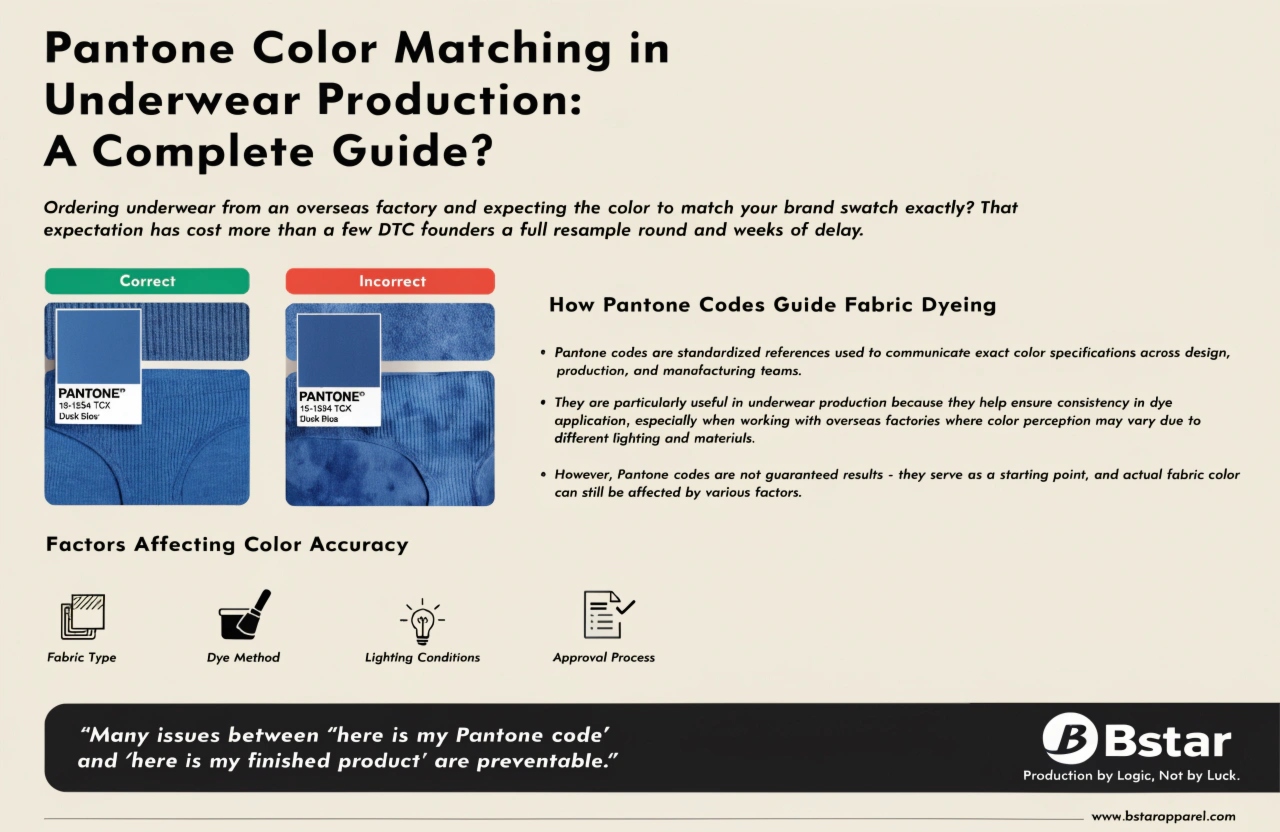
There is a lot that can go wrong between "here is my Pantone code" and "here is my finished product." But most of those problems are preventable. In this guide, I am going to walk you through exactly what controls color accuracy in underwear production, and what you need to set up before sampling even begins.
The Foundation of Color Accuracy: Do You Know Which Pantone System Actually Applies to Fabric?
Most buyers send over a Pantone code without checking which version they are referencing. That alone can send the first sample in the wrong direction.
Pantone has two separate reference systems relevant to apparel. TCX (previously known as the Cotton Passport series) is designed for dyeing on natural and blended fabrics. FHI (Fashion, Home + Interiors) is the broader collection that covers both fabric and paper references. For underwear production, TCX codes are the correct reference — not TPG, which is a paper-based system used in print and graphic design.
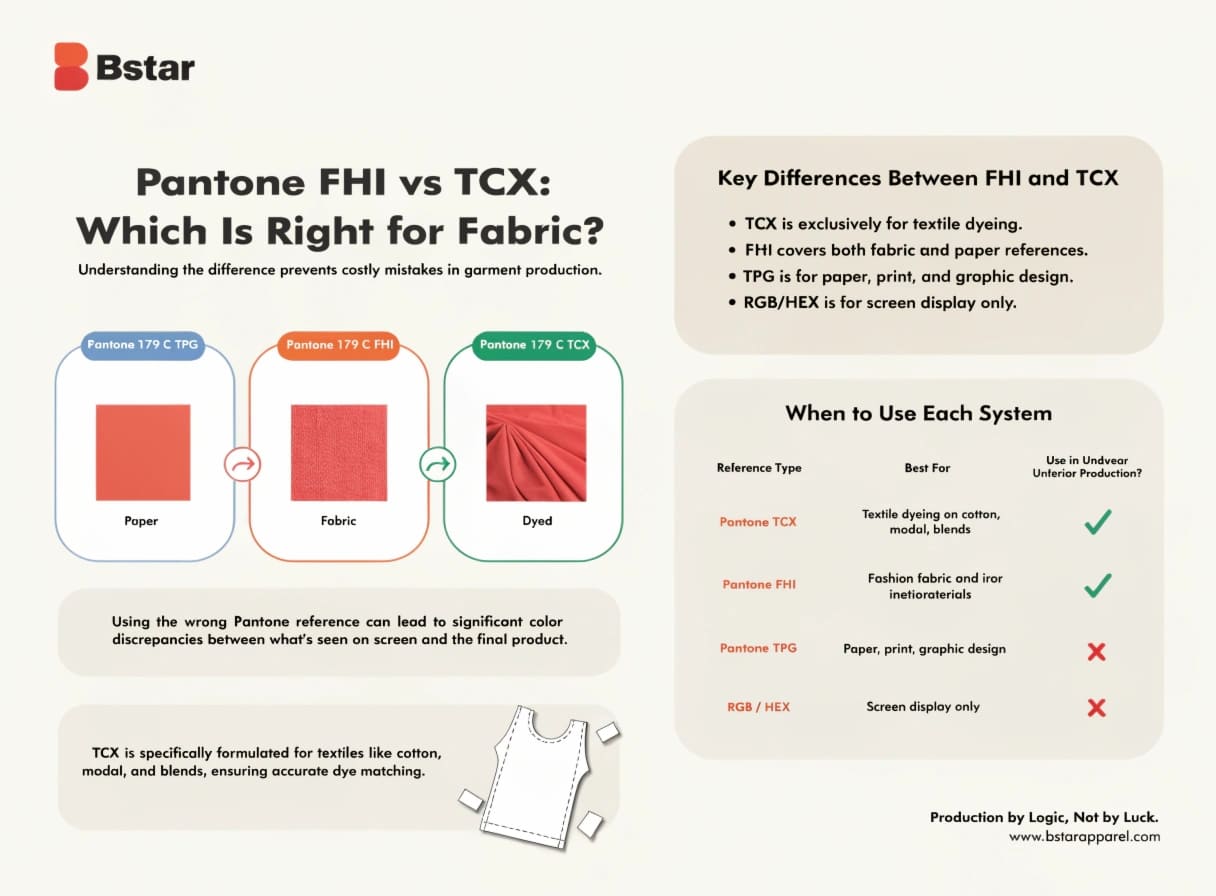
This distinction matters more than most people expect. TPG and TCX versions of the same color name can look visually close on screen, but they are calibrated for completely different surfaces. When a buyer sends a TPG reference to a fabric dye house, the dye team has to interpret it across to textile standards. That interpretation introduces variation before the first sample is even made.
In our production process at BSTAR, the first thing our team checks when a client sends a color reference is which Pantone system they used. If it is TPG, we flag it immediately and ask for the TCX equivalent. This is not a technical formality. It is one of the most common sources of first-sample color mismatch we see from first-time OEM buyers, and catching it early saves at least one round of resampling.
Which System Should You Use?
| Reference Type | Best For | Use in Underwear Production? |
|---|---|---|
| Pantone TCX | Textile dyeing on cotton, modal, blends | ✅ Yes |
| Pantone FHI | Fashion fabric and interior materials | ✅ Yes (check specific range) |
| Pantone TPG | Paper, print, graphic design | ❌ Not recommended for fabric |
| RGB / HEX | Screen display only | ❌ Cannot be used for dye matching |
Before you send a color reference to any factory, confirm you are using a TCX or FHI code. That one step removes a major source of early-stage confusion.
Material Matters: Why Does the Same Pantone Code Look Different on Different Fabrics?
You picked a Pantone code. Your factory confirmed it. The sample comes back, and the color looks clearly off. You are not imagining it.
Different fabric compositions absorb dye at different rates. A Pantone TCX code matched on 100% cotton will look noticeably different on a modal-nylon blend, even when the same dye formula is used. This is a physical property of the fiber, not a factory error. Underwear fabrics — which are typically modal, nylon, spandex, or cotton blends — each respond to dyeing in their own way.
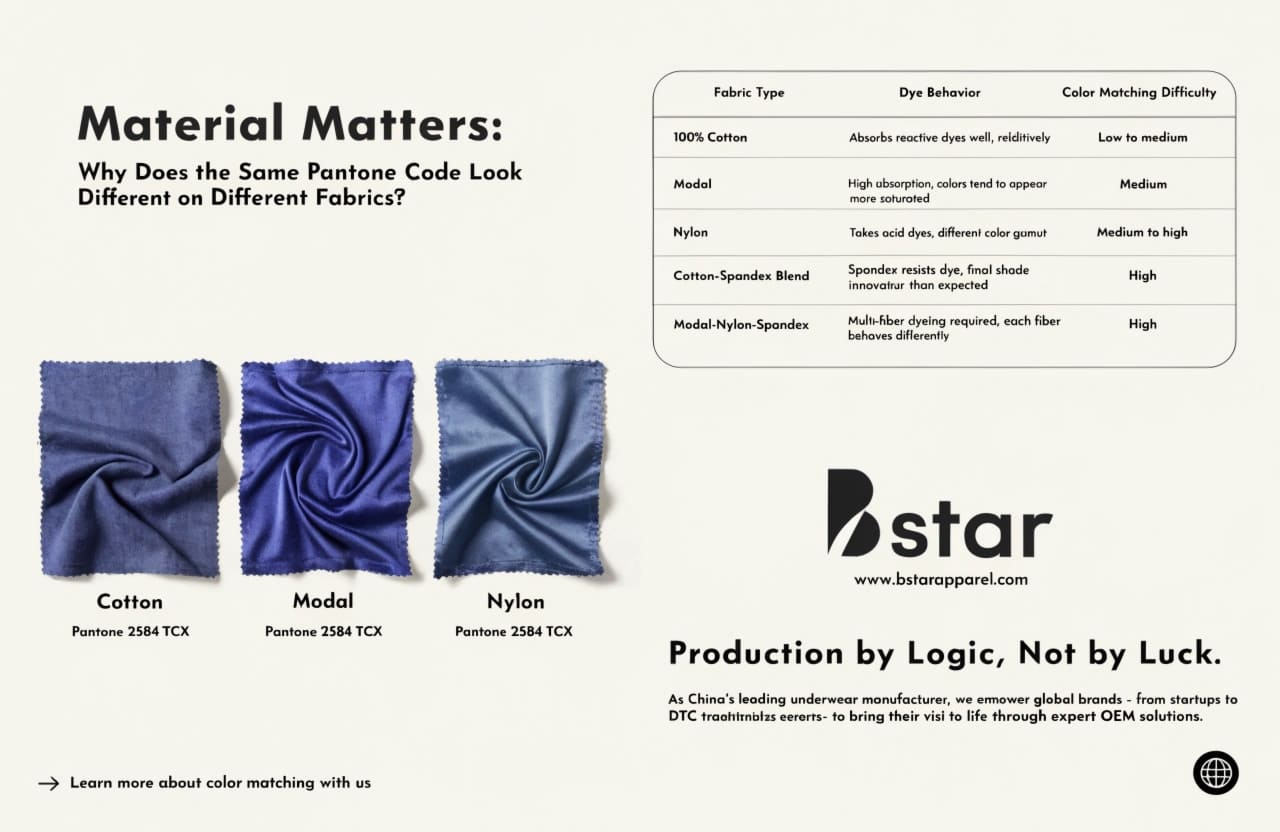
This is the single most important thing I want first-time buyers to understand. The Pantone system was not built to guarantee identical color output across all substrates. It was built to give dye teams a shared reference point to work from. What the final color looks like depends heavily on what the fabric is made of.
From the color matching work we handle at BSTAR with international clients, here is the pattern we see consistently:
How Fabric Type Affects Dye Absorption
| Fabric Type | Dye Behavior | Color Matching Difficulty |
|---|---|---|
| 100% Cotton | Absorbs reactive dyes well, relatively predictable | Low to medium |
| Modal | High absorption, colors tend to appear more saturated | Medium |
| Nylon | Takes acid dyes, different color gamut | Medium to high |
| Cotton-Spandex Blend | Spandex resists dye, final shade lighter than expected | High |
| Modal-Nylon-Spandex | Multi-fiber dyeing required, each fiber behaves differently | High |
What this means practically: when you send a color reference, you should also confirm the exact fabric composition of your garment. The dye house needs to know both pieces of information to make a useful first lab dip. Sending a color code without the fabric spec is like giving someone a destination without telling them what vehicle they are driving.
Setting Tolerances: What Is Delta E and Why Should You Agree on It Before Sampling?
Most buyers have never heard the term Delta E. Most color disputes in bulk production come from buyers who have no agreed standard to measure against.
Delta E (ΔE) is a numerical value that measures the difference between two colors as human vision perceives it. A ΔE of 0 means the colors are identical. A ΔE of 1 is a difference most people cannot detect. A ΔE of 3 or higher is a visible difference to most observers. Professional factories use ΔE to define what counts as an acceptable color match in production — and buyers should agree on this number before sampling begins.
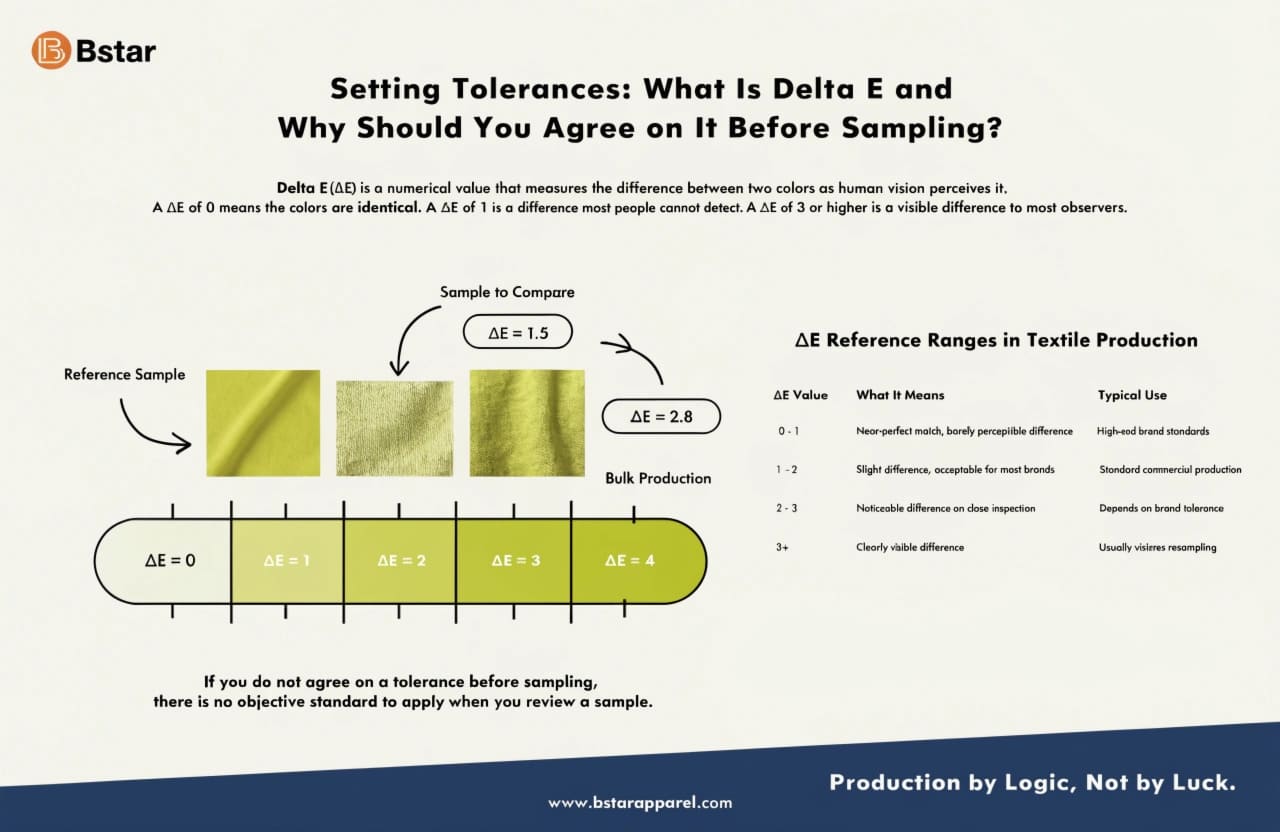
The reason this matters: if you do not agree on a tolerance before sampling, there is no objective standard to apply when you review a sample. One person’s "slightly off" is another person’s "acceptable." That ambiguity is where disputes happen.
ΔE Reference Ranges in Textile Production
| ΔE Value | What It Means | Typical Use |
|---|---|---|
| 0 – 1 | Near-perfect match, barely perceptible difference | High-end brand standards |
| 1 – 2 | Slight difference, acceptable for most brands | Standard commercial production |
| 2 – 3 | Noticeable difference on close inspection | Depends on brand tolerance |
| 3+ | Clearly visible difference | Usually requires resampling |
I want to be clear about one thing: there is no universal correct tolerance. The right ΔE range depends on your brand standards, your end market, and what you and your factory agree on. What matters is that you agree on a number before sampling — not after you receive a bulk shipment and are trying to decide whether to reject it.
At BSTAR, we ask clients to confirm their color tolerance expectation at the inquiry stage. Not because we are trying to lower the bar, but because it gives both sides a clear and shared target to work toward through every round of sampling.
From Digital to Physical: What Does a Proper Color Approval Process Actually Look Like?
Here is a pattern I see with first-time OEM buyers: they approve a sample by comparing it to their screen, or to a printed color swatch, under regular office lighting. Then bulk production comes in and the color looks wrong. The dispute starts.
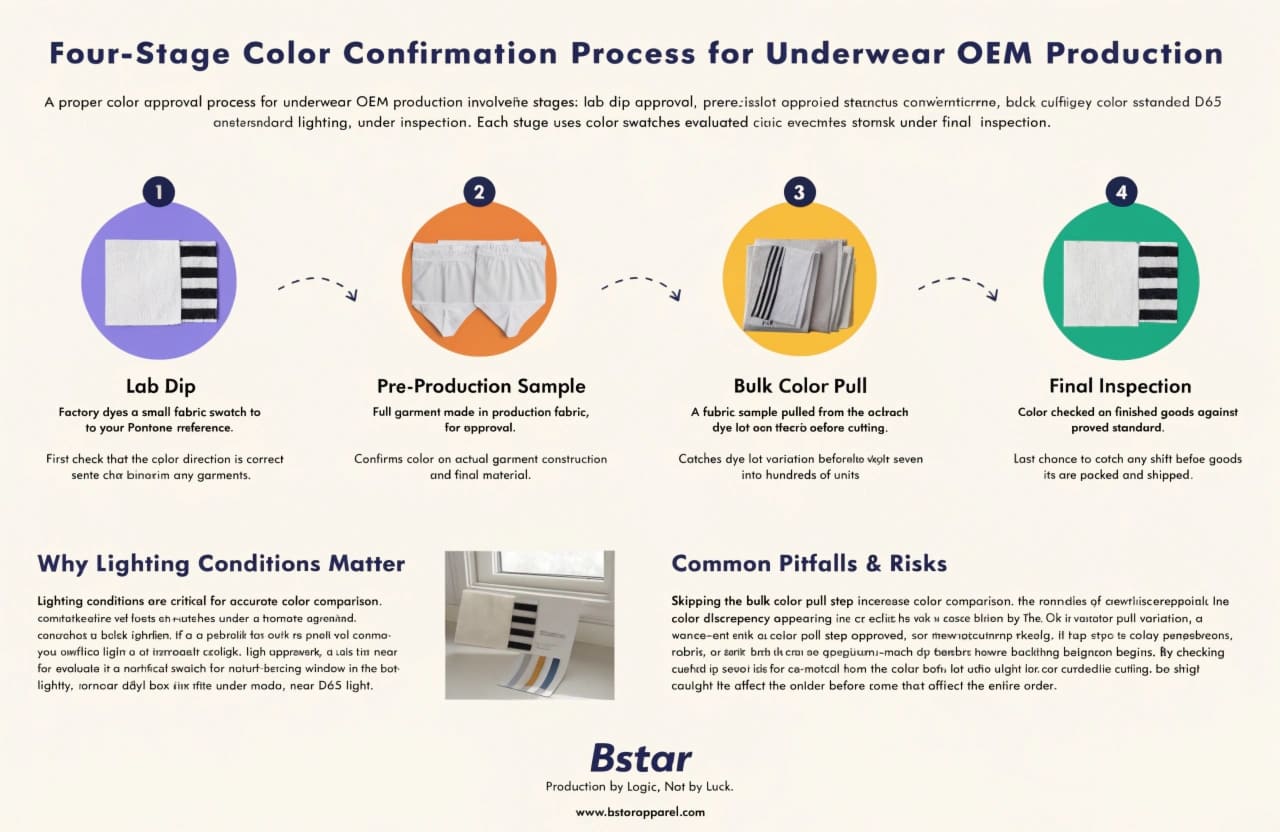
A proper color approval process for underwear production involves four stages: lab dip approval, pre-production sample confirmation, bulk color pull check, and final inspection. Each stage should use physical fabric swatches evaluated under D65 standard lighting — a daylight-equivalent light source — not screens or printed cards. Skipping any stage increases the risk of a color discrepancy appearing in bulk.
Let me walk through what each stage does and why it exists.
The Four-Stage Color Confirmation Process
| Stage | What Happens | Why It Matters |
|---|---|---|
| Lab Dip | Factory dyes a small fabric swatch to your Pantone reference | First check that the color direction is correct before cutting any garments |
| Pre-Production Sample | Full garment made in production fabric, sent for approval | Confirms color on actual garment construction and final material |
| Bulk Color Pull | A fabric sample pulled from the production dye lot before cutting | Catches dye lot variation before it is sewn into hundreds of units |
| Final Inspection | Color checked on finished goods against approved standard | Last chance to catch any shift before goods are packed and shipped |
The bulk color pull step is the one most buyers skip — and it is the most dangerous one to skip. Dye lots vary. Even when the lab dip and pre-production sample were approved, a new dye batch can shift slightly. By checking a swatch from the actual production dye lot before cutting begins, you can catch that shift before it affects your entire order.
One more thing about lighting: D65 standard lighting is a daylight-equivalent lamp specifically designed for color evaluation. Comparing fabric swatches under a warm office light or a phone camera is not a valid comparison. If your factory sends you a physical swatch for approval, evaluate it near a north-facing window in natural daylight, or under a D65 light box. This is the standard we use at BSTAR for all color confirmation with our international clients, and it is what we recommend buyers use on their end.
Conclusion
Pantone color matching in underwear production is manageable — but only if you use the right reference system, account for your fabric composition, agree on a Delta E tolerance, and follow a physical approval process at every stage.