
Hemp Underwear: The Rising Trend in Sustainable Menswear
Hemp underwear is everywhere in 2025 — but is it actually the right move for your brand, or just a trend that looks good on a product page?
Hemp underwear offers real advantages: natural antimicrobial properties, strong moisture-wicking performance, and a credible sustainability story backed by low-input cultivation. But whether it’s the right product-line decision depends on your customer profile, your blend strategy, and how well you can verify your supplier’s certifications.
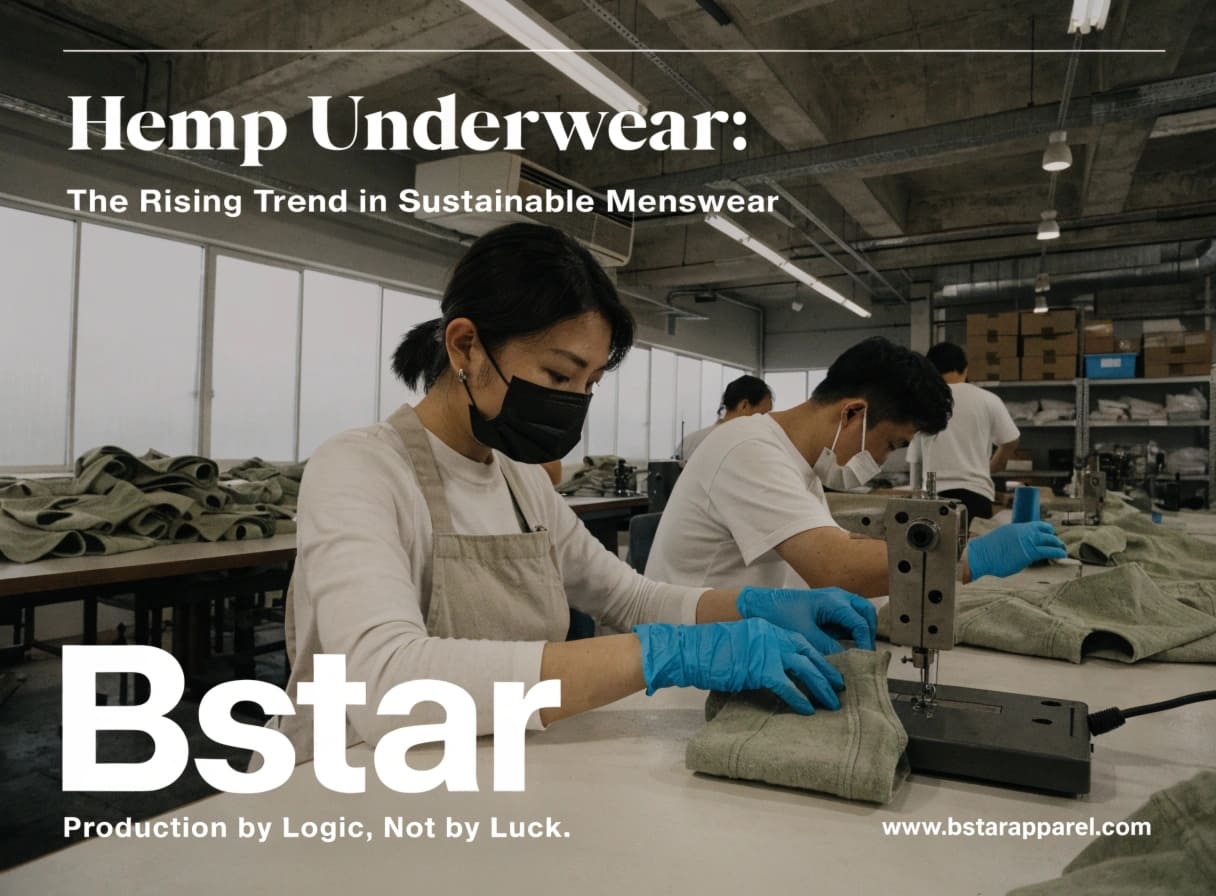
I’ve been on the production side of knitwear manufacturing for nearly two decades in Zhongshan, China. Over the past few years, we’ve fielded a growing number of inquiries from European and North American DTC brands asking about hemp-blend underwear. Some of those conversations led to successful product launches. Others helped brands realize hemp wasn’t the right fit — at least not yet. This article is built on those conversations, not on trend reports.
The Super Fiber Advantage: Does Hemp Actually Outperform Cotton?
Every material comparison article says hemp is "better" than cotton. But better for what, exactly?
Hemp fiber genuinely outperforms cotton in specific performance areas: it wicks moisture faster, resists bacterial odor more effectively due to its naturally porous structure1, and gets softer with repeated washing rather than degrading2. These are measurable, production-verified characteristics — not marketing copy.
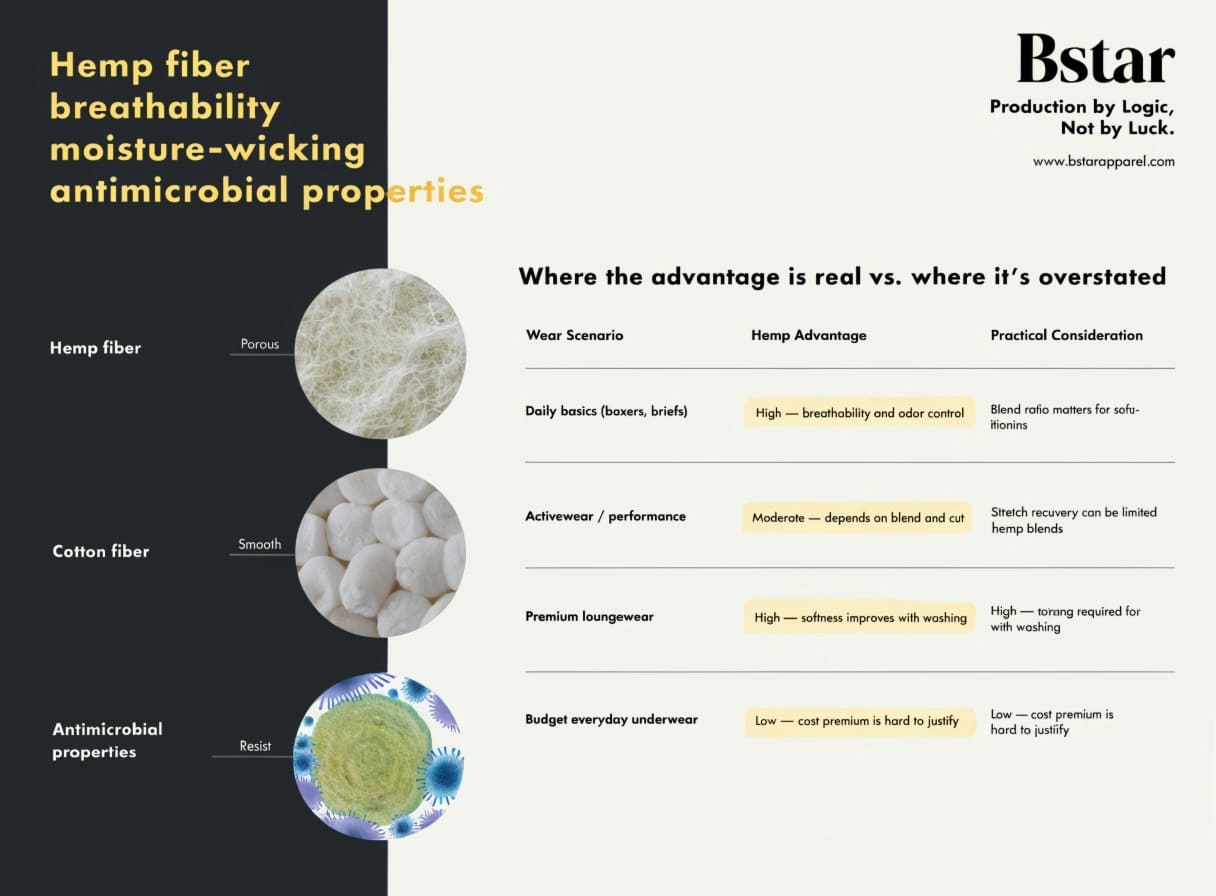
The key word is "specific." In our experience producing hemp-blend underwear, the performance edge shows up most clearly in everyday basics and warm-weather wear — scenarios where breathability and odor control actually matter to the end customer. It shows up less clearly in structured or compression-fit styles where the hand-feel of the fabric dominates the wearing experience.
Where the advantage is real vs. where it’s overstated
| Wear Scenario | Hemp Advantage | Practical Consideration |
|---|---|---|
| Daily basics (boxers, briefs) | High — breathability and odor control | Blend ratio matters for softness |
| Activewear / performance | Moderate — depends on blend and cut | Stretch recovery can be limited in high-hemp blends |
| Premium loungewear | High — softness improves with washing | Bio-processing required for initial hand-feel |
| Budget everyday underwear | Low — cost premium is hard to justify | Wrong segment for hemp positioning |
The honest take: hemp is a strong performer in the right use case. Brands that try to apply it across every SKU in their line without thinking about fit-to-use-case end up with a mixed customer experience — and a sustainability story that gets undermined by return rates and negative reviews.
One thing clients commonly ask us is whether hemp is worth the cost increase over standard organic cotton. The answer depends entirely on whether their customer is buying for performance, for credentials, or for both. If it’s purely credentials, there are cheaper ways to get certified sustainable fabric. If it’s performance plus credentials, hemp-blend has a real case.
Redefining Comfort: Is Hemp Too Rough for Underwear?
This is the question almost every DTC founder asks us. And it’s a fair one.
Raw hemp fiber is stiffer than cotton3. But modern blending — typically with cotton, modal, or Tencel — combined with bio-enzymatic processing significantly softens the fabric4. A well-processed 55% hemp / 45% cotton blend can achieve a hand-feel that most consumers find comparable to mid-weight organic cotton within a few washes5.
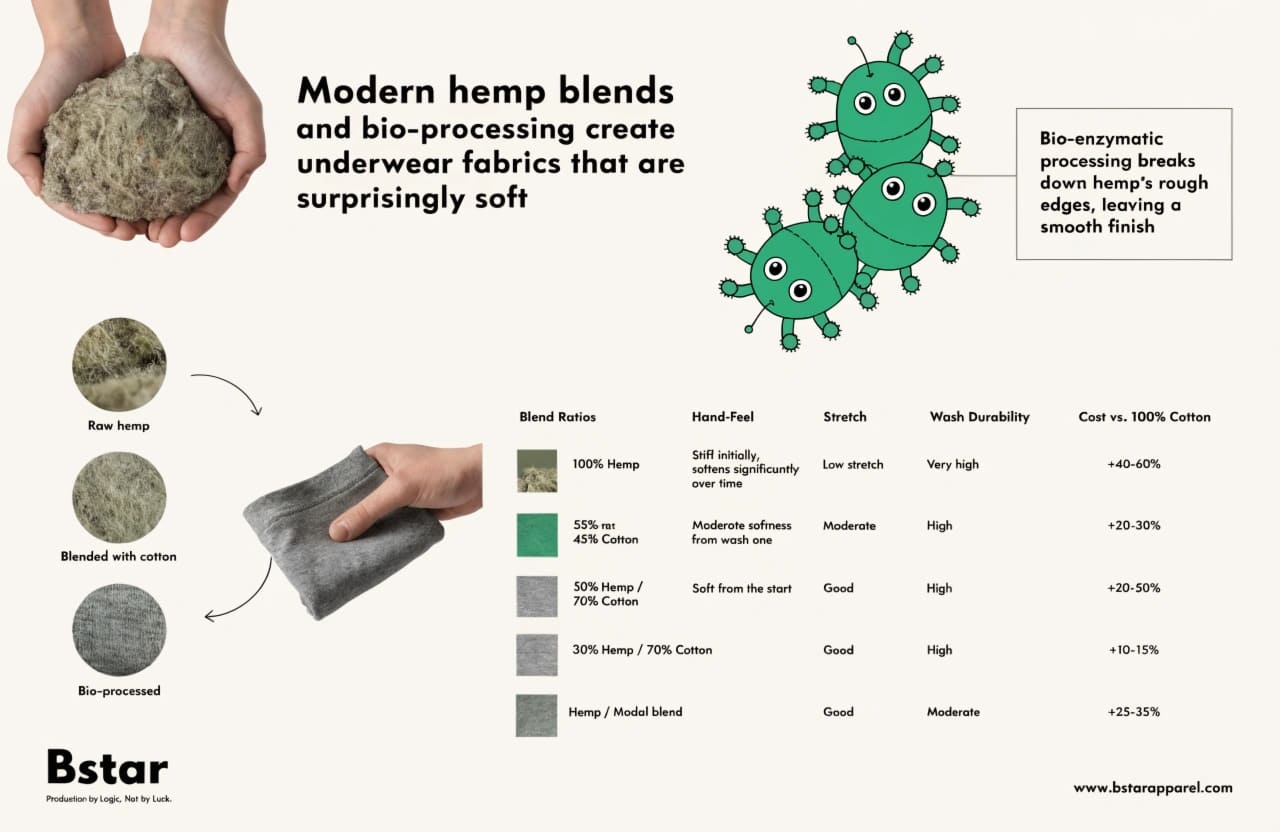
The "hemp is scratchy" reputation comes mostly from raw or minimally processed hemp products — think early-stage sustainable fashion brands that launched without adequate finishing processes. That’s a sourcing and manufacturing problem, not a fiber problem.
What blend ratios actually do to the product
Here’s what we see in production when brands choose different blend ratios:
| Blend Ratio | Hand-Feel | Stretch | Wash Durability | Cost vs. 100% Cotton |
|---|---|---|---|---|
| 100% Hemp | Stiff initially, softens significantly over time | Low stretch | Very high | +40–60% |
| 55% Hemp / 45% Cotton | Moderate softness from wash one | Moderate | High | +20–30% |
| 30% Hemp / 70% Cotton | Soft from the start | Good | High | +10–15% |
| Hemp / Modal blend | Soft, drapes well | Good | Moderate | +25–35% |
For most DTC brands entering the hemp category for the first time, a 30–55% hemp blend is the practical starting point. It delivers enough hemp content to make a credible sustainability claim, while keeping the comfort profile accessible to customers who haven’t worn hemp before.
The decision on blend ratio isn’t just a marketing label choice. It changes how the product performs, how it feels in the first few wears, and how it behaves after 50 wash cycles. These are product decisions that need to be made before you brief a supplier, not after samples arrive.
Eco-Friendly Cultivation: Is Hemp’s Sustainability Story Actually Verified?
Hemp’s environmental credentials are real — but they’re not automatically transferable to your product.
Hemp requires significantly less water than conventional cotton6 (exact figures vary by source and growing region — check third-party agricultural research before citing specific numbers), needs no synthetic pesticides under standard cultivation7, and improves soil health through a process called phytoremediation8. These are well-documented agronomic characteristics.
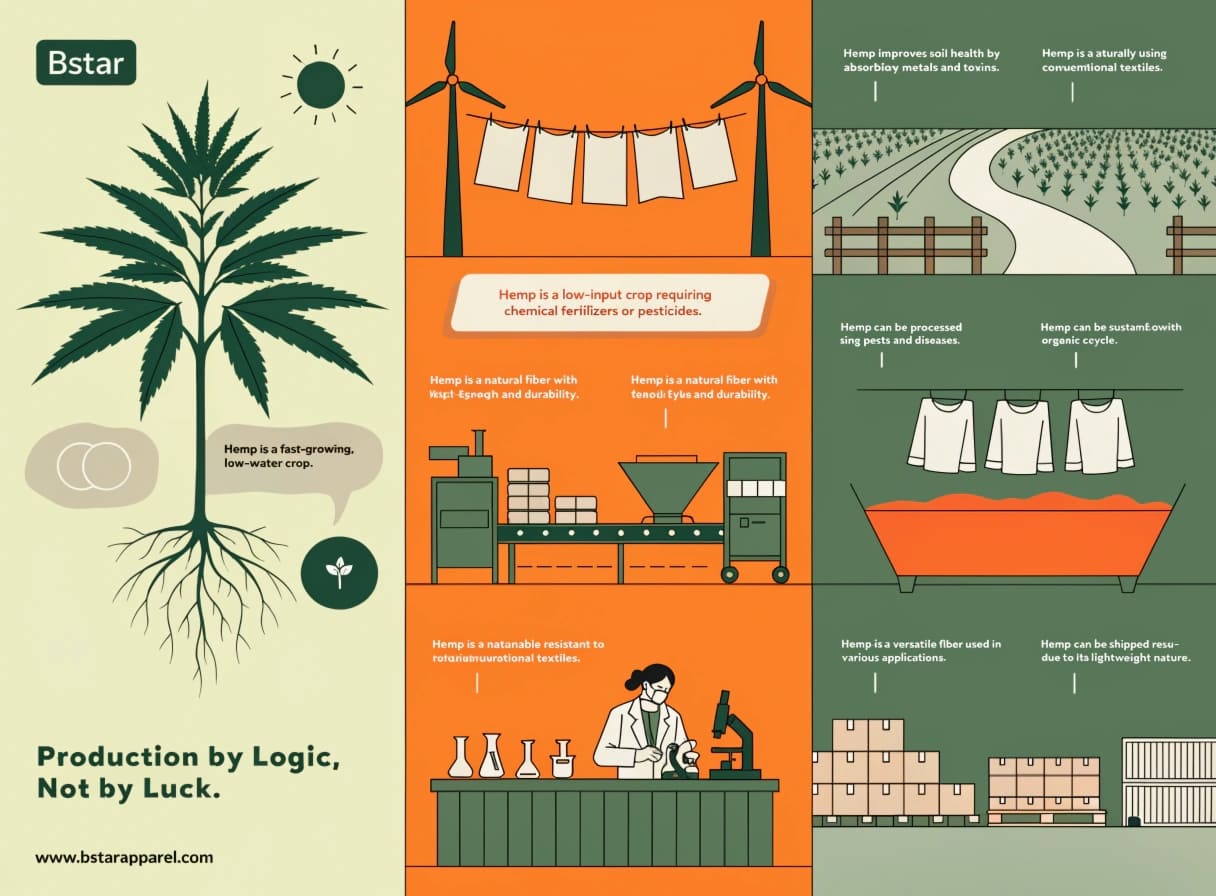
The problem is that the sustainability of the fiber at the farm level doesn’t automatically make your finished product sustainable. What happens between the hemp field and the finished underwear — the retting process, the dyeing, the finishing, the transportation — all carries its own environmental and compliance footprint.
The certification gap that DTC brands miss
This is where we see brands get into trouble. A supplier can source certified hemp fiber and still use non-compliant dyes, or lack chain-of-custody documentation that connects the certified fiber to the finished garment. That gap is what creates greenwashing exposure.
The certifications that actually matter for a finished hemp underwear product include:
- GOTS (Global Organic Textile Standard) — covers the entire chain from fiber to finished product, including dyes and processing chemicals
- OEKO-TEX® Standard 100 — certifies that the finished product is free from harmful substances
- GRS (Global Recycled Standard) — relevant if your blend includes recycled fibers
When we talk to clients evaluating manufacturers, we consistently tell them: ask for chain-of-custody documentation, not just a certificate number. A certificate number can be valid for one product and not applied to another. Chain-of-custody documentation shows that the certified material was used in your specific order.
A small-batch DTC startup doing 500-piece drops faces different verification challenges than a scaling brand doing 10,000+ units per run. At small volumes, you’re more dependent on your manufacturer’s documentation because you can’t afford third-party audits on every run. At scale, building audit checkpoints into your production contract becomes feasible and necessary.
Market Positioning: Does the EU 2030 Textile Strategy Actually Help You Sell Hemp Underwear?
The regulatory tailwind is real, but it’s not a marketing strategy by itself.
The EU 2030 Textile Strategy introduces extended producer responsibility and mandatory sustainability disclosures for textiles sold in the EU market9. Brands with documented sustainable material sourcing — including certified hemp-blend products — will face fewer compliance barriers and have stronger standing with retail buyers and conscious consumers in that market.
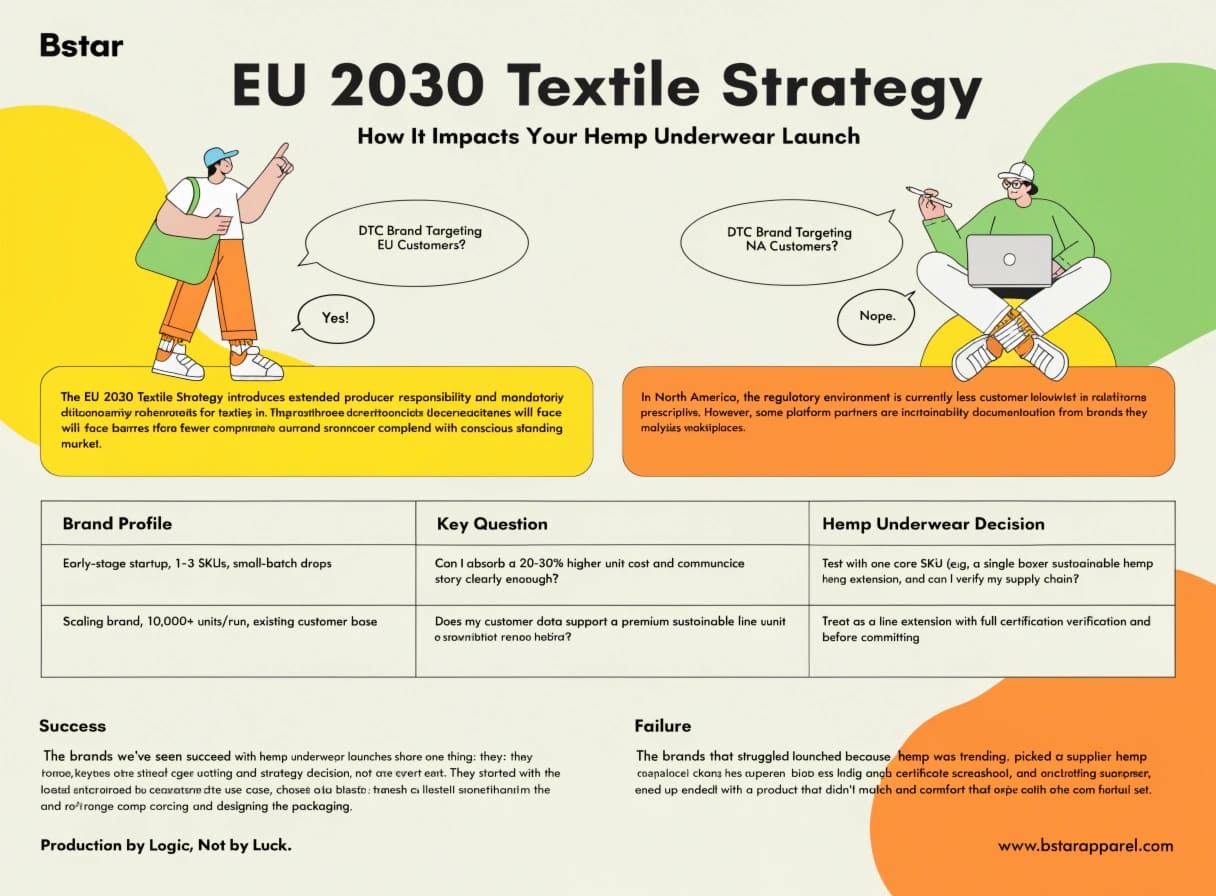
For DTC brands targeting European customers, this matters more than for brands focused on the North American market, where the regulatory environment is currently less prescriptive. But even in North America, we’re seeing more wholesale buyers and platform partners (including some major marketplaces) start to ask for sustainability documentation from brands they carry10.
Two different brand profiles, two different decisions
The calculus for launching a hemp underwear line is genuinely different depending on where your brand is:
| Brand Profile | Key Question | Hemp Underwear Decision |
|---|---|---|
| Early-stage startup, 1–3 SKUs, small-batch drops | Can I absorb a 20–30% higher unit cost and communicate the value story clearly enough? | Test with one core SKU (e.g., a single boxer style) in a mid-range hemp blend before expanding |
| Scaling brand, 10,000+ units/run, existing customer base | Does my customer data support a premium sustainable line extension, and can I verify my supply chain? | Treat as a line extension with full certification verification and a cost-per-unit analysis before committing |
The brands we’ve seen succeed with hemp underwear launches share one thing: they treated it as a sourcing and product strategy decision, not as a marketing one. They started with the customer use case, chose a blend that matched it, and then verified the supply chain before designing the packaging.
The brands that struggled launched because hemp was trending, picked a supplier based on price and a certificate screenshot, and ended up with a product that didn’t match the comfort expectations the marketing had set.
Conclusion
Hemp underwear has real merit — but only for brands that match the right blend to the right customer, verify their supply chain beyond surface-level certifications, and treat it as a product decision first, not a trend.
-
"Improved antibacterial activity of hemp fibre by covalent grafting of …", https://pmc.ncbi.nlm.nih.gov/articles/PMC8074917/. Research into hemp fiber morphology has documented its multicellular, porous structure, which is associated with enhanced moisture absorption and transport; some studies also report inhibitory effects on bacterial growth, though the magnitude of these effects varies by processing method and test conditions. Evidence role: mechanism; source type: paper. Supports: That hemp fiber’s porous structure contributes to superior moisture transport and resistance to bacterial odor compared to cotton. Scope note: Antimicrobial performance in finished blended fabrics may differ substantially from raw fiber test results, and direct comparative studies with cotton under identical conditions are limited. ↩
-
"Hemp Fabric Usage, Properties, and Benefits of Hemp Textile", https://hemptique.com/pages/what-is-hemp-fabric?srsltid=AfmBOopYWJtcMM9s7k2oVtPIFxdAcL9BvVCiVE-NfE_boR058vSEuU-T. Textile durability studies on bast fibers, including hemp, have noted that repeated mechanical action during laundering can progressively separate fiber bundles, contributing to a softer hand-feel over time; cotton, by contrast, is subject to fiber fibrillation and tensile degradation under similar conditions. Evidence role: mechanism; source type: paper. Supports: That hemp fiber retains or improves its tactile properties through repeated laundering cycles relative to cotton. Scope note: Comparative softening outcomes are highly dependent on blend ratio, finishing treatments, and wash conditions, and may not generalize across all hemp-blend constructions. ↩
-
"Applications of Hemp Polymers and Extracts in Food, Textile … – PMC", https://pmc.ncbi.nlm.nih.gov/articles/PMC9612365/. Comparative studies of natural fiber mechanical properties have consistently reported higher bending rigidity and coarser surface morphology in raw hemp fiber relative to cotton, attributable to hemp’s higher lignin and hemicellulose content in the unretted or minimally processed state. Evidence role: general_support; source type: paper. Supports: That raw hemp fiber exhibits greater stiffness than cotton fiber in its unprocessed state. Scope note: Fiber stiffness measurements vary depending on retting method, fiber fineness, and test methodology; processed or degummed hemp fiber may approach cotton in flexibility, making the comparison most applicable to minimally processed material. ↩
-
"Hemp Fibre Properties and Processing Target Textile: A Review", https://pmc.ncbi.nlm.nih.gov/articles/PMC8911747/. Textile chemistry literature documents the use of cellulase and pectinase enzyme treatments in the processing of bast fibers, including hemp, to degrade surface fibrils and pectin-bound fiber bundles, resulting in measurable reductions in fabric stiffness and improvements in tactile softness. Evidence role: mechanism; source type: paper. Supports: That enzymatic treatments applied during textile finishing can reduce the stiffness of hemp fiber and improve hand-feel. Scope note: The degree of softening achieved through enzymatic processing depends on enzyme concentration, treatment duration, temperature, and the specific hemp cultivar and retting method used, and results may not be uniform across production batches. ↩
-
"Consumer Preferences and Willingness to Pay for Hemp-Blend …", https://repository.lsu.edu/gradschool_theses/6269/. Sensory evaluation studies of blended natural fiber fabrics have found that hemp-cotton blends with sufficient cotton content and appropriate finishing treatments can achieve hand-feel ratings comparable to all-cotton controls after repeated laundering, with the rate of softening influenced by blend ratio and finishing chemistry. Evidence role: general_support; source type: paper. Supports: That hemp-cotton blended fabrics can achieve tactile properties comparable to all-cotton fabrics after laundering. Scope note: The specific 55/45 blend ratio cited in the article reflects the manufacturer’s production experience; published studies may use different blend ratios or evaluation protocols, limiting direct comparability. ↩
-
"Water use and productivity of Cannabis sativa L., KwaZulu-Natal …", https://pmc.ncbi.nlm.nih.gov/articles/PMC12398160/. Agronomic assessments of industrial hemp have generally found lower irrigation requirements per kilogram of fiber compared to conventional cotton, with some lifecycle analyses citing hemp’s capacity to rely predominantly on rainfall in temperate climates; however, precise water-use figures vary considerably by cultivar, region, and yield assumptions. Evidence role: statistic; source type: research. Supports: That hemp cultivation requires less water per unit of fiber produced than conventional cotton under comparable growing conditions. Scope note: Water consumption comparisons are sensitive to geographic and methodological differences across studies, and the article appropriately notes that specific figures should be verified against primary agricultural research. ↩
-
"[PDF] New Mexico Department of Agriculture Hemp Production Regulatory …", https://www.ams.usda.gov/sites/default/files/media/NMhempstateplan.pdf. USDA and university extension resources on industrial hemp cultivation note that the crop demonstrates relatively low susceptibility to many common pests and diseases, and that certified organic production without synthetic pesticides is feasible under appropriate growing conditions. Evidence role: expert_consensus; source type: government. Supports: That industrial hemp can be cultivated without synthetic pesticide applications under standard agronomic conditions. Scope note: Pest pressure varies by region and growing season; the absence of synthetic pesticide requirements is not universal and may not apply in all cultivation contexts. ↩
-
""Phytoremediation of mining contaminated soil and groundwater by …", https://digitalcommons.mtech.edu/grad_rsch/254/. Scientific literature has documented Cannabis sativa’s capacity for phytoextraction of heavy metals and other soil contaminants, and the crop is also associated with soil structure improvement through deep root systems and organic matter return from leaf litter; hemp has been studied for remediation at contaminated sites including Chernobyl. Evidence role: mechanism; source type: paper. Supports: That hemp plants can absorb contaminants from soil through phytoremediation and contribute to soil health improvement. Scope note: Phytoremediation effectiveness is highly site-specific, and hemp grown for fiber on agricultural land may not exhibit the same remediation outcomes as hemp cultivated specifically for contamination cleanup. ↩
-
"Textiles Strategy – Environment – European Commission", https://environment.ec.europa.eu/strategy/textiles-strategy_en. The European Commission’s 2022 EU Strategy for Sustainable and Circular Textiles outlines policy measures including extended producer responsibility for textiles, mandatory ecodesign requirements, and provisions for digital product passports intended to improve transparency of sustainability claims across the textile value chain. Evidence role: historical_context; source type: government. Supports: That the EU’s strategy for sustainable and circular textiles includes extended producer responsibility schemes and mandatory sustainability disclosure requirements. Scope note: As of the article’s publication context, several measures within the strategy remain in legislative development or phased implementation, and the precise compliance obligations for specific product categories may not yet be fully codified. ↩
-
"Sustainable Fashion and Apparel Design: Standards | Certificates", https://guides.library.cornell.edu/c.php?g=662121&p=5277662. Industry surveys and trade association reports from organizations such as the Sustainable Apparel Coalition and Business of Fashion have documented a growing trend among retail buyers and marketplace operators to incorporate sustainability criteria, including material certifications and supply chain documentation, into vendor onboarding and compliance requirements. Evidence role: general_support; source type: institution. Supports: That retail buyers and e-commerce platforms are increasingly requiring sustainability credentials and documentation from apparel brands. Scope note: The extent and formality of these requirements varies significantly by buyer, platform, and market segment; the claim reflects a directional industry trend rather than a uniform or legally mandated standard. ↩