
What Instagram Marketing Strategy Actually Works for a New Underwear Brand?
Buyers keep asking if fabric dyeing is "bad for the environment." The real problem is that question leads nowhere useful — and the wrong answer from a supplier could put your brand at serious risk.
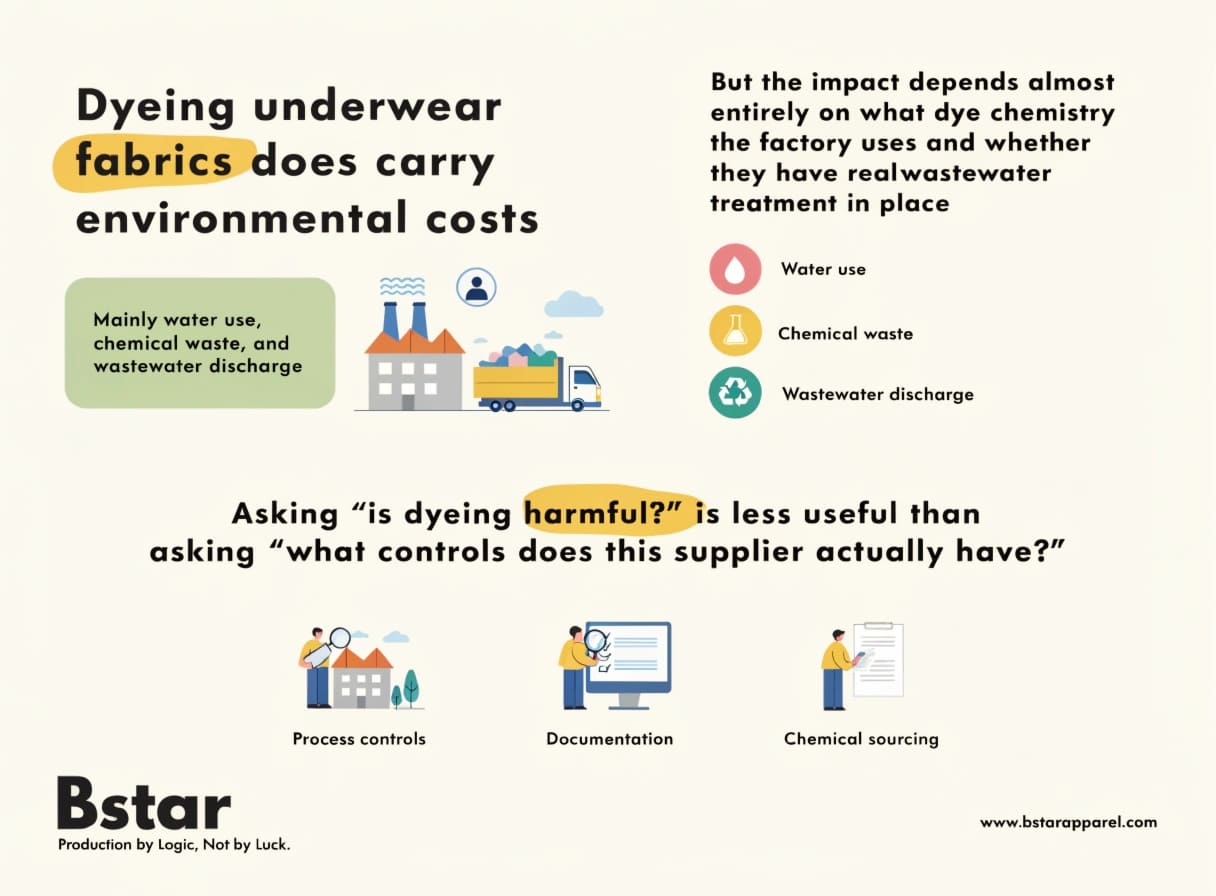
Dyeing underwear fabrics does carry environmental costs — mainly water use, chemical waste, and wastewater discharge. But the impact depends almost entirely on what dye chemistry the factory uses and whether they have real wastewater treatment in place. Asking "is dyeing harmful?" is less useful than asking "what controls does this supplier actually have?"
I work on the factory side. At BSTAR, we manage dyeing in-house for knit underwear and intimate apparel, and we field these questions from overseas buyers constantly. What I’ve noticed is that most buyers come in asking the wrong question. Once we shift the conversation to process controls and documentation, the picture gets a lot clearer — and so does the risk of choosing a supplier who can’t answer those questions.
What Is the Hidden Cost of Color in Traditional Dyeing?
Most buyers know dyeing uses chemicals. Few know how much water is involved — or what leaves the factory after the process is done.
Traditional fabric dyeing is water-intensive. A significant portion of the dye chemicals used do not fully bond to the fiber and end up in the wastewater1. This means every batch of dyed underwear fabric produces colored, chemically loaded effluent that must be treated before it is discharged.
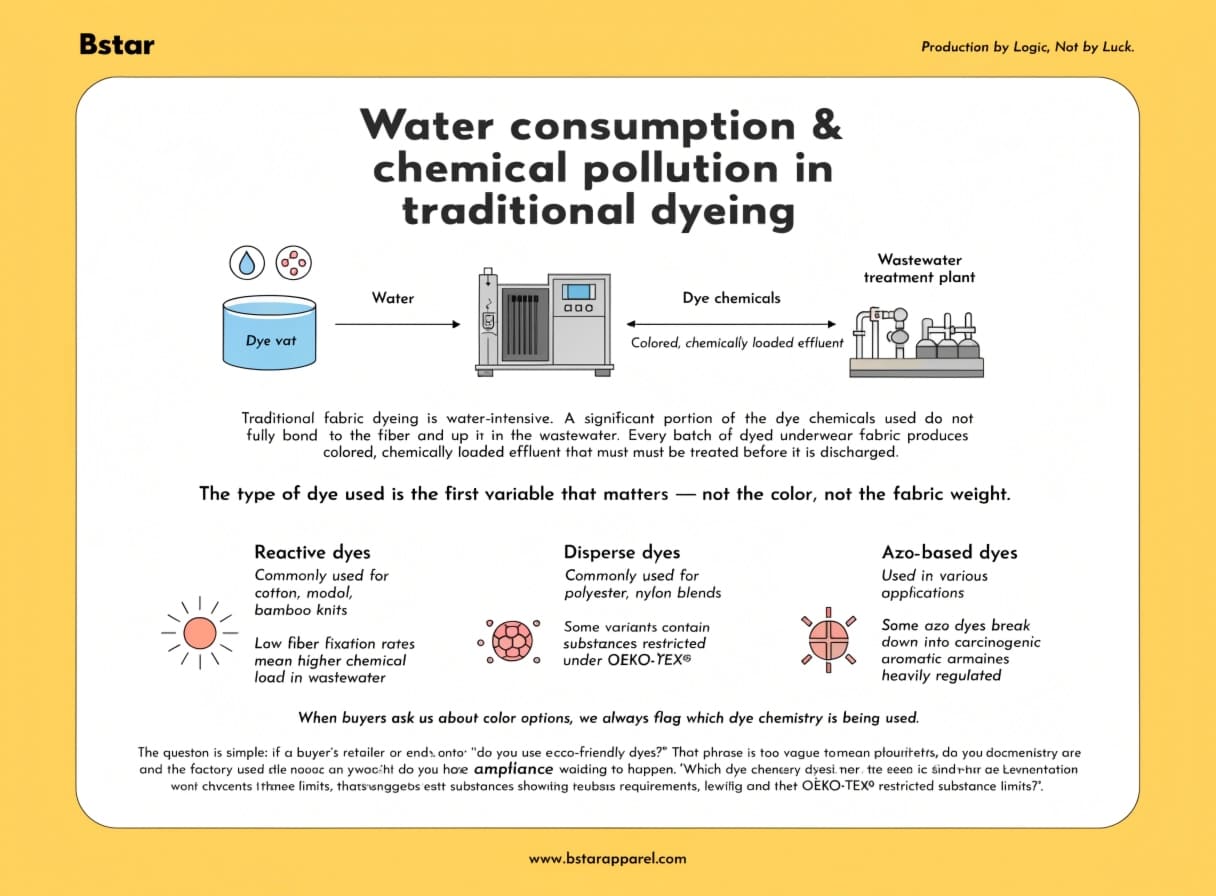
The type of dye used is the first variable that matters here — not the color, not the fabric weight.
Why Dye Chemistry Matters More Than Most Buyers Realize
Different dye types behave very differently in terms of how much chemical stays in the water versus bonds to the fiber. Here’s a basic breakdown of what we work with in knit underwear production:
| Dye Type | Common Use in Underwear | Key Environmental Risk |
|---|---|---|
| Reactive dyes | Cotton, modal, bamboo knits | Low fiber fixation rates mean higher chemical load in wastewater |
| Disperse dyes | Polyester, nylon blends | Some variants contain substances restricted under OEKO-TEX® |
| Azo-based dyes | Various | Some azo dyes break down into carcinogenic aromatic amines — heavily regulated2 |
When buyers ask us about color options, we always flag which dye chemistry is being used. The reason is simple: if a buyer’s retailer or end market has restricted substance requirements, and the factory used an azo dye that wasn’t checked against those limits, that’s a compliance problem waiting to happen.
The question buyers should ask is not "do you use eco-friendly dyes?" That phrase is too vague to mean anything. The right question is: "Which dye chemistry are you using for this fabric, and do you have documentation showing it meets OEKO-TEX® restricted substance limits?"
What Are the Real Health and Environmental Risks of Synthetic Dyes and Wastewater?
Untreated or poorly treated dyeing wastewater is one of the more documented environmental problems in textile manufacturing3. The risk is not hypothetical.
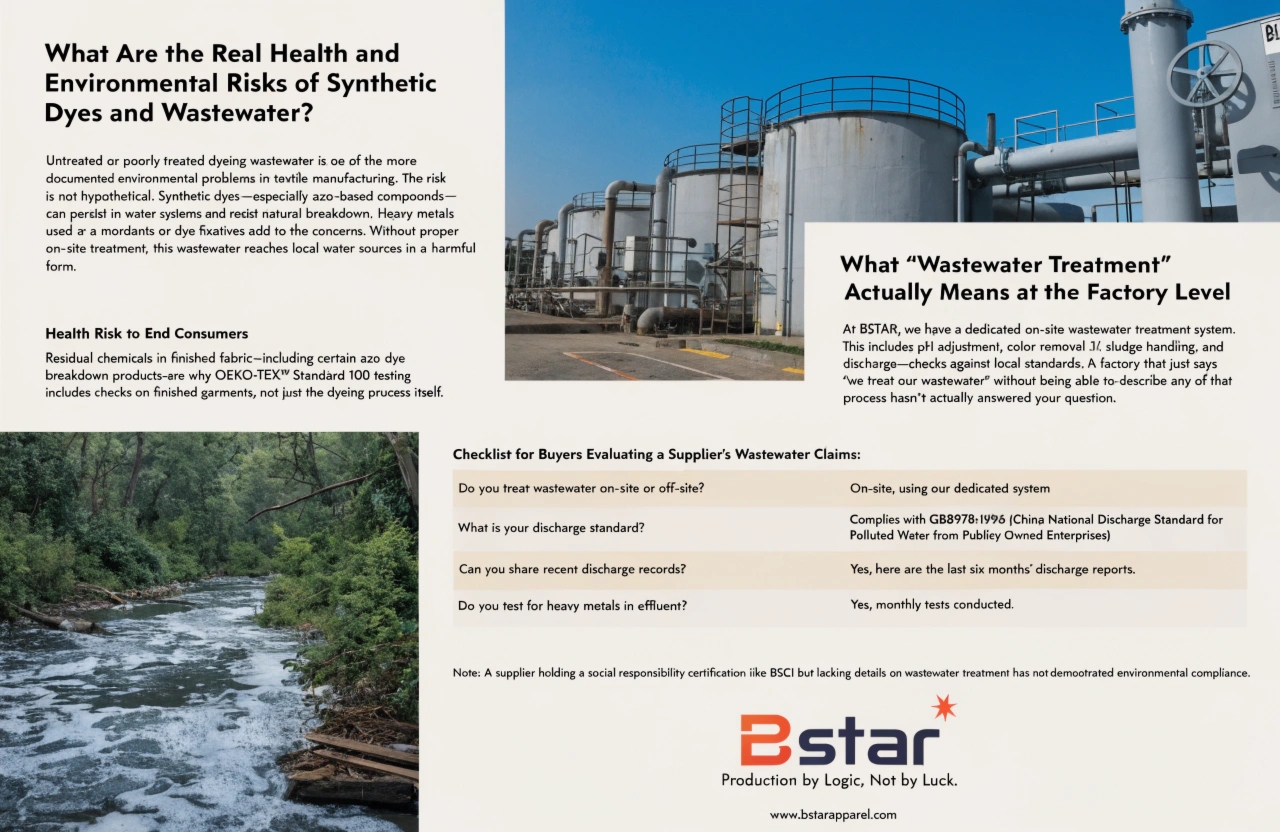
Synthetic dyes — particularly certain azo-based compounds — can persist in water systems and resist natural breakdown4. Heavy metals used as mordants or dye fixatives in some processes add another layer of concern5. Without proper on-site treatment, this wastewater reaches local water sources in a form that’s harmful to ecosystems and human health.
This is where "wastewater treatment" stops being a vague sustainability term and becomes a concrete factory-floor question.
What "Wastewater Treatment" Actually Means at the Factory Level
When we handle wastewater from our dyeing process at BSTAR, there are specific steps involved — pH adjustment, color removal, sludge handling, and discharge checks against local standards. A factory that just says "we treat our wastewater" without being able to describe any of that process hasn’t actually answered your question.
Here’s a practical checklist for buyers evaluating a supplier’s wastewater claims:
| Question to Ask the Supplier | What a Credible Answer Looks Like |
|---|---|
| Do you treat wastewater on-site or off-site? | Clear answer with a description of the method |
| What is your discharge standard? | Reference to a specific national or local regulatory standard |
| Can you share recent discharge records? | Actual documentation, not a verbal assurance |
| Do you test for heavy metals in effluent? | Yes, with testing frequency specified |
A supplier that holds a social responsibility certification like BSCI but cannot walk through their wastewater process has not demonstrated environmental compliance — they’ve demonstrated they passed an audit on labor and social conditions6, which is a different thing entirely.
The health risk to end consumers is also real. Residual chemicals in finished fabric — particularly certain azo dye breakdown products — are why OEKO-TEX® Standard 100 testing includes checks on finished garments7, not just the dyeing process itself.
Are Waterless Dyeing and Digital Printing Actually Practical Solutions?
There’s a lot of marketing noise around "waterless dyeing" and "digital printing" as sustainable alternatives. Some of it is real. Some of it is overstated.
Waterless dyeing technologies — such as supercritical CO₂ dyeing — do reduce water use significantly and eliminate dye-laden wastewater8. Digital printing avoids dye bath processes entirely for certain applications. These are genuine innovations, but they are not universally applicable to all underwear fabric types or production volumes.
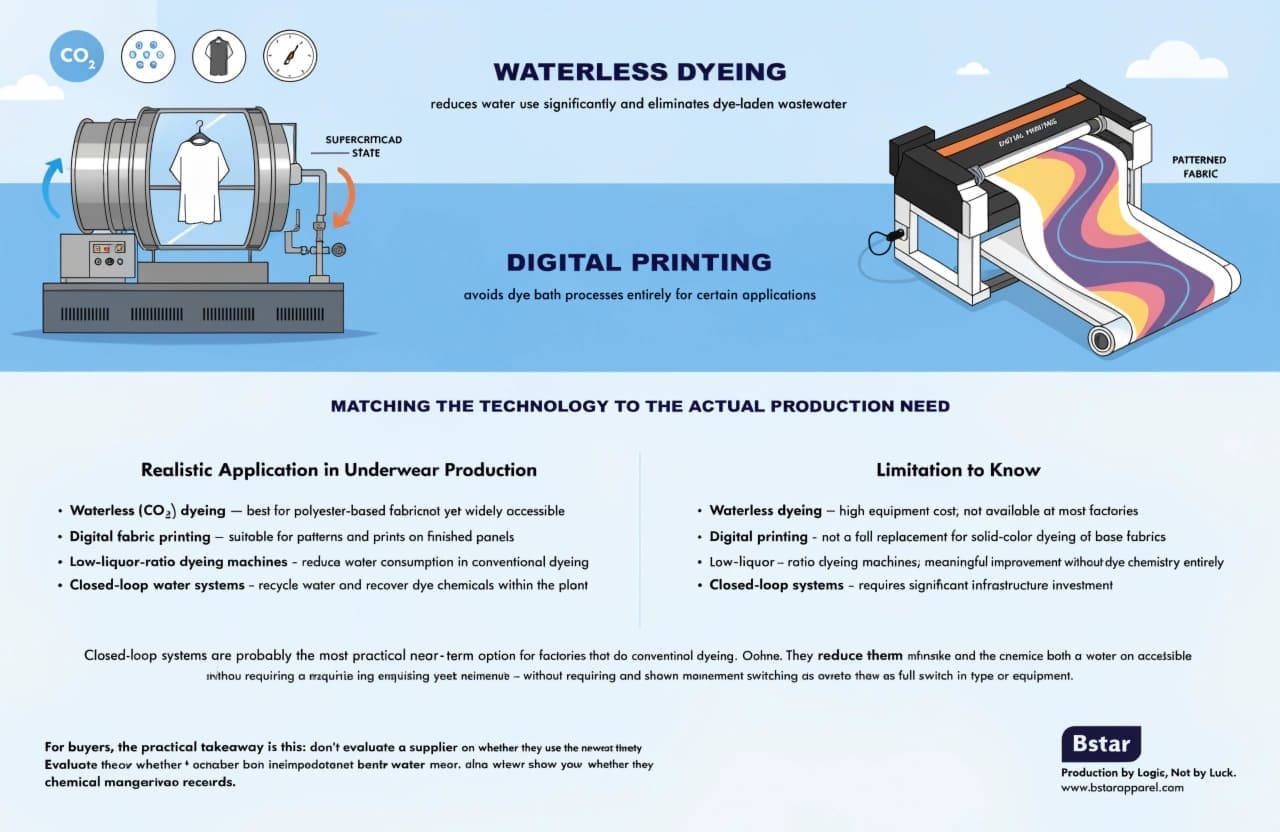
Here’s what I’ve seen in practice from managing production for knit underwear:
Matching the Technology to the Actual Production Need
| Technology | Realistic Application in Underwear Production | Limitation to Know |
|---|---|---|
| Waterless (CO₂) dyeing | Best for polyester-based fabrics; not yet widely accessible | High equipment cost; not available at most factories9 |
| Digital fabric printing | Suitable for patterns and prints on finished panels | Not a full replacement for solid-color dyeing of base fabrics |
| Closed-loop water systems | Recycles water and recovers dye chemicals within the plant | Requires significant infrastructure investment |
| Low-liquor-ratio dyeing machines | Reduces water consumption in conventional dyeing | More accessible; meaningful improvement without switching dye chemistry entirely |
Closed-loop systems are probably the most practical near-term option for factories that do conventional dyeing at volume. They reduce both water intake and the chemical load in discharge — without requiring a full switch in dye type or equipment.
For buyers, the practical takeaway is this: don’t evaluate a supplier on whether they use the newest technology. Evaluate them on whether they have implemented any measurable improvement in water and chemical management, and whether they can show you the records.
How Do Certifications Like OEKO-TEX and GOTS Actually Help Buyers?
Certifications are useful tools. But they are easy to misread — and some suppliers count on buyers misreading them.
GOTS, OEKO-TEX® Standard 100, and GRS each cover different parts of the supply chain and make different claims. Treating them as interchangeable leads to real procurement risk. Knowing what each one actually certifies about the dyeing process helps buyers ask sharper questions.
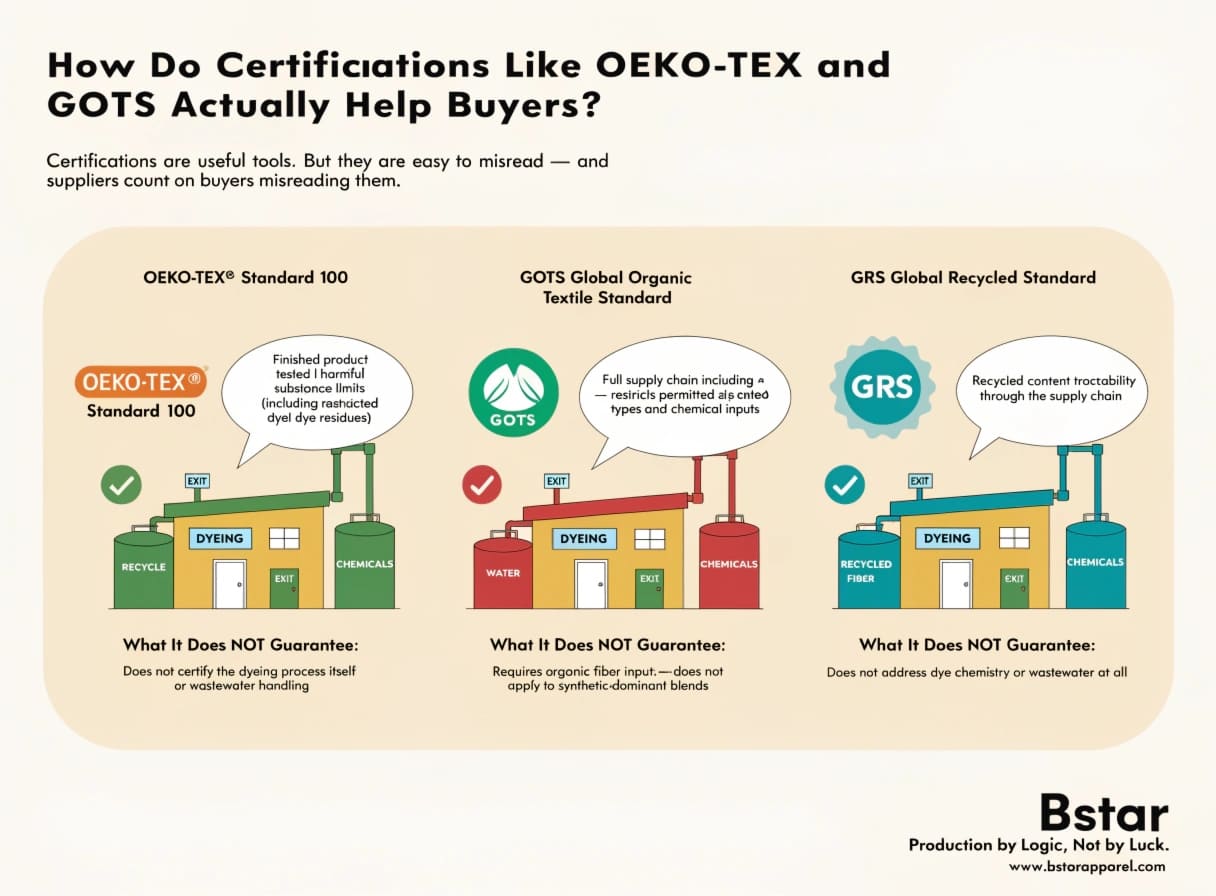
At BSTAR, our raw materials carry OEKO-TEX®, GOTS, and GRS certifications. When buyers ask us what that means for their finished product, we always break it down the same way — because lumping the three together gives a misleading picture.
What Each Certification Actually Covers in the Dyeing Context
| Certification | What It Certifies | What It Does NOT Guarantee |
|---|---|---|
| OEKO-TEX® Standard 100 | Finished product tested for harmful substance limits (including restricted dye residues) | Does not certify the dyeing process itself or wastewater handling |
| GOTS (Global Organic Textile Standard) | Full supply chain including dyeing — restricts permitted dye types and chemical inputs | Requires organic fiber input; does not apply to synthetic-dominant blends |
| GRS (Global Recycled Standard) | Recycled content traceability through the supply chain | Does not address dye chemistry or wastewater at all |
So a buyer who says "this factory is GRS certified, so we’re covered on the environmental side" has misread the certification. GRS tells you the recycled fiber input is traceable. It says nothing about what dye was used on that fiber.
The most direct request a buyer can make to a supplier is: "Can you show me your dye compliance documentation and your most recent wastewater discharge records?" A supplier that can answer that question with actual paperwork — not just a list of certification logos — is in a very different position from one that cannot.
At BSTAR, when buyers ask us this, we walk them through our dye selection records, our OEKO-TEX® substance compliance documentation, and our wastewater handling process. That conversation is more useful to both sides than any marketing claim.
Conclusion
The environmental impact of dyeing underwear fabrics is real — but it is manageable. The supplier you choose, and the questions you ask them, determine your actual risk far more than the fact of dyeing itself.
-
"A critical review of textile industry wastewater: green technologies …", https://pmc.ncbi.nlm.nih.gov/articles/PMC10041522/. Studies on reactive dye fixation efficiency report that between 20% and 50% of reactive dye applied to cellulosic fibers such as cotton may remain unfixed and pass into effluent, depending on dye class and process conditions. Evidence role: statistic; source type: paper. Supports: The proportion of reactive dye that fails to bond to cellulosic fiber and is discharged in wastewater. Scope note: Fixation rates vary considerably by dye class, fiber type, and process parameters; a single figure may not represent all production scenarios. ↩
-
"[PDF] IARC Monographs Volume 127: Some Aromatic Amines and …", https://www.iarc.who.int/wp-content/uploads/2020/06/QA_Monographs_Volume-127.pdf. Regulatory frameworks including EU REACH Annex XVII restrict the use of azo colorants that can release specific aromatic amines — several of which are classified as carcinogenic by the International Agency for Research on Cancer — in textile articles intended for prolonged skin contact. Evidence role: mechanism; source type: government. Supports: That reductive cleavage of certain azo dyes releases aromatic amines classified as carcinogenic. Scope note: Not all azo dyes release regulated amines; the hazard is specific to particular azo structures and cleavage conditions. ↩
-
"A critical review of textile industry wastewater: green technologies …", https://pmc.ncbi.nlm.nih.gov/articles/PMC10041522/. Reports from international bodies including the United Nations Environment Programme identify the textile dyeing and finishing sector as a major contributor to industrial water pollution globally, citing the volume, chemical complexity, and color load of dyehouse effluent as persistent environmental concerns. Evidence role: expert_consensus; source type: institution. Supports: That textile dyeing wastewater represents a significant and well-documented source of industrial water pollution. Scope note: Aggregate pollution rankings vary by methodology and region; the relative severity of textile dyeing compared to other industrial sources depends on geographic and sectoral context. ↩
-
"Systematic Evaluation of Biodegradation of Azo Dyes by …", https://pmc.ncbi.nlm.nih.gov/articles/PMC12387045/. Environmental chemistry literature documents that many synthetic azo dyes exhibit structural stability that renders them resistant to conventional aerobic biodegradation, contributing to persistent coloration and toxicity in receiving water bodies. Evidence role: mechanism; source type: paper. Supports: That azo-based synthetic dyes resist natural biodegradation and persist in water systems. Scope note: Degradation rates differ substantially across dye structures, environmental conditions, and treatment methods; the claim of persistence applies selectively rather than universally to all azo compounds. ↩
-
"Heavy metal contamination from textile wastewater and its health …", https://pmc.ncbi.nlm.nih.gov/articles/PMC12343934/. Research on textile dyeing effluent composition identifies heavy metals such as chromium, copper, and zinc — used in metal-complex dyes and as mordants — as significant contaminants in wastewater discharged from dyehouses lacking adequate treatment. Evidence role: general_support; source type: paper. Supports: That heavy metals including chromium and copper are employed in certain textile dyeing processes and appear in effluent. Scope note: The prevalence of heavy metal use varies by dye class and regional practice; modern synthetic dye formulations have reduced but not eliminated this concern. ↩
-
"[PDF] Guide: The amfori BSCI Social Risk Assessment for Business Partners", https://www.amfori.org/uploads/2026/02/SRA-Guide-BPs-English-FINAL.pdf. The Business Social Compliance Initiative (BSCI), operated by amfori, conducts social audits of supplier facilities against a code of conduct centred on labour rights, health and safety, and ethical business practices; while some environmental elements may be referenced, BSCI audits are not designed to verify environmental management systems or effluent treatment compliance. Evidence role: definition; source type: institution. Supports: That BSCI audits are primarily focused on social and labor conditions rather than environmental management or wastewater compliance. Scope note: BSCI audit criteria have evolved over successive versions of the standard; buyers should consult the current amfori BSCI code of conduct to confirm the precise scope of environmental provisions. ↩
-
"Oeko-Tex – Wikipedia", https://en.wikipedia.org/wiki/Oeko-Tex. The OEKO-TEX® Standard 100 framework, as published by the OEKO-TEX® Association, specifies testing of finished textile articles for a defined list of harmful substances including aromatic amines derived from azo colorants, with limit values set according to the product’s intended use category and skin contact level. Evidence role: definition; source type: institution. Supports: That OEKO-TEX® Standard 100 includes testing of finished textile products for restricted substances including harmful azo dye derivatives. Scope note: The specific substances tested and their limit values are updated periodically; buyers should consult the current edition of the standard for precise requirements. ↩
-
"Production of Sustainable Textiles Using Natural Dye and Eggshell …", https://pmc.ncbi.nlm.nih.gov/articles/PMC12944050/. Studies on supercritical CO₂ dyeing demonstrate that the process uses carbon dioxide as a solvent medium in place of water, achieving high dye fixation rates on polyester substrates and generating no aqueous effluent, though residual CO₂ is recovered and recycled within the system. Evidence role: mechanism; source type: paper. Supports: That supercritical CO₂ dyeing eliminates the need for water as a dye carrier and prevents dye-laden wastewater generation. Scope note: Published performance data are largely derived from laboratory or pilot-scale studies; commercial-scale results may differ, and the technology remains limited primarily to polyester dyeing. ↩
-
"Can Waterless Dyeing Processes Clean Up the Clothing Industry?", https://e360.yale.edu/features/can_waterless_dyeing_processes_clean_up_clothing_industry_pollution. Industry and academic assessments of supercritical CO₂ dyeing technology consistently identify high capital equipment costs and the need for specialized pressure vessels as primary barriers to broad commercial adoption, with installations remaining concentrated among a small number of early-adopter facilities. Evidence role: general_support; source type: research. Supports: That high capital investment limits the widespread adoption of supercritical CO₂ dyeing in commercial textile production. Scope note: Cost data in published sources may not reflect current market pricing, and adoption rates are difficult to verify comprehensively across global textile manufacturing. ↩