Silk Underwear Production: Is Luxury Sourcing Worth the Complexity?
Adding silk to your product line sounds like a clean brand upgrade. But after 19 years of producing knitwear and handling silk underwear sampling for international DTC brands, I can tell you the decision is messier than it looks—and the sourcing variables will make or break your margin before you even hit launch.
Silk underwear is a viable product category for DTC brands, but only with the right sourcing structure. You need to specify momme weight, confirm cut-and-sew compatibility early, and lock in care label requirements during material selection—not after sampling. Get these right, and silk is workable at small batch scale.
Most brands that struggle with silk underwear don’t struggle because silk is impossible to work with. They struggle because they made sourcing decisions too late, or asked the wrong questions. Here’s how to ask the right ones.
Understanding Silk Grades: Does "Mulberry Silk" Actually Tell You Anything?
You’ve probably seen "100% Mulberry Silk" on a dozen product pages. So has your customer. But here’s the problem—mulberry silk is a category, not a quality guarantee1. If you’re sourcing on that label alone, you’re leaving the most important spec off the table.
The spec that actually matters is momme weight. For underwear, 19mm to 22mm is the functional sweet spot2—heavy enough for opacity and durability, light enough for comfort. Anything below 16mm will feel sheer and wear out fast. Grade A silk with the right momme will perform. Grade B silk at the same momme will not.3
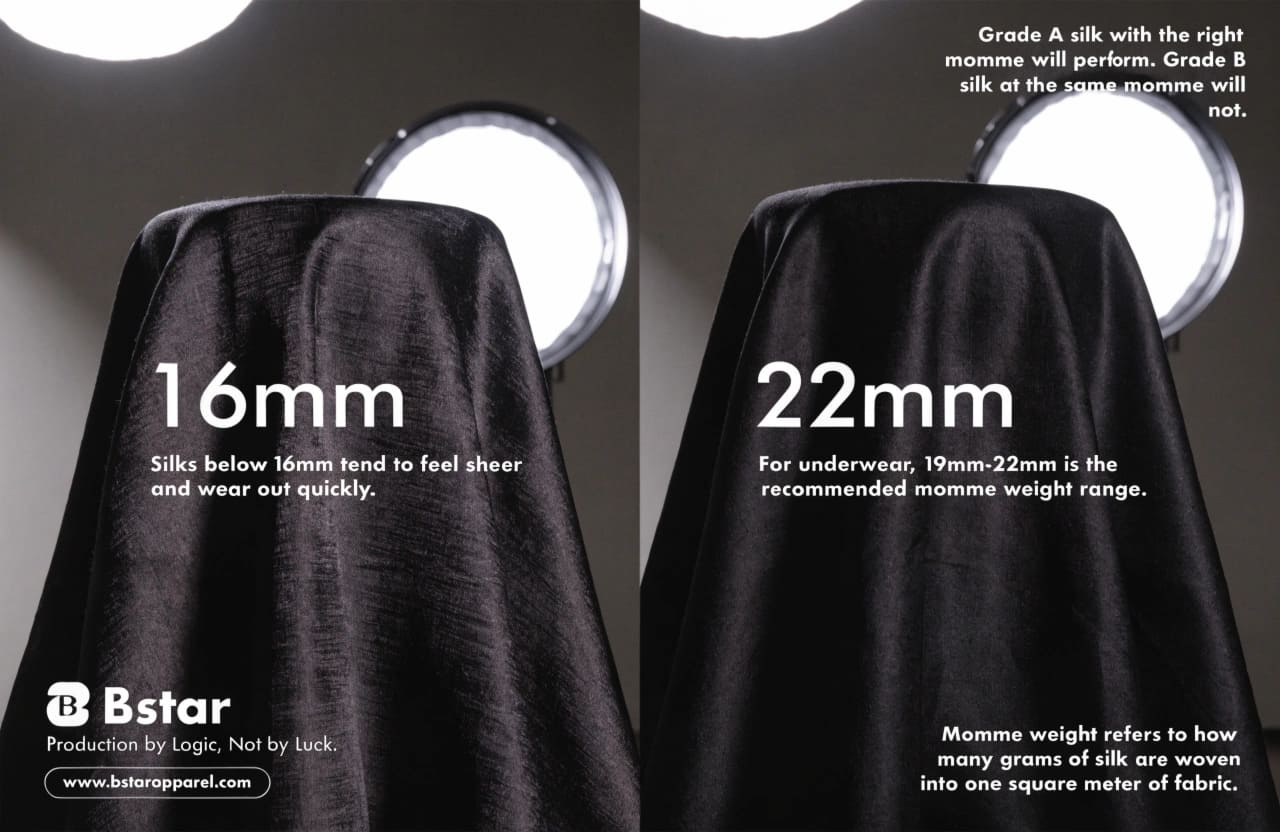
We had a brand come to us after launching a "luxury silk brief" with a 16mm fabric they’d sourced based on supplier claims. The hand-feel in photos looked fine. On the body, it was see-through and had pilling complaints within weeks. They came back asking for 22mm samples. The difference in per-unit cost was real, but so was the difference in return rate.
Here’s what to ask any supplier before you commit to a fabric:
Key Sourcing Variables to Confirm Before Sampling
| Variable | Why It Matters | What to Ask |
|---|---|---|
| Momme weight | Determines opacity, feel, and durability | "What momme is this, and do you have test data?" |
| Silk grade (A/B/C) | Affects yarn consistency and surface quality | "Is this grade A long-fiber silk?" |
| Weave type | Charmeuse vs. satin vs. jersey changes behavior in cut-and-sew | "How does this handle on the bias?" |
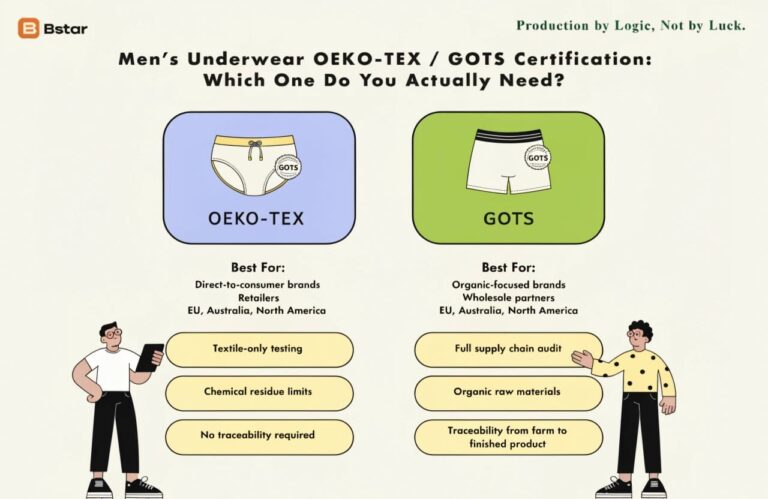
| Certification | OEKO-TEX or similar confirms dye safety | "Do you have material-level certification?" |
If a supplier can’t answer those four questions directly, that’s a sourcing risk you don’t want to carry into production.
The Luxury Appeal: Are the Benefits Real or Just Good Positioning?
Silk gets marketed around softness. That’s real, but it’s also the least interesting thing about it from a product positioning standpoint. The properties that actually drive repeat purchase in the underwear category go deeper.
Silk is naturally hypoallergenic, breathable, and temperature-regulating. These aren’t marketing claims—they’re physical properties of the fiber.4 For underwear specifically, the low-friction surface reduces skin irritation, and the moisture management is measurably better than synthetics in close-contact wear5.
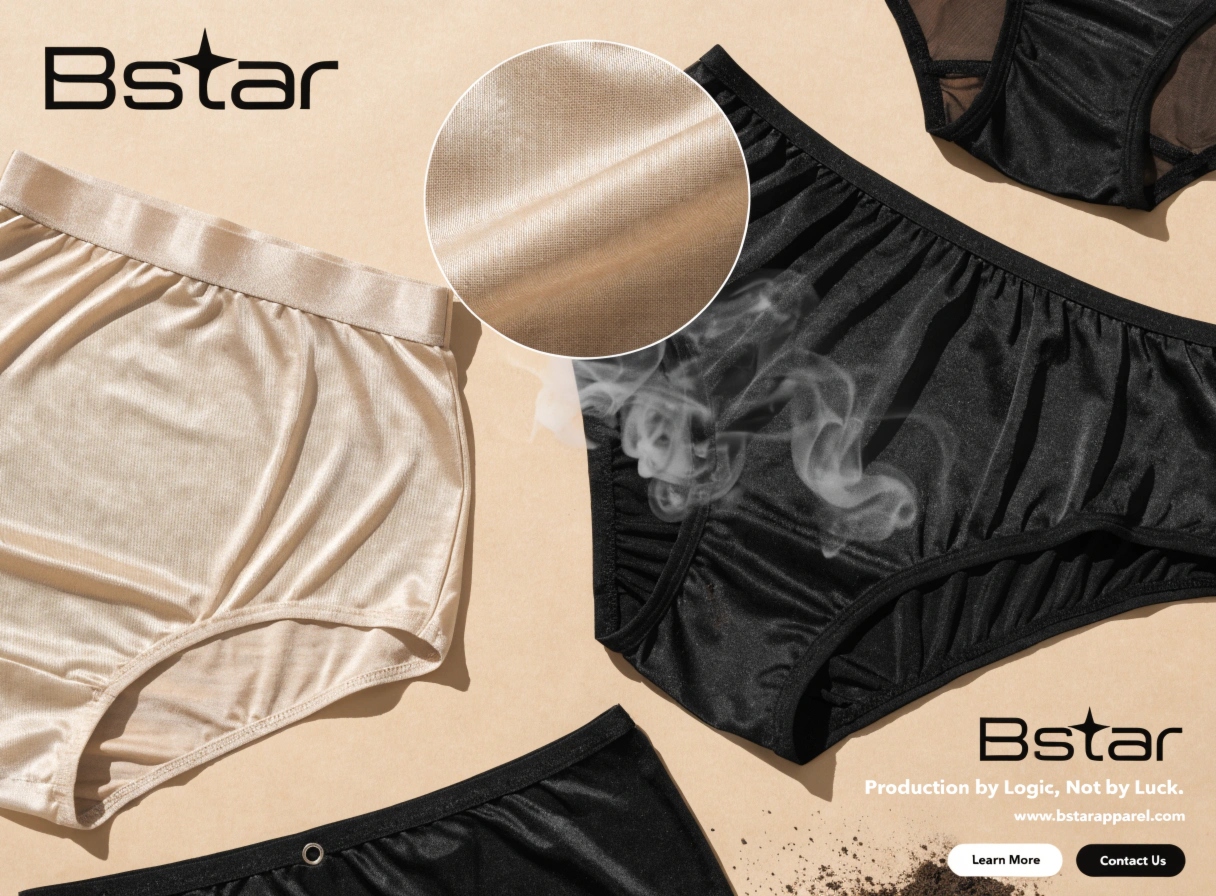
In our sampling work with international brands, the customers who get the most mileage out of silk positioning are the ones who lead with function, not just feel. "Breathable luxury" lands better than "soft silk" because it answers a real question: why does this justify a higher price?
What the Benefits Actually Mean for Your Customer
Hypoallergenic: Silk protein structure is close to human skin. It resists dust mites and doesn’t require chemical softeners6, which are common irritants in synthetic underwear.
Temperature regulation: Silk absorbs up to 30% of its weight in moisture without feeling damp7. In underwear, that matters more than in outerwear.
Low friction surface: Charmeuse-finish silk has a low-drag surface that reduces chafing8. This is relevant positioning for activewear-adjacent customers or postpartum recovery wear—segments that are underserved9.
Anti-static: No synthetic fiber blends means no static cling, which is a practical comfort point, not just a nice-to-have.
The mistake I see brands make is treating these as tag copy. They’re actually the brief for how to photograph the product, write the PDP, and train your customer service team. If you’re not communicating these downstream, you’re under-monetizing the fabric cost you paid upstream.
Production Challenges: What Actually Goes Wrong on the Factory Floor?
Silk is harder to cut and sew than most DTC founders expect. This isn’t a reason to avoid it—but walking in without knowing the production variables is how you end up with delayed samples, unexpected cost revisions, and a spec sheet that doesn’t survive first contact with the cutting table.
The main production challenges with silk underwear are fabric slippage during cutting, seam integrity under stretch, and lace/elastic attachment at the leg and waistband. Each of these affects cost and lead time, and they need to be discussed before you finalize your design brief—not after you’ve approved a tech pack.
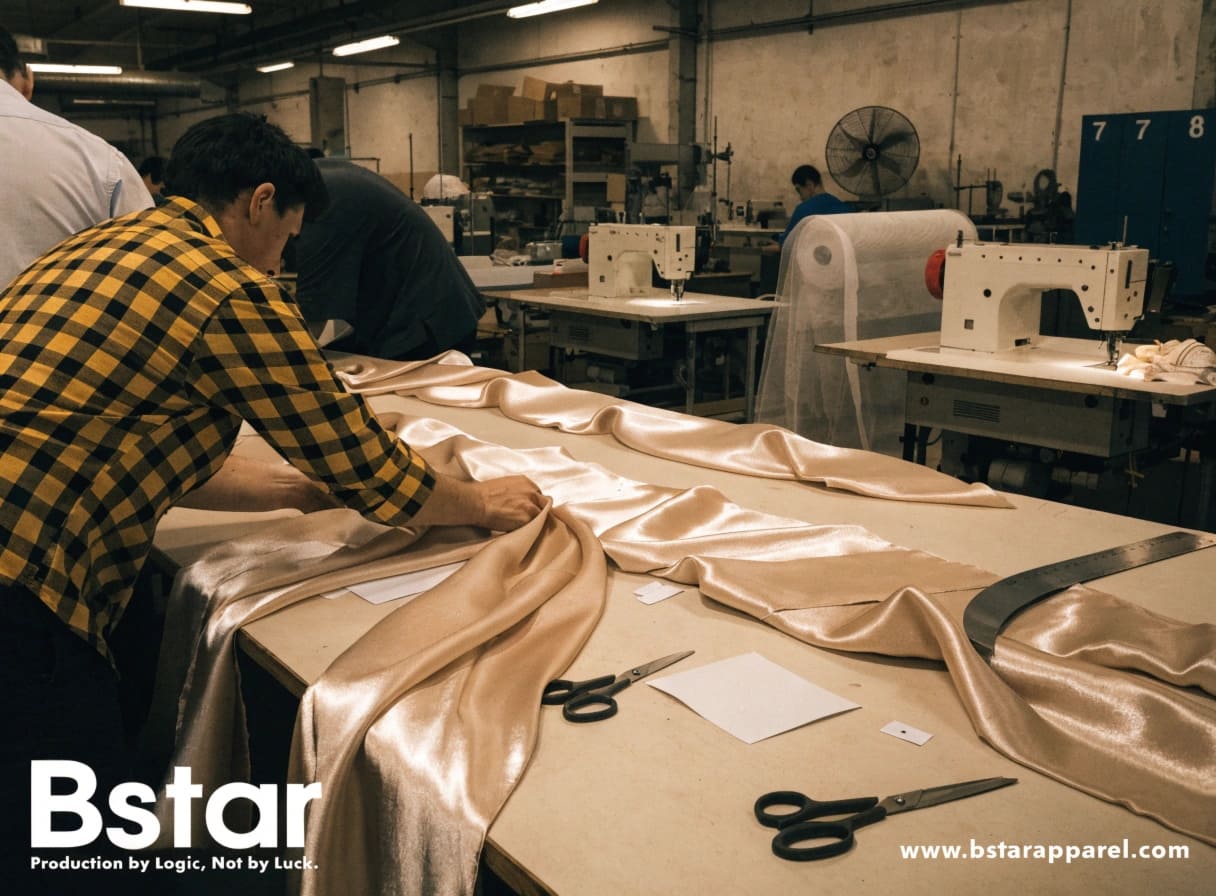
Here’s what I mean in practical terms:
Cut, Sew, and Finish Variables That Affect Your Unit Cost
Bias-cut panels: Many silk brief styles use bias-cut construction for stretch and drape. Bias cutting increases fabric waste by 15–25% compared to straight-grain cutting10. If your costing was done on straight-grain assumptions, your margin is already off.
Slippage during stitching: Silk moves on the feed. Without the right foot pressure and stabilizer technique, seams shift. This requires experienced operators—not a general sewing line.
Seam finishing options:
| Seam Type | Best For | Trade-off |
|---|---|---|
| [French seam | Clean interior finish, minimal irritation](https://pubmed.ncbi.nlm.nih.gov/25204213/)[^11] | Adds sewing time, higher cost |
| Flatlock | Stretch-friendly, low bulk | Less premium look on lightweight silk |
| Rolled hem | Delicate edge finish | Requires specialized foot, slower throughput |
| Bound seam with silk bias | Luxury finish | Highest cost, used for high-price-point styles |
Lace and elastic attachment: Lace trim and waistband elastic behave differently from the silk shell. Attachment methods—whether serged, sewn flat, or encased—affect comfort, durability, and the hand-feel at the contact points. We recommend confirming this in the first sample, not the second.
If you’re in early development, bring these questions to your factory before you finalize the design. The production conversation should happen in parallel with the design conversation, not after.
Essential Care Guidelines: Why Care Labels Are a Sourcing Decision, Not an Afterthought
Care instructions feel like the last thing you decide. In reality, they’re the downstream result of decisions you made when you chose your fabric weight, construction method, and finishing. Get those right, and your care label options open up. Get them wrong, and you’re stuck with "dry clean only" on a product your customer will wear against their skin every day.
If your silk underwear is constructed from 19mm+ grade A fabric with sealed or French seams, machine-washing on a cold delicate cycle is achievable. The care label isn’t determined by the fabric name—it’s determined by the full construction spec. Confirm washability during material selection, not at the compliance stage.
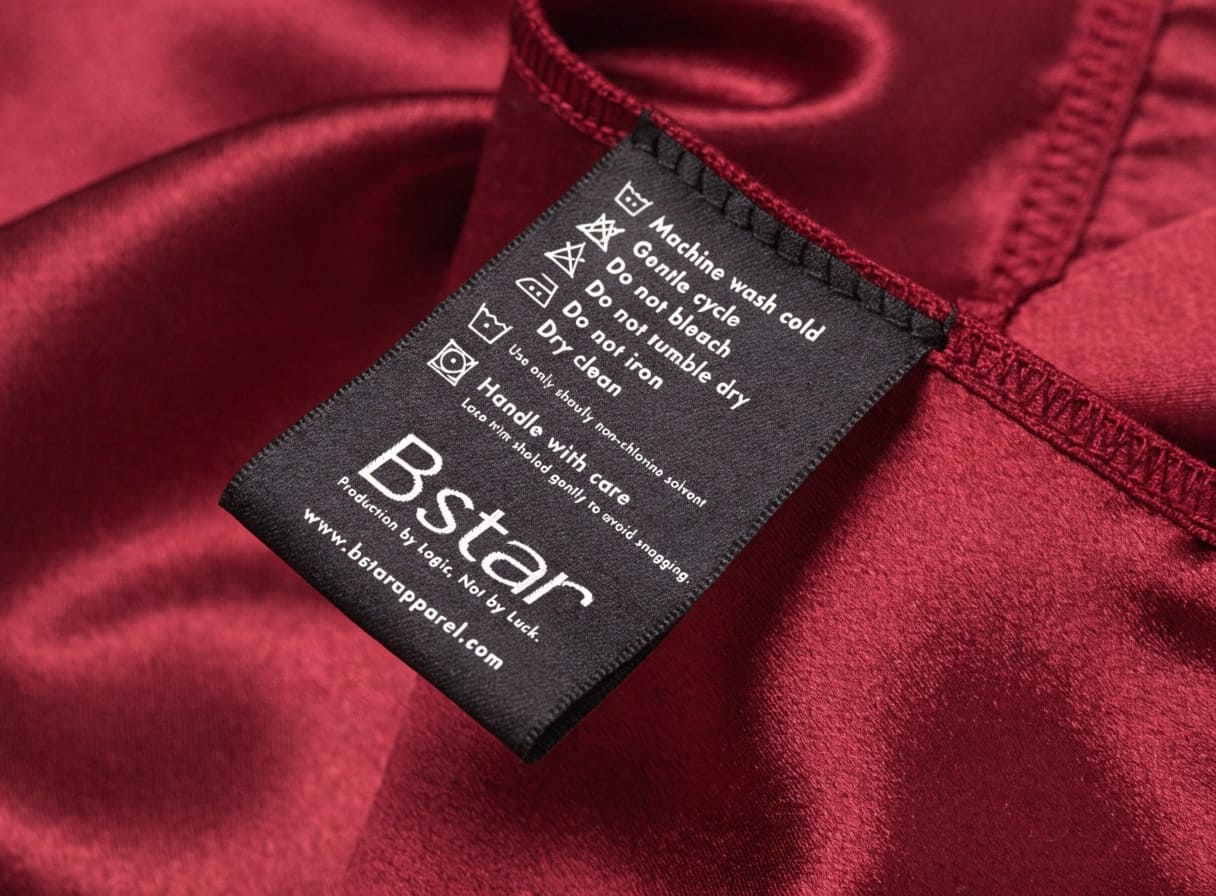
Here’s a practical framework we walk clients through during sampling:
Care Requirement by Construction Type
| Construction Spec | Realistic Care Label | Risk if Ignored |
|---|---|---|
| 19–22mm, French seam, no lace | Cold machine wash, gentle cycle | Low risk if spec is confirmed |
| 16mm, flatlock, decorative lace | Hand wash or dry clean | Lace attachment degrades under machine wash |
| Bias-cut, bound seam, elastic waistband | Hand wash, lay flat to dry | Elastic may distort under heat or agitation |
| Mixed fabric (silk shell + stretch lining) | Depends on lining spec | Lining care req often stricter than silk |
One more thing: OEKO-TEX certified dyes hold better under repeated washing11. If your supplier is using non-certified dyes to cut cost, your "hand wash cold" label becomes "color will bleed" in practice. This is a sourcing decision that shows up on your product reviews six months post-launch.
Conclusion
Before you commit to silk, nail four things: momme weight, seam construction, elastic compatibility, and washability confirmation during sampling—not after. Get those right, and silk is a workable category at any scale.
-
"Silk – Wikipedia", https://en.wikipedia.org/wiki/Silk. Mulberry silk refers to silk produced by Bombyx mori silkworms raised on mulberry leaves, a classification of origin rather than a graded quality standard; separate grading systems assess fiber length, luster, and consistency independently of this label. Evidence role: definition; source type: encyclopedia. Supports: That ‘mulberry silk’ denotes the species-based origin of the fiber (Bombyx mori fed on mulberry leaves) rather than a standardized quality or grade designation.. Scope note: Most encyclopedic sources describe mulberry silk’s origin characteristics but do not explicitly frame the label as a consumer-facing quality guarantee, making this a contextual rather than direct citation. ↩
-
"Momme Explained – Silk Fabric Guide – Mayfairsilk", https://mayfairsilk.com/pages/what-is-momme?srsltid=AfmBOooUoMGWD2aR8IWP_6NgoGYGRTTFc7lD_TneCI-zJmHV0IZBR8aM. Momme (mm) is the standard unit of weight for silk fabrics, with higher values indicating denser, more durable cloth; industry references commonly associate lighter weights (below 16mm) with sheerness and heavier weights (19mm and above) with structural integrity suitable for garments in close-contact use. Evidence role: general_support; source type: institution. Supports: That momme weight is the primary metric for silk fabric density and that higher momme values correspond to greater opacity and durability.. Scope note: The specific 19–22mm range for underwear reflects practitioner convention rather than a formally published standard; no single authoritative body has codified this range for intimate apparel. ↩
-
"Silk – Wikipedia", https://en.wikipedia.org/wiki/Silk. Silk grading systems, including those used in Chinese and international trade, classify raw silk by filament length, uniformity, and defect rate; Grade A designations typically indicate longer, more uniform fibers with fewer surface irregularities, characteristics that affect yarn consistency and finished fabric surface quality at any given momme weight. Evidence role: definition; source type: institution. Supports: That silk grading systems distinguish fiber quality based on criteria such as filament length, uniformity, and surface defects, and that these distinctions affect fabric performance independently of weight.. Scope note: Grading terminology is not universally standardized across producing countries; ‘Grade A’ may refer to different specifications depending on the supplier’s country of origin and the applicable national standard. ↩
-
"Elasticity Anisotropy of Bombyx mori Silkworm Silk Fiber by Brillouin …", https://pmc.ncbi.nlm.nih.gov/articles/PMC12004526/. Research on silk fibroin and sericin proteins documents silk’s low allergenicity relative to synthetic fibers and its capacity for moisture absorption and thermal buffering, properties arising from the fiber’s amino acid composition and fine filament structure. Evidence role: mechanism; source type: paper. Supports: That silk fibers exhibit measurable hypoallergenic and thermoregulatory properties attributable to their protein structure and moisture absorption characteristics.. Scope note: Clinical evidence for silk’s hypoallergenic benefit in dermatological contexts is stronger than for general apparel use; some studies focus on medical-grade silk rather than commercial textile grades. ↩
-
"Textiles and human skin, microclimate, cutaneous reactions", https://pubmed.ncbi.nlm.nih.gov/16702052/. Comparative textile studies measuring moisture vapor transmission rate (MVTR) and liquid moisture management have generally found natural protein fibers, including silk, to outperform hydrophobic synthetics such as polyester in moisture absorption capacity, though moisture-wicking speed may favor engineered synthetic constructions. Evidence role: statistic; source type: paper. Supports: That silk demonstrates superior moisture absorption and vapor transmission compared to common synthetic fibers such as polyester and nylon in controlled textile testing.. Scope note: Performance comparisons depend heavily on fabric construction, finish treatments, and test methodology; some engineered synthetics with moisture-management finishes may match or exceed silk in specific metrics. ↩
-
"Silk Sericin Protein Materials: Characteristics and Applications in …", https://pmc.ncbi.nlm.nih.gov/articles/PMC10003638/. Silk fibroin is composed predominantly of glycine, alanine, and serine residues, an amino acid profile that has been noted in the literature for its biocompatibility with human tissue; studies on silk bedding have documented reduced dust mite colonization compared to synthetic alternatives. Evidence role: mechanism; source type: paper. Supports: That silk’s fibroin protein composition shares structural characteristics with human skin proteins and that this property contributes to its resistance to dust mites.. Scope note: Dust mite resistance studies are more commonly conducted on silk bedding than on silk apparel, and direct extrapolation to underwear fabric requires caution. ↩
-
"An Experimental Investigation to Examine the Wicking …", https://www.scirp.org/journal/paperinformation?paperid=96215. Textile science literature reports silk’s moisture regain at approximately 11% under standard conditions (65% relative humidity, 20°C), with absorption capacity rising under higher humidity; the upper bound of 30% cited in some trade sources reflects saturation conditions rather than typical wear scenarios. Evidence role: statistic; source type: research. Supports: That silk has a high moisture regain capacity, commonly cited in the range of 11–30% depending on ambient humidity and testing methodology.. Scope note: The 30% figure appears in trade and marketing literature; peer-reviewed textile testing under standardized conditions typically yields lower moisture regain values, and the discrepancy should be acknowledged. ↩
-
"[PDF] Coefficient of friction of fabrics", https://nvlpubs.nist.gov/nistpubs/jres/5/jresv5n2p243_A2b.pdf. Charmeuse is a warp-faced satin weave in which long filament floats dominate the face of the fabric, producing a smooth surface with low frictional resistance; textile tribology studies have documented that satin-weave silk fabrics exhibit lower coefficients of friction against skin than plain-weave or synthetic alternatives. Evidence role: mechanism; source type: paper. Supports: That charmeuse-weave silk exhibits low surface friction due to its float-dominant weave structure, which positions the smooth filament face against the skin.. Scope note: Quantitative friction data for charmeuse silk specifically in underwear applications is limited in the published literature; most tribological studies examine silk in broader textile or medical contexts. ↩
-
"Postpartum women’s body satisfaction and appearance …", https://rex.libraries.wsu.edu/esploro/outputs/graduate/Postpartum-womens-body-satisfaction-and-appearance/99900525035301842. Market research on postpartum consumer behavior documents heightened sensitivity to fabric comfort, skin irritation, and ease of care in the weeks following childbirth; industry analyses of the maternity and postpartum apparel segment have identified functional comfort as a primary purchase driver underaddressed by mainstream intimate apparel brands. Evidence role: general_support; source type: institution. Supports: That postpartum intimate apparel represents a distinct consumer need with documented demand characteristics that differ from general underwear markets.. Scope note: Publicly available market research on postpartum silk underwear specifically is sparse; the ‘underserved’ characterization reflects a qualitative market observation rather than a quantified gap supported by published ↩
-
"[PDF] Analysis of Zero Waste Patternmaking Approaches for Application to …", https://dr.lib.iastate.edu/server/api/core/bitstreams/6c9cec2e-af45-4458-ab94-315bc5c7aafe/content. Pattern-making and apparel manufacturing references document that bias-cut garments require greater fabric yardage than straight-grain equivalents, with waste estimates varying by style complexity; figures in the 15–25% range are cited in industry training materials, though precise waste depends on pattern geometry and marker efficiency. Evidence role: statistic; source type: education. Supports: That bias-grain cutting generates measurably greater fabric waste than straight-grain cutting due to the angular alignment of pattern pieces relative to the fabric’s warp and weft.. Scope note: The 15–25% range is a practitioner estimate that varies significantly by style; no single peer-reviewed study establishes this as a universal benchmark. ↩
-
"Oeko-Tex – Wikipedia", https://en.wikipedia.org/wiki/Oeko-Tex. OEKO-TEX Standard 100 certifies that textile products have been tested for harmful substances including restricted dyes, heavy metals, and formaldehyde; the standard includes colorfastness requirements as part of its testing protocol, though its primary purpose is chemical safety rather than wash-performance durability. Evidence role: definition; source type: institution. Supports: What OEKO-TEX Standard 100 certification actually tests and certifies, specifically regarding dye safety and any colorfastness requirements.. Scope note: OEKO-TEX certification does not guarantee superior colorfastness in the sense of dye longevity under consumer washing; the article’s implied equivalence between certification and wash performance is an overstatement that a citation should clarify. ↩