
Anti-Odor Silver Ion Treatment: Efficacy & Safety Data — What Do the Numbers Actually Tell You?
Brands keep adding "anti-odor" to their product pages. But when a buyer asks for the data behind the claim, the room goes quiet fast.
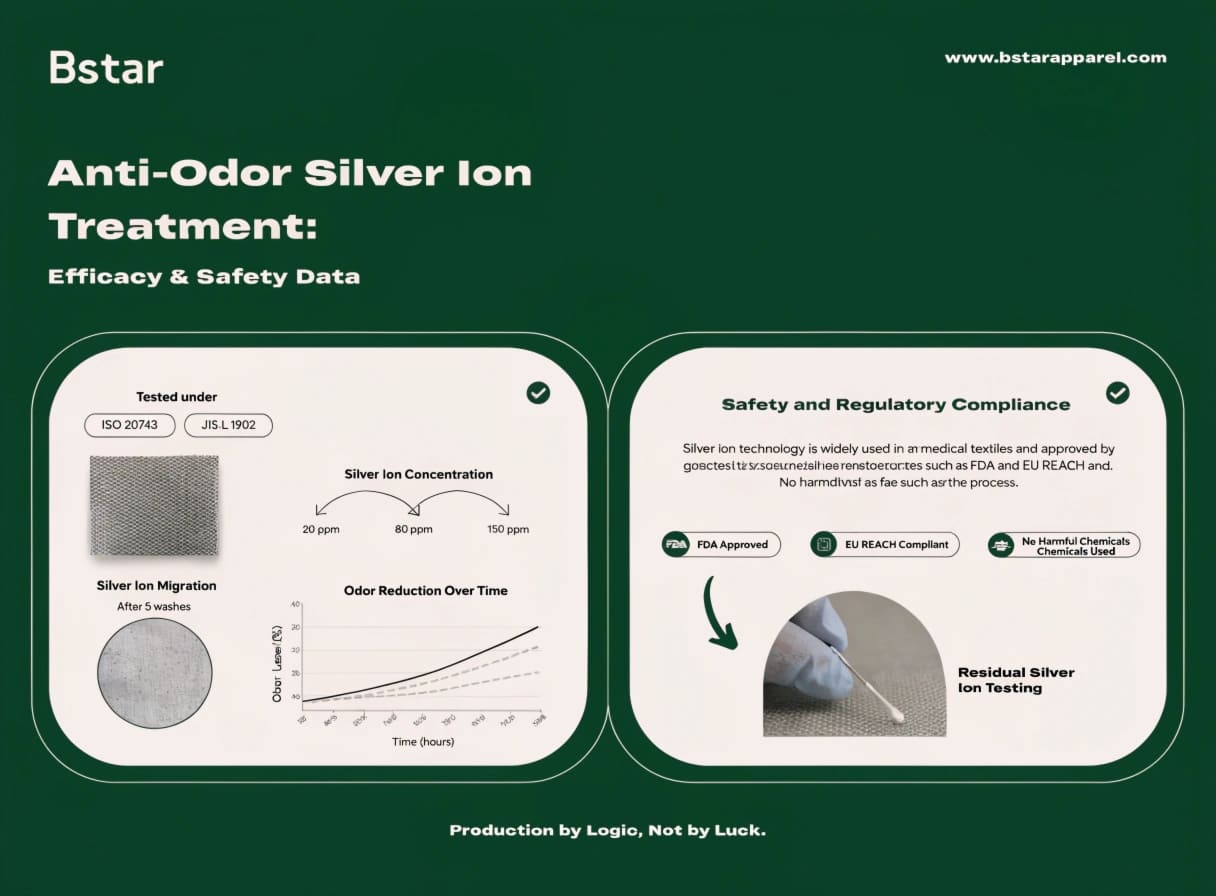
Silver ion antimicrobial finishing delivers real, measurable odor-control performance. The key is knowing what the test data actually guarantees — and what it doesn’t. Under ISO 20743 or JIS L 1902, a well-applied silver ion treatment can show >99% bacteriostatic activity. But that number comes with conditions attached.
We run silver ion finishing in our production process. We see the test reports, we handle the brand inquiries, and we have the conversations where buyers realize they’ve been sold a story rather than a spec. This article is what I wish every brand buyer read before that conversation.
How Do Silver Ions Actually Disrupt Bacteria — and Why Does That Matter for Performance?
Most product descriptions stop at "silver kills bacteria." That’s not wrong, but it doesn’t tell you anything useful about whether the treatment on your garment will actually perform.
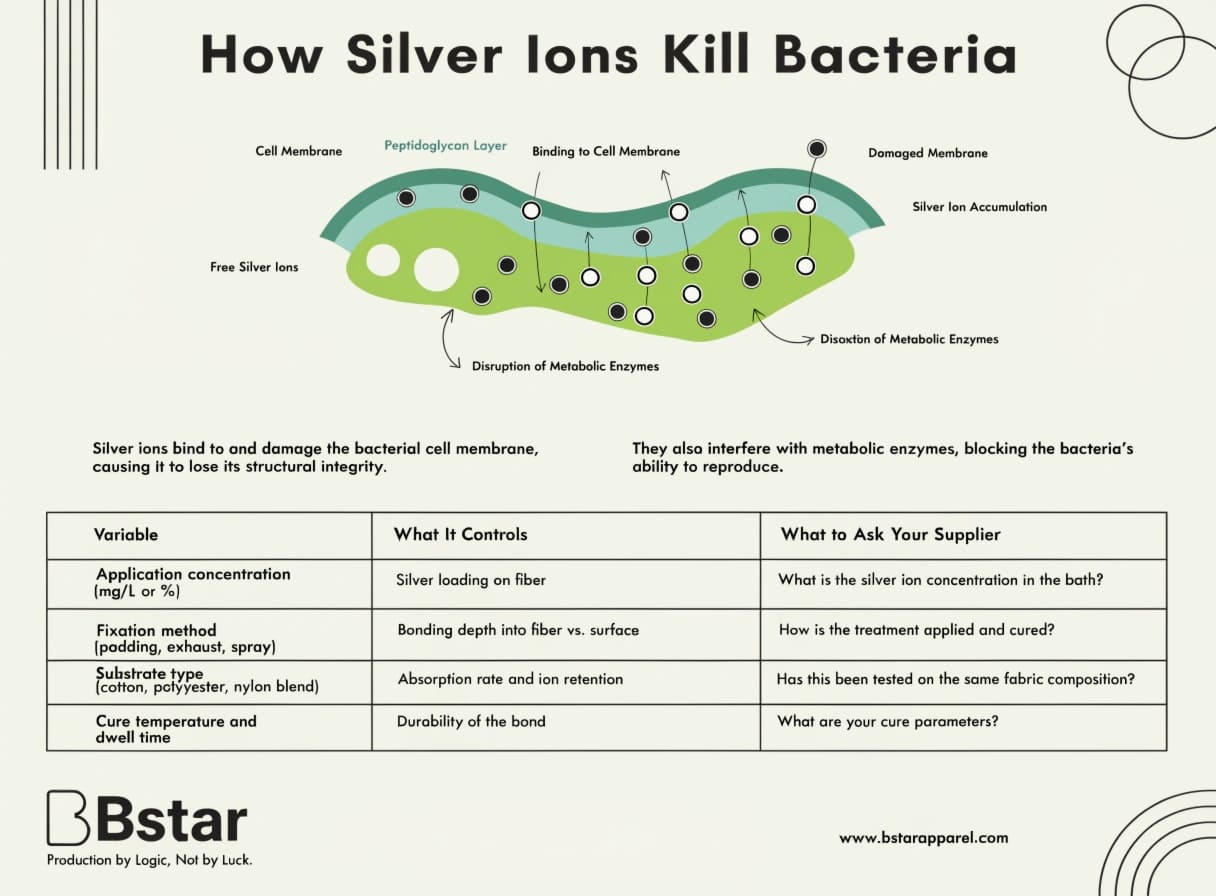
Silver ions work through two primary pathways: they bind to and damage the bacterial cell membrane, causing the cell to lose structural integrity, and they interfere with metabolic enzymes inside the cell, blocking the bacteria’s ability to reproduce. This dual action is why silver ion treatments show strong results against both gram-positive bacteria like Staphylococcus aureus and gram-negative strains.
Understanding the mechanism actually helps you ask better questions at sourcing. Here’s why.
Why the Mechanism Connects to Application
The two pathways above require silver ions to be physically available at the fabric surface — in sufficient concentration, at the right moment. That means the application process directly determines whether the mechanism fires at all.
In our production process, application concentration and fixation temperature are controlled variables. If either is off, the silver ion loading on the fiber is insufficient, and the mechanism doesn’t produce the test result you’re claiming. This isn’t a chemistry lecture — it’s a sourcing point. If your supplier can’t tell you the application concentration or fixation method used, you can’t verify that the mechanism was set up to work in the first place.
Here’s a simple breakdown of what actually affects whether the mechanism delivers:
| Variable | What It Controls | What to Ask Your Supplier |
|---|---|---|
| Application concentration (mg/L or %) | Silver loading on fiber | What is the silver ion concentration in the bath? |
| Fixation method (padding, exhaust, spray) | Bonding depth into fiber vs. surface | How is the treatment applied and cured? |
| Substrate type (cotton, polyester, nylon blend) | Absorption rate and ion retention | Has this been tested on the same fabric composition? |
| Cure temperature and dwell time | Durability of the bond | What are your cure parameters? |
If a supplier can answer all four, you’re talking to someone who understands what they’re producing. If they can’t, that’s your answer.
How Long Does It Last? Understanding Wash Durability Before You Make Any Claims
This is the question most brands don’t ask until it’s too late. "Durable" antimicrobial finishing is not the same as permanent antimicrobial finishing.
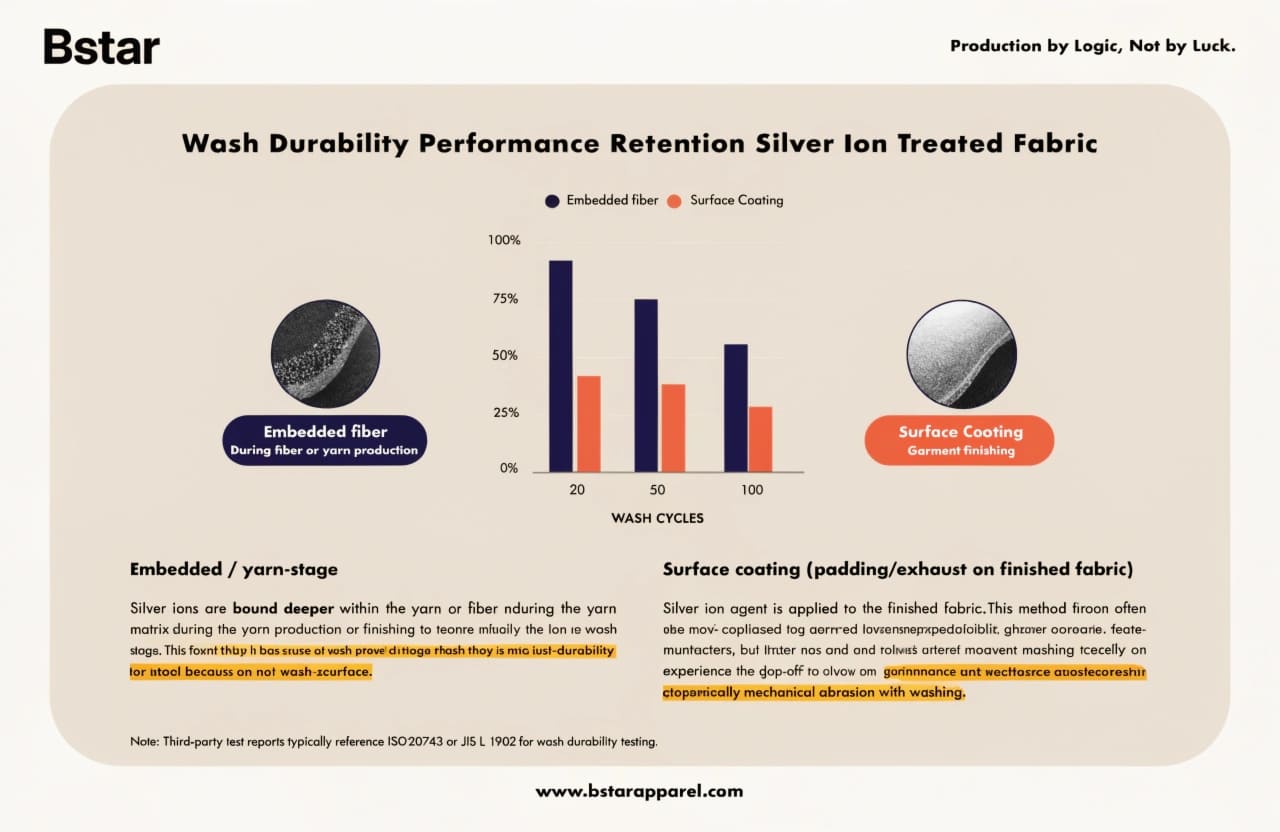
In our production experience, silver ion treatments applied at adequate concentration with proper fixation can retain meaningful bacteriostatic activity after 50 wash cycles — sometimes up to 100 — as shown in third-party test reports referencing ISO 20743 or JIS L 1902. But "meaningful" needs a number, not a word.
The honest version of a durability claim looks like this: "Retains >90% bacteriostatic activity after 50 washes, tested per JIS L 1902 on 100% cotton jersey." That’s a spec. "Long-lasting anti-odor technology" is not.
What Durability Data Should Actually Look Like
There are two fundamentally different ways silver ion treatment is applied, and their durability profiles are not the same.
Embedded fiber treatment binds silver ions deeper into the yarn or fiber matrix during the yarn production or finishing stage. This tends to show better wash-durability because the ions aren’t just sitting on the surface waiting to be washed off.
Surface coating applies the silver ion agent to the finished fabric. It’s faster and more flexible for garment manufacturers, but the bond is shallower. Surface-coated treatments generally show faster performance drop-off with washing, especially on fabrics that experience mechanical abrasion.
| Treatment Type | Application Stage | Typical Wash Durability | Trade-Off |
|---|---|---|---|
| Embedded / yarn-stage | During fiber or yarn production | Higher (often 50–100 wash cycles in test data) | Higher cost, less flexible for late-stage customization |
| Surface coating (padding/exhaust on finished fabric) | Garment finishing | Moderate (30–50 wash cycles typical, depends on substrate) | More flexible, lower cost, needs careful QC on concentration |
The test report you should ask for: a third-party wash-durability report showing bacteriostatic or bactericidal activity at 20-wash, 50-wash intervals, tested per ISO 20743 or JIS L 1902. If your supplier only has an unwashed sample test, that number tells you almost nothing about real-world performance.
Is Silver Ion Treatment Safe for Skin? Here’s the Certification That Answers That
This is the concern that comes up in every product development conversation. Brands targeting EU and US markets are right to take it seriously.
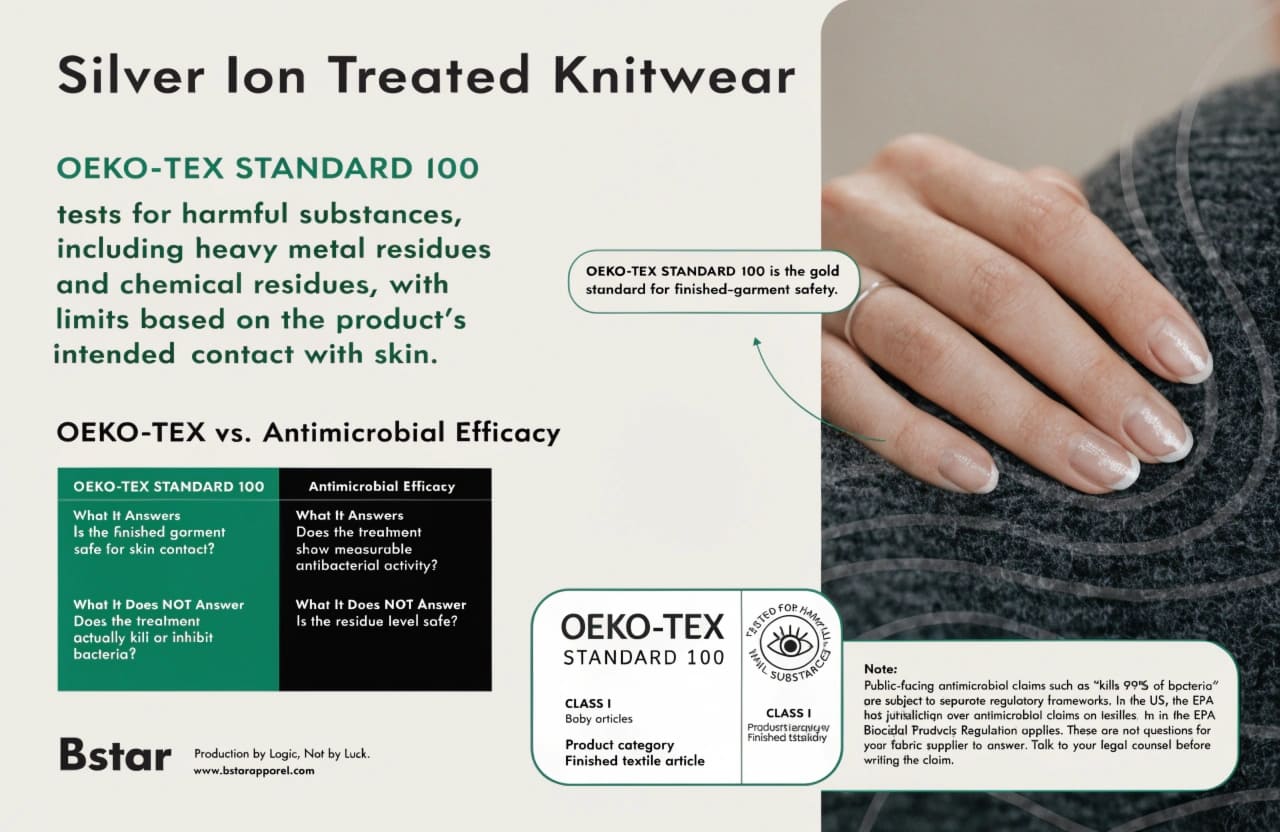
The clearest, most market-recognized answer to the skin-safety question for finished garments is OEKO-TEX STANDARD 100. This certification tests for harmful substances in finished textile products — including heavy metal residues and chemical residues — and sets limits based on the product’s intended contact with skin. A garment with OEKO-TEX STANDARD 100 certification has been tested against these limits.
That’s not a marketing badge. It’s a tested, third-party verified result against a defined safety framework. For brands selling into Europe or the US, this is a real compliance anchor — not just reassurance.
What OEKO-TEX Actually Tests (and What It Doesn’t Cover)
OEKO-TEX STANDARD 100 tests the finished product for residue levels. It does not certify the antimicrobial efficacy of the treatment. Those are two separate certifications, two separate test reports, covering two separate questions.
| Certification / Standard | What It Answers | What It Does NOT Answer |
|---|---|---|
| OEKO-TEX STANDARD 100 | Is the finished garment safe for skin contact? | Does the treatment actually kill or inhibit bacteria? |
| ISO 20743 / JIS L 1902 | Does the treatment show measurable antibacterial activity? | Is the residue level safe? |
You need both. One without the other is an incomplete picture.
One important note: public-facing antimicrobial claims on hang tags or packaging — "kills 99% of bacteria," for example — are subject to separate regulatory frameworks. In the US, the EPA has jurisdiction over antimicrobial claims on textiles. In the EU, the Biocidal Products Regulation applies. These are not questions for your fabric supplier to answer. Talk to your legal counsel before writing the claim.
How to Read a Test Report: Log Reduction, ISO 22196, and What to Actually Ask For
If you’ve never requested an antimicrobial test report before, the numbers can look like they mean something when they might not. Here’s how to read them.
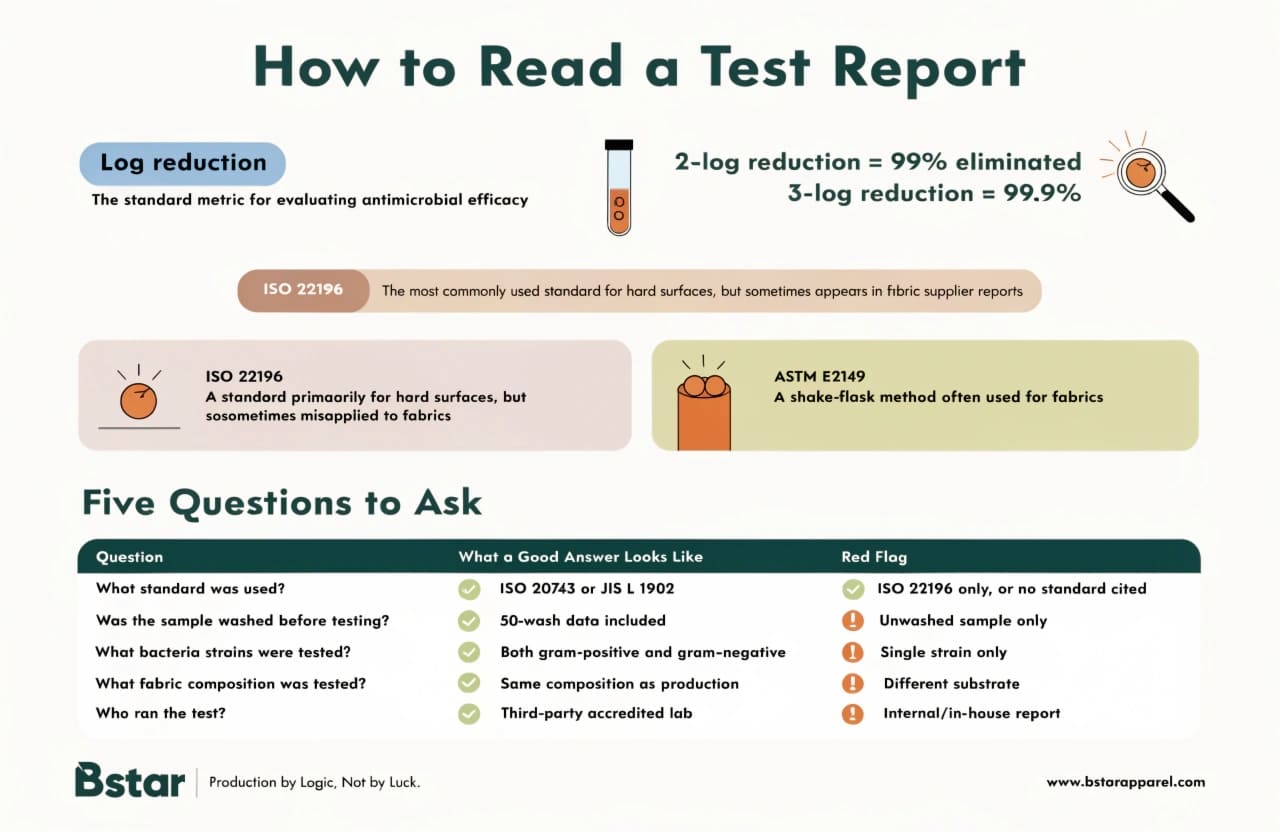
Log reduction is the standard metric. A 2-log reduction means 99% of bacteria were eliminated. A 3-log reduction means 99.9%. For textiles, ISO 20743 and JIS L 1902 are the most widely used standards. ISO 22196 is more common for hard surfaces but appears in some fabric supplier reports. Knowing which standard applies to your substrate is a basic sourcing check.
When a supplier shows you a test report, here are the questions that separate a meaningful result from a number that doesn’t hold up:
The Five Questions to Ask When Reviewing an Antimicrobial Test Report
1. What standard was used?
ISO 20743 and JIS L 1902 are designed for textiles. ASTM E2149 is a shake-flask method, also used for fabrics. If you see ISO 22196, ask if the fabric was tested in the same condition as a hard surface — that’s a red flag.
2. What bacteria strains were tested?
Staphylococcus aureus (gram-positive) and Klebsiella pneumoniae (gram-negative) are the standard strains. A report that only tests one strain is giving you half the picture.
3. Was the sample washed before testing?
An unwashed sample result is nearly useless for real-world claims. Ask for wash-durability data at minimum 20 and 50 cycles.
4. What fabric composition was tested?
A result on 100% polyester does not automatically apply to a cotton-polyester blend. The substrate matters.
5. Who ran the test?
A credible report comes from an accredited third-party lab. In-house test results are not a substitute.
| Question | What a Good Answer Looks Like | Red Flag |
|---|---|---|
| Standard used | ISO 20743 or JIS L 1902 | ISO 22196 only, or no standard cited |
| Wash cycles | 50-wash data included | Unwashed sample only |
| Strain coverage | Both gram-positive and gram-negative | Single strain only |
| Fabric match | Same composition as production | Different substrate |
| Lab accreditation | Third-party accredited lab | Internal/in-house report |
In our production process, we require third-party test reports before we make any antimicrobial finishing claims to brand clients. That’s the standard we hold ourselves to, and it’s the standard worth holding your suppliers to.
Conclusion
Silver ion treatment works — but only when the application parameters are right, the wash durability is documented, and the safety certification matches your target market. Ask for the data, not the story.