
Why You Shouldn’t Choose the Cheapest Underwear Manufacturer?
You asked for the lowest price. Three months later, your shipment arrived late, half the units failed inspection, and your launch date is gone. Sound familiar?
Choosing the cheapest underwear manufacturer feels like smart sourcing. It usually isn’t. The unit price is only one number in a much larger equation. The real costs — resampling fees, failed compliance, missed deadlines, and customer returns — almost never show up in that first quote.
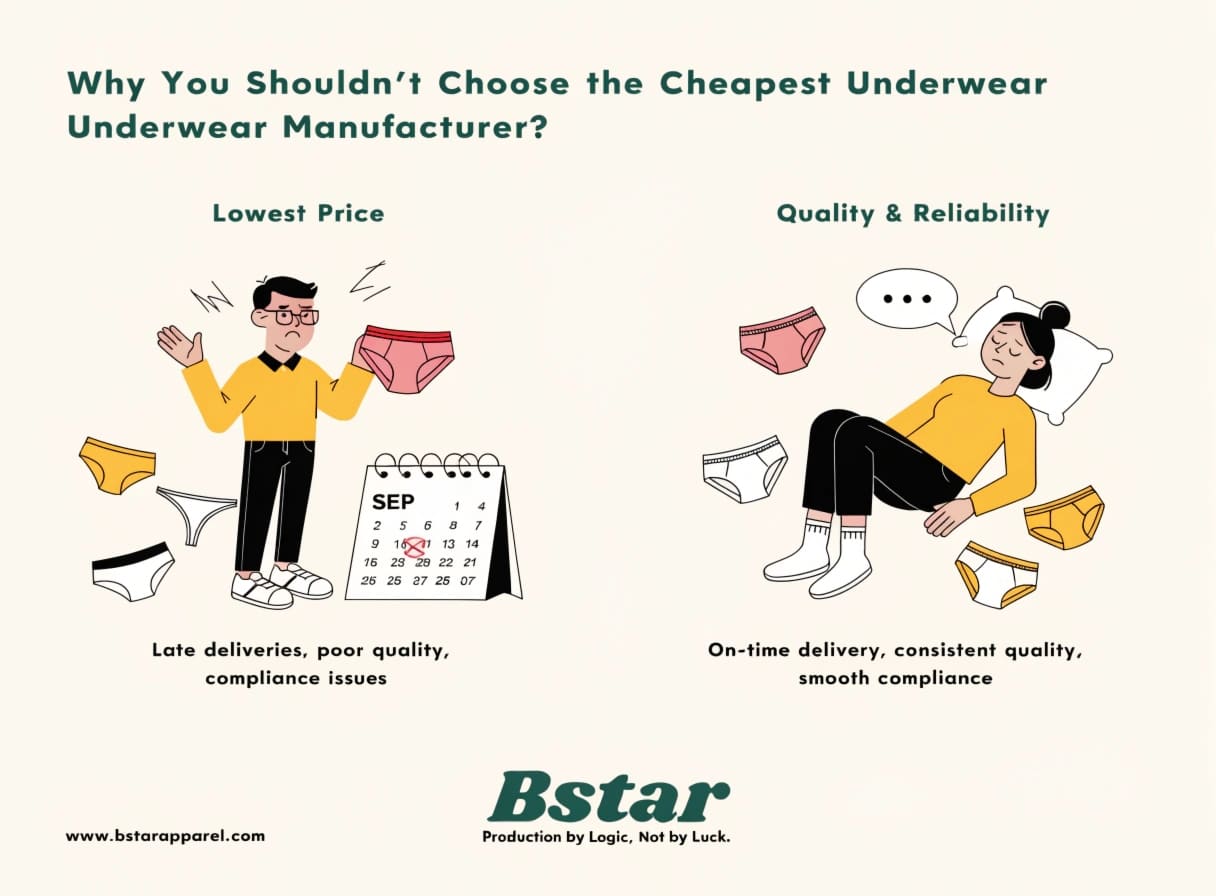
We hear the "what’s your best price?" question a lot. After 19 years of working with DTC brands, traditional retailers, and e-commerce sellers, I can tell you what’s usually hiding inside that question: a missing evaluation framework. Most buyers who lead with price haven’t yet priced in everything else. This article is here to name those variables — not to lecture you about quality, but to give you a clearer picture of what you’re actually comparing when you compare quotes.
Are Hidden Costs Really Hidden, or Are You Just Not Looking for Them?
You get a quote that looks great. The unit price is low. You feel like you’re winning.
But a cheap quote often strips out things you assume are included. Fabric certifications, structured QC checkpoints, AQL-standard inspection1, and English-language communication support are not automatically part of every manufacturer’s price. If you don’t ask, they don’t appear — until you need them.
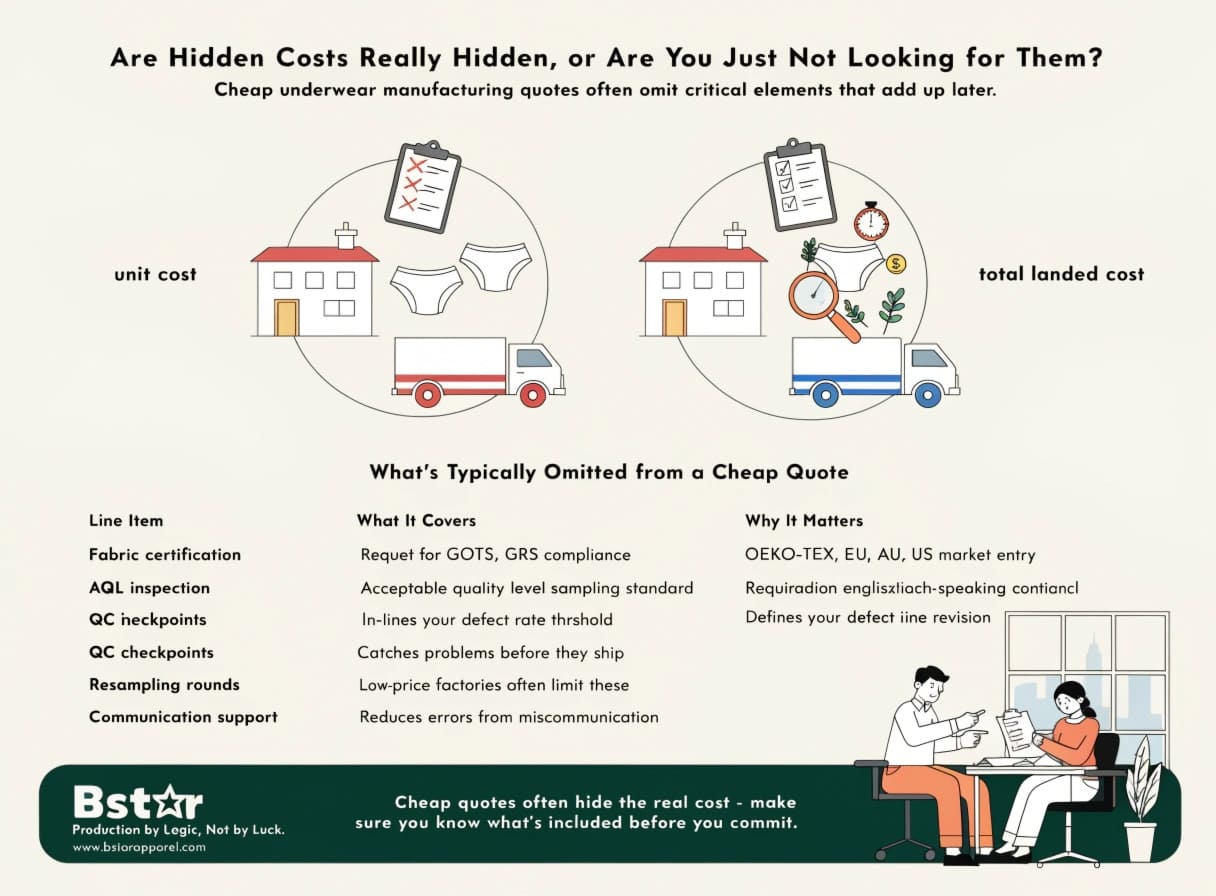
Here’s what I mean by "unit cost vs. total landed cost." The unit cost is what the factory charges per piece. The total landed cost includes everything that happens before those pieces are sellable. Let me break that down.
What Gets Left Out of a Cheap Quote?
| Line Item | What It Covers | Why It Matters |
|---|---|---|
| Fabric certification | OEKO-TEX, GOTS, GRS compliance2 | Required for EU, AU, US market entry |
| AQL inspection | Acceptable quality level sampling standard | Defines your defect rate threshold |
| QC checkpoints | In-line and pre-shipment checks | Catches problems before they ship |
| Resampling rounds | Repeat samples after revision | Low-price factories often limit these |
| Communication support | Dedicated English-speaking contact | Reduces errors from miscommunication |
When a manufacturer quotes low, something in that list is usually missing or reduced. You won’t see it written in the quote. You’ll see it later — in a defect batch, a failed inspection, or a delayed shipment.
The first question to ask any manufacturer isn’t "what’s your unit price?" It’s "what does this price include?" Ask specifically: How many QC checkpoints do you run? Is fabric certification included? How many revision rounds are covered before resampling costs extra? The answers will tell you more than the number itself.
What Happens When the Fabric Fails a Safety Test?
This is the part most first-time buyers don’t think about until it’s too late.
Underwear sits directly against skin. For brands selling into the EU, Australia, or the US, the fabric must meet specific chemical safety standards — things like REACH, OEKO-TEX, or CPSC requirements. A manufacturer that doesn’t use certified materials shifts that compliance risk entirely onto you, the brand.
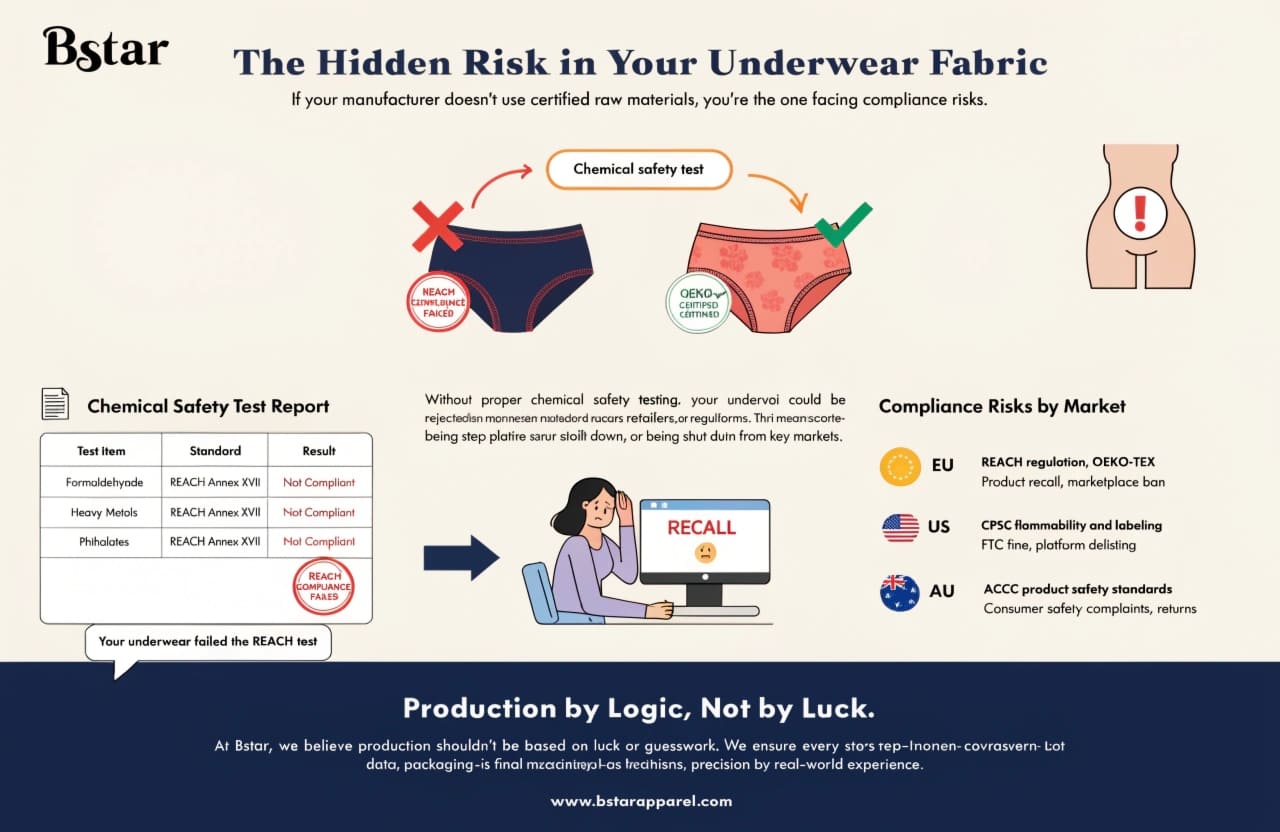
Here’s what compliance failure actually looks like in practice. A brand launching into the EU market, for example, would need to verify that the fabrics used meet REACH chemical restrictions. If they don’t, and the product reaches consumers, the brand faces potential recalls, platform delistings, or regulatory penalties.3 The manufacturer doesn’t bear that liability. You do.
Compliance Risks by Market
| Market | Key Requirement | Consequence of Failure |
|---|---|---|
| European Union | REACH regulation, OEKO-TEX4 | Product recall, marketplace ban |
| United States | CPSC flammability and labeling5 | FTC fine, platform delisting |
| Australia | ACCC product safety standards6 | Consumer safety complaints, returns |
The cheaper manufacturer typically hasn’t invested in certified raw materials. They may not even know which certifications your target market requires. That’s not their problem to solve — it becomes yours.
When you evaluate any manufacturer, ask to see their raw material certifications before you talk price. Ask whether their yarns, dyes, and trims are certified to OEKO-TEX or equivalent standards. If they can’t show you documentation, that’s a risk you’re choosing to carry.
Does a Low-Price Factory Actually Deliver on Time?
Late deliveries aren’t just an inconvenience. For a DTC brand, a missed launch window can mean months of lost revenue.
Budget manufacturers often run lean on staff, equipment, and process infrastructure. That means when production gets busy, your order gets deprioritized.7 Communication slows down. Updates stop coming. And by the time you find out there’s a problem, it’s too late to fix it.
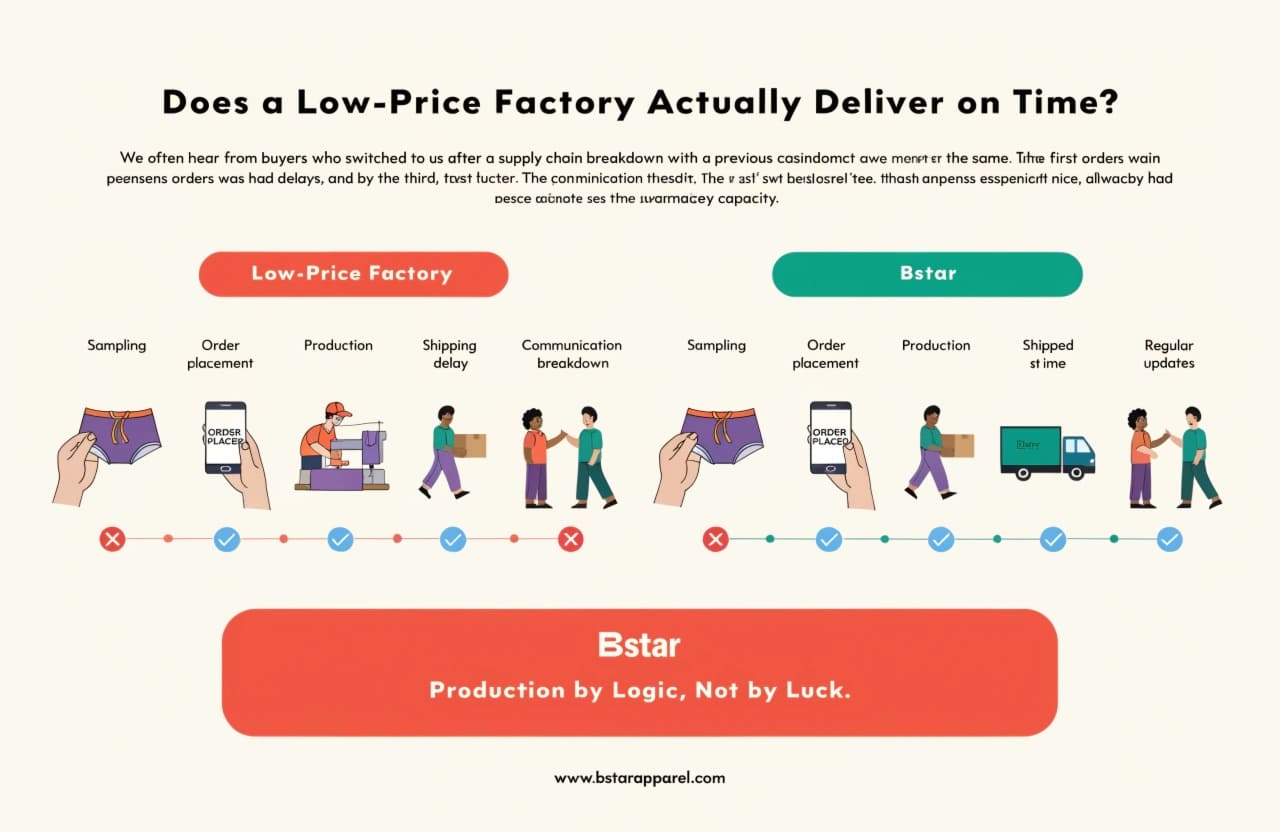
We often hear from buyers who switched to us after a supply chain breakdown with a previous factory. The pattern is almost always the same: the first order was fine, the second order had delays, and by the third order, communication had basically stopped. That’s not bad luck. It’s what happens when a factory optimizes for price at the expense of operational capacity.
What Operational Capacity Actually Looks Like
| Capability | What to Ask the Factory | Red Flag Answer |
|---|---|---|
| Sampling speed | How many days to first sample? | "Depends on our schedule" |
| Communication | Do you have a dedicated English contact? | No direct contact, only email |
| Production updates | How do you report progress mid-production? | "We send photos when it’s done" |
| Capacity planning | What’s your current lead time? | Vague or inconsistent answers |
For DTC brands testing a new SKU, this is especially important. Low MOQ and fast sampling aren’t perks — they’re capabilities that reduce the actual cost of going wrong. If a manufacturer can get you a first sample in 7–10 days and iterate quickly, you can catch problems before they become a full production run. If sampling takes 30 days and revision rounds cost extra, every mistake is expensive.
Ask any manufacturer: what’s your standard sampling turnaround? What happens if the first sample needs changes? How many revision rounds are included, and what does an additional round cost? The answers tell you how much iteration you can afford.
What Does One Bad Product Batch Do to Your Brand?
A defective order isn’t just a financial loss. It’s a customer trust problem.
When a customer buys underwear that falls apart after two washes, or causes a skin reaction, they don’t blame the manufacturer. They blame your brand. They write reviews. They request refunds. They don’t come back.8 The cost of one bad batch runs much deeper than the refund rate.
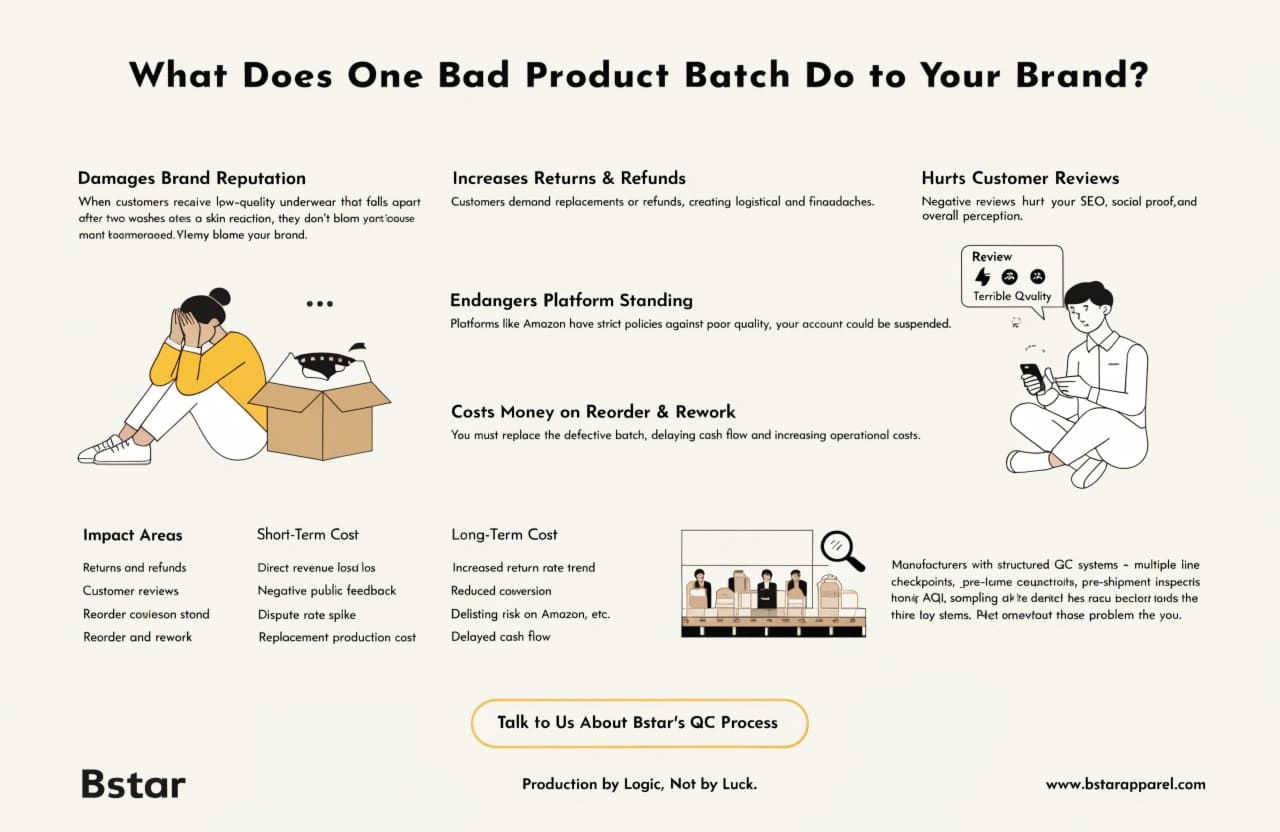
For DTC brands especially, the customer relationship is everything. You’ve spent money acquiring that customer.9 You’ve built a brand promise around your product. A single product failure — especially in a category as personal as underwear — can undo that.
The Real Cost of a Defective Batch
| Impact Area | Short-Term Cost | Long-Term Cost |
|---|---|---|
| Returns and refunds | Direct revenue loss | Increased return rate trend |
| Customer reviews | Negative public feedback | Reduced conversion rate |
| Platform standing | [Dispute rate spike | Delisting risk on Amazon, etc.](https://theappealguru.com/amazon-suspension-high-order-defect-rate-odr-explained/)[^10] |
| Reorder and rework | Replacement production cost | Delayed cash flow |
The manufacturers with structured QC systems — multiple in-line checkpoints, pre-shipment inspection, AQL sampling standards — catch defects before they ship.10 The ones without those systems ship the problem to you.
Ask any manufacturer how many QC checkpoints they run per production order. Ask whether they use AQL sampling standards and at what level. Ask who conducts the final inspection. If the answers are vague, the QC process probably is too.
Conclusion
Price is one input. Sampling speed, defect rate, certification scope, communication response time, and QC checkpoint count are the others. Evaluate all of them before you choose.
-
"[PDF] ISO 2859-1 – UNT Chemistry", https://chemistry.unt.edu/~tgolden/courses/iso2859-1.pdf. Acceptable Quality Level (AQL) inspection is governed by ISO 2859-1, an international standard that specifies sampling procedures and tables for inspection by attributes, establishing the maximum number of defectives considered acceptable in a sample lot. Evidence role: definition; source type: institution. Supports: The definition and origin of the AQL sampling standard used in manufacturing quality control. ↩
-
"Oeko-Tex – Wikipedia", https://en.wikipedia.org/wiki/Oeko-Tex. OEKO-TEX Standard 100, the Global Organic Textile Standard (GOTS), and the Global Recycled Standard (GRS) are independent third-party certification schemes that set chemical safety, organic fiber, and recycled content requirements respectively for textile products; compliance with these standards is frequently required by retailers and regulators in EU, US, and Australian markets. Evidence role: definition; source type: institution. Supports: What OEKO-TEX, GOTS, and GRS certifications cover and which bodies administer them. Scope note: Market-entry requirements vary by jurisdiction and product category; these certifications are not uniformly mandated by law in all three markets cited. ↩
-
"EU REACH – International Trade Administration", https://www.trade.gov/eu-reach. Under REACH, the ‘importer’ — defined as any natural or legal person established in the EU responsible for placing goods from outside the EU onto the EU market — carries obligations to ensure articles comply with substance restrictions, meaning non-EU manufacturers do not bear direct regulatory liability under EU law. Evidence role: mechanism; source type: government. Supports: That importers and brand owners bear legal responsibility for REACH compliance when placing products on the EU market. Scope note: Contractual arrangements between brands and manufacturers may allocate financial liability differently; the regulatory obligation and the commercial risk allocation are distinct matters. ↩
-
"EU REACH – International Trade Administration", https://www.trade.gov/eu-reach. The EU’s Registration, Evaluation, Authorisation and Restriction of Chemicals (REACH) Regulation (EC No 1907/2006), administered by the European Chemicals Agency (ECHA), restricts the use of hazardous substances in articles placed on the EU market, including textile and apparel products that come into contact with skin. Evidence role: mechanism; source type: government. Supports: How the EU REACH regulation applies chemical safety restrictions to textile and apparel products. Scope note: REACH applies to chemical substances in articles broadly; specific restricted substances relevant to underwear depend on the materials and dyes used, requiring case-by-case assessment. ↩
-
"Flammable Fabrics Act (FFA) | CPSC.gov", https://www.cpsc.gov/Business–Manufacturing/Business-Education/Business-Guidance/Flammable-Fabrics-Act. The U.S. Consumer Product Safety Commission (CPSC) enforces flammability standards for clothing textiles under 16 CFR Part 1610 and requires fiber content and care labeling under rules coordinated with the Federal Trade Commission; non-compliant products are subject to recall and civil penalties. Evidence role: mechanism; source type: government. Supports: That the CPSC enforces flammability and labeling standards for apparel sold in the US. Scope note: Specific flammability requirements vary by garment type; underwear is generally subject to the general wearing apparel standard rather than the more stringent children’s sleepwear standard. ↩
-
"Care labelling for clothing and textiles mandatory standard", https://www.productsafety.gov.au/business/search-mandatory-standards/care-labelling-for-clothing-and-textiles-mandatory-standard. The Australian Competition and Consumer Commission (ACCC) administers product safety obligations under the Australian Consumer Law (Schedule 2 of the Competition and Consumer Act 2010), which empowers the regulator to issue mandatory safety standards, bans, and recalls for consumer goods, including clothing and textiles. Evidence role: mechanism; source type: government. Supports: That the ACCC administers product safety standards for consumer goods including apparel in Australia. Scope note: Australia does not currently have a mandatory chemical safety standard specific to underwear equivalent to EU REACH; the ACCC’s primary apparel-related mandatory standards address children’s nightwear and drawstrings rather than adult underwear. ↩
-
""Effective Capacity Planning for Operations in a Contract …", https://arch.astate.edu/ecs-emcmfac/9/. Operations management literature on supplier capacity allocation indicates that contract manufacturers facing capacity constraints typically prioritize orders from larger or more strategically important buyers, a dynamic that can result in delays or quality degradation for lower-volume customers during peak demand periods. Evidence role: mechanism; source type: paper. Supports: That manufacturers with constrained capacity tend to prioritize higher-volume or higher-margin orders, disadvantaging smaller buyers. Scope note: This mechanism is documented in supply chain research generally; empirical studies specific to budget apparel or underwear manufacturers are limited, and the claim is supported by analogy to broader manufacturing contexts. ↩
-
"[PDF] The effects of differing responses to negative online reviews", https://epublications.marquette.edu/cgi/viewcontent.cgi?article=1333&context=mgmt_fac. Research on consumer complaint behavior indicates that dissatisfied customers are more likely to engage in negative word-of-mouth, including online reviews, and to switch to competing brands following a product failure, with the likelihood increasing when the product involves personal or intimate use. Evidence role: general_support; source type: paper. Supports: That consumers respond to product failures by leaving negative reviews, requesting refunds, and not repurchasing. Scope note: The specific claim about underwear as a category is not directly studied in most consumer behavior literature; findings from general product failure research are applied here by analogy. ↩
-
"LTV/CAC Ratio: What It Is & How to Calculate It", https://online.hbs.edu/blog/post/ltv-cac. Studies on direct-to-consumer e-commerce have documented rising customer acquisition costs driven by digital advertising competition, with research indicating that retaining an existing customer is substantially less costly than acquiring a new one, making product-driven churn disproportionately damaging to DTC unit economics. Evidence role: statistic; source type: research. Supports: That customer acquisition costs are high for DTC brands, making retention and repeat purchase behavior financially significant. Scope note: Specific acquisition cost figures vary widely by category, channel, and brand maturity; the claim is directionally supported by industry research but precise figures for the apparel underwear segment are not uniformly available. ↩
-
"Top 10 Benefits of Pre-Shipment Inspections | TradeAider", https://www.tradeaiders.com/top-10-benefits-of-pre-shipment-inspections.html. Quality management literature supports the use of statistical process control and acceptance sampling at multiple production stages as mechanisms for reducing outgoing defect rates; ISO 2859-1 provides the methodological basis for AQL-based pre-shipment inspection as a final verification step. Evidence role: expert_consensus; source type: paper. Supports: That in-line and pre-shipment QC checkpoints using statistical sampling reduce defect rates in manufactured goods. Scope note: The effectiveness of QC checkpoints depends on implementation quality, inspector training, and factory cooperation; the presence of a formal QC system does not guarantee defect-free output. ↩