
Understanding Incoterms for Underwear Imports: FOB vs. EXW vs. DDP?
Most first-time underwear buyers get quoted a price, say yes, then get surprised by costs they never saw coming. The Incoterm was almost always the reason.
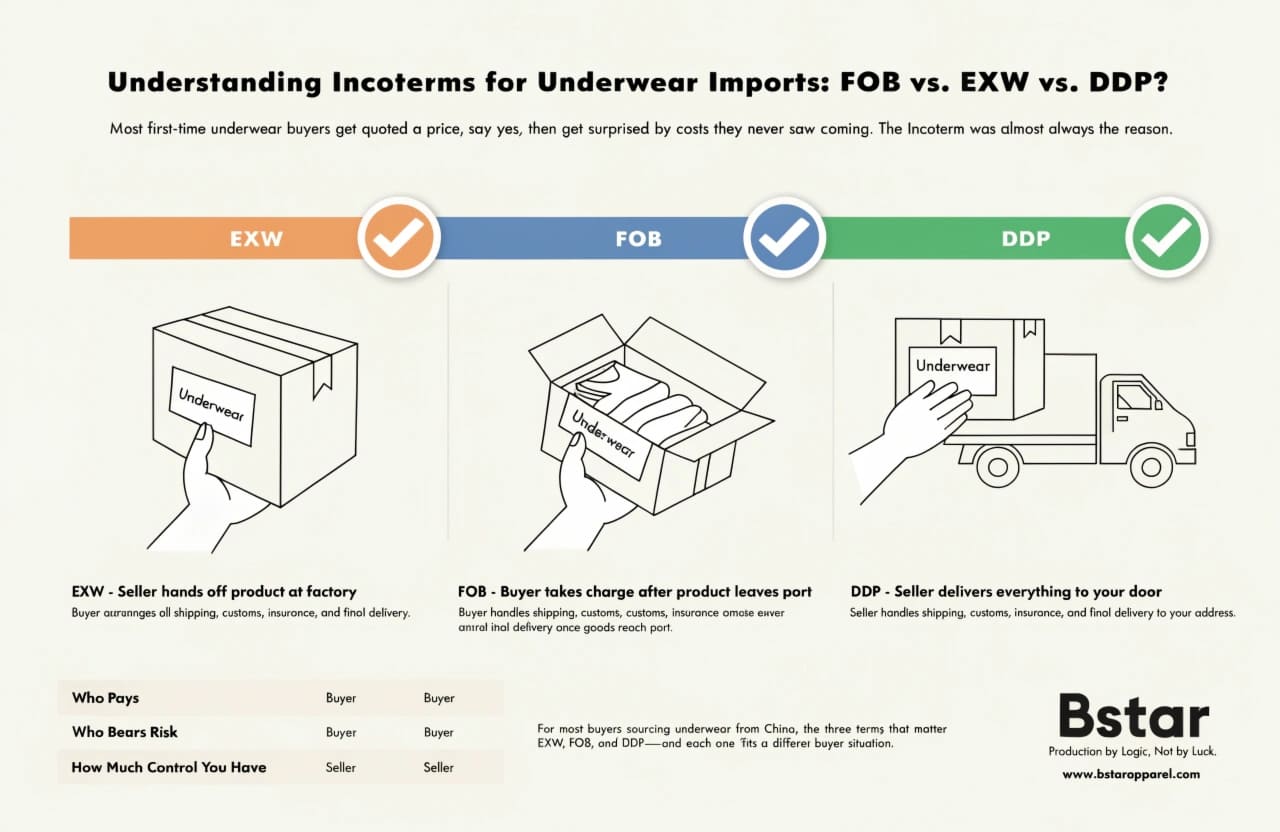
The Incoterm you agree to determines who pays for what, who is responsible when something goes wrong, and how much actual control you have over your shipment. For most buyers sourcing underwear from China, the three terms that matter most are EXW, FOB, and DDP—and each one fits a different buyer situation.
Most buyers treat Incoterms as a shipping technicality. In reality, they are a risk allocation decision. Where you sit on that decision will affect your landed cost, your customs exposure, and your ability to respond when something goes wrong at sea or at the border. Let me break down how each term actually works in practice—and which type of buyer each one is right for.
Decoding the Basics: How Do FOB, EXW, and DDP Actually Split Responsibility?
You get a quote from your underwear supplier. It says "FOB Guangzhou." Do you actually know what you just agreed to?
Each Incoterm is essentially a handoff point. It tells you exactly where the supplier’s responsibility ends and yours begins. EXW means the supplier hands off at the factory door. FOB means the handoff happens when goods are loaded onto the ship. DDP means the supplier—or their agent—handles everything until the goods arrive at your door.
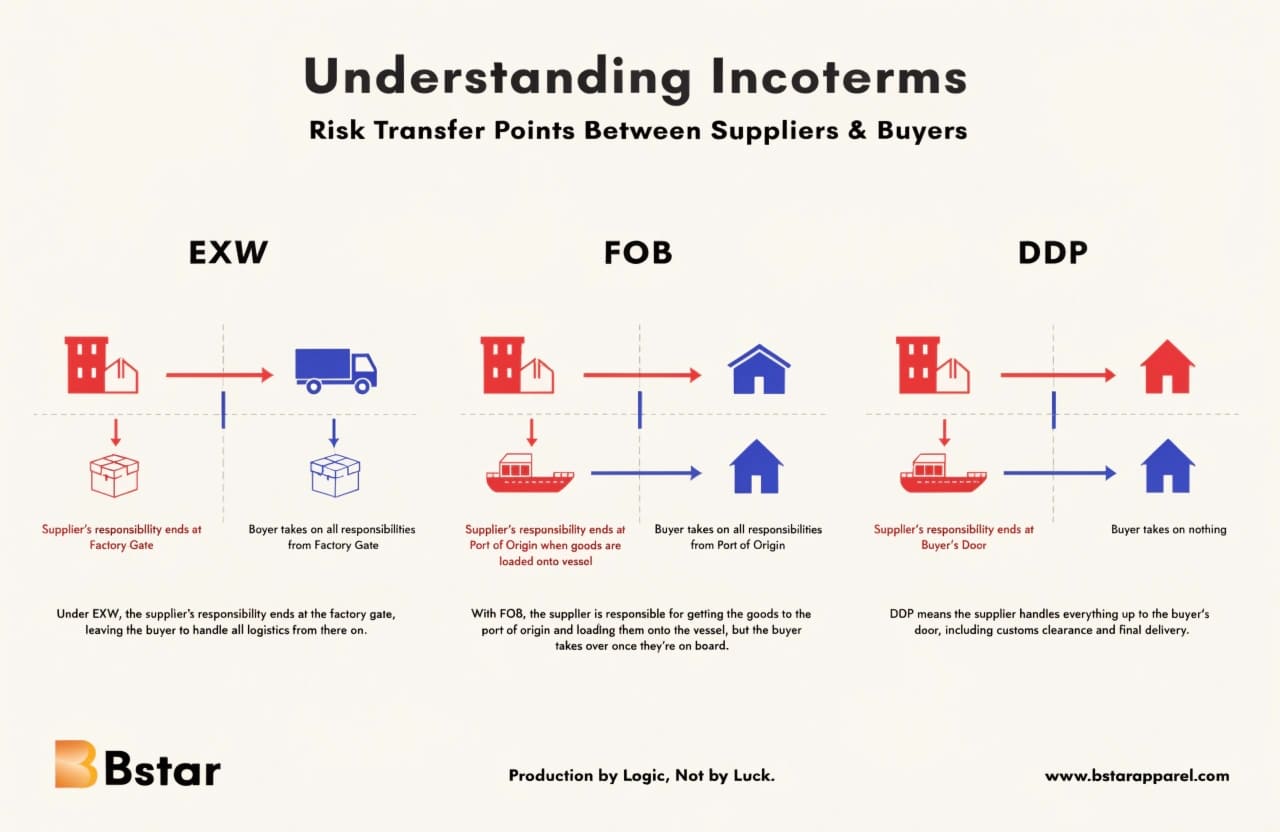
Here is why this matters more than most buyers realize. The handoff point does not just determine cost. It determines who files export documentation, who handles customs holds, who absorbs the cost if goods are damaged in transit, and who has legal standing to make a claim with the carrier.
What each term actually covers
| Term | Supplier’s responsibility ends at | Buyer takes on |
|---|---|---|
| EXW | Factory gate | Export customs, inland freight to port, ocean freight, import customs, last-mile delivery |
| FOB | Port of origin (goods loaded on vessel) | Ocean freight, import customs, last-mile delivery |
| DDP | Buyer’s named destination | Nothing (in theory) |
The table looks simple. But the real complexity is in the middle column for EXW, and in the hidden costs buried inside DDP. FOB sits in a reasonable middle ground for most buyers—which is exactly why it became the industry default for garment manufacturing.
One thing I want to be clear about: I am not a customs attorney or a freight forwarder. What I am sharing here comes from 19 years of working with international buyers at BSTAR, and from real conversations with clients who discovered what their Incoterm meant only after something went wrong.
EXW and FOB Strategies: Should You Take Control at the Factory Gate or the Port?
A buyer once told me they chose EXW because it looked like the cleanest price. Two weeks later they called asking why their goods were sitting at our factory waiting for a truck they had not booked.
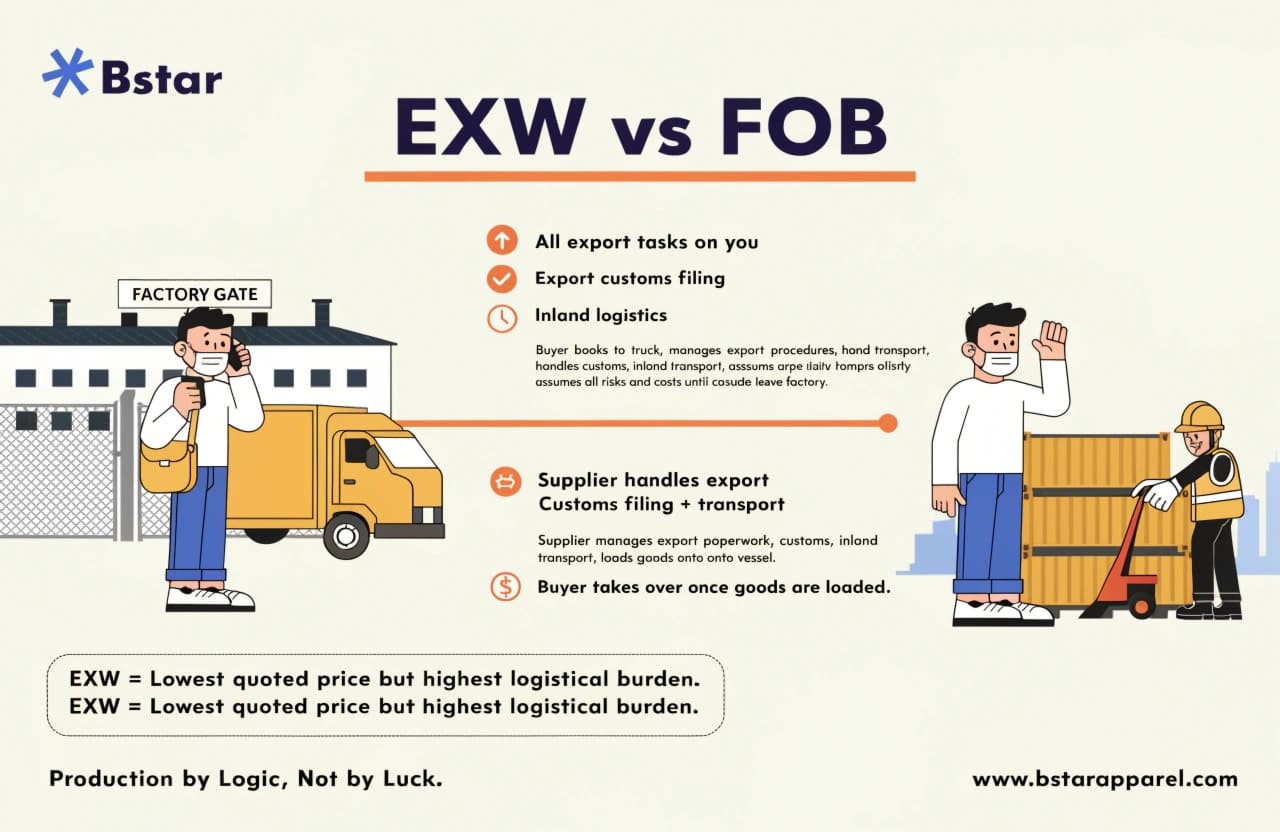
EXW gives you the most price transparency on paper—you only pay the supplier for production. But it immediately puts you in charge of getting goods out of China, including export filing and inland logistics. FOB shifts those export tasks back to the supplier, so your responsibility only starts once the goods are on the vessel.
When EXW actually makes sense
EXW is not a bad term. It is a term for buyers who already have the infrastructure to handle it.
If you have a trusted freight forwarder with a China-side agent, and that agent can handle export customs and factory pickup, then EXW gives you clean cost visibility and maximum control. You are not relying on the supplier’s logistics connections. You pick your own carrier, negotiate your own freight rate, and own the entire chain from factory to destination.
The problem is that a surprising number of first-time buyers choose EXW thinking it is simpler. It is not. Export customs in China requires a licensed entity. Inland trucking from Zhongshan or Guangdong to a Guangzhou or Shenzhen port needs booking. These are real tasks that cost real money—and if you do not have the setup for them, you will end up paying premium prices to fix problems last minute.
Why FOB is the default for a reason
With FOB, your supplier handles the export process. They load the goods onto the vessel at the named port. From that point, the ocean freight, insurance, destination customs, and delivery to your warehouse are on you.
For most buyers sourcing underwear in medium to large quantities, FOB is the right balance. You still need to manage your own freight forwarder for the ocean leg, and you need to be ready for import duties and clearance at your end. But you are not dealing with China-side logistics complexity, which is a real barrier for buyers who are not based there.
| Buyer type | Better fit |
|---|---|
| First-time buyer without China logistics partner | FOB |
| Scaling brand with established freight forwarder | FOB or EXW |
| Buyer wanting full cost transparency and control | EXW (with China agent) |
The DDP Advantage: Does It Really Simplify Things for E-commerce and Small Batches?
I have had clients come to us specifically asking for DDP quotes. Their reasoning: "I just want one price, delivered to my door, no surprises." I understand why that sounds attractive—but there are real tradeoffs they usually do not see until later.
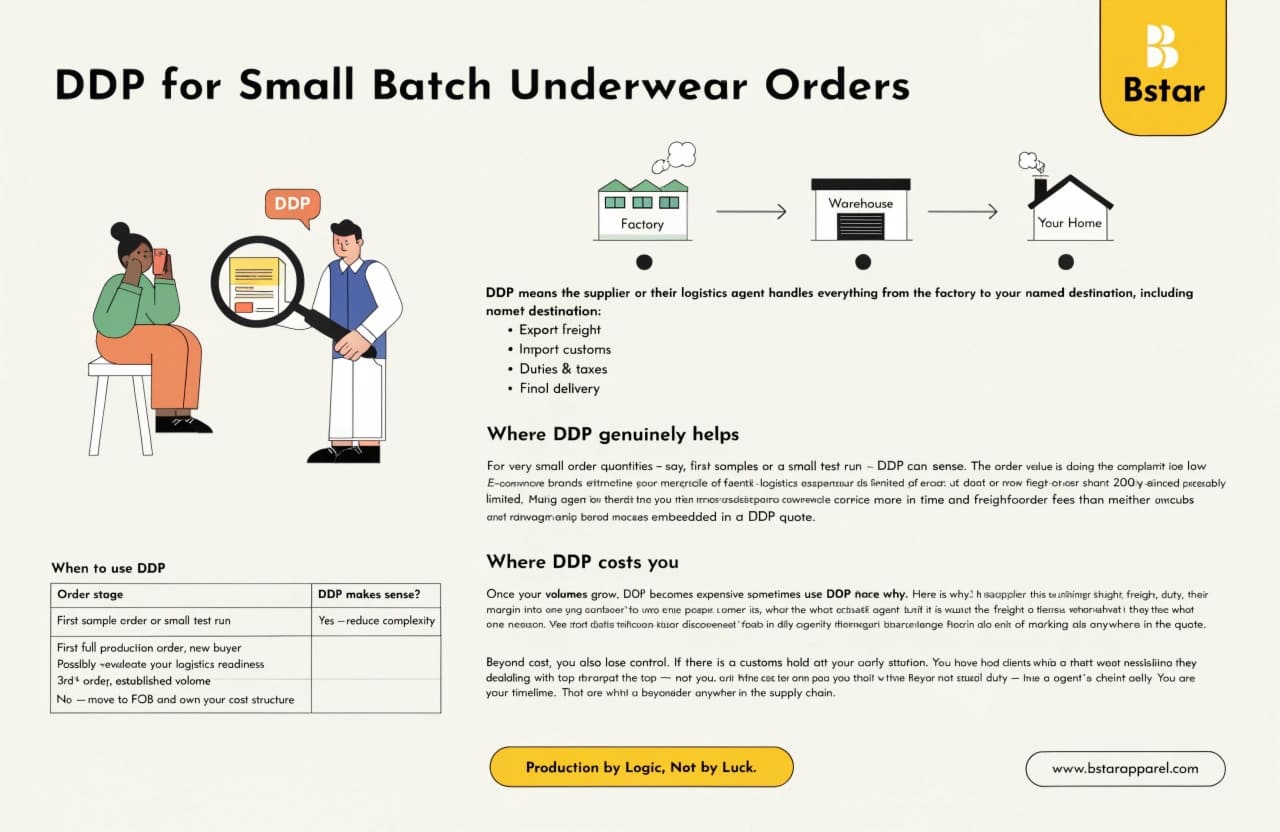
DDP means the supplier or their logistics agent handles everything from the factory to your named destination, including export, ocean freight, import customs, duties, and final delivery. You get one price. But that price bundles costs you have no visibility into, and you have no ability to negotiate or verify the individual components.
Where DDP genuinely helps
For very small order quantities—say, first samples or a small test run—DDP can make sense. The order value is low. The logistics complexity is real but the financial exposure is limited. Managing your own customs clearance for a 200-piece test order probably costs more in time and freight forwarder fees than any markup embedded in a DDP quote.
E-commerce brands doing early-stage validation sometimes use DDP for exactly this reason. It reduces moving parts when you are still testing the market and cannot justify building a logistics process around one small order.
Where DDP costs you
Once your volumes grow, DDP becomes expensive. Here is why.
The supplier or their agent is bundling freight, duty, handling, and their own service margin into one opaque number. You cannot tell what the actual freight rate is, what the duty came to, or how much the agent is marking up the handling fee. We have had clients who later discovered they were paying their DDP agent’s handling fee on top of the actual import duty—neither of which was itemized anywhere in the quote.
Beyond cost, you also lose control. If there is a customs hold at your destination port, it is the supplier’s agent dealing with it—not you. That agent’s priority is not necessarily your timeline. You are a bystander in your own supply chain.
DDP is a starting point, not a permanent strategy
| Order stage | DDP makes sense? |
|---|---|
| First sample order or small test run | Yes—reduce complexity |
| First full production order, new buyer | Possibly—evaluate your logistics readiness |
| 3rd+ order, established volume | No—move to FOB and own your cost structure |
Choosing the Right Term: How Do You Match Incoterms to Where Your Business Actually Is?
The question I get most from new buyers is: "Which Incoterm should I ask for?" My honest answer is always: it depends on what you can actually manage right now.
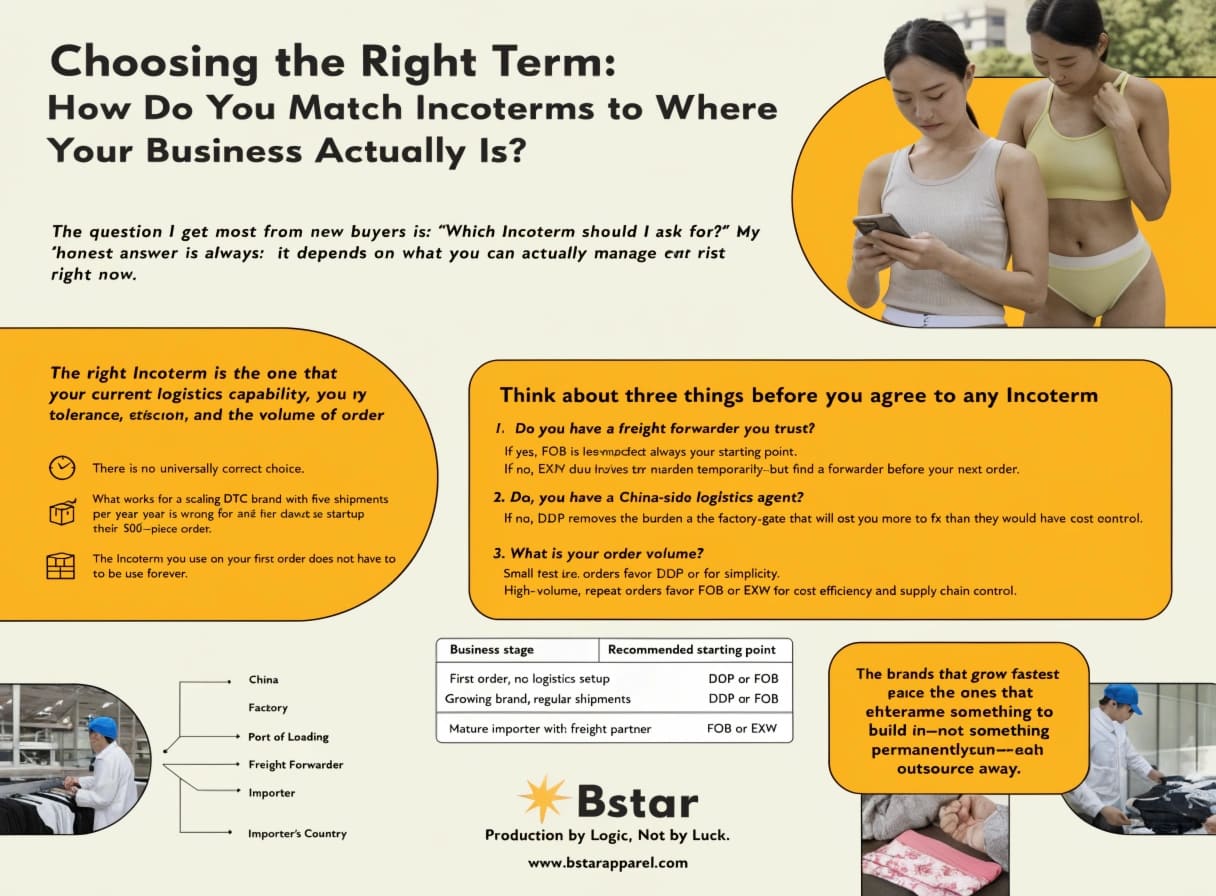
The right Incoterm is the one that matches your current logistics capability, your risk tolerance, and the volume of your order. There is no universally correct choice. What works for a scaling DTC brand with five shipments per year is wrong for a startup placing their first 500-piece order.
A practical decision framework
Think about three things before you agree to any Incoterm:
1. Do you have a freight forwarder you trust?
If yes, FOB is almost always your starting point. Your forwarder handles the ocean leg and destination customs, and you have full visibility into costs. If no, DDP removes the burden temporarily—but find a forwarder before your next order.
2. Do you have a China-side logistics agent?
If yes, EXW gives you maximum control and clean cost separation. If no, EXW will create problems at the factory gate that will cost you more to fix than they would have cost to avoid.
3. What is your order volume?
Small test orders favor DDP or FOB for simplicity. High-volume, repeat orders favor FOB or EXW for cost efficiency and supply chain control.
| Business stage | Recommended starting point |
|---|---|
| First order, no logistics setup | DDP or FOB |
| Growing brand, regular shipments | FOB |
| Mature importer with freight partner | FOB or EXW |
The Incoterm you use on your first order does not have to be the one you use forever. In my experience working with international buyers, the brands that grow fastest are the ones that treat logistics as something to build capability in—not something to permanently outsource away.
Conclusion
EXW, FOB, and DDP each fit a different buyer at a different stage. Start with what your current logistics setup can actually support, then build toward more control as your volume grows.