
How to Negotiate MOQs with Boxer Briefs Factories?
Most buyers walk into a MOQ conversation the wrong way. They ask for a lower number. The factory says no. The deal stalls. Here is what actually works.
MOQ at a boxer briefs factory is not a fixed rule — it is a cost-recovery equation. When you understand what the factory is actually pricing (fabric runs, colorway changeovers, size grading), you can reduce the effective MOQ without the factory bending any policy. You just need to know which levers to pull.
I have been manufacturing knitwear for 19 years. I have sat on the factory side of this conversation hundreds of times. And the buyers who get the best terms are never the ones who push hardest on price. They are the ones who understand how our costs actually work. Let me walk you through the whole picture.
What Actually Drives MOQ — and Why Most Buyers Get This Wrong?
Most buyers think MOQ is about the factory being difficult. It is not. It is about math.
A boxer briefs factory calculates MOQ based on the combination of style × color × size ratio. Each unique combination triggers its own setup cost — dyeing batch minimums, cutting pattern changes, elastic sourcing, and packaging runs1. The MOQ is the number of units needed to recover those costs at a profitable per-unit rate2.
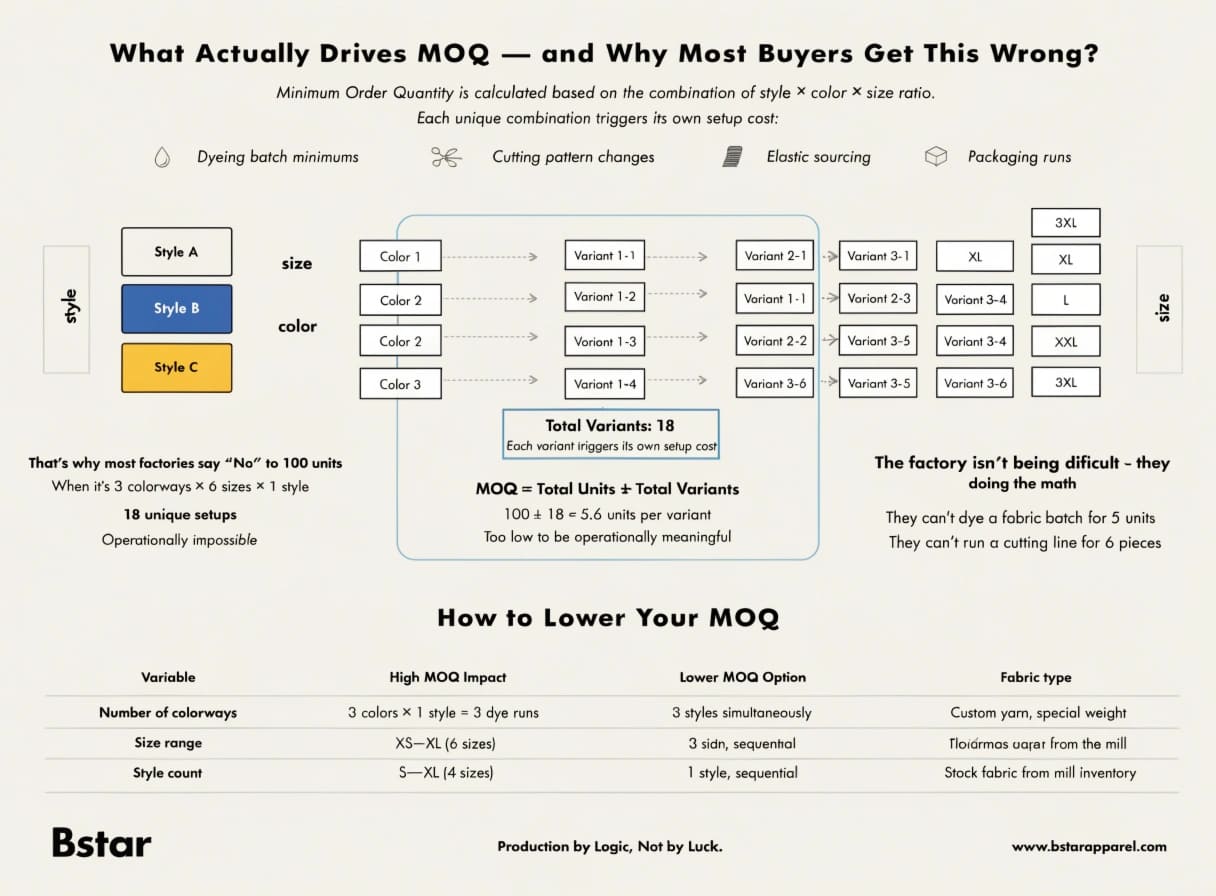
Here is the failure mode I see most often. A buyer says, "I want 100 units." Sounds simple. But then the brief comes in: 3 colorways, 6 sizes (XS through 3XL), one style. That is 18 SKU variants. 100 units divided by 18 variants gives you roughly 5 or 6 units per variant. On the factory floor, that is operationally meaningless. You cannot dye a fabric batch for 5 units3. You cannot run a cutting line for 6 pieces4. The factory is not being unreasonable when they push back. The math simply does not work.
What this means for you as a buyer
| Variable | High MOQ Impact | Lower MOQ Option |
|---|---|---|
| Number of colorways | 3 colors × 1 style = 3 dye runs | 1 color × 1 style = 1 dye run |
| Size range | XS–3XL (6 sizes) | S–XL (4 sizes) |
| Style count | 3 styles simultaneously | 1 style, sequential |
| Fabric type | Custom yarn, special weight | Stock fabric from mill inventory |
In our experience at BSTAR, a buyer who trims from 3 colorways to 1 and narrows their size run from XS–3XL down to S–XL can cut their effective MOQ close to half5 — without us changing a single internal policy. The factory did not lower its MOQ. The buyer just stopped generating so many unique cost triggers.
What Levers Actually Move a Factory on MOQ?
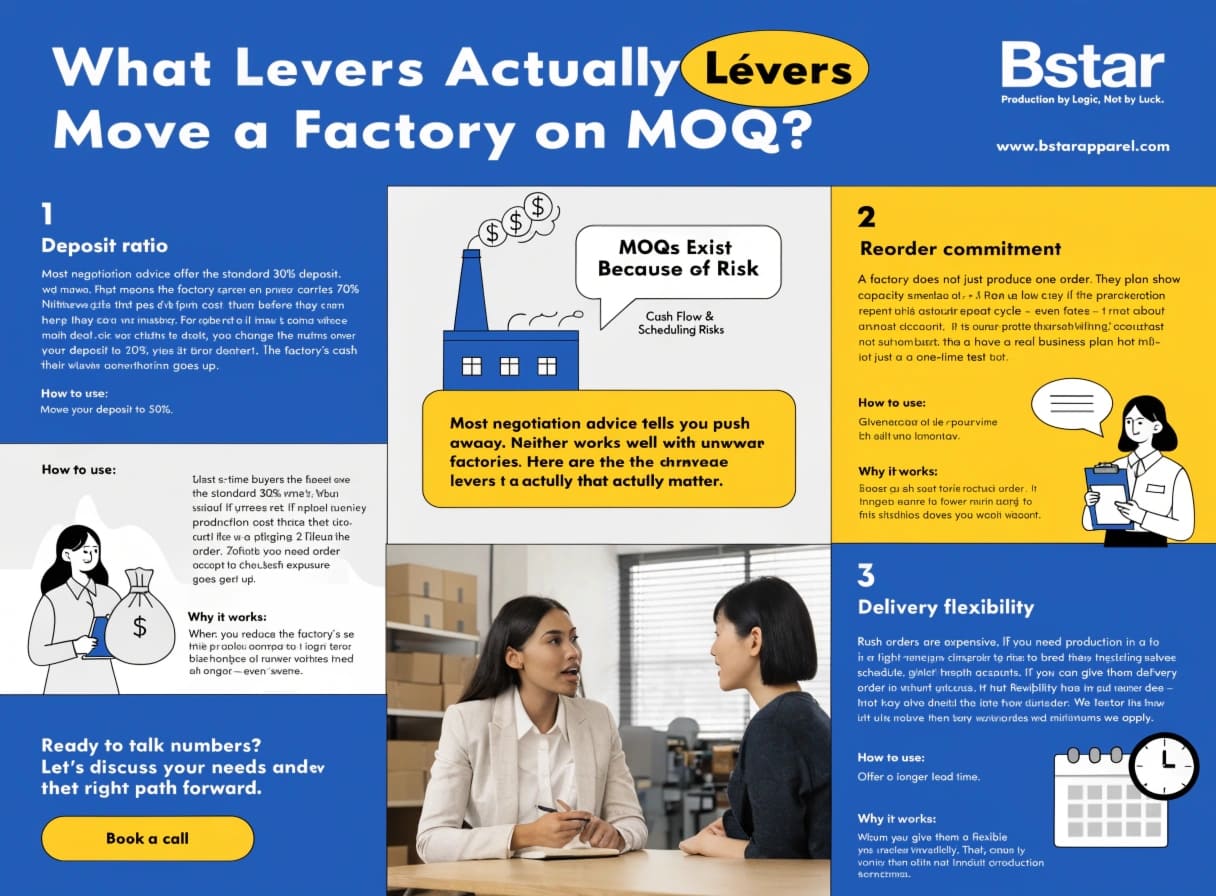
Most negotiation advice tells you to push on price or walk away. Neither works well with underwear factories. Here are the three levers that actually matter.
The real reason MOQs exist is factory risk — cash flow risk and scheduling risk. A higher deposit, a reorder commitment, and a flexible delivery window each reduce that risk directly6. When you reduce the factory’s risk, the MOQ threshold moves. This is more effective than price negotiation, especially for first-time buyers.
Lever 1: Deposit ratio
Most first-time buyers offer the standard 30% deposit. That means the factory carries 70% of the production cost through the entire run before they see money. For a small order, that is a bad deal for the factory. If you move your deposit to 50%, you change the math. The factory’s cash exposure drops. Their willingness to accept a lower volume goes up. We have seen this work directly with new clients — an Australian brand we work with came in with a higher upfront commitment, and that single move unlocked a smaller trial quantity that we would not have offered at standard terms.
Lever 2: Reorder commitment
A factory does not just produce one order. They plan capacity weeks out. If you can show that a small first order is the beginning of a predictable repeat cycle — even informally — that changes how the factory values your account. It is not about signing a contract you cannot keep. It is about showing that you have a real business plan behind the order, not just a one-time test.
Lever 3: Delivery flexibility
Rush orders are expensive. If you need production in a tight window, the factory has to break into their existing schedule7, which costs them in other accounts. If you can give them a flexible delivery window — say, 45 days instead of 21 — they can fit your order into natural production gaps. That flexibility has real monetary value. We factor it directly into how we price and what minimums we apply.
How Sampling Changes the MOQ Conversation Entirely?
There is a common belief that sampling is just about checking quality. It is actually your most effective MOQ negotiation tool, and most buyers do not realize it.
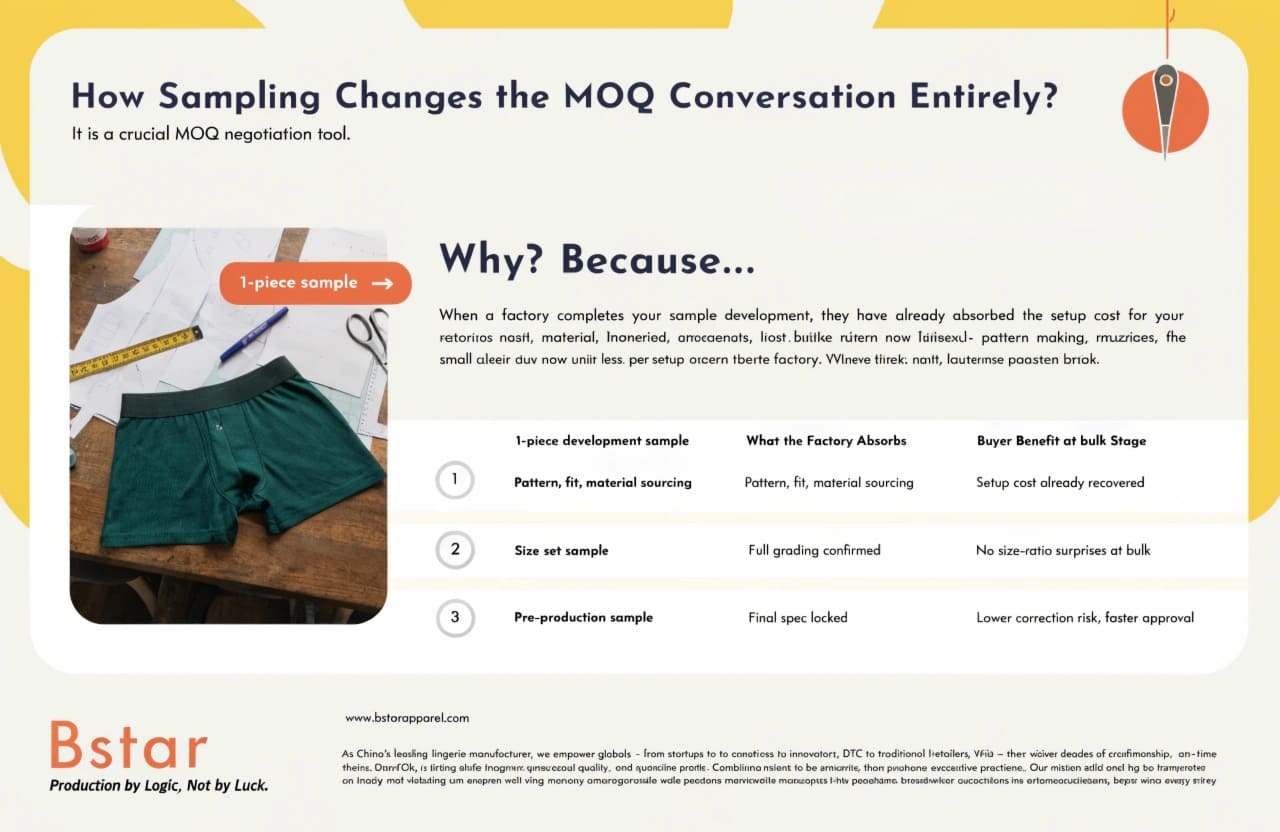
When a factory completes your sample development, they have already absorbed the setup cost for your style — pattern making, fit adjustments, material sourcing. That cost is gone8. A small first bulk order now carries less per-unit risk for the factory because the setup investment is already paid. This is why buyers who sample first consistently get better volume terms.
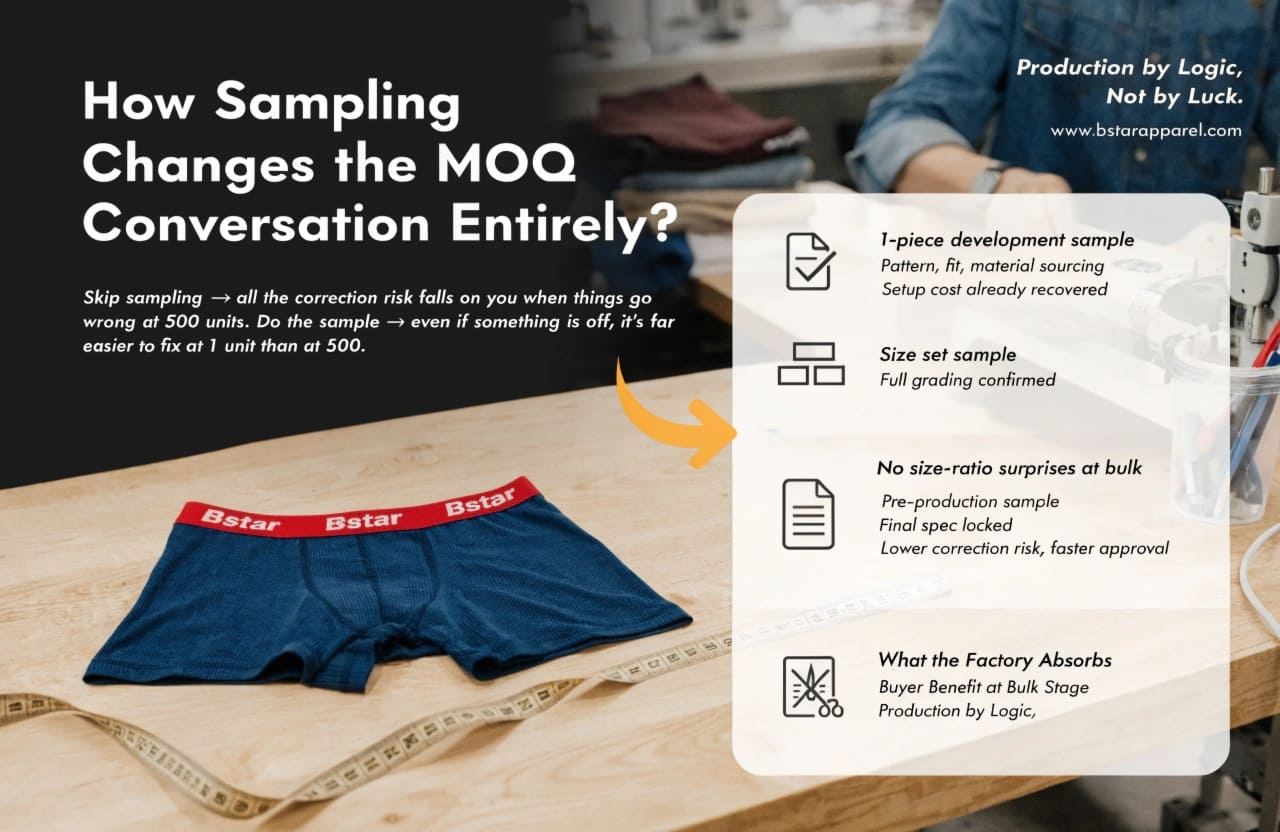
At BSTAR, we support 1-piece sampling. That means a buyer can develop their exact boxer brief spec — fabric weight, waistband construction, size grading, fit — at virtually zero volume commitment. By the time they are ready to place a bulk order, we have already done the hard setup work together. The effective cost to us of running a smaller first order is lower. That translates directly into more flexible terms.
There is also a relationship dimension here, but I want to be direct about why it works structurally, not just emotionally. A buyer who has sampled with us has demonstrated that they are serious, that their spec is real, and that the product is viable. That reduces our risk in every measurable way. Lower risk means we can meet them at a lower opening volume.
What a good sampling process looks like
| Stage | What the Factory Absorbs | Buyer Benefit at Bulk Stage |
|---|---|---|
| 1-piece development sample | Pattern, fit, material sourcing | Setup cost already recovered |
| Size set sample | Full grading confirmed | No size-ratio surprises at bulk |
| Pre-production sample | Final spec locked | Lower correction risk, faster approval |
If you skip sampling and go straight to bulk, you carry all the correction risk. If something is wrong at 500 units, it is a very different problem than if something is wrong at 1 unit. Do the sample.
How Long-Term Partnership Thinking Lowers Your First-Order Barrier?
The buyers who get the worst MOQ terms are the ones who show up with a single order and no context. The buyers who get the best terms are the ones who walk in with a plan.
Factories allocate capacity to accounts they expect to grow with9. If you can show a realistic growth trajectory — even a simple 3-order forecast across 12 months — you shift from being a one-time transaction to being a planned account10. That shift has direct impact on the volume threshold a factory will accept from you on order one.
This does not mean you need to over-promise. In our experience, clients who communicate clearly — "here is my launch quantity, here is what I expect to reorder if sell-through hits X" — give us enough to plan around. We work with DTC brands across Europe, Australia, and North America at BSTAR, and the pattern is consistent. Brands like ONTHATASS and STEP ONE did not start with massive volumes11. They started with a clear business case and a realistic production roadmap. That roadmap is what allowed us to structure opening terms that worked for both sides.
How to frame your business case in the first conversation
| What to share | Why it matters to the factory |
|---|---|
| Target launch date | Helps factory plan capacity slot |
| Expected reorder frequency | Signals long-term account value |
| Current sales channel (DTC, wholesale, etc.) | Tells factory your growth ceiling |
| SKU consolidation plan | Shows you understand their cost logic |
You do not need a perfect pitch deck. You need to show that you have thought past the first order.
Conclusion
MOQ is a cost equation, not a barrier. Understand what drives it, reduce the factory’s risk, sample first, and show up with a plan. That is how you negotiate effectively.
-
"Sustainable Dyeing Techniques: Innovations in Coloring Fabrics", https://www.rmcad.edu/blog/sustainable-dyeing-techniques-innovations-in-coloring-fabrics/. Manufacturing cost analysis in apparel production identifies setup or changeover costs — including dye batch preparation, cutting die changes, and line reconfiguration — as fixed costs incurred per production run variant, independent of run volume, consistent with broader literature on batch manufacturing economics. Evidence role: mechanism; source type: education. Supports: Each distinct product variant in apparel manufacturing requires separate production setups across dyeing, cutting, and finishing operations, each carrying fixed costs that must be recovered across the units produced in that run. Scope note: The precise cost structure varies by factory type, automation level, and product category; sources addressing general batch manufacturing may not fully reflect knit underwear-specific operations ↩
-
"Economic order quantity – Wikipedia", https://en.wikipedia.org/wiki/Economic_order_quantity. Operations management and supply chain references define minimum order quantity as the smallest order a supplier will accept, typically set to ensure that fixed production costs — including setup, tooling, and changeover — are recovered at an acceptable per-unit margin. Evidence role: definition; source type: encyclopedia. Supports: Minimum order quantity in manufacturing is determined by the need to spread fixed production setup costs across a sufficient number of units to achieve a viable per-unit cost. Scope note: Definitions in general operations management literature may not capture the multi-variable SKU complexity specific to apparel manufacturing described in the article ↩
-
"Sustainable Dyeing Techniques: Innovations in Coloring Fabrics", https://www.rmcad.edu/blog/sustainable-dyeing-techniques-innovations-in-coloring-fabrics/. Textile dyeing operations require minimum bath volumes to maintain consistent dye-to-fiber ratios; industry literature on wet processing confirms that sub-minimum batches produce unacceptable color variation and are not commercially viable. Evidence role: mechanism; source type: education. Supports: Textile dyeing processes require minimum liquor ratios and batch volumes to achieve consistent color results, making very small runs technically and economically impractical. Scope note: Specific minimum unit thresholds vary by dyeing method (jet, beam, jig) and fiber type; a general source may not reflect the exact constraints of knit underwear fabric ↩
-
"The Most Valuable Job in Your Apparel Cutting Room – YouTube", https://www.youtube.com/watch?v=Fzi7rQ0gf34. Garment technology literature describes cutting room operations as requiring minimum fabric spreads to achieve viable marker efficiency; cutting setups involve fixed time costs for marker making and spreading that are not recoverable at very low unit counts. Evidence role: mechanism; source type: education. Supports: Garment cutting operations require minimum fabric lay lengths and ply counts to achieve acceptable marker efficiency and justify the time cost of pattern placement and cutting setup. Scope note: Modern computerized cutting systems have reduced some minimum thresholds compared to manual operations; the practical minimum varies by equipment type and factory configuration ↩
-
"Lean Thinking and Methods – Cellular Manufacturing", https://www.epa.gov/sustainability/lean-thinking-and-methods-cellular-manufacturing. SKU rationalization literature in apparel and consumer goods manufacturing supports the principle that reducing variant count decreases aggregate setup cost burden; the proportional MOQ reduction depends on the relative weight of per-variant fixed costs versus shared fixed costs in the production run. Evidence role: mechanism; source type: paper. Supports: Reducing the number of distinct production variants (colorways and size options) proportionally reduces the number of independent setup cost triggers, which can lower the aggregate minimum order requirement. Scope note: The specific claim of ‘close to half’ is an approximation dependent on the factory’s internal cost structure; no published study directly validates this figure for boxer brief manufacturing ↩
-
"[PDF] Brand Purchasing Practices and Labor Outcomes in Apparel and …", https://www.ilr.cornell.edu/sites/default/files-d8/2025-07/brand-purchasing-practices-gli-report.pdf. Supply chain management research identifies advance payment and volume commitment arrangements as risk-mitigation instruments that shift financial exposure from supplier to buyer, thereby improving supplier willingness to accept smaller or non-standard orders (see, e.g., literature on buyer–supplier risk allocation in apparel supply chains). Evidence role: mechanism; source type: paper. Supports: Risk-sharing mechanisms between buyers and suppliers, including advance payments and volume commitments, are documented in supply chain literature as tools that reduce supplier financial exposure and improve order acceptance terms. Scope note: Academic sources typically address risk-sharing in general supply chain contexts; direct empirical evidence specific to underwear manufacturing MOQ negotiation is limited ↩
-
"[PDF] Rescheduling manufacturing systems: a framework of strategies …", https://isr.umd.edu/Labs/CIM/projects/jos-rescheduling.pdf. Operations management literature on production scheduling identifies expedited or rush orders as sources of schedule disruption cost, including changeover penalties, sequencing inefficiencies, and opportunity costs from displaced planned production; these costs are typically passed to the buyer through expediting premiums. Evidence role: mechanism; source type: paper. Supports: Inserting rush orders into existing production schedules imposes costs through setup changeovers, idle time for displaced jobs, and potential penalties on delayed existing orders. Scope note: Quantitative estimates of rush order cost premiums vary widely by industry and factory type; apparel-specific data on this cost component is not widely published ↩
-
"Cost Of Manufacturing Clothing: Factors & Key Insights", https://nofalapparel.com/cost-of-manufacturing-clothing/. Apparel production cost literature identifies pattern development, fit sampling, and material sourcing as non-recurring costs that manufacturers recover through sample charges or first-order pricing; once absorbed, these costs do not recur for repeat production of the same style. Evidence role: mechanism; source type: education. Supports: Garment manufacturing cost structures include non-recurring engineering and development costs (pattern making, grading, material sourcing) that are typically recovered either through sampling fees or amortized into bulk order pricing. Scope note: Cost recovery practices vary by factory and contract structure; the claim that these costs are fully ‘gone’ after sampling may oversimplify arrangements where factories partially re-amortize development costs ↩
-
"[PDF] Brand Purchasing Practices and Labor Outcomes in Apparel and …", https://www.ilr.cornell.edu/sites/default/files-d8/2025-07/brand-purchasing-practices-gli-report.pdf. Supply chain and operations management literature documents that suppliers facing capacity constraints apply customer tiering strategies, prioritizing accounts with predictable repeat demand; this behavior is consistent with models of supplier relationship management in the apparel sector. Evidence role: expert_consensus; source type: paper. Supports: Manufacturers in capacity-constrained industries preferentially allocate production slots to buyers representing stable, recurring demand rather than one-time purchasers. Scope note: Academic literature on this topic tends to address large-scale buyer–supplier relationships; evidence specific to small-order buyers negotiating with mid-size garment factories is sparse ↩
-
"[PDF] Partner Trust Level in Collaborative Demand Forecast Sharing and …", https://commons.und.edu/cgi/viewcontent.cgi?article=1000&context=ent-fac. Supply chain collaboration research demonstrates that buyer-provided demand forecasts reduce supplier planning uncertainty and enable more efficient capacity allocation; studies on collaborative planning, forecasting, and replenishment (CPFR) frameworks support the finding that forecast-sharing buyers receive preferential scheduling and terms from suppliers. Evidence role: expert_consensus; source type: paper. Supports: Sharing demand forecasts with suppliers is documented in supply chain collaboration literature as a mechanism that reduces supplier uncertainty, improves capacity planning, and can result in more favorable order terms for the buyer. Scope note: CPFR research primarily addresses large retail–supplier relationships; evidence for the effect of informal 3-order forecasts from small DTC buyers on factory MOQ terms is largely anecdotal ↩
-
"Let me show you the good and the ugly behind 86 million …", https://www.instagram.com/reel/DP0qUqOkTbL/. Public reporting on DTC apparel brand launches, including investor disclosures and founder interviews, may corroborate claims about initial production scale; however, no independently verified source is cited in the article for the specific brands referenced. Evidence role: case_reference; source type: other. Supports: That named DTC underwear brands launched with limited initial production quantities and scaled through repeat ordering. Scope note: Without a cited source, the claim about these specific brands rests solely on the author’s assertion; readers cannot independently verify the production history described ↩