
Questions to Ask Your Man Underwear Manufacturer Before Placing an Order
You found a factory. Their samples look decent. The sales rep replies within hours. So why do first-time buyers still get burned? Because the right questions were never asked.
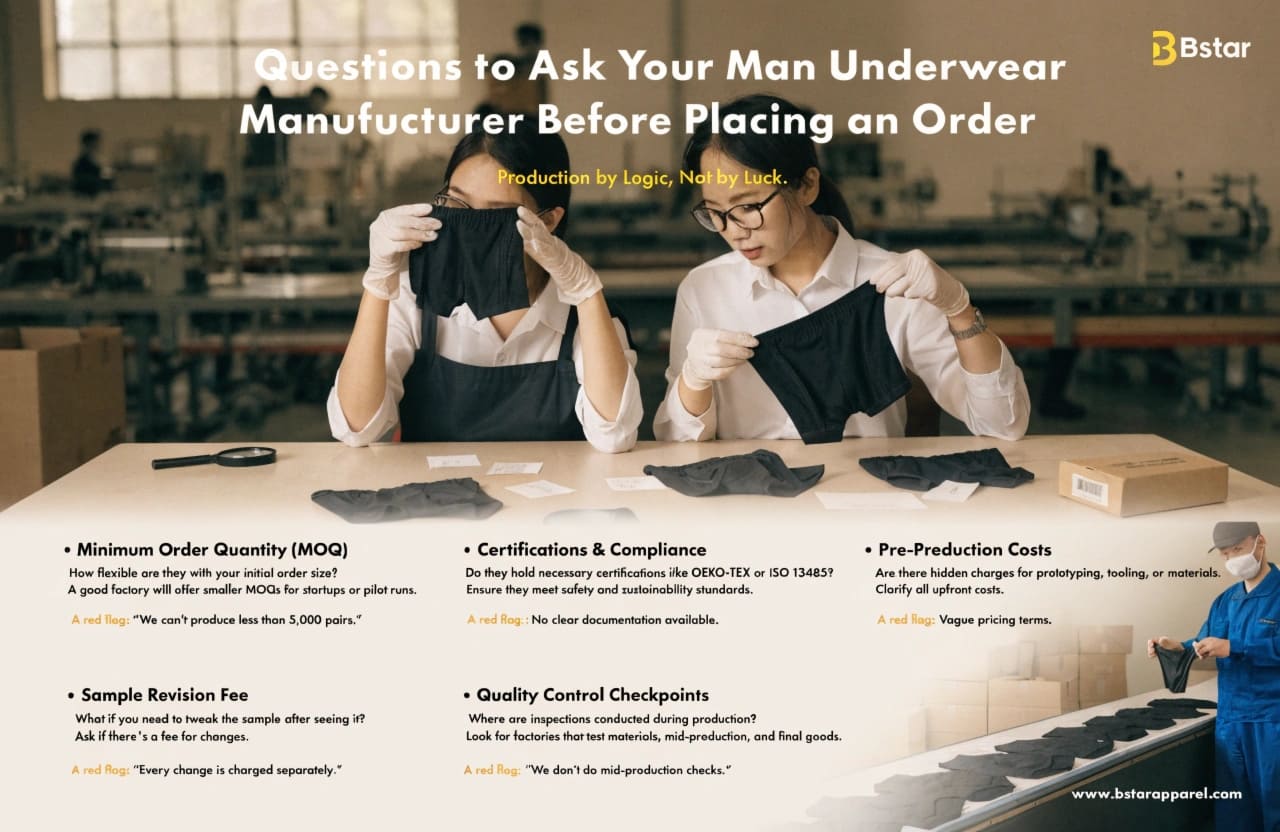
Before placing an order with any men’s underwear manufacturer, ask about MOQ flexibility, sample revision fees, certification scope, inspection checkpoints, and total pre-production costs. These six areas reveal whether a factory can actually deliver — not just sell.
A smooth sales conversation feels reassuring. But a responsive sales rep only tells you their commercial team is well-staffed. It tells you nothing about what happens on the production floor. The questions below will help you find that out — and more importantly, I’ll show you what a strong answer looks like versus one that should make you walk away.
Production Capabilities: What Should You Actually Ask About MOQs, Customization, and Samples?
Most buyers ask: "What’s your MOQ?" Then they stop. That one number doesn’t tell you much.
Ask instead: "What is your MOQ per colorway, per style, and per fabric type — and does that change for custom waistbands or custom packaging?" A factory with real small-batch capabilities will answer all four parts without hesitation. A vague or single-number answer usually means their system isn’t built for flexibility.
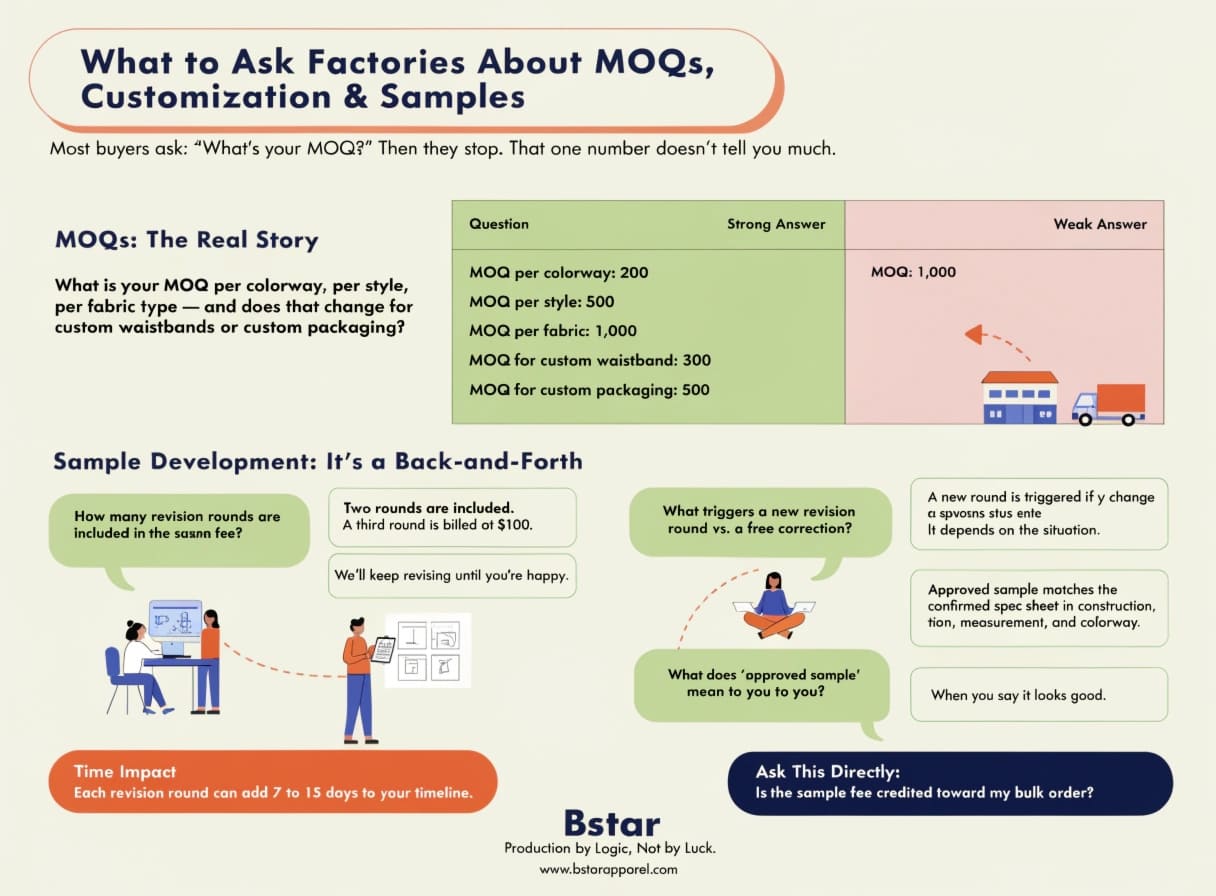
Here is where first-time buyers consistently underestimate the process. Sampling is not a one-step event. It is a back-and-forth that can take weeks — sometimes months — depending on how many revision rounds you need and how clearly you communicated your specs upfront.
Ask these specific questions before you commit to any timeline:
How many revision rounds are included in the sample fee?
| Question | Strong Answer | Weak Answer |
|---|---|---|
| How many revisions are included? | "Two rounds are included. A third round is billed at [specific fee]." | "We’ll keep revising until you’re happy." |
| What triggers a new revision round vs. a free correction? | "A new round is triggered if you change the spec sheet after approval." | "It depends on the situation." |
| What does ‘approved sample’ mean to you? | "Approved sample matches the confirmed spec sheet in construction, measurement, and colorway." | "When you say it looks good." |
Each revision round can add 7 to 15 days to your timeline.1 If your launch date is fixed, you need to know this math before you start — not after round three.
Also ask: "Is the sample fee credited toward my bulk order?" In most cases, it is not. Ask this directly. If a factory is vague here, the cost will surprise you later.
Quality Assurance: How Do You Verify Fabric Standards and Inspection Processes?
A factory that says "we have strict QC" is giving you nothing useful. That phrase means nothing without specifics.
Ask: "What AQL level do you inspect to2, how many checkpoints exist during production, and who performs the final inspection — your team or a third party?" A factory that can answer all three clearly has a real QC system. One that can only say "we check everything carefully" does not.
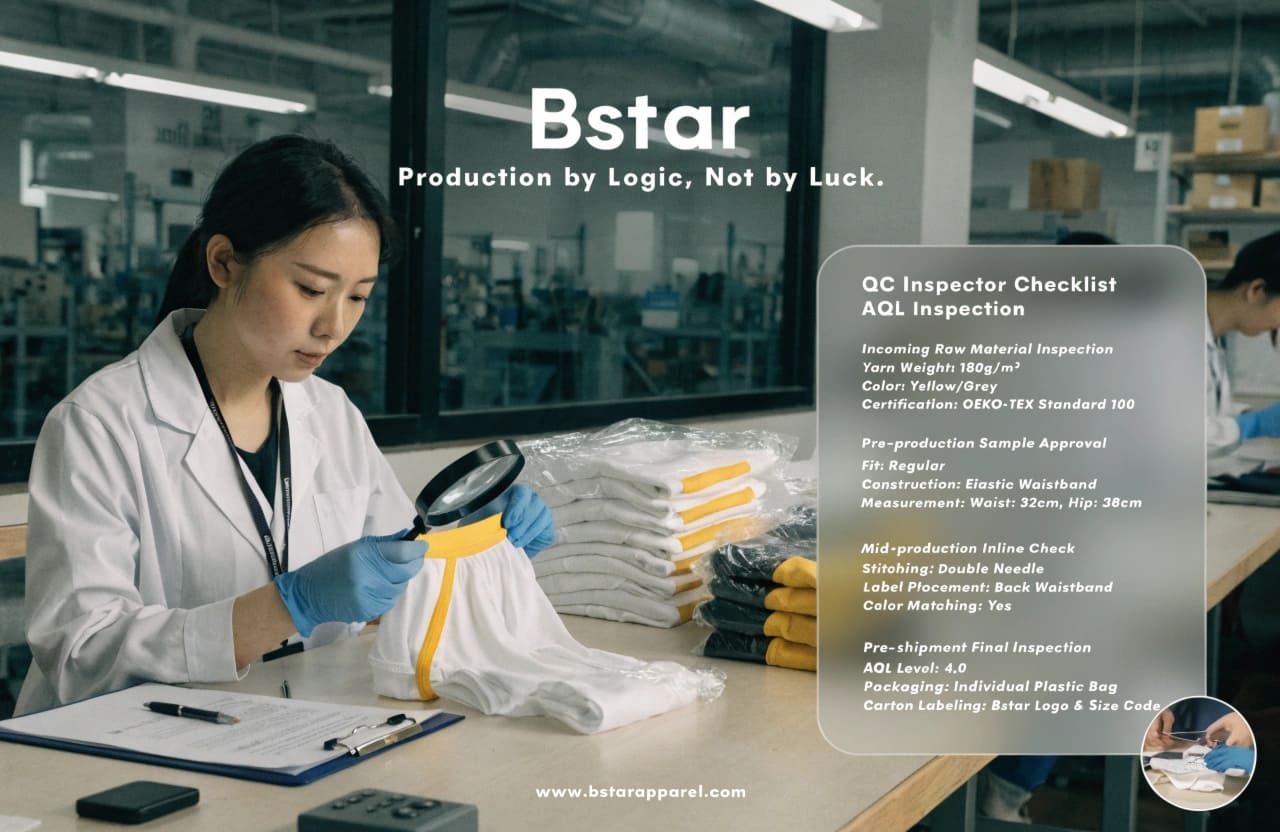
Fabric sourcing is equally important — and equally under-asked. Here is how to break it down:
What should you ask about fabric and stitching standards?
Fabric origin: Ask where the yarn comes from and whether it carries any certification. This matters especially if you plan to make any environmental or organic claims in your marketing.
Stitching construction: Ask how many stitches per inch are used on the waistband seam and gusset. Ask whether they use flatlock, overlock, or coverstitch — and why3. A factory that knows its own construction specs will answer this without checking with someone else.
Inspection checkpoints: A solid production process has at minimum these checkpoints:
| Checkpoint | What Gets Checked |
|---|---|
| Incoming raw material inspection | Yarn weight, color, certification compliance |
| Pre-production sample approval | Fit, construction, measurement against spec sheet |
| Mid-production inline check | Stitching consistency, label placement, color matching |
| Pre-shipment final inspection | AQL sampling, packaging, carton labeling |
If a factory describes fewer than four checkpoints, ask what happens when a defect is found mid-production. The answer will tell you whether they catch problems or just ship and hope.
Cost & Logistics: What Is the Real Total Cost Before Production Starts?
Unit price is the number buyers fixate on. It is rarely the number that matters most.
The real question is: "What is my total cost before I have a confirmed, production-ready sample?" This includes sample fees, revision fees, courier charges, and any spec sheet preparation costs. Get this number in writing before you agree to anything.
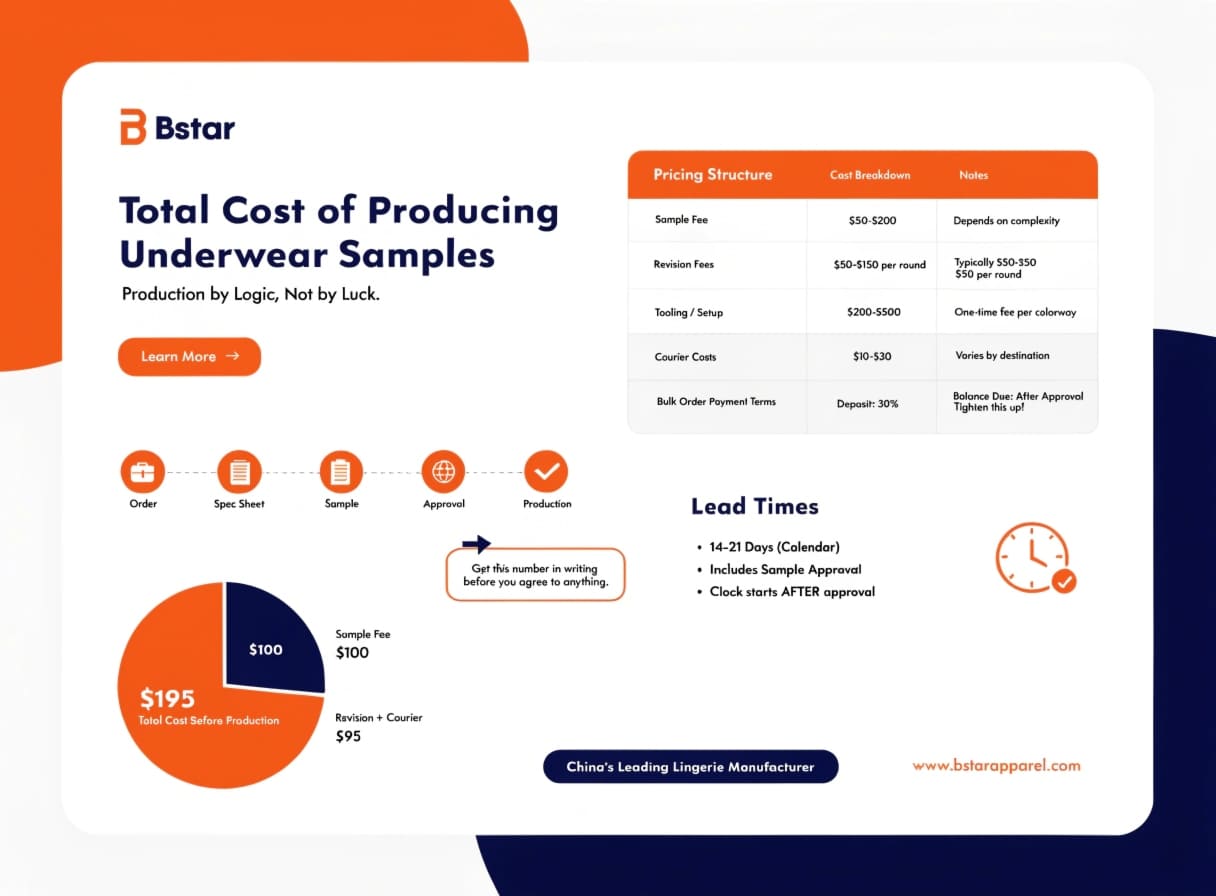
Fee fragmentation is where buyers lose the most money.4 A quote that shows a low unit price often excludes costs that add up fast. Here is what to ask about:
How should you break down the total cost structure?
| Cost Item | Ask This | Red Flag |
|---|---|---|
| Sample fee | "Is this credited toward my bulk order?" | No clear answer |
| Revision fees | "How much is each additional round?" | "We don’t charge for revisions" with no limit stated |
| Tooling or setup fees | "Are there any one-time setup fees per colorway?" | Surprise invoice after order confirmation |
| Shipping of samples | "Who pays courier costs for sample delivery?" | Assumed to be buyer without disclosure |
| Bulk order payment terms | "What is the deposit percentage and when is the balance due?" | 100% upfront with no milestone structure |
On lead times: ask for the number in calendar days, not business days5, and ask what that number assumes. Ask: "Does this include time for my sample approval, or does the clock start after approval?" These are two very different timelines. Many missed launches happen because buyers assumed the former and factories counted the latter.
Compliance & Ethics: How Do You Check Certifications and IP Protection?
Not all certifications protect you. Some protect the factory’s workers. Some protect your end customer. Some protect your sustainability claims. You need to know which is which.
Ask: "Which certifications apply to the specific product I’m ordering — and can you provide the certificate with the scope of coverage?" A factory that only says ‘we are certified’ without specifying scope is giving you a credential that may not apply to your order at all.
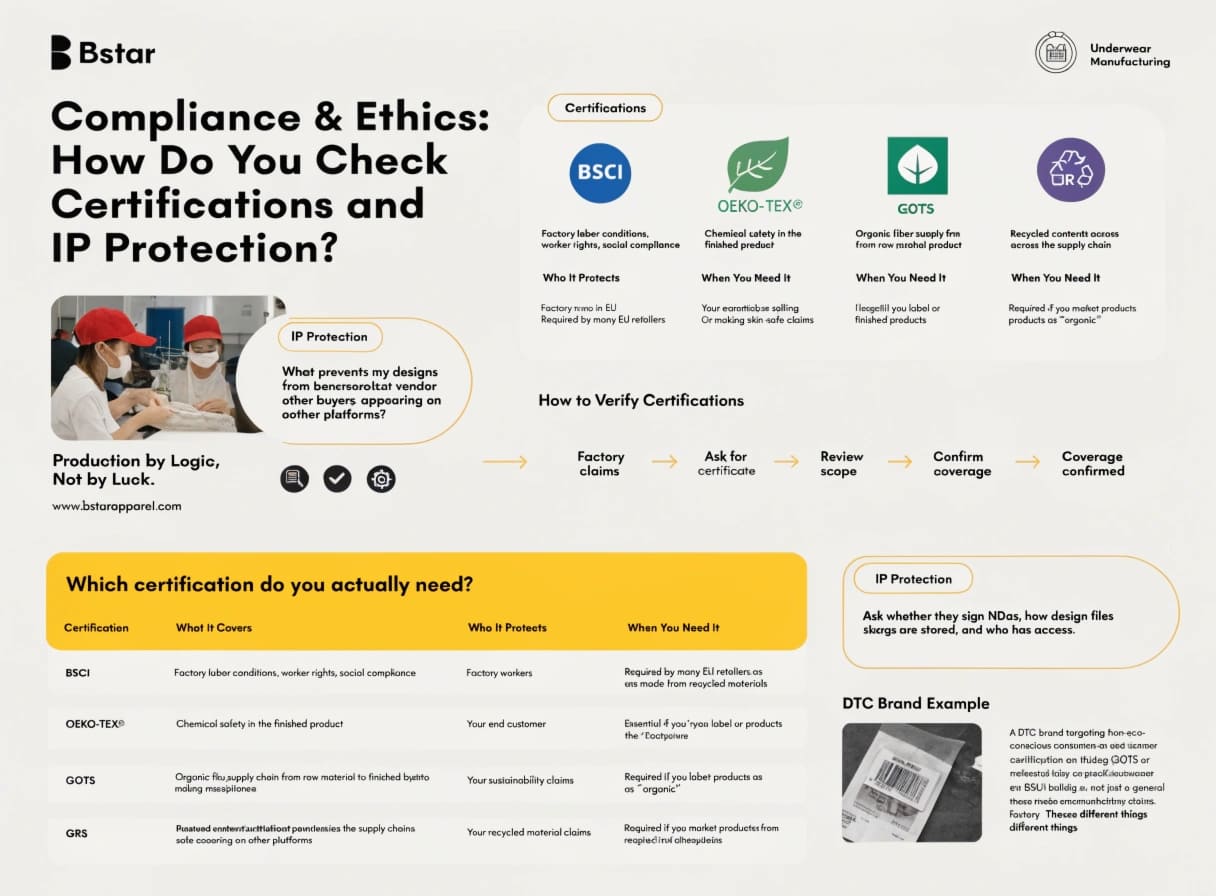
Here is what each certification actually covers — and why it matters to your specific market:
Which certification do you actually need?
| Certification | What It Covers | Who It Protects | When You Need It |
|---|---|---|---|
| [BSCI | Factory labor conditions, worker rights, social compliance](https://greenly.earth/en-us/blog/company-guide/bsci-code-of-conduct-approach-implementation-and-audit)[^6] | Factory workers | Required by many EU retailers as a vendor prerequisite6 |
| [OEKO-TEX® Standard 100 | Chemical safety in the finished product](https://en.wikipedia.org/wiki/Oeko-Tex)[^8] | Your end customer | Essential if you’re selling in EU or making skin-safe claims |
| [GOTS | Organic fiber supply chain from raw material to finished product](https://global-standard.org/certification-and-labelling/certification)[^9] | Your sustainability claims | Required if you label or market products as "organic" |
| [GRS | Recycled content verification across the supply chain](https://textileexchange.org/recycled-claim-global-recycled-standard/)[^10] | Your recycled material claims | Required if you market products as made from recycled materials |
A DTC brand targeting eco-conscious consumers needs GOTS or GRS certification on the specific product — not just a general BSCI audit of the factory building. These are different things. Ask the factory to show you the certificate and confirm the product category listed in the scope.
On intellectual property: ask directly — "What prevents my designs from being shared with other buyers or appearing on other platforms?" Ask whether they sign NDAs, how design files are stored, and who has access. A factory with a clear answer has dealt with this question seriously. One that seems surprised by it probably hasn’t.
Conclusion
Ask about real costs, specific certifications, inspection checkpoints, and revision policies — not just unit price. The factory’s answers to these questions will tell you exactly what you need to know.
-
"What Is The Lead Time For Sample Development In …", https://shanghaigarment.com/what-is-the-lead-time-for-sample-development-in-clothing/. Industry analyses of apparel product development cycles document that each sampling iteration—encompassing production, shipping, and buyer review—commonly extends a project timeline by one to three weeks, depending on geographic distance between buyer and factory and the complexity of the revision. Evidence role: general_support; source type: research. Supports: That iterative sampling rounds in garment manufacturing add measurable days to development timelines, with typical ranges documented in supply chain or fashion industry research.. Scope note: Most published sources report ranges for full development cycles rather than isolating the per-revision increment; the 7–15 day figure cited in the article may not be directly verifiable from a single authoritative source. ↩
-
"[PDF] ISO 2859-1 – UNT Chemistry", https://chemistry.unt.edu/~tgolden/courses/iso2859-1.pdf. Acceptable Quality Limit (AQL), as defined under ISO 2859-1, is a quality management tool specifying the maximum number of defective items considered acceptable in a statistical sample during inspection; common AQL levels in apparel manufacturing range from 1.0 (stricter) to 4.0 (more permissive), with the chosen level determining sample size and rejection thresholds. Evidence role: definition; source type: encyclopedia. Supports: That AQL is a standardized statistical sampling methodology used in manufacturing quality inspection to define the maximum acceptable number of defective units in a sample.. ↩
-
"The Flatlock Seam – YouTube", https://www.youtube.com/shorts/QzPxpo_uPbA. In textile and apparel engineering literature, flatlock stitching joins fabric edges so the seam lies flat against the skin, reducing chafing; overlock (serge) stitching encases raw edges to prevent fraying; and coverstitch creates a flat, stretchy seam on the fabric face with a looped underside, each construction offering different trade-offs in seam bulk, stretch recovery, and durability relevant to close-fitting garments. Evidence role: definition; source type: education. Supports: That flatlock, overlock, and coverstitch are technically distinct seam constructions with different structural and comfort properties relevant to intimate apparel and activewear.. Scope note: Terminology and application conventions vary by region and manufacturer; the functional distinctions described are broadly accepted but may not map precisely to every factory’s internal classification. ↩
-
"[PDF] Investigating the role of open costing in the buyer supplier relationship", https://libres.uncg.edu/ir/uncg/f/J_Su_Investigating_2021.pdf. Research on apparel sourcing and supply chain management consistently identifies a gap between factory-quoted unit prices and total landed costs, with studies noting that duties, freight, compliance testing, and ancillary supplier fees can add 20–50% or more to the ex-factory price depending on product category and sourcing origin. Evidence role: general_support; source type: research. Supports: That the landed cost of imported apparel frequently exceeds the quoted unit price due to ancillary fees, duties, and logistics costs not included in initial supplier quotations.. Scope note: The claim that fee fragmentation is where buyers ‘lose the most money’ is a comparative assertion; published research documents the phenomenon but does not uniformly rank it above other cost drivers such as quality failures or logistics delays. ↩
-
"Lead time – Wikipedia", https://en.wikipedia.org/wiki/Lead_time. Supply chain management literature identifies ambiguous lead time definitions—including inconsistent use of calendar days, business days, and working days across buyer and supplier organizations—as a recurring source of planning errors and delivery failures, particularly in cross-border manufacturing relationships where holiday calendars and workweek structures differ. Evidence role: general_support; source type: research. Supports: That inconsistent lead time definitions between buyers and suppliers are a documented source of supply chain miscommunication and missed delivery dates.. Scope note: Published research addresses lead time definition ambiguity broadly across supply chains; studies specific to the apparel or underwear manufacturing context are limited. ↩
-
"BSCI Certification for European Buyers: Complete Guide to Social …", https://seller.alibaba.com/blogs/2026/southeast-asia/general-merchandise/bsci-certification-european-buyers-guide-alibaba. Amfori reports that its BSCI program has been adopted by thousands of member companies, predominantly European retailers and importers, who require supplier factories to undergo BSCI audits as a condition of doing business, making it a de facto vendor prerequisite in segments of the EU retail market. Evidence role: general_support; source type: institution. Supports: That BSCI/amfori membership and audits are widely used by European retailers as a supply chain social compliance requirement for vendors.. Scope note: Adoption rates vary by retail sector and company size; ‘many EU retailers’ is a generalization that may not hold uniformly across all product categories or market segments. ↩