The Complete Guide to Ethical & Sustainable Underwear Manufacturing?
Buyers ask me this all the time: "Which certifications do we need?" They expect a short list. What they actually need is a decision framework — because the wrong certifications won’t protect them. They’ll expose them.
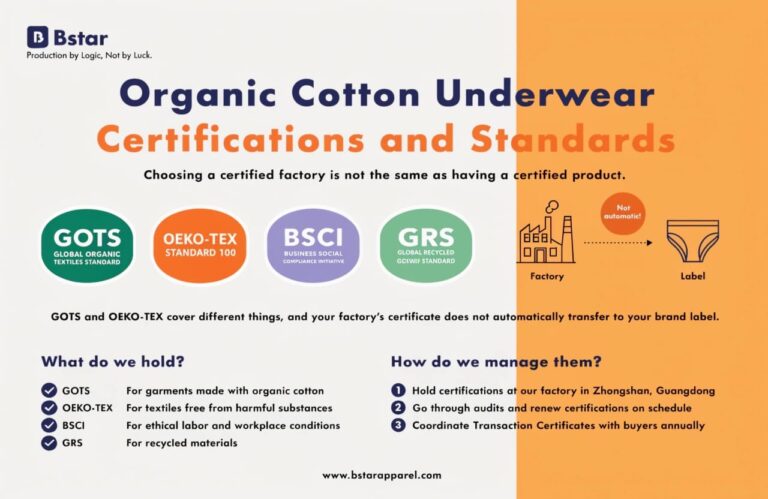
Sustainable underwear manufacturing requires matching certifications to specific brand claims. OEKO-TEX® covers product safety. GOTS covers organic fiber traceability. GRS covers recycled content. BSCI covers labor practices. Using the wrong one — or mixing them without alignment — creates greenwashing risk, not credibility.
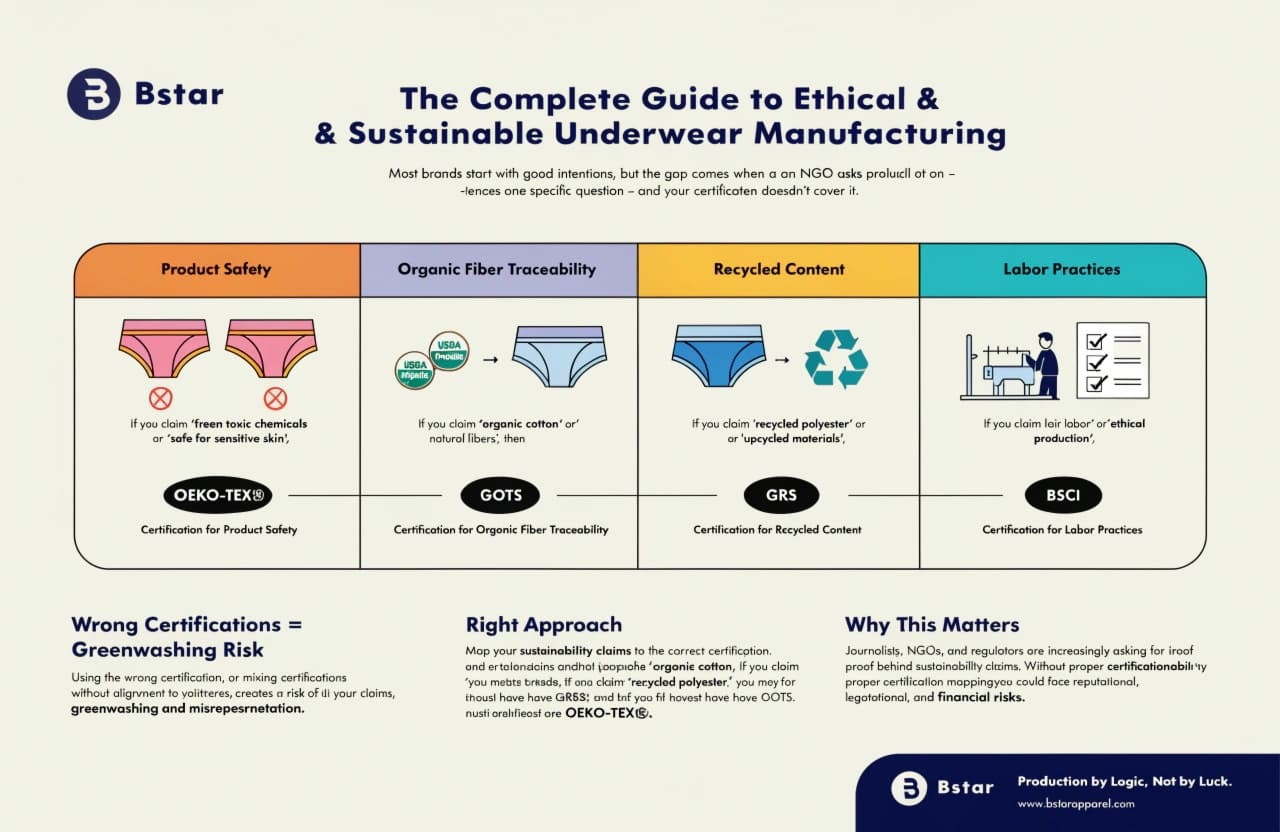
Most brands start with good intentions. They find a factory with a wall full of certificates, pick the ones that sound right, and write their website copy. Then a journalist or an NGO asks one specific question — "Can you show the chain-of-custody documentation for that organic cotton?" — and the brand has no answer. The certificate doesn’t cover that. It never did. That’s the gap we’re going to close in this guide.
Material Innovation: Are You Sourcing the Right Eco-Friendly Fabrics and Fibers?
Brands come to us asking for "sustainable fabric." That phrase doesn’t mean anything on its own. Sustainable compared to what? Proven how? By whom?
Eco-friendly fabrics for underwear manufacturing fall into two main tracks: organic natural fibers (like GOTS-certified cotton or bamboo) and recycled synthetic fibers (like GRS-certified recycled polyester or nylon1). Each track requires different certifications, different supply chains, and supports different brand claims.
Let’s get specific about what these certifications actually cover — and where they stop.
What Does GOTS Actually Certify?
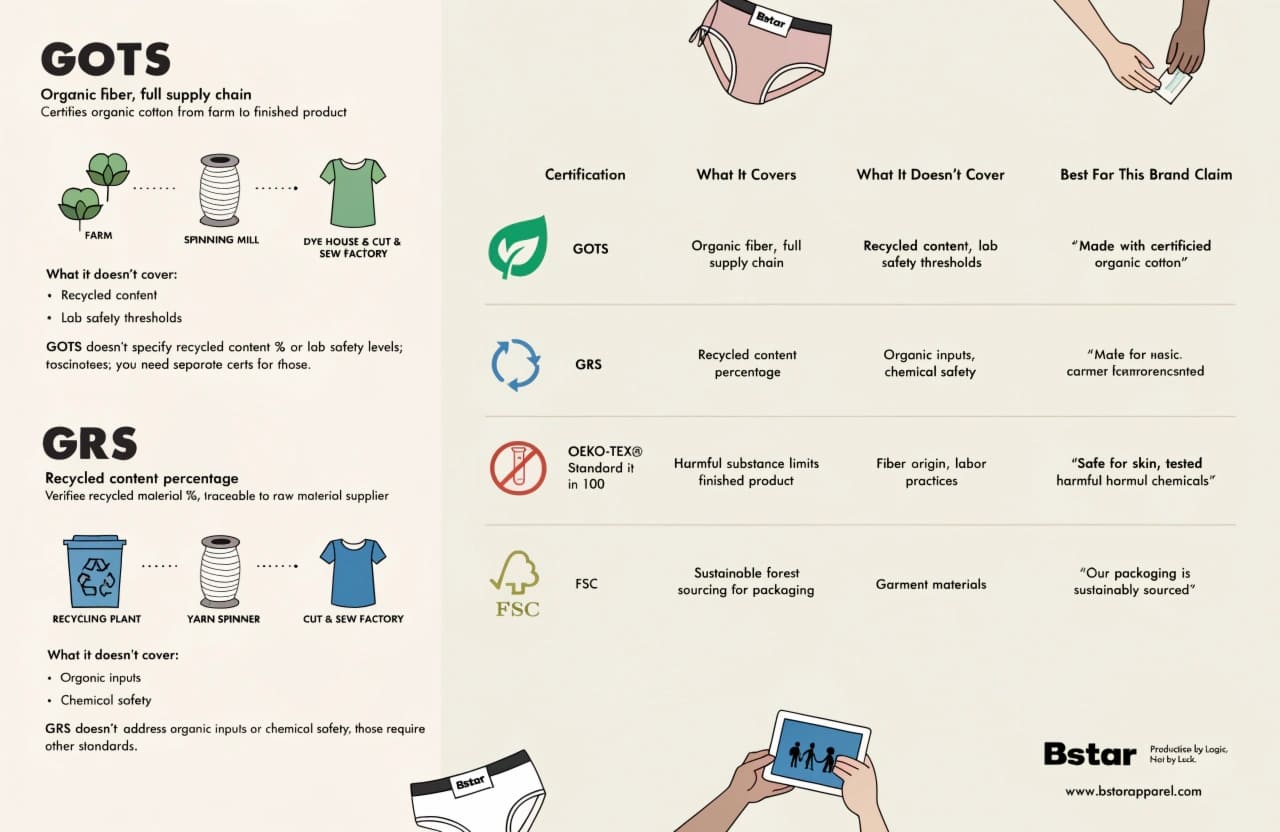
GOTS (Global Organic Textile Standard) certifies the entire chain of custody from raw fiber to finished product2. That means every handoff — from the farm to the spinning mill, from the mill to the dye house, from the dye house to the cut-and-sew factory — needs to be documented and audited. If one link in that chain isn’t GOTS-certified, the finished garment cannot carry a GOTS label.
This is where most brands get into trouble. They find a factory with GOTS certification and assume that means their "organic cotton" product is covered. It’s not — unless the yarn supplier and all upstream processors are also in the GOTS system. In our experience running GOTS-certified production runs, what auditors actually check is the transaction certificates at each material handoff. Not just the factory’s certificate number.
What Does GRS Actually Certify?
GRS (Global Recycled Standard) certifies that a product contains a verified percentage of recycled material — traceable back to the raw material supplier3. The auditors want to see documentation proving the recycled content claim, not just a supplier’s word.
If a brand wants to say "made from recycled bottles," GRS is the right certification. If they say "made from organic cotton," GRS does nothing for that claim.
| Certification | What It Covers | What It Doesn’t Cover | Best For This Brand Claim |
|---|---|---|---|
| GOTS | Organic fiber, full supply chain | Recycled content, lab safety thresholds | "Made with certified organic cotton" |
| GRS | Recycled content percentage | Organic inputs, chemical safety | "Made from recycled materials" |
| OEKO-TEX® Standard 100 | Harmful substance limits in finished product | Fiber origin, labor practices | "Safe for skin, tested for harmful chemicals" |
| FSC | Sustainable forest sourcing for packaging | Garment materials | "Our packaging is sustainably sourced" |
The decision isn’t "which certification looks best." It’s "which certification actually backs up what I’m putting on my product tag."
Social Responsibility: Are Fair Labor Practices Actually Audited in Your Supply Chain?
A lot of brands treat environmental sustainability and ethical labor as the same thing. They’re not. They run on completely different audit tracks. Mixing them up leaves real gaps.
BSCI (Business Social Compliance Initiative) audits social compliance: wages, working hours, health and safety conditions, and freedom of association4. Environmental certifications like GOTS and GRS do not audit labor practices. A factory can hold GOTS certification and still have labor compliance issues — because no one audited for them5.
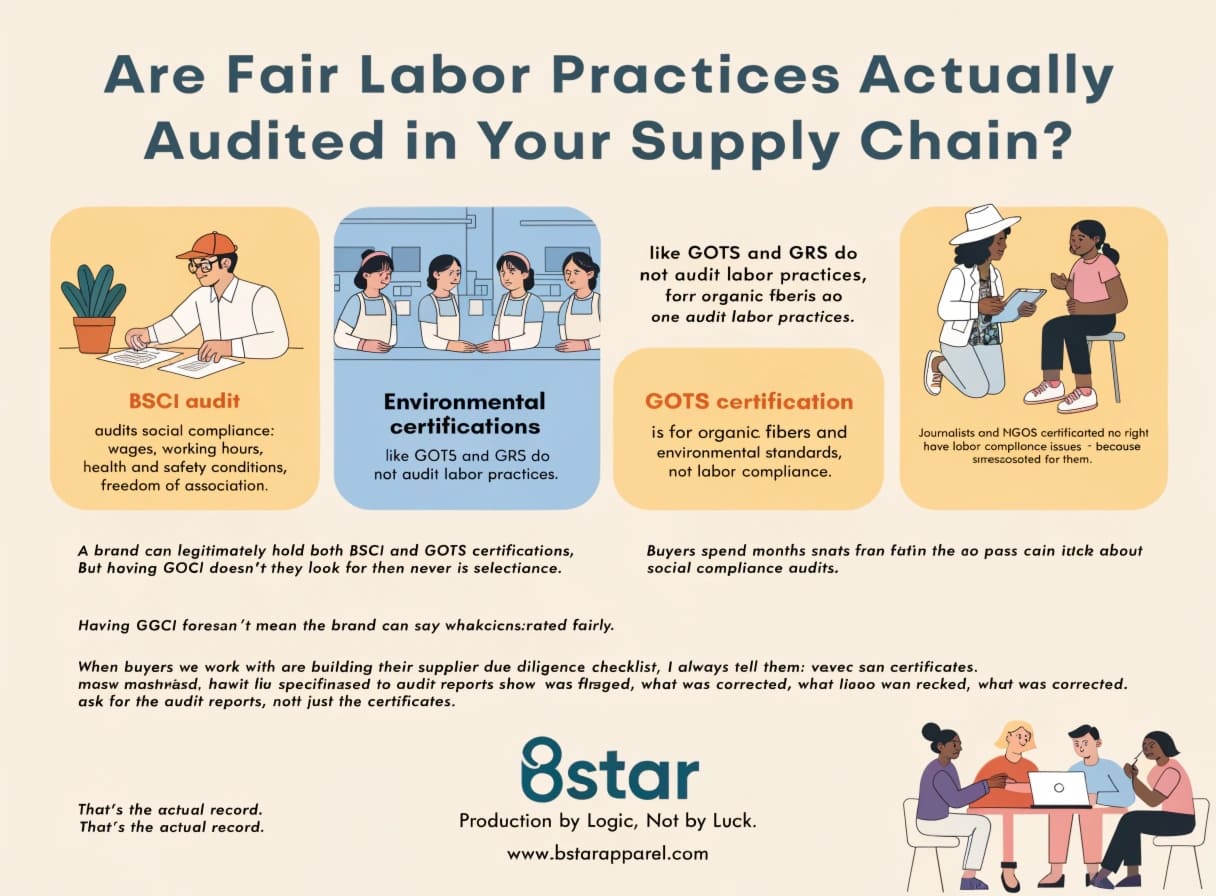
This is one of the most common gaps I see in buyer due diligence. Buyers spend months selecting the right fabric certification and then never ask about social compliance audits. Journalists and NGOs know this pattern. They look for it specifically.6
What a BSCI Audit Actually Checks
BSCI audits cover working hours and overtime compliance, minimum wage and legal wage requirements, workplace safety conditions, child labor and forced labor prevention, and the right of workers to organize. These are reviewed through document checks, worker interviews, and physical site inspections.
What BSCI doesn’t cover: environmental practices, chemical inputs, or fiber origin. It’s a labor audit, not an environmental one.
Why Both Tracks Matter
A brand can legitimately hold both BSCI and GOTS certifications — and they should, if they’re making claims in both areas. But having GOTS doesn’t mean the brand can say workers are treated fairly. Having BSCI doesn’t mean the brand can say the cotton is organic.
When buyers we work with are building their supplier due diligence checklist, I always tell them: ask for the audit reports, not just the certificates. Certificates show that a factory passed at a point in time. Audit reports show what was checked, what was flagged, and what was corrected. That’s the actual record.
Green Production: Are Energy Efficiency and Waste Reduction Actually Built Into the Process?
Sustainable materials are only part of the picture. How those materials are processed matters just as much — and this is the area where brands have the least visibility.
Green production in underwear manufacturing includes reducing water and energy consumption in dyeing and finishing, eliminating or capturing chemical waste, and minimizing fabric offcuts through optimized cutting. These are operational commitments — they’re not covered by any single certification, but they show up in a factory’s audit trail if you know what to ask for.

What to Actually Ask a Factory
Most factories will say they care about sustainability. Few can show you the specifics. Here’s what operational green production actually looks like:
Water use in dyeing: Low-liquor-ratio dyeing machines use significantly less water per kilogram of fabric than conventional equipment7. Ask the factory what dyeing equipment they run and whether they have water consumption records per production batch.
Chemical inputs: OEKO-TEX® certification on a finished product means the product was tested for harmful substance limits. It doesn’t mean the dyeing process itself was clean. Ask whether the dye house uses OEKO-TEX® certified dyes and auxiliaries — those are audited differently.
Fabric waste: Optimized marker-making in the cutting room directly reduces fabric offcut waste8. This is a technical process improvement, not a certification. Ask what their fabric utilization rate is on a typical underwear cut.
Energy consumption: Some factories track their energy use per unit produced as part of environmental management systems. If a factory can’t give you any production efficiency data, that’s a signal.
None of these questions require a certification to answer. They require a factory that actually runs this way — and has the records to prove it.
Certifications and Transparency: Does Your Factory’s Audit Trail Actually Support Your Brand Claims?
This is the section most brands skip. They get the certificate number, put it on the website, and move on. That’s exactly where the greenwashing risk lives.
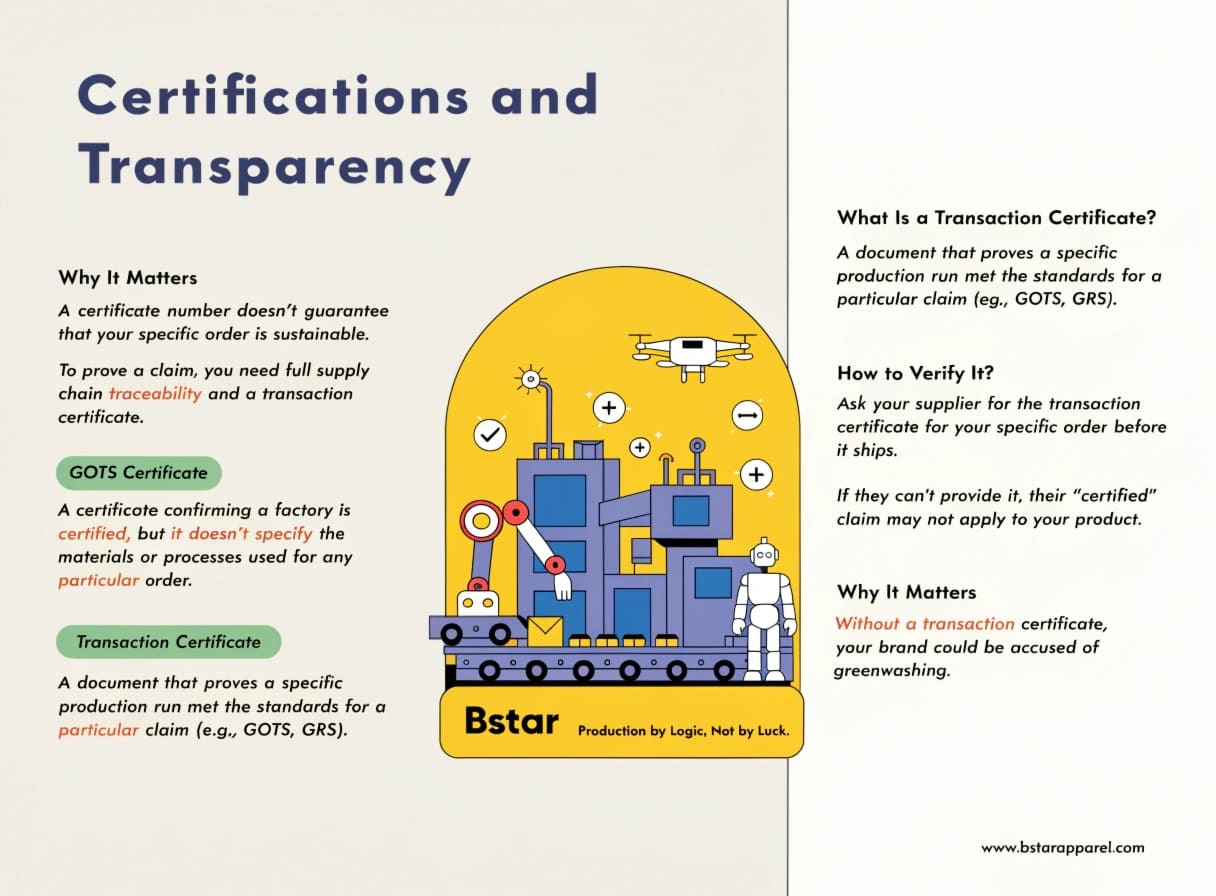
Transparency in sustainable manufacturing means being able to show the full audit trail — from raw material supplier through every production step to finished product. A certificate number on a website is a claim. The chain-of-custody documentation behind it is the proof. Brands that can show the documentation can defend their claims. Brands that can’t are exposed.
The Question Buyers Should Always Ask
When I talk to buyers who are finalizing their supplier selection, I tell them to ask one specific question: "Can you show me the transaction certificates for the last GOTS or GRS production run you completed?"
A transaction certificate is issued for each specific production order in the GOTS and GRS systems9. It shows the material inputs, the certified entities involved, and the output quantity. If a factory has genuinely run certified production, they have these documents. If they don’t, the certification certificate on their wall doesn’t cover your order.
A Scenario Where Certifications Leave Claims Unsupported
Here’s a real pattern I’ve seen: A brand sources from a GOTS-certified factory. The factory’s GOTS certificate is current and real. But the specific yarn used for that brand’s order came from a non-GOTS-certified mill — because the GOTS-certified yarn supplier was out of stock and the factory substituted without telling the buyer.
The factory still has their GOTS certificate. The brand’s product is not GOTS-certified. The brand’s website says "certified organic." That’s a problem.
The protection against this isn’t more certificates. It’s asking for the transaction certificate for your specific order before it ships. That document is either there or it isn’t.
Conclusion
Sustainable underwear manufacturing is a decision framework, not a certificate collection. Match each certification to the specific claim it supports, audit both environmental and labor tracks separately, and always ask for the documentation behind the certificate.
-
"Evaluating Environmental Impact of Natural and Synthetic Textile …", https://rex.libraries.wsu.edu/esploro/outputs/graduate/Evaluating-Environmental-Impact-of-Natural-and/99901019638101842. Lifecycle assessments of recycled polyester generally show reduced greenhouse gas emissions and energy use compared to virgin polyester production; however, research including Browne et al. (2011) in Environmental Science & Technology has documented that synthetic textiles shed microplastic fibers during laundering, representing an environmental trade-off not addressed by GRS certification. Evidence role: general_support; source type: paper. Supports: Recycled polyester and nylon reduce reliance on virgin petroleum feedstocks and lower certain lifecycle impacts, but shed microplastic fibers during washing. Scope note: The environmental net benefit of recycled synthetics versus virgin synthetics depends on the impact category assessed; microplastic shedding rates vary by fabric construction and washing conditions. ↩
-
"Traceability – GOTS", https://global-standard.org/the-standard/gots-key-features/traceability. The Global Organic Textile Standard (GOTS) requires certification of all processing stages in the textile supply chain, including spinning, weaving, dyeing, and finishing, with transaction certificates issued at each material transfer point; see GOTS Version 7.0, Global Standard gGmbH. Evidence role: definition; source type: institution. Supports: The official GOTS standard defines chain-of-custody requirements covering all processing stages from raw fiber through finished product. Scope note: The standard document defines requirements but does not independently verify how consistently these requirements are enforced across all certified facilities. ↩
-
"Recycled Claim Standard (RCS) + Global Recycled Standard (GRS)", https://textileexchange.org/recycled-claim-global-recycled-standard/. The Global Recycled Standard, administered by Textile Exchange, establishes chain-of-custody requirements for recycled content claims and requires traceability documentation from the point of reclamation through the finished product; see Textile Exchange, Global Recycled Standard Version 4.0. Evidence role: definition; source type: institution. Supports: The GRS standard defines minimum recycled content thresholds and chain-of-custody traceability requirements back to the source material. Scope note: The standard defines requirements for certification bodies to audit; it does not itself constitute evidence of how individual factories implement those requirements. ↩
-
"amfori BSCI – Business Social Compliance Initiative", https://www.amfori.org/amfori-bsci/. The amfori BSCI audit methodology evaluates supplier performance across eleven areas including fair remuneration, decent working hours, occupational health and safety, and freedom of association, as defined in the amfori BSCI Code of Conduct and Audit Guidelines. Evidence role: definition; source type: institution. Supports: The BSCI audit framework covers specific labor practice areas including working hours, wages, health and safety, and freedom of association. Scope note: BSCI audit scope is defined by amfori’s own framework; independent assessments of audit effectiveness and enforcement consistency are not reflected in the standard documentation alone. ↩
-
"Key Features – GOTS – Global Organic Textile Standard", https://global-standard.org/?view=category&id=106. While GOTS Version 7.0 incorporates social criteria referencing ILO conventions—including prohibitions on child and forced labor—the standard’s primary audit focus is on organic fiber integrity and chemical inputs; dedicated social compliance frameworks such as amfori BSCI conduct more extensive labor practice audits through separate methodologies. Evidence role: definition; source type: institution. Supports: The GOTS standard includes some social criteria but these differ in scope and depth from dedicated social compliance audits such as BSCI. Scope note: GOTS does include social criteria, so the article’s claim that ‘no one audited for them’ is a simplification; the more precise distinction is that GOTS social auditing is less comprehensive than a dedicated labor audit. ↩
-
"[PDF] Enforcing Consumer Protection Laws Against Greenwashing in the …", https://scholarlycommons.law.emory.edu/cgi/viewcontent.cgi?article=1324&context=eilr. Organizations including the Clean Clothes Campaign and the Business & Human Rights Resource Centre have published investigations documenting labor rights violations at suppliers holding environmental or quality certifications, illustrating that environmental and social audit tracks operate independently; see Clean Clothes Campaign, Tailored Wages reports. Evidence role: historical_context; source type: institution. Supports: NGOs and investigative journalists have documented cases where apparel brands held environmental certifications while labor violations occurred in their supply chains. Scope note: Cited reports document specific cases rather than establishing a systematic statistical pattern of co-occurrence between environmental certification and labor non-compliance. ↩
-
"Reducing water and energy consumption in sustainable cotton …", https://link.springer.com/article/10.1007/s44371-026-00506-x. Research on textile wet processing has documented that low-liquor-ratio dyeing machines can reduce water consumption substantially compared to conventional jet dyeing equipment, with reported liquor ratios of 1:4 to 1:6 versus 1:10 to 1:20 for older machinery; see, e.g., Broadbent, A.D., Basic Principles of Textile Coloration, Society of Dyers and Colourists, 2001. Evidence role: statistic; source type: paper. Supports: Low-liquor-ratio dyeing technology reduces water consumption per kilogram of fabric relative to conventional dyeing equipment. Scope note: Actual water savings vary by machine model, fiber type, and dyeing process; published figures represent ranges rather than universal benchmarks. ↩
-
"The role of fabric usage for minimization of cut-and-sew waste within …", https://www.sciencedirect.com/science/article/abs/pii/S0959652619340910. Studies in apparel engineering have established that marker efficiency—the ratio of pattern piece area to total marker area—is a primary determinant of fabric utilization in cut-and-sew operations, with computerized marker-making systems documented to improve utilization rates compared to manual methods; see Tyler, D.J., Carr, H., and Latham, B., Technology of Clothing Manufacture, Blackwell Science, 1994. Evidence role: mechanism; source type: paper. Supports: Marker-making efficiency directly affects fabric utilization rates and the volume of offcut waste generated in garment cutting. Scope note: Achievable efficiency gains depend on garment complexity, fabric width, and pattern geometry; published benchmarks vary across product categories. ↩
-
"Certification – GOTS – Global Organic Textile Standard", https://global-standard.org/certification-and-labelling/certification. Under GOTS and GRS chain-of-custody requirements, transaction certificates must be issued for each sales transaction involving certified products, documenting the certified entities, material inputs, and output quantities for that specific order; see GOTS Version 7.0, Section 5, and Textile Exchange GRS Version 4.0, Section 5. Evidence role: mechanism; source type: institution. Supports: Both GOTS and GRS require transaction certificates to be issued for individual production orders as part of chain-of-custody documentation. Scope note: The precise procedural requirements for transaction certificate issuance may differ between GOTS and GRS; readers should consult the current version of each standard directly. ↩