Tencel/Lyocell Underwear: Is It the Eco-Friendly Alternative to Modal?
Many underwear brands want “eco-friendly” fabric claims. The problem starts when the claim is too broad, too early, or not backed by documents.
Tencel/Lyocell can be an eco-friendly alternative to Modal for underwear, but I would not call it automatically better. I would compare the fiber process, underwear performance, blend ratio, supplier documents, and the exact consumer claim before choosing it for a launch.
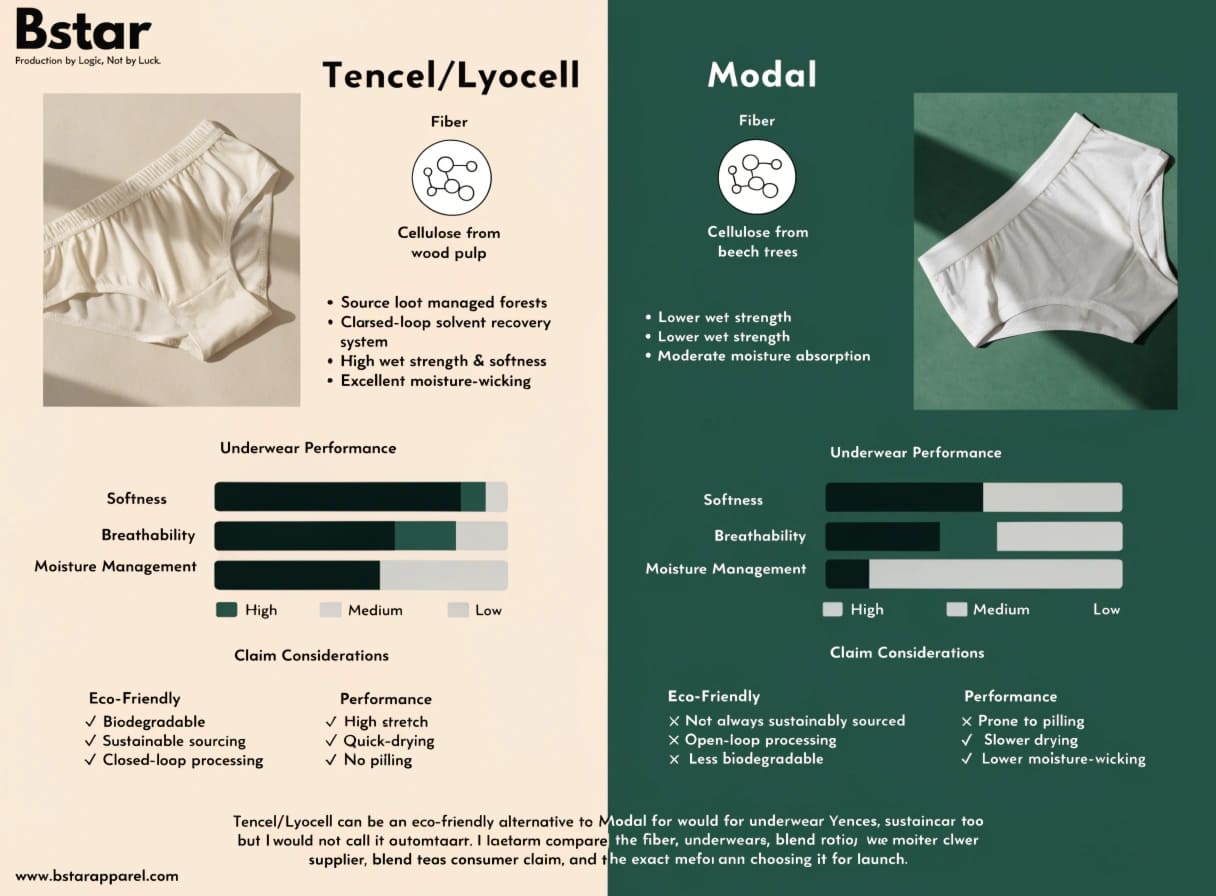
In our factory work with DTC underwear buyers, I often see the same question: “Is Tencel better than Modal?” I think that question is too simple. A better question is this: “Which fabric helps my underwear product perform well, and which claim can my brand safely support?”
The Green Production Edge: What Does the Closed-Loop NMMO Solvent Process Change?
Eco claims can sound clean on a product page. They become risky when the brand cannot explain what “eco” really means.
Tencel/Lyocell is known for a closed-loop NMMO solvent process, where the solvent is largely recovered and reused1. This gives Tencel a stronger process-based sustainability story than many generic Modal options, but the claim still depends on supplier documents and chain-of-custody proof.
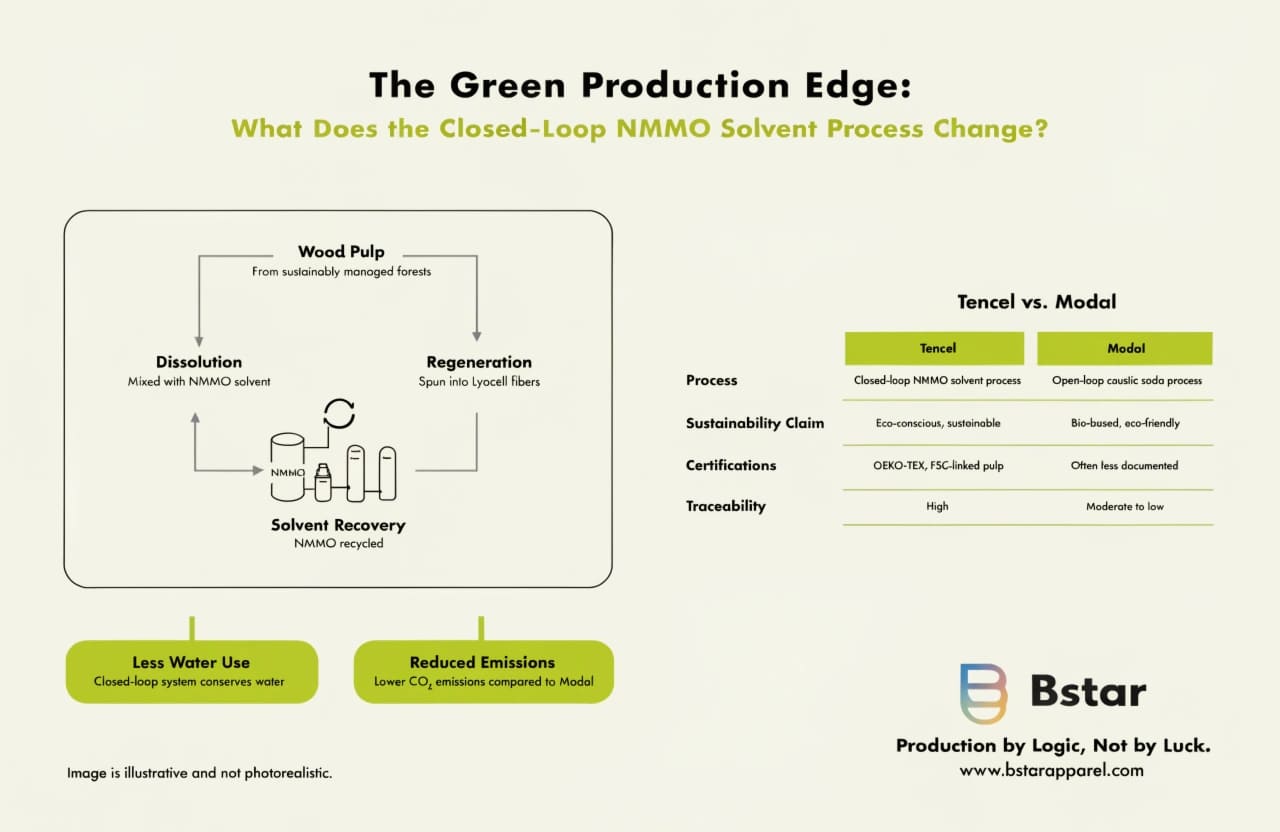
Why I treat “eco-friendly” as a claim, not a feeling
In our production experience, buyers often use “eco-friendly” as one word. I do not treat it that way. I break it into clear parts. I ask where the wood pulp comes from. I ask what production process is used. I ask what certificates belong to the yarn, fabric, mill, or garment. This matters because Tencel and Modal can both be made from wood-based cellulose2, but their sustainability stories are not identical.
| Question I ask | Why it matters for underwear brands |
|---|---|
| Is the fiber branded Tencel Lyocell? | The source and process are easier to trace. |
| Is the pulp FSC linked3? | The forest sourcing story needs proof. |
| Is OEKO-TEX available for the fabric4? | Skin-contact underwear needs safer chemical control. |
| Does the finished garment have its own documents? | Fabric certificates do not automatically cover brand claims. |
I see Tencel as stronger when a brand wants a clear process story. I still ask the brand to confirm what it can legally say in its market.
Performance vs. Modal: How Should We Compare Strength, Moisture Management, and Softness?
A soft fabric can still create complaints. Underwear fails when it loses shape, traps moisture, or feels wrong after washing.
For underwear, I compare Tencel/Lyocell and Modal by strength, moisture feel, softness, recovery, and blend behavior. Tencel often supports moisture comfort and strength5, while Modal can feel very soft and may offer better natural recovery in some underwear designs6.
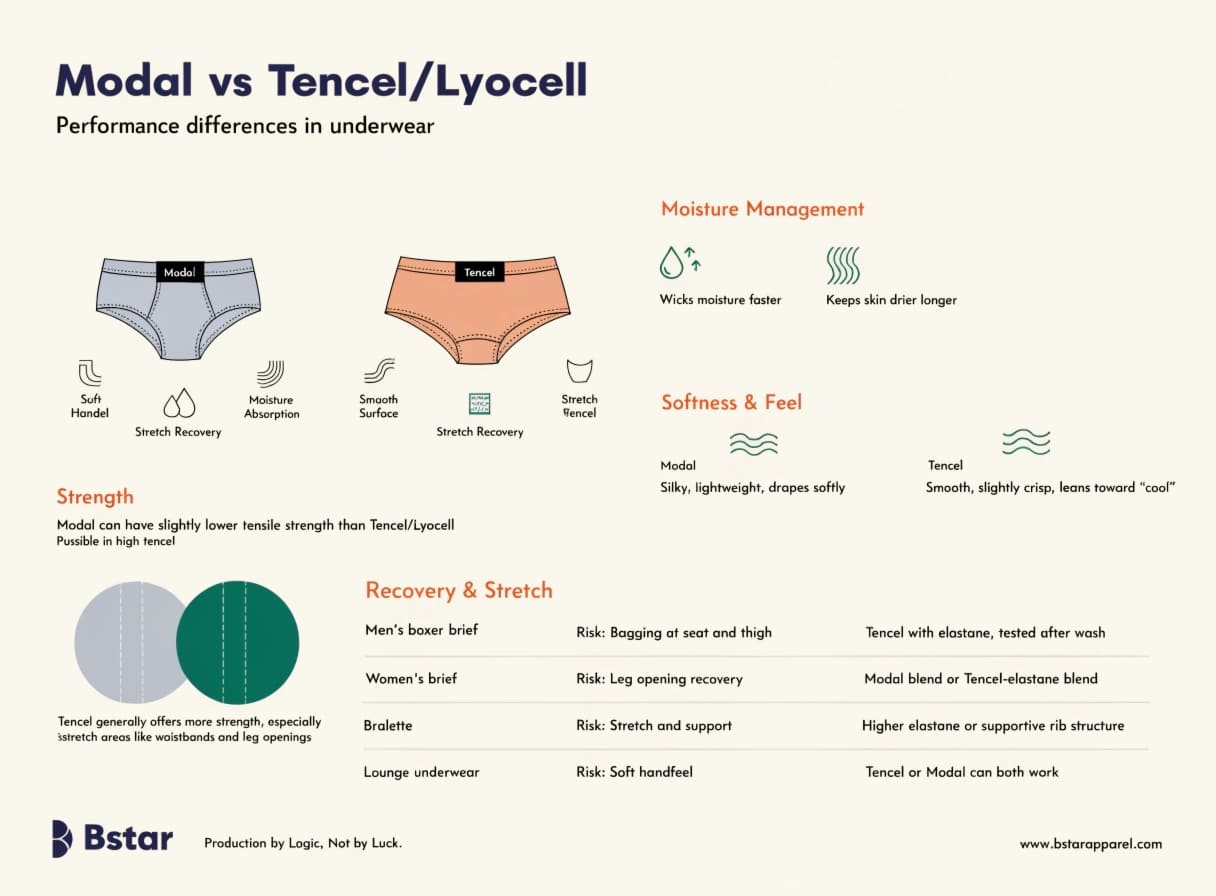
Why the underwear style changes the answer
I never choose Tencel or Modal in isolation. I first look at the product shape. A loose boxer short has different needs from a body-hugging brief. A bralette needs different support from a sleep short. Tencel Lyocell can feel smooth and cool. It can manage moisture well. It can also have lower elasticity recovery by default, especially when compared with some Modal blends. That matters around waistbands, leg openings, gussets, and tight panels.
| Product type | Risk I check first | Possible fabric direction |
|---|---|---|
| Men’s boxer brief | Bagging at seat and thigh | Tencel with elastane, tested after wash |
| Women’s brief | Leg opening recovery | Modal blend or Tencel-elastane blend |
| Bralette | Stretch and support | Higher elastane or supportive rib structure |
| Lounge underwear | Soft handfeel | Tencel or Modal can both work |
I usually tell buyers that there is no single “best” fiber. The better choice is the one that matches the fit promise. If the product page says “second-skin support,” I need recovery data. If it says “cool daily comfort,” I need moisture and wash feedback. I would not rely only on a supplier sheet. I would sample, wash, measure, and wear-test before launch.
Many buyers ask for Tencel, but not every quotation gives the same level of traceability. The name matters, and the paperwork matters more.
Tencel is a branded Lyocell fiber7. Generic Lyocell can be different in sourcing, documents, consistency, and claim support. I would ask for fiber origin, fabric composition, certification scope, and transaction documents before building consumer-facing sustainability copy.
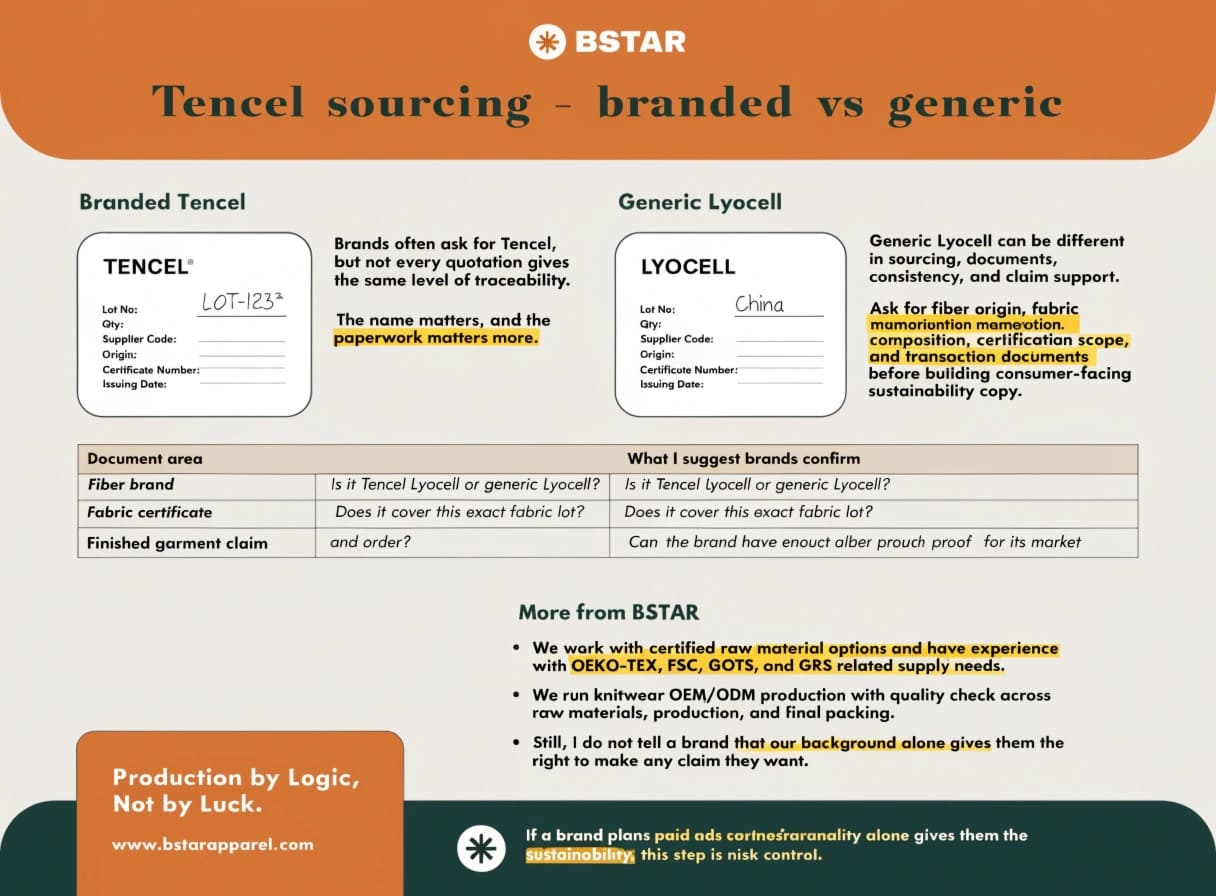
Where brands often misunderstand certification scope
This is the point where I see the most risk for DTC brands. A fabric may have OEKO-TEX. A yarn may have FSC-related documentation. A factory may hold BSCI or work with certified raw materials. That does not mean the finished underwear can automatically be sold as “certified sustainable.” The claim must match the document chain.
At BSTAR, we work with certified raw material options and have experience with OEKO-TEX, FSC, GOTS, and GRS related supply needs8. We also run knitwear OEM/ODM production with quality checks across raw materials, production, and final packing. Still, I do not tell a brand that our background alone gives them the right to make any claim they want.
| Document area | What I suggest brands confirm |
|---|---|
| Fiber brand | Is it Tencel Lyocell or generic Lyocell? |
| Fabric certificate | Does it cover this exact fabric lot? |
| Chain documents | Can the supplier connect fiber, yarn, fabric, and order? |
| Finished garment claim | Does the brand have enough proof for its market? |
I think this boundary protects both sides. The factory must supply clear documents. The brand must review claim wording. If the brand plans paid ads around sustainability, this step is not small. It is part of launch risk control.
Market Positioning: How Can We Leverage Biodegradability for Eco-Conscious Consumers?
Biodegradability is attractive in marketing. It can also be easy to overstate if the brand ignores trims, elastane, dyes, and real disposal conditions.
Tencel/Lyocell can support a biodegradable material story because the main cellulose fiber can break down under suitable conditions9. For underwear, I would phrase this carefully because elastane, sewing thread, labels, waistbands, dyes, and finishes may change the full garment story10.
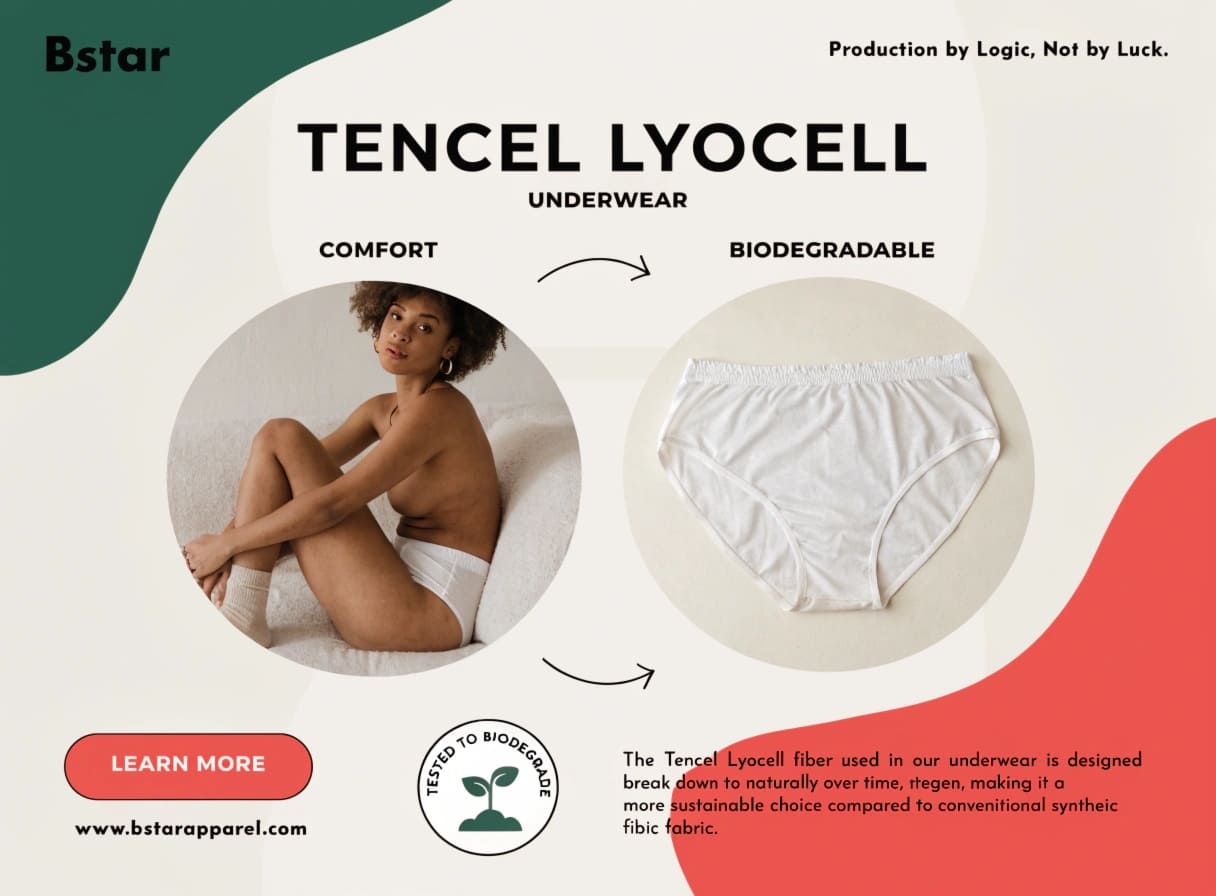
How I would turn the fabric choice into a safer brand message
I like sustainability marketing when it is specific. I do not like broad words that create questions later. If a brand sells Tencel underwear, I would not lead with “100% sustainable” unless the whole supply chain and legal review support it. I would use clearer lines. For example, I might say the underwear is made with Tencel Lyocell from wood-based cellulose. I might say the fabric was selected for softness, moisture comfort, and a lower-impact production process. I would then link the claim to documents.
| Claim style | Risk level | My view |
|---|---|---|
| “Eco-friendly underwear” | Medium | Too broad without proof |
| “Made with Tencel Lyocell” | Lower | Clear if composition is true |
| “Closed-loop fiber process” | Lower to medium | Good if supplier documents support it |
| “Certified sustainable garment” | High | Needs exact garment-level support |
| “Biodegradable underwear” | High | Must check elastane, trims, and test basis |
For eco-conscious consumers, trust is built after purchase too. The underwear must feel good after washing. The waistband must hold. The gusset must stay comfortable. If the garment fails, the sustainability story will not save the brand. I would use biodegradability as one part of the story, not the whole story. The main promise should still match the daily wearing experience.
Conclusion
I would choose Tencel or Modal by product fit, claim proof, and launch risk, not by a simple “which is greener” answer.
-
"Regenerated cellulose by the Lyocell process, a brief review of the …", https://bioresources.cnr.ncsu.edu/resources/regenerated-cellulose-by-the-lyocell-process-a-brief-review-of-the-process-and-properties/. The Lyocell process dissolves cellulose in N-methylmorpholine N-oxide (NMMO) and recovers the solvent in a closed loop, with recovery rates reported in the literature at approximately 99%; see, e.g., Rosenau et al. (2001) or comparable process chemistry reviews for technical detail on solvent recycling mechanisms. Evidence role: mechanism; source type: paper. Supports: That Lyocell production employs a closed-loop NMMO solvent system with high solvent recovery rates, distinguishing it from other cellulosic fiber processes.. Scope note: Recovery rate figures vary by facility and process generation; published figures may not reflect all commercial operations. ↩
-
"Paper – Wikipedia", https://en.wikipedia.org/wiki/Paper. Modal and Lyocell are classified as man-made cellulosic fibers, both derived from wood pulp cellulose through distinct wet-spinning or solvent-spinning processes; see the relevant entries in the Encyclopaedia of Textile Fibres or comparable fiber science references for process differentiation. Evidence role: definition; source type: encyclopedia. Supports: That both Lyocell (Tencel) and Modal are man-made cellulosic fibers produced from wood pulp.. ↩
-
"Forest Stewardship Council", https://en.wikipedia.org/wiki/Forest_Stewardship_Council. The Forest Stewardship Council (FSC) operates a chain-of-custody certification system that tracks forest-derived materials, including wood pulp for viscose and Lyocell production, from forest of origin through processing; FSC certification does not by itself certify the fiber production process or finished garment. Evidence role: definition; source type: institution. Supports: That FSC (Forest Stewardship Council) certification provides a chain-of-custody framework for verifying that wood pulp used in cellulosic fiber production originates from responsibly managed forests.. Scope note: FSC chain-of-custody certification covers material traceability but does not address chemical processing, labor conditions, or garment-level sustainability claims. ↩
-
"Oeko-Tex – Wikipedia", https://en.wikipedia.org/wiki/Oeko-Tex. OEKO-TEX Standard 100 is an independent testing and certification system for textile materials that screens for over 100 harmful substances including pesticides, heavy metals, formaldehyde, and certain dyes; product class requirements are stricter for articles with direct skin contact, making it relevant for underwear certification. Evidence role: definition; source type: institution. Supports: That OEKO-TEX Standard 100 tests textiles for harmful substances and is particularly relevant for skin-contact products such as underwear.. Scope note: OEKO-TEX Standard 100 certifies the tested article against a substance list but does not certify environmental or social sustainability of the production process. ↩
-
"Regenerated cellulose by the Lyocell process, a brief review …", https://bioresources.cnr.ncsu.edu/resources/regenerated-cellulose-by-the-lyocell-process-a-brief-review-of-the-process-and-properties/. Published fiber characterization studies report that Lyocell has a high degree of crystallinity and orientation, contributing to tensile strength values generally exceeding those of viscose rayon, along with moisture regain values comparable to cotton; see Fink et al. or comparable textile fiber science literature for quantitative property comparisons. Evidence role: general_support; source type: paper. Supports: That Lyocell fiber exhibits high moisture absorption and relatively high tensile strength compared to other cellulosic fibers, supporting its use in performance-oriented textile applications.. Scope note: Fiber properties measured in standardized laboratory conditions may differ from performance in finished knitted underwear constructions, where blend composition and fabric structure are significant variables. ↩
-
"Tencel vs Viscose vs Modal vs Rayon vs Lyocell: Fabric Guide", https://taihusnow.com/viscose-vs-tencel.html. Modal is produced via a modified viscose process yielding fibers with higher wet strength and elongation at break compared to standard viscose; comparative studies on cellulosic fiber mechanical properties suggest differences in recovery behavior between Modal and Lyocell that are relevant to knitted underwear performance, though outcomes depend on fabric construction and blend ratios. Evidence role: general_support; source type: paper. Supports: That Modal fiber may exhibit different elastic recovery characteristics compared to Lyocell, relevant to fit retention in close-fitting garments.. Scope note: Direct head-to-head recovery comparisons between Modal and Lyocell in knitted underwear constructions are limited in the published literature; most data derive from yarn or fiber-level testing. ↩
-
"Lyocell – Wikipedia", https://en.wikipedia.org/wiki/Lyocell. Tencel is a registered trademark of Lenzing AG, an Austrian fiber manufacturer, applied to its branded Lyocell and Modal fiber products; the brand distinction carries implications for traceability and claim verification that generic Lyocell designations do not automatically provide. Evidence role: definition; source type: institution. Supports: That Tencel is a proprietary brand name owned by Lenzing AG for its Lyocell fiber, distinct from generic Lyocell produced by other manufacturers.. Scope note: Brand ownership and licensing terms may evolve; verification against current trademark registrations is advisable. ↩
-
"Global Organic Textile Standard: Home – GOTS", https://global-standard.org/. The Global Organic Textile Standard (GOTS) sets requirements for the processing, manufacturing, packaging, labeling, and trading of textiles made from certified organic fibers, including social criteria; the Global Recycled Standard (GRS), administered by Textile Exchange, certifies recycled input materials and chain of custody but does not address organic sourcing or processing chemistry. Evidence role: definition; source type: institution. Supports: That GOTS (Global Organic Textile Standard) and GRS (Global Recycled Standard) are distinct certification frameworks with different scopes: GOTS covers organic fiber processing and social criteria, while GRS certifies recycled content claims.. Scope note: Neither GOTS nor GRS automatically certifies a finished garment as sustainable in a comprehensive sense; scope is limited to the specific claims each standard addresses. ↩
-
"Biodegradability of cellulose fibers, films, and particles: A Review", https://bioresources.cnr.ncsu.edu/resources/biodegradability-of-cellulose-fibers-films-and-particles-a-review/. Cellulosic fibers including Lyocell have been shown to biodegrade under aerobic composting and soil conditions in laboratory studies, with degradation rates dependent on temperature, moisture, and microbial activity; see relevant ISO 14855 or ASTM D5988 test-based studies for quantitative context. Evidence role: mechanism; source type: paper. Supports: That cellulose-based Lyocell fiber undergoes biodegradation under appropriate environmental conditions such as composting or soil burial.. Scope note: Biodegradation rates measured in controlled laboratory conditions may not reflect real-world disposal environments such as landfill. ↩
-
"[PDF] Part 260 – Guides for the Use of Environmental Marketing Claims", https://www.ftc.gov/sites/default/files/attachments/press-releases/ftc-issues-revised-green-guides/greenguides.pdf. Regulatory guidance such as the U.S. Federal Trade Commission’s Green Guides (16 CFR Part 260) cautions that unqualified biodegradability claims require that the entire product, including all components, will completely decompose within a reasonably short time; synthetic components such as elastane are not generally considered biodegradable under these standards. Evidence role: mechanism; source type: government. Supports: That biodegradability claims for finished garments must account for all components, including synthetic trims and elastane, which may not biodegrade at the same rate or at all.. Scope note: The FTC Green Guides apply specifically to the U.S. market; equivalent guidance in other jurisdictions may differ. ↩