Low MOQ Underwear Manufacturing: How to Start Small
You have a product idea. You contact a factory. They say the minimum is 500 pieces per color. That kills your budget before you even start.
Low MOQ underwear manufacturing is possible, but only with factories built for it. The key is finding manufacturers with per-colorway minimums, fast sampling (7–15 days), and certified materials that apply at any order size — not just factories that say yes to close a deal.
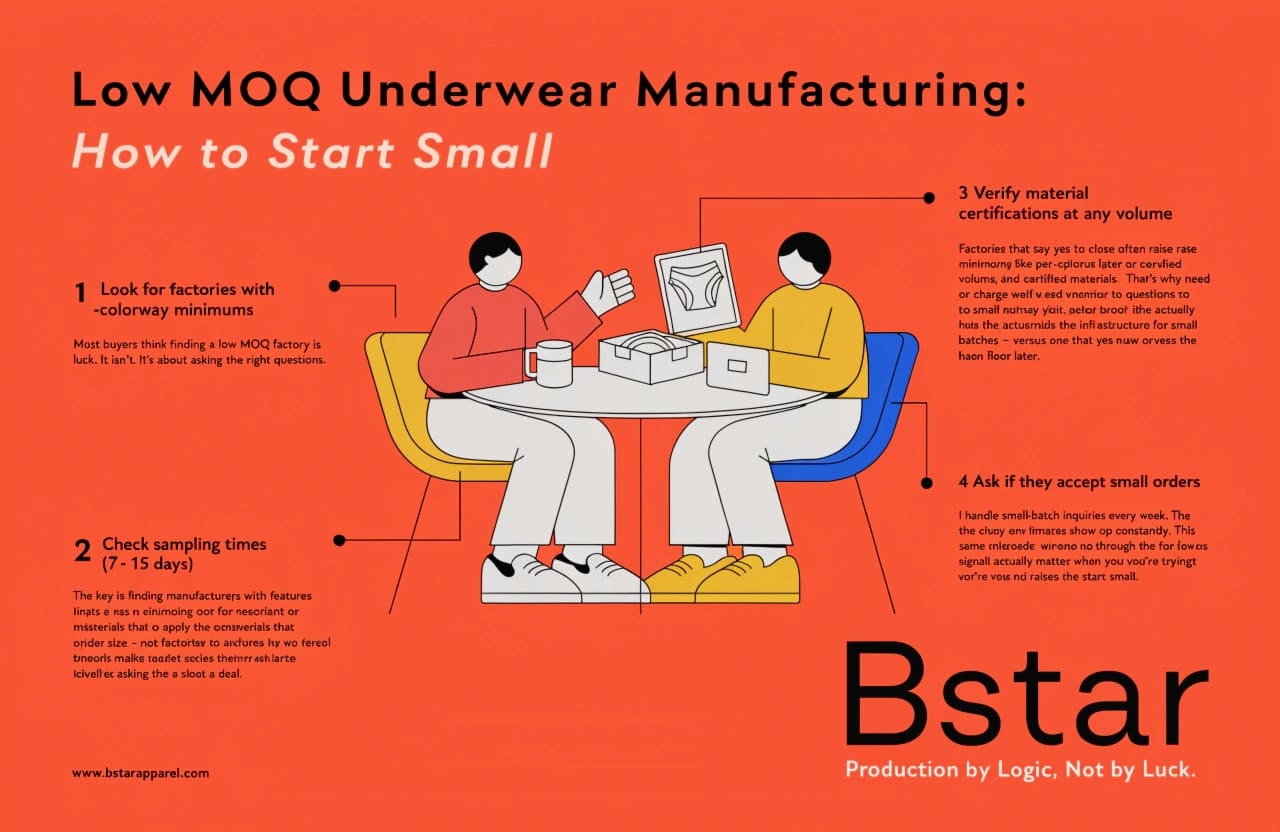
Most buyers think finding a low MOQ factory is about luck. It isn’t. It’s about knowing what questions to ask and what answers signal a factory that actually has the infrastructure for small batches — versus one that says yes now and raises the floor later.
I handle small-batch inquiries every week. The same misreads show up constantly. This article walks through the four things that actually matter when you’re trying to start small.
Finding Flexible Partners: How Do You Identify Manufacturers Actually Open to Small Batch Orders?
You send an inquiry. The factory says "yes, we support low MOQ." Three weeks later, after sampling, they tell you the real minimum is 300 pieces per color. That’s the most common breakdown I see in first-time buyer conversations.
The real signal is whether a factory can state its minimum per colorway, not just per order. A genuinely low-MOQ factory will give you a number like "30–50 pieces per colorway" upfront, in the first quote — not after you’ve already spent time on sampling.
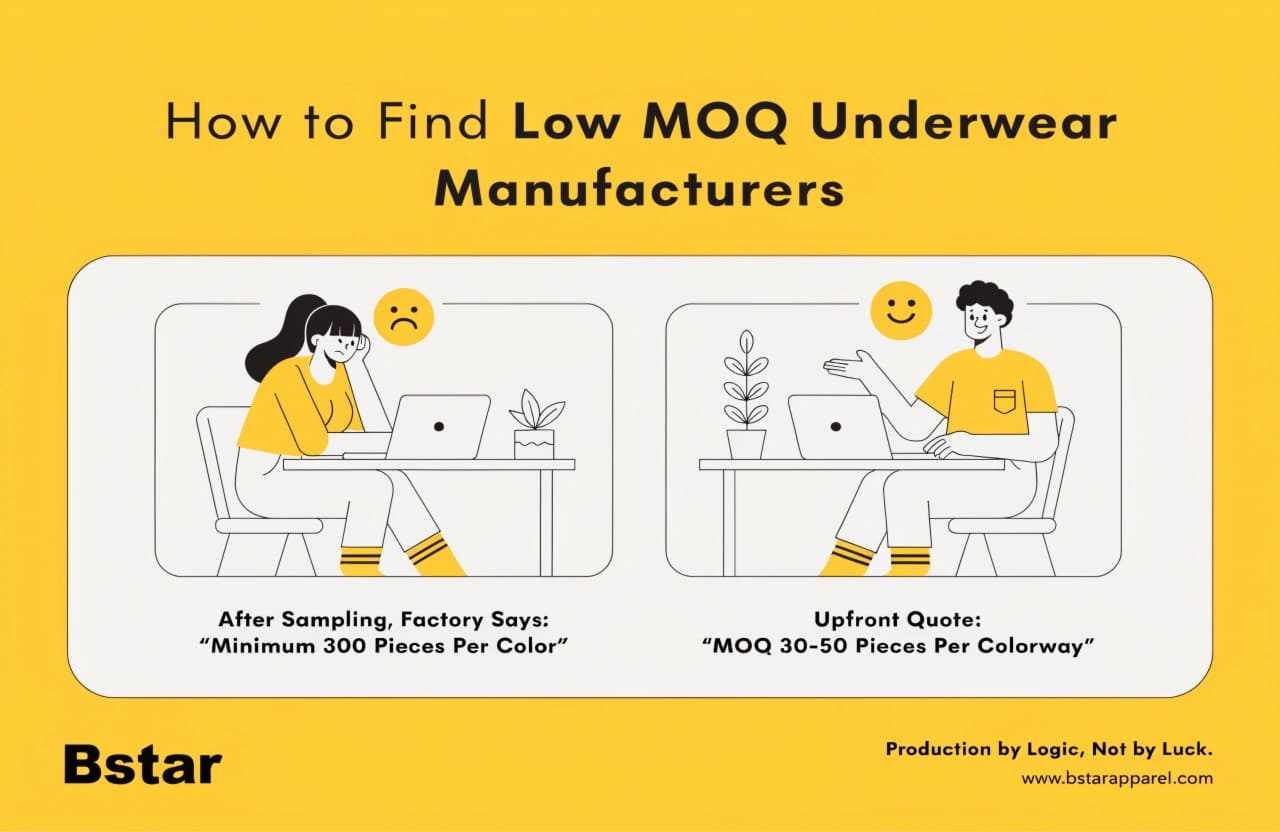
Here’s what I actually check when a new DTC buyer asks how to verify a factory is real about small batches.
Ask the right first question
Don’t ask "what’s your MOQ?" Ask: "What is your minimum per colorway for a basic brief or boxer style?" These are different questions. A total order floor hides the actual constraint. If a factory hesitates on the colorway question, that tells you something.
Check the sampling workflow
A factory built for repeat small-batch clients will usually offer to deduct sampling fees from the first production order1. This isn’t charity. It’s a structural signal — they expect a real relationship, not a one-time transaction. Factories that only do bulk runs don’t need to offer this because they’re not trying to build that kind of pipeline.
Look at their existing client profile
We’ve worked with brands like ONTHATASS from the Netherlands and STEP ONE from Australia. Both started as small-run clients testing product-market fit. If a factory’s reference list is all large retailers with no DTC names, that’s worth noting.
Turnaround time should be a number, not a promise
"We are fast" means nothing. "We complete sampling in 7–15 days" means something. Ask for the sampling lead time in days during your first conversation. If the answer is "it depends" without any range, push back.
Small-batch buyers almost always get surprised by cost. Not because factories are hiding fees — but because unit economics at low volume work differently, and most buyers haven’t seen a proper breakdown before.
At low volumes, your per-unit cost is higher. This is normal. The key factors are fabric minimums, dyeing setup fees, and trim sourcing. Understanding which costs are fixed versus variable lets you structure your first order to minimize waste and build toward better pricing on repeat runs.
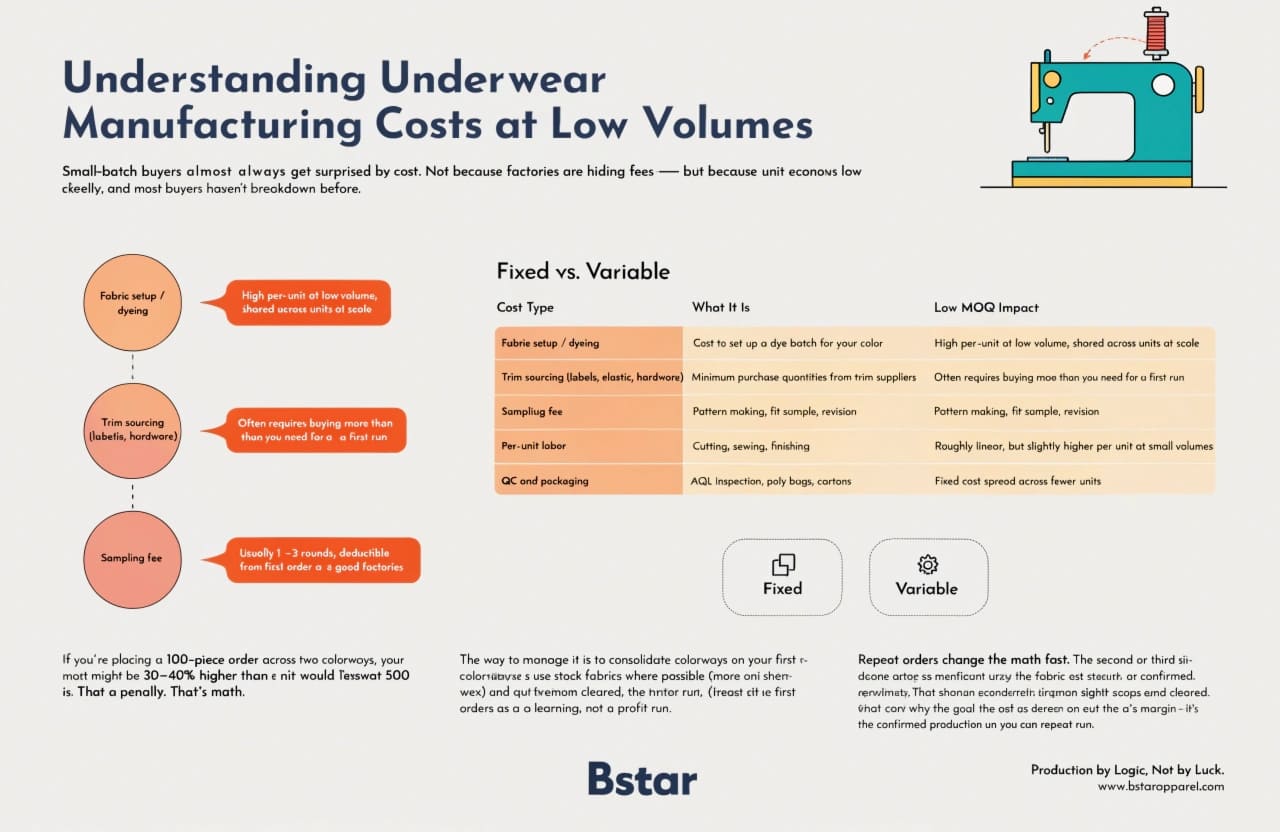
Let me break this down the way I explain it to new clients.
Fixed vs. variable costs in a small batch order
| Cost Type | What It Is | Low MOQ Impact |
|---|---|---|
| Fabric setup / dyeing | Cost to set up a dye batch for your color | High per-unit at low volume, shared across units at scale |
| Trim sourcing (labels, elastic, hardware) | Minimum purchase quantities from trim suppliers | Often requires buying more than you need for a first run |
| Sampling fee | Pattern making, fit sample, revision | Usually 1–3 rounds; deductible from first order at good factories |
| Per-unit labor | Cutting, sewing, finishing | Roughly linear, but slightly higher per unit at small volumes |
| QC and packaging | AQL inspection2, poly bags, cartons | Fixed cost spread across fewer units |
What this means in practice
If you’re placing a 100-piece order across two colorways, your unit cost might be 30–40% higher than it would be at 500 pieces. That’s not a penalty. That’s math. The way to manage it is to consolidate colorways on your first run, use stock fabrics where possible (more on that next), and treat the first order as a learning run, not a profit run3.
Repeat orders change the math fast
The second or third order with the same factory drops cost significantly. The fabric is already sourced, the pattern is confirmed, and the trim minimums are already cleared.4 That’s why the goal on order one is not margin — it’s a clean, confirmed production run you can repeat.
Smart Sourcing Strategies: How Can You Use Ready-Made Fabrics and Stock Options to Lower Your Minimums?
Custom fabric is the single biggest driver of high MOQs. If you ask a factory to source a specific custom yarn or develop a new fabric weight, you immediately inherit the fabric supplier’s minimums — which can be thousands of meters5.
The fastest way to reduce MOQ friction is to use a factory’s stock fabrics and ready-made blanks for your first run. This removes the fabric development step entirely. You can still add custom labels, custom fits, and custom colors within the stock range — without triggering high fabric minimums.
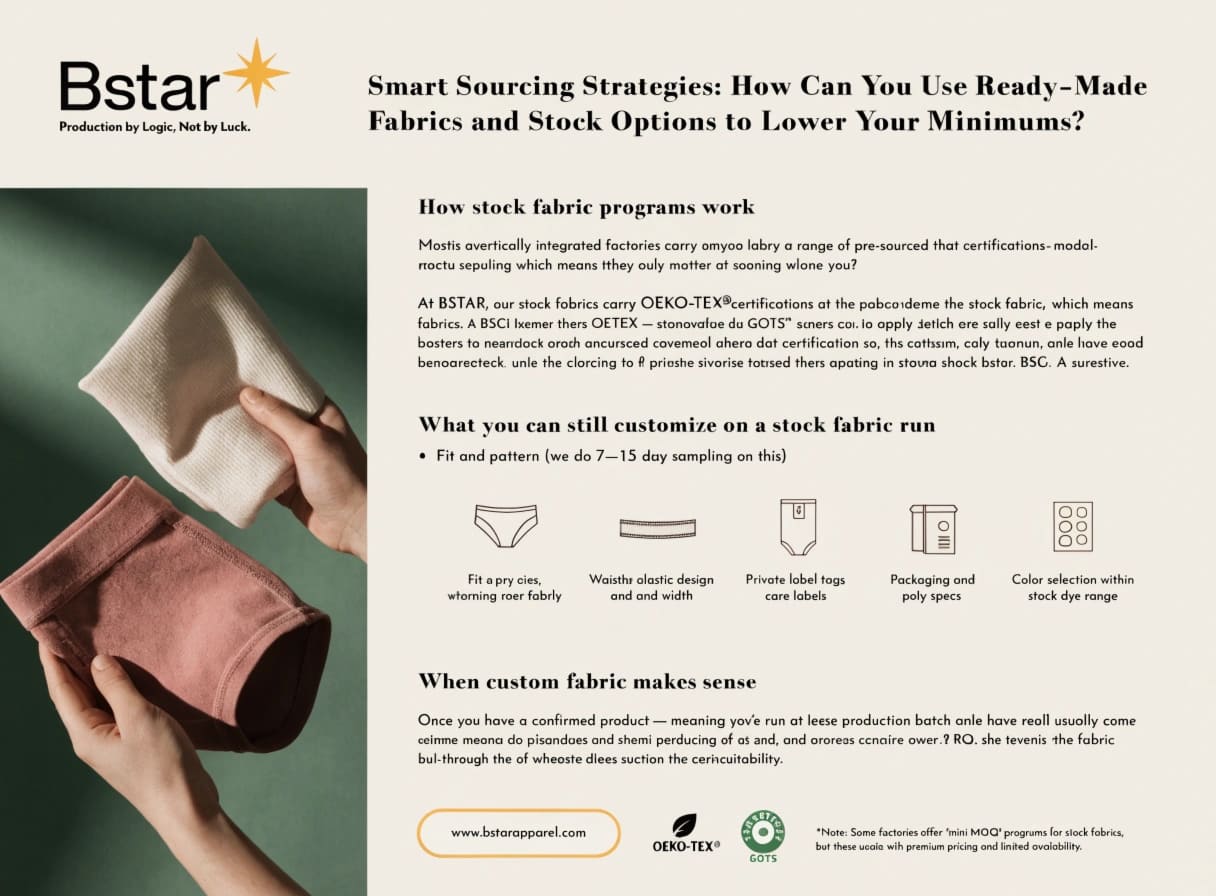
This is something I recommend to almost every first-time DTC client who comes in with a custom fabric spec on order one.
How stock fabric programs work
Most vertically integrated factories carry a range of pre-sourced fabrics — standard cotton-modal blends, bamboo jersey, recycled polyester6 — that are already in stock and certified. At BSTAR, our stock fabrics carry OEKO-TEX® and GOTS certifications at the fabric level7, which means they apply to your 200-piece order exactly the same way they apply to a 10,000-piece order.
This is a point worth stopping on. A lot of small-batch buyers assume that certifications only matter at scale. That’s wrong. Certifications are facility-level and material-level. If we are BSCI certified8 and our fabric is OEKO-TEX® certified, those certifications don’t disappear because your order is small.
What you can still customize on a stock fabric run
- Fit and pattern (we do 7–15 day sampling on this)
- Waistband elastic design and width
- Private label tags and care labels
- Packaging and poly bag specs
- Color selection within the stock dye range
When custom fabric makes sense
Once you have a confirmed product — meaning you’ve run at least one production batch and have real sell-through data — that’s the right time to develop custom fabric. By then your volume is higher, your margins are clearer, and the development cost is easier to justify.
Scaling Your Brand: What Does the Path from Startup Quantities to Mass Production Actually Look Like?
Most first-time buyers think about their first order. Smart buyers think about their third order. The brands that scale well treat manufacturing like a relationship, not a transaction.
The typical growth path is: sampling run (pre-production), small batch (50–200 pieces per colorway), repeat run with minor fit adjustments, then scaled production (500+ pieces per colorway)9. Each stage builds factory familiarity that reduces lead time and cost on the next run.
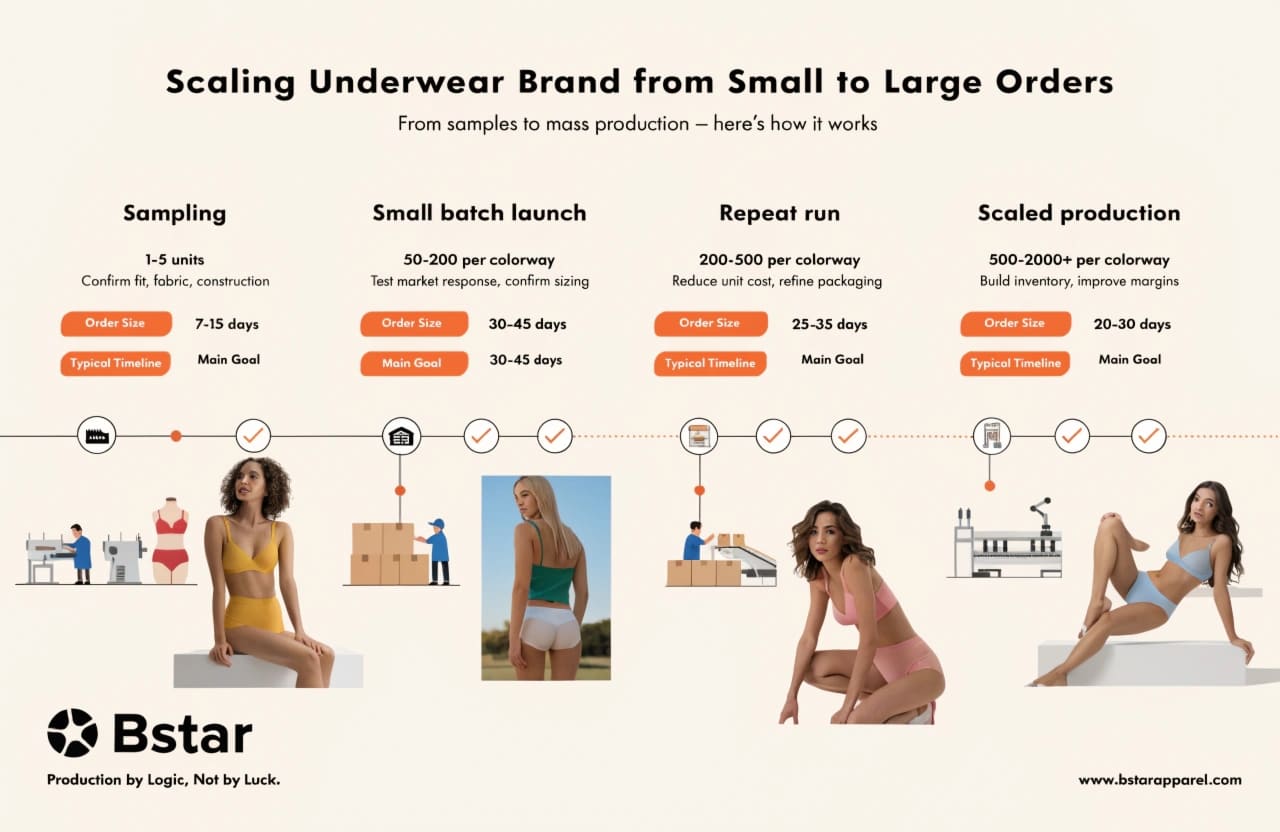
Here’s how I see successful DTC clients move through this progression.
Stage-by-stage production roadmap
| Stage | Order Size | Main Goal | Typical Timeline |
|---|---|---|---|
| Sampling | 1–5 units | Confirm fit, fabric, construction | 7–15 days |
| Small batch launch | 50–200 per colorway | Test market response, confirm sizing | 30–45 days production |
| Repeat run | 200–500 per colorway | Reduce unit cost, refine packaging | 25–35 days |
| Scaled production | 500–2000+ per colorway | Build inventory, improve margins | 20–30 days |
What changes as you scale
The fit is already confirmed. The fabric is already sourced. Your label artwork is in our system. The production team knows your quality standards. Every repeat order is faster and cheaper than the first because the setup work is already done.
One of our Australian clients ran their first order at 120 pieces across three styles. By their fourth order, they were at 800 pieces per style. Nothing changed structurally — they just repeated a process that worked until the numbers supported larger runs.
What doesn’t change
Quality checkpoints stay the same at any order size. We run six QC nodes from raw material inspection through final packaging10 regardless of whether the order is 200 pieces or 20,000 pieces. AQL standards don’t have a volume floor.
Conclusion
Start with the right questions: per-colorway minimums, sampling lead time in days, and whether certifications apply at your volume. Get those right, and scaling becomes a process, not a gamble.
If you’re ready to test a first small batch, reach out and request a sample. We’ll confirm whether what you need matches what we actually do — before you spend anything.
-
"[PDF] Brand Purchasing Practices and Labor Outcomes in Apparel and …", https://www.ilr.cornell.edu/sites/default/files-d8/2025-07/brand-purchasing-practices-gli-report.pdf. Apparel sourcing and supplier evaluation literature notes that the commercial terms a manufacturer offers during pre-production—including sampling cost policies—can serve as indicators of the supplier’s target client profile and relationship model, with fee-deduction arrangements generally associated with suppliers seeking ongoing production partnerships rather than transactional bulk orders. Evidence role: general_support; source type: institution. Supports: That commercial terms offered during the sampling phase, such as fee deductions on conversion to production orders, reflect a supplier’s business model orientation and client acquisition strategy. Scope note: This practice is not universally documented as a formal industry standard; the cited claim reflects a practitioner interpretation that a source would support contextually rather than as established empirical fact. ↩
-
"[PDF] ISO 2859-1 – UNT Chemistry", https://chemistry.unt.edu/~tgolden/courses/iso2859-1.pdf. The Acceptable Quality Level (AQL) framework, codified in ISO 2859-1, defines statistical sampling procedures used to determine whether a production lot meets specified quality thresholds; it is widely adopted in apparel and textile manufacturing as a basis for incoming and outgoing quality inspection. Evidence role: definition; source type: institution. Supports: That AQL refers to an internationally standardized statistical sampling method used to assess production quality in manufacturing. ↩
-
"Lean startup", https://en.wikipedia.org/wiki/Lean_startup. Lean startup and new product development literature, including work associated with the build-measure-learn framework, supports the principle that early production runs should be structured to generate validated learning about customer demand and product fit rather than to maximize short-term financial returns. Evidence role: expert_consensus; source type: paper. Supports: That prioritizing learning and validation over margin optimization in early production runs is a recognized approach to managing risk in new product development. Scope note: This citation supports the general strategic principle; it does not specifically address apparel or underwear manufacturing contexts. ↩
-
"Research on the ordering strategy problem in supply chain … – PMC", https://pmc.ncbi.nlm.nih.gov/articles/PMC11731874/. Manufacturing economics literature, including research on the learning curve effect and setup cost amortization, documents that repeat production runs with an established supplier reduce effective per-unit costs by distributing fixed setup expenditures—including tooling, pattern development, and material qualification—across a larger cumulative volume. Evidence role: mechanism; source type: paper. Supports: That repeat production orders with an established supplier reduce per-unit costs by eliminating or amortizing one-time setup activities such as pattern development, material sourcing, and tooling. Scope note: The magnitude of cost reduction on repeat orders depends on factory-specific overhead structures and is not uniformly quantified in the literature. ↩
-
"Understanding Minimum Order Quantity (MOQ) in Fashion Industry", https://www.linkedin.com/posts/ahamed-sadab-980464265_fashionindustry-garmentproduction-merchandising-activity-7354027849864892417-asIJ. Industry sourcing guides and textile trade organizations document that fabric mills commonly impose minimum order quantities ranging from hundreds to thousands of meters per colorway, creating a structural barrier for small-volume apparel buyers seeking custom materials. Evidence role: general_support; source type: institution. Supports: That textile fabric suppliers impose minimum order quantities that can be prohibitively large for small-volume apparel brands. Scope note: Minimums vary significantly by fabric type, mill size, and geographic region; a single source is unlikely to confirm a universal threshold applicable to all custom fabric development scenarios. ↩
-
"Cotton vs. Modal: Why Your Underwear Fabric Matters Most guys …", https://www.facebook.com/manmade.brand/posts/cotton-vs-modal-why-your-underwear-fabric-matters-most-guys-grew-up-wearing-cott/875217608492872/. Textile industry reports and fiber association publications identify cotton, modal (a cellulosic fiber derived from beech wood), bamboo-derived viscose, and recycled synthetic fibers as prevalent material categories in the innerwear and underwear segment, reflecting both performance and sustainability-oriented sourcing trends. Evidence role: general_support; source type: institution. Supports: That cotton-modal blends, bamboo-derived jersey, and recycled polyester are among the commonly used fabric categories in contemporary underwear and intimate apparel manufacturing. Scope note: Stock fabric availability varies by factory and region; this citation supports the general prevalence of these materials rather than confirming their universal availability as stock options. ↩
-
"[PDF] oeko-tex® standard 100", https://www.oeko-tex.com/importedmedia/downloadfiles/OEKO-TEX_STANDARD_100_Standard_EN_DE.pdf. According to the Global Organic Textile Standard (GOTS) and the OEKO-TEX® Association, certifications are issued to facilities and apply to certified materials processed within those facilities, meaning the certification status of a product is determined by the supply chain and production facility rather than by the size of any individual order. Evidence role: definition; source type: institution. Supports: That OEKO-TEX® and GOTS certifications are granted at the facility and material level and are not contingent on production order volume. ↩
-
"amfori BSCI Certification & BSCI Audit Services | TÜV SÜD", https://www.tuvsud.com/en-us/services/auditing-and-system-certification/amfori-business-social-compliance-initiative. The Business Social Compliance Initiative (BSCI), administered by amfori, is a supply chain management program that audits manufacturing facilities against a code of conduct covering labor rights, health and safety, and environmental practices; it is widely referenced in apparel sourcing as a social compliance benchmark. Evidence role: definition; source type: institution. Supports: That BSCI (now operating under amfori) is an internationally recognized social compliance auditing program assessing labor conditions in manufacturing supply chains. ↩
-
"Determinants of consumer attitudes and re-purchase intentions …", https://pmc.ncbi.nlm.nih.gov/articles/PMC7829058/. Literature on direct-to-consumer brand development and lean startup methodologies in fashion describes a staged approach to production scaling, in which brands use small initial runs to validate product-market fit before increasing order volumes, thereby managing inventory risk during early growth phases. Evidence role: general_support; source type: research. Supports: That emerging DTC apparel brands commonly adopt a phased production approach, beginning with small validation runs before committing to larger inventory investments. Scope note: The specific volume thresholds cited (50–200 pieces, 500+ pieces) reflect one manufacturer’s framing and may not correspond to universally documented industry benchmarks. ↩
-
"Different Stages of Quality Control in Apparel Manufacturing – LTLabs", https://ltlabs.co/blog/different-stages-of-quality-control-in-apparel-manufacturing/. Quality management frameworks applied to apparel manufacturing, including those aligned with ISO 9001 principles and industry-specific guidelines from organizations such as the American Apparel and Footwear Association, recommend multi-stage inspection protocols covering raw material receipt, in-process production, and final goods verification to reduce defect rates and ensure consistent output. Evidence role: expert_consensus; source type: institution. Supports: That quality control in apparel manufacturing is most effective when applied at multiple stages of the production process, from incoming raw material inspection through final product verification. Scope note: The specific number of QC nodes (six) cited in the article reflects one manufacturer’s internal process; industry standards define principles rather than a universal node count. ↩