Custom Underwear Cost Breakdown: What Factors Impact Pricing?
You asked for a price. The factory sent back a quote. The number surprised you — and not in a good way. This happens in almost every first inquiry we receive.
Custom underwear pricing is determined by a set of manufacturing decisions you make before you ever contact a supplier. Fabric type, design complexity, order quantity, and compliance requirements each add a separate cost layer. Understanding these variables won’t give you a magic number, but it will tell you exactly which tier you’re pricing yourself into.
We’re a manufacturer. We see pricing from the inside. And the most common problem we see isn’t that brands can’t afford custom underwear — it’s that they’re surprised by a price they had already locked in through their own design and sourcing choices. This article walks through exactly how that happens.
Material Matters: How Does Fabric Quality and Component Selection Drive Unit Costs?
A client once sent us a reference sample. Beautiful product. Soft hand feel, wide branded waistband, recycled content1. Then they asked us to match it at a price point that suggested they thought it was a standard cotton brief.
It wasn’t. And the gap between what they expected to pay and what it actually cost came entirely from materials.
Fabric and components are the single largest variable in your unit cost. The fiber content, yarn weight, knit structure, elastic specification, and any certified material standard (like OEKO-TEX® or GRS recycled content) each carry a specific price. These don’t blend into one cost — they stack.
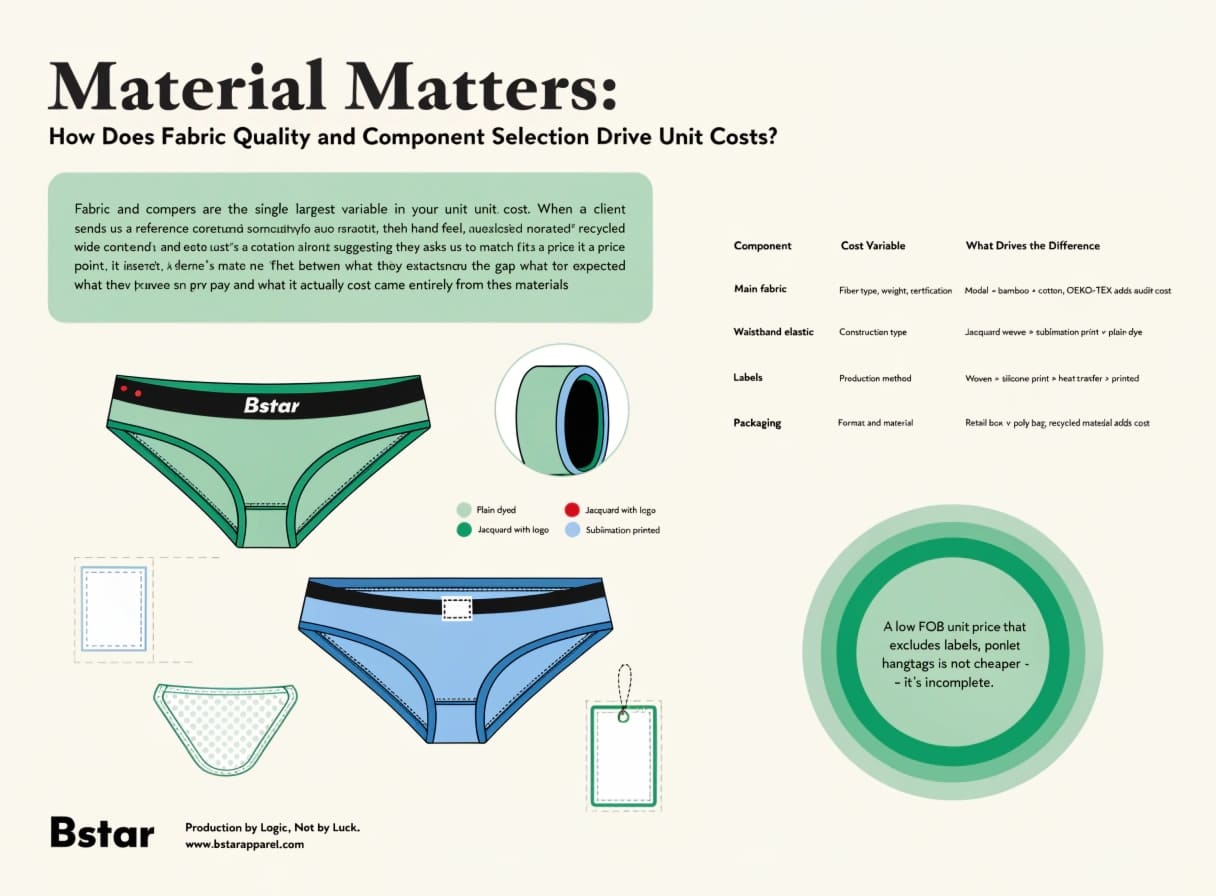
Let’s break this down practically. The main body fabric is the obvious one — modal, bamboo viscose, and recycled nylon all cost more than basic cotton jersey2, and they cost different amounts from each other. But the waistband elastic is often where brands lose track. A plain dyed elastic, a jacquard elastic with your logo woven in, and a sublimation-printed elastic are three completely different products at three different price points. They’re not interchangeable options for the same component.
The same logic applies to labels. A printed care label costs less than a woven label. A silicone-printed interior label costs more than both3. Hangtags, recycled poly bags, retail box packaging — each one is a separate line item on your BOM (bill of materials), not a free finish.
| Component | Cost Variable | What Drives the Difference |
|---|---|---|
| Main fabric | Fiber type, weight, certification | Modal > bamboo > cotton; OEKO-TEX adds audit cost4 |
| Waistband elastic | Construction type | Jacquard weave > sublimation print > plain dye |
| Labels | Production method | Woven > silicone print > heat transfer > printed |
| Packaging | Format and material | Retail box > poly bag; recycled material adds cost |
When you’re reviewing a quote, the first question to ask is: what’s actually included? A low FOB unit price that excludes labels, packaging, and hangtags is not cheaper — it’s incomplete.
The Complexity Factor: How Does Design Intricacy Affect What You’ll Pay?
This is where we see the most mismatched expectations. A brand will show us a design with an embroidered logo on the waistband, a printed graphic on the leg, and a custom lace trim on the hem. Then they describe it as "basically a simple underwear."
The product is not simple. It has three custom process add-ons. Each one is a separate cost node.
Every custom process — embroidery, screen printing, sublimation, lace attachment, bonding — adds machine time, setup cost, and labor. These costs compound. Adding three custom elements to a garment does not make it "a custom garment." It makes it three separate manufacturing steps on top of the base garment.
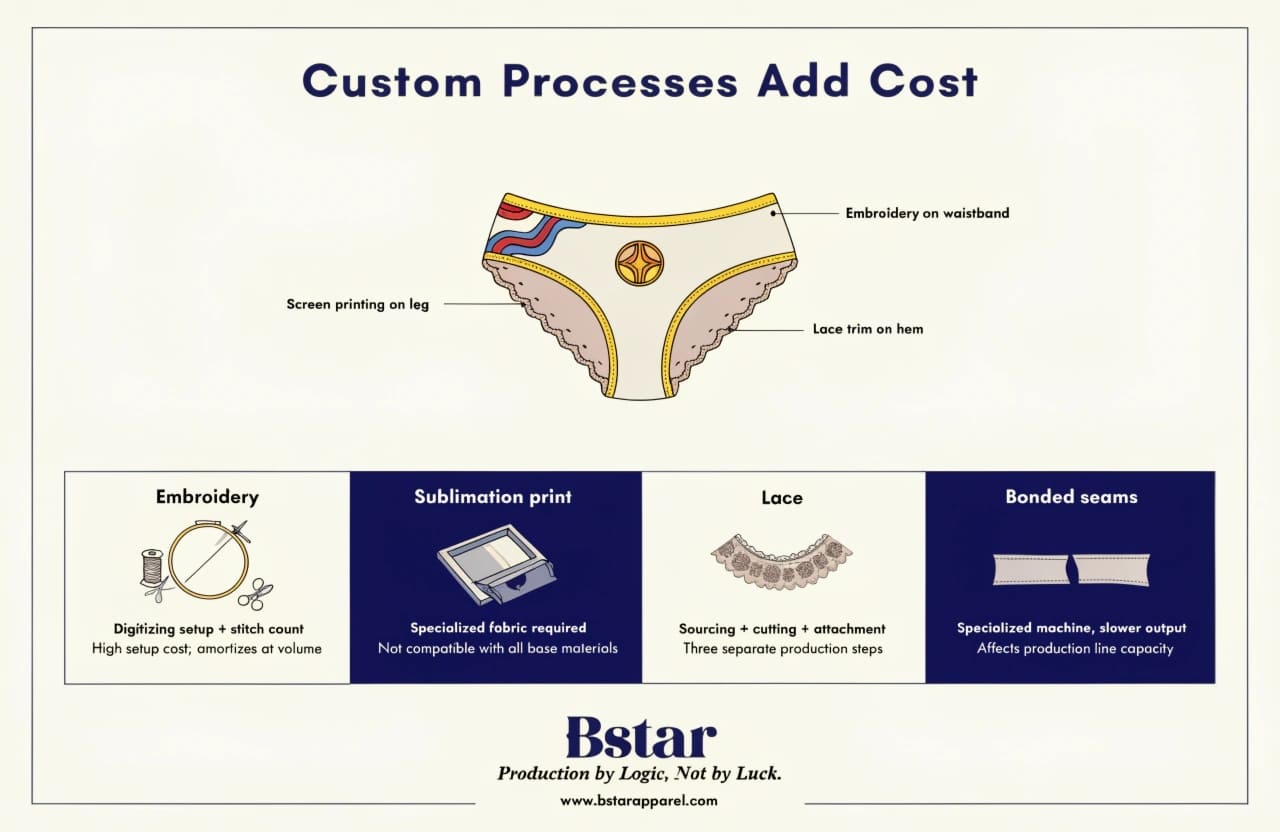
Here’s how this plays out in real production. Embroidery has a setup fee for digitizing the design, plus a per-piece cost based on stitch count and placement5. That fee exists whether you order 100 pieces or 1,000 pieces. At 100 pieces, the setup cost per unit is high. At 1,000 pieces, it spreads out. But it never disappears.
Lace trim requires sourcing, cutting, and attaching — three steps, each with labor time. Bonded seams need a different machine and a slower production line6. Sublimation printing requires a specialized fabric base that accepts the dye process; you can’t apply it to every fabric7.
| Process Add-On | Cost Drivers | Notes |
|---|---|---|
| Embroidery | Digitizing setup + stitch count | High setup cost; amortizes at volume |
| Sublimation print | Specialized fabric required | Not compatible with all base materials |
| Lace trim | Sourcing + cutting + attachment | Three separate production steps |
| Bonded seams | Specialized machine, slower output | Affects production line capacity |
| Custom jacquard elastic | Separate weaving order | MOQ applies to the elastic itself |
The practical takeaway: before you finalize your design, map every custom process and ask your supplier to price each one separately. That’s the only way to see where your cost is actually coming from — and where you have room to simplify.
Economies of Scale: What Does Order Volume Actually Do to Your Price?
We support orders starting from 1 piece for sampling and small-batch development. This is a real capability. But it’s important to understand what small MOQ means for pricing — because it does not mean flexible pricing in the direction most brands hope for.
Order volume affects unit cost through setup amortization. Every production run carries fixed costs — pattern setup, machine changeovers, color calibration, quality inspection protocols8. At low volumes, these fixed costs are divided across fewer units. At higher volumes, they spread out. That’s the entire mechanism.
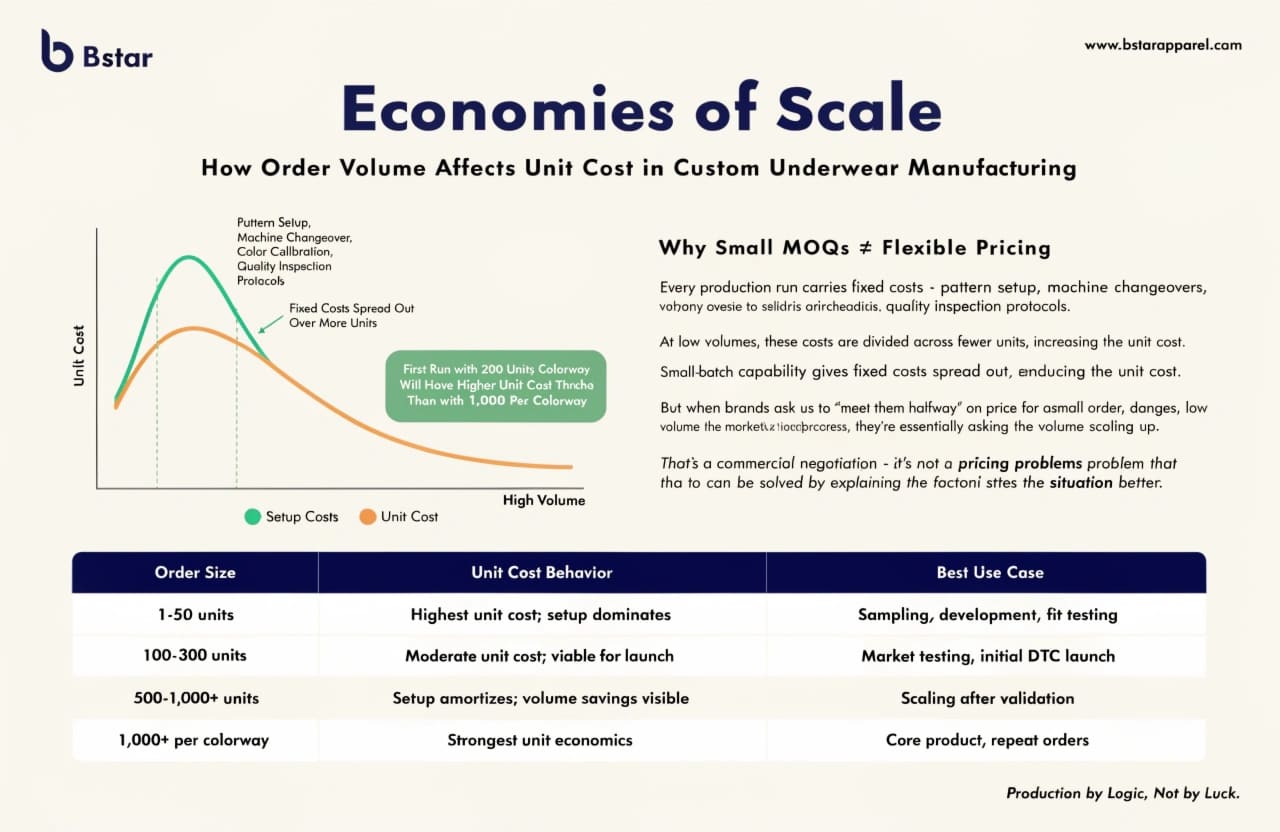
A first run with 200 units per colorway will carry a higher unit cost than a run of 1,000 units per colorway. This is not a factory being inflexible. It’s the math of fixed costs per unit. When a brand asks us to "meet them halfway" on price for a small order, what they’re actually asking is for the factory to absorb setup costs. That’s a commercial negotiation — it’s not a pricing problem that can be solved by explaining the situation better.
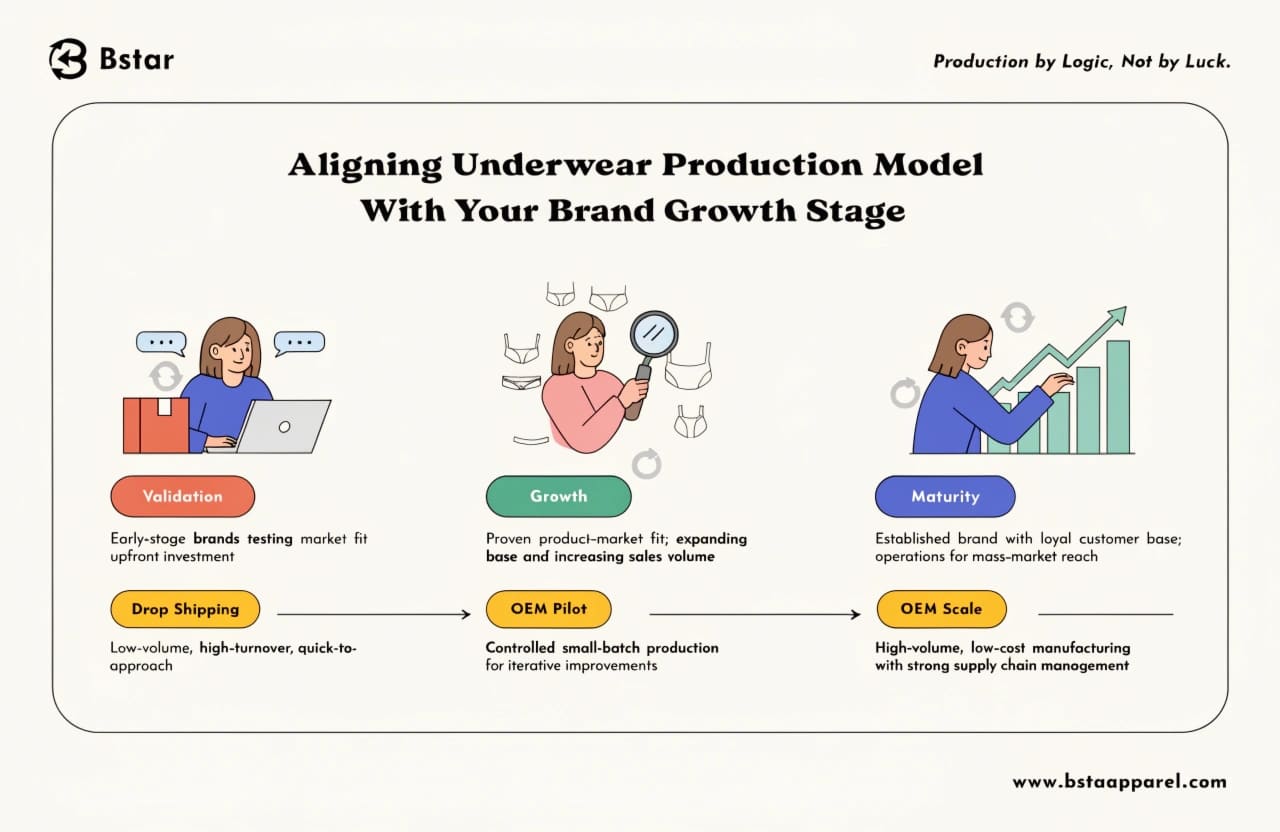
What small-batch capability does give you is access to market testing. You can launch at low volume, validate your product with real customers, and then scale into better unit economics on your reorder9. That’s a legitimate and common strategy for DTC brands. It works best when you go in knowing that the first run is a development investment, not a volume buy.
| Order Size | Unit Cost Behavior | Best Use Case |
|---|---|---|
| 1–50 units | Highest unit cost; setup dominates | Sampling, development, fit testing |
| 100–300 units | Moderate unit cost; viable for launch | Market testing, initial DTC launch |
| 500–1,000+ units | Setup amortizes; volume savings visible | Scaling after validation |
| 1,000+ per colorway | Strongest unit economics | Core product, repeat orders |
Beyond the Stitch: What Hidden Costs Should You Account for in Sampling, Logistics, and Compliance?
The FOB price is where most brands stop reading the quote. It shouldn’t be. In most first-order scenarios for international DTC brands, the gap between FOB price and landed cost is meaningful10 — and it’s made up of costs that every serious supplier will apply, whether they surface them in the initial quote or not.
Sampling, compliance testing, freight, duties, and packaging all sit outside your garment unit price. Comparing suppliers on FOB without standardizing these variables means you’re comparing different products. A lower FOB quote with unbundled packaging and no compliance testing is not a better price — it’s an incomplete one.
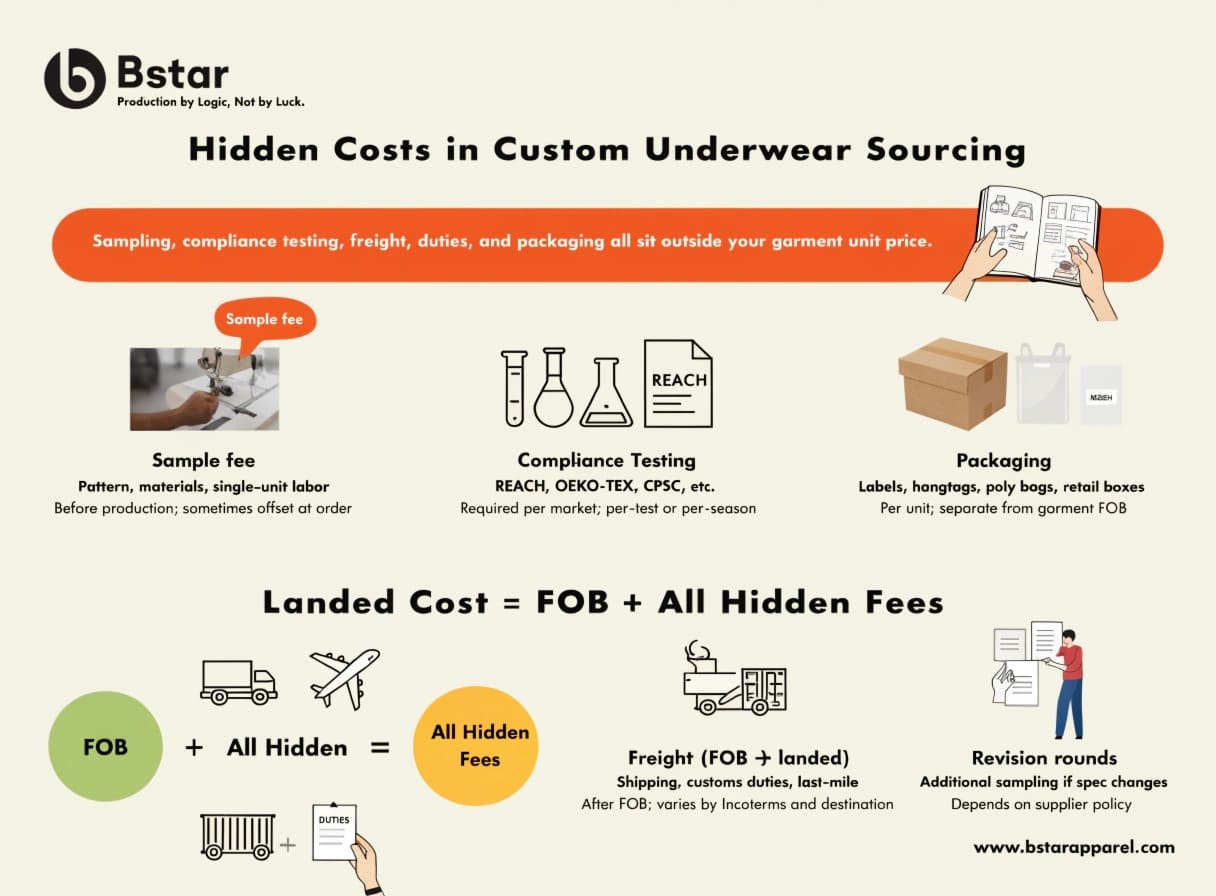
Sampling is the most commonly misunderstood cost. A sample fee covers pattern-making for your specific design, material sourcing in small quantity (often at higher cost than bulk), and labor for a single unit or small set11. When a factory charges for samples, they’re billing you for a real development process. The better question isn’t whether samples should be free — it’s whether sample costs offset against your production order, and under what conditions.
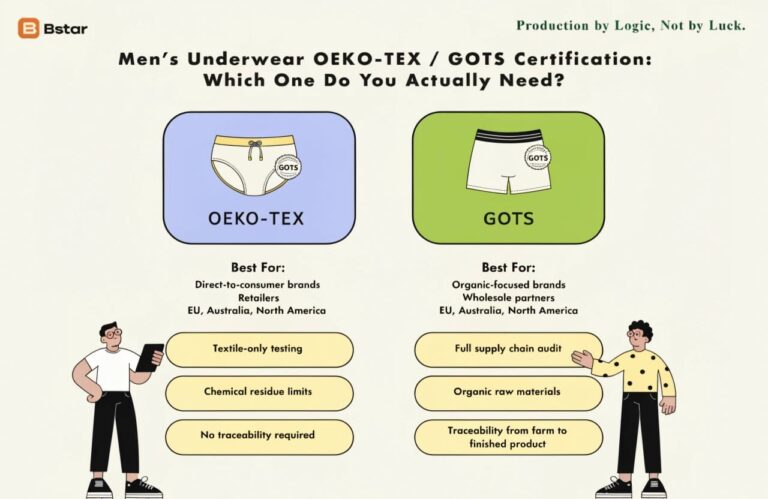
Compliance testing is another cost that brands sometimes discover late. If your target market (EU, US, UK, Australia) requires third-party testing for chemical content — REACH compliance, OEKO-TEX certification, CPSC requirements12 — that cost belongs in your product cost plan. Some factories quote it separately. Others build it in. Knowing which situation you’re in before sampling starts prevents budget surprises later.
| Cost Category | Typical Scope | When It Appears |
|---|---|---|
| Sample fee | Pattern, materials, single-unit labor | Before production; sometimes offset at order |
| Compliance testing | REACH, OEKO-TEX, CPSC, etc. | Required per market; per-test or per-season |
| Packaging | Labels, hangtags, poly bags, retail boxes | Per unit; separate from garment FOB |
| Freight (FOB → landed) | Shipping, customs duties, last-mile | After FOB; varies by Incoterms and destination |
| Revision rounds | Additional sampling if spec changes | Depends on supplier policy |
The brands we work with who have the smoothest sourcing experience are the ones who ask for a full cost breakdown — not just FOB — before they approve the first sample. It takes one extra email at the start. It saves several difficult conversations later.
Conclusion
Custom underwear pricing is set by your design and sourcing decisions before you contact a factory. Know your material specs, count your custom processes, match your volume to your cost expectations, and always ask for a full landed cost breakdown — not just FOB.
-
"Recycled Claim Standard (RCS) + Global Recycled Standard (GRS)", https://textileexchange.org/recycled-claim-global-recycled-standard/. The Global Recycled Standard (GRS), administered by Textile Exchange, is an international voluntary standard that sets requirements for third-party certification of recycled content, chain of custody, social and environmental processing practices, and chemical restrictions in textile and apparel products; certified materials carry a traceable recycled content claim that requires audit and documentation at each supply chain tier. Evidence role: definition; source type: institution. Supports: That the Global Recycled Standard (GRS) is a third-party certification verifying recycled input content and chain of custody in textile products.. Scope note: GRS certification costs and premiums vary by facility size and supply chain complexity; the standard does not itself set a price for certified materials. ↩
-
"Cutting Edge: Sourcing Materials – Cornell University", https://courses.cit.cornell.edu/cuttingedge/sourcing_matl/10sourcing.html. Textile economics research documents that specialty fibers including modal (a beech-pulp lyocell variant) and bamboo viscose require more complex chemical processing than conventional cotton, contributing to higher raw material costs at the mill level. Evidence role: general_support; source type: research. Supports: That specialty fibers such as modal, bamboo viscose, and recycled nylon carry higher production and market costs than conventional cotton jersey.. Scope note: Spot market prices fluctuate with commodity cycles; a static source may not reflect current pricing differentials. ↩
-
"Printed labels vs Woven labels: Which are better? – Weavabel", https://www.weavabel.com/blog/printed-labels-vs-woven-labels-which-are-better. Apparel trim sourcing practice distinguishes printed labels (produced via inkjet or screen printing on woven or non-woven substrate) from woven labels (requiring jacquard loom setup and yarn cost) and silicone-printed labels (requiring silicone ink, screen preparation, and heat curing); each successive method adds process steps and material cost. Evidence role: general_support; source type: other. Supports: That label production costs vary by method, with inkjet or screen-printed labels being least capital-intensive, woven labels requiring loom setup and yarn, and silicone screen-printing onto fabric involving additional material and curing steps.. Scope note: Relative costs depend on order quantity, design complexity, and supplier; the hierarchy may not hold at all volume levels. ↩
-
"FAQ – Oeko-Tex", https://www.oeko-tex.com/en/faq/. The OEKO-TEX Association administers the STANDARD 100 by OEKO-TEX label, which requires laboratory testing and periodic facility audits by accredited institutes; these costs are borne by the manufacturer and typically reflected in certified material pricing. Evidence role: mechanism; source type: institution. Supports: That OEKO-TEX certification involves a formal third-party audit and associated fees that are passed through the supply chain.. Scope note: Exact fee schedules vary by institute, product category, and production volume and are not publicly standardized. ↩
-
"Embroidery Price List: Ultimate Cost Breakdown and Savings Guide", https://maggieframestore.com/blogs/maggieframe-news/embroidery-price-list-ultimate-cost-breakdown-and-savings-guide?srsltid=AfmBOoqq3d6RFg8dTVaDMMB24EeImb9Ec6-vBMdSclwZjN–4SC1UoIA. Industry practice in contract embroidery separates a non-recurring digitizing fee—converting artwork into machine-readable stitch files—from a recurring per-piece run charge that scales with total stitch count and the number of placement positions per garment. Evidence role: mechanism; source type: other. Supports: That commercial embroidery pricing is composed of a one-time digitizing setup charge and a variable per-piece rate determined by stitch count and logo placement.. Scope note: Pricing conventions vary among contract decorators and regions; no single authoritative standard governs the fee structure. ↩
-
"[PDF] Mechanisms of ultrasonic joining of textile materials", https://ptacts.uspto.gov/ptacts/public-informations/petitions/1556778/download-documents?artifactId=DfHRmjzS3NaOaK-frISO_9FQov-wG3RqWY5WgJLKShlCEpjreZeghfI. Textile engineering literature describes bonded or welded seam technology—including ultrasonic welding and thermoplastic adhesive bonding—as requiring dedicated capital equipment and process parameters (temperature, pressure, dwell time) that differ fundamentally from lockstitch sewing; cycle times per seam are generally longer than high-speed sewing, affecting throughput per operator hour. Evidence role: mechanism; source type: research. Supports: That bonded seam construction uses ultrasonic or heat-bonding equipment distinct from conventional sewing machines and that the bonding process cycle time affects line output.. Scope note: Production speed comparisons are equipment- and specification-dependent; no universal throughput differential applies across all bonding technologies. ↩
-
"Dye-sublimation printing – Wikipedia", https://en.wikipedia.org/wiki/Dye-sublimation_printing. Dye sublimation transfers disperse dyes into a gaseous state that then bond covalently with polyester or other synthetic polymer fibers; natural fibers such as cotton lack the requisite polymer structure, making them incompatible with the process without a polymer coating. Evidence role: mechanism; source type: education. Supports: That dye sublimation requires a synthetic polymer substrate, typically polyester, because the process depends on dye molecules bonding with polymer chains under heat and pressure.. Scope note: Polymer-coated natural fiber substrates can accept sublimation in some applications, so the incompatibility is not absolute. ↩
-
"Optimal single machine scheduling of products with components …", https://www.sciencedirect.com/science/article/abs/pii/S0377221713006814. Operations management literature classifies setup costs—including machine changeover, tooling calibration, and inspection protocol initialization—as fixed costs per batch; because these costs do not vary with batch size, the per-unit setup cost declines as a function of increasing order quantity. Evidence role: definition; source type: education. Supports: That manufacturing setup costs are fixed per production run and therefore decrease on a per-unit basis as order volume increases.. Scope note: The specific cost categories relevant to apparel (pattern setup, color calibration) are industry-specific applications of a general principle; direct apparel-sector data would strengthen the claim. ↩
-
"Lean startup – Wikipedia", https://en.wikipedia.org/wiki/Lean_startup. The lean startup methodology, as described in entrepreneurship and product management literature, advocates for minimum viable product (MVP) launches to validate market demand with real customers prior to scaling production investment; this approach is widely applied in direct-to-consumer product categories to reduce inventory risk and inform reorder decisions. Evidence role: expert_consensus; source type: education. Supports: That launching a product at minimum viable volume to gather real customer demand data before committing to large-scale production is a documented risk-reduction strategy in product commercialization.. Scope note: The lean startup framework originates in software product development; its application to physical goods manufacturing involves additional constraints such as MOQs and longer lead times not fully addressed in the original literature. ↩
-
"Landed Cost: Complete Guide to Calculating Total Import and …", https://www.finaleinventory.com/blog/guides/landed-cost/. US International Trade Commission and customs data indicate that apparel imports are subject to ad valorem tariff rates that vary by product category and country of origin, with additional costs from ocean or air freight, customs brokerage, and last-mile logistics; collectively these charges can add 20–50% or more to the FOB price depending on trade lane and Incoterms arrangement. Evidence role: statistic; source type: government. Supports: That freight, customs duties, and ancillary import charges add a material percentage to the FOB price of imported apparel, making landed cost substantially higher than FOB.. Scope note: The precise gap depends on tariff classification, country of origin, shipping mode, and destination market; a single figure cannot represent all scenarios. ↩
-
"Knitted Fabric Price: Is Bulk Buying Cheaper? | Suerte Textile", https://www.suertetextile.com/news/is-it-cheaper-to-buy-fabric-by-the-yard/. Supply chain economics research documents that fabric and trim suppliers impose minimum order quantities (MOQs) and volume-tiered pricing; procurement below MOQ thresholds typically requires a short-run surcharge or purchase of excess material, both of which elevate the effective per-unit material cost during the sampling stage. Evidence role: mechanism; source type: research. Supports: That purchasing fabric in small quantities for sampling incurs a per-unit cost premium relative to bulk orders due to minimum order quantity constraints and the absence of volume discounts.. Scope note: The magnitude of the premium varies significantly by supplier, fiber type, and geographic sourcing region. ↩
-
"Clothing – Business Guidance FAQ | CPSC.gov", https://www.cpsc.gov/Business–Manufacturing/Business-Education/FAQ?p=2993&tid[2997]=2997. EU Regulation 1907/2006 (REACH) restricts the use of hazardous substances in articles including textiles sold in the European market, while the US Consumer Product Safety Commission (CPSC) enforces standards such as the Flammable Fabrics Act and the Consumer Product Safety Improvement Act for textile products; both frameworks require documented compliance and, in many cases, third-party laboratory testing. Evidence role: definition; source type: government. Supports: That REACH (EU Regulation 1907/2006) and CPSC regulations impose chemical safety and testing obligations on textile products placed in the EU and US markets respectively.. Scope note: OEKO-TEX is a voluntary private certification rather than a government regulation; grouping it with REACH and CPSC may overstate its mandatory character in some markets. ↩