
How to Source Sustainable Packaging for Your Underwear Brand?
Sustainable packaging sounds simple until you’re staring at three supplier quotes, two certification logos, and a retailer compliance form that doesn’t match either of them.
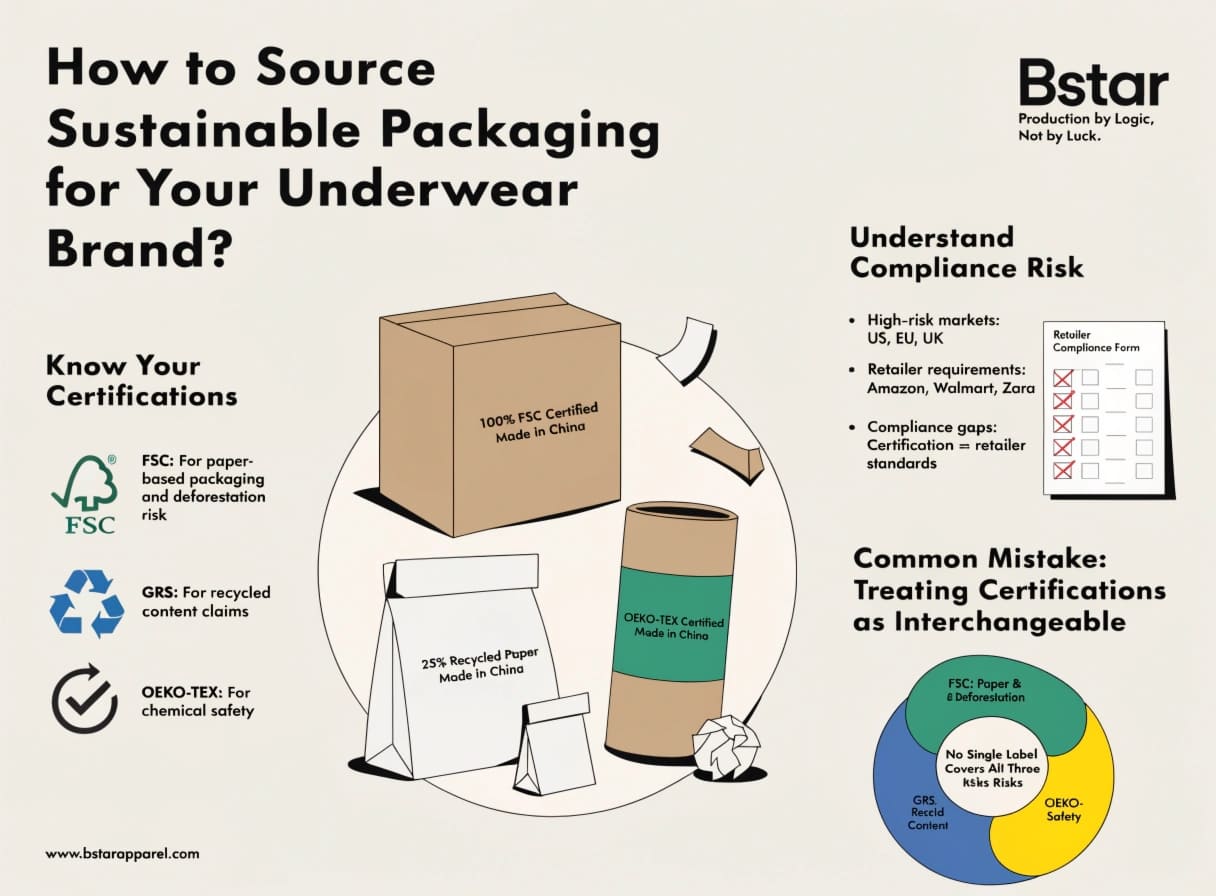
Sourcing sustainable packaging for an underwear brand means matching the right certification to your specific compliance risk — FSC for paper and deforestation, GRS for recycled content claims, and OEKO-TEX for chemical safety. No single label covers all three, and treating them as interchangeable is the most common and costly mistake brands make.
I’ve worked on the production side at BSTAR for years. Our team handles packaging questions from DTC brands in Europe, Australia, and North America almost every week. The questions sound different on the surface, but they usually come from the same place: a brand has decided to go sustainable, they’ve found a supplier who says the right things, and now they’re not sure if the paperwork actually holds up. This article is about that gap — the one between "certified" and "compliant for your specific situation."
Most brands we talk to are aware that regulations are tightening. What they underestimate is how fast the goalposts are moving.
The EU Packaging and Packaging Waste Regulation (PPWR) is pushing brands toward recyclable, reusable, or compostable packaging by defined deadlines.1 For underwear brands selling into European markets, this means your current poly bags and hangtag stock may already be non-compliant within a shorter window than your next reorder cycle.
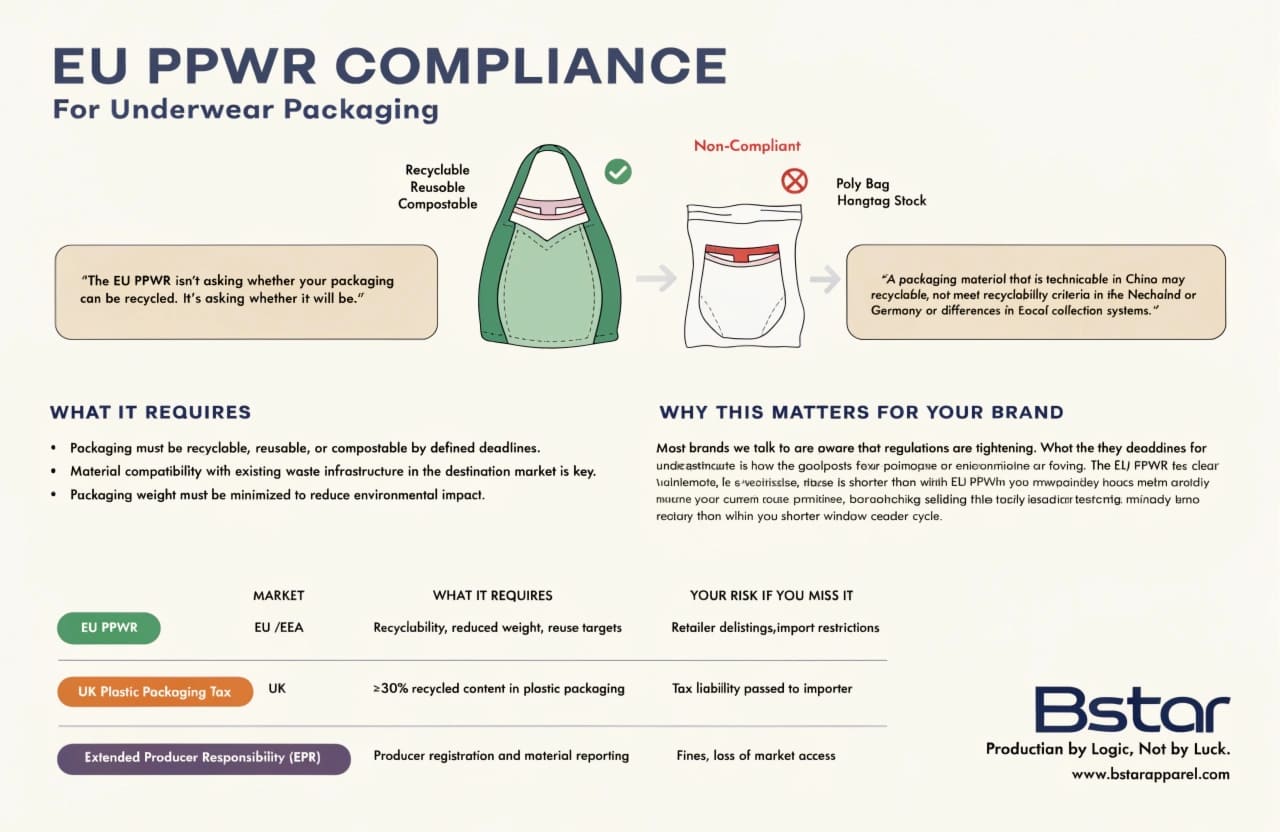
Here’s what makes this harder than it looks. The regulation doesn’t just ask whether your packaging can be recycled. It asks whether it will be recycled — meaning the material has to be compatible with the actual waste infrastructure in the destination market. A packaging material that is technically recyclable in China may not meet the recyclability criteria in Germany or the Netherlands because the local collection systems are different.2
We had a European client come to us with poly bags their previous supplier had labeled "recyclable PE." That was technically true. But the bags were multi-layer laminated, and the local sorting facilities couldn’t process them. The label said one thing. The compliance auditor said another.
What You Actually Need to Track
| Regulation | Market | What It Requires | Your Risk If You Miss It |
|---|---|---|---|
| EU PPWR | EU / EEA | Recyclability, reduced weight, reuse targets | Retailer delistings, import restrictions |
| [UK Plastic Packaging Tax | UK | ≥30% recycled content in plastic packaging | Tax liability passed to importer](https://www.gov.uk/guidance/check-if-you-need-to-register-for-plastic-packaging-tax)[^3] |
| [Extended Producer Responsibility (EPR) | France, Germany, others | Producer registration and material reporting | Fines, loss of market access](https://www.uh.edu/energy/eti/research/circularity/epr/eu_policies.php)[^4] |
The practical takeaway: know which markets you’re shipping to before you finalize any packaging spec. Then work backward from that market’s regulatory framework, not forward from your supplier’s available stock.
Material Innovations: Are GRS-Certified Recycled Polyethylene and FSC-Certified Paper Actually Different Things?
Yes. And this is where I see brands lose money and time every year.
FSC certification applies to paper and board products, and it verifies that the material came from responsibly managed forests.3 GRS — the Global Recycled Standard — verifies that a material contains a stated percentage of recycled content.4 These two certifications solve completely different supply-chain problems and cannot substitute for each other.
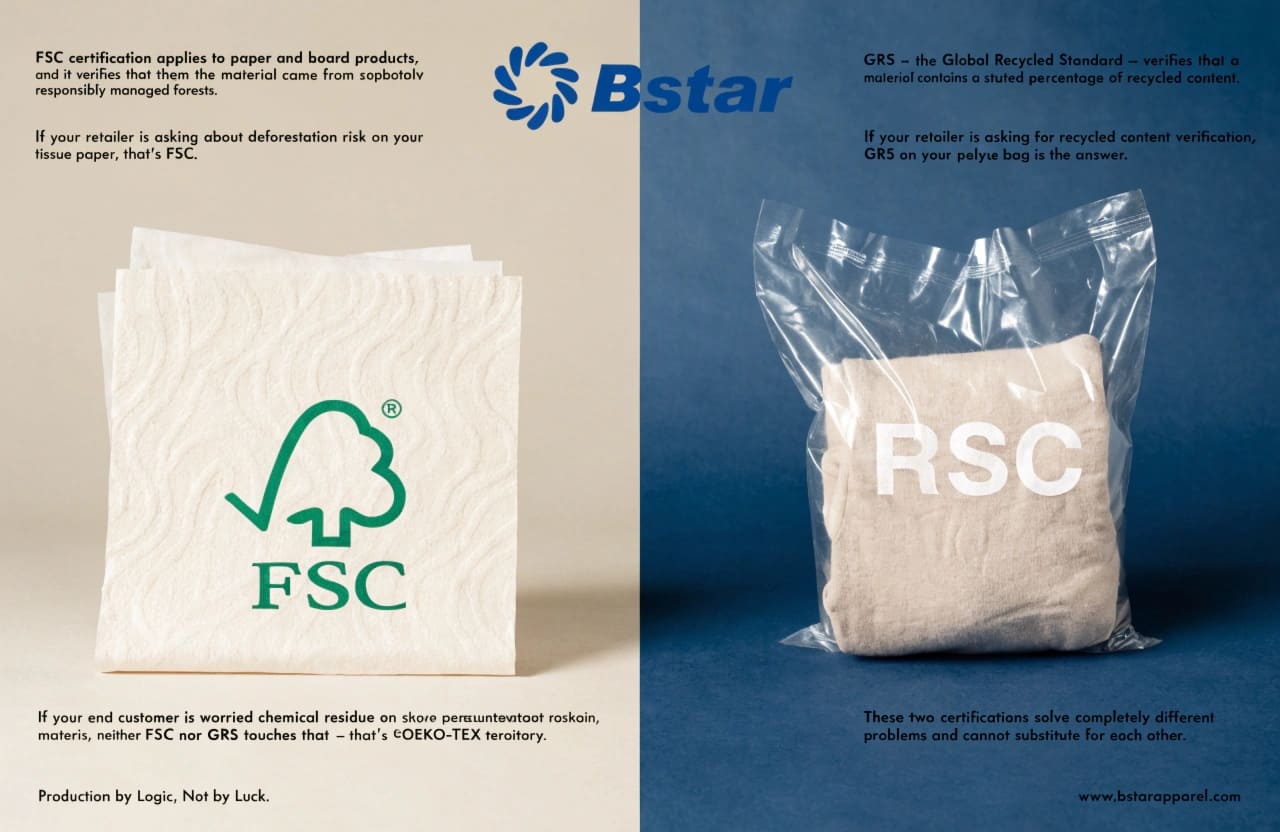
When a brand asks us about sustainable packaging, the first question we ask back is: what compliance requirement are you actually trying to meet? Because if your retailer is asking for recycled content verification, GRS on your poly bag is the answer. If your retailer is asking about deforestation risk on your tissue paper, that’s FSC. If your end customer is worried about chemical residue on product contact materials, neither FSC nor GRS touches that — that’s OEKO-TEX territory.
The Three Certifications, Plainly Explained
FSC (Forest Stewardship Council)
This applies to paper, cardboard, and wood-derived materials. It tells you the tree that became your hangtag box was harvested without destroying a forest ecosystem. It says nothing about what chemicals were used in the printing process.
GRS (Global Recycled Standard)
This applies to any material with a recycled content claim — recycled polyester, recycled cotton, recycled PE for poly bags. It validates the chain of custody from post-consumer or post-industrial waste back to the finished product. It does not tell you the material is safe for skin contact.
OEKO-TEX STANDARD 100
This tests for harmful substances in the finished material. For packaging that touches your product — tissue paper, inner wraps, direct-contact poly bags — this is the certification that protects you from a chemical compliance failure at retail audit.
A brand can hold all three and still have an incomplete picture. But holding one and assuming it covers the others is the gap that shows up in retailer questionnaires at the worst possible time.
Designing for Circularity: Does Minimalist Packaging Actually Help, or Is It Just Aesthetic?
Minimalist packaging became popular for two reasons: it looks good in unboxing videos, and it uses less material. Both of those things can be true. But "less material" is not the same as "better material."
Designing for circularity means every component of your packaging — poly bag, hangtag, inner wrap, adhesive label — can be separated, collected, and processed through existing waste streams. Minimalism helps when it removes unnecessary layers. It doesn’t help when it removes the label that tells the consumer how to dispose of what’s left.
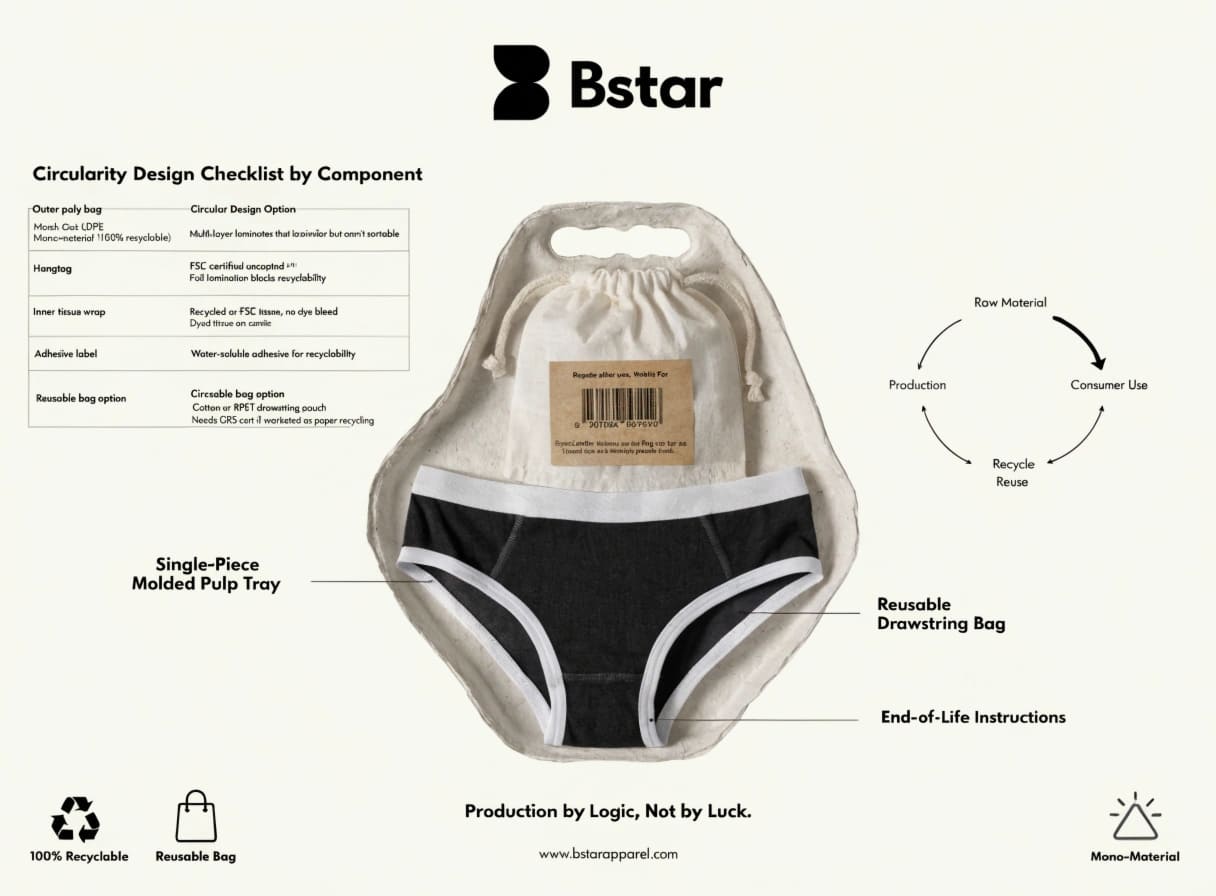
One thing we’ve started seeing from more advanced DTC brands is the reusable packaging model — packaging designed to have a second function so it doesn’t immediately enter the waste stream. Drawstring bags that become storage pouches. Rigid boxes that become drawer organizers. This extends the perceived value of the packaging beyond the unboxing moment.
Circularity Design Checklist by Component
| Packaging Component | Circular Design Option | Watch Out For |
|---|---|---|
| Outer poly bag | Mono-material LDPE (100% recyclable)5 | Multi-layer laminates that look similar but aren’t sortable |
| Hangtag | FSC-certified uncoated board | Foil lamination blocks recyclability6 |
| Inner tissue wrap | Recycled or FSC tissue, no dye bleed | Dyed tissue on light-colored product is a quality risk |
| Adhesive label | Water-soluble adhesive for recyclability7 | Standard adhesive contaminates paper recycling |
| Reusable bag option | Cotton or RPET drawstring pouch | Needs GRS cert if marketed as recycled content |
The brands that get this right are the ones who brief their packaging supplier on end-of-life requirements, not just material inputs. That’s a different kind of conversation, and most packaging suppliers aren’t used to having it unless you push.
Verifying Authenticity: How Do You Know a Supplier’s Certification Is Actually Valid?
This is the part nobody talks about in trend pieces on sustainable packaging. Finding certified suppliers is not the hard part. Verifying that the certification applies to your specific order is.
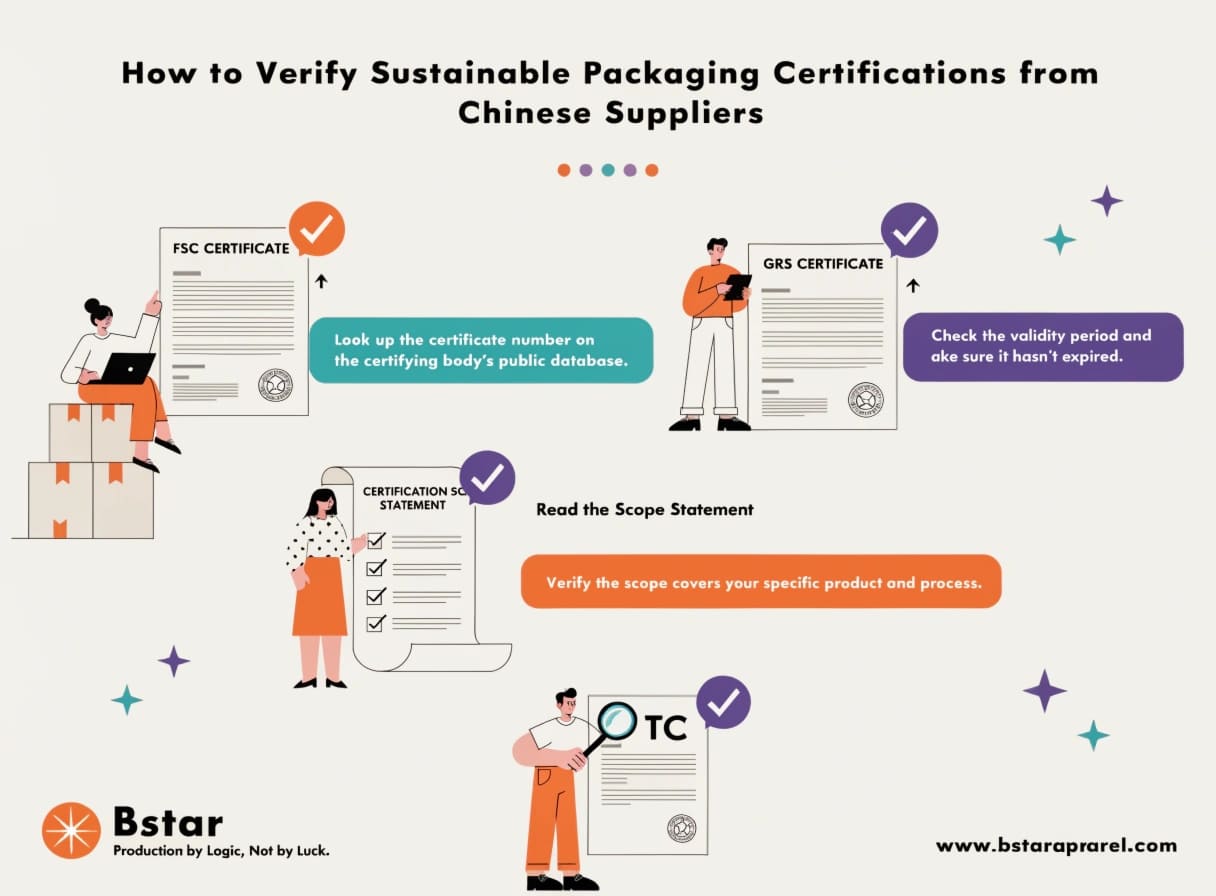
When a packaging supplier says they are "FSC certified," that tells you almost nothing on its own. You need the certificate number, the scope (which products and processes are covered), the validity period, and confirmation that the specific SKU you’re ordering falls within that scope. Expired certificates and scope mismatches are common, and suppliers don’t always flag them proactively.
We’ve seen this happen with our own clients. One brand approved a quote from a packaging supplier who had an FSC certificate displayed on their website. What they didn’t check: the certificate had expired four months earlier. Another client’s supplier had a valid GRS certificate — but only for their polyester yarn division, not for the poly bag product line the client was actually buying.
What to Ask Every Packaging Supplier
Certificate number — Look it up directly on the certifying body’s public database. FSC certificates are searchable at info.fsc.org. GRS and other Textile Exchange standards are at textileexchange.org.8
Certificate scope — The scope statement defines exactly which products and processes are covered. Read it. Don’t assume it covers your SKU because the supplier’s website says they’re certified.
Validity period — Certificates expire and require annual renewal. Ask for the current certificate, not a copy from their last audit cycle.
Transaction certificates — For FSC and GRS, individual shipments may require a transaction certificate (TC) in addition to the supplier’s scope certificate. If your retailer asks for chain-of-custody documentation, a TC is what they’re asking for.
At BSTAR, when we source packaging materials for clients, we pull the live certificate records ourselves before confirming any spec. It adds a step. It has also caught expired certifications and scope mismatches more than once. The cost of that check is zero. The cost of approving a non-compliant packaging run and reshipping before a retail launch window is not.
Conclusion
Sustainable packaging sourcing is not about finding the greenest-sounding supplier — it’s about matching the right certification to your specific risk, verifying that the certificate is real, and fitting the decision inside a supply chain that can actually support the claim.
-
"Packaging waste – Environment – European Commission", https://environment.ec.europa.eu/topics/waste-and-recycling/packaging-waste_en. The EU Packaging and Packaging Waste Regulation (PPWR), as published in the Official Journal of the European Union, establishes mandatory recyclability, reuse, and compostability targets for packaging placed on the EU market, with phased compliance deadlines extending to 2030 and beyond. Evidence role: definition; source type: government. Supports: The EU PPWR’s legal requirements for recyclability, reusability, and compostability, including the applicable deadlines.. Scope note: The regulation was still undergoing final legislative steps as of 2024; specific deadline provisions may differ between the Commission proposal and the final adopted text. ↩
-
"[PDF] Report Name:European Commission Proposes New Rules on …", https://apps.fas.usda.gov/newgainapi/api/Report/DownloadReportByFileName?fileName=European%20Commission%20Proposes%20New%20Rules%20on%20Packaging%20and%20Packaging%20Waste_Brussels%20USEU_European%20Union_E42022-0074. European Commission guidance on the PPWR specifies that recyclability is assessed against the ‘recyclability at scale’ criterion, which requires compatibility with the waste collection, sorting, and reprocessing infrastructure actually operating in the relevant market. Evidence role: mechanism; source type: government. Supports: That EU PPWR recyclability assessments are based on whether packaging will be recycled in practice within existing collection and sorting infrastructure, not merely technical recyclability.. Scope note: Detailed implementing acts defining the recyclability assessment methodology were pending adoption as of 2024; the precise country-level application may be clarified in subsequent delegated regulations. ↩
-
"Forest Stewardship Council – Wikipedia", https://en.wikipedia.org/wiki/Forest_Stewardship_Council. The Forest Stewardship Council defines FSC certification as a chain-of-custody system that tracks wood and paper products from FSC-certified forests or controlled sources through processing and manufacturing to the end product, verifying compliance with FSC’s Principles and Criteria for responsible forest management. Evidence role: definition; source type: institution. Supports: That FSC certification verifies chain of custody from responsibly managed forests to paper and board products.. ↩
-
"Recycled Claim Standard (RCS) + Global Recycled Standard (GRS)", https://textileexchange.org/recycled-claim-global-recycled-standard/. Textile Exchange’s Global Recycled Standard (GRS) is a voluntary product standard that sets requirements for third-party certification of recycled content and chain of custody, applicable to any product containing at least 20% recycled material from post-consumer or post-industrial sources. Evidence role: definition; source type: institution. Supports: That the GRS, administered by Textile Exchange, verifies recycled content claims and chain of custody for materials derived from post-consumer or post-industrial waste.. Scope note: The GRS does not assess product safety, chemical compliance, or environmental performance beyond recycled content traceability. ↩
-
"Recycling of post-consumer plastic packaging waste in the EU – PMC", https://pmc.ncbi.nlm.nih.gov/articles/PMC8162419/. Research from the Ellen MacArthur Foundation and Plastics Recyclers Europe identifies mono-material flexible polyethylene (including LDPE) as technically recyclable through dedicated film collection streams, and notes it is significantly more compatible with existing sorting and reprocessing infrastructure than multi-layer laminate alternatives. Evidence role: mechanism; source type: research. Supports: That mono-material LDPE is technically recyclable and preferred over multi-layer laminates for recyclability, though actual recycling rates depend on collection infrastructure.. Scope note: Technical recyclability does not guarantee high recycling rates in practice; collection infrastructure for flexible films remains limited in many EU member states, and actual recycling rates for LDPE film are substantially below 100%. ↩
-
"The Lifecycle of Laminate: Is It Recyclable? – Avance Floors", https://avancefloors.com/the-lifecycle-of-laminate-is-it-recyclable/. Industry guidance from paper recycling bodies, including CEPI (Confederation of European Paper Industries), identifies metallised foil laminates as a problematic contaminant in paper recycling, as the aluminium or polyester foil layer cannot be separated from the paper fibre during standard repulping processes. Evidence role: mechanism; source type: research. Supports: That foil lamination on paper or board substrates renders the material incompatible with standard paper recycling streams.. Scope note: Recyclability outcomes may vary depending on the specific foil type, laminate thickness, and the capabilities of individual recycling facilities. ↩
-
"recyclability of mixed office waste papers containing pressure", https://research.fs.usda.gov/download/treesearch/9107.pdf. Guidelines from the Paper Recycling Promotion Center and label industry bodies such as FINAT identify standard pressure-sensitive adhesives as a source of ‘stickies’ contamination in paper recycling, and recognise wash-off or water-soluble adhesive formulations as a design-for-recycling improvement for paper-based substrates. Evidence role: mechanism; source type: institution. Supports: That standard pressure-sensitive adhesives on labels contaminate paper recycling streams, and that water-soluble or wash-off adhesives improve recyclability.. Scope note: The recyclability benefit of water-soluble adhesives is contingent on the label substrate and the repulping conditions used at the receiving mill; performance may vary across facilities. ↩
-
"FSC Public Search – Certificate Data", https://connect.fsc.org/fsc-public-certificate-search. The Forest Stewardship Council maintains a public certificate database at info.fsc.org where scope certificates and their validity periods can be searched by certificate code or company name; Textile Exchange similarly provides a public integrity portal for verifying GRS and other Textile Exchange standard certificates held by certified organisations. Evidence role: general_support; source type: institution. Supports: That FSC and GRS certificates can be independently verified through publicly accessible databases maintained by the respective certification bodies.. Scope note: Public databases display scope certificate status but may not reflect real-time suspension or withdrawal actions; transaction certificates, which are required for individual shipment chain-of-custody claims, are typically held by the supplier and are not universally searchable in these databases. ↩