
How to Calculate Landed Cost for Imported Underwear?
Most buyers I talk to have made the same mistake at least once. They got a great factory price, did some quick math on freight, and felt confident about their margins — until the goods arrived.
Landed cost for imported underwear includes your factory price, international freight, insurance, import duties, customs brokerage fees, port handling charges, and local delivery. Miss any one of these, and your margin calculation is wrong before your first unit sells.
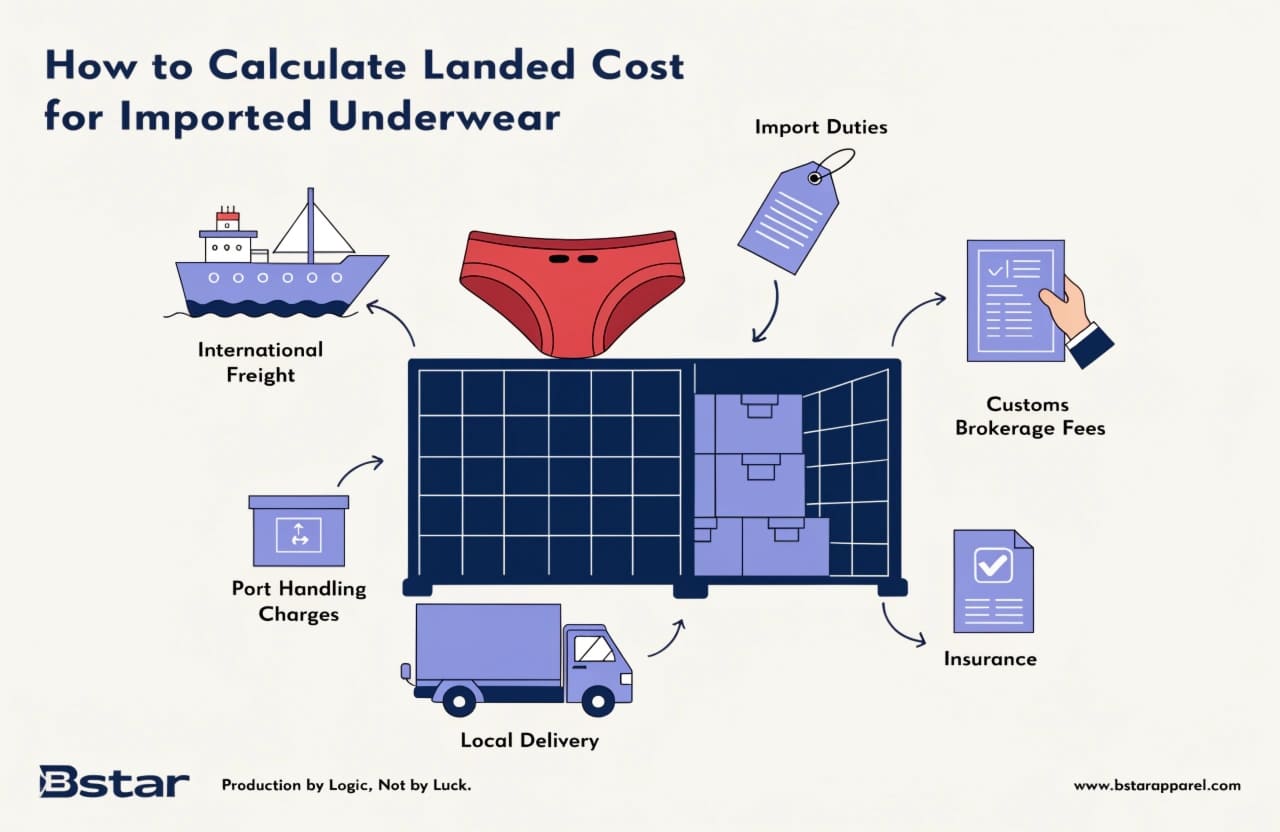
We get asked about total import costs constantly. Buyers reach out with a FOB price in hand and ask if it’s a "good deal." The honest answer is: we don’t know yet. Not until we know where the goods are going, how they’re classified, and what it costs to get them from our factory floor to your warehouse shelf. That’s what this article is about.
Deconstructing the Formula: From CIF Value and Duties to Port Handling Charges?
New buyers almost always undercount the line items. They build a spreadsheet with two rows — factory price and freight — and call it landed cost. Then they get an invoice from their customs broker and the numbers stop making sense.
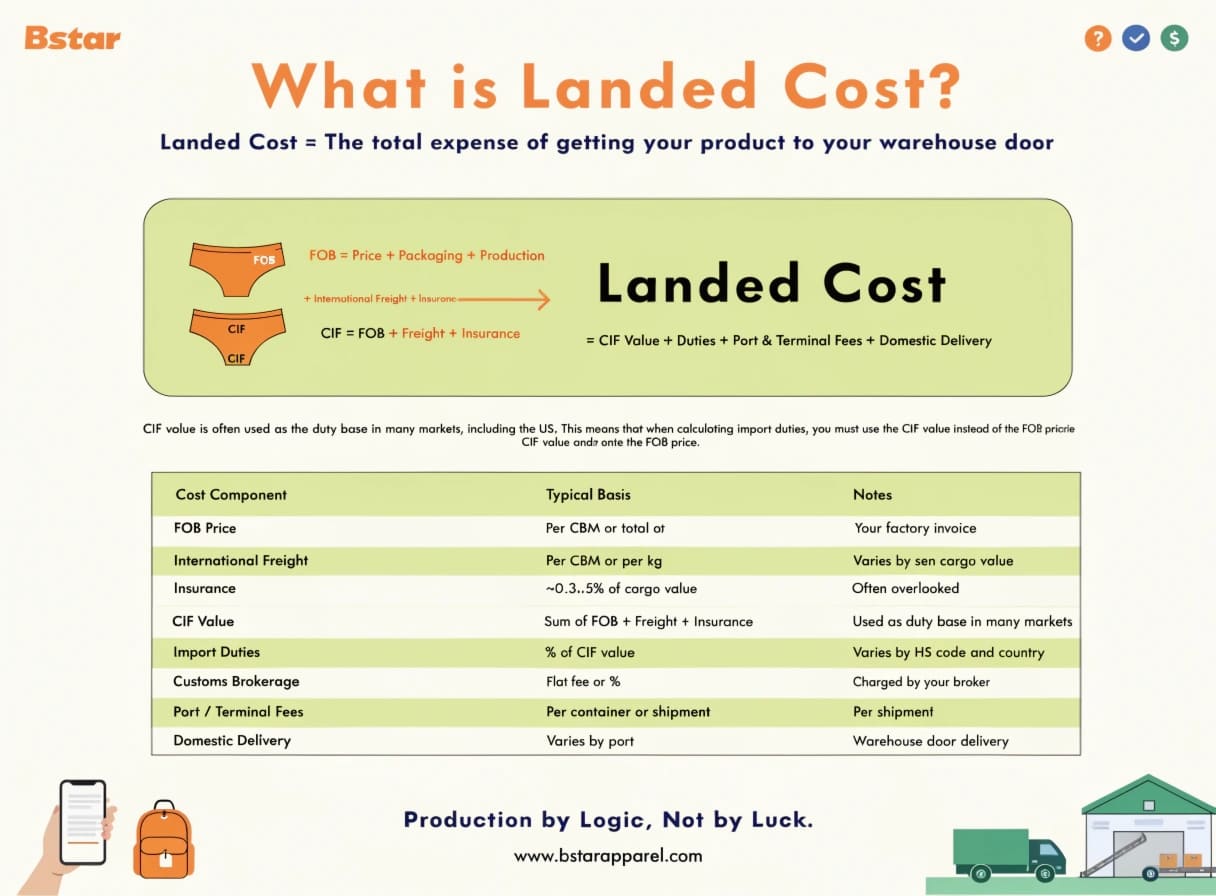
The real landed cost formula has 8 to 12 line items. At minimum, it includes: FOB price, international freight, insurance, CIF value (used as the duty base in many markets), import duties, customs brokerage fees, port handling and terminal fees, and domestic delivery to your warehouse.
Let me walk through why each piece matters.
FOB vs. CIF — this distinction changes your duty base. Many markets calculate import duties on the CIF value, which means the customs authority taxes you on the cost of goods plus freight plus insurance. So if you paid $5,000 FOB and spent $500 on freight and $50 on insurance, your duty base is $5,550 — not $5,000. That gap compounds fast at higher volumes.
Port and terminal handling fees are real money. These show up under names like THC (Terminal Handling Charges), ISF filing fees (for US imports)1, documentation fees, and customs exam fees. Buyers we work with in the US have found that port-side charges alone can add $200–$500 per shipment, sometimes more if your goods are flagged for a physical exam2.
Here’s a simplified view of how the components stack up:
| Cost Component | Typical Basis | Notes |
|---|---|---|
| FOB Price | Per unit or total order | Your factory invoice |
| International Freight | Per CBM or per kg | Varies by season and route |
| Insurance | ~0.3–0.5% of cargo value | Often overlooked |
| Import Duties | % of CIF value | Varies by HS code and country |
| Customs Brokerage | Flat fee or % | Charged by your broker |
| Port / Terminal Fees | Per container or shipment | Varies by port |
| Domestic Delivery | Per shipment | Warehouse door delivery |
None of these numbers are fixed. Every single row changes based on your destination market, shipment volume, carrier, and how your goods are classified.
Mastering HS Code Classification: Avoiding Tariff Pitfalls Specific to Intimate Apparel?
This is where buyers lose real money, in both directions. The wrong HS code can mean you underpay duties and face a penalty later, or you overpay because you used a code that doesn’t match your product3.
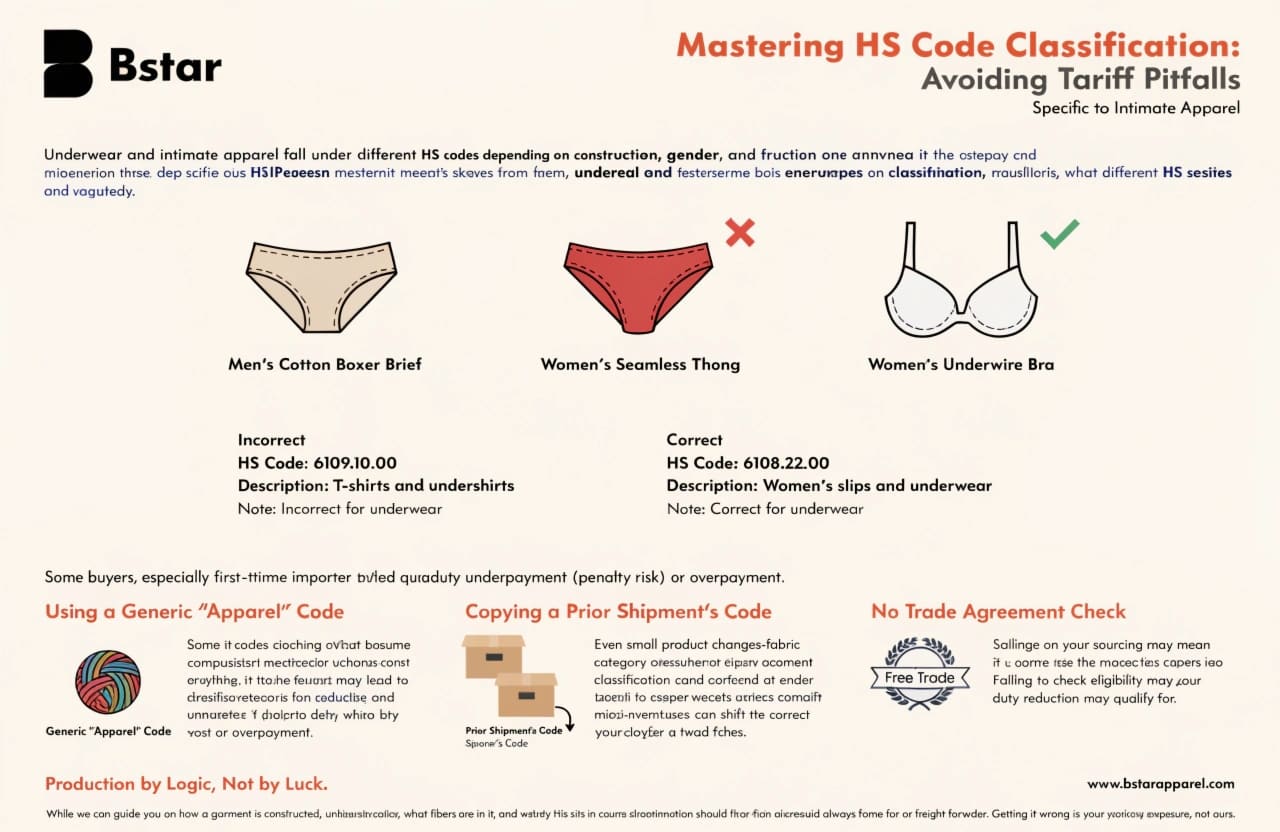
Underwear and intimate apparel fall under different HS codes depending on construction, gender, and function. Common codes include 6108 (women’s slips and underwear), 6109 (T-shirts and undershirts), and 6212 (bras, corsets, and similar)4. Each can carry a different duty rate in the same destination market.
I want to be direct about something: we are a manufacturer, not a customs compliance firm. We can tell you how a garment is constructed, what fibers are in it, and what category it sits in commercially. But the final HS code determination should always come from your licensed customs broker or freight forwarder. That’s their job, and getting it wrong is your legal exposure, not ours.
That said, here’s what I see buyers get wrong most often:
Using a generic "apparel" code. Some buyers, especially first-time importers, pick a broad clothing category and assume it covers everything. It doesn’t. Underwear has specific codes, and intimate apparel with functional components (like underwire bras) may land in a completely different subheading with a different rate.
Copying a code from a different product or a past shipment. Even small product changes — fabric composition, construction method, gender classification — can shift the correct code. A men’s cotton boxer brief and a women’s seamless thong are not the same code, even if they come from the same factory.
Not checking trade agreement eligibility. Depending on your sourcing country and destination market, you may qualify for a reduced duty rate under a trade agreement5. Or you may not. This changes the math entirely, and you won’t know unless you check — before you place the order.
| Common Mistake | Potential Consequence |
|---|---|
| Wrong HS code used | Duty underpayment (penalty risk) or overpayment |
| Generic apparel code | Misclassification, possible customs delay |
| No trade agreement check | Missing a duty reduction you qualified for |
| Copying a prior shipment’s code | Product change means code change — may not match |
Verify the code first. Price second.
Factoring in Hidden Expenses: Allocating Freight, Insurance, and Customs Brokerage Fees?
The costs that surprise buyers most aren’t the big visible ones. They’re the small fees that never made it into the original estimate.
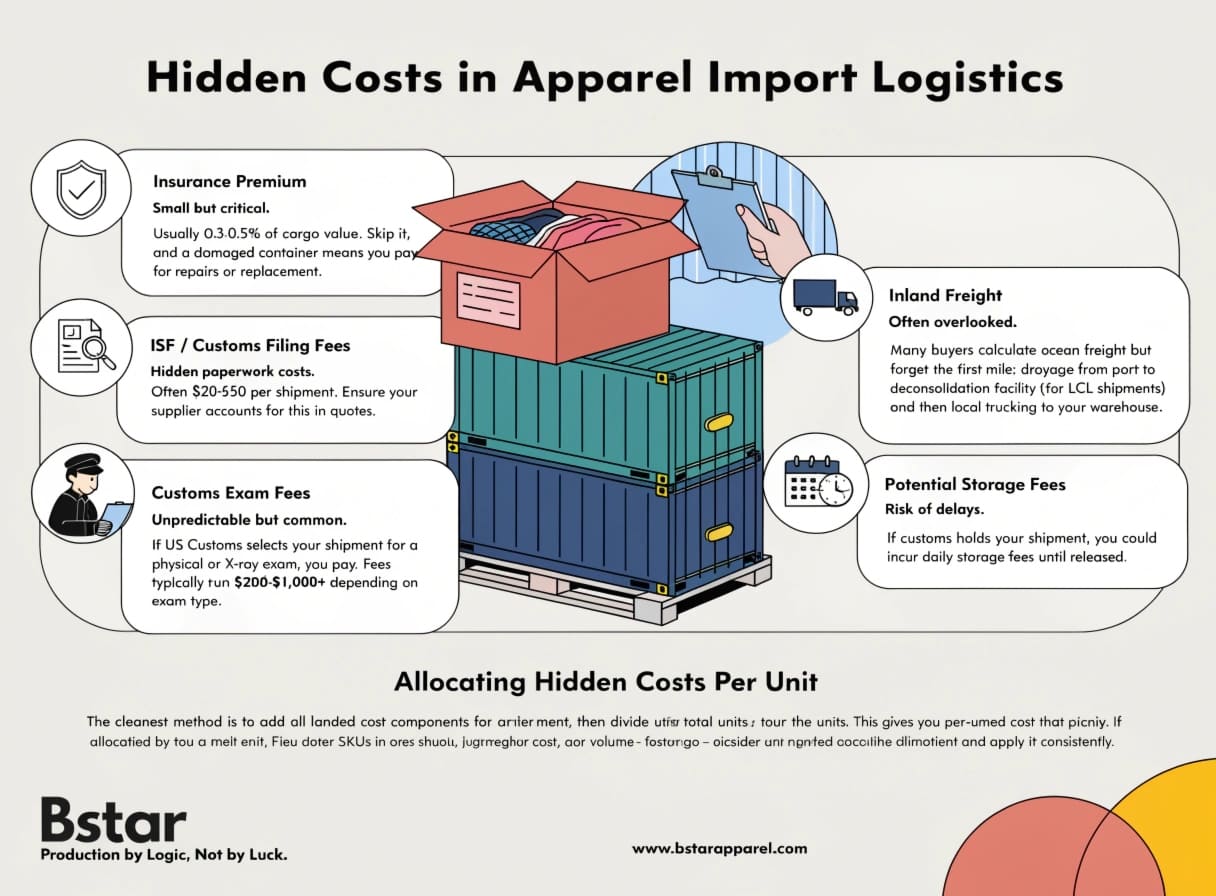
Hidden import costs include insurance premiums, ISF or customs filing fees, customs exam fees, inland freight from port to warehouse, and potential storage fees if your goods are delayed at customs. These can add 8–15% to your original cost estimate depending on the shipment6.
Let me give you a few specific examples of what I mean.
Insurance. A lot of buyers skip cargo insurance to save money. The premium is usually 0.3–0.5% of cargo value — genuinely small. But if your container gets damaged or delayed, that decision looks very different. I’d always recommend building it in.
Customs exam fees. If US Customs selects your shipment for a physical or X-ray exam, you pay for it. Exam fees typically run $200–$1,000+ depending on exam type7. You can’t predict this, but you can budget a small buffer for it.
First-mile vs. last-mile delivery. Some buyers calculate ocean freight and assume the goods appear at their warehouse. They don’t. You need drayage from the port to a deconsolidation facility (for LCL shipments), and then local trucking to your door. These fees are real, and they vary by distance from the port.
How to allocate these costs per unit:
The cleanest method is to add all landed cost components for a shipment, then divide by total units. This gives you a true per-unit landed cost that you can use for pricing. If you’re mixing SKUs in one shipment, allocate by unit cost weight or volume — pick a method and apply it consistently.
Strategic Pricing: Integrating Landed Cost with Retail Margins and Market Positioning?
Here’s the part most buyers skip until it’s too late. Landed cost isn’t just a cost to minimize — it’s the foundation your retail price has to stand on.
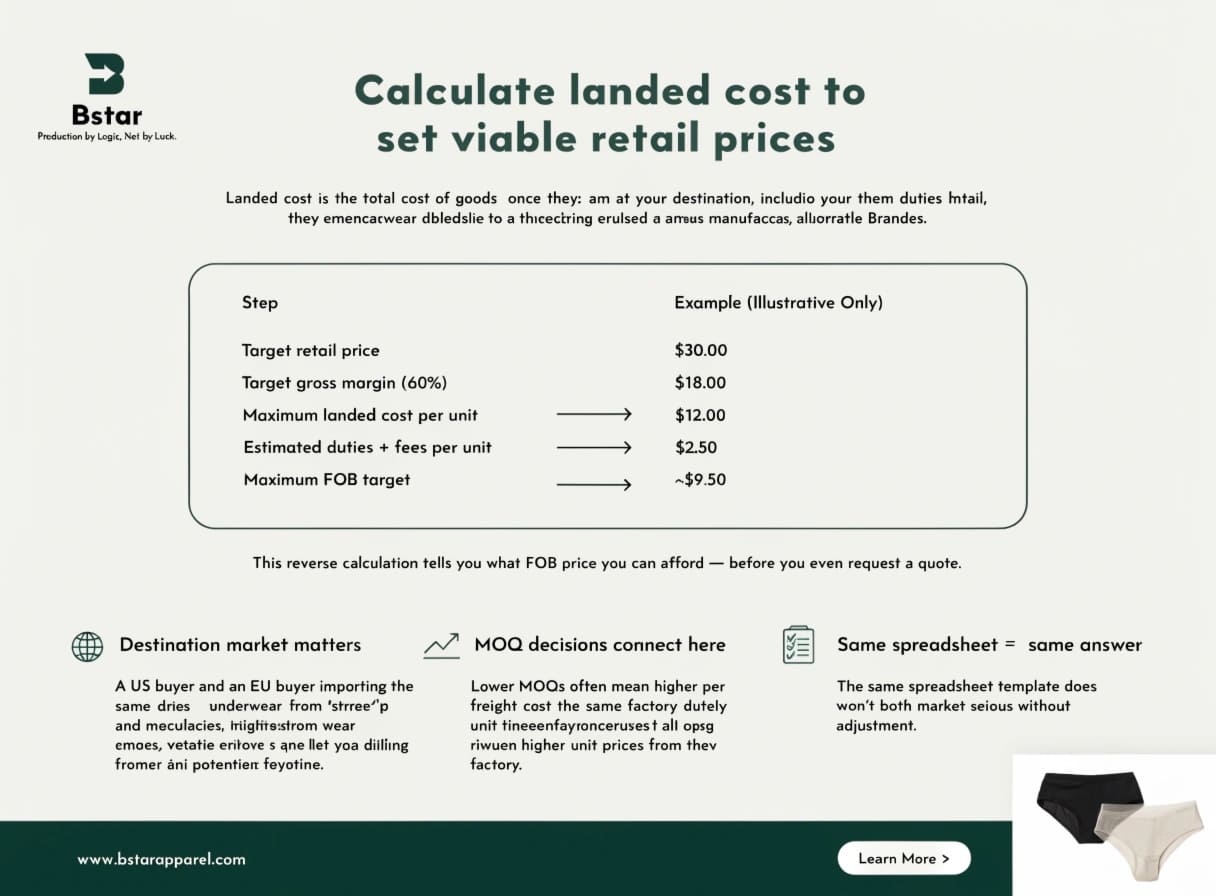
To set a viable retail price, work backwards from your target margin. Start with your retail price, subtract your target gross margin percentage, and the remaining number is your maximum allowable landed cost per unit. If your actual landed cost exceeds this, your pricing doesn’t work — and you need to renegotiate, reposition, or adjust your order structure.
Buyers we work with who get this right do one thing differently: they calculate landed cost before confirming the order, not after the goods ship.
Working backwards from retail price:
| Step | Example (Illustrative Only) |
|---|---|
| Target retail price | $30.00 |
| Target gross margin (60%) | $18.00 |
| Maximum landed cost per unit | $12.00 |
| Estimated duties + fees per unit | $2.50 |
| Maximum FOB target | ~$9.50 |
This reverse calculation tells you what FOB price you can afford — before you even request a quote. It also tells you how sensitive your margins are to duty changes, freight rate shifts, or exchange rate movements.
MOQ decisions connect here too. Lower MOQs often mean higher per-unit freight costs and potentially higher unit prices from the factory8. When you know your landed cost ceiling, you can evaluate whether a small test order is financially viable — or whether the per-unit economics only work at higher volumes.
One more thing: destination market matters more than most buyers expect. A US buyer and an EU buyer importing the same underwear from the same factory face different duty structures, different VAT obligations, and different trade agreement eligibility9. The same spreadsheet template does not work for both markets without serious adjustment.
Conclusion
Landed cost is not a formula problem. It’s a judgment problem. Know your line items, verify your HS code, factor in every fee, and price backwards from your retail target — before you commit to an order.
-
"Import Security Filing (ISF) – When to submit to CBP", https://www.help.cbp.gov/s/article/Article-1868. U.S. Customs and Border Protection regulations (19 CFR Part 149) require importers to submit an Importer Security Filing—commonly called ISF or ’10+2’—for cargo arriving by vessel, establishing the filing as a mandatory compliance step that generates associated brokerage or filing fees. Evidence role: mechanism; source type: government. Supports: That ISF filing is a mandatory regulatory requirement for US ocean freight imports, making the associated fee a non-discretionary cost. ↩
-
"What are Terminal Handling Charges (THC): How to mitigate …", https://www.container-xchange.com/blog/terminal-handling-charges. Terminal handling charges (THC) are assessed by ocean carriers and marine terminal operators to cover container movement within port facilities; the Federal Maritime Commission notes that THC and related port surcharges are separately itemized on freight invoices and vary by carrier, terminal, and trade lane, with no uniform federal rate schedule governing their amounts. Evidence role: statistic; source type: institution. Supports: That terminal handling charges and associated port fees constitute a real and variable cost component of US ocean freight imports. Scope note: The $200–$500 range cited is illustrative and not drawn from a published fee schedule; actual charges depend on port, carrier, container size, and shipment type and may fall outside this range. ↩
-
"Mitigation Guidelines ICP: Fraud, Gross Negligence, Negligence …", https://www.cbp.gov/document/publications/mitigation-guidelines-icp-fraud-gross-negligence-negligence-1592. Under 19 U.S.C. § 1592, U.S. Customs and Border Protection may assess civil penalties against importers of record for material false statements or omissions in entry documents, including misclassification of goods; penalties are tiered by culpability (fraud, gross negligence, or negligence) and may be assessed on the unpaid duties or the dutiable value of the merchandise, establishing a direct legal basis for the financial exposure described. Evidence role: mechanism; source type: government. Supports: That HS code misclassification resulting in duty underpayment exposes importers to civil penalties under US customs law. Scope note: Penalty application depends on the specific facts, degree of culpability, and CBP enforcement discretion; not all misclassifications result in penalties, particularly where the importer demonstrates good-faith reliance on professional ↩
-
"[PDF] Harmonized Tariff Schedule of the United States Revision 9 (2026)", https://hts.usitc.gov/reststop/file?release=currentRelease&filename=Chapter%2061. The World Customs Organization Harmonized System Nomenclature (2022 edition), Chapter 61, assigns heading 6108 to women’s slips and underwear, heading 6109 to T-shirts and undershirts, and heading 6212 to brassieres, corsets, and similar articles, with each heading carrying distinct subheadings based on fiber composition and construction. Evidence role: definition; source type: institution. Supports: That HS headings 6108, 6109, and 6212 correspond to the described product categories within the World Customs Organization Harmonized System. Scope note: National tariff schedules may add further subheadings beyond the 6-digit HS level, so duty rates and precise classifications must be verified against the destination country’s specific tariff schedule. ↩
-
"Textiles | United States Trade Representative", https://ustr.gov/trade-agreements/free-trade-agreements/trans-pacific-partnership/tpp-chapter-chapter-negotiating-1. The U.S. International Trade Commission and the Office of the U.S. Trade Representative document multiple preferential trade programs—including free trade agreements and unilateral preference programs such as GSP—that can reduce or eliminate import duties on qualifying apparel, subject to rules-of-origin requirements that typically specify where yarn, fabric, or assembly operations must occur. Evidence role: general_support; source type: government. Supports: That preferential duty rates on apparel are available under various trade agreements, contingent on rules-of-origin compliance. Scope note: Eligibility is product- and country-specific; the article’s general statement does not substitute for a shipment-level rules-of-origin analysis. ↩
-
"Logistics Costs and U.S. Gross Domestic Product – FHWA Operations", https://ops.fhwa.dot.gov/freight/freight_analysis/econ_methods/lcdp_rep/index.htm. Supply chain and trade logistics research consistently identifies customs duties, brokerage fees, port charges, and inland transportation as significant components of total landed cost beyond the factory price; estimates of these ancillary costs as a share of goods value vary widely by trade lane, product category, and shipment size, with some studies placing non-freight, non-duty logistics costs in the range of 5–15% of FOB value for consumer goods. Evidence role: statistic; source type: research. Supports: That ancillary import costs beyond factory price and ocean freight represent a material percentage addition to total landed cost. Scope note: The 8–15% figure cited in the article is not attributed to a specific study; the actual range is highly shipment-specific, and published research figures may not directly correspond to intimate apparel import scenarios. ↩
-
"Cargo Examination – U.S. Customs and Border Protection", https://www.cbp.gov/border-security/ports-entry/cargo-security/examination. U.S. Customs and Border Protection policy places the cost of cargo examinations—including tailgate, intensive, and non-intrusive inspections conducted at Container Examination Stations—on the importer of record; fee amounts are set by the examination station operators and vary by exam type, container size, and facility, with no single published federal fee schedule governing all exam types. Evidence role: statistic; source type: government. Supports: That importers bear the cost of CBP-directed examinations and that these fees vary by exam type. Scope note: The $200–$1,000+ range cited in the article is not drawn from an official CBP fee schedule and should be treated as an illustrative estimate subject to significant variation by port and facility. ↩
-
"Economies of scale", https://en.wikipedia.org/wiki/Economies_of_scale. Operations management and supply chain economics literature documents that per-unit logistics costs decline with shipment volume due to the fixed-cost structure of container freight (LCL shipments bearing higher per-CBM rates than FCL), and that manufacturing unit costs typically decrease with order quantity as setup and overhead costs are spread across more units—a relationship central to MOQ-based pricing in contract manufacturing. Evidence role: mechanism; source type: paper. Supports: That per-unit freight and manufacturing costs decline with increasing order volume due to fixed-cost spreading and economies of scale. Scope note: The magnitude of these effects varies significantly by factory, trade lane, and product; the article’s qualitative claim is well-supported in principle but specific cost differentials require empirical verification for a given sourcing scenario. ↩
-
"[PDF] Harmonized Tariff Schedule of the United States Revision 9 (2026)", https://hts.usitc.gov/reststop/file?release=currentRelease&filename=Chapter%2061. The European Union’s Common Customs Tariff (published by the European Commission) and the U.S. Harmonized Tariff Schedule (published by the U.S. International Trade Commission) set independent duty rates for apparel under Chapter 61; additionally, EU member states apply value-added tax to imports at the border under Council Directive 2006/112/EC, a structural obligation absent from the U.S. federal import framework, creating materially different total cost structures for the same product. Evidence role: general_support; source type: government. Supports: That the EU and US apply distinct tariff schedules, VAT/sales tax frameworks, and trade agreement networks to the same imported apparel products. Scope note: Duty rates and VAT rates vary by specific HS subheading and EU member state; the claim is directionally accurate but requires product- and country-specific verification. ↩