
What Are the Legal Requirements for Selling Underwear in the USA?
Selling underwear in the US sounds straightforward. It is not. One missing line on a label can stop your shipment, pull your listing, or trigger a federal complaint.
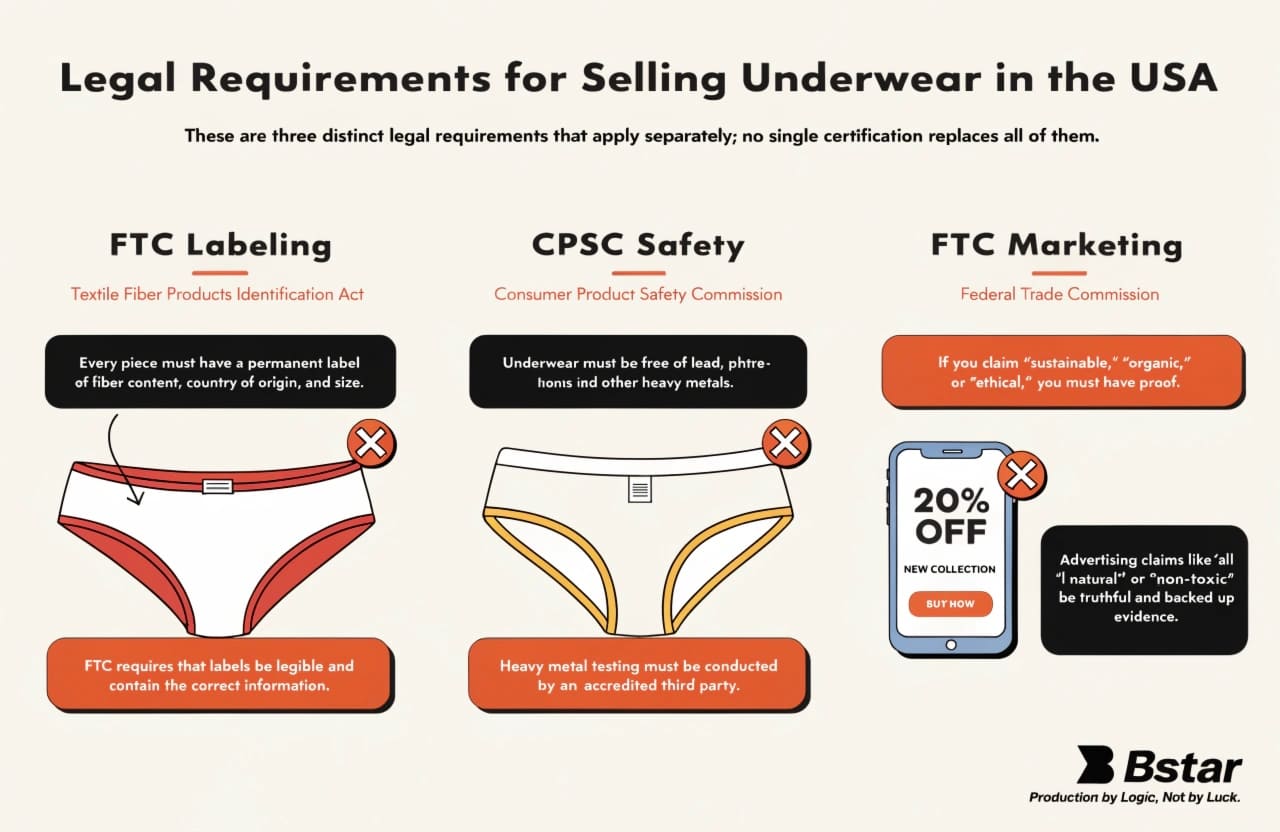
To sell underwear in the US, you must meet FTC labeling rules under the Textile Fiber Products Identification Act, follow CPSC safety standards, and comply with FTC marketing guidelines. These are separate legal requirements. No single certification replaces all of them.
I work with DTC brands and sourcing managers every day from our factory in China. The question I hear most often is: "What do I need to legally sell underwear in the US?" I always tell them the same thing. There is no one short answer. The requirements depend on your sales channel, your product claims, and your customer segment. What I can do is walk you through the main layers — and show you where brands most often get it wrong before the order is even cut.
Disclaimer: This article is based on our manufacturing-side experience working with US-market brands. It is not legal advice. You should verify all current requirements at FTC.gov and consult a qualified US attorney for your specific situation.
What Must Your Underwear Labels Actually Say?
Most brands assume labeling is simple. Then they get a compliance rejection from a retailer and realize they missed something basic.
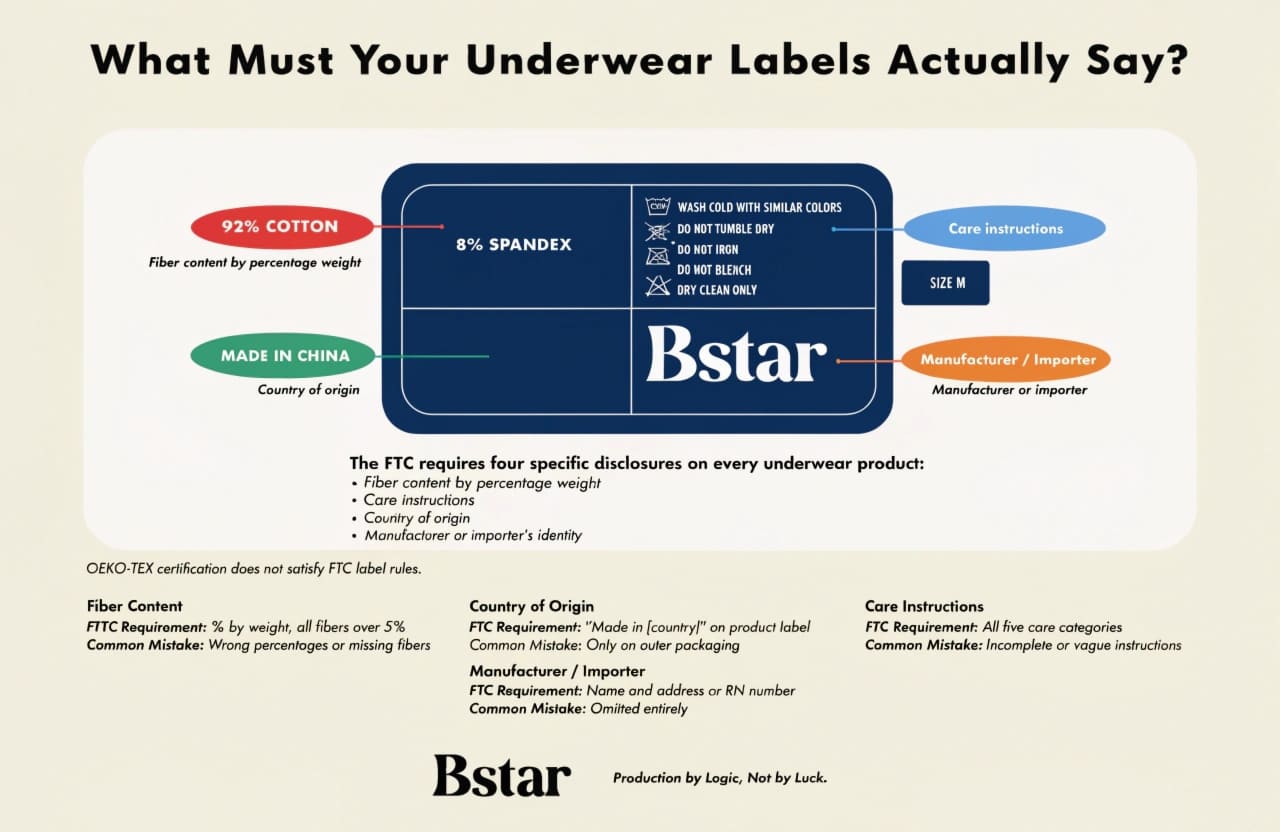
FTC labeling rules under the Textile Fiber Products Identification Act require every underwear product to carry four things: fiber content listed by percentage weight, care instructions, country of origin, and the manufacturer or importer’s identity. These are federal law requirements, not optional best practices.
Here is where I see brands get into trouble at the production stage.
The fiber content percentage has to be accurate. If your fabric is 92% cotton and 8% spandex, the label must say exactly that. It cannot say "mostly cotton." It cannot round up to 95%. The percentages must reflect the actual composition by weight. We ask clients to confirm this with their fabric supplier before we print a single label — because fixing it after production is expensive.
The country of origin is another common problem. It must say "Made in China" (or wherever it is made) in a clear, readable format on the product label itself. A stamp on the outer packaging does not satisfy this requirement. We see this mistake more than almost any other.
Care instructions fall under a separate FTC rule — the Care Labeling Rule. You need washing, drying, ironing, bleaching, and dry cleaning guidance. All five care categories must be addressed.
| Label Element | FTC Requirement | Common Mistake |
|---|---|---|
| Fiber Content | % by weight, all fibers over 5% | Wrong percentages or missing fibers |
| Country of Origin | "Made in [country]" on product label | Only on outer packaging |
| Manufacturer / Importer | Name and address or RN number | Omitted entirely |
| Care Instructions | All five care categories | Incomplete or vague instructions |
One more thing worth saying clearly. OEKO-TEX certification, GOTS, GRS — these certify what is in your fabric. Chemical safety. Sustainability standards. They do not satisfy FTC label rules. A brand can hold every certification we offer and still violate federal law if the fiber content is mislabeled. These two frameworks cover completely different things.
How Do CPSC Rules Apply to Your Underwear Products?
Brands focused on FTC labeling sometimes forget there is a second regulatory body involved: the Consumer Product Safety Commission.
The CPSC requires that underwear sold in the US meets federal flammability standards under 16 CFR Part 1610. For children’s underwear, CPSIA restrictions apply — limiting lead content, phthalates, and other harmful substances. Adult underwear has fewer CPSIA requirements but is not fully exempt from CPSC oversight.
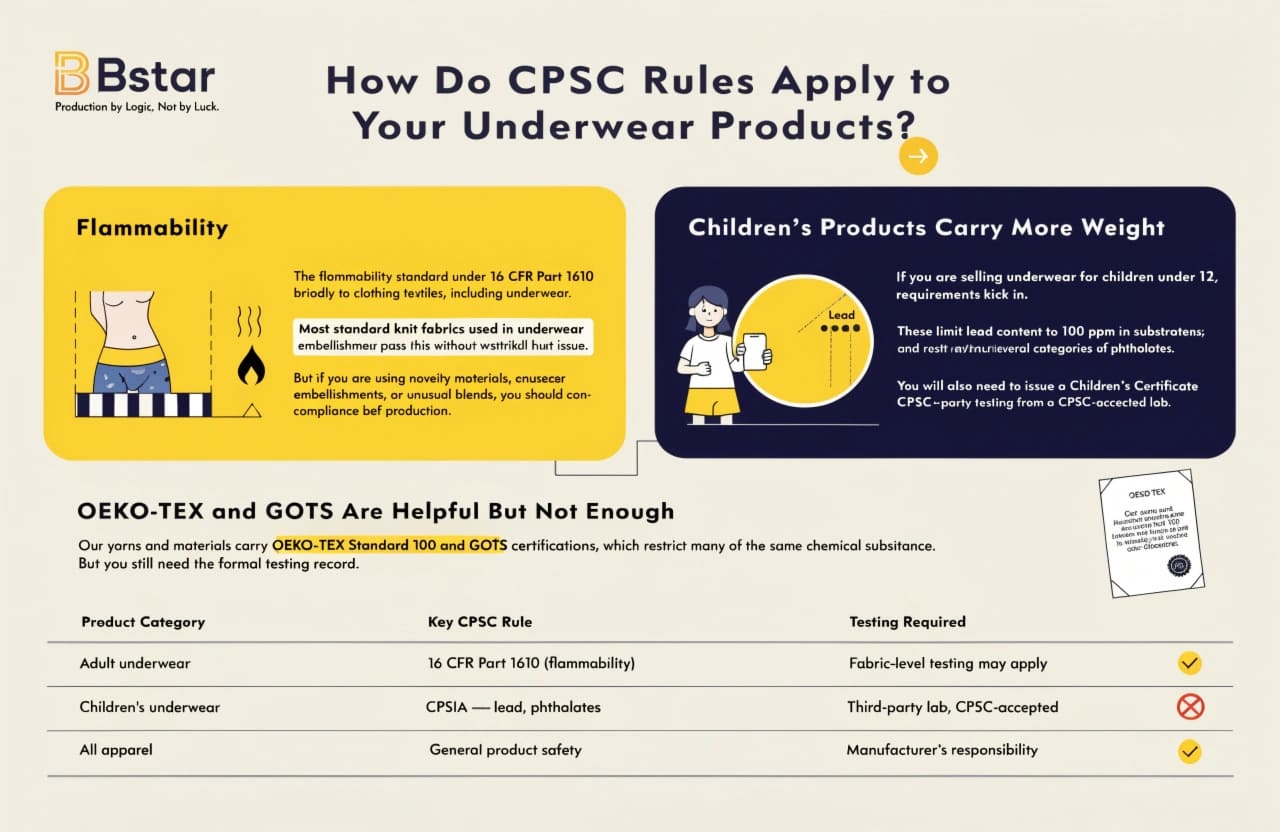
The flammability standard under 16 CFR Part 1610 applies broadly to clothing textiles, including underwear. Most standard knit fabrics used in underwear pass this without issue. But if you are using novelty materials, embellishments, or unusual fabric blends, you should confirm compliance before production.
Children’s products carry significantly more weight. If you are selling underwear for children under 12, CPSIA requirements kick in. These limit lead content to 100 ppm in substrate materials and restrict several categories of phthalates. You will also need to issue a Children’s Product Certificate based on third-party testing from a CPSC-accepted lab.
| Product Category | Key CPSC Rule | Testing Required |
|---|---|---|
| Adult underwear | 16 CFR Part 1610 (flammability) | Fabric-level testing may apply |
| Children’s underwear | CPSIA — lead, phthalates | Third-party lab, CPSC-accepted |
| All apparel | General product safety | Manufacturer’s responsibility |
From our side as a manufacturer, we work with clients to source fabrics that meet these thresholds. Our yarns and materials carry OEKO-TEX Standard 100 and GOTS certifications, which restrict many of the same chemical substances. But I want to be clear — those certifications help, and they reflect real quality commitments. They do not replace a CPSIA compliance certificate for a children’s product sold in the US. You still need the formal testing record.
Are Your "Made in USA" and Eco Claims Actually Legal?
Marketing claims are where brands get creative. They are also where the FTC pays close attention.
The FTC requires that "Made in USA" claims reflect that the product is "all or virtually all" made in the United States. Eco-friendly, organic, and sustainable claims must be specific, substantiated, and not misleading. Unverified or vague claims can trigger FTC enforcement action.
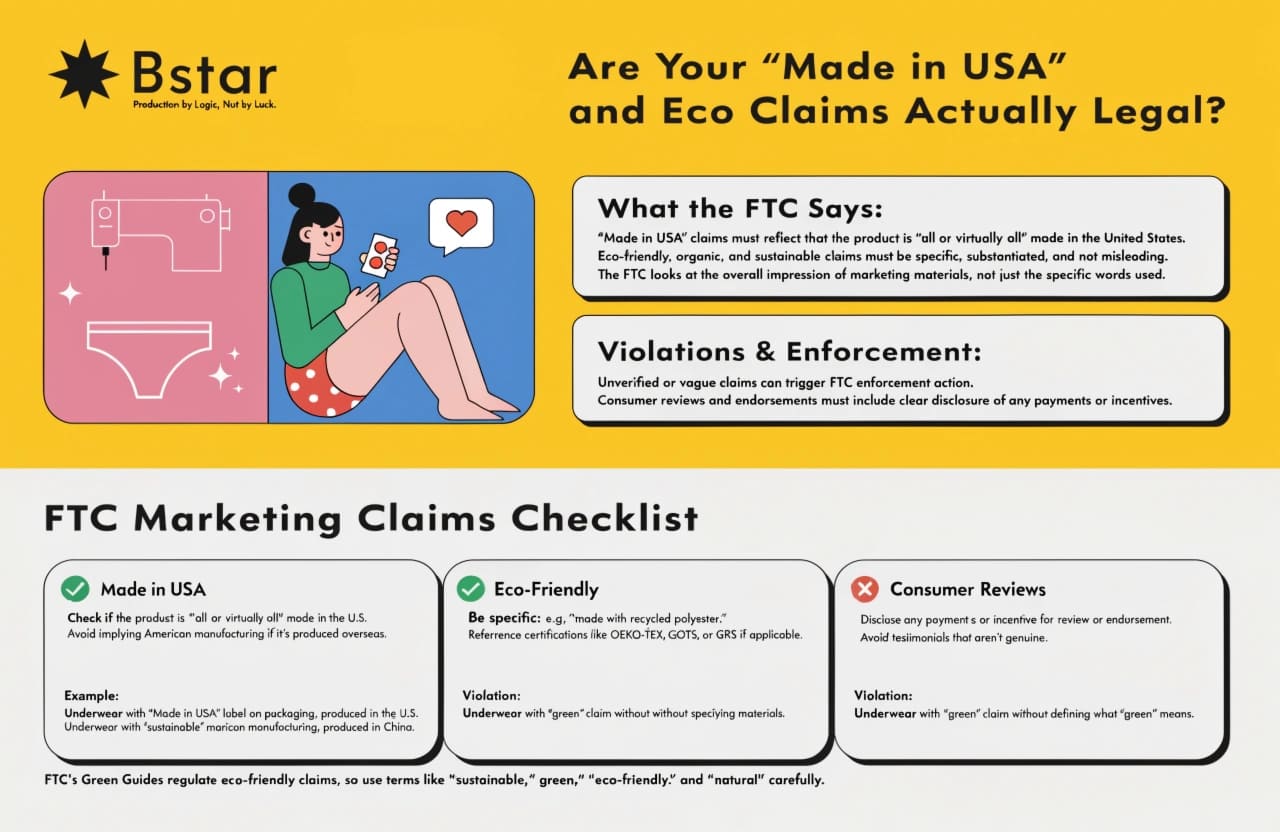
If your underwear is manufactured in China, you cannot call it "Made in USA." This seems obvious, but we have seen clients want to say things like "designed in USA" alongside imagery that strongly implies US manufacturing. The FTC looks at the overall impression, not just the specific words. If a reasonable consumer would think the product is American-made, that is a problem — even if you technically used the word "designed."
Eco claims deserve the same care. Words like "sustainable," "green," "eco-friendly," and "natural" are all on the FTC’s radar under its Green Guides. The FTC expects these claims to be specific and backed by evidence. Saying "made with sustainable materials" without explaining what that means is the kind of vague claim the Green Guides target.
If you hold a certification — OEKO-TEX, GOTS, GRS — you can reference it. Be specific about what it covers. "OEKO-TEX Standard 100 certified fabric" is a supportable claim. "Completely eco-friendly underwear" is not.
Consumer reviews and endorsements follow FTC rules too. Paid reviews, incentivized testimonials, and influencer partnerships require clear disclosure. This is not a gray area anymore.
What Happens If You Get Any of This Wrong?
Compliance failures are not just abstract legal risks. They show up in very practical ways at very inconvenient times.
Brands that fail FTC labeling rules, CPSC safety standards, or marketing guidelines face penalties including product recalls, mandatory relabeling, retailer rejections, and in serious cases, FTC enforcement action. Most of these problems surface after production — when fixing them is most expensive.
Based on what brands we work with have encountered, the most common real-world consequences fall into three categories.
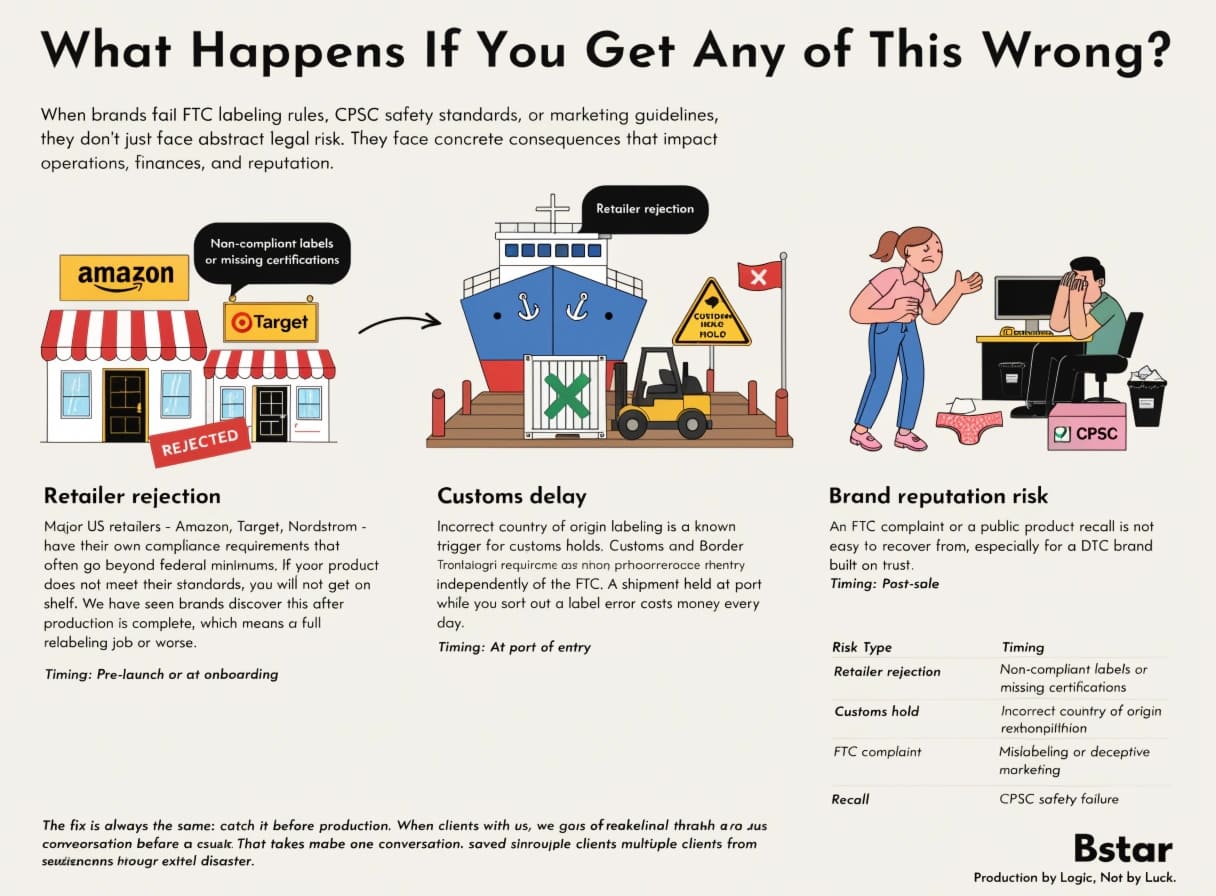
The first is retailer rejection. Major US retailers — Amazon, Target, Nordstrom — have their own compliance requirements that often go beyond federal minimums. If your product does not meet their standards, you will not get on shelf. We have seen brands discover this after production is complete, which means a full relabeling job or worse.
The second is customs delay. Incorrect country of origin labeling is a known trigger for customs holds. Customs and Border Protection enforces country of origin requirements independently of the FTC. A shipment held at port while you sort out a label error costs money every day.
The third is brand reputation risk. An FTC complaint or a public product recall is not easy to recover from, especially for a DTC brand built on trust.
| Risk Type | Trigger | Timing |
|---|---|---|
| Retailer rejection | Non-compliant labels or missing certifications | Pre-launch or at onboarding |
| Customs hold | Incorrect country of origin | At port of entry |
| FTC complaint | Mislabeling or deceptive marketing | Post-sale |
| Recall | CPSC safety failure | Post-launch |
The fix is always the same: catch it before production. When clients work with us, we go through label requirements before we cut a single piece. It takes maybe one extra conversation. That conversation has saved multiple clients from a relabeling disaster.
Conclusion
US underwear compliance is a layered system — FTC labeling, CPSC safety, and marketing rules all apply separately. Getting one right does not cover the others. Catch the gaps before production, not after.