
Quality Control Checklist for Custom Underwear Production: What You Need to Verify at Every Stage?
Running your first custom underwear production and hoping the factory handles quality automatically? That passive trust is exactly how first runs become disputes instead of reorders.
A quality control checklist for custom underwear covers four stages: raw material inspection, dimensional accuracy checks, stitching and elastic integrity, and final AQL inspection with packaging audit. Each stage requires documented evidence — not verbal confirmation — from your factory.
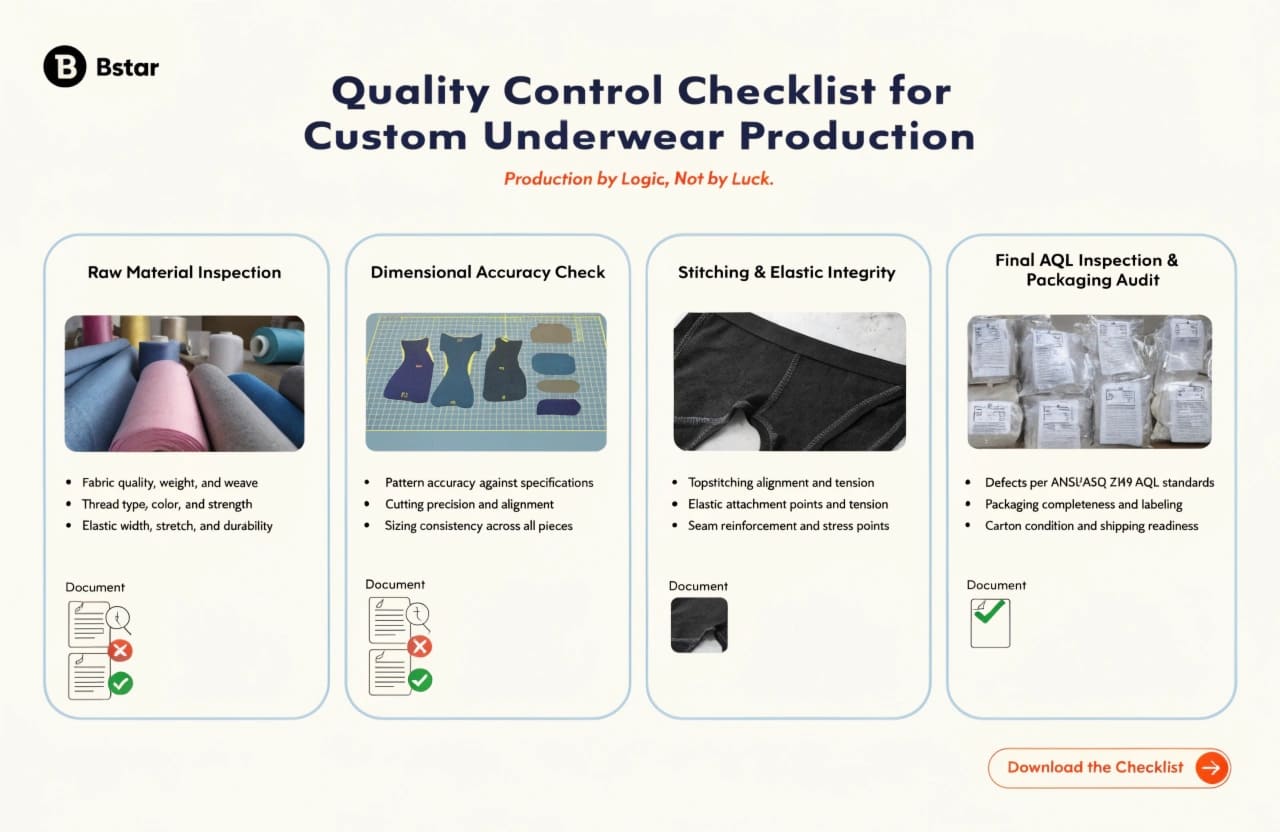
Most DTC brand founders I talk to assume placing an order activates quality control on the factory side. In reality, QC outcome depends on whether you have defined the checkpoints before production starts. The checklist I’m walking you through below is the exact framework we follow at BSTAR across our 6 production checkpoints. Use it before your first cutting order — and use it to evaluate whether your factory can actually deliver documentation at each stage.
Raw Material and Fabric Inspection: How Do You Verify Fiber Composition, Shrinkage Rates, and Colorfastness Before Cutting?
You approved the fabric sample. But did you verify what it’s actually made of — and whether it holds up after washing? Skipping this step before cutting is one of the most common and costly mistakes we see from first-time buyers.
Before cutting begins, verify three things on every fabric roll: fiber composition matches the tech pack spec, shrinkage rate stays within a 3–5% tolerance after wash testing1, and colorfastness meets a minimum Grade 4 under ISO 105 standards2. Require lab test reports, not just supplier claims.
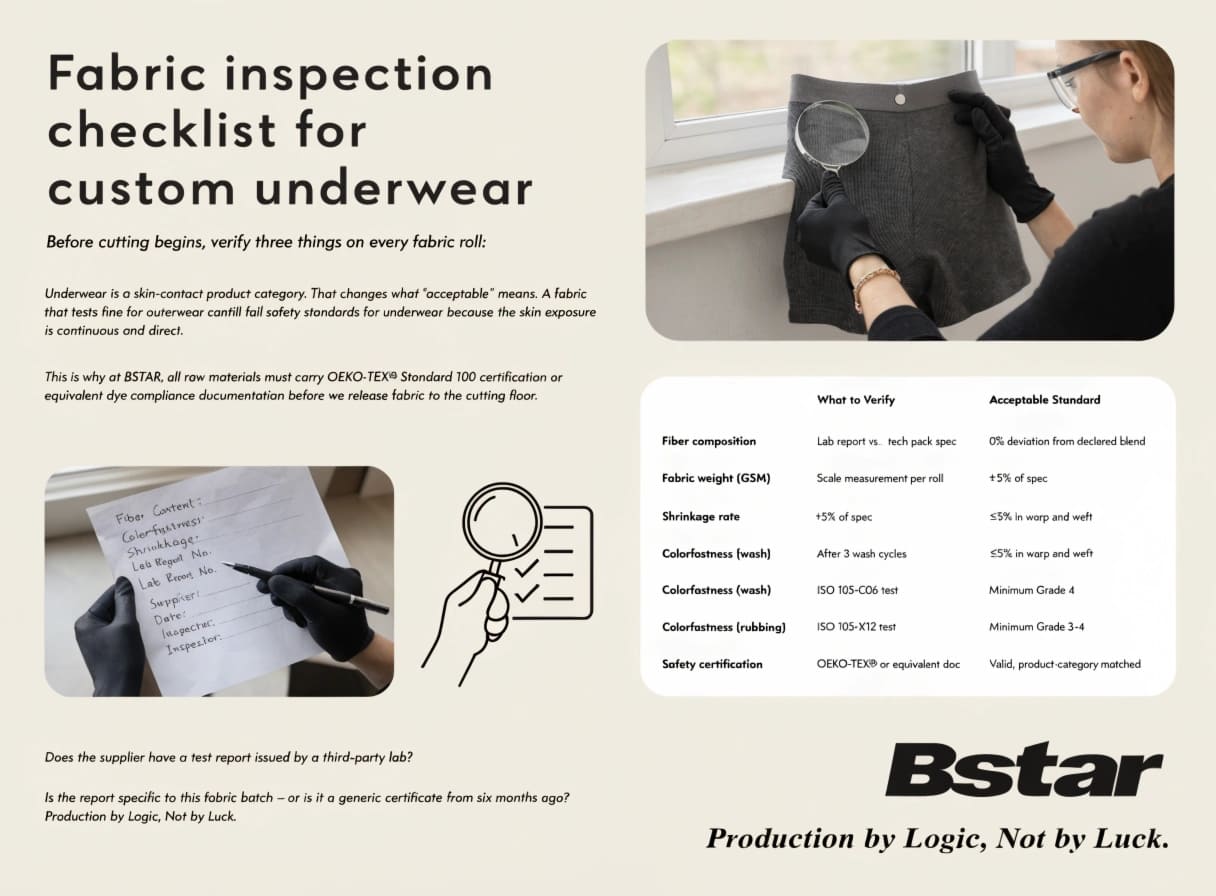
Underwear is a skin-contact product category. That changes what "acceptable" means. A fabric that tests fine for outerwear can still fail safety standards for underwear because the skin exposure is continuous and direct. This is why at BSTAR, all raw materials must carry OEKO-TEX® Standard 100 certification or equivalent dye compliance documentation3 before we release fabric to the cutting floor.
What the Incoming Material Inspection Actually Covers
| Checkpoint | What to Verify | Acceptable Standard |
|---|---|---|
| Fiber composition | Lab report vs. tech pack spec | 0% deviation from declared blend |
| Fabric weight (GSM) | Scale measurement per roll | ±5% of spec |
| Shrinkage rate | After 3 wash cycles | ≤5% in warp and weft |
| Colorfastness (wash) | ISO 105-C06 test4 | Minimum Grade 4 |
| Colorfastness (rubbing) | ISO 105-X12 test5 | Minimum Grade 3–4 |
| Safety certification | OEKO-TEX® or equivalent doc | Valid, product-category matched |
The questions we ask before cutting begins: Does the supplier have a test report issued by a third-party lab? Is the report specific to this fabric batch — or is it a generic certificate from six months ago? Those two questions filter out most of the unreliable material sourcing situations we’ve seen over 19 years in this business.
Dimensional Accuracy and Pattern Compliance: Are Finished Garments Actually Hitting Your Tech Pack Measurements?
You sent a detailed tech pack. But a tech pack only controls output if someone on the factory floor is actively measuring against it during production — not just at the final inspection.
Dimensional compliance for custom underwear requires measuring at least five critical points per garment: waistband relaxed width, waistband stretched width, hip circumference, front rise, and inseam. Measurements must be taken on a minimum of 3 garments per size per inline check, and compared directly against tech pack tolerances.
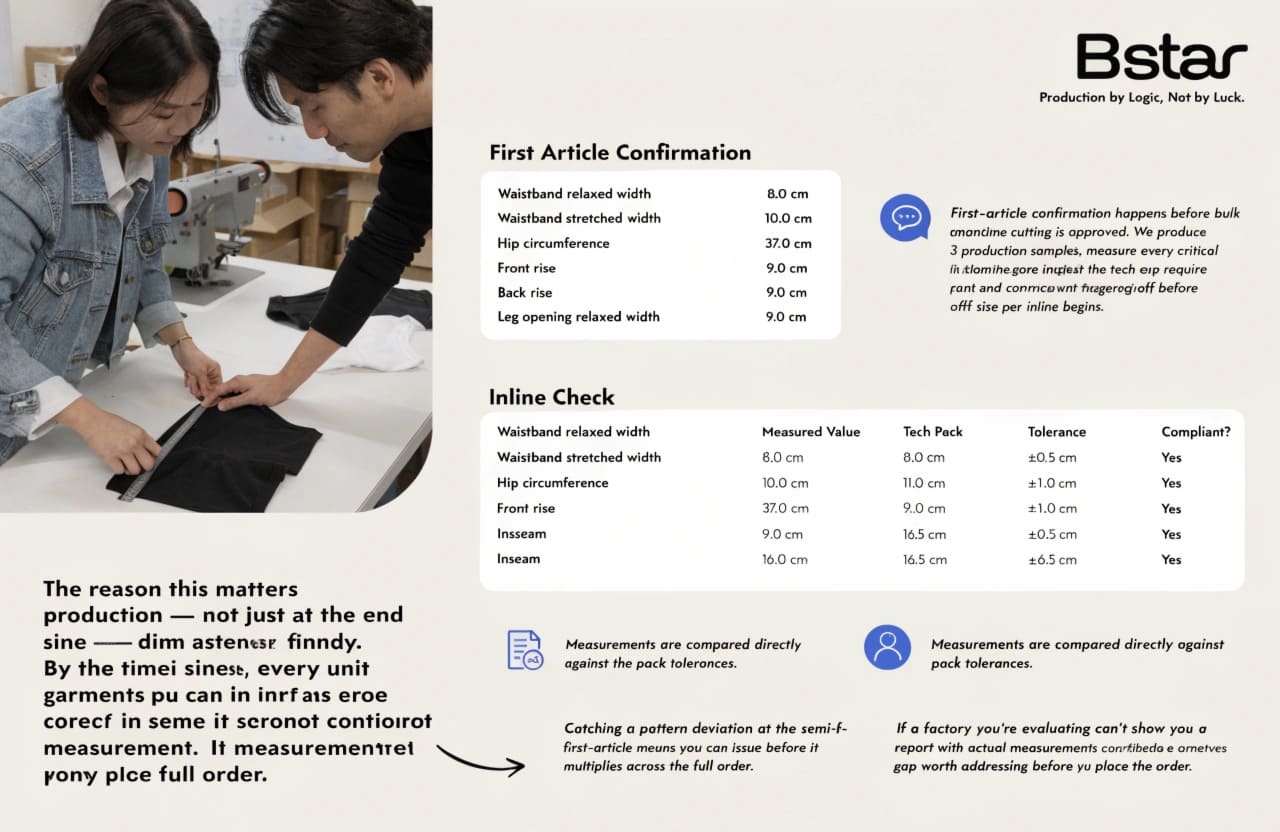
The reason this matters mid-production — not just at the end — is simple. By the time you inspect finished garments, every unit in that run has already been cut and sewn to the same incorrect measurement. Catching a pattern deviation at the semi-finished stage means you can correct the issue before it multiplies across the full order.
Critical Measurement Points for Underwear
| Measurement Point | Measuring Method | Typical Tolerance |
|---|---|---|
| Waistband width (relaxed) | Flat, no tension | ±0.5 cm |
| Waistband width (stretched) | Pull to full extension | ±1.0 cm |
| Hip circumference | Flat measurement × 2 | ±1.0 cm |
| Front rise | Natural position, flat | ±0.5 cm |
| Back rise | Natural position, flat | ±0.5 cm |
| Leg opening (relaxed) | Flat, no tension | ±0.5 cm |
In our production workflow, first-article confirmation happens before bulk cutting is approved. We produce 1–3 pre-production samples, measure every critical point against the tech pack, and require written sign-off before the run begins. If a factory you’re evaluating can’t show you a first-article report with actual measurements recorded — that’s a gap worth addressing before you place the order.
Stitching Integrity and Seam Strength: How Do You Evaluate Whether the Construction Will Actually Hold?
The stitching looks clean in the sample photos. But does the elastic bounce back after 50 wears? Does the waistband seam hold under real stretch stress? These are the questions that show up in customer reviews — and they’re decided during construction, not at final inspection.
For underwear, evaluate four construction elements: stitch density (stitches per 3 cm), elastic attachment security at waistband and leg openings, seam strength under stretch and recovery6, and lace or trim edge finish. These must be checked at the semi-finished stage — not only on finished garments.
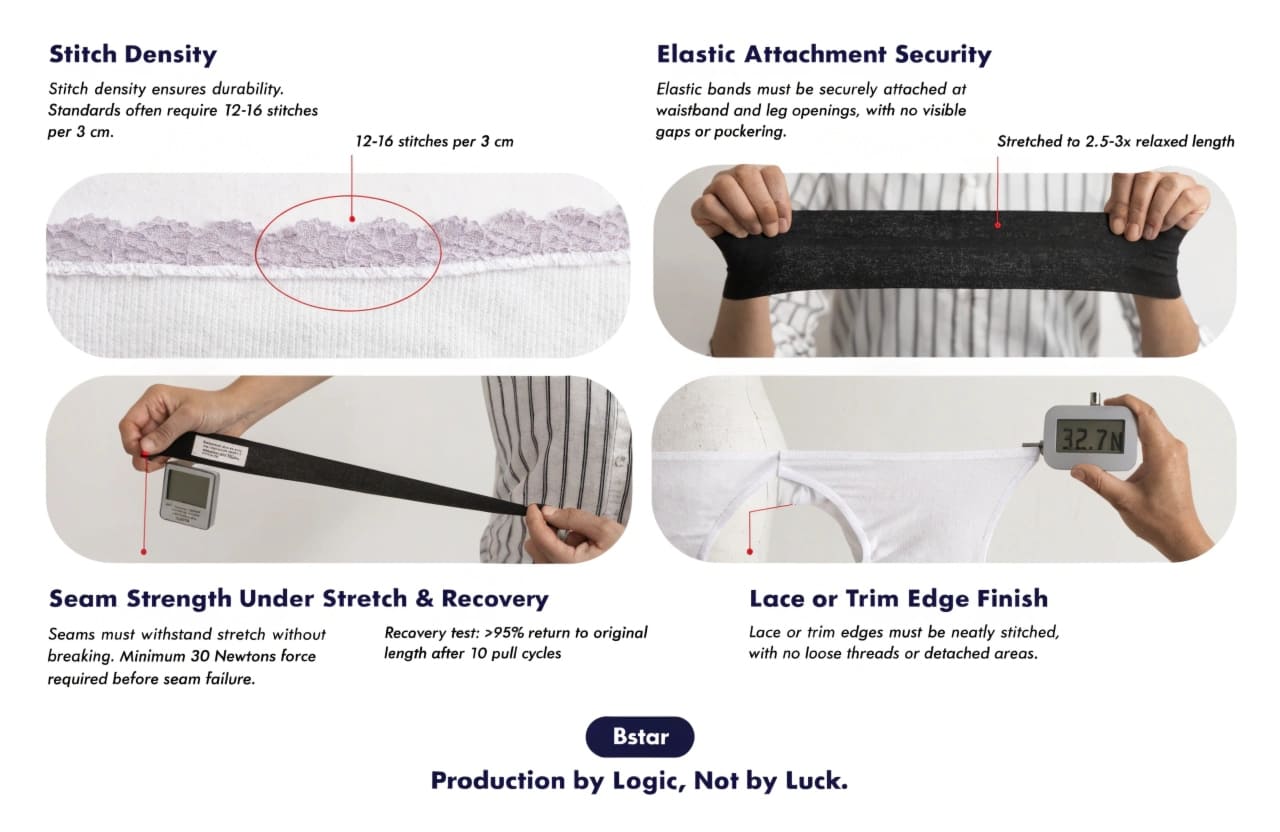
This is the section where underwear QC differs most from generic apparel inspection. Elasticity and waistband recovery are locked in during the assembly stage. By the time a finished garment fails a stretch test, the entire production run is already committed to the same construction defect. Buyers who only inspect finished goods are systematically catching problems too late.
Underwear-Specific Construction Checkpoints
| Construction Element | What to Check | Standard / Benchmark |
|---|---|---|
| Stitch density | Stitches per 3 cm at seam | Per tech pack spec (typically 12–16 SPI) |
| Elastic stretch ratio | Stretched vs. relaxed length | Typically 2.5–3× relaxed measurement |
| [Elastic recovery | Return-to-shape after 10 pull cycles | ≥95% return to original length](https://pmc.ncbi.nlm.nih.gov/articles/PMC9570736/)[^7] |
| Seam strength | Pull test at stress points | No seam failure below 30N force |
| Lace/trim attachment | Edge stitching security | No loose threads, no detachment under hand pull |
| Waistband join | Overlap seam at elastic join point | No visible gap, secure under stretch |
In my experience with DTC clients, the elastic recovery test is the one most frequently skipped — and the one that generates the most customer complaints. We run a simple 10-cycle manual stretch test on waistband sections during inline checks. It takes two minutes per sample and catches degraded elastic before it reaches your customer.
Final AQL Inspection and Packaging Audit: What Does Zero-Defect Delivery Actually Require?
The garments are finished. Now the question is: are you accepting based on a visual scan, or based on a documented sampling standard? Those two approaches produce very different results.
Final inspection for custom underwear should follow AQL 2.5 sampling as a minimum standard for major defects, and AQL 4.0 for minor defects7. Packaging audit must verify labeling accuracy (fiber content, care instructions, country of origin), size marking, and carton configuration against your packing list.
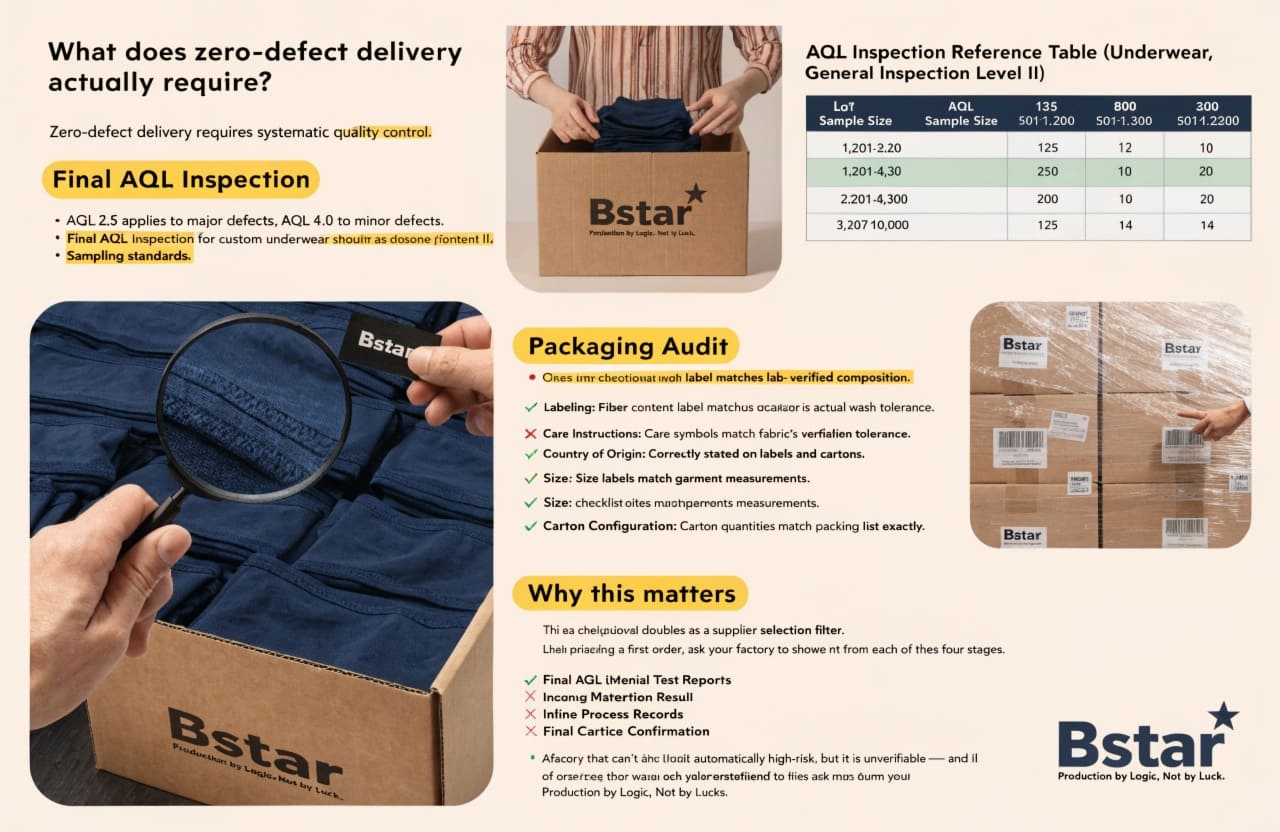
AQL isn’t a pass/fail opinion — it’s a statistical sampling framework that tells you exactly how many units to inspect per lot size, and what the maximum acceptable defect count is before the shipment is rejected. Using it consistently means your quality standard is documented, repeatable, and defensible if a dispute arises.
AQL Inspection Reference Table (Underwear, General Inspection Level II)
| Lot Size | Sample Size | AQL 2.5 (Major) — Max Defects | AQL 4.0 (Minor) — Max Defects |
|---|---|---|---|
| 501–1,200 | 80 | 5 | 7 |
| 1,201–3,200 | 125 | 7 | 10 |
| 3,201–10,000 | 200 | 10 | 14 |
For the packaging audit, what we typically check includes: fiber content label matches the lab-verified composition8, care symbols match the fabric’s actual wash tolerance, size labels match the garment measurements, country of origin is correctly stated, and carton quantities match the packing list exactly. Brand labeling errors are the most common reason shipments get held at customs or returned by retailers — and they’re entirely preventable at this stage.
The checklist also functions as a supplier selection filter. Before placing a first order, ask your factory to show you documentation from each of these four stages — incoming material test reports, first-article confirmation, inline process records, and final AQL inspection results. A factory that can produce all four is verifiable. A factory that can’t isn’t automatically high-risk, but it is unverifiable — and that’s a decision you should make with your eyes open.
Conclusion
A QC checklist for custom underwear shifts you from passive order placer to active spec holder. Run it at every stage — before cutting, mid-production, and at final inspection — and your factory becomes accountable by design.
-
"What is Fabric Shrinkage? | Fabric Guide | EYSAN FABRICS", https://www.eysan.com.tw/what-is-fabric-shrinkage/. AATCC Test Method 135 and ISO 6330 provide standardized procedures for measuring dimensional change in fabrics after laundering; industry practice commonly references a 3–5% shrinkage tolerance for knit fabrics used in close-fitting garments, though acceptable limits vary by fabric construction and buyer specification. Evidence role: expert_consensus; source type: institution. Supports: That standardized wash shrinkage test methods exist and that tolerance thresholds in the 3–5% range are commonly referenced for knit apparel fabrics. Scope note: No single universal standard mandates a 3–5% tolerance for underwear specifically; the figure reflects common commercial practice rather than a codified regulatory requirement. ↩
-
"Colorfastness Test Methods for Textiles: Complete Guide – QIMA Blog", https://blog.qima.com/textile/colorfastness-test-methods-for-textiles-guide. ISO 105 establishes a five-point grading scale for colorfastness assessment; Grade 4 is widely referenced in trade and retail specifications as the minimum acceptable rating for wash-fastness in consumer apparel, though exact thresholds may vary by buyer specification and end-use category. Evidence role: definition; source type: institution. Supports: That ISO 105 uses a 1–5 grading scale and that Grade 4 represents a commonly cited minimum for commercial apparel colorfastness. Scope note: Specific minimum grade requirements are often set by individual retailers or brands rather than mandated universally by the ISO standard itself. ↩
-
"OEKO-TEX® STANDARD 100", https://www.oeko-tex.com/en/our-standards/oeko-tex-standard-100/. OEKO-TEX® Standard 100, administered by the OEKO-TEX Association, certifies textiles tested against a list of harmful substances; Product Class I applies to items with direct skin contact for babies and toddlers, while Product Class II covers direct skin-contact articles for adults, establishing it as a recognized benchmark for underwear fabric safety. Evidence role: definition; source type: institution. Supports: That OEKO-TEX® Standard 100 tests textiles for harmful substances and applies stricter limits for products in direct skin contact, making it relevant to underwear. Scope note: Certification scope and tested substance lists are updated periodically; the article does not specify which product class applies to the underwear category discussed. ↩
-
"[PDF] ISO 105-C06", https://img45.chem17.com/5/20110505/634401932070537500.pdf. ISO 105-C06 specifies test methods for determining the resistance of the colour of textiles to domestic and commercial laundering procedures, using standardized wash conditions and grey scale assessment; it is part of the broader ISO 105 series covering colorfastness of textiles. Evidence role: definition; source type: institution. Supports: That ISO 105-C06 is the internationally recognized test method for determining colorfastness of textiles to domestic and commercial laundering. Scope note: The standard includes multiple test options (A1S, A2S, B1S, etc.) with varying wash temperatures and conditions; the article does not specify which test option is required, which may affect comparability of results across suppliers. ↩
-
"ISO 105 X12 Color Fastness to Crocking/Rubbing – YouTube", https://www.youtube.com/watch?v=LcwYPu96B-4. ISO 105-X12 specifies a method for determining the resistance of the colour of textiles to rubbing using a crockmeter device, assessing both dry and wet rubbing conditions; results are graded on the ISO grey scale for staining, making it the standard reference for evaluating dye transfer risk in skin-contact garments. Evidence role: definition; source type: institution. Supports: That ISO 105-X12 specifies the test method for colorfastness to rubbing using a crockmeter, covering both dry and wet rubbing conditions. Scope note: Some markets and retailers reference AATCC Test Method 8 as an alternative rubbing fastness standard; buyers should confirm which method is required by their target market or retail partner. ↩
-
"ISO 13935-2:2014 – Textiles — Seam tensile properties of fabrics …", https://www.iso.org/standard/60679.html. ISO 13935-1 and ISO 13935-2 specify methods for determining seam strength in textile fabrics using strip and grab test configurations respectively; minimum seam strength thresholds are typically defined in buyer specifications, with the 30N figure cited in the article representing a common lower-bound benchmark for lightweight knit underwear seams. Evidence role: definition; source type: institution. Supports: That standardized seam strength test methods exist for textiles and that minimum force thresholds are used to evaluate seam integrity in apparel. Scope note: The 30N threshold is not derived from a specific ISO or ASTM standard requirement; it reflects a practical commercial specification, and appropriate minimum values vary with fabric weight, seam type, and end-use stress conditions. ↩
-
"[PDF] ISO 2859-1 – UNT Chemistry", https://chemistry.unt.edu/~tgolden/courses/iso2859-1.pdf. ISO 2859-1 defines acceptance quality limit (AQL) sampling procedures for inspection by attributes; in apparel manufacturing, AQL 2.5 for major defects and AQL 4.0 for minor defects represent widely adopted industry conventions, though specific levels are ultimately set by buyer contract rather than mandated by the standard itself. Evidence role: definition; source type: institution. Supports: That AQL sampling is defined under ISO 2859-1 and that AQL 2.5 and 4.0 are standard levels applied to major and minor defects respectively in apparel quality inspection. Scope note: ISO 2859-1 provides the statistical framework but does not prescribe which AQL level must be applied to which defect category; the 2.5/4.0 convention reflects common trade practice. ↩
-
"Threading Your Way Through the Labeling Requirements Under the …", https://www.ftc.gov/business-guidance/resources/threading-your-way-through-labeling-requirements-under-textile-wool-acts. In the United States, the Textile Fiber Products Identification Act (15 U.S.C. § 70) requires that textile products bear labels disclosing fiber content by percentage; in the European Union, Regulation (EU) No 1007/2011 mandates fiber composition labeling for textile products placed on the market, making accurate fiber content disclosure a legal obligation rather than a voluntary quality measure. Evidence role: historical_context; source type: government. Supports: That fiber content labeling is a legal requirement in major consumer markets, with mandatory disclosure of fiber composition by percentage. Scope note: Specific labeling requirements—including language, placement, and tolerance for fiber content deviation—vary by jurisdiction; the article does not specify target markets, so readers should ↩