
Seamless Underwear Manufacturing Process Explained: What Actually Happens Before Your Sample Ships?
A lot of buyers come to us with a sketch, a fabric reference, and a deadline. Then they’re surprised when the quote comes back with questions — or when the sample doesn’t match what they had in mind.
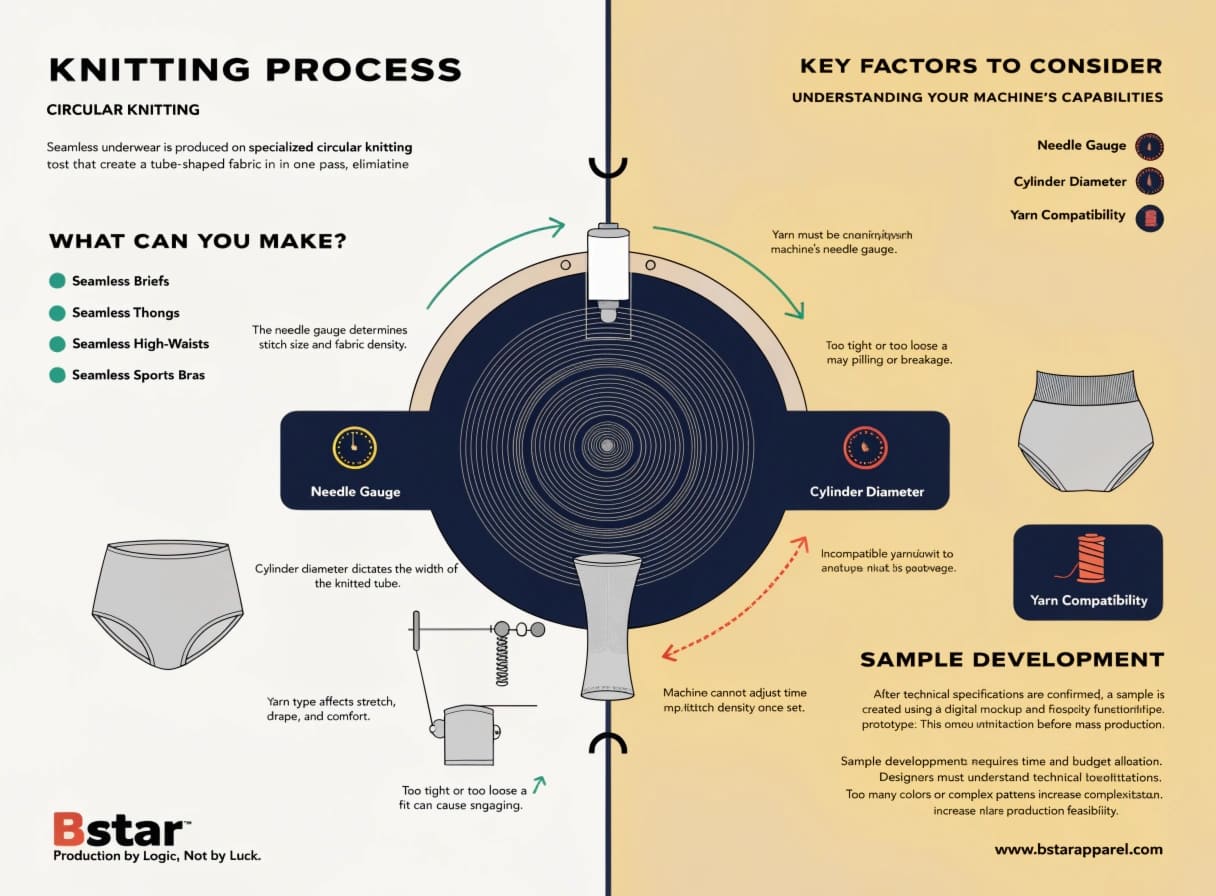
Seamless underwear is made on circular knitting machines that produce a tube-shaped fabric in one pass. The machine’s needle gauge, cylinder diameter, and yarn compatibility define what structures, thicknesses, and coverage zones are achievable before any design work begins. Understanding this process helps buyers set realistic specs and avoid wasted sampling budgets.
Most sourcing problems we see aren’t about bad factories or bad buyers. They’re about mismatched expectations — a buyer imagines a product, and the factory sees a set of machine constraints. The gap between those two things is where budgets get burned. So let me walk you through how this process actually works, and what it means for your sourcing decisions.
The Magic of One-Piece Knitting: How Circular Seamless Machines Eliminate Side Seams?
We get asked this a lot: "If it’s seamless, why does my sample still have a seam on the crotch?"
Circular seamless machines knit a complete garment tube in one continuous pass, which eliminates side seams entirely. However, "seamless" refers specifically to the body construction. Secondary operations — like gusset attachment, elastic bonding, or edge finishing — still apply to most underwear SKUs after the tube leaves the machine.
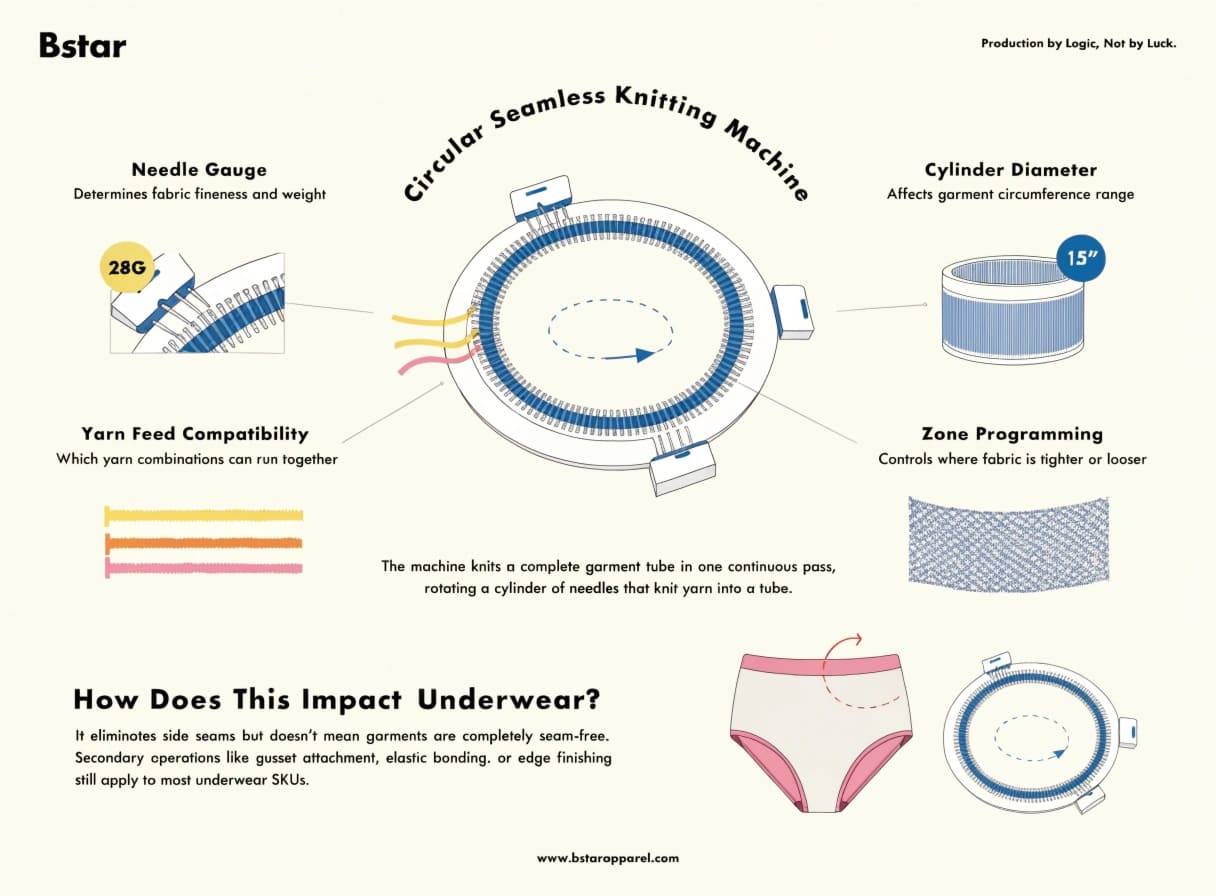
The machine at the center of this process — brands like Santoni are the most widely known — works by rotating a cylinder of needles that knit yarn into a tube continuously. Think of it like a sock being knit in the round, but with far more programmed complexity built in.
Here’s what the machine actually controls, and why it matters for your product:
What the Machine Decides Before You Do
| Machine Parameter | What It Controls | What Changes for You |
|---|---|---|
| Needle gauge (e.g., 28G, 32G) | Fabric fineness and weight | Thicker support zones vs. lightweight second-skin feel |
| Cylinder diameter | Garment circumference range | Size range feasibility — not every size runs on every machine |
| Yarn feed compatibility | Which yarn combos can run together | Determines nylon/spandex ratio options per structure |
| Zone programming | Where fabric is tighter or looser | Structural support panels, sheer zones, waistband integration |
The practical point here is this: when a buyer sends a tech pack with a 4-way stretch body, a firm waistband, and a sheer hip panel all in one SKU, we have to check whether one machine can output all three in a single knitting pass — or whether that spec requires two separate fabrics being joined later. That changes the cost, the timeline, and the seam count. It’s not a negotiation. It’s a physics question.
Precision Programming and Yarn Selection: Engineering Structural Support and Elasticity?
Buyers are sometimes surprised to learn that yarn selection is a structural decision, not just a comfort or feel decision.
The ratio of nylon to spandex in the yarn directly controls stretch recovery, opacity, support level, and how well the fabric holds its shape after washing. A common spec — 80% nylon / 20% spandex — delivers balanced stretch and recovery for everyday underwear. Adjusting that ratio shifts the product in ways that affect both performance and price.
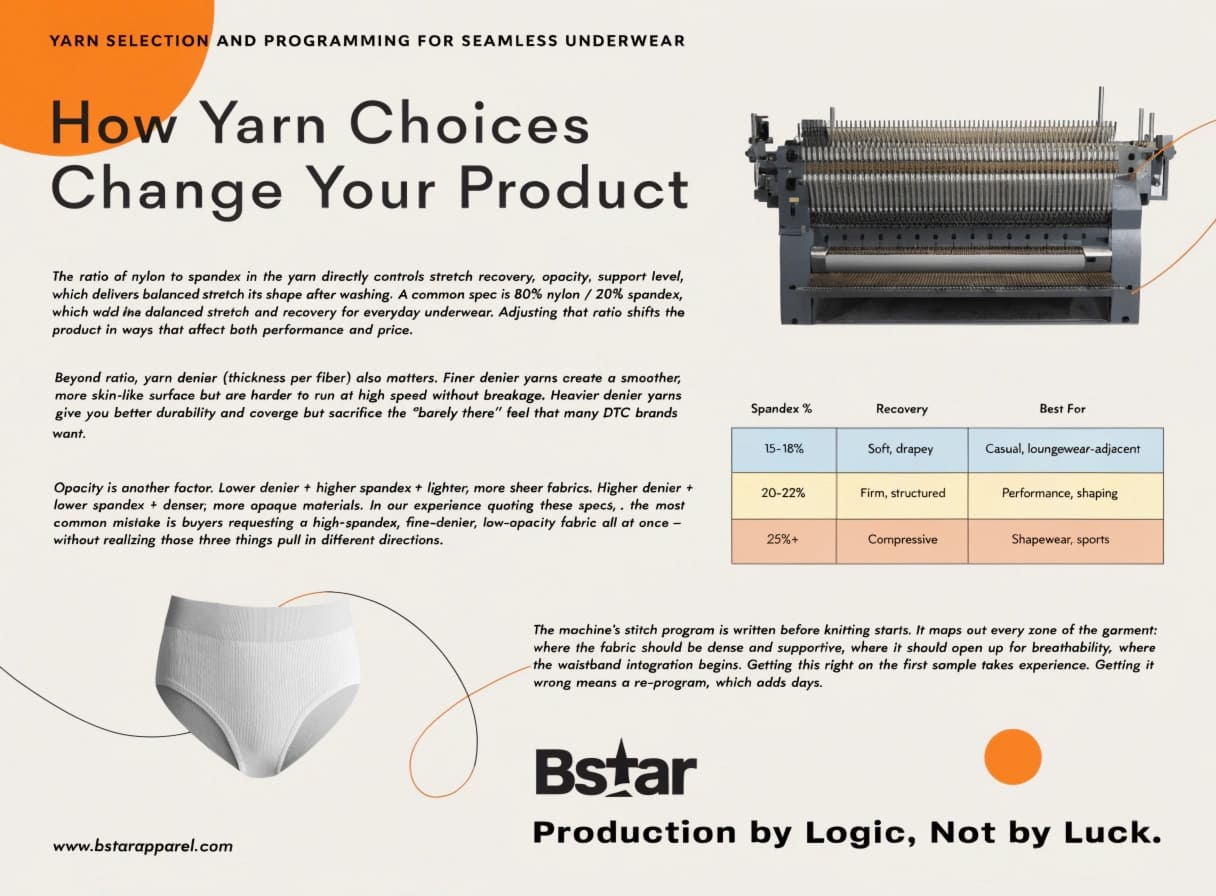
The machine’s stitch program is written before knitting starts. This program maps out every zone of the garment — where the fabric should be dense and supportive, where it should open up for breathability, where the waistband integration begins. Getting this right on the first sample takes experience. Getting it wrong means a re-program, which adds days.
How Yarn Ratio Changes Your Product
| Spandex % | Feel | Recovery | Best For |
|---|---|---|---|
| 15–18% | Soft, drapey | Moderate | Casual, loungewear-adjacent |
| 20–22% | Firm, structured | Strong | Performance, shaping |
| 25%+ | Compressive | Very strong | Shapewear, sports |
Beyond ratio, yarn denier (thickness per fiber) also matters. Finer denier yarns create a smoother, more skin-like surface but are harder to run at high speed without breakage. Heavier denier yarns give you better durability and coverage but sacrifice the "barely there" feel that many DTC brands want.
In our experience quoting these specs, the most common mistake is buyers requesting a high-spandex, fine-denier, low-opacity fabric all at once — without realizing those three things pull in different directions. The conversation usually ends with a clear trade-off decision, and that’s a healthy conversation to have before sampling, not after.
Ultrasonic Bonding and Thermal Welding: Replacing Traditional Stitching for Smooth Edges?
Here’s where "seamless" gets complicated — in a way that experienced buyers actually appreciate knowing.
Ultrasonic bonding and thermal welding use sound waves or heat to fuse fabric layers together without thread. This creates smooth, flat edges and interior surfaces that won’t irritate skin. These techniques replace traditional stitching at leg openings, waistband edges, and gusset attachment points — but they are secondary operations that happen after knitting, not during it.
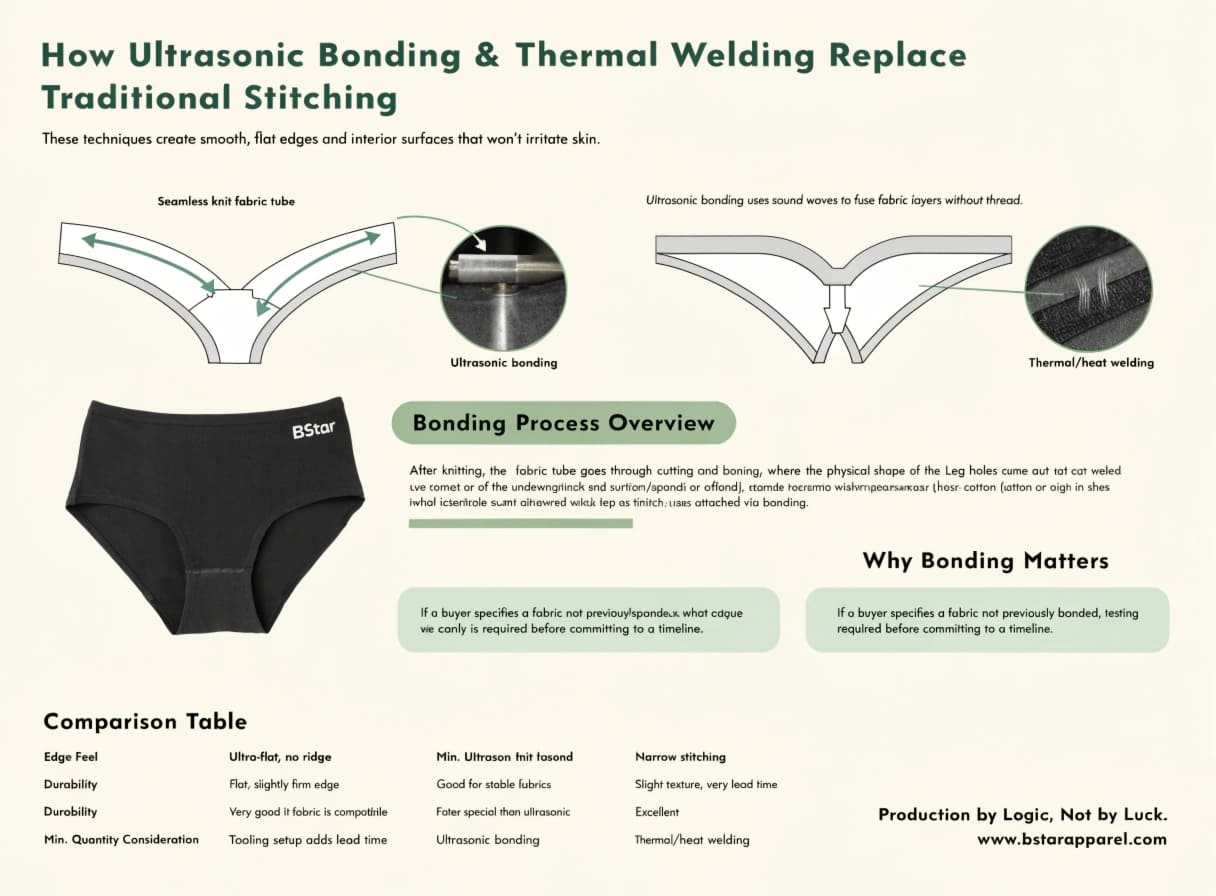
After the fabric tube comes off the machine, it goes through cutting and bonding. This is where the physical shape of the underwear is created. Leg holes are cut and sealed. Waistband edges are bonded or folded and fused. The gusset — the cotton or moisture-wicking panel in the crotch — is attached here, either by bonding or by a narrow stitch.
Bonding vs. Stitching: What the Difference Means for Your SKU
| Method | Edge Feel | Durability | Min. Quantity Consideration |
|---|---|---|---|
| Ultrasonic bonding | Ultra-flat, no ridge | Very good if fabric is compatible | Tooling setup adds lead time |
| Thermal/heat welding | Flat, slightly firm edge | Good for stable fabrics | Faster setup than ultrasonic |
| Narrow stitch (flatlock) | Slight texture, very durable | Excellent | No special tooling needed |
The bonding method also affects what fabrics you can use. Not every nylon/spandex blend bonds cleanly — some surface finishes resist adhesion. This is one reason we always ask for a fabric reference early in the conversation. If a buyer specifies a fabric we haven’t bonded before, we’ll test it before committing to a timeline. That’s not us being slow. That’s us not shipping you a batch where the edges peel after three washes.
Advanced Dyeing and Heat Setting: Ensuring Color Fastness and Dimensional Stability?
The last major step before QC is also the one most buyers think about last — which is usually a mistake.
Seamless knit fabric is dyed after knitting, using either piece dyeing or garment dyeing methods. After dyeing, heat setting stabilizes the fabric’s dimensions and locks in the elasticity. These two steps directly affect whether the finished product holds its color, its shape, and its size spec — all of which are measured during final QC.
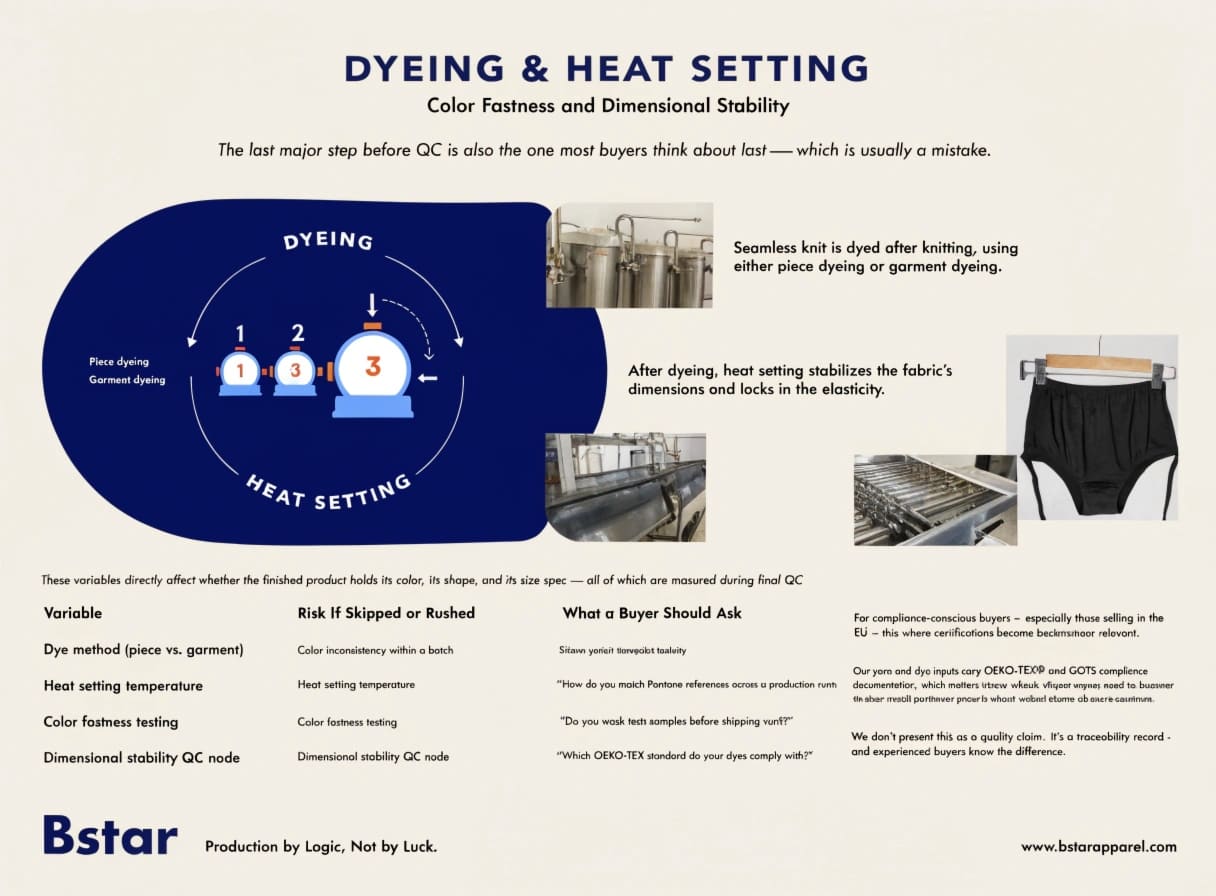
Heat setting runs the fabric through controlled heat and tension to lock the fibers into position. If this step is skipped or rushed, the garment can grow or shrink after the buyer’s own wash test — which creates a sizing problem that shows up after shipment, not before. That’s a painful place to discover a process gap.
Dyeing and Heat Setting Variables That Affect Your Delivery
| Variable | Risk If Skipped or Rushed | What a Buyer Should Ask |
|---|---|---|
| Dye method (piece vs. garment) | Color inconsistency within a batch | "How do you match Pantone references across a production run?" |
| Heat setting temperature | Garment grows or shrinks after washing | "Do you wash test samples before shipping them?" |
| Color fastness testing | Bleeding or fading in consumer wash | "Which OEKO-TEX standard do your dyes comply with?" |
| Dimensional stability QC node | Size spec drift in bulk vs. sample | "At what point in production do you re-check measurements?" |
For compliance-conscious buyers — especially those selling in the EU — this is also where certifications become relevant. Our yarn and dye inputs carry OEKO-TEX® and GOTS compliance documentation, which matters when buyers need to answer questions from their own retail partners or end customers about what’s in the product. We don’t present this as a quality claim. It’s a traceability record — and experienced buyers know the difference.
Conclusion
Understanding the seamless underwear manufacturing process helps you set better specs, ask better questions, and compare suppliers more accurately. If you’re working through a spec right now and hitting questions you can’t resolve, talk to us about it.