Screen Printing vs. Heat Transfer for Underwear Logos: Which One Should You Actually Use?
When clients send us a logo file and ask "which method is better," we can’t answer that question yet. The wrong choice means failed samples, delayed launches, and returns from customers complaining about skin irritation.
The short answer: neither method is universally better. The right choice depends on three things — your fabric type, where the logo sits on the garment, and how many pieces you’re ordering. Get these three inputs right first, and the method picks itself.
We’ve run both methods on underwear products for DTC brands across Australia, the Netherlands, and the US over the past 19 years. What we’ve learned from real sampling runs and bulk production — including quality complaints and wash-durability issues — is that most clients are asking the wrong question from the start. Let’s fix that.
Screen Printing Fundamentals: Is It Really Just for Simple Logos?
Most buyers think screen printing is the "old school" option — good for basics, bad for anything complex. That assumption costs money.
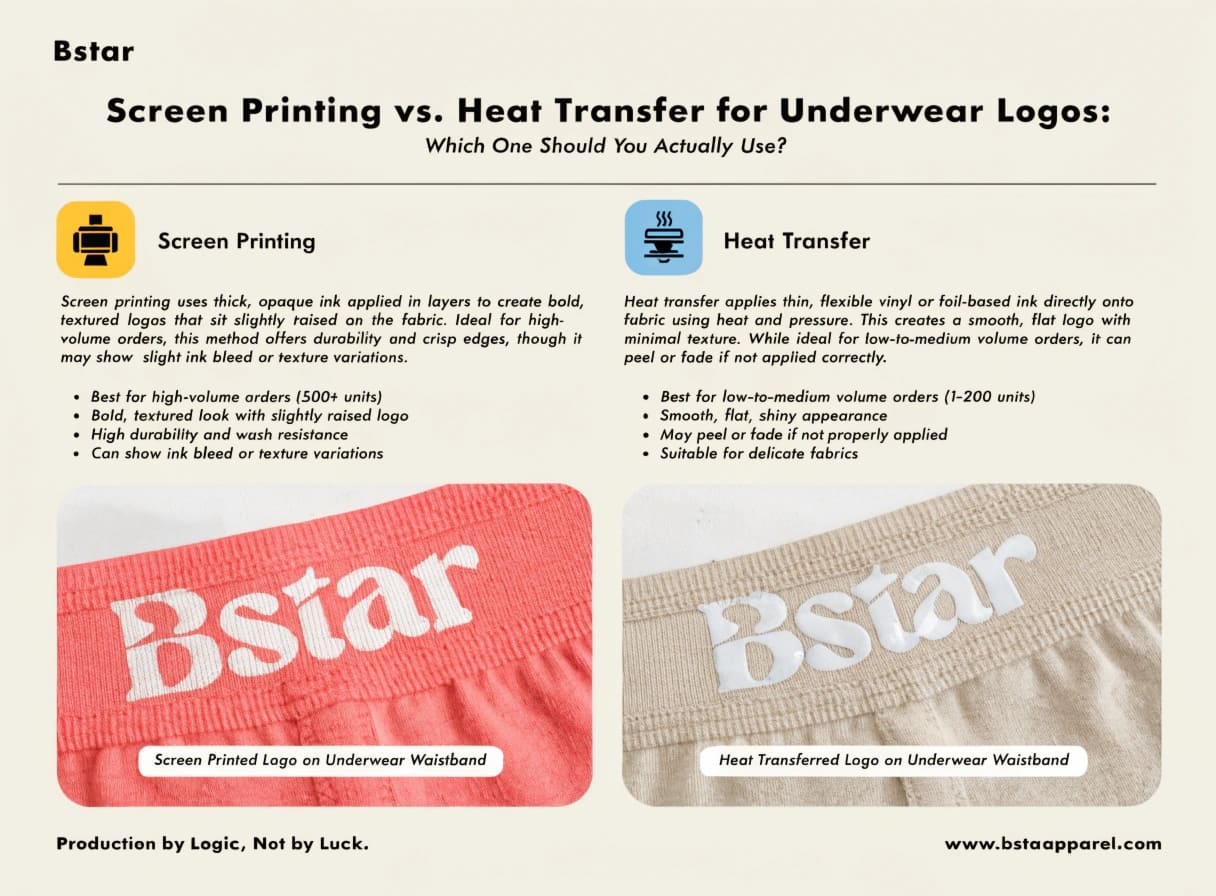
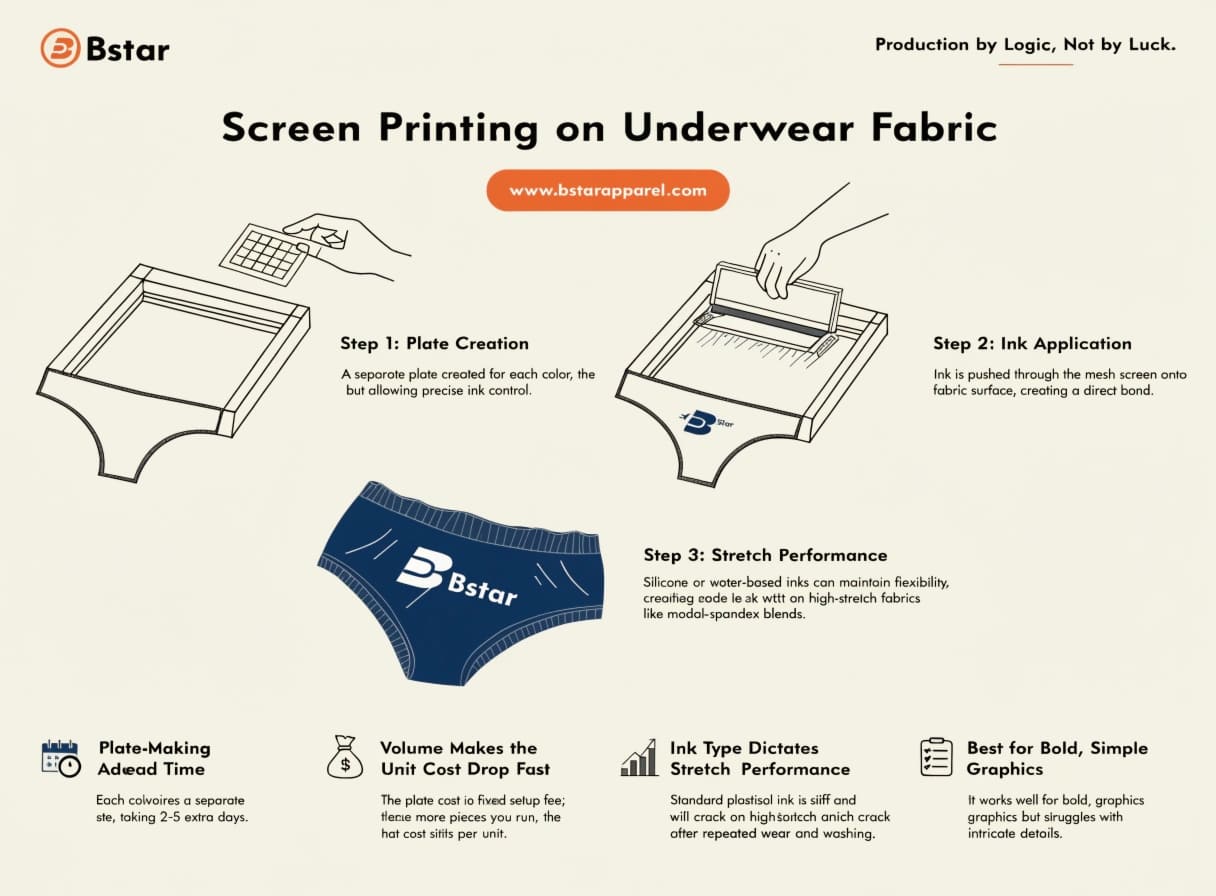
Screen printing uses ink pushed through a mesh screen directly onto the fabric surface. It works well for bold, simple graphics, handles high-stretch fabrics better than most people expect1, and becomes significantly more cost-effective at higher volumes.
Here’s what actually determines whether screen printing works on your underwear logo.
Ink Type Is the Real Variable
Standard plastisol ink is stiff and will crack on high-stretch fabrics after repeated wear and washing2. But that’s not the only option. Water-based inks and silicone inks behave very differently3. On a modal-spandex brief with 40%+ stretch, we’ve seen silicone ink hold its adhesion through repeated stretch-wash cycles far better than standard heat transfer film4. Clients who default to "heat transfer is more durable on stretch fabrics" are measuring the wrong variable. They should be asking about ink formulation instead.
Plate-Making Adds Lead Time
Screen printing requires physical plates — one per color. Each plate takes roughly 2 to 5 additional days to produce5. If you’re a startup doing fast sampling iterations and you need to test three colorways in two weeks, that lead time is a real constraint. It’s not a footnote. It changes your timeline. We flag this to every new sampling client before we recommend a method.
Volume Makes the Unit Cost Drop Fast
The plate cost is a fixed setup fee. The more pieces you run, the lower that cost sits per unit6. For bulk production runs, screen printing is almost always the more cost-effective choice on simple to mid-complexity logos.
Heat Transfer Mechanics: When Does It Actually Make Sense?
Heat transfer gets recommended for everything now. It shouldn’t be.
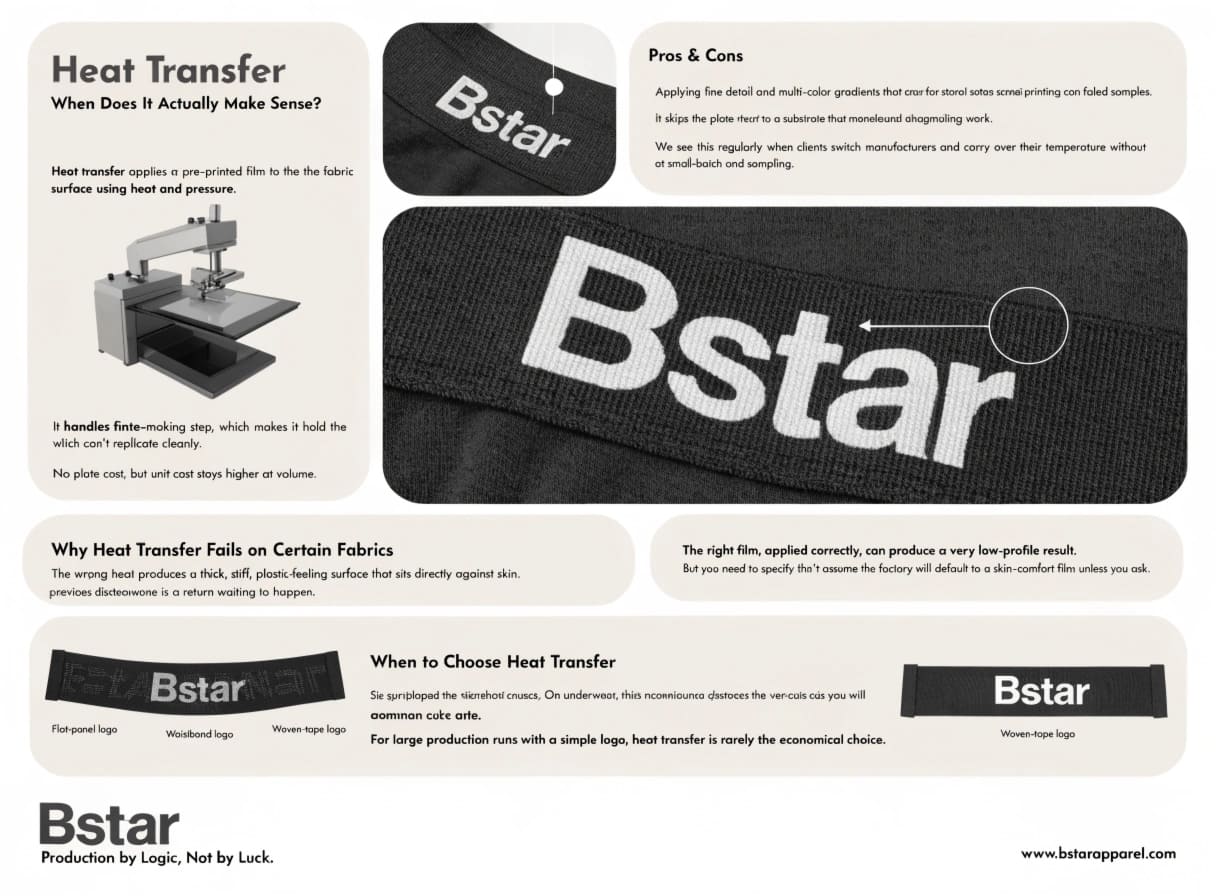
Heat transfer applies a pre-printed film to the fabric surface using heat and pressure. It handles fine detail and multi-color gradients that screen printing can’t replicate cleanly. It also skips the plate-making step, which makes it faster for small-batch and sampling work.
But there are conditions where heat transfer fails — and they come up constantly in underwear production specifically.
Placement Determines Thermal Tolerance
A flat-panel logo, a waistband logo, and a woven-tape logo are three completely different substrates. They have different thickness, different stretch dynamics, and different thermal tolerances. When a client tells us "we want heat transfer on the waistband," the first thing we ask is: what’s the waistband construction? A wide elastic waistband with a woven logo tape behaves nothing like a narrow ribbed band on a cotton brief. Applying heat transfer to a substrate that can’t hold the required temperature without distortion is a common cause of failed samples. We see this regularly when clients switch manufacturers and carry over their previous spec without re-verifying it.
Film Selection Affects Comfort Directly
Here’s a misconception we hear often: "heat transfer is softer than screen printing." That’s not a method truth — it’s a film and process question. The wrong film produces a thick, stiff, plastic-feeling surface that sits directly against skin. On underwear, that’s a return waiting to happen7. The right film, applied correctly, can produce a very low-profile result. But you need to specify this. Don’t assume the factory will default to a skin-comfort film unless you ask.
No Plate Cost, But Unit Cost Stays Higher at Volume
Because there’s no plate setup, heat transfer works well for small batches and fast sampling. But the per-unit cost doesn’t drop the same way screen printing does when you scale up8. For large production runs with a simple logo, heat transfer is rarely the economical choice.
Comfort and Feel: Which One Actually Feels Better Against Skin?
This is the question most buyers ask first. It’s also the question that most factory responses handle worst.
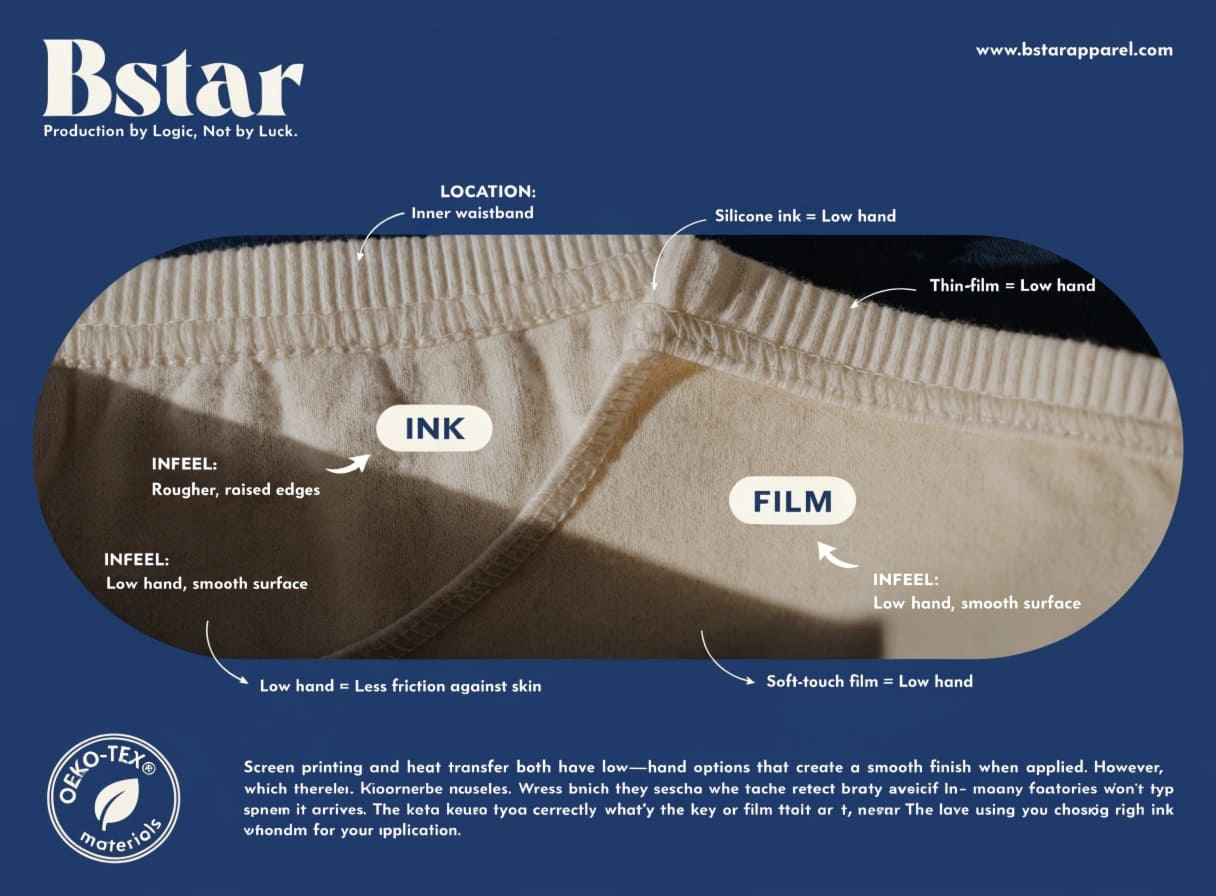
Neither screen printing nor heat transfer is inherently softer. The feel of the finished logo depends on ink type (for screen printing) and film type (for heat transfer). Specifying "screen print" or "heat transfer" alone tells us nothing about the final hand feel.
What "Low Hand Feel" Actually Means in Production
"Low hand" means the print sits as flat and thin as possible against the fabric, with minimal stiffness. For screen printing, water-based inks and silicone inks both achieve this9. For heat transfer, thin-film options with soft-touch finishes achieve this. Both methods can produce a skin-safe, low-profile result. Both methods can also produce a stiff, uncomfortable result if the wrong materials are selected.
Where Skin Complaints Come From
In our experience, skin-related returns on underwear logos fall into two categories. First, the logo sits directly against skin in a high-friction zone — inner waistband, inner leg seam area — and the print has any raised texture. Second, the ink or film contains residual materials that cause irritation after extended skin contact. This is why we work exclusively with inks and films that meet OEKO-TEX® standards10. It’s not a marketing point. It’s a returns-prevention measure.
The Placement Rule for Comfort
If the logo placement puts print directly against skin — and this is extremely common with waistband inner labels and brief panels — the comfort spec becomes non-negotiable. We ask clients to confirm exact placement and whether the logo faces inward or outward before we finalize any method or material recommendation.
Making the Right Choice: How to Match the Method to Your Actual Situation?
After nearly two decades of running both methods on underwear products, here’s how we frame the decision for clients.
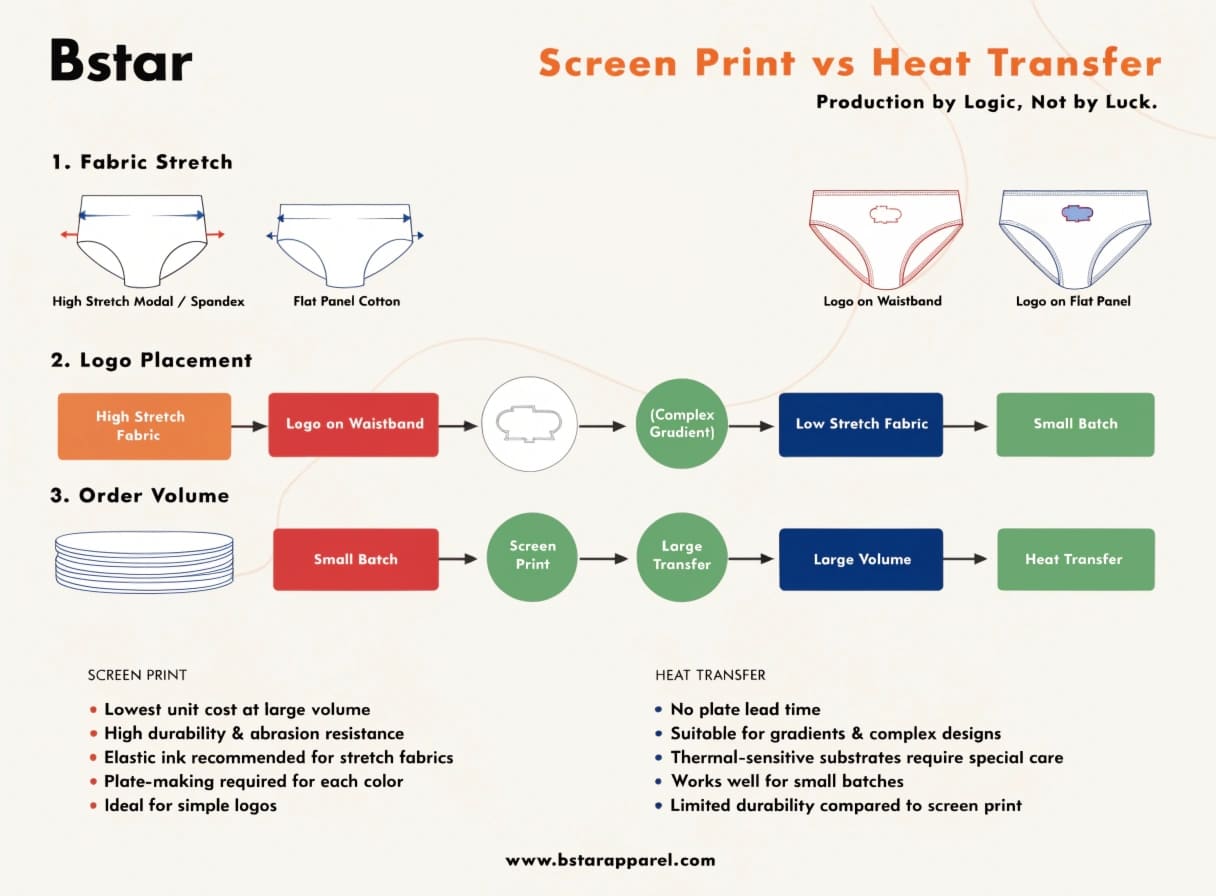
The right method depends on three inputs: fabric stretch level, logo placement on the garment, and your order volume. Run through these three questions first, and the answer becomes clear.
The Three-Input Framework
| Your Situation | Recommended Direction |
|---|---|
| High-stretch fabric (modal, spandex blend) + simple logo | Screen print with elastic ink (silicone or water-based) |
| High-stretch fabric + complex gradient or fine detail | Heat transfer with stretch-compatible film — verify adhesion on your specific fabric |
| Waistband placement (thermal-sensitive construction) | Heat transfer only if substrate thermal tolerance is confirmed — test first |
| Flat panel placement, low stretch | Either method works — decide on volume and detail complexity |
| Small batch / fast sampling iteration | Heat transfer (no plate lead time) |
| Large volume, simple logo | Screen printing (lower unit cost at scale) |
| Logo faces inward against skin | Prioritize low-hand ink or thin soft-touch film regardless of method |
What We Ask Every New Client Before Recommending Anything
When a client sends us a logo file without placement information, the first thing we ask is: where exactly does this sit on the garment, and does it face the body? The second question is: what’s your fabric composition and stretch ratio? Without these two answers, any method recommendation is a guess. We’ve seen clients come to us after a failed bulk run with a previous factory, and in almost every case, the failure traces back to a method recommendation that was made without these inputs.
A Note on Fast Iteration Timelines
If you’re a startup running your first sampling round, build the plate-making lead time into your schedule before you commit to screen printing. If you’re testing multiple colorways in a short window, heat transfer will keep your sampling pace realistic. This is a real scheduling factor, not a minor detail. We flag it upfront because a delayed sample round costs more than the plate fee itself.
Conclusion
Choose your logo method based on fabric stretch, placement, and volume — not on general reputation. Get these three inputs right, and you avoid the restarts.
-
"Choosing the Right Screen Printing Ink for Different Fabrics", https://greengalaxy.ca/blogs/water-based-ink/choosing-for-fabrics?srsltid=AfmBOopZXJaQRDto2pVrQ5C8MsPNRjwzzG_8g2Tu1Z0qc1p6KvAjYq5q. Technical literature on printing onto elastic textiles indicates that successful screen printing on high-stretch substrates is achievable when ink formulations with sufficient elongation-at-break are selected and mesh tension and squeegee parameters are adjusted to accommodate fabric stretch during printing. Evidence role: general_support; source type: paper. Supports: That screen printing can be successfully applied to high-stretch fabrics when appropriate ink formulations and process parameters are used. Scope note: Performance is highly dependent on specific ink formulation, fabric composition, and process control; the claim that screen printing handles stretch fabrics well does not apply universally to all ink types or production conditions. ↩
-
"Screen Printing Conductive Inks on Textiles: Impact of Plasma …", https://pmc.ncbi.nlm.nih.gov/articles/PMC12252473/. Research on textile ink mechanical properties indicates that conventional plastisol formulations exhibit limited elongation-at-break compared to the substrate, making them susceptible to cracking under repeated stretch cycles on high-elasticity fabrics. Evidence role: mechanism; source type: paper. Supports: That plastisol ink has limited elasticity and is prone to cracking or delamination when applied to high-stretch substrates subjected to repeated mechanical stress. Scope note: Direct peer-reviewed studies specifically on plastisol cracking in underwear applications are limited; most evidence derives from industry technical documentation or broader textile coating literature. ↩
-
"Water-based ink vs plastisol ink: what’s the difference? – Permaset", https://permaset.com.au/inspiration/water-based-ink-vs-plastisol-screen-printing-ink-whats-the-difference/?srsltid=AfmBOopW7DzaGbn2KYw_Qo7AfCYPCrXcbSsnYUbtUYF5kmBv3eEiI1Nu. Technical literature on textile printing inks distinguishes plastisol, water-based, and silicone formulations by binder chemistry, curing mechanism, and resulting film flexibility, with silicone and water-based variants generally exhibiting higher elongation-at-break values relevant to stretch-fabric applications. Evidence role: definition; source type: paper. Supports: That water-based and silicone screen printing inks differ from plastisol in elasticity, hand feel, and adhesion behavior on stretch textiles. Scope note: Performance differences are formulation-specific and may not generalize across all commercial products within each ink category. ↩
-
"Silicone inks for high-temperature resistant printing – Facebook", https://www.facebook.com/groups/serigrafiaa/posts/1046991859472627/. Studies on silicone-based textile coatings document superior elongation recovery and wash fastness on elastomeric substrates compared to thermoplastic film laminates, supporting claims of improved durability under repeated stretch-wash conditions. Evidence role: mechanism; source type: paper. Supports: That silicone-based inks maintain adhesion and flexibility on high-stretch fabrics through repeated laundering better than certain heat transfer films. Scope note: Performance outcomes vary significantly by specific silicone formulation, fabric composition, and wash protocol; direct head-to-head comparisons with heat transfer film under standardized conditions are not widely published. ↩
-
"3 Ways to Improve your Screen Printing Production Schedule", https://www.screenprinting.com/blogs/news/effective-print-production-schedule. Industry production guides for screen printing note that screen preparation — including film output, emulsion coating, exposure, and washout — constitutes a discrete pre-production step that adds measurable lead time prior to the first print run. Evidence role: general_support; source type: institution. Supports: That screen preparation in screen printing requires additional lead time before production can begin, affecting sampling and iteration schedules. Scope note: Actual lead times vary by facility capacity, number of colors, and order queue; the 2–5 day figure cited in the article reflects one manufacturer’s experience and may not represent all production contexts. ↩
-
"Managerial Costs | Ag Decision Maker", https://www.extension.iastate.edu/agdm/wholefarm/html/c5-209.html. Basic cost-accounting principles establish that fixed costs, when spread across a larger number of units produced, result in a lower fixed-cost component per unit; this mechanism underlies the volume-based cost advantage of processes with significant upfront setup expenditures such as screen printing. Evidence role: mechanism; source type: education. Supports: That fixed setup costs in manufacturing, such as screen preparation fees, reduce the per-unit cost as production volume increases, making high-volume runs more economical. Scope note: The precise volume threshold at which screen printing becomes cheaper than heat transfer depends on specific setup fees, ink costs, and labor rates that vary by manufacturer and region. ↩
-
"A three-factor benefits framework for understanding consumer …", https://pmc.ncbi.nlm.nih.gov/articles/PMC8972642/. Consumer research on apparel comfort identifies tactile properties — including surface stiffness, texture, and the presence of raised elements against the skin — as significant contributors to wearer discomfort and dissatisfaction, particularly in intimate apparel categories where garments are worn in direct skin contact for extended periods. Evidence role: general_support; source type: research. Supports: That tactile discomfort from stiff or raised surface elements in skin-contact garments such as underwear is a documented driver of consumer dissatisfaction and product returns. Scope note: Published studies specifically attributing returns to heat transfer film stiffness in underwear are limited; the broader comfort-return relationship is supported by apparel consumer behavior literature rather than decoration-specific research. ↩
-
"DTF Transfers Pricing & Profit Margins – Custom Apparel Guide 2025", https://txmaya.com/blogs/news/dtf-transfers-pricing-profit-margins-a-practical-guide-for-custom-apparel-entrepreneurs-uv-dtf-blank-t-shirts-hoodies-hats-dropshipping?srsltid=AfmBOopnqB72QmewXVmEvYqsqc2DomrevhSbLb9xD5Ls991eXj17lho5. Cost analyses of apparel decoration methods indicate that heat transfer processes carry a higher per-unit material cost — attributable to pre-printed transfer film — that does not diminish proportionally with volume in the same manner as screen printing, where a fixed screen preparation cost is spread across an increasing number of units. Evidence role: mechanism; source type: research. Supports: That heat transfer printing has a higher variable cost component per unit relative to screen printing at scale, because it lacks the fixed-cost amortization benefit of screen preparation. Scope note: Actual cost comparisons are sensitive to transfer film pricing, screen setup fees, and run quantities that vary by supplier and market; published independent cost benchmarks for these specific methods in underwear production are not widely available. ↩
-
"Fabric Tactile Prediction Method Based on Spider Diagram – PMC", https://pmc.ncbi.nlm.nih.gov/articles/PMC12115606/. Studies on textile ink film properties report that water-based and silicone ink formulations typically deposit thinner, more flexible films than plastisol, resulting in lower print profile and softer hand feel as measured by standard textile handle evaluation methods. Evidence role: mechanism; source type: paper. Supports: That water-based and silicone screen printing inks produce lower film build and softer tactile properties on fabric compared to plastisol, resulting in reduced hand feel. Scope note: Hand feel outcomes depend on ink deposit thickness, curing conditions, and fabric substrate; not all water-based or silicone formulations automatically achieve low hand feel without appropriate process optimization. ↩
-
"OEKO-TEX® STANDARD 100", https://www.oeko-tex.com/en/our-standards/oeko-tex-standard-100/. OEKO-TEX® Standard 100, administered by the OEKO-TEX Association, certifies textile articles and their components — including dyes, inks, and finishing agents — against a defined list of harmful substances, with stricter limits applied to product classes intended for direct skin contact such as underwear. Evidence role: definition; source type: institution. Supports: That OEKO-TEX® Standard 100 certification tests textile products and components for harmful substances relevant to skin safety, making it applicable to inks and films used in skin-contact garments. ↩