
Sustainable Men’s Underwear Fabrics: Tencel, Bamboo & Recycled Nylon — Which One Is Actually Right for Your Brand?
Picking the wrong sustainable fabric doesn’t just hurt your margins. It can kill your product launch before it starts.
Tencel, bamboo, and recycled nylon are the three most common sustainable fabric choices for men’s underwear right now. Each one works well for a specific set of brand priorities. The right choice depends on what your brand needs to deliver — softness, performance, certifications, or price — not on which fiber sounds the most sustainable.
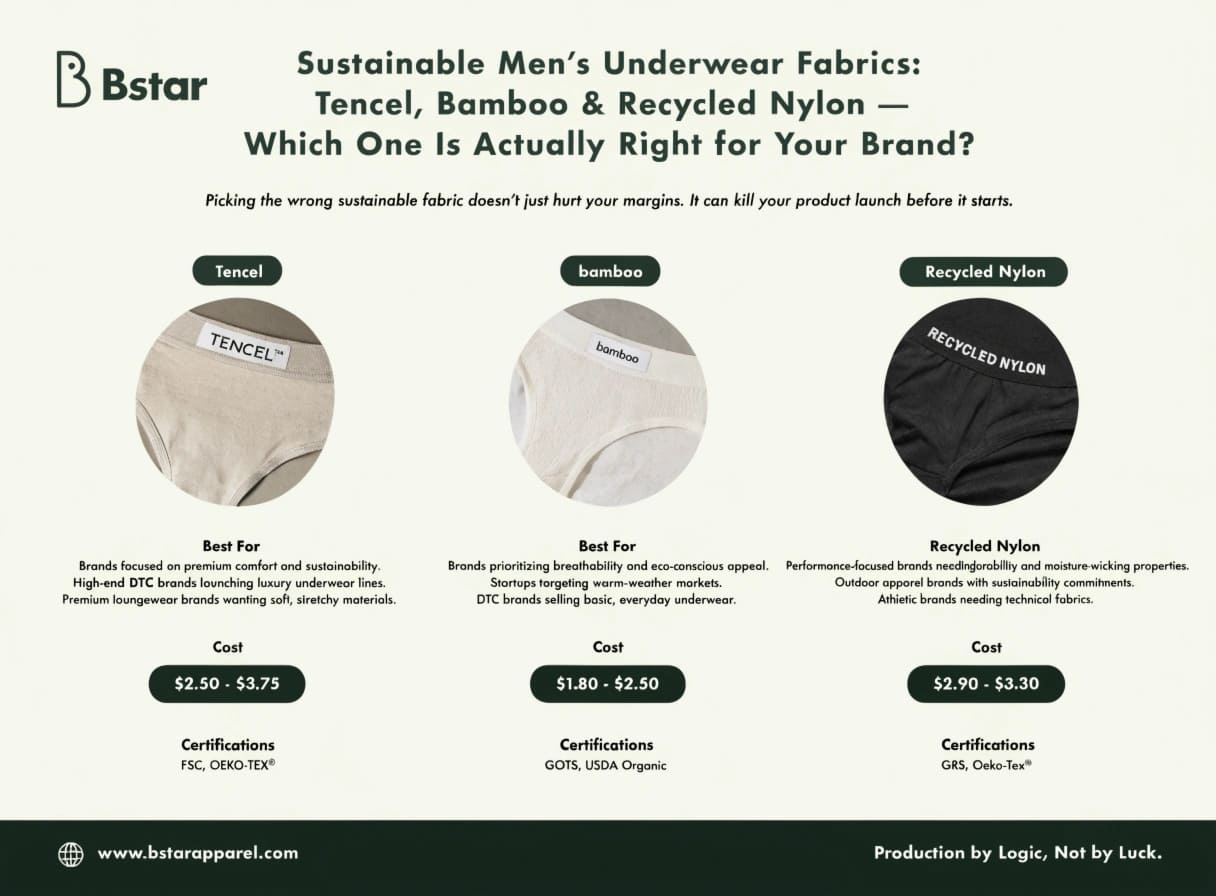
I’ve been sourcing and producing all three of these fabrics for men’s underwear at our factory in Zhongshan, China for years. Brands we work with — mostly DTC founders from Europe and North America — ask us the same question almost every time: "Which sustainable fabric should I use?" My honest answer is always the same: it depends on what you’re actually building. Let me break down each one so you can make that call with real information.
Tencel (Lyocell): Is Closed-Loop Wood Pulp Processing Worth the Premium?
You’ve probably heard that Tencel is sustainable. But do you know why — and whether that matters for your specific product?
Tencel is made from wood pulp, usually eucalyptus1, using a closed-loop solvent process. That means roughly 99% of the water and solvent used in production gets recaptured and reused2. It produces a very soft, smooth fiber with strong moisture-wicking properties3 — which makes it a solid choice for next-to-skin products like men’s underwear.
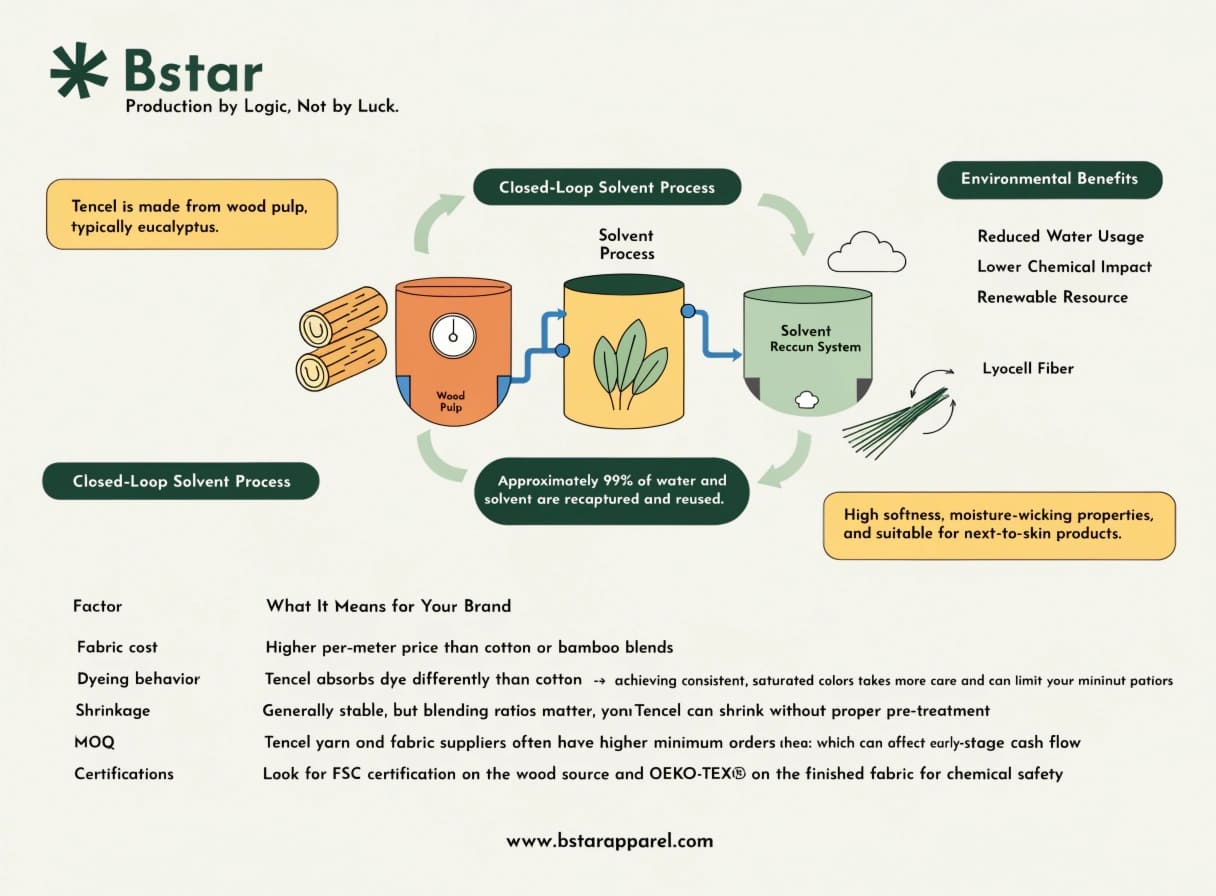
In our production experience, Tencel performs exceptionally well in the areas that matter most to comfort-first underwear brands. The fabric feels silky against skin and manages moisture better than most cotton alternatives. Customers who try it tend to notice the difference immediately.
That said, Tencel comes with real trade-offs that brands need to think through before committing.
What Tencel Actually Costs You in Production
| Factor | What It Means for Your Brand |
|---|---|
| Fabric cost | Higher per-meter price than cotton or bamboo blends |
| Dyeing behavior | Tencel absorbs dye differently than cotton — achieving consistent, saturated colors takes more care and can limit your colorway options |
| Shrinkage | Generally stable, but blending ratios matter; pure Tencel can shrink without proper pre-treatment |
| MOQ | Tencel yarn and fabric suppliers often have higher minimum orders, which can affect early-stage cash flow |
| Certifications | Look for FSC certification on the wood source4 and OEKO-TEX® on the finished fabric for chemical safety5 |
The dyeing limitation is the one that catches brands off guard most often. If your brand identity depends on a wide range of bold colors, Tencel blends require more testing to get right. If your line is built around neutrals and earth tones, you’ll have a much easier time.
Tencel is best suited for brands whose primary promise to the customer is comfort and softness, and who can absorb a slightly higher cost of goods.
Bamboo Fiber: Does "Natural Antibacterial" Actually Hold Up?
Bamboo underwear is everywhere right now. The marketing almost writes itself — fast-growing plant, no pesticides6, naturally antibacterial. But there’s a part of the bamboo story that brands often skip, and skipping it creates a real greenwashing risk.
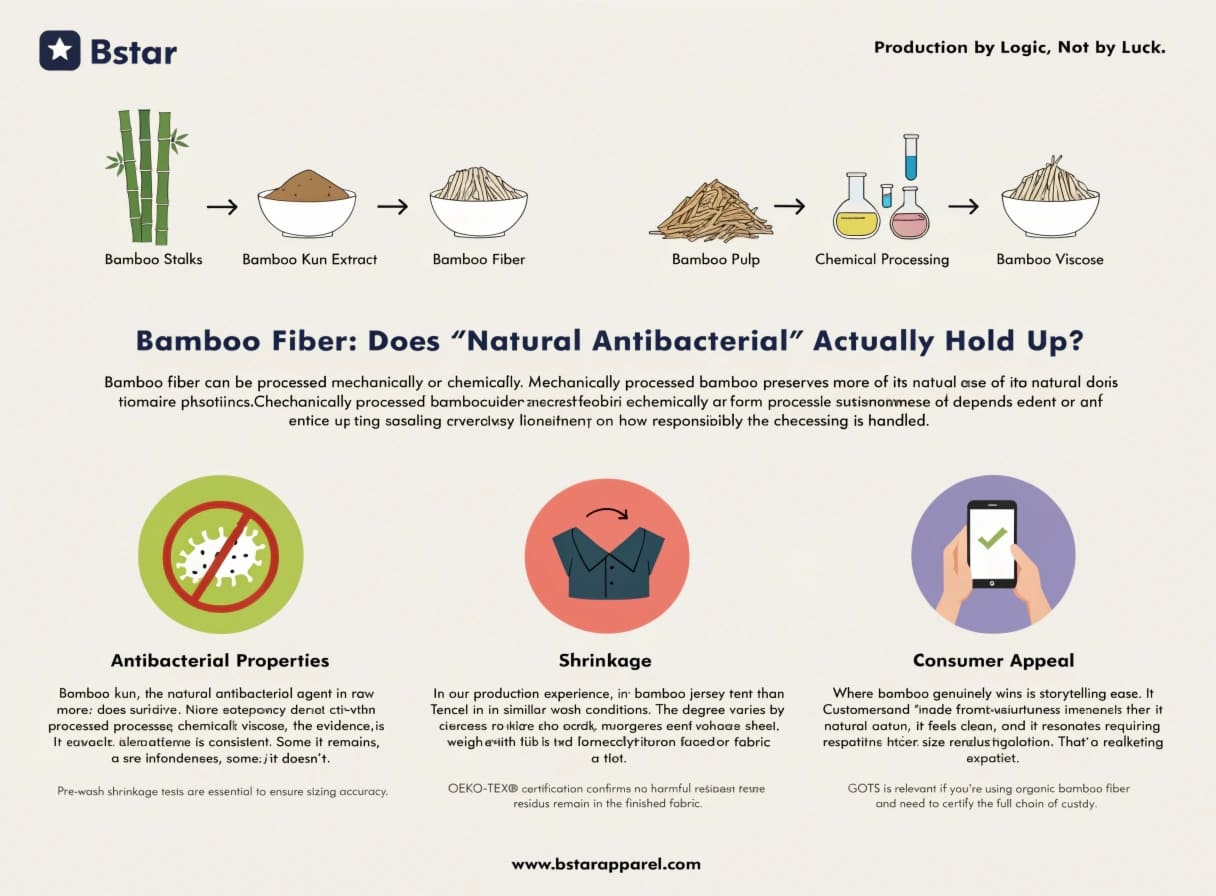
Bamboo fiber can be processed two ways: mechanically, which preserves more of the plant’s natural properties but is expensive and rare, or chemically, which is how most "bamboo fabric" is made. Chemically processed bamboo is technically a form of viscose or rayon7. The sustainability of the end product depends entirely on how responsibly the chemical processing is handled.
We produce bamboo jersey regularly, and we’re straightforward with brands about this. When a customer comes to us saying they want "bamboo fabric" because it’s natural, the first thing we do is explain the processing difference. Most bamboo fabric on the market — including what we produce — is chemically processed. That doesn’t make it a bad choice. It just means your sustainability claim needs to be precise.
Breaking Down the Bamboo Trade-offs
The antibacterial angle: Bamboo kun, the natural antibacterial agent in raw bamboo, does survive in mechanically processed fiber. In chemically processed bamboo viscose, the evidence is less consistent8. Some of it remains, some of it doesn’t. If antibacterial performance is a core part of your product story, you should verify this claim with your specific fabric supplier and consider third-party testing before putting it on your packaging.
Shrinkage: In our production experience, bamboo jersey tends to shrink more than Tencel in similar wash conditions9. The degree varies by blend ratio and fabric weight. If you’re building a fitted brief or boxer brief with tight size tolerances, this matters a lot. Pre-washing and proper construction techniques can control it, but it adds steps to production.
Consumer appeal: Where bamboo genuinely wins is storytelling ease. Customers understand "made from bamboo" immediately. It feels natural, it feels clean, and it resonates with sustainability-aware shoppers without requiring a lot of explanation. That’s a real marketing asset.
The right certification here is OEKO-TEX® for chemical safety, which confirms no harmful residues remain in the finished fabric. GOTS is relevant if you’re using organic bamboo fiber and need to certify the full chain of custody.
Recycled Nylon: Can Ocean Plastic Actually Make Good Underwear?
Recycled nylon has the most dramatic raw material story — fishing nets pulled from the ocean, plastic bottles diverted from landfill, turned into high-performance yarn. But "dramatic story" and "right fit for your product" are two different things.
Recycled nylon (often branded as ECONYL® or similar) is made by regenerating nylon waste — primarily ocean plastics and discarded fishing nets — back into virgin-quality yarn10. The resulting fiber has the same stretch, durability, and recovery properties as conventional nylon, with a significantly lower carbon footprint in raw material production11.
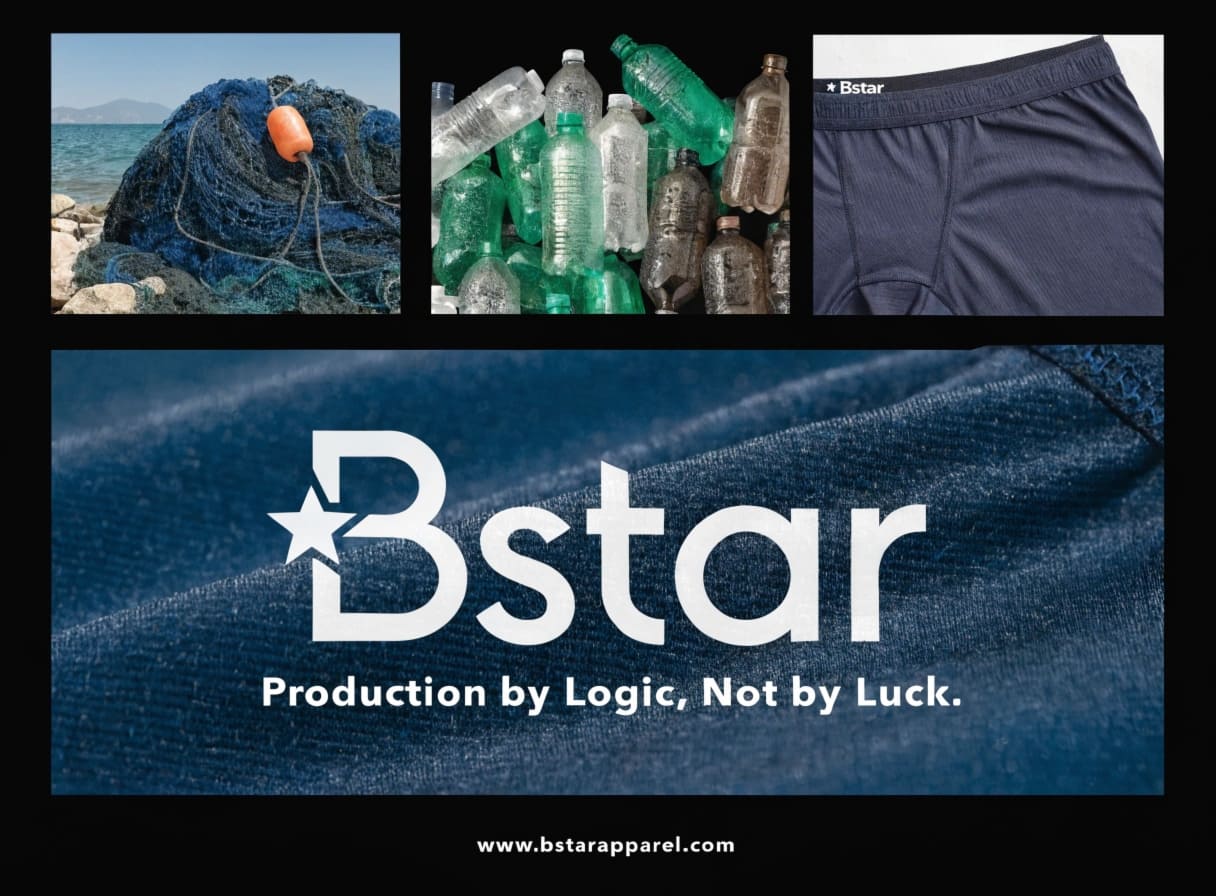
We work with recycled nylon blends primarily for performance-oriented underwear — the kind designed for active use, longer wear, or products where stretch retention over time is a key selling point. For men’s underwear specifically, a recycled nylon and spandex blend delivers excellent shape retention and durability through repeated washing.
Where Recycled Nylon Fits — and Where It Doesn’t
| Priority | Recycled Nylon Performance |
|---|---|
| Stretch and recovery | Excellent — holds shape well over time |
| Softness vs. skin | Good, but typically not as soft as Tencel or bamboo against bare skin |
| Moisture management | Good wicking, dries fast — strong for active or athletic fits |
| Sustainability communication | Strong raw material story, but harder to explain simply to general consumers |
| Certification needed | GRS (Global Recycled Standard) — not GOTS, which applies to natural fibers12 |
The certification point is one where we see brands make mistakes. GRS is the standard you need to verify recycled content claims on nylon. If a retail buyer or platform asks for documentation on your recycled content, GRS is what they want to see. GOTS doesn’t apply here — it’s designed for organic natural fibers.
The harder challenge with recycled nylon is consumer communication. "Made from ocean plastic" resonates strongly with some audiences and confuses others. If your customer base is already sustainability-literate and responds to impact metrics, this fabric and its story can be a strong differentiator. If your audience is more mainstream, you may need to invest more in education.
Comparative Sourcing Guide: How Do You Actually Choose Between These Three?
You’ve read about all three fabrics. Now comes the real question: which one do you source?
There is no single best sustainable fabric for men’s underwear. The right choice depends on your product’s core promise, your price ceiling, your target certification, and how much production complexity your team can manage. Tencel fits comfort-first brands. Bamboo fits lifestyle and story-driven brands willing to manage shrinkage carefully. Recycled nylon fits performance and durability-focused products.
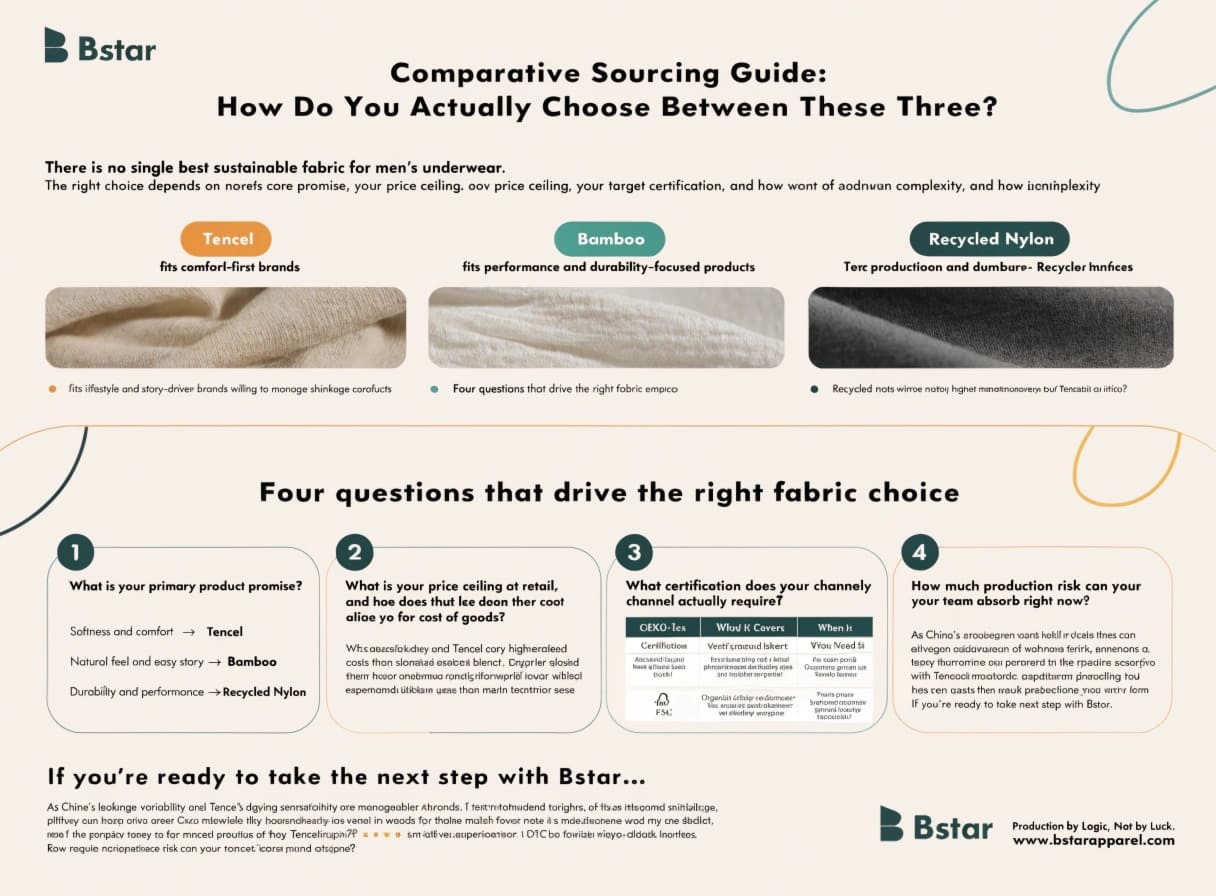
When brands come to us at BSTAR with this decision, we walk them through four questions before we recommend anything.
The Four Questions That Drive the Right Fabric Choice
1. What is your primary product promise?
Softness and comfort → Tencel. Natural feel and easy story → Bamboo. Durability and performance → Recycled Nylon.
2. What is your price ceiling at retail, and what does that leave you for cost of goods?
Recycled nylon and Tencel carry higher material costs than standard bamboo viscose blends. If your retail price point is tight, your fabric options narrow quickly.
3. What certification does your channel actually require?
| Certification | What It Covers | When You Need It |
|---|---|---|
| OEKO-TEX® | Chemical safety in finished fabric | Almost always useful |
| GOTS | Organic fiber origin + processing chain | Organic cotton or bamboo |
| FSC | Sustainable forest source | Tencel / wood-pulp fibers |
| GRS | Verified recycled content | Recycled nylon or polyester |
4. How much production risk can your team absorb right now?
Bamboo’s shrinkage variability and Tencel’s dyeing sensitivity are manageable — but they require experience on the production side to control consistently. If you’re launching your first product and your margin for error is low, factor that into your choice. Working with a manufacturer who has direct experience producing all three is one way to reduce that risk without doing all the testing yourself.
The goal of this whole exercise is not to find the fabric that sounds most sustainable. It’s to find the fabric that lets your brand deliver on its actual promise — to your customer, your retail buyer, and your own quality standard.
Conclusion
Tencel, bamboo, and recycled nylon are all legitimate sustainable choices. The one that’s right for your brand is the one that matches your product promise, your price point, and the certification your channel actually needs.
-
"What Is the Difference Between TENCEL and Lyocell?", https://cosh.eco/en/articles/tencel-vs-lyocell. Tencel, a branded lyocell fiber produced by Lenzing AG, is primarily derived from eucalyptus wood pulp sourced from certified sustainably managed forests, though other wood species including beech and spruce may also be used depending on production line. Evidence role: definition; source type: institution. Supports: That Tencel brand lyocell fiber is predominantly derived from eucalyptus wood pulp sourced from certified forests. Scope note: Feedstock composition may vary by product line and production period; this characterization reflects general brand positioning rather than a fixed specification. ↩
-
"Lyocell – Wikipedia", https://en.wikipedia.org/wiki/Lyocell. The lyocell process employs a closed-loop system in which the N-methylmorpholine N-oxide (NMMO) solvent is recovered and recycled at rates commonly reported at approximately 99%, substantially reducing chemical discharge compared to conventional viscose production. Evidence role: statistic; source type: research. Supports: The solvent recovery rate in closed-loop lyocell production, typically cited at approximately 99%. Scope note: Recovery rate figures may vary by facility and production scale; manufacturer-reported figures should be distinguished from independently audited data. ↩
-
"Eco-Friendly Fibers Embedded Yarn Structure in High-Performance …", https://pmc.ncbi.nlm.nih.gov/articles/PMC9920085/. Lyocell fibers demonstrate high moisture absorption capacity attributable to their cellulosic structure and fibril arrangement, which facilitates capillary transport of moisture away from the skin, a property documented in textile science literature on regenerated cellulose fibers. Evidence role: mechanism; source type: paper. Supports: That lyocell fiber exhibits superior moisture absorption and wicking characteristics relative to synthetic and some natural fibers. Scope note: Performance in finished fabric depends on fabric construction, blend ratios, and finishing treatments, not fiber properties alone. ↩
-
"What Is the Difference Between TENCEL and Lyocell?", https://cosh.eco/en/articles/tencel-vs-lyocell. The Forest Stewardship Council (FSC) certification system covers forest management and chain of custody for wood and wood-derived products, including wood pulp used in the production of regenerated cellulose fibers such as lyocell and viscose, verifying that raw material sourcing meets defined environmental and social standards. Evidence role: definition; source type: institution. Supports: That FSC certification applies to the forest and wood pulp sourcing stage of lyocell and other wood-pulp-derived textile fibers. Scope note: FSC certification covers the forest and pulp sourcing stage only; it does not certify the chemical processing or finished textile, for which separate standards such as OEKO-TEX apply. ↩
-
"OEKO-TEX® STANDARD 100", https://www.oeko-tex.com/en/our-standards/oeko-tex-standard-100/. OEKO-TEX Standard 100, administered by the OEKO-TEX Association, certifies that every component of a finished textile article has been tested against a list of harmful substances including pesticide residues, heavy metals, formaldehyde, and certain dyes, and meets defined threshold limits intended to protect human health. Evidence role: definition; source type: institution. Supports: That OEKO-TEX Standard 100 certification verifies that finished textile products have been tested for and found free of a defined list of harmful chemical substances. Scope note: OEKO-TEX Standard 100 addresses chemical safety in the finished product only and does not certify environmental performance of the production process or the sustainability of raw material sourcing. ↩
-
"Impact of pesticides use in agriculture: their benefits and hazards", https://pmc.ncbi.nlm.nih.gov/articles/PMC2984095/. Agronomic literature on bamboo cultivation notes that bamboo’s rapid growth rate and natural resilience reduce the need for pesticide application in most commercial growing contexts, though the degree to which pesticides are used varies by species, region, and farming practice. Evidence role: expert_consensus; source type: research. Supports: That bamboo cultivation generally requires minimal or no pesticide application due to the plant’s natural growth characteristics. Scope note: The absence of pesticide use is not universal across all bamboo cultivation operations; claims of pesticide-free production should be verified at the specific farm or supply chain level. ↩
-
"Bamboo Textiles – Federal Trade Commission", https://www.ftc.gov/bamboo-textiles. The U.S. Federal Trade Commission has issued guidance stating that bamboo fabric produced through chemical processing must be labeled as ‘rayon’ or ‘rayon made from bamboo,’ as the chemical process destroys the original plant fiber structure, and that marketing such products as ‘bamboo’ without qualification may constitute a deceptive trade practice. Evidence role: definition; source type: government. Supports: That chemically processed bamboo fabric must be labeled and classified as viscose or rayon under consumer protection and textile labeling regulations. Scope note: Regulatory requirements vary by jurisdiction; FTC guidance applies specifically to the U.S. market and may differ from EU or other international labeling standards. ↩
-
"Resistance of natural bamboo fiber to microorganisms and factors …", https://bioresources.cnr.ncsu.edu/resources/resistance-of-natural-bamboo-fiber-to-microorganisms-and-factors-that-may-affect-such-resistance/. Research on bamboo-derived textiles indicates that bamboo kun, a bio-agent associated with antimicrobial activity in raw bamboo, is substantially degraded during the alkaline chemical processing used to produce bamboo viscose, rendering antibacterial performance claims for chemically processed bamboo fabric scientifically contested. Evidence role: mechanism; source type: paper. Supports: That the antibacterial compound bamboo kun is degraded or inconsistently retained during the chemical viscose processing of bamboo fiber. Scope note: Studies vary in methodology and the specific bamboo species and processing conditions examined; results may not generalize across all commercial bamboo viscose products. ↩
-
"Bamboo fibre: A sustainable solution for textile manufacturing", https://www.sciencedirect.com/science/article/pii/S2773139124000338. Textile testing literature on regenerated cellulose fabrics indicates that bamboo viscose exhibits relatively high dimensional instability upon repeated laundering, a characteristic associated with the fiber’s swelling behavior in water, while lyocell fabrics generally demonstrate superior dimensional stability attributable to differences in fibril structure and finishing treatments. Evidence role: general_support; source type: paper. Supports: That bamboo viscose jersey fabric is prone to greater dimensional change upon laundering compared to lyocell fabric of similar construction. Scope note: Shrinkage performance is highly dependent on fabric construction, blend composition, and finishing; direct comparative data for identical jersey constructions is limited in published literature. ↩
-
"Sustainability in Business with ECONYL® Regenerated Nylon", https://econyl.aquafil.com/sustainability/. ECONYL, produced by Aquafil, employs a depolymerization and repolymerization process that converts nylon waste—including discarded fishing nets and industrial plastic—into caprolactam monomer, which is then repolymerized into nylon 6 fiber reported to be equivalent in quality to virgin nylon. Evidence role: mechanism; source type: research. Supports: That ECONYL and similar regenerated nylon products are derived from post-consumer nylon waste including fishing nets and achieve comparable mechanical properties to virgin nylon 6. Scope note: Independent verification of fiber property equivalence and feedstock sourcing proportions is limited; lifecycle assessment data is primarily producer-reported. ↩
-
"Plastic production via advanced recycling lowers GHG emissions", https://www.anl.gov/article/plastic-production-via-advanced-recycling-lowers-ghg-emissions. Lifecycle assessment studies comparing recycled and virgin nylon production indicate that regenerated nylon can reduce global warming potential by approximately 50–80% per kilogram of fiber relative to conventional nylon 6 production, primarily due to avoided fossil fuel extraction and polymerization energy demands. Evidence role: statistic; source type: research. Supports: That recycled nylon production generates lower greenhouse gas emissions per kilogram of fiber compared to virgin nylon production. Scope note: Carbon savings estimates vary significantly across LCA studies depending on system boundaries, energy grid assumptions, and the specific recycling technology employed. ↩
-
"Recycled Claim Standard (RCS) + Global Recycled Standard (GRS)", https://textileexchange.org/recycled-claim-global-recycled-standard/. The Global Recycled Standard (GRS), administered by Textile Exchange, provides third-party verification of recycled input materials and chain of custody for products including recycled synthetic fibers; the Global Organic Textile Standard (GOTS) is explicitly scoped to natural fibers of organic origin and does not cover recycled synthetic materials. Evidence role: definition; source type: institution. Supports: That GRS certifies recycled content in synthetic fibers such as nylon, while GOTS is limited to organic natural fibers and does not apply to recycled synthetics. Scope note: Certification scope and requirements are subject to revision; brands should consult current standard versions from the respective certifying bodies. ↩