

What Is the Real Environmental Impact of Dyeing Underwear Fabrics?
Buyers keep asking if fabric dyeing is "bad for the environment." The real problem is that question leads nowhere useful — and the wrong answer from a supplier could put your brand at serious risk.
Dyeing underwear fabrics does carry environmental costs — mainly water use, chemical waste, and wastewater discharge. But the impact depends almost entirely on what dye chemistry the factory uses and whether they have real wastewater treatment in place. Asking "is dyeing harmful?" is less useful than asking "what controls does this supplier actually have?"
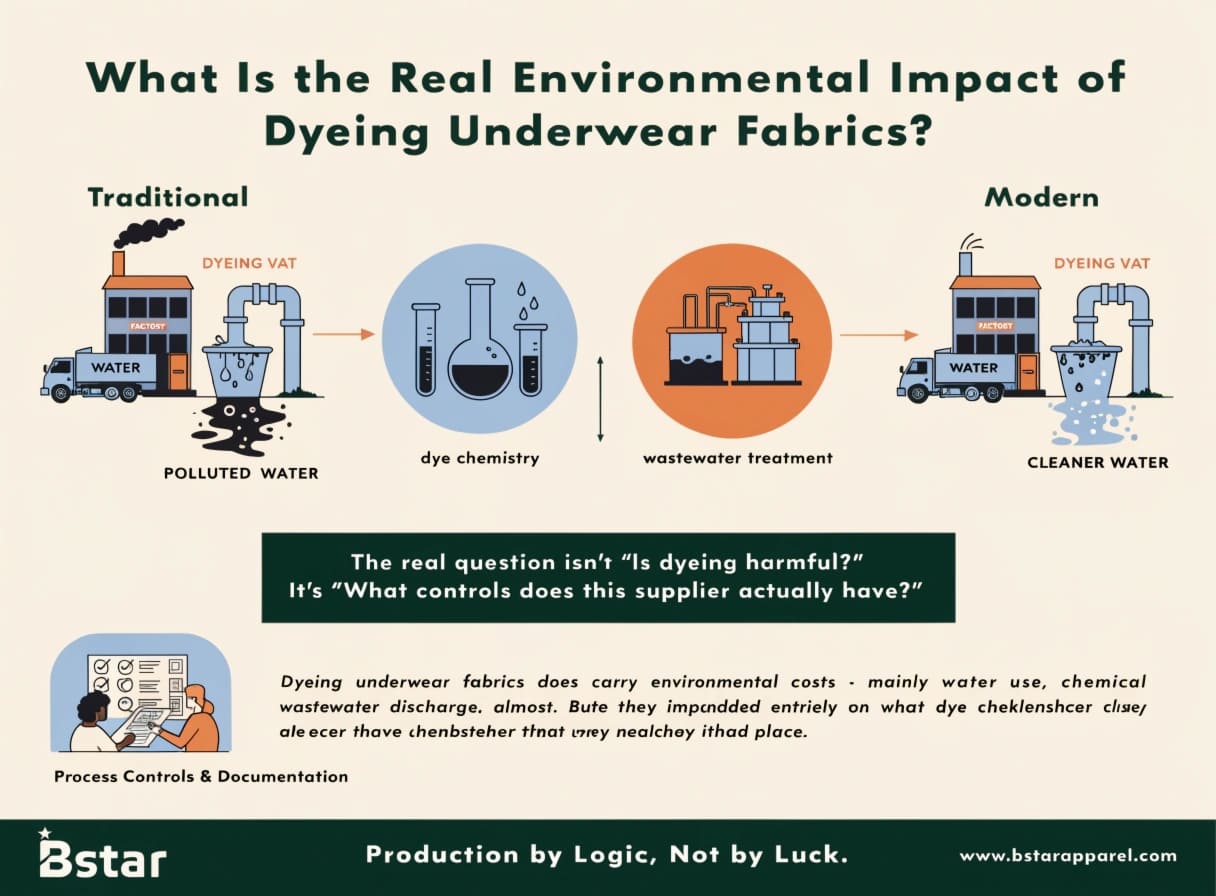
I work on the factory side. At BSTAR, we manage dyeing in-house for knit underwear and intimate apparel, and we field these questions from overseas buyers constantly. What I’ve noticed is that most buyers come in asking the wrong question. Once we shift the conversation to process controls and documentation, the picture gets a lot clearer — and so does the risk of choosing a supplier who can’t answer those questions.
What Is the Hidden Cost of Color in Traditional Dyeing?
Most buyers know dyeing uses chemicals. Few know how much water is involved — or what leaves the factory after the process is done.
Traditional fabric dyeing is water-intensive. A significant portion of the dye chemicals used do not fully bond to the fiber and end up in the wastewater. This means every batch of dyed underwear fabric produces colored, chemically loaded effluent that must be treated before it is discharged.
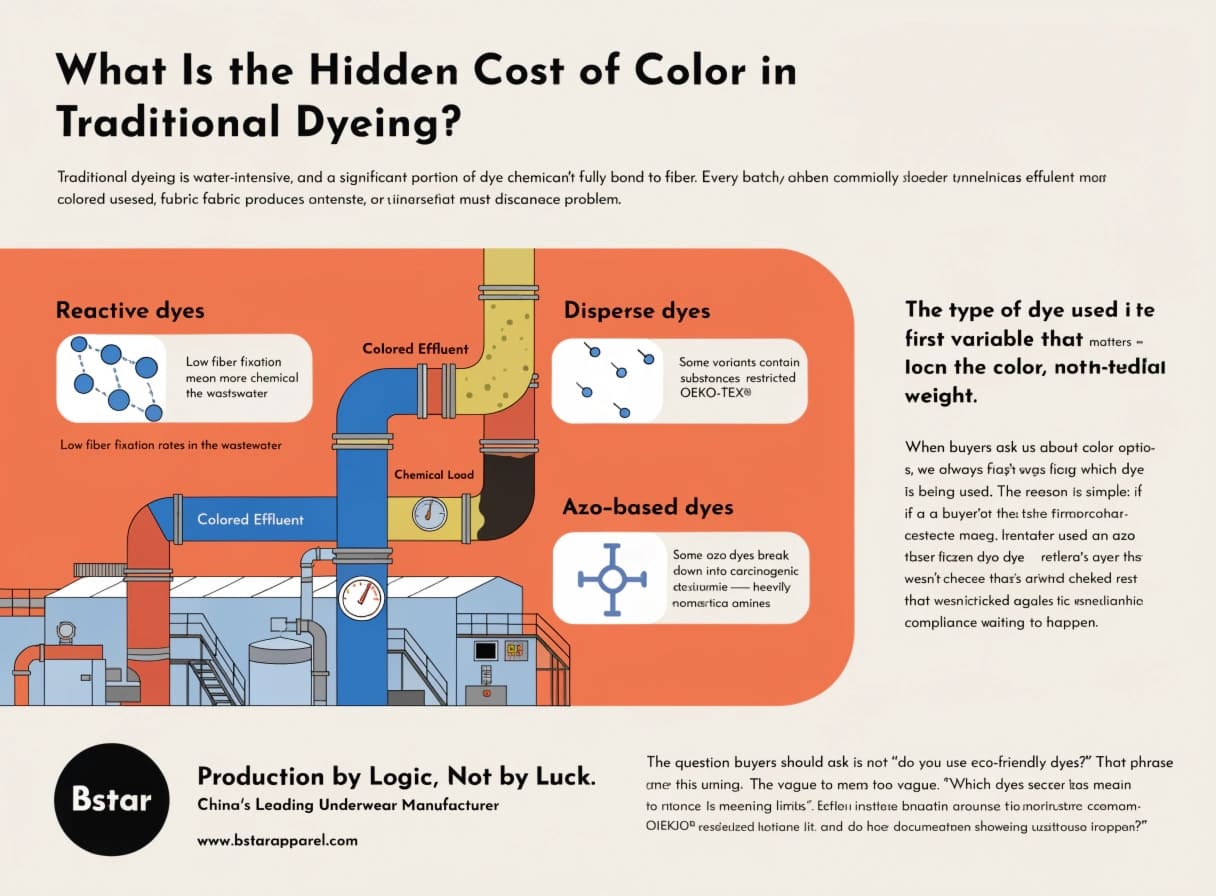
The type of dye used is the first variable that matters here — not the color, not the fabric weight.
Why Dye Chemistry Matters More Than Most Buyers Realize
Different dye types behave very differently in terms of how much chemical stays in the water versus bonds to the fiber. Here’s a basic breakdown of what we work with in knit underwear production:
| Dye Type | Common Use in Underwear | Key Environmental Risk |
|---|---|---|
| Reactive dyes | Cotton, modal, bamboo knits | Low fiber fixation rates mean higher chemical load in wastewater |
| Disperse dyes | Polyester, nylon blends | Some variants contain substances restricted under OEKO-TEX® |
| Azo-based dyes | Various | Some azo dyes break down into carcinogenic aromatic amines — heavily regulated |
When buyers ask us about color options, we always flag which dye chemistry is being used. The reason is simple: if a buyer’s retailer or end market has restricted substance requirements, and the factory used an azo dye that wasn’t checked against those limits, that’s a compliance problem waiting to happen.
The question buyers should ask is not "do you use eco-friendly dyes?" That phrase is too vague to mean anything. The right question is: "Which dye chemistry are you using for this fabric, and do you have documentation showing it meets OEKO-TEX® restricted substance limits?"
What Are the Real Health and Environmental Risks of Synthetic Dyes and Wastewater?
Untreated or poorly treated dyeing wastewater is one of the more documented environmental problems in textile manufacturing. The risk is not hypothetical.
Synthetic dyes — particularly certain azo-based compounds — can persist in water systems and resist natural breakdown. Heavy metals used as mordants or dye fixatives in some processes add another layer of concern. Without proper on-site treatment, this wastewater reaches local water sources in a form that’s harmful to ecosystems and human health.
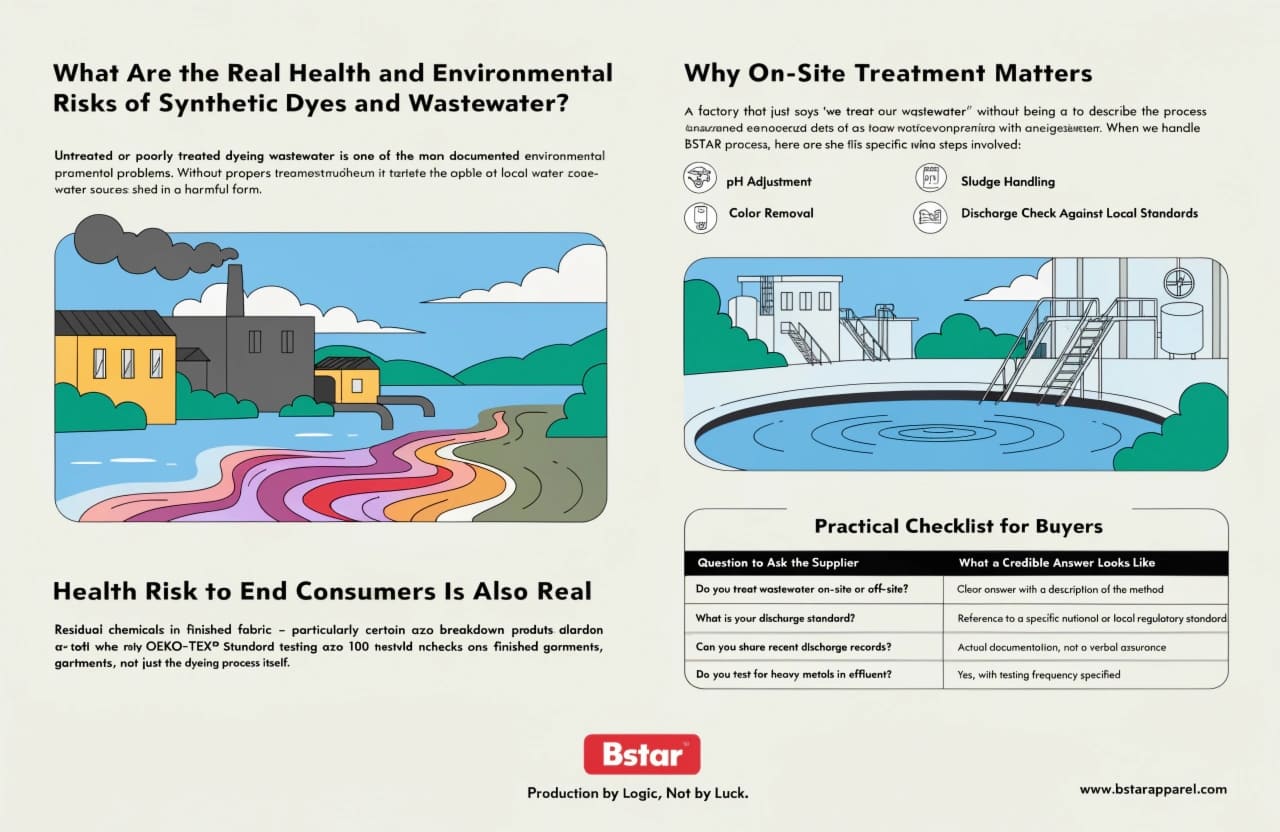
This is where "wastewater treatment" stops being a vague sustainability term and becomes a concrete factory-floor question.
What "Wastewater Treatment" Actually Means at the Factory Level
When we handle wastewater from our dyeing process at BSTAR, there are specific steps involved — pH adjustment, color removal, sludge handling, and discharge checks against local standards. A factory that just says "we treat our wastewater" without being able to describe any of that process hasn’t actually answered your question.
Here’s a practical checklist for buyers evaluating a supplier’s wastewater claims:
| Question to Ask the Supplier | What a Credible Answer Looks Like |
|---|---|
| Do you treat wastewater on-site or off-site? | Clear answer with a description of the method |
| What is your discharge standard? | Reference to a specific national or local regulatory standard |
| Can you share recent discharge records? | Actual documentation, not a verbal assurance |
| Do you test for heavy metals in effluent? | Yes, with testing frequency specified |
A supplier that holds a social responsibility certification like BSCI but cannot walk through their wastewater process has not demonstrated environmental compliance — they’ve demonstrated they passed an audit on labor and social conditions, which is a different thing entirely.
The health risk to end consumers is also real. Residual chemicals in finished fabric — particularly certain azo dye breakdown products — are why OEKO-TEX® Standard 100 testing includes checks on finished garments, not just the dyeing process itself.
Are Waterless Dyeing and Digital Printing Actually Practical Solutions?
There’s a lot of marketing noise around "waterless dyeing" and "digital printing" as sustainable alternatives. Some of it is real. Some of it is overstated.
Waterless dyeing technologies — such as supercritical CO₂ dyeing — do reduce water use significantly and eliminate dye-laden wastewater. Digital printing avoids dye bath processes entirely for certain applications. These are genuine innovations, but they are not universally applicable to all underwear fabric types or production volumes.
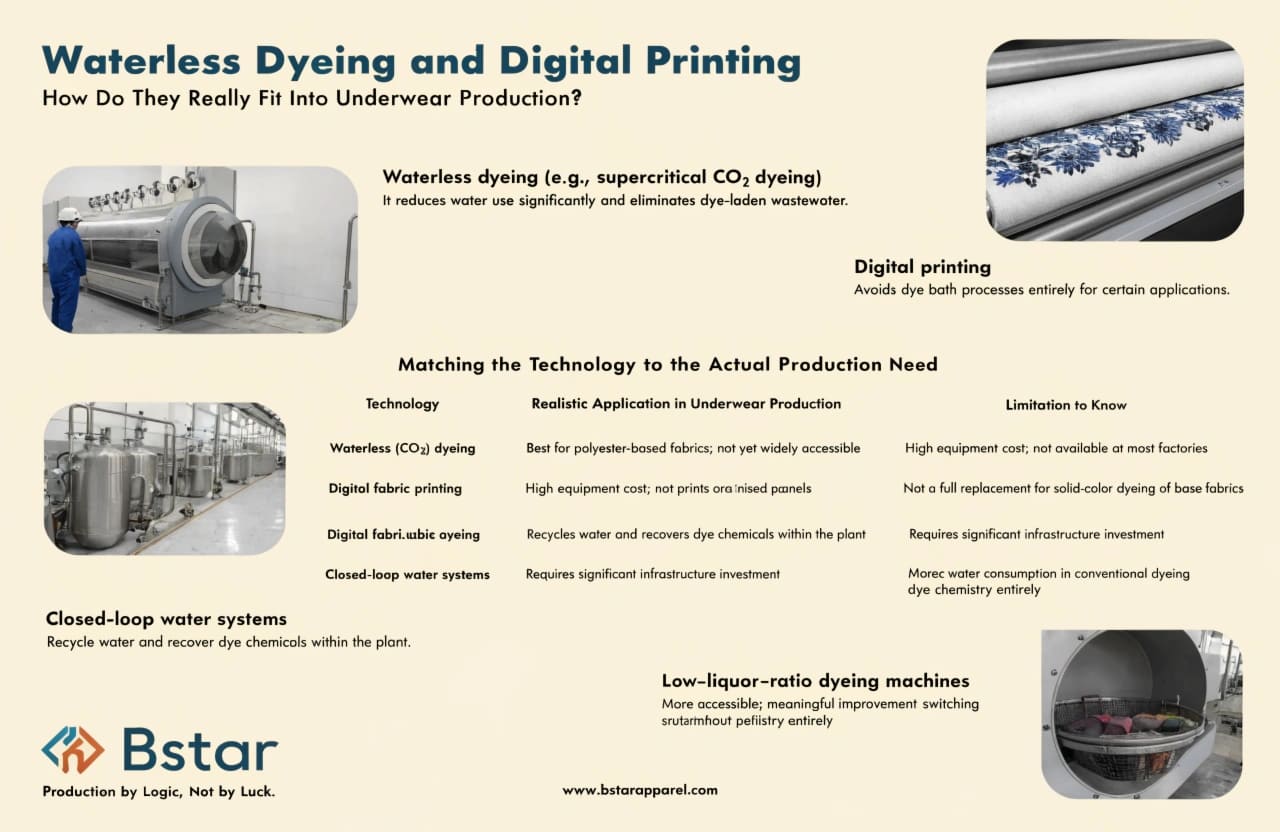
Here’s what I’ve seen in practice from managing production for knit underwear:
Matching the Technology to the Actual Production Need
| Technology | Realistic Application in Underwear Production | Limitation to Know |
|---|---|---|
| Waterless (CO₂) dyeing | Best for polyester-based fabrics; not yet widely accessible | High equipment cost; not available at most factories |
| Digital fabric printing | Suitable for patterns and prints on finished panels | Not a full replacement for solid-color dyeing of base fabrics |
| Closed-loop water systems | Recycles water and recovers dye chemicals within the plant | Requires significant infrastructure investment |
| Low-liquor-ratio dyeing machines | Reduces water consumption in conventional dyeing | More accessible; meaningful improvement without switching dye chemistry entirely |
Closed-loop systems are probably the most practical near-term option for factories that do conventional dyeing at volume. They reduce both water intake and the chemical load in discharge — without requiring a full switch in dye type or equipment.
For buyers, the practical takeaway is this: don’t evaluate a supplier on whether they use the newest technology. Evaluate them on whether they have implemented any measurable improvement in water and chemical management, and whether they can show you the records.
How Do Certifications Like OEKO-TEX and GOTS Actually Help Buyers?
Certifications are useful tools. But they are easy to misread — and some suppliers count on buyers misreading them.
GOTS, OEKO-TEX® Standard 100, and GRS each cover different parts of the supply chain and make different claims. Treating them as interchangeable leads to real procurement risk. Knowing what each one actually certifies about the dyeing process helps buyers ask sharper questions.

At BSTAR, our raw materials carry OEKO-TEX®, GOTS, and GRS certifications. When buyers ask us what that means for their finished product, we always break it down the same way — because lumping the three together gives a misleading picture.
What Each Certification Actually Covers in the Dyeing Context
| Certification | What It Certifies | What It Does NOT Guarantee |
|---|---|---|
| OEKO-TEX® Standard 100 | Finished product tested for harmful substance limits (including restricted dye residues) | Does not certify the dyeing process itself or wastewater handling |
| GOTS (Global Organic Textile Standard) | Full supply chain including dyeing — restricts permitted dye types and chemical inputs | Requires organic fiber input; does not apply to synthetic-dominant blends |
| GRS (Global Recycled Standard) | Recycled content traceability through the supply chain | Does not address dye chemistry or wastewater at all |
So a buyer who says "this factory is GRS certified, so we’re covered on the environmental side" has misread the certification. GRS tells you the recycled fiber input is traceable. It says nothing about what dye was used on that fiber.
The most direct request a buyer can make to a supplier is: "Can you show me your dye compliance documentation and your most recent wastewater discharge records?" A supplier that can answer that question with actual paperwork — not just a list of certification logos — is in a very different position from one that cannot.
At BSTAR, when buyers ask us this, we walk them through our dye selection records, our OEKO-TEX® substance compliance documentation, and our wastewater handling process. That conversation is more useful to both sides than any marketing claim.
Conclusion
The environmental impact of dyeing underwear fabrics is real — but it is manageable. The supplier you choose, and the questions you ask them, determine your actual risk far more than the fact of dyeing itself.


Dyeing fabrics really has a bigger impact than I thought. It’s interesting how something so small can affect the environment.
“You’ve hit on a crucial point. The hidden danger of chemical dyeing is that those harmful substances don’t just disappear after manufacturing; they are continuously released into our water systems with every single wash. This cumulative runoff is exactly what causes such severe environmental damage. Thank you for recognizing the importance of this issue!”