Organic Cotton Underwear Production: Certifications and Standards?
When brands come to us asking about organic cotton underwear, most of them already know they need "some kind of certification." But that vague sense of needing a certificate is exactly where things start to go wrong.
Choosing a certified factory is not the same as having a certified product. GOTS and OEKO-TEX cover different things, and your factory’s certificate does not automatically transfer to your brand label. If you plan to sell organic cotton underwear with a certification claim, you need to understand what each standard actually covers — before you place your first order.
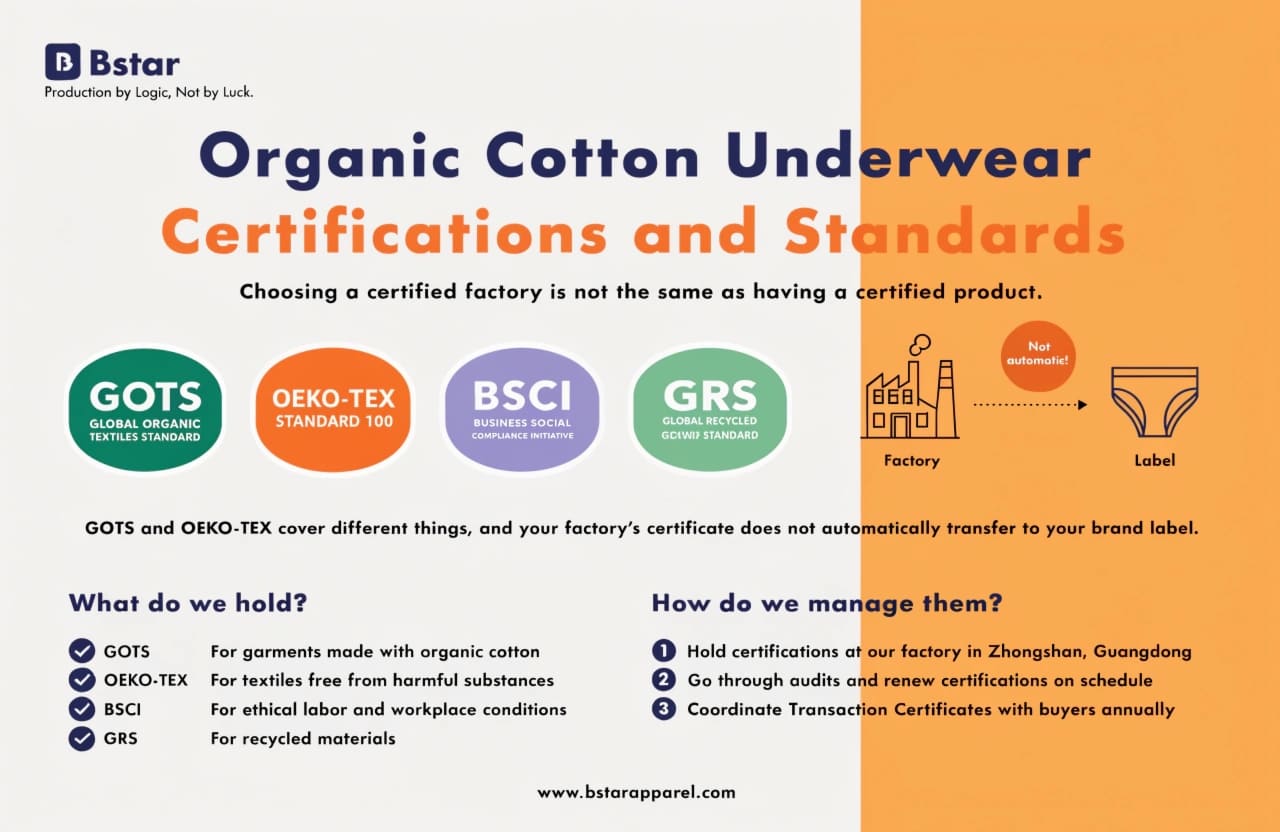
We hold GOTS, OEKO-TEX, BSCI, and GRS certifications at our factory in Zhongshan, Guangdong. We go through audits, renew these certifications on schedule, and coordinate Transaction Certificates with buyers every year. What we see again and again is that first-time buyers arrive with the right intentions but the wrong assumptions. This article is our attempt to fix that — before it costs you a launch window or a retailer relationship.
GOTS vs. OCS: Decoding the Key Differences in Organic Fiber Standards?
Most buyers hear "organic cotton" and assume any certificate with the word "organic" in it covers everything. It doesn’t — and mixing up GOTS and OCS is one of the most common mistakes we see at the inquiry stage.
GOTS (Global Organic Textile Standard) certifies the entire supply chain — from fiber sourcing through processing, dyeing, and final product — plus social responsibility conditions at each facility1. OCS (Organic Content Standard) only verifies that the raw fiber is organic. It says nothing about what happens to that fiber after it leaves the farm2.
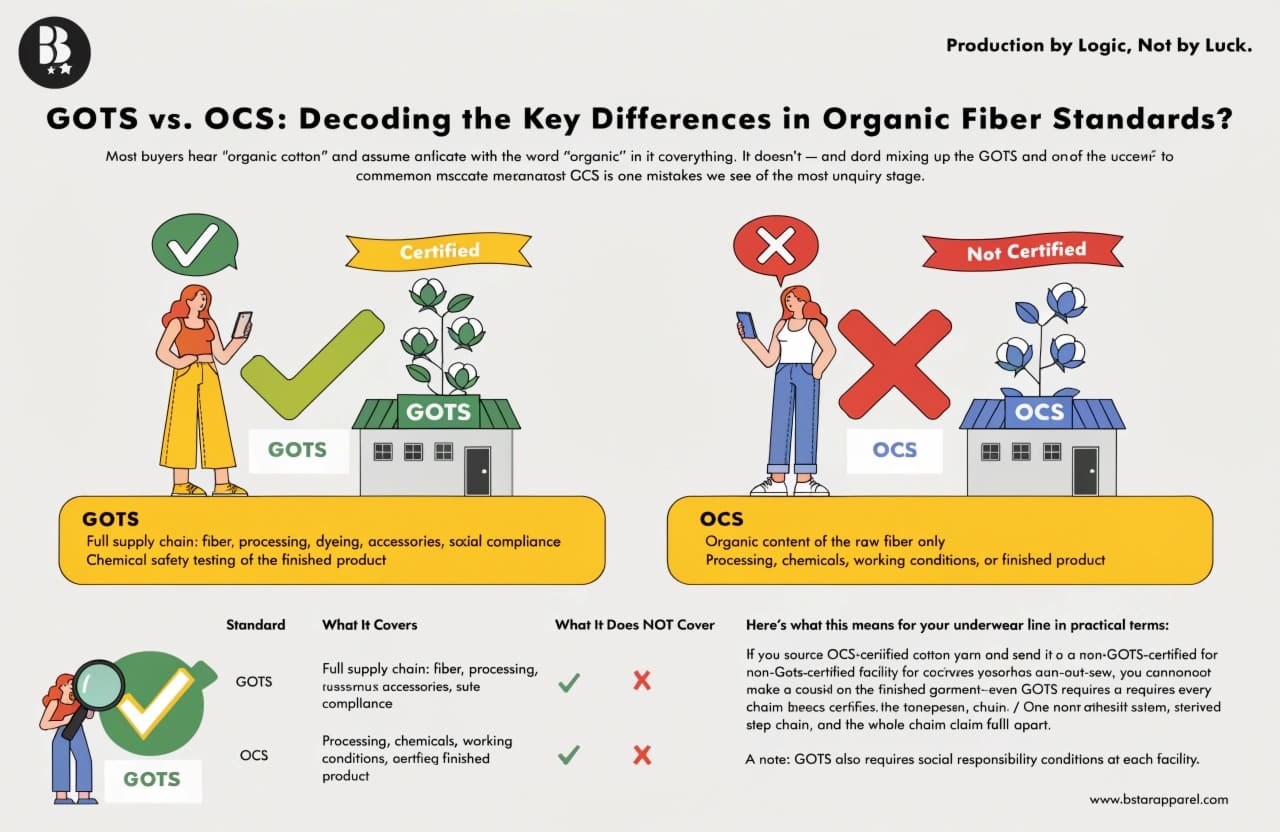
Here is what this means for your underwear line in practical terms.
If you source OCS-certified cotton yarn and send it to a non-GOTS-certified facility for dyeing and cut-and-sew, you cannot make a GOTS claim on the finished garment — even if the fiber itself is legitimate. GOTS requires every entity in the supply chain to be certified. One non-certified step breaks the chain of custody, and the whole claim falls apart3.
| Standard | What It Covers | What It Does NOT Cover |
|---|---|---|
| GOTS | Full supply chain: fiber, processing, dyeing, accessories, social compliance | Chemical safety testing of the finished product |
| OCS | Organic content of the raw fiber only | Processing, chemicals, working conditions, or finished product |
When we onboard new buyers, we typically ask them early: "What claim do you want to put on your label?" That single question determines whether OCS is sufficient for your situation or whether you need GOTS end-to-end. For most DTC brands selling directly to consumers in the EU, US, or Australia with an "organic" label claim, GOTS is what your retailer or customs authority will ask for. OCS alone usually isn’t enough to support consumer-facing marketing language.
One more thing people miss: even at a GOTS-certified factory like ours, the accessories matter. Elastic waistbands, labels, threads, and dyes all need to meet GOTS input requirements. If you bring your own trims from a non-compliant supplier, that can break your certification path too. We raise this at the sampling stage, not after production.
OEKO-TEX Standard 100: Ensuring Chemical Safety and Consumer Protection?
Here is where brands often make a category error. They see that a factory has OEKO-TEX STANDARD 100 certification and assume that covers their organic claim. It doesn’t — and the two standards are not interchangeable.
OEKO-TEX STANDARD 100 tests the finished textile product for harmful substances — things like pesticide residues, heavy metals, formaldehyde, and allergenic dyes4. A product that passes OEKO-TEX testing is verified safe for human contact. It says nothing about whether the fiber was organically grown or how the supply chain was managed.
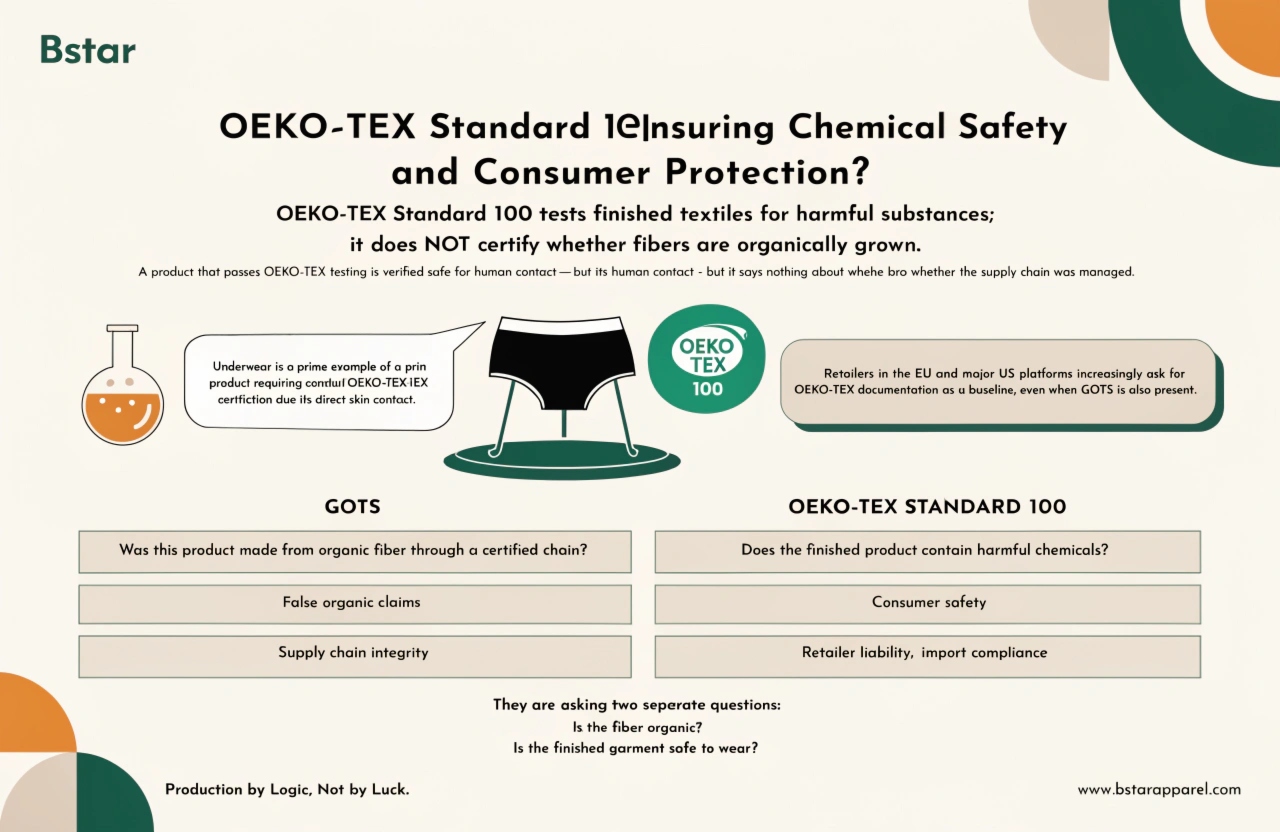
For underwear specifically, this matters more than for outerwear. Underwear sits directly against skin for hours at a time5. Retailers in the EU and major US platforms increasingly ask for OEKO-TEX STANDARD 100 documentation as a baseline6, even when GOTS is also present. They are asking two separate questions: "Is the fiber organic?" and "Is the finished garment safe to wear?" You need answers to both.
| Standard | Core Question It Answers | Relevant Risk It Addresses |
|---|---|---|
| GOTS | Was this product made from organic fiber through a certified chain? | False organic claims, supply chain integrity |
| OEKO-TEX STANDARD 100 | Does the finished product contain harmful chemicals? | Consumer safety, retailer liability, import compliance |
In our experience, brands that only chase GOTS and skip OEKO-TEX verification sometimes run into problems at the retail buyer stage — especially with European department stores or specialty organic retailers who require both. The reverse is also true: brands that get OEKO-TEX and try to market their product as "organic" without GOTS documentation can face false-claims challenges.
The practical answer for most DTC underwear brands is: you probably need both. They cover different risks, and together they give you a complete compliance story for both retail buyers and end consumers.
This is the part that surprises buyers most when they first work with a certified supply chain. Getting compliant materials from a certified factory is only half the process. Your brand also has its own compliance steps to complete.
To use the GOTS logo or make a GOTS claim on your finished product, your brand must obtain a Transaction Certificate (TC) issued by an accredited GOTS certifier7. The TC is issued per shipment and requires your brand to be registered in the GOTS system. The factory cannot do this step for you.
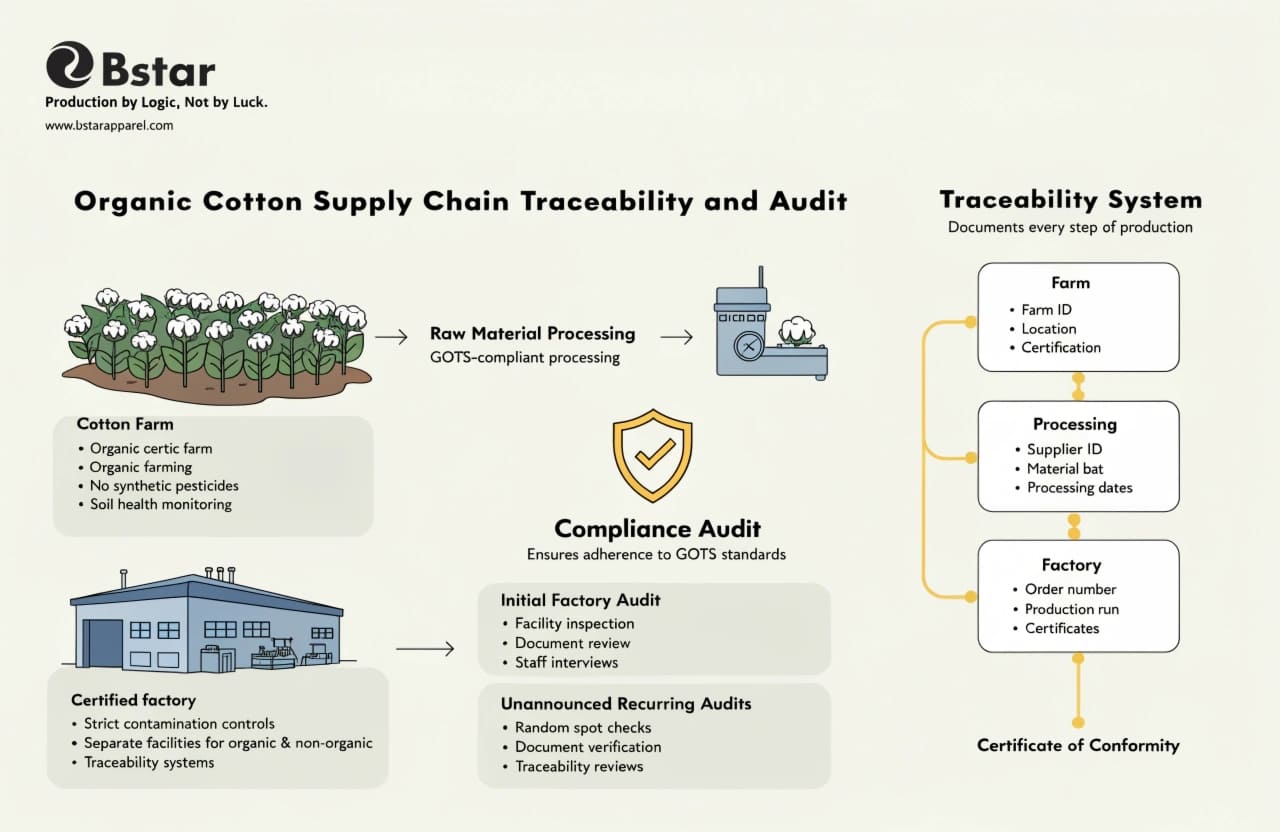
We see buyers discover this requirement at the wrong moment — sometimes after samples are approved, sometimes after production has started. By that point, there is real pressure on the timeline. Here is a simplified picture of what the compliance process actually looks like end-to-end:
| Step | Who Is Responsible | Typical Timeline |
|---|---|---|
| Factory GOTS certification confirmed | Factory (us) | Ongoing, renewed annually |
| Brand registers with GOTS-accredited certifier | Brand | 2–6 weeks depending on certifier |
| Fabric and trims approved against GOTS input requirements | Factory + Brand | During sampling stage |
| Production completed at certified facility | Factory | Per order schedule |
| Transaction Certificate (TC) applied for and issued | Brand (with factory documentation support) | 1–2 weeks after production completion |
| Shipment released with valid TC | Both parties | Before or at shipment date |
The certification bodies publish their own requirements and timelines, and those can change. What we describe here is what we typically observe in our own order cycle — not a guarantee of any particular outcome.
The point is: if you treat certification as a last-minute checkbox, you will miss seasonal windows. Brands that plan certification readiness as part of their launch timeline — not after it — avoid most of these delays.
Traceability documentation also matters for audits. We maintain records of fiber origin, supplier certificates for every input material, and production records linked to specific orders. When a buyer’s certifier asks for supporting documents for a TC application, we can provide them. But the brand’s own certifier will still need to verify the brand-level compliance independently.
Building Brand Trust: Leveraging Certifications for Market Differentiation?
Getting certified is one thing. Using those certifications effectively to build your brand is another question entirely — and it’s one that first-time founders often underestimate.
Certifications like GOTS and OEKO-TEX STANDARD 100 are not just compliance checkboxes. They are marketing assets that communicate a verifiable standard to retailers, consumers, and platform algorithms. Used correctly, they reduce buyer friction and increase the perceived value of your product.
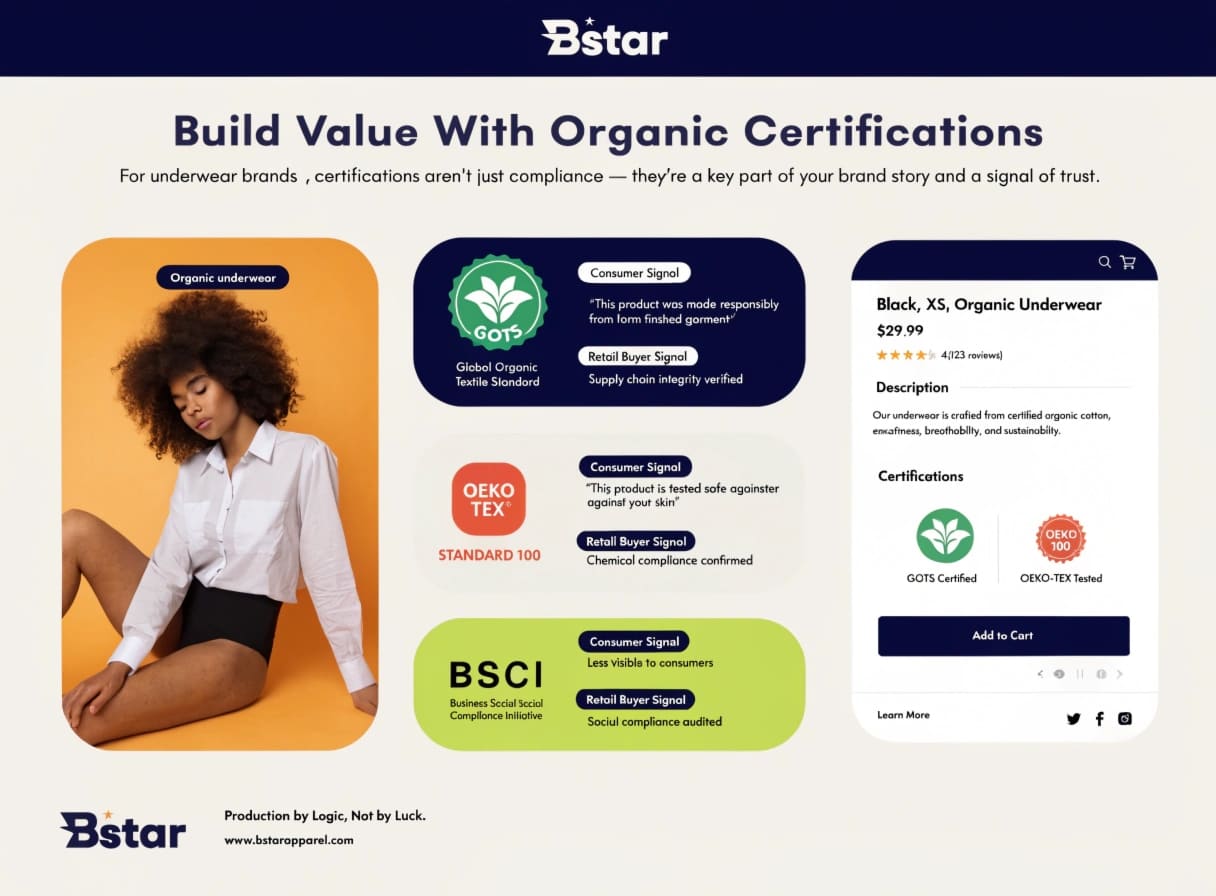
Here is what we observe across the brands we work with at different stages of growth.
Early-stage brands often use certification language loosely — "made with organic cotton" without a TC in hand, or "certified materials" when only the fiber has an OCS certificate. This creates real liability. Retailers, especially in the EU, are tightening their scrutiny on sustainability claims following greenwashing enforcement actions8. A claim you can’t document is a claim that can come back at you.
More established brands treat their certification stack as a competitive moat. The investment in GOTS and OEKO-TEX certification creates a barrier that casual competitors can’t easily replicate9. It also opens doors — certain retail channels, corporate procurement programs, and B2B buyers explicitly require certified documentation before they’ll even evaluate a new supplier or brand10.
| Certification | Consumer Signal | Retail Buyer Signal |
|---|---|---|
| GOTS | "This product was made responsibly from farm to finished garment" | Supply chain integrity verified |
| OEKO-TEX STANDARD 100 | "This product is tested safe against your skin" | Chemical compliance confirmed |
| BSCI11 | Less visible to consumers | Social compliance audited |
One practical tip from our onboarding conversations: put your TC number and certification references on your product page, not just in your brand story section. Consumers who are willing to pay a premium for certified organic underwear are also the consumers who will look for that documentation12. Making it easy to find is part of the product experience.
We work with brands at early stages where getting the certification story straight is part of the factory selection conversation. The brands that grow fastest in this category are the ones who understand that their certification isn’t just a badge — it’s a commitment that needs to run all the way through their supply chain.
Conclusion
Organic cotton underwear certifications are not interchangeable. GOTS covers your supply chain, OEKO-TEX covers your product safety, and your brand still needs its own TC. Get this right before production starts.
-
"GOTS – Wikipedia", https://en.wikipedia.org/wiki/GOTS. The Global Organic Textile Standard (GOTS) defines certification requirements spanning raw fiber through finished textile, including chemical inputs and social compliance criteria at each certified facility; see GOTS e.V., ‘Global Organic Textile Standard Version 7.0’ (2023). Evidence role: definition; source type: institution. Supports: GOTS covers fiber, processing, manufacturing, and social criteria across the supply chain. Scope note: The standard document is periodically revised; readers should confirm the current version applies to their certification cycle. ↩
-
"Organic Content Standard (OCS) – Textile Exchange", https://textileexchange.org/organic-content-standard/. Textile Exchange’s Organic Content Standard (OCS) is designed to verify the presence and amount of organically grown material in a final product, and explicitly does not address processing inputs, chemical safety, or labor conditions; see Textile Exchange, ‘Organic Content Standard (OCS) Version 3.0’. Evidence role: definition; source type: institution. Supports: OCS verifies organic material content in a product but does not address processing conditions, chemical use, or social compliance. Scope note: OCS version requirements may be updated; the cited version should be confirmed against the current Textile Exchange publication. ↩
-
"Traceability – GOTS", https://global-standard.org/the-standard/gots-key-features/traceability. Under GOTS chain-of-custody requirements, each operator handling certified goods must hold a valid GOTS certificate; a gap in certification at any processing stage renders the final product ineligible for a GOTS label claim; see GOTS e.V., ‘Global Organic Textile Standard Version 7.0,’ Section 5. Evidence role: mechanism; source type: institution. Supports: GOTS requires all processing stages to be performed by certified operators to maintain a valid chain of custody for the final product claim. Scope note: Specific section numbering may differ across GOTS versions; the principle should be verified against the version in force at time of production. ↩
-
"OEKO-TEX® STANDARD 100", https://www.oeko-tex.com/en/our-standards/oeko-tex-standard-100/. OEKO-TEX STANDARD 100 specifies limit values for over 100 substance groups in finished textile products, including pesticide residues, heavy metals, formaldehyde, and allergenic colorants; see OEKO-TEX Association, ‘OEKO-TEX Standard 100 Annex 6’ (current edition). Evidence role: definition; source type: institution. Supports: OEKO-TEX STANDARD 100 tests finished textile articles for a defined list of harmful substances including pesticide residues, heavy metals, formaldehyde, and allergenic dyes. Scope note: The tested substance list is updated annually; the applicable edition should be confirmed for the production year in question. ↩
-
"Heavy Metals in Infant Clothing: Assessing Dermal Exposure Risks …", https://pmc.ncbi.nlm.nih.gov/articles/PMC12390519/. Research on dermal exposure pathways indicates that textiles worn in direct skin contact, such as underwear, present greater potential for chemical absorption than garments worn over other clothing layers; see, e.g., Rovira et al., ‘Human exposure to trace elements through the skin by direct contact with clothing,’ Science of the Total Environment (2015). Evidence role: mechanism; source type: paper. Supports: Prolonged direct skin contact with textiles increases potential dermal exposure to chemical residues compared to outerwear. Scope note: Exposure levels depend on specific chemical concentrations and individual skin characteristics; the cited study addresses trace elements and may not generalize to all substance classes. ↩
-
"A Guide to United States Apparel and Household Textiles …", https://www.cpsc.gov/s3fs-public/Guide-to-US-Apparel-and-Household-Textiles.pdf. Industry sustainability reporting, including Textile Exchange’s annual market reports, documents growing retailer adoption of third-party chemical safety certifications such as OEKO-TEX STANDARD 100 as baseline supplier requirements; see Textile Exchange, ‘Preferred Fiber & Materials Market Report’ (most recent edition). Evidence role: general_support; source type: institution. Supports: Retailers in major markets are incorporating chemical safety certification requirements into supplier standards. Scope note: Market reports reflect aggregate trends and may not capture individual retailer policies; specific retailer requirements should be confirmed directly with the buyer. ↩
-
"Certification – GOTS – Global Organic Textile Standard", https://global-standard.org/certification-and-labelling/certification. GOTS requires that a Transaction Certificate (TC) be issued by an approved certification body for each shipment of GOTS-certified goods, and that the brand or trader receiving the goods be registered in the GOTS system; see GOTS e.V., ‘GOTS Labelling Requirements and Transaction Certificate Procedure.’ Evidence role: mechanism; source type: institution. Supports: Use of the GOTS label or claim on a finished product requires a valid Transaction Certificate issued by an accredited certification body. Scope note: TC procedural requirements may be updated; the current GOTS certification body guidelines should be consulted for the applicable version. ↩
-
"[PDF] Enforcing Consumer Protection Laws Against Greenwashing in the …", https://scholarlycommons.law.emory.edu/cgi/viewcontent.cgi?article=1324&context=eilr. The European Commission’s proposed Green Claims Directive (2023) and prior enforcement actions by national consumer protection authorities establish a regulatory framework under which unsubstantiated sustainability claims, including organic labeling without certification, may constitute unfair commercial practices; see European Commission, ‘Proposal for a Directive on Green Claims,’ COM(2023) 166 final. Evidence role: historical_context; source type: government. Supports: EU regulatory bodies have pursued enforcement actions related to unsubstantiated sustainability and organic claims. Scope note: The Green Claims Directive was in legislative process as of 2024; its final adopted form and transposition timeline should be verified for current applicability. ↩
-
"[PDF] Measuring the Competitive Advantage of the US Textile and Apparel …", https://web.mit.edu/is08/pdf/Parrish.pdf. Research on eco-labeling and certification in consumer goods markets suggests that credible third-party certifications reduce consumer uncertainty and can confer price premiums and retailer access advantages that are difficult for uncertified competitors to replicate; see Darnall et al., ‘Do Voluntary Environmental Programs Reduce Pollution?’ Policy Studies Journal (2010). Evidence role: general_support; source type: paper. Supports: Third-party sustainability certifications can function as differentiation signals that create barriers to entry for non-certified competitors. Scope note: The cited research addresses voluntary environmental programs broadly; direct evidence specific to GOTS or OEKO-TEX as competitive barriers in the underwear segment is limited. ↩
-
"Sustainable Fashion and Apparel Design: Standards | Certificates", https://guides.library.cornell.edu/c.php?g=662121&p=5277662. Sustainability procurement frameworks published by major retail groups and industry bodies such as the Sustainable Apparel Coalition document the use of third-party certifications, including GOTS and OEKO-TEX, as baseline criteria in supplier qualification processes; see Sustainable Apparel Coalition, ‘Higg Index Facility Environmental Module’ documentation. Evidence role: general_support; source type: institution. Supports: Corporate and retail procurement programs in the textile sector increasingly list third-party certifications as mandatory supplier criteria. Scope note: Specific certification requirements vary by retailer and procurement program; the cited framework provides general context rather than confirmation of any individual buyer’s policy. ↩
-
"amfori BSCI Certification & BSCI Audit Services | TÜV SÜD", https://www.tuvsud.com/en-us/services/auditing-and-system-certification/amfori-business-social-compliance-initiative. The Business Social Compliance Initiative (BSCI), administered by amfori, is a supply chain management system that audits facilities against a code of conduct covering labor rights, health and safety, and management practices; see amfori, ‘amfori BSCI System Description’ (current edition). Evidence role: definition; source type: institution. Supports: BSCI is a social compliance auditing program administered by amfori that assesses labor conditions in supply chain facilities. Scope note: BSCI audits assess compliance at a point in time and do not constitute continuous monitoring; audit outcomes should be interpreted alongside other social compliance data. ↩
-
"[PDF] Consumer likelihood of purchasing organic cotton apparel", https://www.ftc.gov/system/files/documents/public_events/975753/hustvedt_et_al_on_consumer_likelihood_2009.pdf. Consumer behavior research on eco-labels indicates that environmentally conscious consumers who demonstrate willingness to pay premiums for certified products also exhibit greater information-seeking behavior regarding certification credentials; see Thøgersen et al., ‘Consumer responses to ecolabels,’ European Journal of Marketing (2010). Evidence role: general_support; source type: paper. Supports: Consumers who pay premiums for certified organic or sustainable products show higher engagement with certification information and label transparency. Scope note: The cited study addresses eco-labels generally and may not reflect behavior specific to organic underwear consumers or the specific format of TC number disclosure on product pages. ↩