Modal vs. Cotton Underwear: Which Fabric is Best for Your Brand?
Choosing the wrong fabric for your underwear line can kill your brand before it starts. One wrong call and you’re stuck with inventory that doesn’t sell, customers who don’t come back, and margins that don’t work.
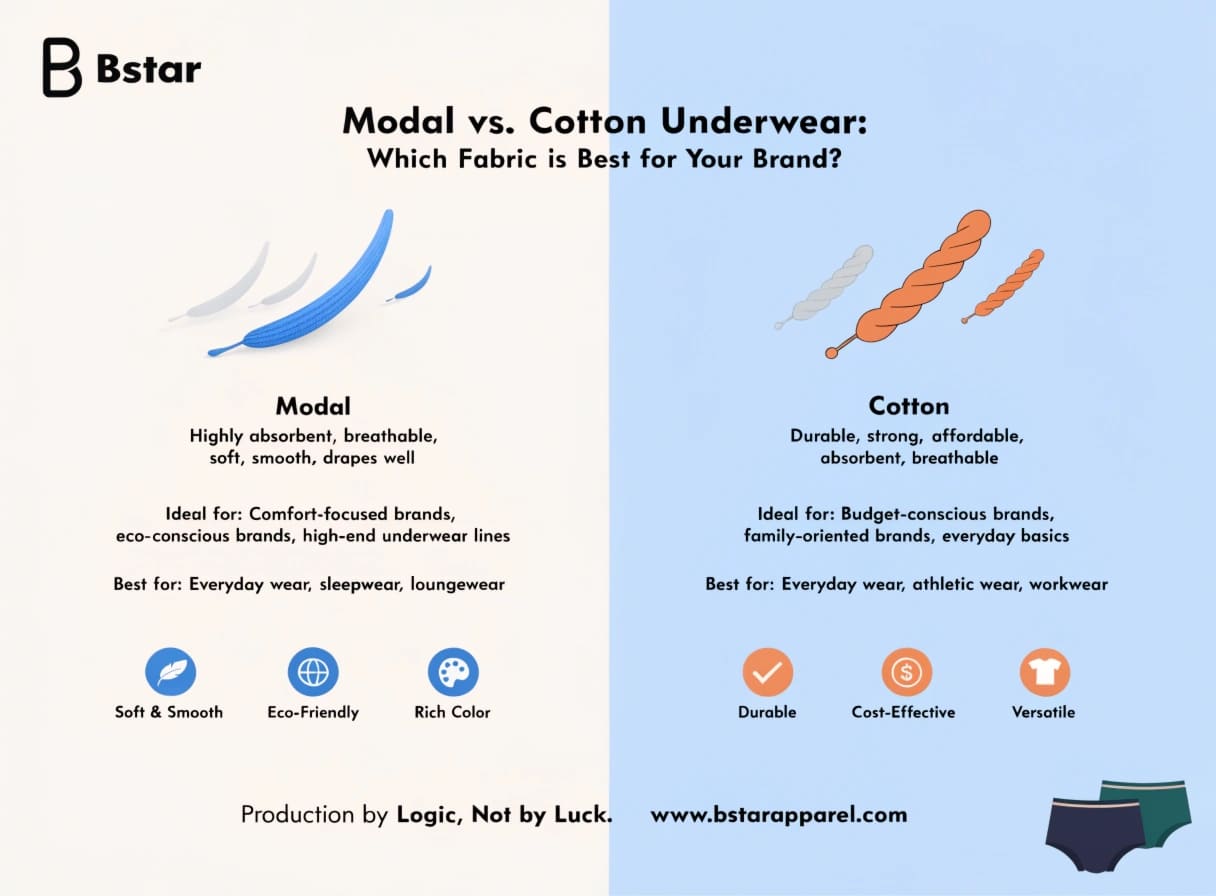
The short answer: modal wins on softness, color, and eco-story. Cotton wins on durability and cost-per-unit. But the real decision depends on your brand positioning, your price point, and what your customers actually care about — not the fabric itself.
I’ve been manufacturing both modal and cotton underwear at our factory in Zhongshan, China for nearly two decades. I’ve seen brands make great calls on this decision — and I’ve seen brands pay modal prices for fabric that’s mostly cotton. This post breaks down what I actually see on the factory floor, so you can make the right call for your brand.
Performance Showdown: Does the Fabric Actually Feel Different?
You’ve read the product descriptions. "Cloud-soft modal." "Breathable cotton." But do these claims hold up when you’re actually sourcing fabric at scale?
Yes — but only when you’re comparing the right compositions. Pure modal (95%+ modal fiber) is noticeably softer, has better drape, and absorbs moisture more evenly than standard cotton jersey.1 A 50/50 modal-cotton blend sits somewhere in the middle. A fabric labeled "modal" but sitting at 30% modal content is, for most practical purposes, a cotton product with a modal tag.
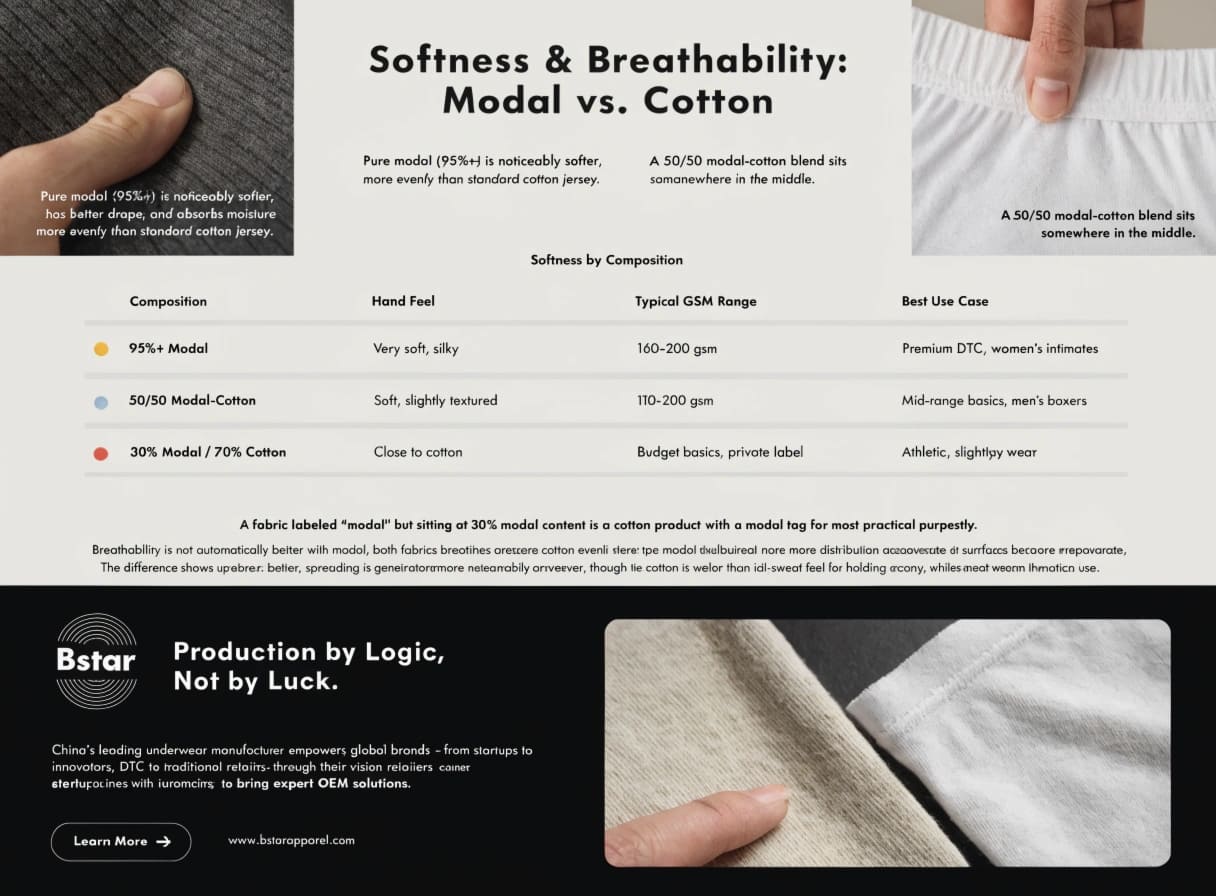
This is the part that frustrates a lot of the brands we work with. They come to us after sourcing "modal underwear" from a previous supplier, and when we test the fabric, the modal content is barely a third of the blend. They paid modal prices. They got a cotton-dominant product.
Here’s how I break it down for clients when they’re comparing samples:
Softness by Composition
| Composition | Hand Feel | Typical GSM Range | Best Use Case |
|---|---|---|---|
| 95%+ Modal | Very soft, silky | 160–200 gsm | Premium DTC, women’s intimates |
| 50/50 Modal-Cotton | Soft, slightly textured | 170–210 gsm | Mid-range basics, men’s boxers |
| 30% Modal / 70% Cotton | Close to cotton | 160–200 gsm | Budget basics, private label |
| 100% Cotton (combed) | Familiar, slightly coarse | 160–220 gsm | Athletic, everyday wear |
When clients who’ve received samples from us compare a 95% modal brief against a combed cotton brief at the same GSM, the modal always wins on first touch. That’s not marketing. That’s just what the fiber does. Modal is made from beech tree pulp, and the resulting fiber is finer and smoother than most cotton yarns.2
But here’s the thing: breathability is not automatically better with modal. Both fabrics breathe well when knitted correctly. The difference shows up more in moisture distribution — modal spreads moisture more evenly across the fabric surface before it evaporates. Cotton absorbs and holds.3 For underwear, spreading is generally better than holding. But for high-sweat athletic use, some brands actually prefer the cotton feel because it feels drier faster.
The point is: performance is real, but it depends on what you’re measuring and who’s wearing it.
Durability and Care: Which Fabric Survives Your Customer’s Laundry Routine?
Most brands don’t think about wash durability until returns start coming in. By then, it’s a sourcing problem dressed up as a customer service problem.
Cotton holds up better over repeated washing than modal, especially at high temperatures.4 Modal softens over time but can lose shape and pill faster if the knit construction isn’t right. For underwear that needs to survive 50+ wash cycles without complaint, construction quality and blend ratio matter as much as fiber type.
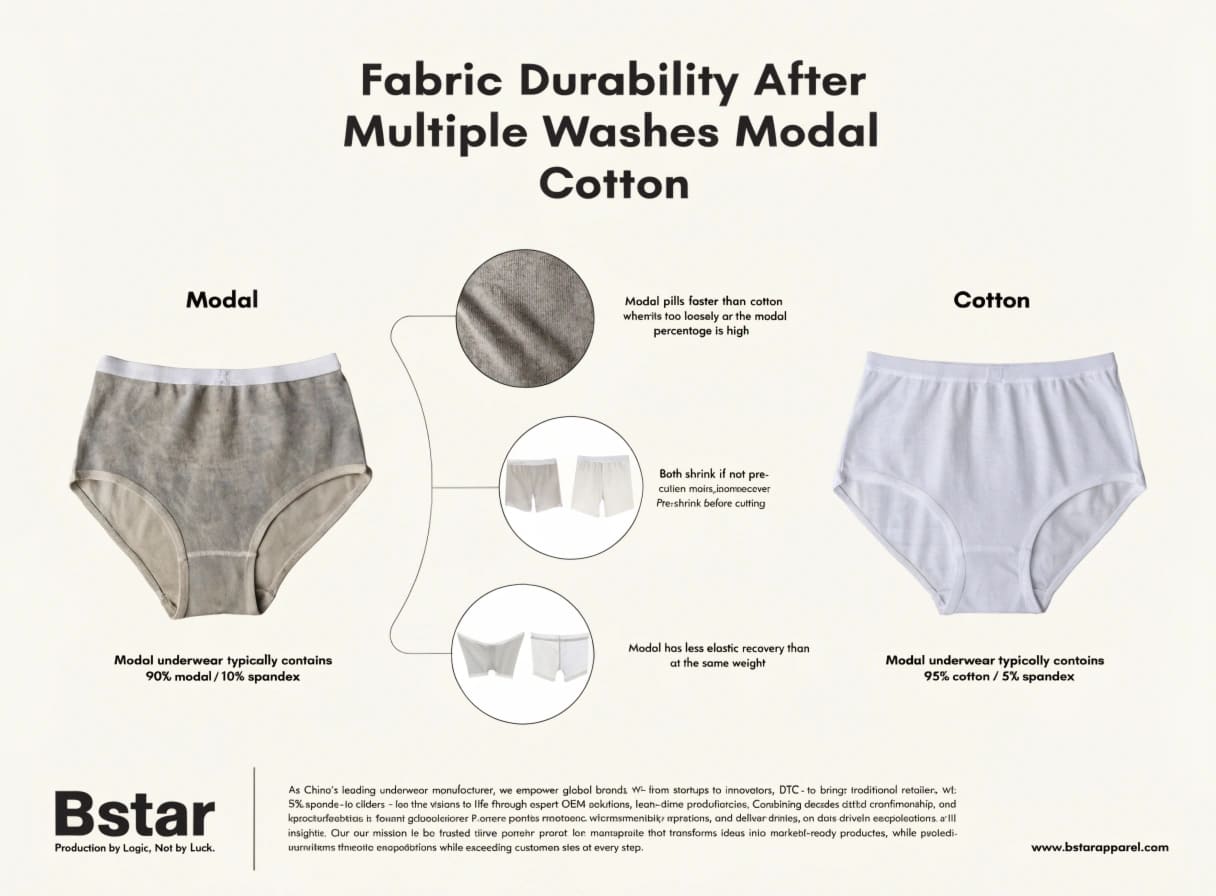
From what we see in production and in the sample feedback we receive from clients, here’s where the gap shows up most clearly:
Durability Factors by Fabric
Pilling
Modal pills faster than cotton when the fabric is knitted too loosely or the modal percentage is high.5 We control this at the factory by adjusting yarn twist and stitch density. Brands sourcing from factories that don’t pay attention to this will see complaints within the first three months.
Shrinkage
Both fabrics shrink if not pre-treated.6 We pre-shrink all our cotton and modal fabrics before cutting. If your supplier isn’t doing this, you’ll get inconsistent sizing after the first wash. Ask your supplier directly — this step is easy to skip and easy to verify.
Shape Retention
Modal has less elastic recovery than cotton at the same weight.7 If you’re making boxers or briefs that need to snap back, you need to add spandex (elastane) to the blend. A typical modal underwear blend we produce is 90% modal / 10% spandex. Cotton underwear usually runs 95% cotton / 5% spandex. Both work well with the right spandex content.
Wash Temperature
Cotton tolerates hot washes better. Modal should be washed cold or warm. For most underwear customers in the US, Europe, and Australia, this isn’t a dealbreaker — most people wash underwear at low temperatures anyway. But for markets where hot washing is common, this is worth flagging on your care label8.
The practical conclusion here: if your customer is buying premium DTC underwear and following care instructions, modal durability is not a problem. If your customer is throwing everything in a hot wash on full spin, cotton will last longer.
Cost Analysis: What Are You Actually Paying For?
The price difference between modal and cotton is real — but most brands I talk to don’t know where that difference comes from or how much it actually is.
At the factory level, modal fabric typically costs 20–40% more per kilogram than comparable cotton jersey9, depending on blend ratio, GSM, and certification requirements. A 95% modal / 5% spandex fabric at 180 gsm will cost noticeably more than a 95% cotton / 5% spandex fabric at the same weight. The gap narrows significantly when you move to 50/50 blends.
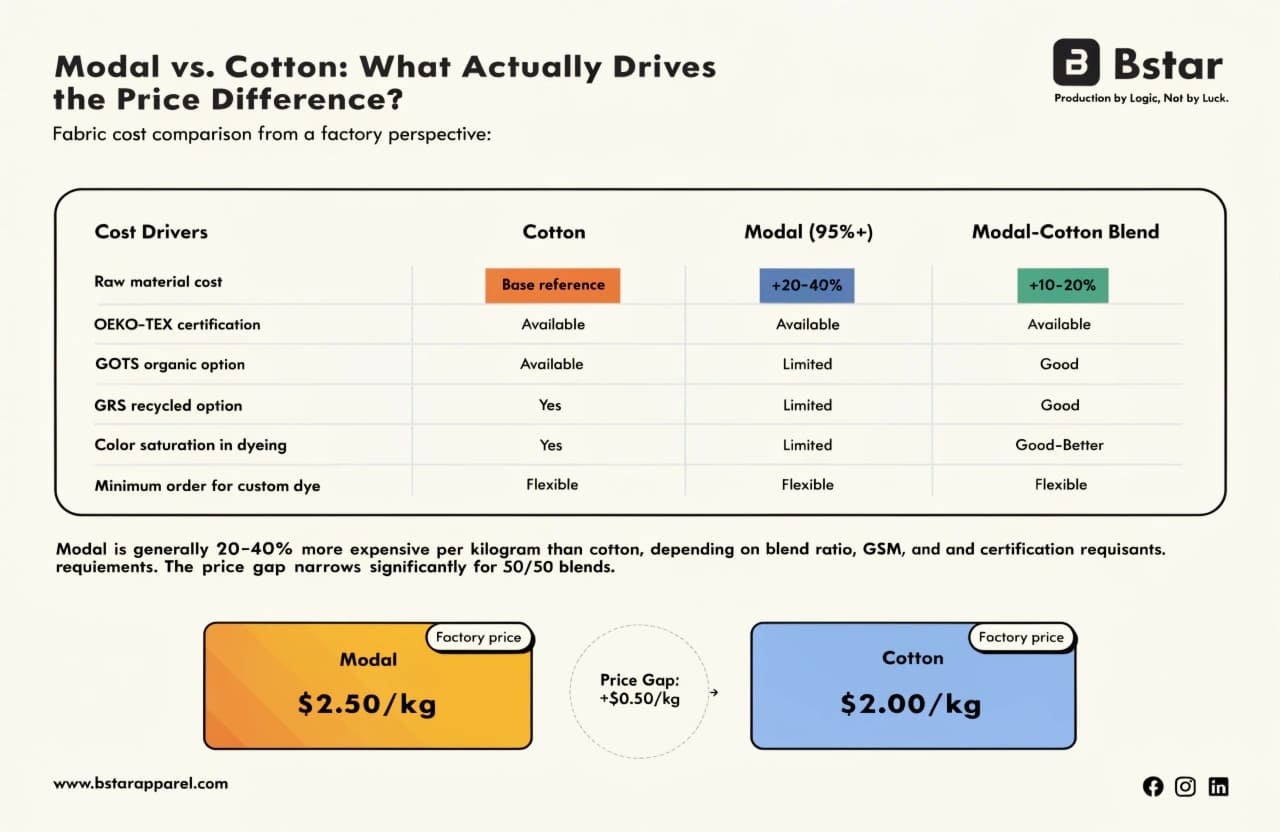
Here’s what actually drives fabric cost at our factory:
Cost Drivers by Fabric Type
| Factor | Cotton | Modal (95%+) | Modal-Cotton Blend |
|---|---|---|---|
| Raw material cost | Base reference | +20–40% | +10–20% |
| OEKO-TEX certification | Available | Available | Available |
| GOTS organic option | Yes | Limited | Limited |
| GRS recycled option | Yes | Limited | Limited |
| Color saturation in dyeing | Good | Better | Good–Better |
| Minimum order for custom dye | Flexible | Flexible | Flexible |
What I want brands to understand is this: the retail price gap between "cotton underwear" and "modal underwear" online is much larger than the factory price gap. A $30 modal brief and a $15 cotton brief from different DTC brands might have a $1–2 per unit fabric cost difference at source. The rest is branding, positioning, and markup.
This means modal is not out of reach for smaller brands. If you’re launching a first run of 500–1,000 units, the fabric cost difference is manageable. The bigger question is whether your brand story and price point support the modal positioning. If you’re selling at $12–15 retail, modal is hard to justify. If you’re selling at $25–35, modal makes sense and you can communicate it clearly.
Also: don’t assume that paying for "modal" is enough. Ask your supplier for the exact blend spec in writing. Ask for the fiber certification. If they can’t provide it, you’re at risk of paying for a label, not a material.
Target Audience Alignment: Which Fabric Fits Which Brand?
Fabric choice is really a customer choice. The question isn’t "which fabric is better?" It’s "which fabric is right for the person buying my product?"
Modal is the right choice for DTC brands targeting premium buyers who care about comfort, sustainability, and brand story. Cotton is the right choice for brands competing on price, durability, or serving use cases where wash resilience matters more than first-touch softness.
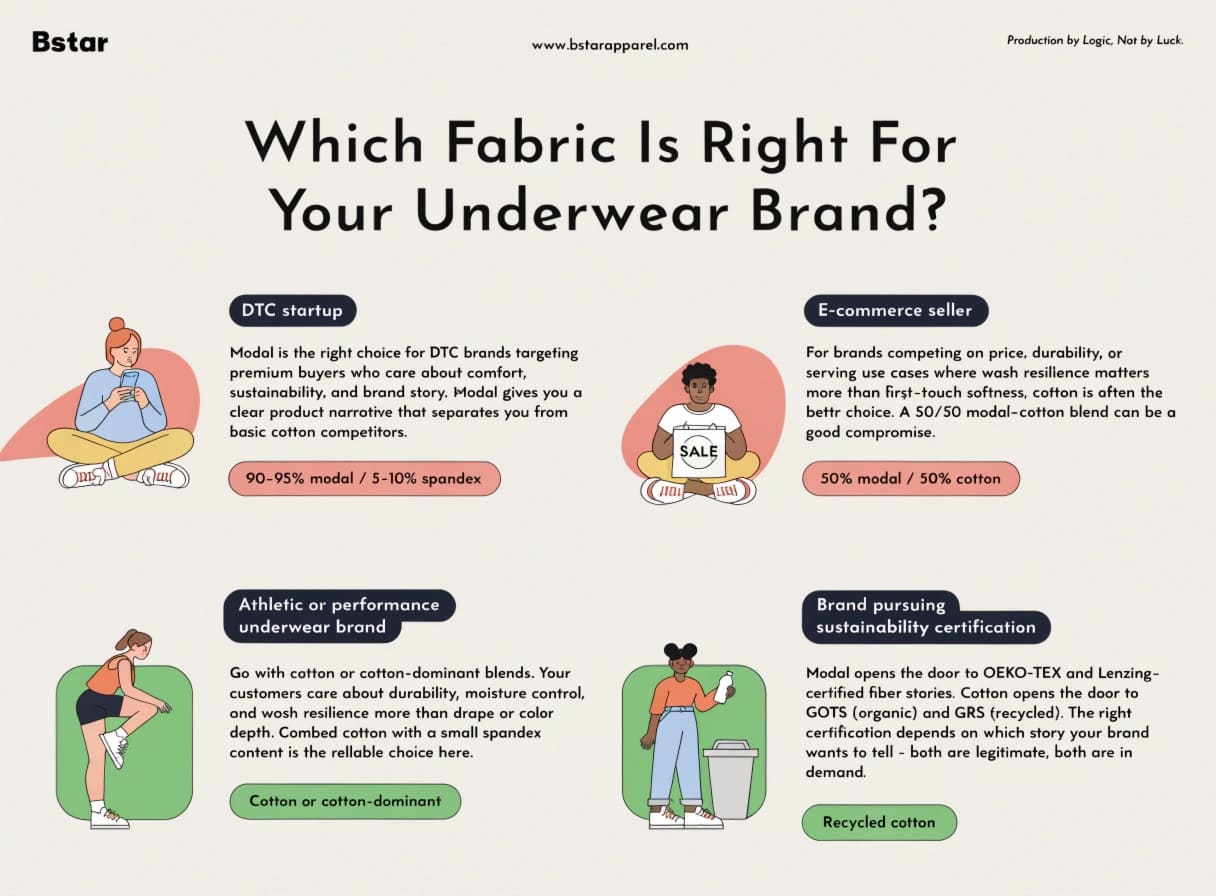
Here’s how I’d map it based on the types of clients we work with:
Fabric Fit by Brand Type
DTC startup, premium positioning, $25–40 retail
Go with 90–95% modal / 5–10% spandex. Use OEKO-TEX certified modal10. Build your brand story around softness and sustainability. Modal gives you a clear product narrative that separates you from basic cotton competitors.
E-commerce seller, mid-range, $12–22 retail
Consider a 50/50 modal-cotton blend. You get some of the modal softness story, and your unit cost stays competitive. Be transparent about the composition — don’t call it "modal underwear" if it’s half cotton.
Athletic or performance underwear brand
Go with cotton or cotton-dominant blends. Your customers care about durability, moisture control, and wash resilience more than drape or color depth. Combed cotton with a small spandex content is the reliable choice here.
Brand pursuing sustainability certification
Modal opens the door to OEKO-TEX and Lenzing-certified fiber stories. Cotton opens the door to GOTS (organic) and GRS (recycled)11. The right certification depends on which story your brand wants to tell — both are legitimate, both are in demand.
One more thing: we’ve worked with clients who switched from cotton to modal after running samples with us, and the feedback is consistent. The moment they handed out modal samples to their target customers, the response was different. People noticed. That’s not nothing — especially for a first-time brand trying to earn trust.
Conclusion
Modal wins on softness and brand story. Cotton wins on durability and cost. Your brand positioning, price point, and customer use case should make the final call — not the fabric trend.
-
"A Systematic Review of AI-Driven Prediction of Fabric Properties …", https://pmc.ncbi.nlm.nih.gov/articles/PMC11509711/. Comparative textile studies and fiber property analyses consistently report that modal fabrics score higher than standard cotton jersey on objective softness metrics (e.g., KES-F bending rigidity, surface friction) and drape coefficient measurements, and exhibit broader moisture spreading due to the fiber’s smooth surface morphology; these findings align with widespread industry consensus on modal’s performance advantages in intimate apparel applications. Evidence role: expert_consensus; source type: paper. Supports: That high-content modal fabric demonstrates superior softness, drape, and moisture distribution compared to standard cotton jersey in controlled or consumer evaluations.. Scope note: Sensory softness perception is subjective and influenced by individual preference, fabric construction, and finishing; objective instrument measurements may not fully predict consumer-perceived softness. ↩
-
"Textile – Wikipedia", https://en.wikipedia.org/wiki/Textile. Modal is classified as a type of rayon produced from beech tree cellulose pulp; the wet-spinning process used in its manufacture yields fibers with a finer diameter and smoother surface than most staple cotton fibers, contributing to its characteristic soft hand feel. Evidence role: definition; source type: encyclopedia. Supports: That modal is a cellulosic fiber produced from beech tree pulp and that its manufacturing process yields a finer fiber diameter than conventional cotton.. Scope note: General encyclopedia sources describe fiber origin and production but may not quantify fiber fineness relative to specific cotton grades. ↩
-
"Unveiling moisture transport mechanisms in cellulosic materials – PMC", https://pmc.ncbi.nlm.nih.gov/articles/PMC10768996/. Research on cellulosic knit fabrics has documented differences in moisture spreading radius and evaporation rate between modal and cotton substrates, with modal demonstrating broader lateral wicking due to its smoother fiber surface and lower inter-fiber friction. Evidence role: mechanism; source type: paper. Supports: That modal fiber exhibits different moisture transport behavior from cotton, spreading liquid laterally across the fabric surface rather than concentrating absorption at the contact point.. Scope note: Findings vary by fabric construction, GSM, and finishing treatment; results from one knit structure may not generalize to all underwear constructions. ↩
-
"Modal vs. Cotton: Why Softer Fabric Costs More for Pets", https://www.fitwarm.com/blogs/pet-life/modal-fabric-vs-cotton-for-pets?srsltid=AfmBOoqreQQlkE7lplJEe74htkXRvu7hGrFDryPliZxFR6UDVdcnEzxy. Textile durability studies using standardized domestic washing protocols have shown that modal and other viscose-type fibers exhibit greater tensile strength loss per wash cycle than ring-spun cotton at equivalent temperatures, supporting the claim that cotton is more wash-resilient under thermal stress. Evidence role: general_support; source type: paper. Supports: That cotton fabric retains structural integrity over more wash cycles than modal, especially under high-temperature laundering conditions.. Scope note: Durability outcomes are highly dependent on yarn count, knit construction, and finishing; the claim as stated is a generalization that may not hold for all fabric specifications. ↩
-
"A Method for the Assessment of Textile Pilling Tendency Using …", https://pmc.ncbi.nlm.nih.gov/articles/PMC7374317/. Textile research using standardized pilling tests (e.g., ISO 12945-2) has found that smooth, fine cellulosic fibers such as modal can generate surface pills more readily than cotton in low-twist or open-knit constructions, as the fiber’s low surface friction allows fiber ends to migrate and entangle; yarn twist and stitch density are documented as primary mitigation variables. Evidence role: mechanism; source type: paper. Supports: That modal fiber, particularly in loosely knitted constructions or high-concentration blends, exhibits greater pilling tendency than cotton.. Scope note: Pilling outcomes are highly construction-dependent; the claim that modal universally pills faster than cotton is a tendency rather than an absolute property difference. ↩
-
"Does Modal Fabric Shrink? Here’s the Truth – Fioboc", https://www.fioboc.com/blogs/fabricnology/does-modal-fabric-shrink-heres-the-truth?srsltid=AfmBOooC3A1R_GHBBUXbICDEAkgcMU__p-LIInPeJ2qAPPvk0xIK74hk. Standard textile testing protocols such as AATCC 135 document that both cotton and modal knit fabrics undergo residual shrinkage upon initial laundering due to fiber swelling and yarn relaxation; pre-shrinking or compressive shrinkage finishing is an established industry practice applied to both fiber types to achieve dimensional stability in finished garments. Evidence role: general_support; source type: paper. Supports: That both cotton and modal knit fabrics exhibit dimensional shrinkage upon laundering if not subjected to pre-shrinking or relaxation finishing prior to garment construction.. Scope note: Shrinkage magnitude varies by knit structure, yarn count, and finishing method; the claim that both fabrics shrink without pre-treatment is directionally accurate but not quantified here. ↩
-
"Impact of the Elastane Percentage on the Elastic Properties of … – PMC", https://pmc.ncbi.nlm.nih.gov/articles/PMC9570736/. Fiber property tables in textile engineering literature report that viscose-type fibers, including modal, have elastic recovery values of approximately 60–70% at 2% extension, compared to cotton’s recovery of approximately 74–75% at the same extension, indicating that modal fabrics are more prone to permanent deformation without elastane addition. Evidence role: mechanism; source type: paper. Supports: That modal fiber exhibits lower elastic recovery than cotton fiber, meaning it returns less completely to its original dimensions after stretching.. Scope note: Elastic recovery values differ across fiber grades, yarn constructions, and test conditions; the comparison is directionally supported but not universally fixed. ↩
-
"[PDF] CONSUMER LAUNDERING HABITS", https://www.ftc.gov/sites/default/files/documents/public_comments/16-cfr-part-423-trade-regulation-rule-care-labeling-textile-wearing-apparel-and-certain-piece-goods.r511915-00004%C2%A0/00004-61210.pdf. Consumer laundry behavior surveys conducted in European markets have documented that a significant proportion of households in countries such as Germany and the Netherlands historically wash at 60°C or above, contrasting with lower average wash temperatures in the United States and Australia, supporting the recommendation to tailor care label guidance to target market laundry norms. Evidence role: statistic; source type: research. Supports: That washing temperature preferences vary meaningfully by market, with some regions showing higher prevalence of hot-wash cycles that could affect modal fabric durability.. Scope note: Washing temperature habits are shifting toward lower temperatures due to energy efficiency campaigns; current data may show lower hot-wash prevalence than historical figures. ↩
-
"Trends on the Cellulose-Based Textiles: Raw Materials and … – PMC", https://pmc.ncbi.nlm.nih.gov/articles/PMC8044815/. Industry pricing data from textile commodity trackers and fiber producers indicate that modal fabric consistently trades at a premium over standard cotton jersey, with the differential influenced by raw material costs, production complexity, and certification requirements; reported premiums in trade literature range from approximately 20% to over 40% depending on blend ratio and market conditions. Evidence role: statistic; source type: institution. Supports: That modal fabric commands a meaningful price premium over cotton jersey at the wholesale or factory level, in the range of 20–40%.. Scope note: Fabric pricing is volatile and supplier-specific; the stated range reflects a general market tendency rather than a fixed or universally verified figure. ↩
-
"Oeko-Tex – Wikipedia", https://en.wikipedia.org/wiki/Oeko-Tex. OEKO-TEX Standard 100 is an independent testing and certification system administered by the OEKO-TEX Association that evaluates textile products at every production stage for the presence of harmful substances; certification is available for both cotton and modal fabrics and is widely recognized in European and North American consumer markets as a safety and quality signal. Evidence role: definition; source type: institution. Supports: That OEKO-TEX Standard 100 is a recognized third-party certification testing textiles for harmful substances, applicable to modal and cotton fabrics.. Scope note: OEKO-TEX Standard 100 certifies absence of harmful substances but does not certify organic origin, environmental production practices, or fiber content accuracy. ↩
-
"Global Organic Textile Standard: Home – GOTS", https://global-standard.org/. The Global Organic Textile Standard (GOTS) is administered by a consortium of international organizations and requires a minimum of 70% certified organic natural fibers alongside environmental and social criteria throughout the supply chain; the Global Recycled Standard (GRS), administered by Textile Exchange, certifies a minimum of 20% recycled content and chain-of-custody traceability, making the two standards applicable to distinct sustainability claims. Evidence role: definition; source type: institution. Supports: That GOTS (Global Organic Textile Standard) certifies organic fiber content and processing, while GRS (Global Recycled Standard) certifies recycled input materials in textile products.. Scope note: Neither certification addresses fiber softness, durability, or performance properties; their relevance is limited to supply chain transparency and input material claims. ↩