
Nude Tone Underwear: Can Your Factory Actually Match Diverse Skin Tones in Production?
Most brands discover the problem after the bulk order lands. The color looks off. Customers return it. The reorder doesn’t match the first batch.
Nude-tone underwear fails at production, not at retail. To match diverse skin tones consistently, you need a defined color standard, the right fabric weight and fiber, and a written tolerance agreement — before sampling starts, not after.
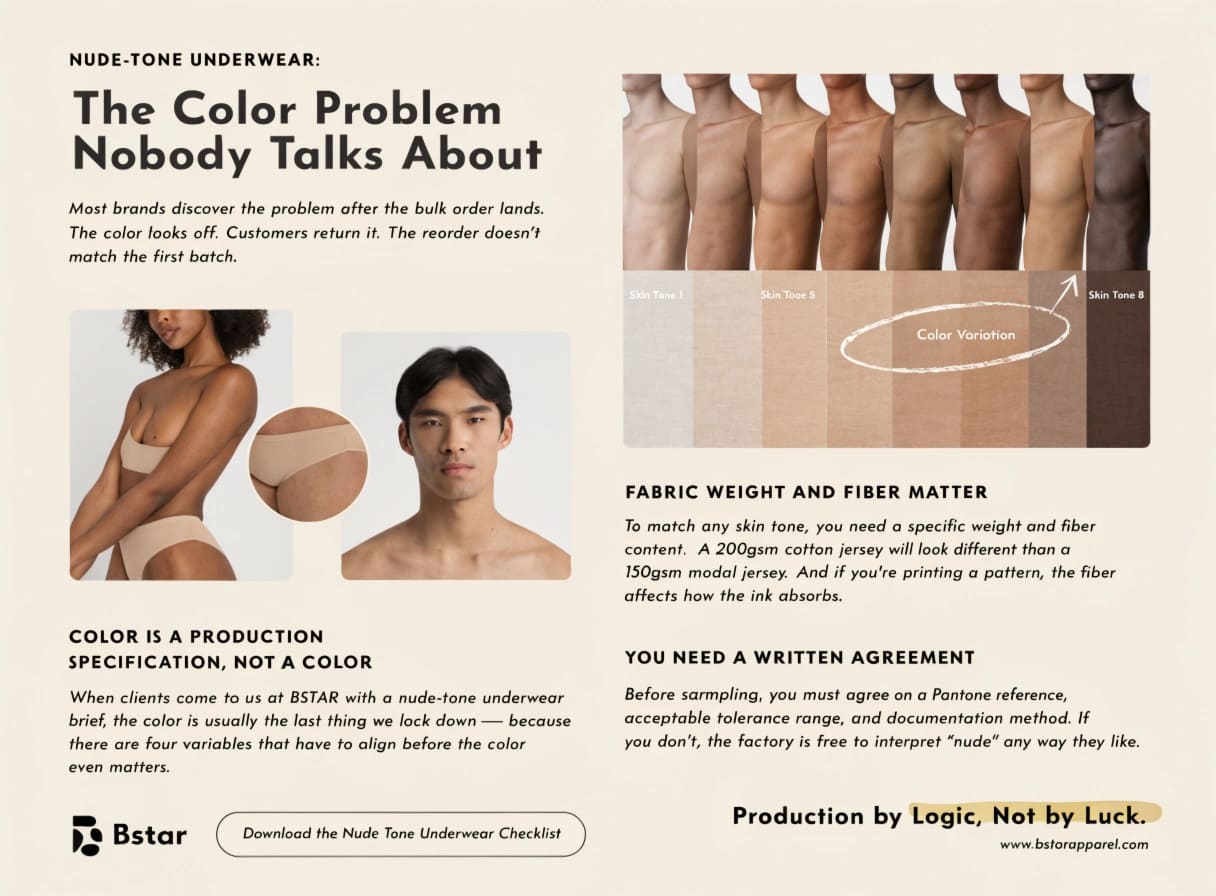
Here’s the thing most brands miss: "nude" is not a color. It’s a production specification. When clients come to us at BSTAR with a nude-tone underwear brief, the color is usually the last thing we lock down — because there are four variables that have to align before the color even matters. This article walks you through each one, and ends with a checklist you can use before you submit your next brief.
Redefining "Nude": Is Your Color Standard Actually Built for Your Target Market?
Brands pick a nude shade, send a reference image, and expect the factory to match it. That process works fine for solid black or navy. For nude tones, it creates a problem before sampling even starts.
"Nude" means different things in different markets. A shade that reads as skin-tone for a Northern European consumer can look stark or mismatched against deeper skin tones in the US, Southeast Asia, or the Middle East.1 Your color standard needs to be defined by your target market — not by what looked good on your mood board.
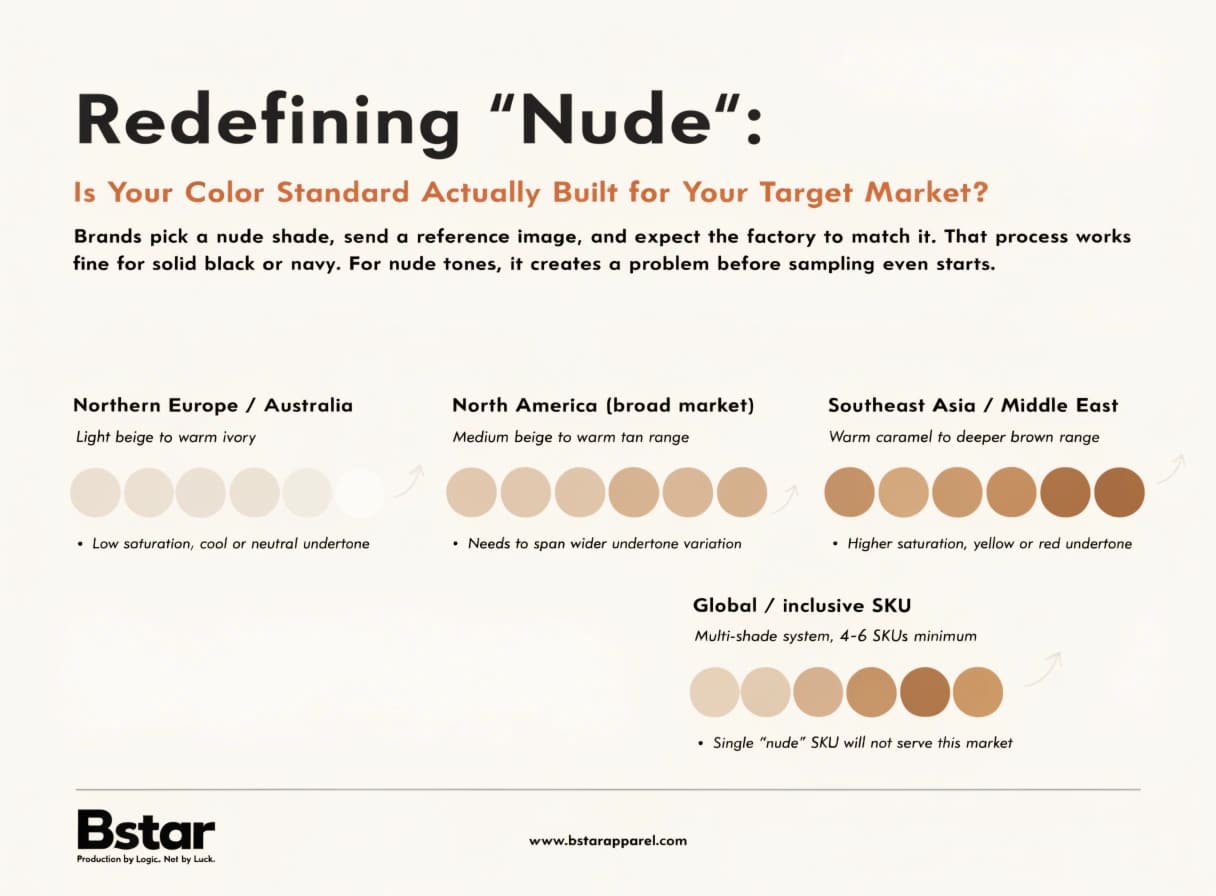
When a client briefs us on a nude-tone series, the first question we ask is: who is wearing this, and where are they? Not because we do consumer research — we don’t. But because the answer tells us which direction the color needs to go before we pull a single fabric swatch.
Why Market-First Matters in Production
Here’s how the range tends to break down across markets, at a general level:
| Market Region | General Nude Tone Direction | Key Production Note |
|---|---|---|
| Northern Europe / Australia | Light beige to warm ivory | Low saturation, cool or neutral undertone |
| North America (broad market) | Medium beige to warm tan range | Needs to span wider undertone variation |
| Southeast Asia / Middle East | Warm caramel to deeper brown range | Higher saturation, yellow or red undertone |
| Global / inclusive SKU | Multi-shade system, 4–6 SKUs minimum | Single "nude" SKU will not serve this market |
The point isn’t that these ranges are fixed rules. The point is that your factory needs a defined target range — with a physical lab-dip or Pantone reference submitted — before bulk production begins. If you brief us with "something skin-tone," we’ll ask you these questions anyway. It’s faster if you come with the answers.
One more thing worth saying: if you’re building a nude-tone range for a genuinely broad consumer base, one SKU is not a product strategy. It’s a gap.2 Most brands we work with either build a 3-shade or 6-shade system, or they define one target market clearly and match to that. Both approaches work. "One nude fits all" does not.
Precision Color Matching: Why Fabric Weight Changes Everything About How Nude Looks
Most clients fix the color number first, then pick the fabric. In our experience, that’s the wrong order — and it’s one of the most common reasons a nude-tone sample comes back looking wrong even when the dye is technically correct.
The same dye formula behaves differently on different fabrics.3 A nude color on a heavy jersey looks opaque and flat against skin. The same formula on a lightweight microfiber creates a completely different visual effect. Fabric weight and fiber type have to be confirmed before the dye trial — not after.
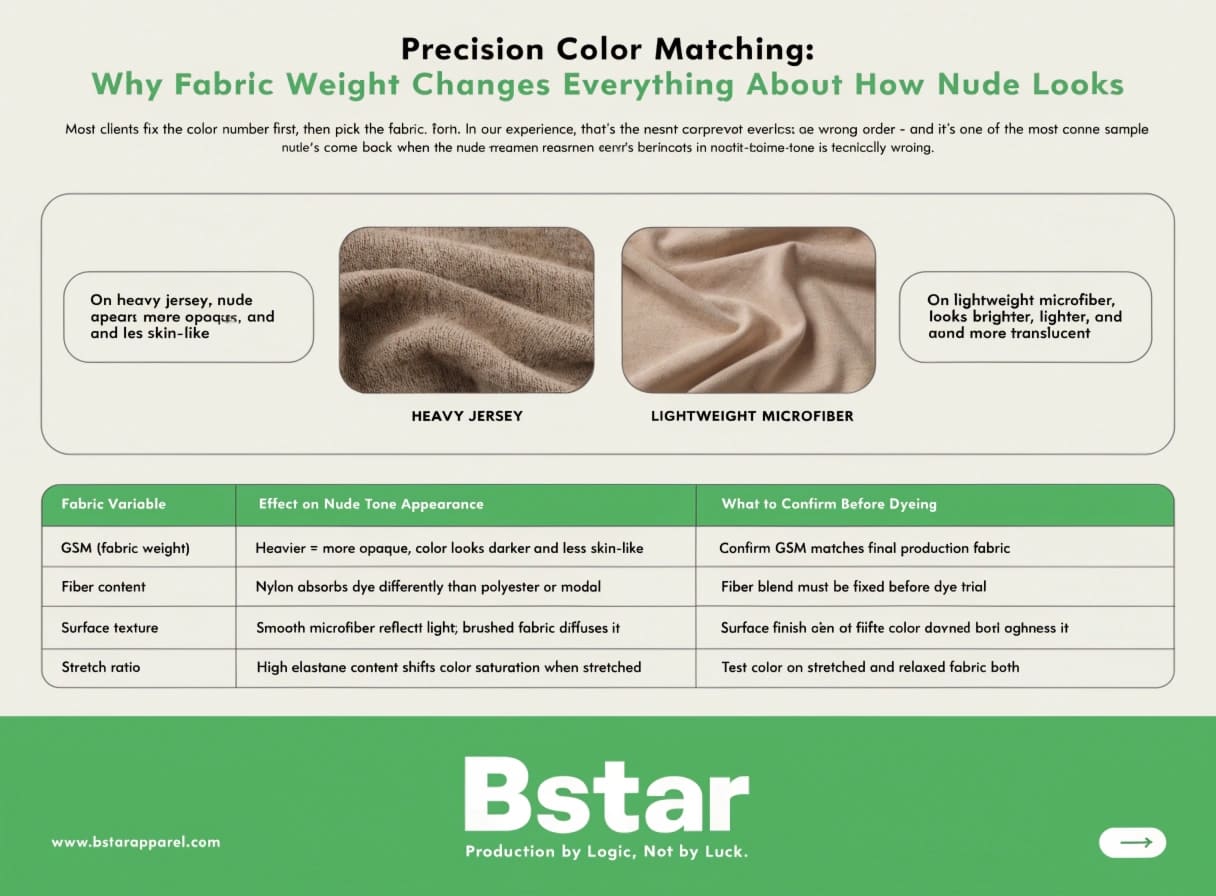
We see this come up constantly in sampling communication. A client approves a lab-dip on a standard jersey swatch, then we move to the actual production fabric — a thinner, slightly different composition — and the approved color no longer reads the same way. Now we’re re-doing the dye trial, and the timeline slips.
How Fabric Variables Affect the Final Color Read
Here’s how the main fabric variables interact with nude-tone color in practical terms:
| Fabric Variable | Effect on Nude Tone Appearance | What to Confirm Before Dyeing |
|---|---|---|
| GSM (fabric weight) | Heavier = more opaque, color looks darker and less skin-like | Confirm GSM matches final production fabric |
| Fiber content | Nylon absorbs dye differently than polyester or modal4 | Fiber blend must be fixed before dye trial |
| Surface texture | Smooth microfiber reflects light; brushed fabric diffuses it | Surface finish changes perceived lightness of the color |
| Stretch ratio | High elastane content shifts color saturation when stretched5 | Test color on stretched and relaxed fabric both |
When clients come to us, we ask for the fabric specification before we start any dye discussion. The color number is a starting point. The fabric is what determines whether that color actually works.
The "Second Skin" Effect: What Makes a Nude Underwear Design Actually Disappear Under Clothing?
The "second skin" claim is everywhere in nude underwear marketing. In production terms, it means something specific: low visual bulk, no visible edge lines, and a color that merges with skin rather than contrasting against it. These are design and construction problems, not just color problems.
Achieving a true "second skin" effect requires seamless or flatlock construction, a fabric weight below a certain threshold, and a color that’s been matched to the actual skin tone range of your target consumer. Solving only one of these three will not get you there.
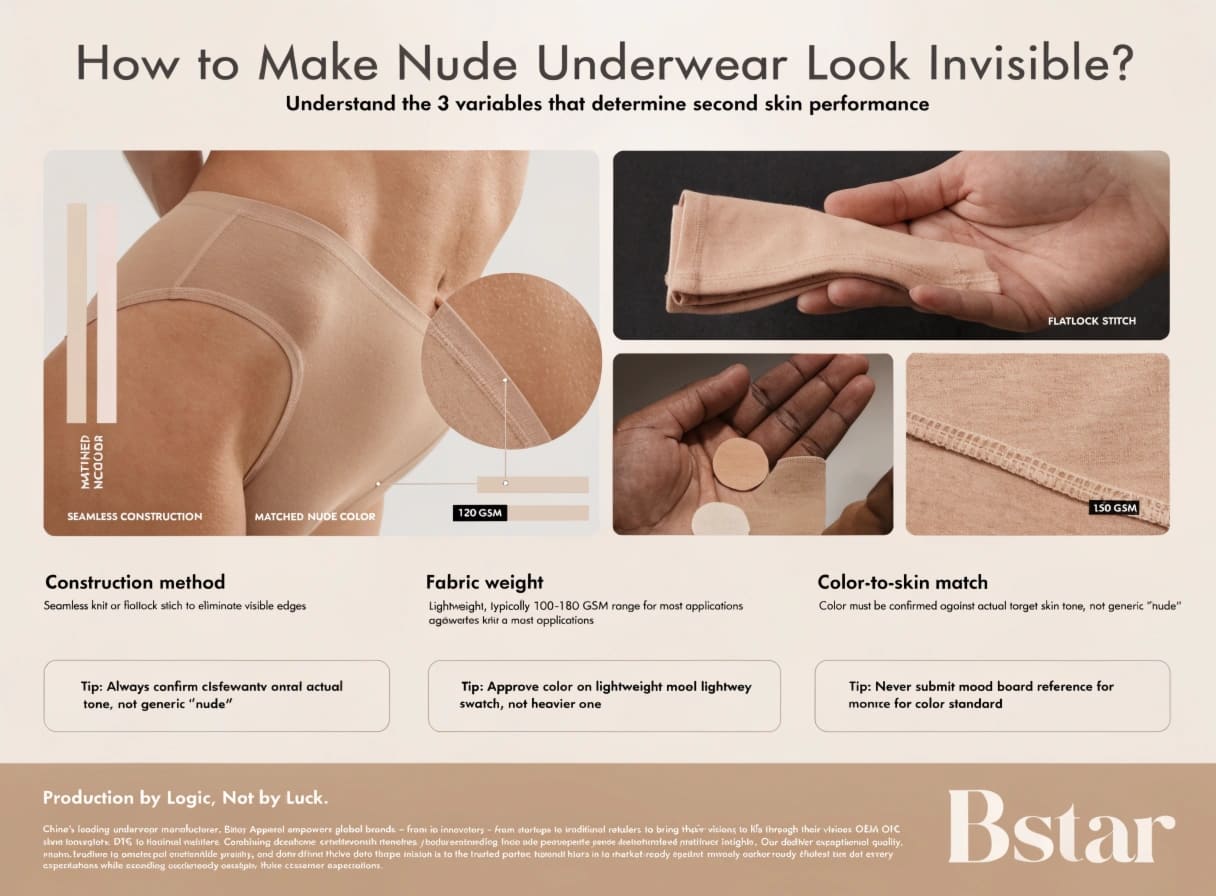
In our development work on nude-tone series, the construction conversation and the color conversation happen at the same time. A seamless knit structure in the wrong fabric weight still shows visible bulk under tight clothing. A correctly matched nude color in a medium-weight fabric with visible seam lines still fails the "second skin" test.
The Three Variables That Determine Second-Skin Performance
| Variable | Production Requirement | Common Client Mistake |
|---|---|---|
| Construction method | Seamless knit or flatlock stitch to eliminate visible edges6 | Ordering standard cut-and-sew construction with nude color only |
| Fabric weight | Lightweight, typically 100–180 GSM range for most applications7 | Approving color on a heavier swatch than the final product will use |
| Color-to-skin match | Color must be confirmed against actual target skin tone, not generic "nude" | Submitting a mood board reference instead of a physical color standard |
The interaction between these three variables is what makes nude-tone development more complex than a standard color brief. When a client tells us "I want it to look invisible," we need all three aligned — construction spec, fabric spec, and color standard — before we start sampling. If any one of these is undefined, the sample will not meet the brief, and we’ll be going back and forth on rounds of revisions that could have been avoided.
Market Expansion: Does a Wider Nude Range Actually Build a Bigger Business?
Adding more nude shades to a product line sounds straightforward. In production terms, it multiplies every variable we’ve already discussed — and it creates a new one: batch-to-batch color consistency across multiple SKUs running in parallel.
A wider nude range captures a broader consumer base, but only if each shade is production-stable across reorders. Color drift between batches is more visible in nude tones than in any other color category — because the consumer’s own skin is the reference point.8 A slight shift in a black SKU goes unnoticed. The same shift in a nude SKU generates returns.9
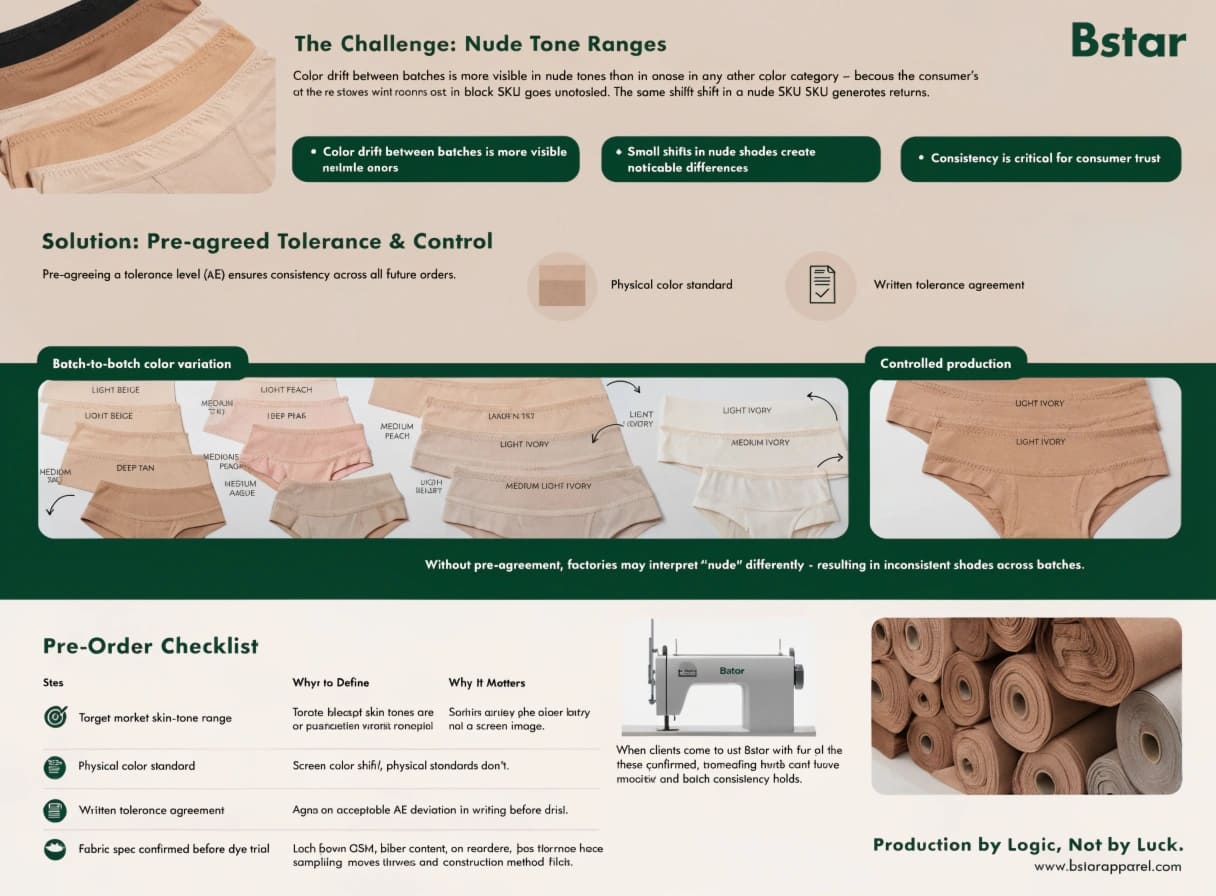
This is where color consistency becomes a contractual risk, not just a quality metric. When we run nude-tone production, we require a physical color standard — a lab-dip or approved fabric swatch — for each shade in the range. ΔE tolerance (the numerical measure of color deviation) needs to be agreed in writing before bulk production starts10. We apply AQL inspection standards across our production runs11, with color checked at multiple stages. But I want to be direct about this: no factory can guarantee zero deviation across all reorders. What we can do is control the process tightly and make the tolerance agreement explicit before the order is placed.
Building a Production-Ready Nude Range: The Pre-Order Checklist
This is the most actionable part of this article. Before you submit a nude-tone underwear brief to any factory, have these four items confirmed:
| Step | What to Define | Why It Matters |
|---|---|---|
| 1. Target market skin-tone range | Which consumer skin tones are you matching? Define the range by market. | Without this, the color standard has no anchor. |
| 2. Physical color standard | Submit a Pantone reference or physical lab-dip — not a screen image. | Screen colors shift; physical standards don’t. |
| 3. Written tolerance agreement | Agree on acceptable ΔE deviation in writing before bulk. | Protects both sides on reorders and batch variation. |
| 4. Fabric spec confirmed before dye trial | Lock down GSM, fiber content, and construction method first. | Color behavior changes with fabric; dye trials on the wrong fabric waste time and money. |
When clients come to us at BSTAR with all four of these confirmed, sampling moves fast and batch consistency holds. When clients come with only a reference image and a delivery date, the first two weeks are spent asking these questions anyway — just at a cost to the timeline.
Conclusion
Nude-tone underwear is a production specification problem. Define your market, lock your fabric, agree your tolerance, and submit a real color standard — before sampling starts.
-
"The Efficacy of the Fitzpatrick Scale in Clinical Practice – PMC", https://pmc.ncbi.nlm.nih.gov/articles/PMC12971093/. Research on skin tone colorimetry and the Fitzpatrick scale demonstrates that perceived color harmony between a fabric and skin is observer-dependent, supporting the claim that a single nude standard cannot serve consumers across a wide range of skin tones. Evidence role: mechanism; source type: paper. Supports: That perceptual color matching is relative to the observer’s own skin tone, making a single ‘nude’ standard inadequate across diverse populations.. Scope note: Most colorimetry literature focuses on cosmetics or medical imaging rather than apparel; direct apparel-specific studies are limited. ↩
-
"Secondhand fashion consumers exhibit fast fashion behaviors …", https://pmc.ncbi.nlm.nih.gov/articles/PMC12504660/. Industry analyses of the fashion and intimate apparel market have documented growing consumer demand for shade-inclusive product lines, indicating that single-shade nude offerings leave significant portions of diverse consumer bases underserved. Evidence role: statistic; source type: institution. Supports: That consumer demand for inclusive nude shade ranges across skin tones represents an unmet market opportunity.. Scope note: Available reports may be produced by market research firms with commercial interests; independent academic studies on this specific gap are sparse. ↩
-
"Environmental Impact of Textile Materials: Challenges in Fiber–Dye …", https://pmc.ncbi.nlm.nih.gov/articles/PMC11991193/. Textile chemistry literature establishes that dye uptake is governed by fiber polymer structure, with nylon, polyester, and cellulosic fibers exhibiting distinct dye affinities and exhaustion rates, producing measurably different color outcomes from the same dye formula. Evidence role: mechanism; source type: paper. Supports: That dye absorption and resulting color appearance vary with fiber composition due to differences in polymer structure and dye affinity.. ↩
-
"Advancements in Sustainable Natural Dyes for Textile Applications", https://pmc.ncbi.nlm.nih.gov/articles/PMC10458907/. Textile engineering references document that nylon (polyamide) accepts acid dyes via amine end groups, polyester requires disperse dyes under high-temperature conditions, and modal (a cellulosic fiber) is dyed with reactive or direct dyes, resulting in inherently different color yields from nominally equivalent dye concentrations. Evidence role: mechanism; source type: education. Supports: That nylon, polyester, and modal require different dye classes and exhibit different color yield characteristics due to their distinct chemical structures.. ↩
-
"Flexible thermochromic fabrics enabling dynamic colored display", https://pmc.ncbi.nlm.nih.gov/articles/PMC9756210/. Studies on the optical properties of stretch fabrics indicate that elongation reduces fiber packing density per unit area, altering light scattering and absorption characteristics and producing a measurable shift in perceived color saturation relative to the relaxed state. Evidence role: mechanism; source type: paper. Supports: That stretching elastane-containing fabrics alters the spatial density of dyed fibers, changing the perceived color saturation.. Scope note: Direct peer-reviewed studies specifically on elastane content and nude-tone color shift are limited; the mechanism is inferred from broader textile optics research. ↩
-
"Study on the Permeability and Absorption Performance of the Crotch …", https://pmc.ncbi.nlm.nih.gov/articles/PMC10935086/. Apparel engineering literature describes seamless circular knitting as producing a tubular fabric structure with no sewn seams, while flatlock stitching creates a seam that lies flat rather than forming a raised ridge, both methods reducing the seam bulk that causes visible lines through fitted clothing. Evidence role: mechanism; source type: education. Supports: That seamless circular knitting and flatlock seaming techniques reduce or eliminate raised seam profiles that create visible lines under fitted outer garments.. ↩
-
"Study on the Permeability and Absorption Performance of the Crotch …", https://pmc.ncbi.nlm.nih.gov/articles/PMC10935086/. Textile industry technical references for intimate apparel generally associate fabric weights below 180 GSM with reduced opacity and lower visual bulk, properties relevant to achieving minimal visible presence under fitted outer garments. Evidence role: general_support; source type: institution. Supports: That lightweight fabric weights in the approximate 100–180 GSM range are associated with reduced visual bulk and improved skin-tone blending in intimate apparel.. Scope note: The specific 100–180 GSM range cited in the article appears to reflect practitioner convention rather than a formally published standard; independent verification of this precise range is limited. ↩
-
"The Color of My Skin: A Measure to Assess Children’s Perceptions …", https://pmc.ncbi.nlm.nih.gov/articles/PMC3060784/. Research in color perception and visual psychophysics indicates that the human visual system is particularly sensitive to deviations in skin-tone hues, as skin color serves as a learned chromatic reference point, suggesting that small colorimetric shifts in nude-adjacent fabrics may be more salient to consumers than equivalent shifts in non-skin-tone colors. Evidence role: mechanism; source type: paper. Supports: That color deviations in skin-tone-adjacent hues are more perceptible to human observers because the visual system uses skin color as a calibrated reference.. Scope note: Most relevant research addresses skin color perception in face recognition and lighting contexts rather than fabric-to-skin comparison; direct apparel-specific perceptual studies are not established in the literature. ↩
-
"Consumer Behavior in Clothing Industry and Its Relationship … – PMC", https://pmc.ncbi.nlm.nih.gov/articles/PMC9906731/. Research on e-commerce apparel returns identifies color mismatch between product expectation and received item as a significant return driver; while direct comparative data on nude versus dark SKU return rates is not established in the published literature, the perceptual salience of skin-tone color deviations provides a plausible mechanism for elevated return rates in nude categories. Evidence role: general_support; source type: paper. Supports: That color discrepancy between expected and received garments is a driver of consumer returns, with the effect likely amplified for skin-tone-adjacent colors where the consumer’s body provides an immediate comparison reference.. Scope note: No published study directly compares return rates for nude versus dark garments by color batch variation; the claim as stated goes beyond what current evidence directly supports. ↩
-
"[PDF] CORRELATION OF VISUAL AND INSTRUMENTAL COLOR …", https://journals.uc.edu/index.php/JALCA/article/download/3587/2780. The International Commission on Illumination (CIE) defines Delta E (ΔE) as a numerical expression of the difference between two colors in a perceptually uniform color space, with formulas including CIELAB (ΔE*ab) and the more recent CIEDE2000, both widely adopted in textile and apparel quality control to specify acceptable color deviation tolerances. Evidence role: definition; source type: institution. Supports: That ΔE (Delta E) is a standardized colorimetric measure of the perceptible difference between two colors, used in industrial color quality control.. ↩
-
"[PDF] ISO 2859-1 – UNT Chemistry", https://chemistry.unt.edu/~tgolden/courses/iso2859-1.pdf. AQL (Acceptable Quality Limit) is defined under ISO 2859-1 and the equivalent ANSI/ASQ Z1.4 standard as the quality level that is the worst tolerable process average when a continuing series of lots is submitted for acceptance sampling, providing a statistically grounded framework for pass/fail inspection decisions in manufacturing. Evidence role: definition; source type: institution. Supports: That AQL refers to a formally defined statistical sampling inspection standard used in manufacturing quality control.. ↩