
Designing Underwear for Sensitive Skin: What Does "Hypoallergenic" Actually Mean?
Customers return underwear for many reasons. Skin reactions are one of the worst. Once it happens, the damage to your brand trust is hard to undo.
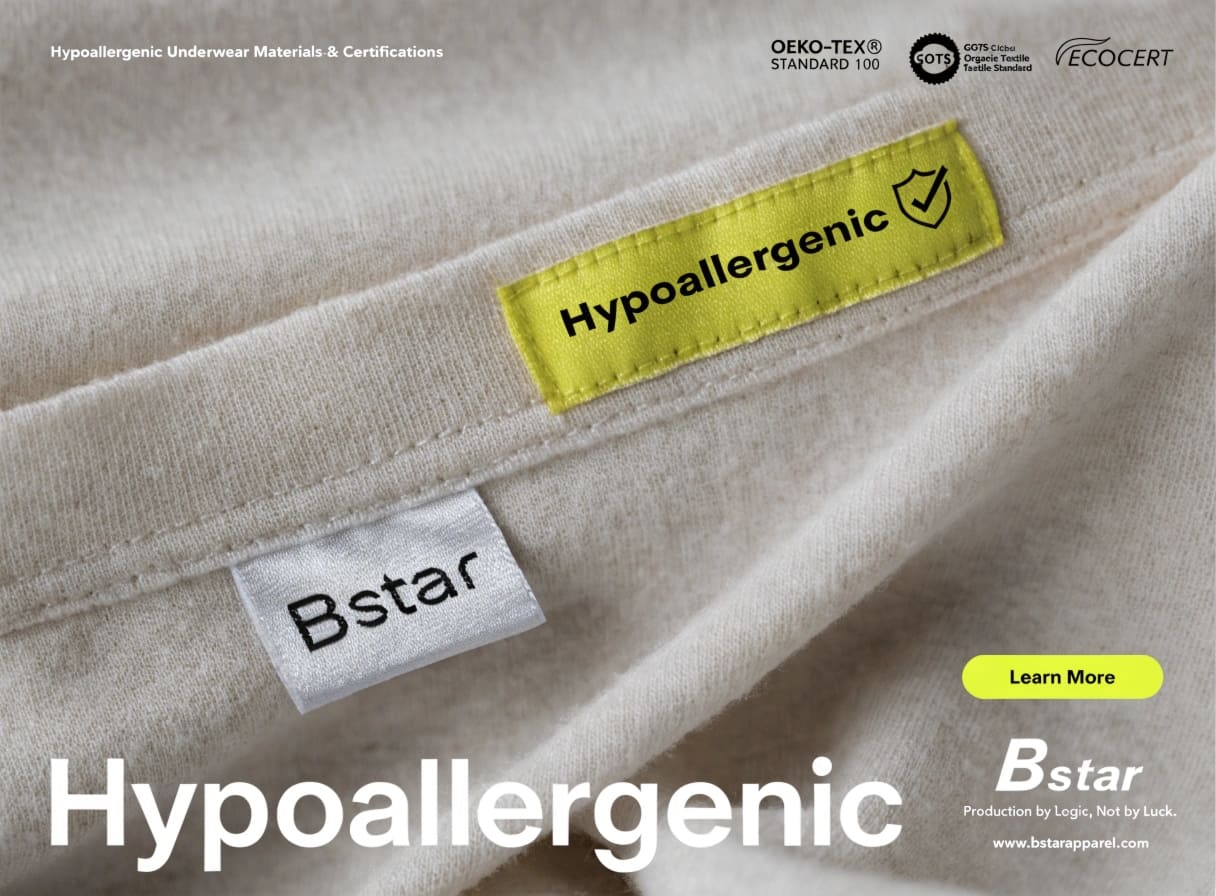
"Hypoallergenic underwear" is not a fabric type. It is a process outcome. The safest underwear products are built by controlling materials, dyes, construction, and finishing chemistry together — not by selecting one certified fabric and calling it done.
I have worked in knitwear OEM/ODM manufacturing for 19 years. We handle client feedback on skin-reaction complaints more often than most people expect. Almost every time, the problem is not what the buyer thought it was. This article is for DTC brand founders and private-label buyers who want to write a smarter spec brief — one that actually reduces the risk of skin complaints after launch.
Selecting Safe Materials: Does Your Fabric Certification Actually Cover What You Think It Does?
Brands often start here. They request organic cotton or ask for OEKO-TEX certified fabric. This is a reasonable starting point, but it is not enough on its own.
Organic cotton certifies how the raw fiber was grown. OEKO-TEX Standard 100 certifies that tested materials do not exceed defined thresholds for harmful substances. Neither certification tells you what happens to the fabric during finishing — and finishing is where many contact irritants are introduced.
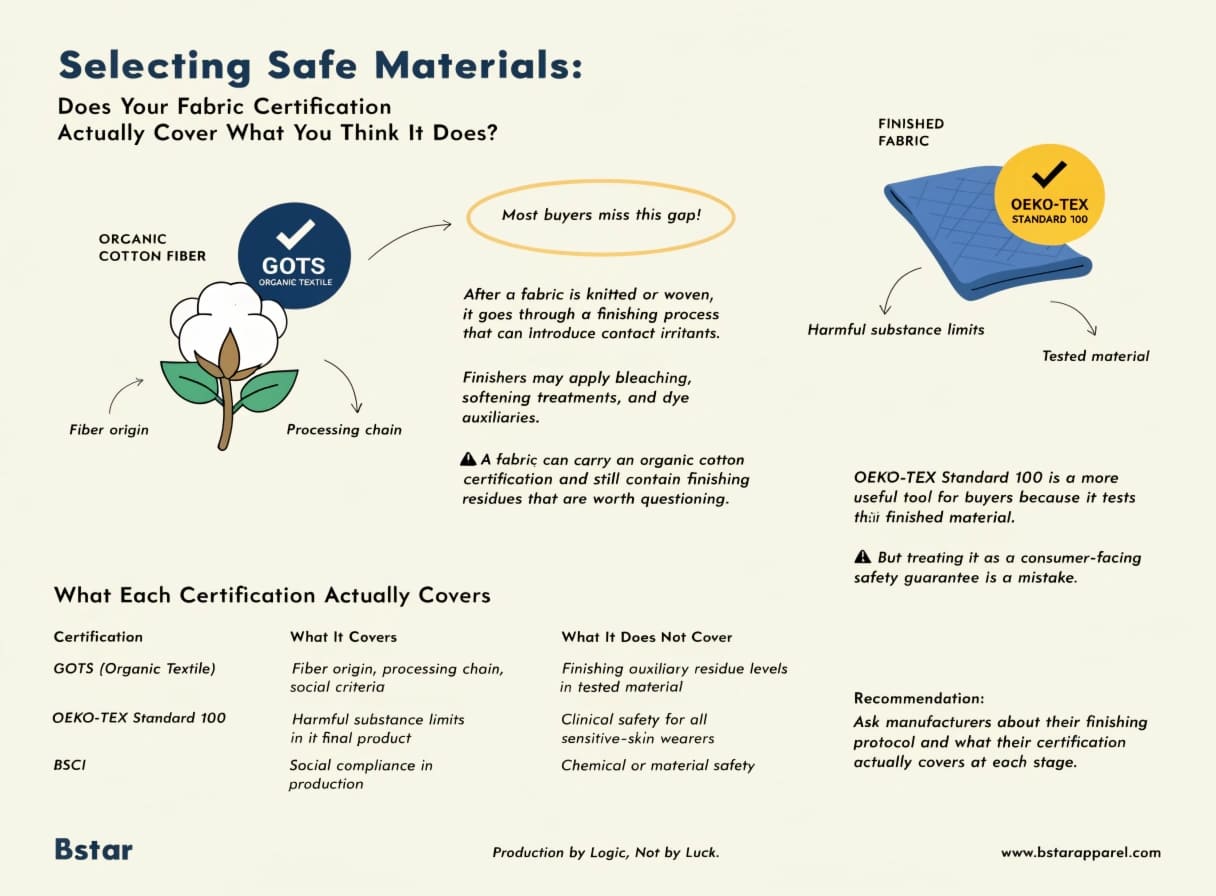
Here is the gap that most buyers miss. After a fabric is knitted or woven, it goes through a finishing process. This can include bleaching, softening treatments, and dye auxiliaries. These are applied after the fiber stage. A fabric can carry an organic cotton certification and still contain finishing residues that are worth questioning.
OEKO-TEX Standard 100 is a more useful tool for buyers because it tests the finished material — not just the raw input. But even here, the scope matters. The certification confirms that tested substances fall within defined limits. It does not confirm that every sensitive-skin wearer will have no reaction. Treating it as a consumer-facing safety guarantee is a mistake.
The better question to ask your manufacturer is not "do you use certified fabric?" It is "what is your finishing protocol, and what does your certification actually cover at each stage?"
| Certification | What It Covers | What It Does Not Cover |
|---|---|---|
| GOTS (Organic Textile) | Fiber origin, processing chain, social criteria | Finishing auxiliary residue levels in final product |
| OEKO-TEX Standard 100 | Harmful substance limits in tested material | Clinical safety for all sensitive-skin wearers |
| BSCI | Social compliance in production | Chemical or material safety |
When we source materials at our factory, we ask suppliers to provide test records that specify what the certification scope includes. That is the habit we recommend buyers build into their own briefs.
Eliminating Chemical Irritants: Are You Asking the Right Questions About Dyes and Finishing?
Most buyers specify fabric composition. Very few specify dye class or finishing auxiliary residue limits. This is where real exposure happens.
Conventional reactive dyes and their auxiliaries can leave residues in finished fabric. These residues can contribute to skin irritation in wearers with sensitive skin. Asking your manufacturer to specify the dye class used — and to provide finishing residue test records — is a basic step that most briefs skip.

Azo dyes are one category worth raising with your manufacturer. Some azo compounds can release aromatic amines, which are restricted under REACH regulations and OEKO-TEX limits. Reactive dyes, when properly rinsed and finished, are widely used and can meet certification thresholds. The key word is "properly." Wash-off quality and finishing discipline vary by supplier.
Waterless or low-water dyeing technologies have moved from specialty applications into more mainstream production. They tend to reduce residual dye and auxiliary levels because the process chemistry is more controlled. They are also better for water consumption — a selling point for sustainability-positioned brands.
Natural dyed options using plant-based colorants have grown in demand. They can be suitable for sensitive-skin positioning, but they introduce their own variables — color consistency, wash fastness, and the mordants used to fix color to fiber. "Natural dye" is not automatically safe. The full process still needs to be specified.
The question to put in your brief: "What dye class is used for this fabric, and can you provide test records for finishing auxiliary residues in the finished garment?" A manufacturer who can answer this clearly is giving you better risk information than one who only sends you a fabric certification document.
Ergonomic Construction for Comfort: Is Your Underwear’s Construction Adding to Skin Risk?
Fabric is one contact point. In underwear, there are several more. The elastic waistband. The leg elastics. The seam placement. The label.
Underwear construction creates multiple skin contact points beyond the main fabric. Waistband elastics, leg elastics, seam placement, and label attachment methods all carry independent contact risk. Specifying fabric composition alone audits less than half of the contact surface.

We have had clients trace skin reactions back to the elastic component — not the fabric. Elastic in conventional underwear often contains latex or uses adhesive bonding agents that can contribute to irritation. Specifying latex-free elastic, or specifying a covered elastic where the elastic does not contact skin directly, is a construction decision that belongs in your brief.
Seam placement and seam type matter in a similar way. Flatlock seams reduce the ridge of fabric pressing against skin at high-friction zones — inner thighs, waistband edge, gusset. Seamless knitting goes further by eliminating many seams entirely. For a sensitive-skin product line, seamless construction is worth the investment because it removes a whole category of friction-based irritation triggers.
Heat-transfer labels are now standard practice for most quality underwear manufacturers. Woven labels sewn into the waistband are a known irritant for many wearers. If your spec still calls for a sewn-in label at the center back waistband, change it.
| Construction Element | Conventional Risk | Lower-Risk Specification |
|---|---|---|
| Waistband elastic | Latex, adhesive agents | Latex-free, silicone-free, covered elastic |
| Seam type | Raised overlock seams at friction zones | Flatlock or seamless construction |
| Label attachment | Sewn-in woven label | Heat-transfer printed label |
| Gusset lining | Synthetic lining fabric | OEKO-TEX certified cotton gusset |
Maintaining Skin Barrier Health: Can Functional Finishing Add Value Without Adding Risk?
Some brands are going further. They are looking at functional textile technologies — moisturizing microcapsules and pH-balanced finishing — as part of their sensitive-skin product story.
Moisturizing microcapsule finishing and weak-acid pH balancing are functional textile technologies that can support skin barrier health in intimate apparel. Both involve finishing chemistry, and both need to be sourced and tested carefully to avoid introducing new irritants while trying to reduce existing ones.
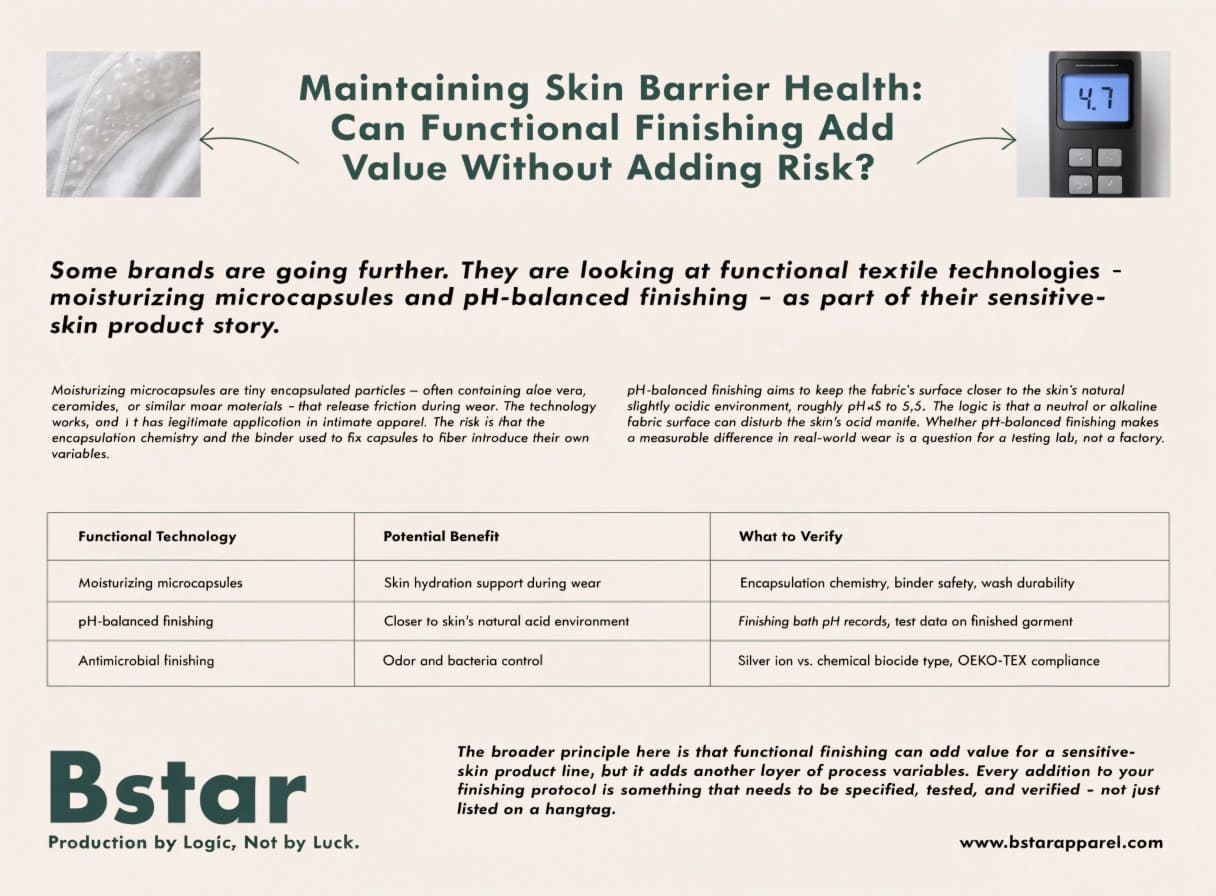
Moisturizing microcapsules are applied during finishing. They are tiny encapsulated particles — often containing aloe vera, ceramides, or similar materials — that release through friction during wear. The technology works, and it has legitimate application in intimate apparel. The risk is that the encapsulation chemistry and the binder used to fix capsules to fiber introduce their own variables. Ask for the full material safety data on the encapsulation system, not just the marketing claim for the active ingredient.
pH-balanced finishing aims to keep the fabric’s surface closer to the skin’s natural slightly acidic environment, roughly pH 4.5 to 5.5. The logic is that a neutral or alkaline fabric surface can disturb the skin’s acid mantle. Whether pH-balanced finishing makes a measurable difference in real-world wear is a question for a testing lab, not a factory. What we can say from a production side is that the finishing bath pH can be controlled and tested, and that test records should be available.
The broader principle here is that functional finishing can add value for a sensitive-skin product line, but it adds another layer of process variables. Every addition to your finishing protocol is something that needs to be specified, tested, and verified — not just listed on a hangtag.
| Functional Technology | Potential Benefit | What to Verify |
|---|---|---|
| Moisturizing microcapsules | Skin hydration support during wear | Encapsulation chemistry, binder safety, wash durability |
| pH-balanced finishing | Closer to skin’s natural acid environment | Finishing bath pH records, test data on finished garment |
| Antimicrobial finishing | Odor and bacteria control | Silver ion vs. chemical biocide type, OEKO-TEX compliance |
Conclusion
Hypoallergenic underwear is a process outcome. Control your materials, dye systems, construction decisions, and finishing chemistry together — and ask your manufacturer to show you the records that prove it.