
How to Make Sweat-Wicking Underwear for Athletes?
Most brands think making sweat-wicking underwear is a fabric problem. It is not. It is a selection and risk judgment problem — and getting it wrong burns sampling rounds fast.
Sweat-wicking underwear for athletes requires three aligned decisions: fiber type (not just fabric weight), knit construction (not just surface treatment), and pattern engineering (not just a fabric upgrade). Get any one of these wrong in your brief, and your first sample will look right but perform wrong.
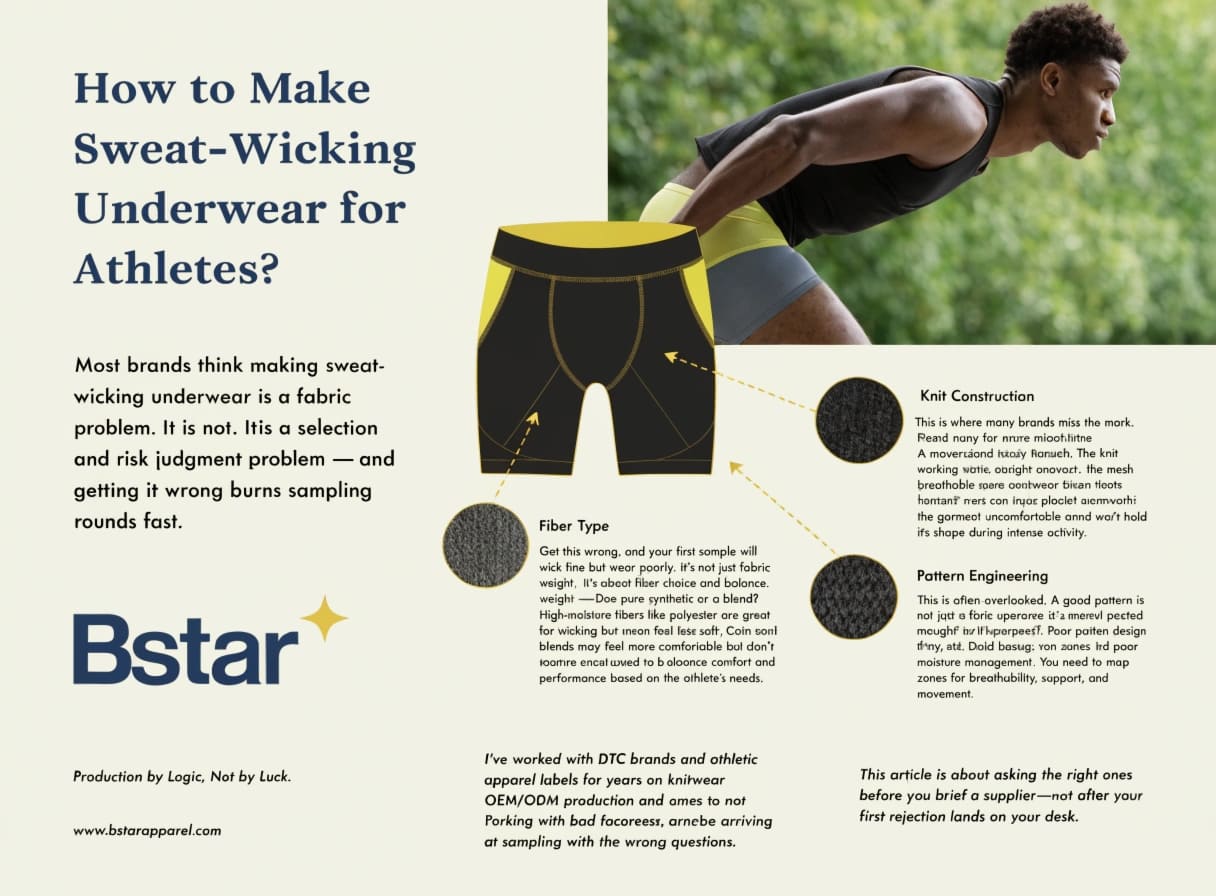
I’ve worked with DTC brands and athletic apparel labels for years on knitwear OEM/ODM production. The brands that waste the most sampling rounds are not working with bad factories. They are arriving at sampling with the wrong questions. This article is about asking the right ones before you brief a supplier — not after your first rejection lands on your desk.
The Science of Capillary Action: Engineering Fibers and Yarn Structures for Superior Moisture Transport?
A lot of brands open their brief with "we want something as light as possible." That sounds reasonable. But lower GSM does not mean better moisture transfer — and this is where the first round of rework usually starts.
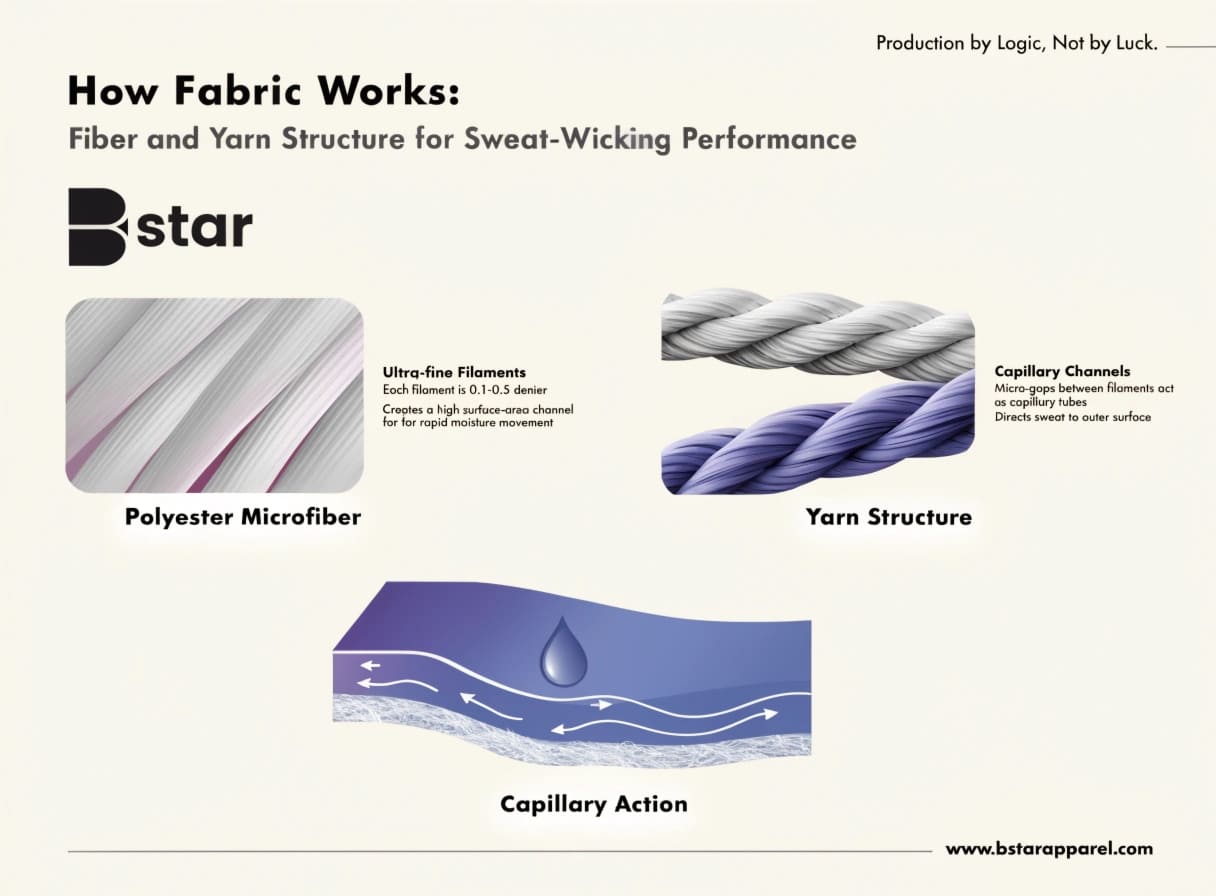
Moisture transport in athletic fabric is driven by yarn structure and fiber blend ratio. Capillary action — the mechanism that pulls sweat away from skin — depends on how tightly fibers are packed together and how they interact with water at the fiber level1, not on how light the fabric feels.
When I look at a moisture-wicking brief from a new client, the first thing I want to know is what fiber they have in mind — and whether they understand why that fiber matters.
Polyester microfiber is the most common choice2. The ultra-fine filaments create a high surface-area channel network that moves moisture through the fabric by capillary force3. It is fast-drying and structurally durable. But not all polyester constructions behave the same way.
| Fiber Type | Moisture Mechanism | Wash Durability | Common Use |
|---|---|---|---|
| Polyester microfiber | Capillary channels between filaments | High | Performance base layers |
| Modal | Hydrophilic fiber absorption | Medium | Comfort-focused athletic wear |
| Treated Nylon | Surface-modified hydrophilicity | Medium-Low | Compression and seamless styles |
| Cotton blend | Absorption only — holds moisture | Low | Leisure, not performance |
The key decision here is this: a brand that writes "polyester blend, moisture-wicking" in their brief without specifying filament count, loop density, or knit construction will receive a sample that uses a compliant fiber but delivers weak wicking performance. The yarn structure — how those fibers are knitted together — is what activates or blocks the capillary path. A loose open knit with the right fiber still performs poorly. This is the variable most brands underspecify.
Advanced Fabric Technologies: Integrating Hydrophilic Treatments and 3D Honeycomb Knits to Accelerate Evaporation?
Here is something I hear from brands regularly: "Can you just add a moisture-wicking treatment to the fabric?" Yes, it is possible. No, it is not the same thing — and this misunderstanding creates the most misleading supplier conversations I see.
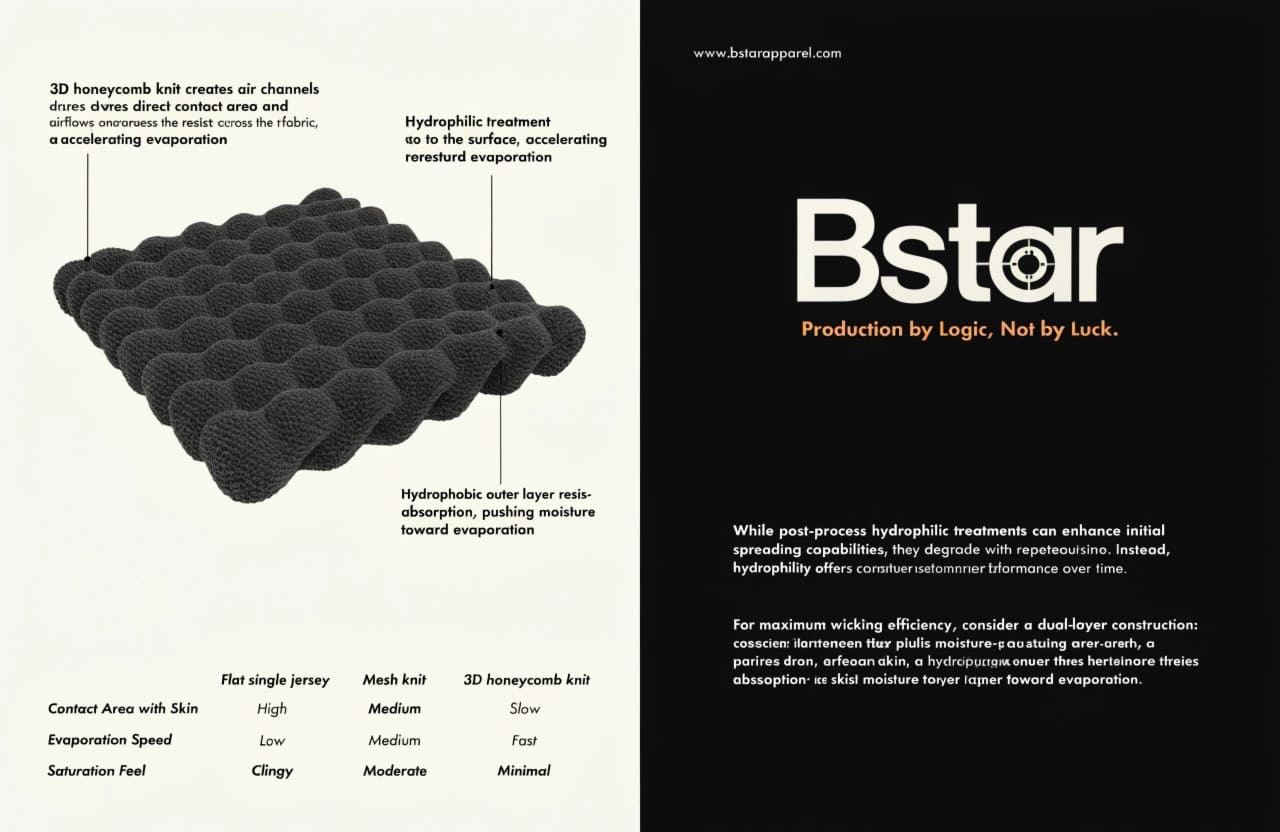
Wicking performance is primarily a fiber-level property. Post-process hydrophilic finishing treatments can improve initial moisture spreading, but they degrade with repeated washing4. Fiber-inherent hydrophilicity does not degrade. Brands that rely on surface treatments alone will receive complaints about performance drop after 20–30 wash cycles.
This matters a lot in your supplier conversation. Some factories will describe a treated fabric as "moisture-wicking" without distinguishing between finishing-based and fiber-based performance. If you do not ask the right question, you will not know what you are getting until the product is in customer hands.
What I recommend instead is a two-layer construction approach combined with a structural fabric choice:
Dual-Layer Logic
The inner layer (skin-contact side) should use a hydrophilic fiber structure that actively pulls moisture away from skin. The outer layer should use a more hydrophobic structure that resists re-absorption and pushes moisture toward evaporation. This is not a finishing treatment — it is a construction decision.
3D Honeycomb Knit Structure
A 3D honeycomb knit creates air channels between the skin and the fabric5. These channels reduce direct contact area and increase airflow across the fabric surface, which accelerates evaporation6. This construction also reduces the clammy sensation athletes report when fabrics saturate and collapse against skin.
| Construction Type | Contact Area with Skin | Evaporation Speed | Saturation Feel |
|---|---|---|---|
| Flat single jersey | High | Slow | Clingy |
| Mesh knit | Medium | Medium | Moderate |
| 3D honeycomb knit | Low | Fast | Minimal |
If a client specifies only fabric weight and fiber type without addressing knit construction, they are leaving one of the biggest performance variables open. In our sampling process, this is where we push back before accepting the brief — not after returning a sample that misses the mark.
Ergonomic Construction: Utilizing Seamless Bonding and Anatomical Pouches to Eliminate Chafing During High-Impact Activities?
This is where brands most consistently underestimate what they are building. Athletic underwear is not regular underwear with better fabric. The construction logic is different — and if your brief treats it like a fabric upgrade, your sample will have good material and poor function.
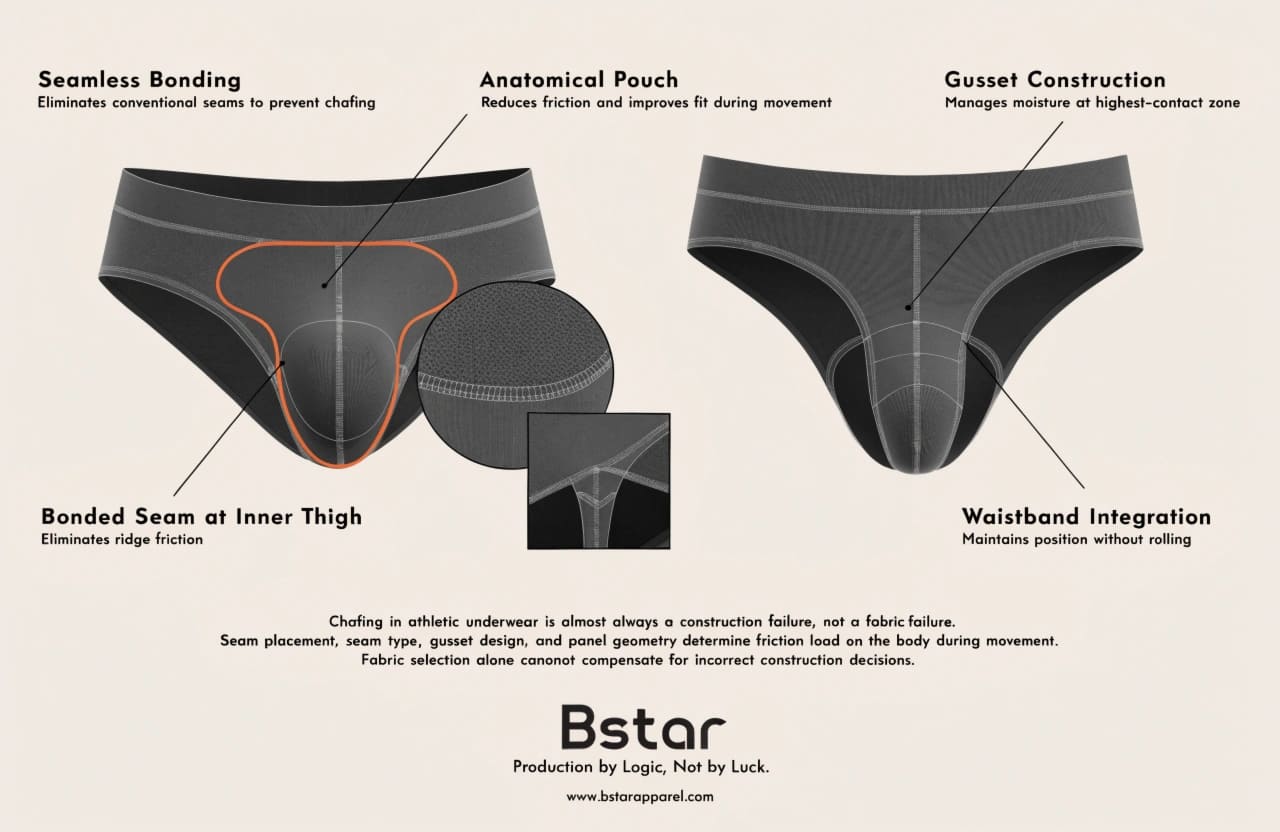
Chafing in athletic underwear is almost always a construction failure, not a fabric failure7. Seam placement, seam type, gusset design, and panel geometry determine friction load on the body during movement8. Fabric selection alone cannot compensate for incorrect construction decisions.
In our experience, brands that come from a fashion or lifestyle background frequently brief athletic underwear the same way they brief lounge or basics. The result is a sample that fits well standing still and causes problems the moment the athlete moves at speed.
Seam Strategy
Conventional sewn seams create ridges at friction zones — inner thighs, waistband edges, gusset perimeter. For high-impact activities like running or cycling, these ridges cause consistent skin irritation over 30–60 minutes of activity.
Flat-lock stitching reduces ridge height. Bonded seams eliminate the ridge entirely.9 The right choice depends on the performance tier your brand is targeting and the knit construction you are using.
Anatomical Panel and Pouch Design
| Construction Element | Purpose | Risk if Skipped |
|---|---|---|
| Anatomical pouch panel | Reduces friction and improves fit during movement | Fabric bunching, discomfort at speed |
| Gusset construction | Manages moisture at highest-contact zone | Saturation concentration, skin irritation |
| Flatlock or bonded seam at inner thigh | Eliminates ridge friction | Chafing within 20 minutes of activity |
| Waistband integration | Maintains position without rolling | Constant adjustment, distraction during performance |
When I review an athletic underwear brief, I am looking for sweat-path thinking in the construction spec — not just fabric spec. Where does sweat concentrate during activity? Those zones need both the right fabric and the right seam treatment. Treating them separately in the brief is where samples fail functional wear tests.
Durability and Care: Ensuring Long-Lasting Performance Through Permanent Wicking Finishes and Proper Washing Guidelines?
Performance athletic underwear gets washed hard and washed often. A product that wicks well on day one but degrades after a month of training use is a returns and review problem — not just a technical problem.
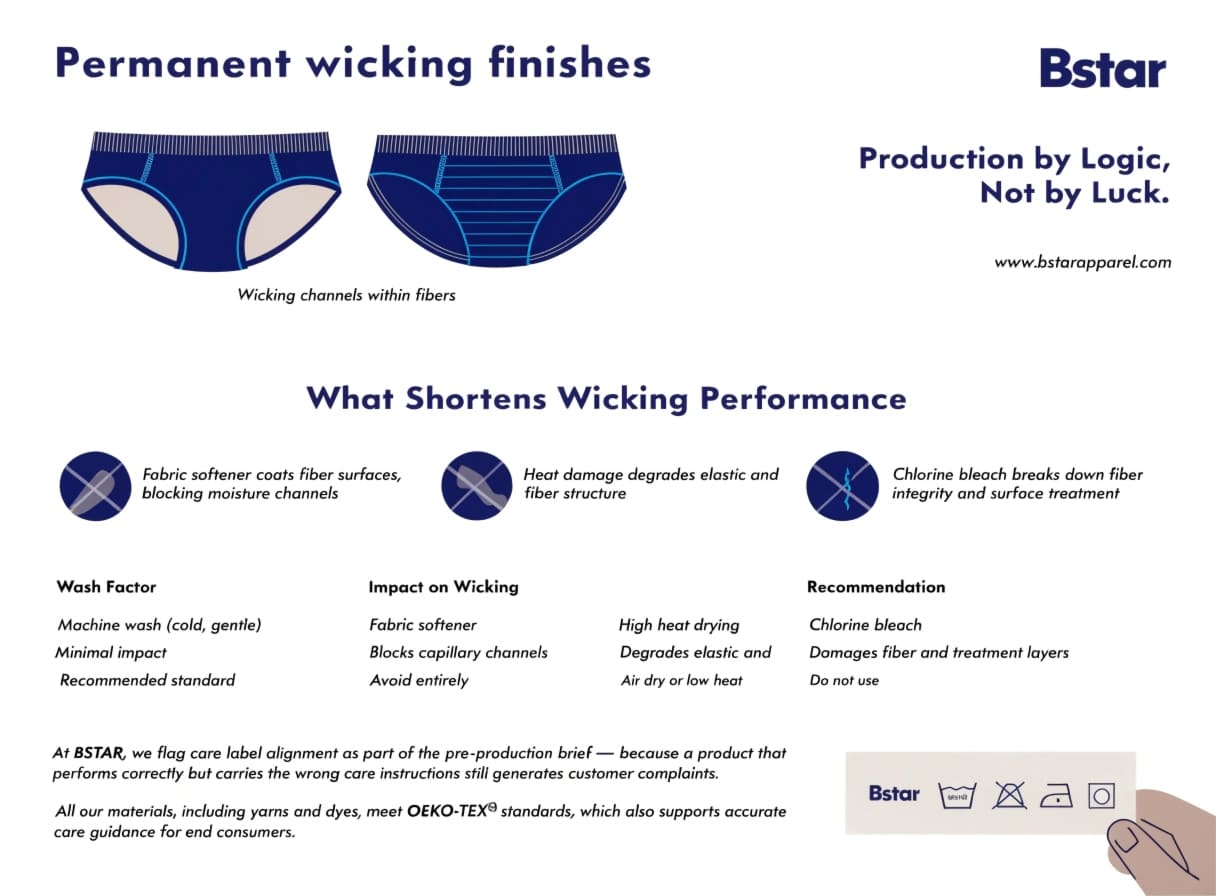
The durability of wicking performance depends on whether the performance is built into the fiber or applied as a surface treatment. Fiber-level performance survives repeated washing. Surface-applied finishing agents do not. Wash care instructions are not a workaround for weak construction — they are a maintenance protocol for a performance product.
This is a decision that has to happen at the specification stage, not at the quality check stage. If a brand selects a surface-treated fabric to hit a lower unit cost, they are accepting a built-in performance decay curve. Some brands are fine with that. Others are not. But the decision should be conscious, not accidental.
What Shortens Wicking Performance
Fabric softeners are the most common killer of wicking function. They coat fiber surfaces and block moisture channels.10 Heat damage from high-temperature drying degrades elastic content and can compromise knit structure11. Chlorine bleach breaks down both fiber integrity and any remaining surface treatment.
| Wash Factor | Impact on Wicking | Recommendation |
|---|---|---|
| Fabric softener | Blocks capillary channels | Avoid entirely |
| High heat drying | Degrades elastic and fiber structure | Air dry or low heat |
| Chlorine bleach | Damages fiber and treatment layers | Do not use |
| Machine wash (cold, gentle) | Minimal impact | Recommended standard |
Care labels on athletic underwear are not generic. They are part of the product specification. At BSTAR, we flag care label alignment as part of the pre-production brief — because a product that performs correctly but carries the wrong care instructions still generates customer complaints. All our materials, including yarns and dyes, meet OEKO-TEX® standards12, which also supports accurate care guidance for end consumers.
Conclusion
Making sweat-wicking underwear for athletes is a selection problem. Get your fiber, knit construction, and panel engineering aligned before sampling — and your factory can do its job right the first time.
-
"Capillary action – Wikipedia", https://en.wikipedia.org/wiki/Capillary_action. Capillary action in textile structures is governed by the Washburn equation, where liquid transport rate depends on fiber surface energy, inter-fiber spacing, and liquid viscosity, with tighter fiber packing creating smaller capillary radii that enhance wicking force. Evidence role: mechanism; source type: research. Supports: the physical principles of capillary action in fibrous materials and how fiber spacing affects liquid transport. Scope note: This describes general capillary physics in textiles; specific performance outcomes depend on additional factors like fiber chemistry and knit architecture. ↩
-
"Advancements in functional smart and wearable textiles for … – PMC", https://pmc.ncbi.nlm.nih.gov/articles/PMC12716241/. Polyester accounts for the majority of synthetic fiber usage in global sportswear production, with microfiber variants particularly dominant in moisture management applications due to their high surface-area-to-volume ratio. Evidence role: statistic; source type: research. Supports: the widespread adoption of polyester microfiber in performance athletic textiles. Scope note: Market share data varies by region and product category; this represents general industry trends rather than precise market statistics. ↩
-
"Eco-Friendly Fibers Embedded Yarn Structure in High-Performance …", https://pmc.ncbi.nlm.nih.gov/articles/PMC9920085/. Microfibers with diameters below 10 micrometers create inter-filament spaces that function as capillary channels, with surface area per unit mass increasing inversely with fiber diameter, thereby enhancing liquid wicking rates through increased capillary pressure. Evidence role: mechanism; source type: paper. Supports: how reduced filament diameter increases surface area and creates capillary networks for liquid transport. ↩
-
"The effects of a moisture-wicking fabric shirt on the physiological …", https://pubmed.ncbi.nlm.nih.gov/24768089/. Surface-applied hydrophilic finishes typically show measurable performance decline after 20-50 wash cycles due to mechanical abrasion and chemical extraction, with durability depending on application method and chemical bonding strength to the fiber substrate. Evidence role: mechanism; source type: paper. Supports: the degradation of surface-applied hydrophilic treatments through laundering. Scope note: Degradation rates vary significantly based on specific finishing chemistry, application technique, and washing conditions. ↩
-
"3DKnITS: Three-dimensional Knitted Intelligent Textile Sensor", https://www.media.mit.edu/videos/re-3dknits-2022-06-24/?autoplay=true. Three-dimensional spacer knit structures, including honeycomb configurations, use connecting yarns between two fabric layers to create air gaps of 2-5mm that reduce skin contact area while maintaining structural integrity and enhancing air permeability. Evidence role: mechanism; source type: research. Supports: how three-dimensional knit structures create air spaces that reduce direct skin contact. ↩
-
"Correlation of Air Permeability to Other Breathability Parameters of …", https://pmc.ncbi.nlm.nih.gov/articles/PMC8747439/. Evaporation rate from textile surfaces increases with air permeability and decreases with fabric-skin contact area, as greater air circulation enhances vapor pressure gradient and reduced contact allows moisture to spread across a larger evaporative surface. Evidence role: mechanism; source type: paper. Supports: the physical relationship between fabric-skin contact area, air circulation, and evaporative cooling. Scope note: Actual evaporation rates depend on additional environmental factors including ambient temperature, humidity, and air velocity. ↩
-
"Exercise-Induced Urticaria: A Rare Case Report – PMC", https://pmc.ncbi.nlm.nih.gov/articles/PMC8995004/. Exercise-induced chafing is predominantly attributed to repetitive friction from garment seams, edges, and structural elements rather than fabric surface properties, with seam placement and construction type identified as primary risk factors in athletic apparel design. Evidence role: expert_consensus; source type: research. Supports: the role of garment construction features in causing friction-related skin irritation during athletic activity. Scope note: Fabric properties like moisture retention and surface roughness can contribute to chafing severity, though construction is generally considered the primary factor. ↩
-
"Performance Apparel: Patterning for Movement, Heat, and Weather", https://www.rmcad.edu/blog/performance-apparel-patterning-for-movement-heat-and-weather/. Friction between garments and skin during movement is influenced by seam height, seam location relative to movement axes, and panel geometry that affects fabric tension distribution, with raised seams at high-movement zones generating significantly higher friction coefficients. Evidence role: mechanism; source type: research. Supports: how garment construction features influence friction forces during body movement. ↩
-
"[PDF] FCS2-304: Seams and Seam Finishes – Extension Publications", https://publications.mgcafe.uky.edu/sites/publications.ca.uky.edu/files/fcs2304.pdf. Flat-lock stitching creates interlocking thread loops that lie flatter than conventional seams, typically reducing seam thickness by 40-60%, while thermally bonded or adhesively bonded seams eliminate thread entirely, creating a seam profile flush with the fabric surface. Evidence role: definition; source type: education. Supports: the structural differences between flat-lock stitching and bonded seam construction methods. ↩
-
"Super-Hydrophobicity of Polyester Fabrics Driven by Functional …", https://pmc.ncbi.nlm.nih.gov/articles/PMC9957304/. Fabric softeners deposit hydrophobic quaternary ammonium compounds or silicone polymers onto fiber surfaces, which reduce surface energy and fill inter-fiber capillary spaces, thereby significantly decreasing wicking rate and moisture transport capacity in hydrophilic and microfiber fabrics. Evidence role: mechanism; source type: research. Supports: how fabric softener deposits affect moisture transport in technical textiles. ↩
-
"Structural influence of knitting patterns on mechanical, electrical and …", https://pmc.ncbi.nlm.nih.gov/articles/PMC12546620/. Elastomeric fibers such as spandex undergo thermal degradation above 150°C, with prolonged exposure to temperatures above 80°C causing gradual loss of elastic recovery and potential fiber embrittlement, while excessive heat can also cause dimensional changes in thermoplastic knit structures. Evidence role: mechanism; source type: paper. Supports: the thermal degradation mechanisms of elastic fibers and textile structures at elevated temperatures. Scope note: Degradation rates depend on exposure duration, specific polymer composition, and presence of stabilizing additives. ↩
-
"Oeko-Tex – Wikipedia", https://en.wikipedia.org/wiki/Oeko-Tex. OEKO-TEX® Standard 100 is an independent certification system that tests textile products at all processing stages, including raw materials, yarns, fabrics, and finished articles, for harmful substances according to product class and intended use. Evidence role: definition; source type: institution. Supports: the scope of OEKO-TEX® certification for textile materials. ↩