
What Does an Underwear Manufacturer’s Quality Control Process Actually Look Like?
Sourcing underwear at scale is a high-stakes decision. One bad production run can flood your returns queue, tank your reviews, and burn your reshipment budget before you even see the problem coming.
An underwear manufacturer’s quality control process runs across four main stages: raw material inspection (IQC), in-process inspection (IPQC), finished goods inspection (FQC), and outgoing inspection (OQC). Each stage catches different defect types. Missing any one of them means defects reach the next stage — and the later you catch a defect, the more it costs.
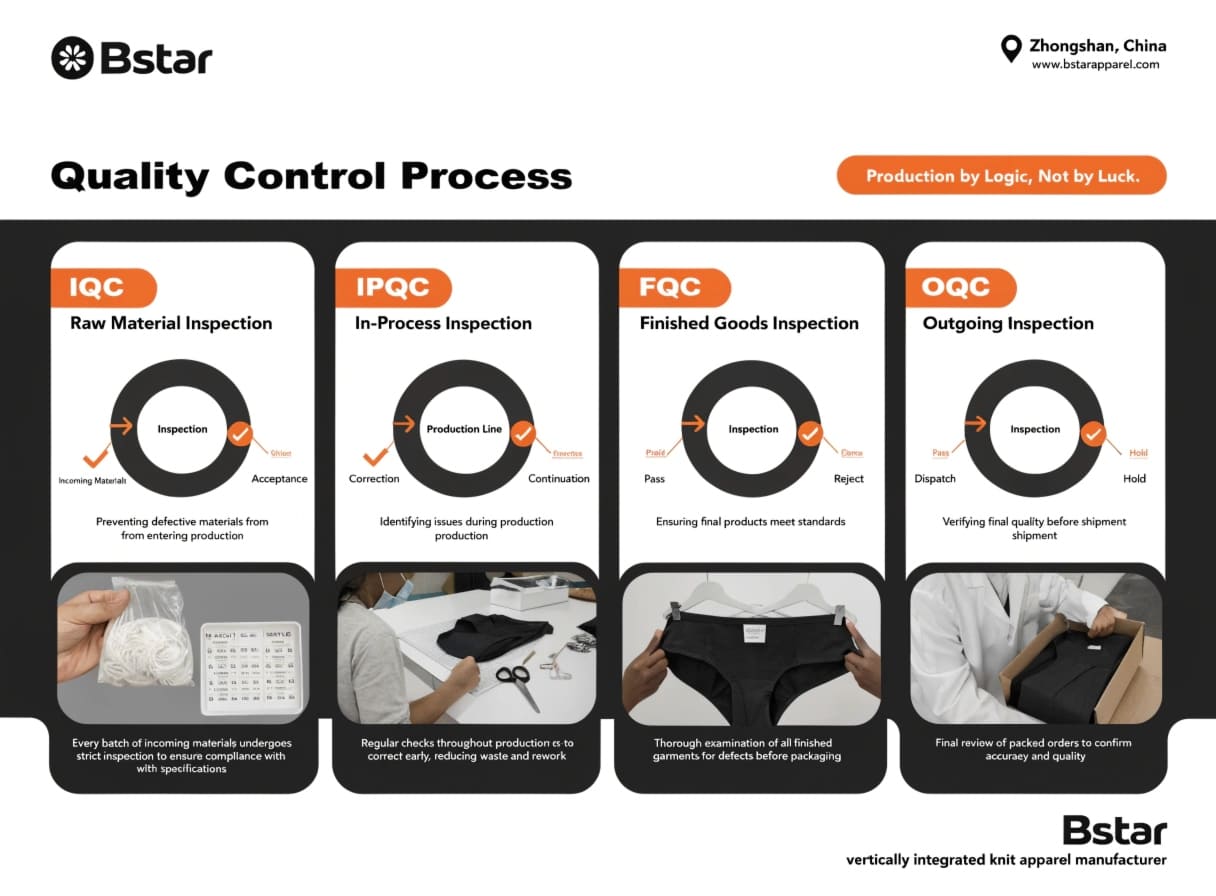
I’ve been running QC operations at BSTAR, a vertically integrated knit apparel manufacturer in Zhongshan, China, for years. In that time, the most expensive production problems I’ve seen weren’t caused by bad factories — they were caused by factories that only checked quality at the end. Here’s exactly what we do at each stage, and why each one exists.
Raw Material Inspection and Pre-Production Validation: What Are You Actually Starting With?
Most quality problems don’t start on the sewing floor. They start in the fabric roll.
If you let off-spec fabric into production, you will get off-spec garments. By the time you discover it at the end of the line, you’ve already cut and sewn hundreds of units you can’t ship.
At the IQC (Incoming Quality Control) stage, we check every incoming fabric roll and trim component before anything enters production. This includes fabric weight (GSM), width, shrinkage rate after wash, colorfastness, and elasticity recovery1 on all elastic trims. Any lot that fails gets quarantined and returned or re-sourced before cutting starts.
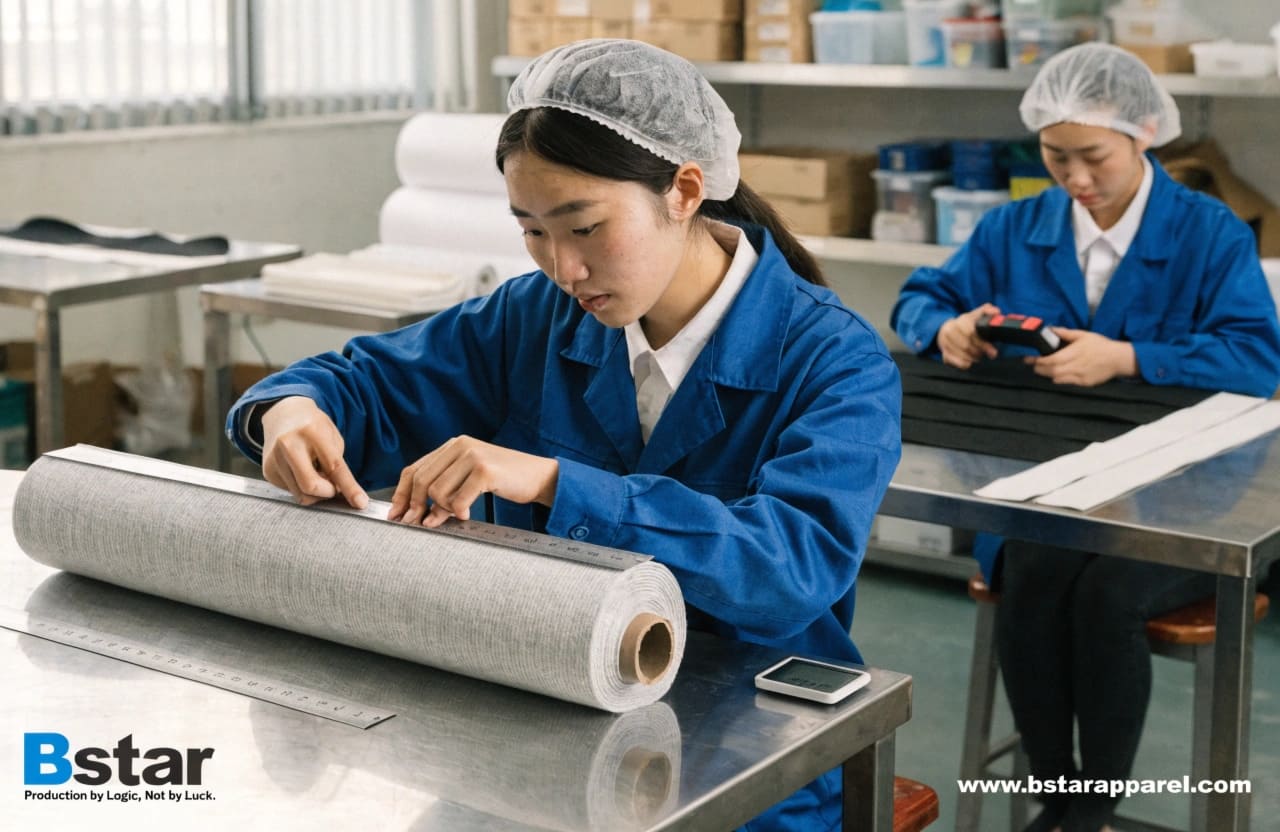
For underwear specifically, elastic inspection is non-negotiable. The waistband and leg opening elastics are stress points that wear out faster than almost any other component in the garment2. We measure elongation rate and recovery force on every elastic lot — not just look at it visually. A roll that passes a visual check can still have tension calibration issues that cause the waistband to go slack after 20 washes.
We also validate all trims at this stage: labels, care tags, packaging inserts, hangtags. Labeling errors that ship to the EU or US market create compliance problems that are far harder to fix than a fabric defect.
What We Check at IQC
| Component | What We Measure | Pass Criteria |
|---|---|---|
| Fabric (knit) | GSM, width, shrinkage | Within ±5% of spec |
| Elastic trim | Elongation rate, recovery force | Per client’s tension spec |
| Dyed fabric | Colorfastness (wash, rub) | Grade 4 or above |
| Labels & care tags | Content, language, placement spec | Exact match to approved sample |
| Packaging materials | Dimension, print accuracy | Per approved artwork |
If the material doesn’t pass IQC, it doesn’t move. That’s the only rule at this stage.
In-Process Quality Control: Why the Sewing Floor Is Where Quality Is Actually Made?
Here’s something I tell every new client who asks about our QC: the pre-shipment inspection report you receive at the end is a summary of decisions made weeks earlier, on the production floor. If those decisions were wrong, no final audit saves you.
Catching a seam defect at the inline stage costs a few seconds of rework. Catching the same defect at final inspection means unpacking cartons, sorting units, and potentially missing your shipment window3.
IPQC (In-Process Quality Control) at BSTAR runs in three sub-stages: first article confirmation before bulk sewing starts4, inline patrol checks every two hours during production, and end-of-line inspection before units move to finishing. Each sub-stage has a defined checklist and a defined pass/fail trigger.
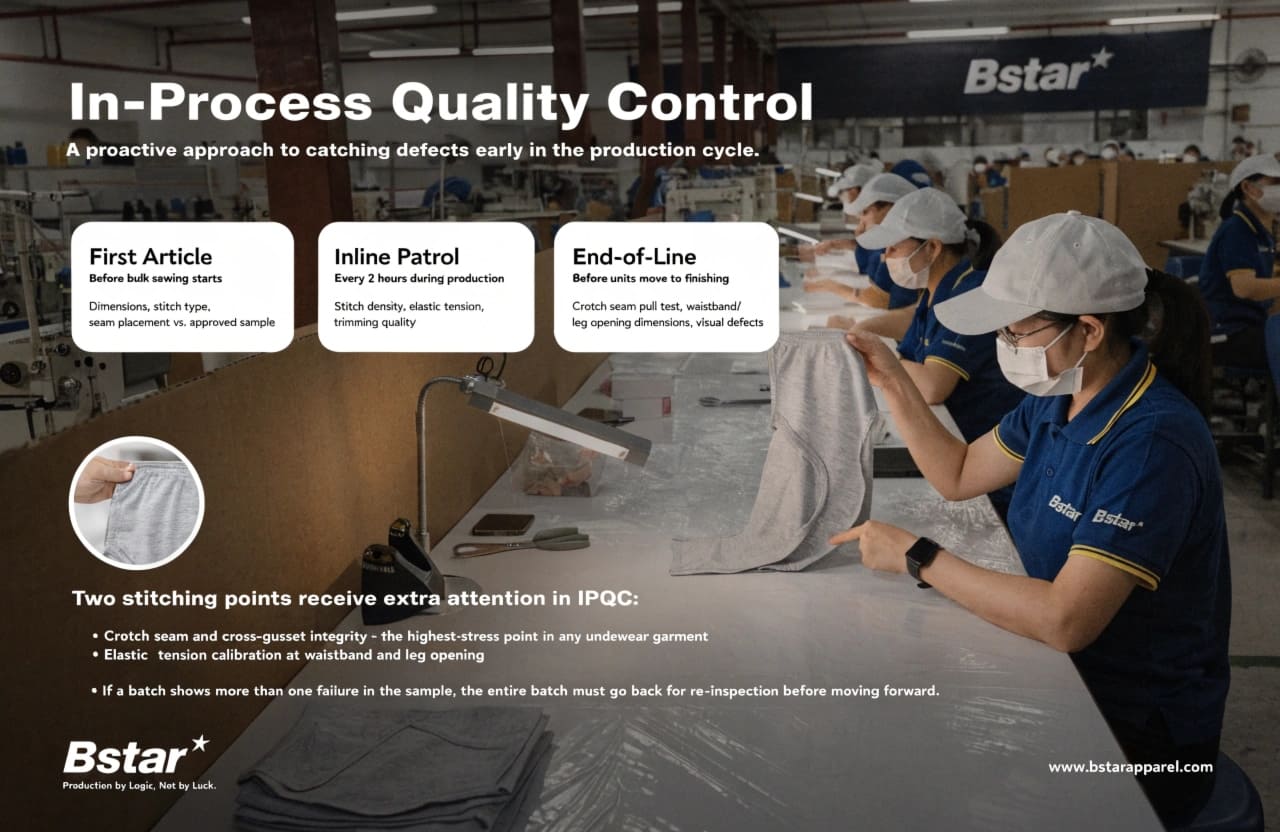
For underwear, two stitching points get extra attention in our IPQC process.
Crotch seam and cross-gusset integrity. This is the highest-stress point in any underwear garment. It takes multi-directional tension during wear, and it fails first if stitch density is off, thread tension is inconsistent, or the seam allowance is too narrow. We do a dedicated pull test on crotch seams at the end-of-line check — not just visual. If a batch shows more than one failure in the sample, the whole batch goes back for re-inspection before moving forward.
Elastic tension calibration at waistband and leg opening. Elastic that’s too tight is uncomfortable. Elastic that’s too loose loses its shape after a few washes. We measure the unstretched and stretched dimensions of both points against the client’s approved spec at the inline check stage, not just at the end. If the sewing tension is drifting — which happens as operators fatigue or machine settings shift — we catch it mid-batch, not after 2,000 units are already finished.
IPQC Checkpoint Summary
| Stage | Trigger | What’s Checked |
|---|---|---|
| First Article | Before bulk sewing starts | Dimensions, stitch type, seam placement vs. approved sample |
| Inline Patrol | Every 2 hours during production | Stitch density, elastic tension, trimming quality |
| End-of-Line | Before units move to finishing | Crotch seam pull test, waistband/leg opening dimensions, visual defects |
Finished Product Testing and AQL Sampling: What Does "Passed Inspection" Actually Mean?
When I send a client an inspection report that says "AQL 2.5 — Passed," I always include a short note explaining what that means. Because if you read it as "no defects found," you’ll eventually be disappointed.
AQL sampling is not a 100% check. It’s a statistical method. Passing AQL 2.5 means the defect rate in the shipment is likely within an acceptable range — not that zero defective units exist in the boxes.
FQC (Final Quality Control) at BSTAR uses AQL international sampling standards, with defects classified as critical, major, or minor5. Critical defects (safety hazards, wrong product) have a zero-tolerance threshold6. Major defects (dimensional failures, seam breaks) use AQL 2.5. Minor defects (light surface marks, minor thread ends) use AQL 4.0. Sample size is calculated from the total shipment quantity per standard AQL tables.
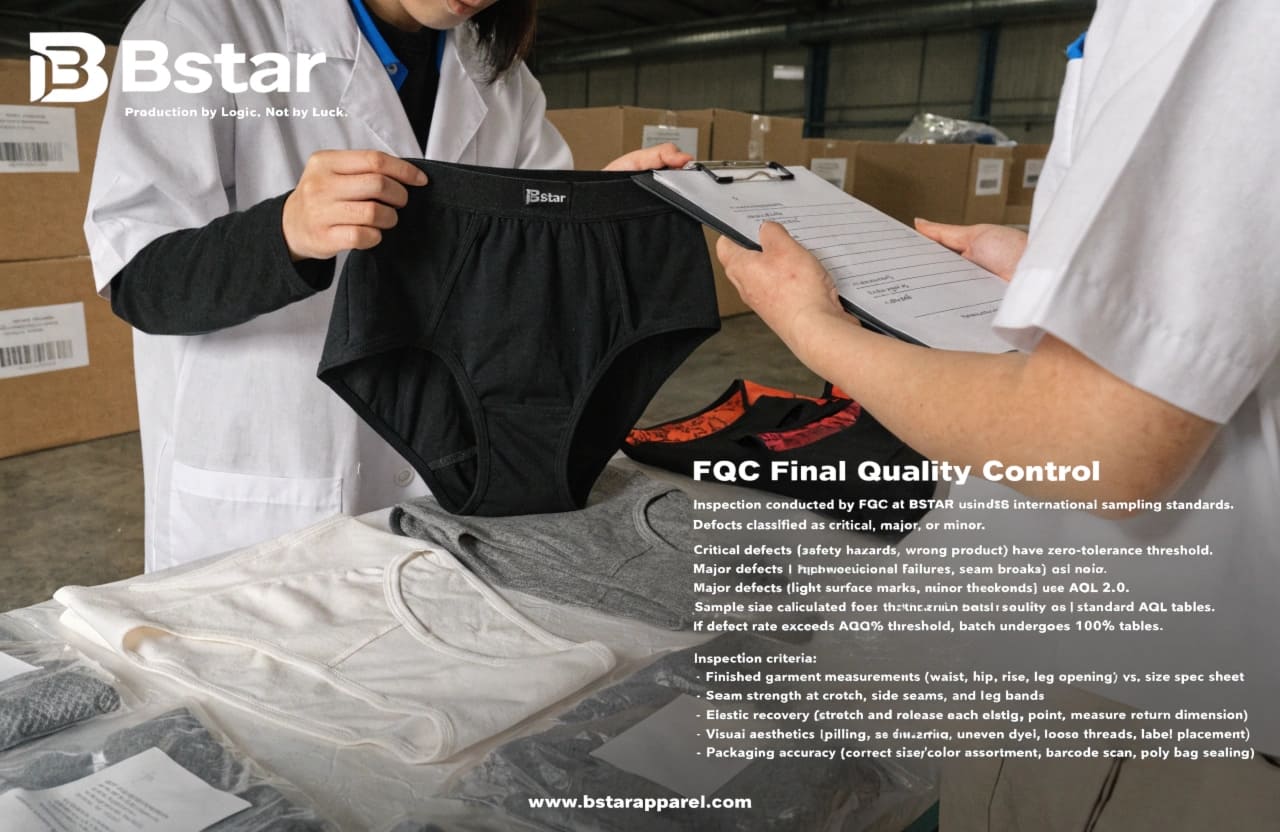
At FQC, we check each sampled unit against the following criteria:
- Finished garment measurements (waist, hip, rise, leg opening) vs. size spec sheet
- Seam strength at crotch, side seams, and leg bands
- Elastic recovery — we stretch and release each elastic point and measure the return dimension
- Visual aesthetics: pilling, staining, uneven dyeing, loose threads, label placement
- Packaging accuracy: correct size/color assortment, barcode scan, poly bag sealing
The goal at this stage isn’t to replace the upstream QC — it’s to verify that what left the sewing floor is what you ordered. If FQC finds a defect rate above the AQL threshold, the batch goes back for 100% sorting before we proceed.
Safety Compliance and Traceability: What Needs to Be Right Before the Box Closes?
This stage is where a lot of factories cut corners, and it’s usually invisible to buyers until a customs hold or a consumer complaint makes it visible.
Compliance isn’t the same as quality — but non-compliance at shipment creates just as much brand damage.
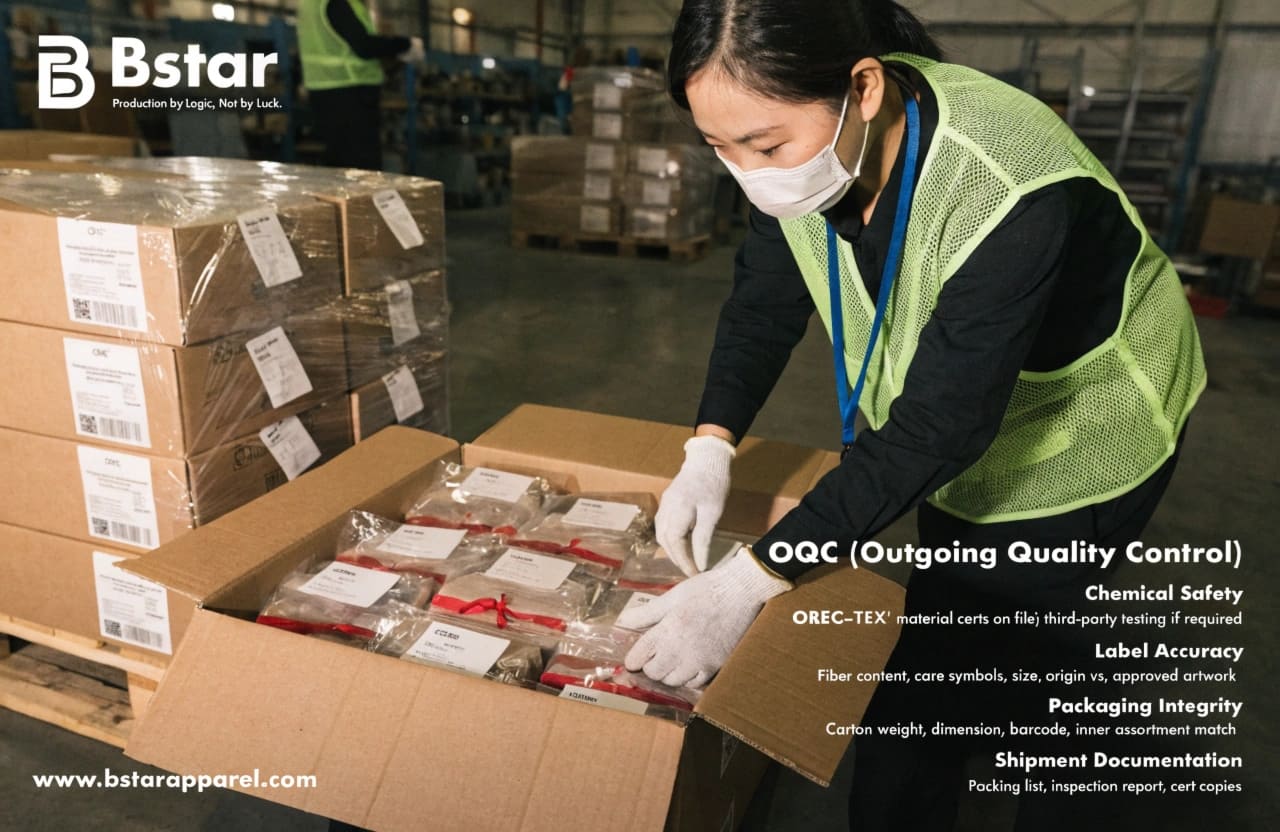
OQC (Outgoing Quality Control) is the final check before shipment. At BSTAR, OQC covers three areas: chemical safety verification on finished goods (aligned with OEKO-TEX® and REACH requirements7), label accuracy against the client’s approved artwork and destination market requirements, and carton/packaging integrity — weight, dimensions, markings, and inner assortment accuracy.
On the chemical safety side, our raw materials carry OEKO-TEX® Standard 100 certification, which means they’ve been tested for harmful substances8 before they enter our facility. This is a material-level certification, not a production-level guarantee — but it gives us a traceable baseline. If a client requires third-party finished goods testing (Intertek, SGS, Bureau Veritas), we coordinate that directly.
On labeling: EU and US markets have specific requirements for fiber content declaration, care instruction symbols, country of origin, and sizing standards9. A mislabeled garment shipped to the EU market can be pulled from sale10. We check label content against the approved layout at IQC (before sewing), then re-verify the applied label at OQC against the shipment’s destination requirements.
What OQC Covers Before Shipment
| Check Area | What We Verify |
|---|---|
| Chemical safety | OEKO-TEX® material certs on file; third-party testing if required |
| Label accuracy | Fiber content, care symbols, size, origin vs. approved artwork |
| Packaging integrity | Carton weight, dimension, barcode, inner assortment match |
| Shipment documentation | Packing list, inspection report, cert copies |
One more thing worth saying clearly: BSCI and OEKO-TEX® certifications tell you that a factory operates responsibly and uses safe materials11. They don’t tell you whether the factory catches a bad elastic lot before it goes into sewing, or whether the crotch seams are actually tested before shipment. Those two things are separate. Both matter.
Conclusion
Quality in underwear manufacturing is controlled between raw materials and shipment — not at the end. A factory that can walk you through IQC, IPQC, FQC, and OQC with specifics isn’t just organized. It’s the factory that won’t surprise you at delivery.
-
"Learn garment testing protocols with Dr. Subrata Das – LinkedIn", https://www.linkedin.com/posts/dr-subrata-das-aaa00b28_garment-testing-basics-common-test-protocols-activity-7387064924931403776-5B99. Industry textile testing standards, including those published by ISO and ASTM, define fabric weight (GSM), dimensional stability after washing, and colorfastness as core measurable parameters in incoming material evaluation for apparel production. Evidence role: expert_consensus; source type: institution. Supports: That GSM, width, shrinkage, and colorfastness are recognized standard parameters in textile incoming quality inspection. Scope note: Specific pass/fail thresholds such as ±5% tolerance are production-specific and may not be universally mandated by a single standard ↩
-
"[PDF] Effect of Laundering on Dynamic Elastic Behavior of Cotton and …", https://jtatm.textiles.ncsu.edu/index.php/JTATM/article/viewFile/2593/1790. Research on elastic textile degradation indicates that repeated elongation cycles and exposure to laundering chemicals cause progressive loss of recovery force in elastomeric yarns, with waistband and leg-opening elastics in close-fitting garments subject to particularly high cumulative mechanical stress. Evidence role: mechanism; source type: paper. Supports: That elastic trims in underwear, particularly at waistband and leg openings, are subject to accelerated degradation due to repeated mechanical stress and laundering. Scope note: Comparative failure rate data across all garment components is not consistently reported in the literature; the claim that elastics fail ‘faster than almost any other component’ is a qualitative industry observation rather than a universally quantified finding ↩
-
"[PDF] Cost of quality tradeoffs in manufacturing process and – DSpace@MIT", https://dspace.mit.edu/bitstreams/a90ca64b-5ec0-4240-92f1-514ea11f2d1f/download. The ‘cost of quality’ framework, developed in quality management literature by Juran and others, establishes that the cost of correcting a nonconformance escalates at each successive stage of production; defects identified at inline inspection incur only rework costs, while those detected at final inspection or post-shipment incur sorting, logistics, and potential market withdrawal costs. Evidence role: expert_consensus; source type: paper. Supports: That the cost of correcting a defect increases substantially as it progresses further through the production and supply chain process. Scope note: Precise cost multipliers vary widely by industry, product type, and supply chain configuration; the specific cost differential in apparel manufacturing is not uniformly quantified in published research ↩
-
"First Article Inspection: Your First Step Toward Quality Control", https://www.linkedin.com/pulse/first-article-inspection-your-step-toward-quality-control-2qf4c. First Article Inspection (FAI) is a documented quality control practice in which the initial unit produced under a given production setup is measured and verified against design specifications before bulk production commences; the practice is formalized in standards such as AS9102 for aerospace and is widely applied across discrete manufacturing industries including apparel. Evidence role: definition; source type: institution. Supports: That first article inspection is a formally recognized quality control practice used to verify that a production process can produce a conforming unit before bulk manufacturing proceeds. Scope note: AS9102 is an aerospace-specific standard; its direct applicability to apparel manufacturing is analogical rather than regulatory, as no equivalent mandatory FAI standard exists specifically for garment production ↩
-
"Acceptable Quality Level, AQL Sampling Chart and Calculator – QIMA", https://www.qima.com/aql-acceptable-quality-limit. ISO 2859-1 (equivalent to ANSI/ASQ Z1.4) defines the Acceptable Quality Limit sampling framework used in apparel inspection, including the classification of nonconformities as critical, major, or minor, and prescribes sample size determination based on lot size and inspection level. Evidence role: definition; source type: institution. Supports: That AQL-based inspection uses a standardized three-tier defect classification system and that sample sizes are derived from shipment quantity tables. ↩
-
"ISO 2859-1", https://chemistry.unt.edu/~tgolden/courses/iso2859-1.pdf. Under ISO 2859-1 and common apparel industry practice, critical defects—those posing safety risks or rendering a product unfit for use—are assigned an acceptance number of zero (Ac=0), meaning a single critical nonconformity found in the sample triggers rejection of the entire lot. Evidence role: expert_consensus; source type: institution. Supports: That critical defects in AQL-based inspection are assigned an acceptance number of zero, meaning any occurrence results in lot rejection. Scope note: The precise definition of what constitutes a ‘critical’ defect is buyer- and product-specific and is not exhaustively enumerated in the standard itself ↩
-
"EU REACH – International Trade Administration", https://www.trade.gov/eu-reach. Regulation (EC) No 1907/2006 (REACH), administered by the European Chemicals Agency, restricts the use of certain hazardous substances in articles including textile products; importers placing garments on the EU market are responsible for ensuring compliance with substance restrictions under REACH Annex XVII and SVHC communication obligations. Evidence role: definition; source type: government. Supports: That REACH (Regulation EC No 1907/2006) imposes chemical substance restrictions relevant to textile and apparel articles exported to the EU market. Scope note: REACH obligations differ depending on whether the manufacturer is the EU importer or a non-EU supplier; the regulation’s direct legal obligations fall on the EU-based importer of record ↩
-
"OEKO-TEX® STANDARD 100 FAQ – Hohenstein", https://www.hohenstein.us/en-us/oeko-tex/output-control/standard-100/faq. According to the OEKO-TEX Association, OEKO-TEX Standard 100 is an independent testing and certification system for textile raw materials, intermediate, and end products, verifying that every component has been tested for harmful substances including pesticides, heavy metals, formaldehyde, and pH value. Evidence role: definition; source type: institution. Supports: That OEKO-TEX Standard 100 is a material-level certification verifying that textile products have been tested against a defined list of harmful substances. Scope note: Certification applies to the tested material lot and does not automatically extend to finished goods produced from those materials in subsequent manufacturing steps ↩
-
"Threading Your Way Through the Labeling Requirements Under the …", https://www.ftc.gov/business-guidance/resources/threading-your-way-through-labeling-requirements-under-textile-wool-acts. In the EU, Regulation (EU) No 1007/2011 mandates fiber composition labeling on textile products; in the US, the Textile Fiber Products Identification Act (15 U.S.C. § 70) and the Care Labeling Rule (16 CFR Part 423), enforced by the FTC, require fiber content disclosure and care instruction labeling on garments sold in the American market. Evidence role: historical_context; source type: government. Supports: That both the EU and US have distinct statutory labeling requirements for garments covering fiber content, care instructions, and country of origin. Scope note: Country-of-origin marking requirements in the US are additionally governed by US Customs and Border Protection rules, which operate separately from FTC labeling regulations ↩
-
"Market surveillance", https://single-market-economy.ec.europa.eu/single-market/goods/building-blocks/market-surveillance_en. Under EU Regulation (EU) No 1007/2011 and the EU Market Surveillance Regulation (EU) 2019/1020, national market surveillance authorities are empowered to order the withdrawal or recall of textile products found to be non-compliant with labeling requirements, including incorrect fiber content declarations. Evidence role: mechanism; source type: government. Supports: That EU authorities have the power to require withdrawal or recall of textile products that do not comply with labeling regulations. Scope note: Enforcement actions and their severity vary by EU member state, as market surveillance is implemented at the national level ↩
-
"amfori Business Social Compliance Initiative Social Audit Program …", https://www.ul.com/services/amfori-business-social-compliance-initiative-social-audit-program-ul-solutions. The amfori Business Social Compliance Initiative (BSCI) is an industry-driven program that conducts social audits of manufacturing facilities against a code of conduct covering labor rights, health and safety, and management systems; a passing audit score indicates assessed compliance at the time of audit but does not constitute continuous monitoring of factory conditions. Evidence role: definition; source type: institution. Supports: That BSCI (now amfori BSCI) is a social compliance auditing program that assesses factory performance against labor rights and working condition standards. Scope note: BSCI audits are point-in-time assessments and have been critiqued in academic and NGO literature ↩