
What Does It Actually Cost to Manufacture Private Label Men’s Underwear?
Most first-time buyers come to us with one question: "What’s your price per piece?"
That’s the wrong question. And asking it first is exactly how brands blow their launch budget.
Private label men’s underwear manufacturing costs typically range from $3.50 to $12+ per unit at FOB, depending on fabric composition, order quantity, customization level, and packaging spec. But FOB unit price alone will never tell you what your launch actually costs.
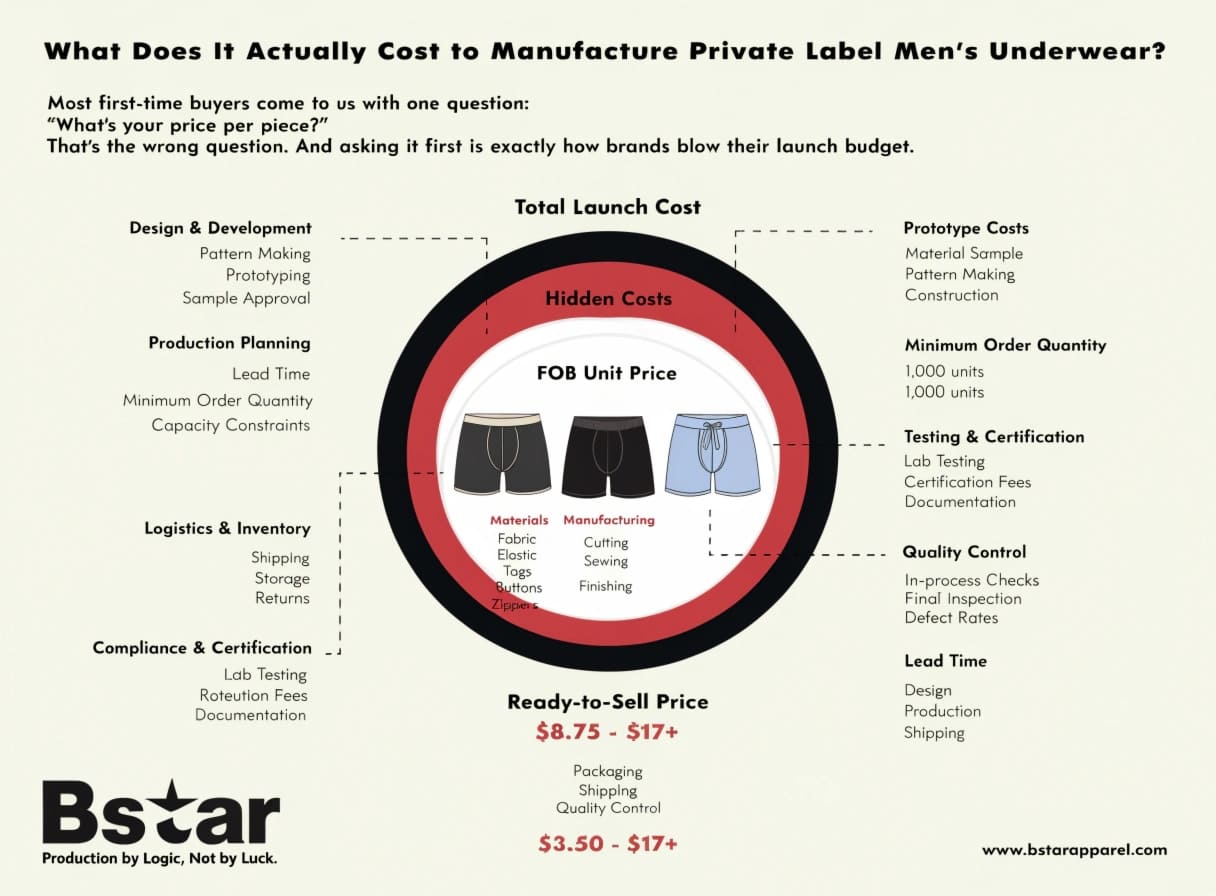
I’ve been quoting knit apparel for brands across Europe and North America for nearly two decades. The buyers who get surprised by their final costs aren’t the ones who forgot to negotiate. They’re the ones who optimized the wrong number. This article breaks down every real cost layer so you can build an honest budget before you commit to a supplier.
Raw Material Sourcing and Fabric Allocation: Does Fiber Choice Really Drive the Price?
When a quote comes back higher than you expected, most buyers assume it’s the factory’s margin.
Nine times out of ten, it’s the fabric.
Fabric and trims typically account for 50–70% of total unit cost in men’s underwear. That means if your FOB price is $6.00, roughly $3.00 to $4.20 of it is just materials. Changing your fabric spec is the single most powerful cost lever you have before production starts.
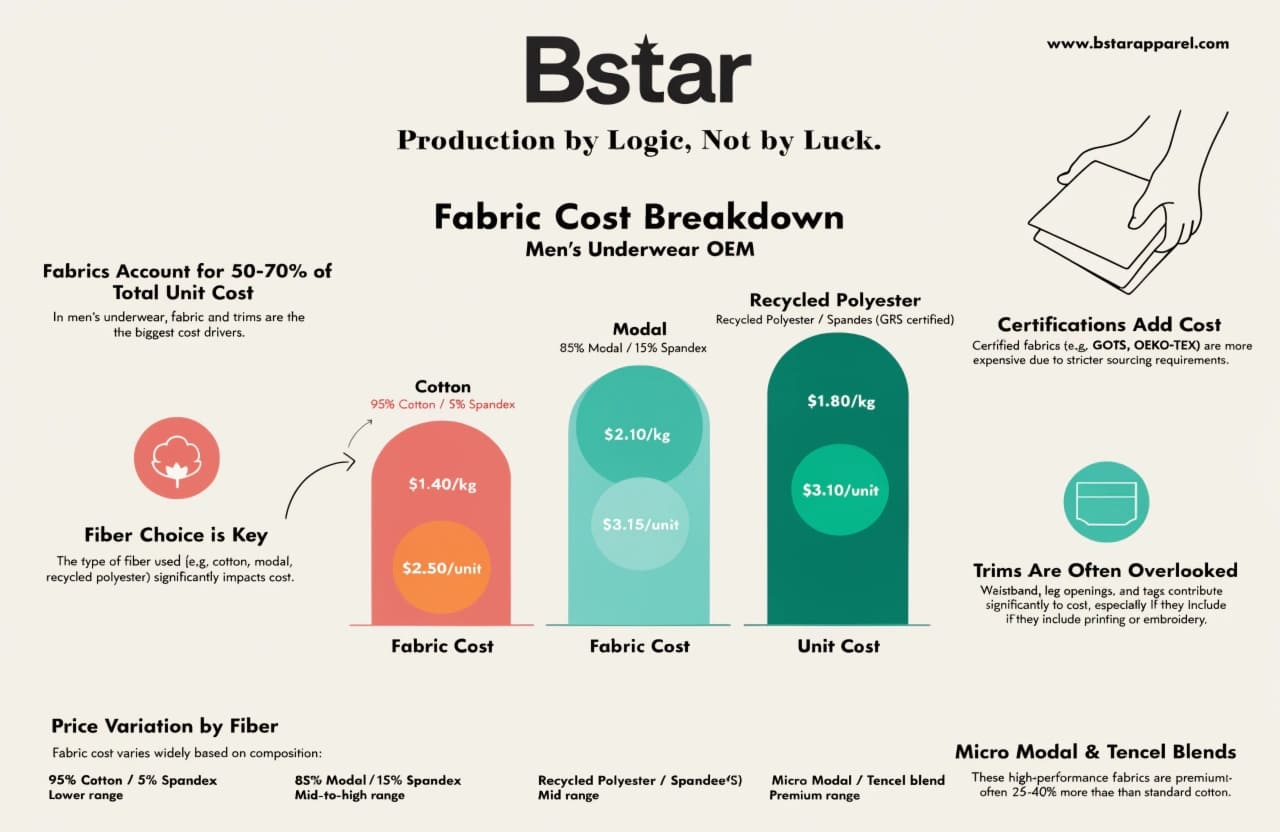
Here’s what I see most often in the quotes we process. Buyers come in asking for a "cotton underwear" price, but the actual spec is where all the cost difference lives.
How Fiber Composition Shifts Your Unit Cost
The fiber blend you choose directly changes your fabric cost per kilogram, which flows straight into your unit price. Here’s a rough picture based on our factory’s typical cost structure:
| Fabric Composition | Fabric Cost Range (per kg) | Unit Cost Impact |
|---|---|---|
| 95% Cotton / 5% Spandex | Lower range | Base price reference |
| 85% Modal / 15% Spandex | Mid-to-high range | +15–30% vs. cotton |
| Recycled Polyester / Spandex (GRS certified) | Mid range | +10–20% depending on cert |
| Micro Modal / Tencel blend | Premium range | +25–40% vs. cotton |
Beyond fiber, trims add up faster than buyers expect. Waistband construction is a good example. A basic elastic waistband with a printed logo costs meaningfully less than a jacquard-woven branded waistband. The difference can be $0.40–$0.80 per unit. On 500 units, that’s $200–$400 that never appeared in the FOB line item you were comparing.
Certifications also affect fabric cost. If you require OEKO-TEX® certified fabric, or GOTS for organic cotton, the raw material price goes up. That’s not a factory margin decision—it’s a mill-level price difference. We source certified materials at a premium, and that cost passes through directly. If sustainability credentials are important to your brand, build them into your spec from day one, not after you’ve already set a target price.
Labor and Manufacturing Overhead: What Are You Actually Paying for Beyond the Fabric?
Buyers often assume labor is where factories make their money. That’s not quite right.
Labor in knit underwear manufacturing is actually a smaller cost component than most people expect.
In our factory’s cost structure, cut-and-sew labor for a standard men’s brief or boxer brief typically represents 15–25% of total unit cost. The rest comes from fabric, overhead, and finishing. Labor costs are more sensitive to garment complexity than to order volume.
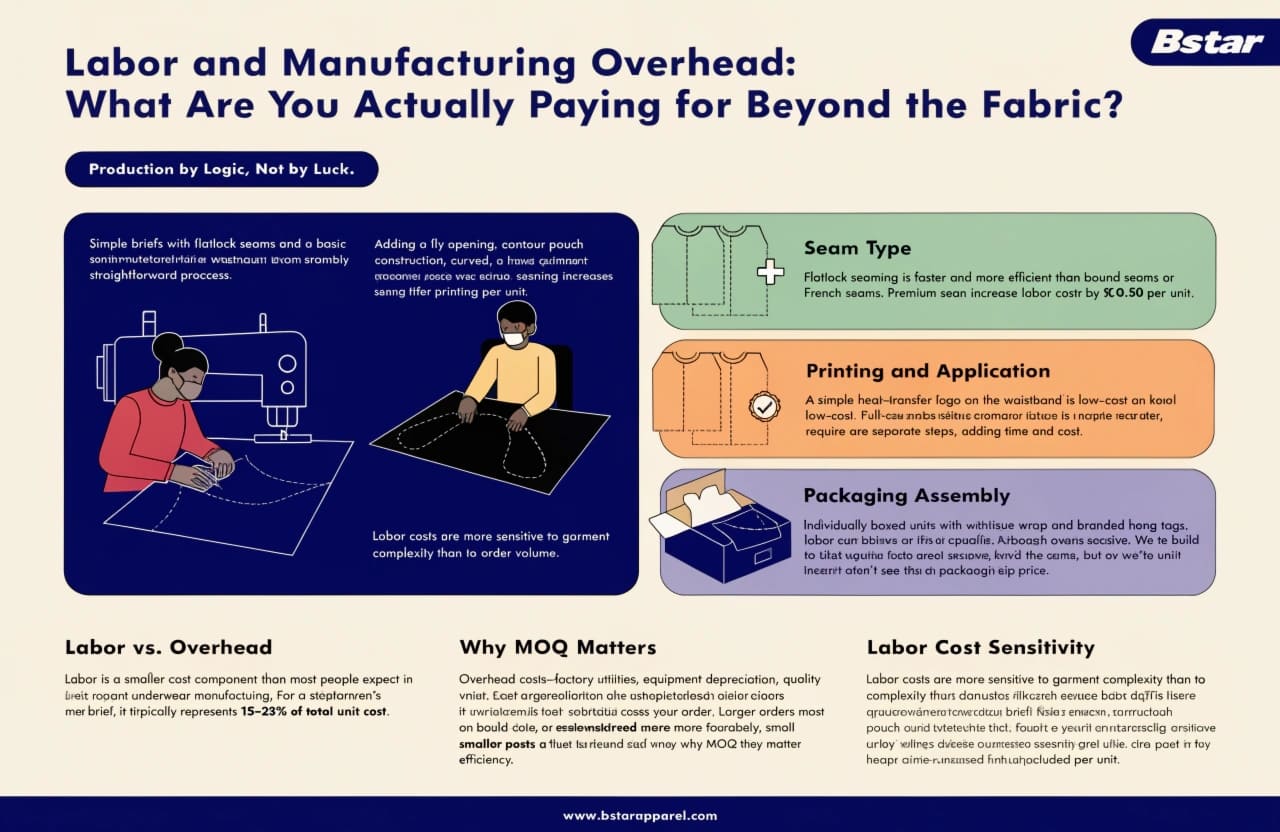
A simple brief with flatlock seams and a basic waistband has a straightforward assembly process. Add a fly opening, a contour pouch construction, curved side seams, or heat-transfer printing, and the sewing time per unit goes up. More time per unit means higher labor cost per unit. It’s that direct.
What Adds Labor Cost Per Unit
Here are three specific process choices I see shift pricing in our quotes:
Seam type: Flatlock seaming is faster and more efficient than bound seams or French seams. If your spec calls for a premium seam finish on all edges, expect labor cost to move upward by $0.20–$0.50 per unit.
Printing and application: A simple heat-transfer logo on the waistband is low-cost. A full-panel sublimation print or an embroidered detail requires separate process steps. Each step adds time on the line, and time on the line adds cost.
Packaging assembly: If your spec includes individually boxed units with tissue wrap and a branded hang tag, someone on the production floor is doing that by hand. We build that labor into the quote, but buyers reviewing a basic unit price often don’t see it until they ask for a packaging-included price.
Overhead—factory utilities, equipment depreciation, quality control labor, compliance costs—is distributed across your order. Larger orders spread this more favorably. Smaller orders carry more overhead per unit. This is part of why MOQ matters beyond just material efficiency.
Customization and Branding Expenses: How Much Does Private Label Actually Add?
Your brand isn’t just in the fabric. It’s in the label, the packaging, and the details.
These are real costs, and they often catch first-time buyers off guard.
Private label branding—including custom woven labels, care labels, custom packaging, and hang tags—typically adds $0.30 to $1.50+ per unit depending on complexity. One-time tooling or setup fees for custom labels and packaging may range from $50 to $300+ per component, and these don’t appear in your FOB unit price.
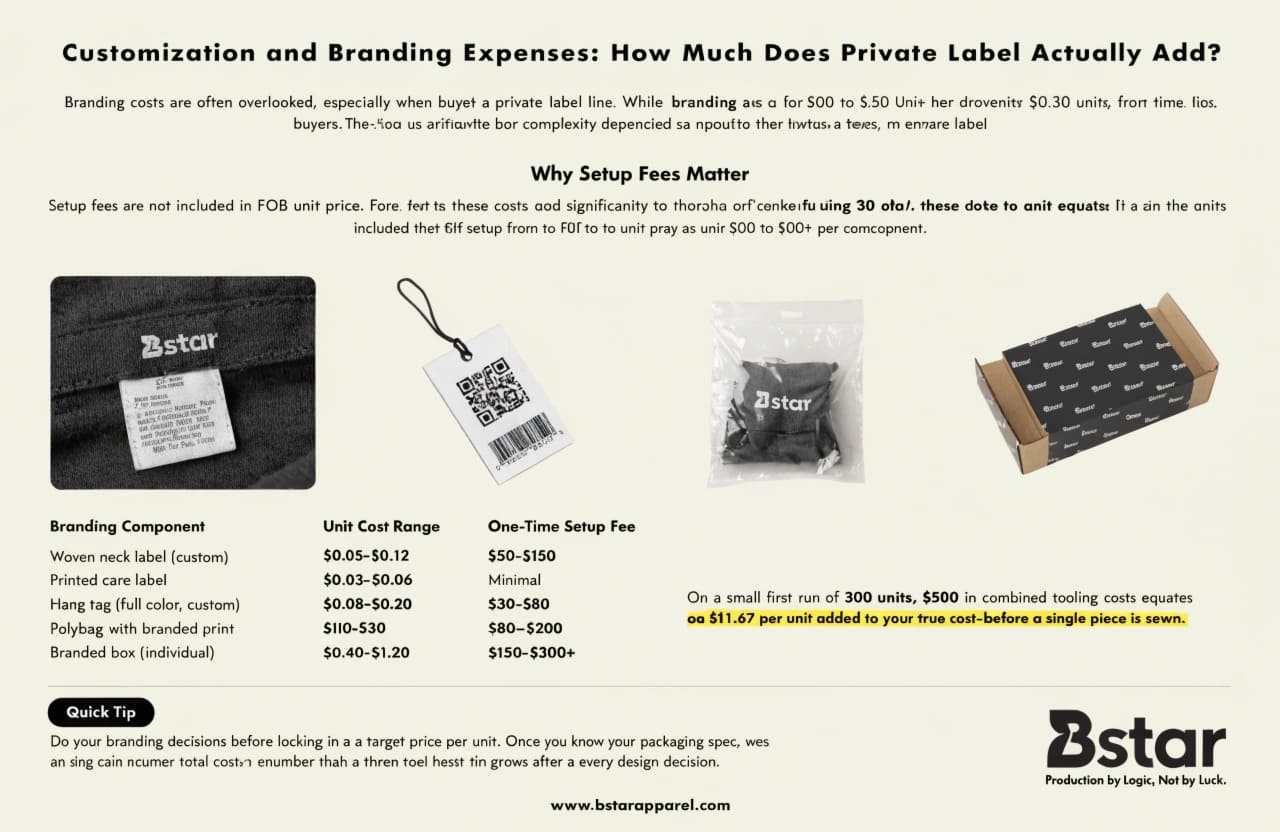
When we work with a brand launching their first private label line, we walk them through every branding touchpoint individually, because each one has its own cost structure.
Branding Cost Touchpoints Broken Down
| Branding Component | Unit Cost Range | One-Time Setup Fee |
|---|---|---|
| Woven neck label (custom) | $0.05–$0.12 | $50–$150 |
| Printed care label | $0.03–$0.06 | Minimal |
| Hang tag (full color, custom) | $0.08–$0.20 | $30–$80 |
| Polybag with branded print | $0.10–$0.30 | $80–$200 |
| Branded box (individual) | $0.40–$1.20 | $150–$300+ |
The setup fee is the part that matters most on a small first run. If you’re ordering 300 units and you’ve got $500 in combined tooling costs across labels and packaging, that’s $1.67 per unit added to your true cost—before a single piece is sewn.
This is why we always tell buyers: do your branding decisions before you lock in a target price per unit. Once you know your packaging spec, we can give you an honest total cost number rather than a number that grows after every design decision.
Hidden Costs and Profit Margins: What Doesn’t Show Up in the Quote?
You’ve got a unit price. You think you know your costs.
Then the invoice comes and it’s different.
The biggest budget gap in private label underwear manufacturing comes from costs outside the FOB unit price: sampling fees, freight, import duties, and MOQ-driven price tiers. On a first production run of 300–500 units, these additional costs can add $2–$5+ to your effective per-unit cost.
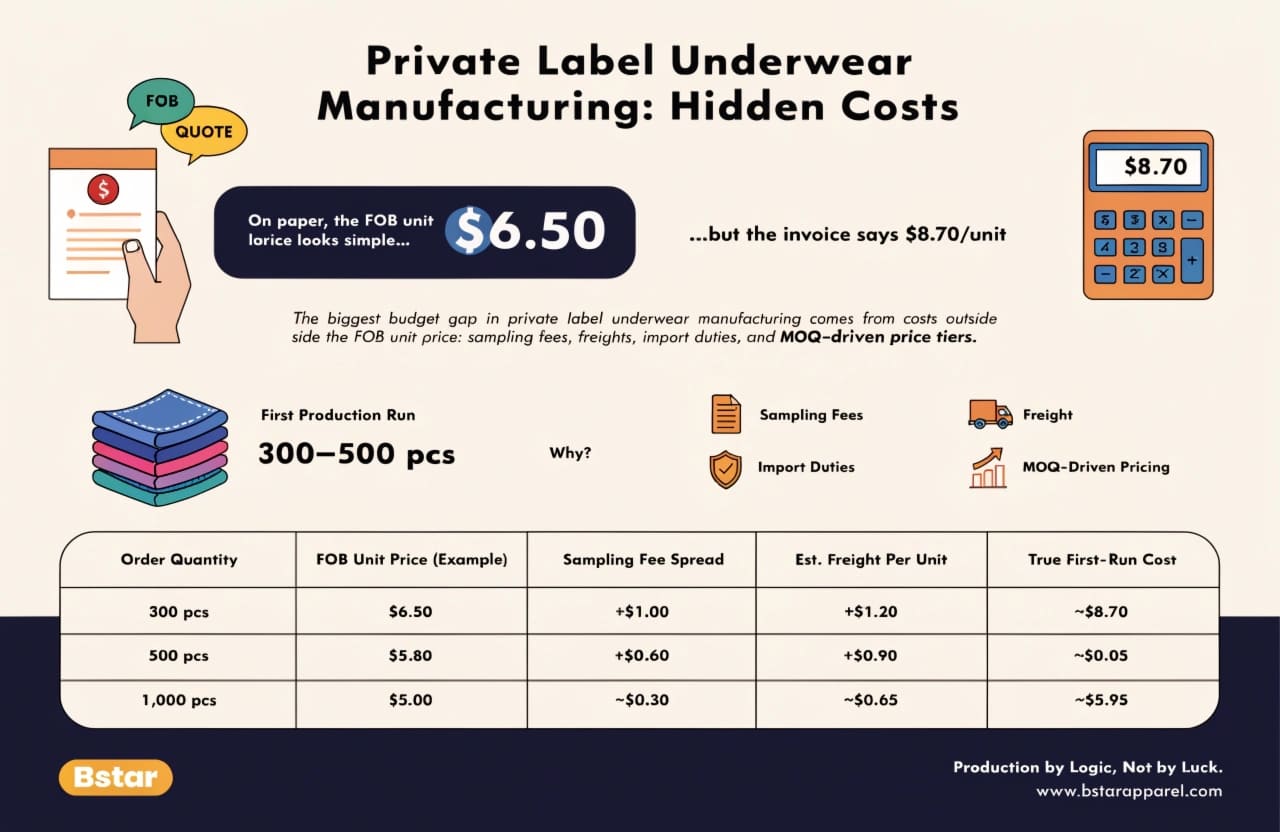
Let me show you what I mean with a real cost scenario based on our factory’s typical structure.
MOQ and Per-Unit Cost: A Tiered Example
| Order Quantity | FOB Unit Price (Example) | Sampling Fee Spread | Est. Freight Per Unit | True First-Run Cost |
|---|---|---|---|---|
| 300 pcs | $6.50 | +$1.00 | +$1.20 | ~$8.70 |
| 500 pcs | $5.80 | +$0.60 | +$0.90 | ~$7.30 |
| 1,000 pcs | $5.00 | +$0.30 | +$0.65 | ~$5.95 |
These are illustrative numbers, not guarantees. But the pattern is accurate to what buyers experience in practice. A 300-unit first run might look affordable on unit price, but when you spread sampling costs, freight, and any import duties (which vary significantly by destination country and HS code), the real cost per unit looks very different.
Sampling fees at our factory run $150–$400 per style depending on complexity. That’s a real upfront cost. If you’re developing three styles, you’re looking at $450–$1,200 before a single production unit is made. On a small run, that’s meaningful.
Freight depends on your shipping method. Sea freight is cheaper per unit but slower. Air freight is faster but can add $0.80–$2.00 per unit on small shipments. Duties depend on your country of import and the fiber content of your product—this is something buyers need to research independently with a customs broker, but it’s real money that needs to be in your model.
The honest conversation we try to have with every new buyer is this: tell us your target retail price and your launch quantity, and we’ll help you reverse-engineer a cost structure that actually works. Optimizing the FOB unit price in isolation doesn’t get you there.
Conclusion
Fabric drives your unit cost. MOQ drives your economics. Setup fees hit your first run hardest. Build a total-landed-cost model before you compare quotes—not after.