
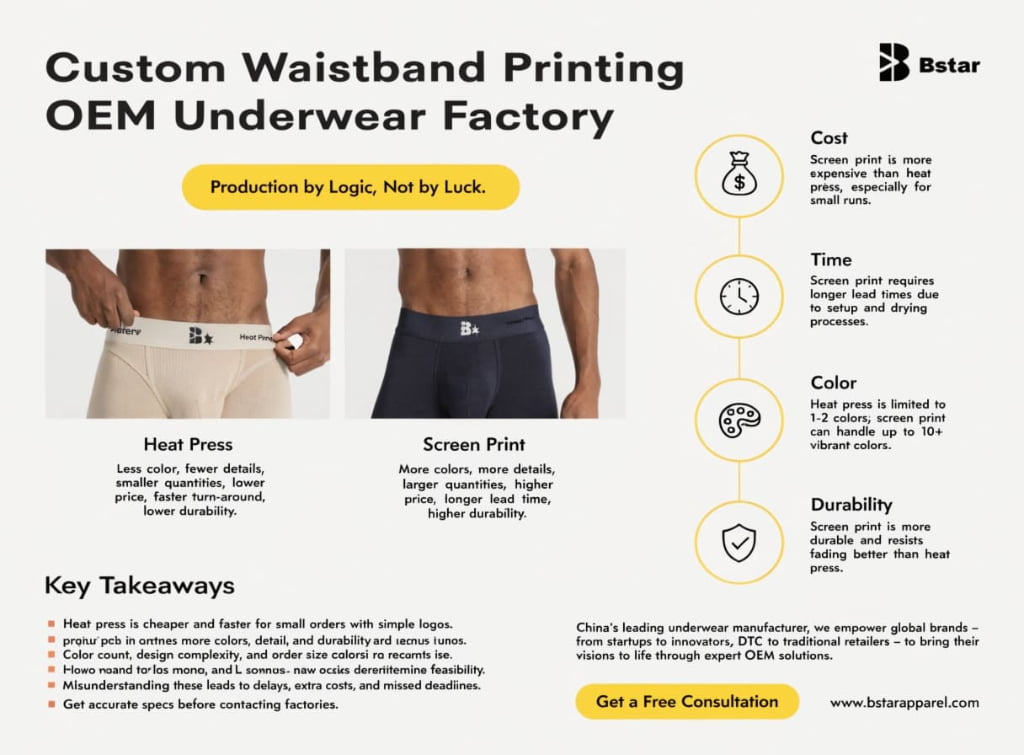
Custom Waistband Printing OEM Underwear Factory: Which Approach Actually Fits Your Brand?
Most DTC founders come to us with the same opening question: "Can you do custom waistband printing?" The short answer is yes. But that question is the wrong starting point.
Custom waistband printing is not a single capability — it is a set of trade-offs between print method, color count, order volume, and wash durability. Choosing the wrong combination at briefing stage costs you weeks and sampling budget before you even see a prototype.
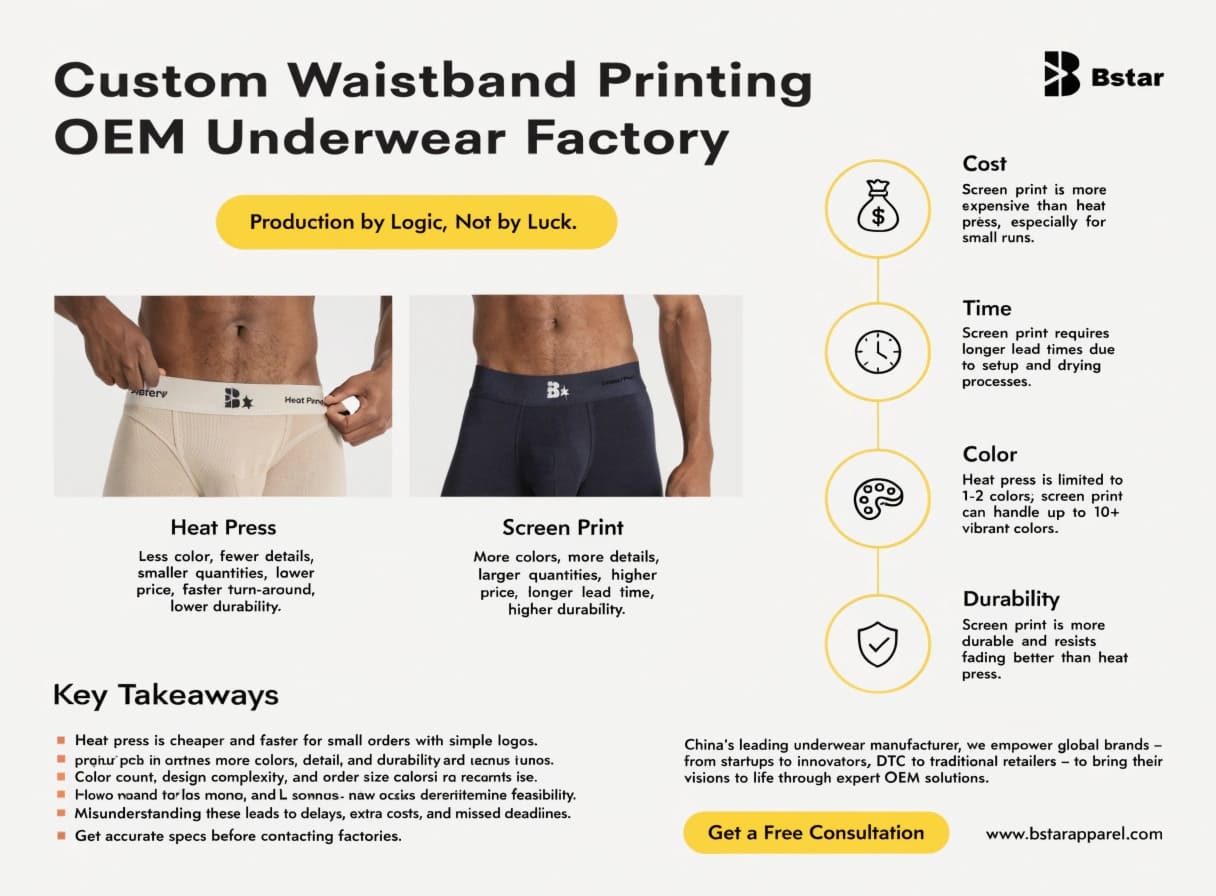
I have been handling inquiries from EU and US DTC brands at BSTAR for years. The pattern I see most often is not a factory capability gap. It is a briefing gap. Buyers arrive with a logo file and a launch date, but without the specs that actually determine what print method is viable for their project. The rest of this article breaks down what those specs are and why they matter before you contact any factory.
Advanced Printing Technologies: Which Method Fits Your Situation?
Not every print method works for every logo. This is the part most first-time buyers miss completely.
Silicone coating, silk screen printing, and heat transfer printing are not interchangeable. Each has a different MOQ floor, color limit, cost curve, and durability profile. Picking the wrong one at briefing stage means your sample will either look wrong, cost more than expected, or fail wash testing.
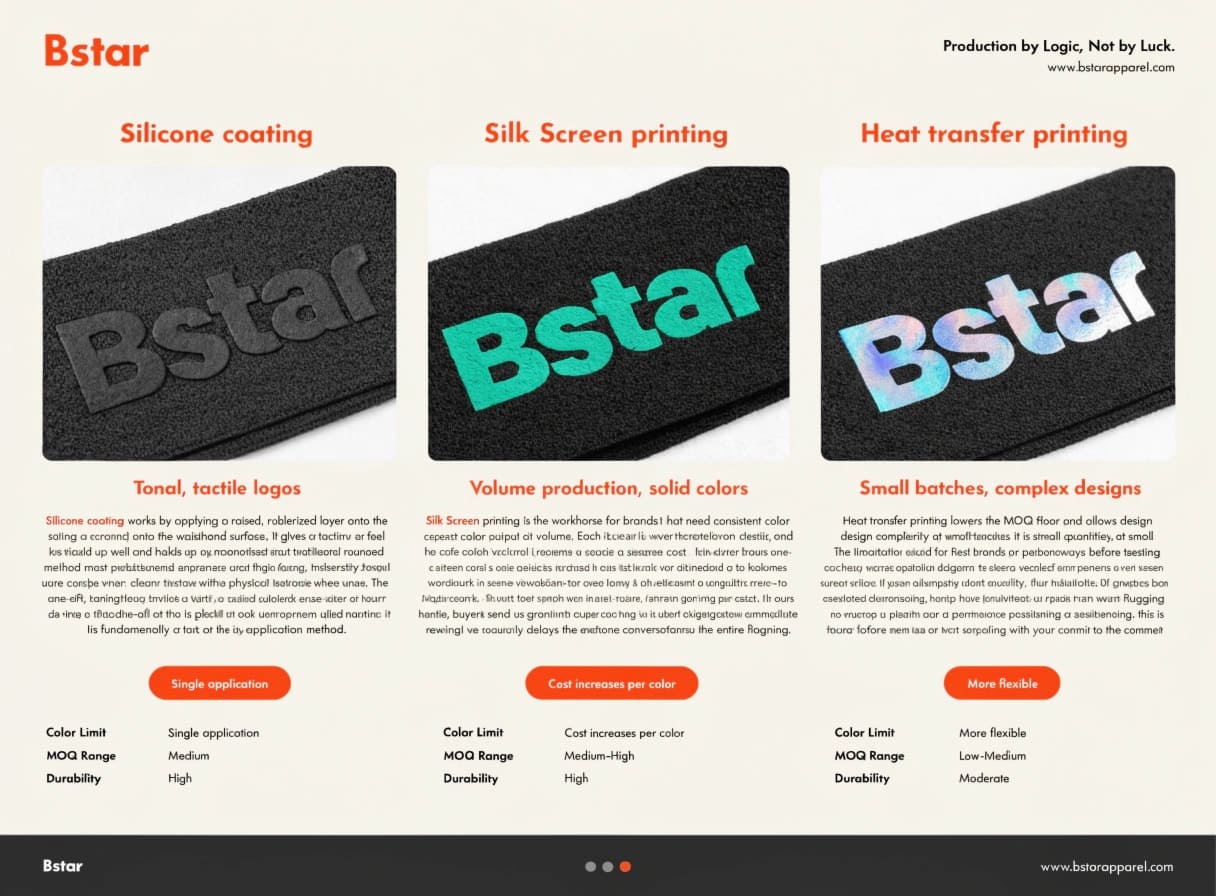
Here is how I explain the difference to buyers in initial calls:
Silicone coating works by applying a raised, rubberized layer onto the waistband surface. It gives a tactile, premium feel and holds up well through repeated washing1. It is the method most performance and lifestyle underwear brands use when they want a clean, tonal logo with a physical texture. The trade-off is that it is not the right tool for a complex, multi-color design. It is fundamentally a single-application method.
Silk screen printing is the workhorse for brands that need consistent color output at volume. Each color in your design requires a separate screen2, and each screen has a setup cost. This is where color count becomes a direct cost driver. A one-color wordmark in screen print is cost-efficient at medium-to-high volume. A four-color logo with gradients is either going to require significant simplification or a noticeably higher per-unit cost. In inquiries we regularly handle, buyers send us a brand logo without checking how many Pantone colors are in it. That single oversight delays the entire sampling conversation.
Heat transfer printing lowers the MOQ floor and allows more design complexity at small quantities. It is genuinely useful for first-production runs or brands testing colorways before scaling. The limitation is wash durability over time — heat transfer prints can crack or fade earlier than screen-printed alternatives3, depending on the substrate and application quality. If your brand competes on a premium or performance positioning, this is worth flagging with your factory before you commit to the method.
| Method | Best For | Color Limit | MOQ Range | Durability |
|---|---|---|---|---|
| Silicone Coating | Tonal, tactile logos | Single application | Medium | High |
| Silk Screen | Volume production, solid colors | Cost increases per color | Medium–High | High |
| Heat Transfer | Small batches, complex designs | More flexible | Low–Medium | Moderate |
Material Selection and Durability: What Holds Up After 50 Washes?
The waistband material is not a neutral variable. The print method you choose has to be matched to the fabric construction underneath.
Waistband elasticity, anti-slip grip performance, and wash resistance are all affected by the combination of elastic substrate and print application. A print that adheres well to a flat woven waistband may crack on a high-stretch knit band after repeated washing4.
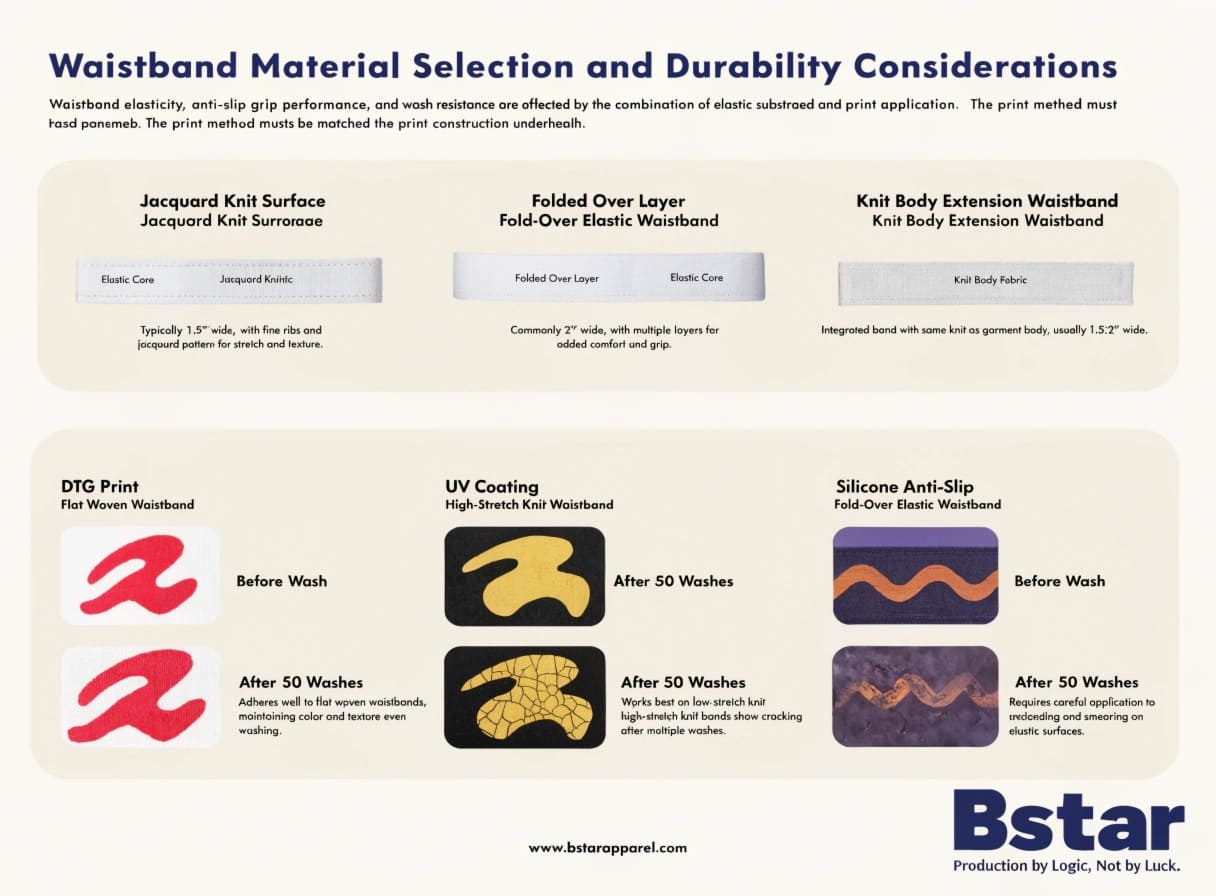
In the underwear category, waistbands are typically jacquard elastic, fold-over elastic, or a knitted band cut from the same fabric as the garment body5. Each behaves differently under tension and heat. This matters for print adhesion.
What We Confirm Before Starting a Sample
When a buyer requests a custom waistband print, we ask the following before we touch a sample brief:
- What is the waistband construction? Jacquard, fold-over, or knit body extension?
- What is the stretch percentage of the elastic? Higher stretch means higher risk of print cracking.
- What wash standard is required? Some EU buyers need compliance with specific wash cycle counts for retail or certification purposes6.
- Is anti-slip grip a functional requirement? If the waistband needs to stay in place during wear, the print method and silicone application have to serve a dual purpose.
Getting these answers from the buyer before sampling is not bureaucratic overhead. It is how we avoid a situation where the sample looks right on the table but fails at wear or wash stage.
Durability Is Not One Number
Wash resistance is directional, not a fixed spec. More wash cycles, higher water temperature, and more aggressive detergents all degrade print integrity faster7. What we can confirm is which method and material combination is most appropriate for the buyer’s end-use scenario. What we cannot do — and what no honest factory should do — is quote you a wash cycle guarantee without knowing your specific material, print method, and care label instructions together.
Design Precision and Color Matching: Getting Your Logo Right
A logo that looks sharp on screen does not automatically translate to a sharp print on a 3-centimeter elastic waistband.
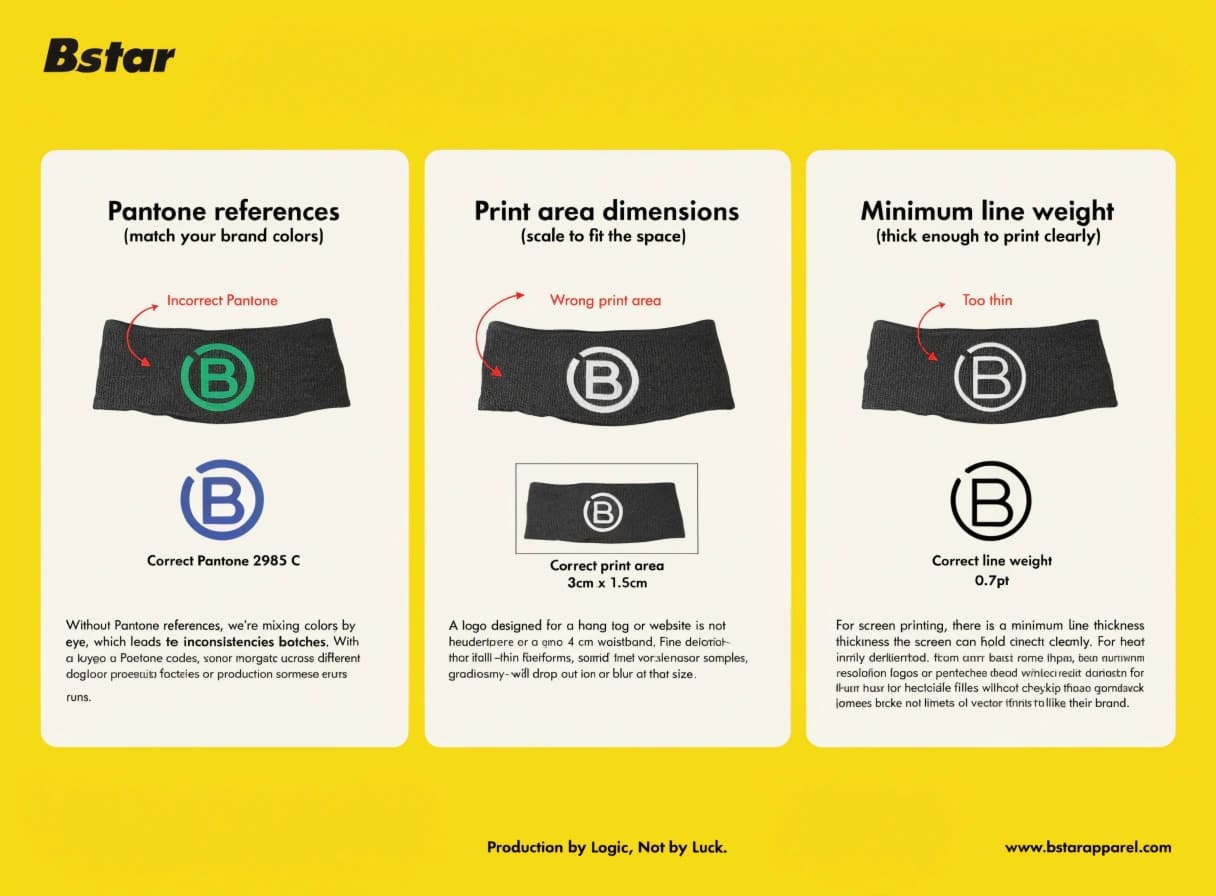
Design precision on a waistband depends on print area dimensions, minimum line thickness the method can hold, and accurate Pantone color references. Without these three inputs, the factory is guessing, and the sample will reflect that.
The Three Inputs Most Buyers Skip
1. Pantone references.
"Match our brand blue" is not a Pantone reference. Without a PMS code, we are mixing colors by eye. Two production runs from the same factory can drift if there is no fixed Pantone anchor8. For DTC brands where brand color consistency across products matters, this is not a small detail.
2. Waistband width and print area dimensions.
A logo designed for a hang tag or website header is not scaled for a 3 cm or 4 cm waistband. Fine detail — thin letterforms, small iconography, light gradients — will drop out or blur at that size. We resize and confirm the print area with buyers before starting a sample, but this works faster when the buyer already knows what dimensions they need.
3. Minimum line weight and resolution.
For screen printing, there is a minimum line thickness the screen can hold cleanly9. For heat transfer, there is a minimum resolution for the artwork file. Buyers who send low-resolution logos or heavily detailed vector files without checking these limits get samples back that do not look like their brand.
Multi-Color Prints: Where Budget and Realism Meet
More colors in a design means more screens (for screen print), more processing time (for heat transfer or digital), and a higher per-unit cost or higher MOQ to justify the setup. For first-time buyers, I usually suggest stress-testing the brand logo against a two-color version before committing to a four-color spec. In many cases, the simplified version reads just as strongly on a waistband — and the economics of the production run change significantly.
OEM Quality Standards and Production Efficiency: MOQs, Sampling, and Lead Times
The practical question behind all of this is: what does the process actually look like from first inquiry to production?
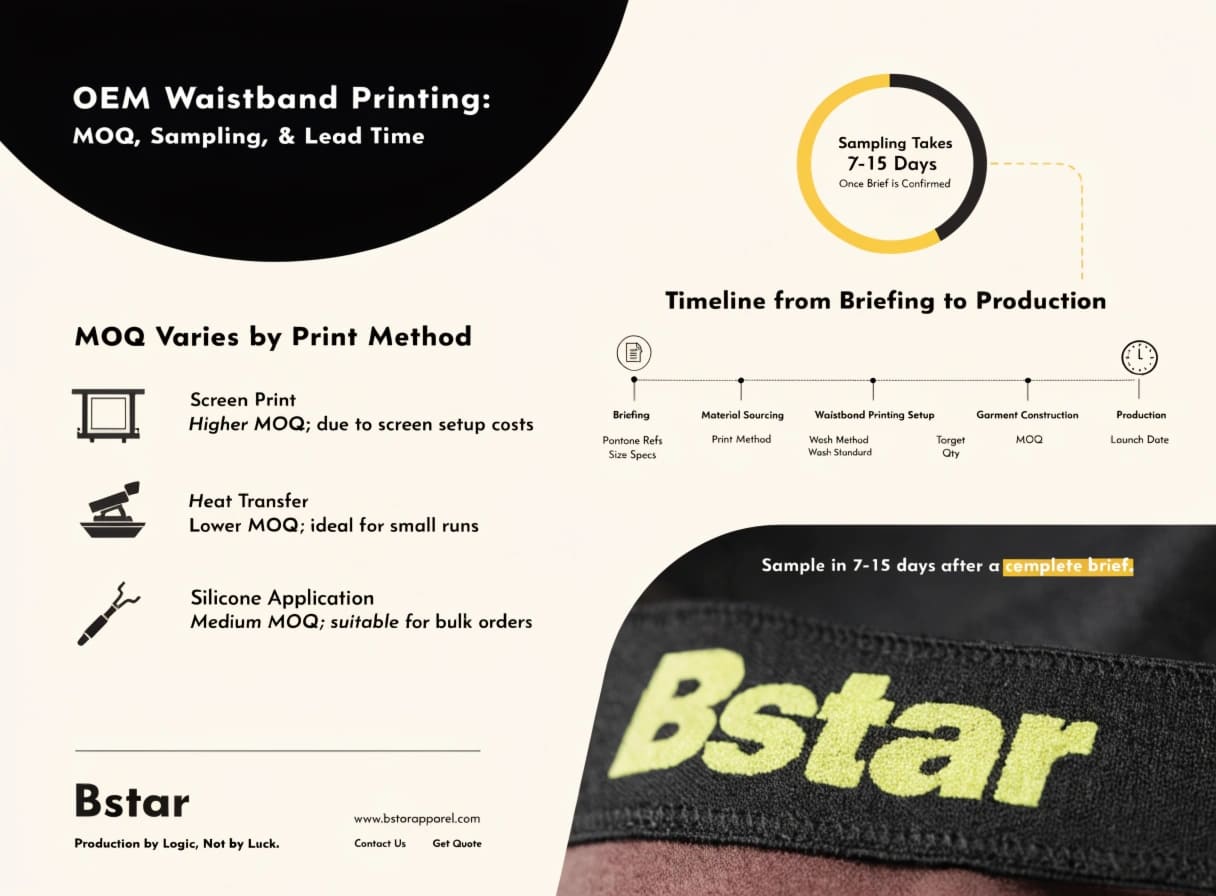
OEM waistband printing projects require clear MOQ expectations, a realistic sampling timeline, and a completed brief before development starts. Factories that skip the brief and go straight to sampling are not saving you time — they are shifting the risk of a mismatch onto you.
What a Realistic Timeline Looks Like
At BSTAR, we can complete a sample in 7 to 15 days once we have a confirmed brief. That window includes waistband material sourcing, print setup, and garment construction. The briefing stage — getting Pantone refs, size specs, and method confirmation — is not included in that window. Buyers who arrive with a complete brief get samples faster. Buyers who arrive with a logo file and "make it look good" take longer.
MOQ Is Method-Dependent
There is no single MOQ for custom waistband printing because the MOQ depends on the print method. Screen printing carries screen setup costs that need to be spread across a minimum order quantity to be economical. Heat transfer can start lower. Silicone application sits somewhere in between. When buyers ask us for an MOQ without specifying a method, the honest answer is that we need the method confirmed first.
What to Prepare Before You Approach Any Factory
This is the practical takeaway from every point in this article:
- Pantone color codes for all brand colors in the logo
- Waistband width and intended print area dimensions
- Preferred print method (or openness to a factory recommendation based on your design)
- Required wash standard or wash cycle target
- Target order quantity and launch timeline
- Any certification requirements (OEKO-TEX, GOTS, GRS10, etc.)
Factories that receive a brief with these inputs can give you an accurate sample timeline and cost estimate. Factories that receive a logo file and a launch date are starting from a guess.
Conclusion
Custom waistband printing works when the method, material, and brief all match. The biggest risk for DTC brands is not factory capability — it is arriving without the right specs and losing weeks to preventable back-and-forth.
-
"Modifications of Textile Materials with Functional Silanes, Liquid …", https://pmc.ncbi.nlm.nih.gov/articles/PMC9611165/. The wash resistance of silicone-based coatings on textile substrates is attributable to the thermal and chemical stability of cross-linked polydimethylsiloxane networks; standardized wash fastness evaluation is conducted under ISO 105-C06 or equivalent protocols. Evidence role: mechanism; source type: institution. Supports: Silicone coatings on textile substrates exhibit resistance to degradation under repeated laundering due to the chemical stability of cured silicone elastomers. Scope note: General silicone chemistry literature may not directly address narrow elastic waistband applications; performance varies with coating thickness and substrate stretch. ↩
-
"Color printing – Wikipedia", https://en.wikipedia.org/wiki/Color_printing. Screen printing (also known as serigraphy) is a stencil-based printing technique in which each color in a multicolor design requires a separate screen, with ink forced through the mesh onto the substrate in successive passes; see, e.g., the Wikipedia article ‘Screen printing.’ Evidence role: definition; source type: encyclopedia. Supports: The screen printing process requires a distinct stenciled mesh screen for each ink color applied, as each screen carries only one color of ink per pass. ↩
-
"Screen Printing vs. Embroidery vs. Heat Transfer: Which Is Right for …", https://www.epromos.com/blog/screen-printing-vs-embroidery-vs-heat-transfer/?srsltid=AfmBOoq42c3hcB8QwOx4YZuwBqNavbczdEsmkmUiWGdYDDqPNSxwpc_Z. Studies on garment decoration durability indicate that heat transfer films are more susceptible to delamination and cracking on high-elongation substrates than cured screen-print inks, particularly after repeated thermal and mechanical stress during laundering. Evidence role: expert_consensus; source type: paper. Supports: Heat transfer prints generally exhibit lower adhesion longevity on stretch fabrics compared to plastisol or water-based screen prints after multiple wash cycles. Scope note: Comparative durability is highly dependent on application temperature, pressure, dwell time, and substrate composition; generalizations may not apply uniformly across all product types. ↩
-
"[PDF] Achieving Highly Conductive, Stretchable, and Washable Fabric …", https://www.lamp.pitt.edu/Publications/054.pdf. The mechanical integrity of applied print films on elastic substrates is governed by the compatibility between the film’s elongation-at-break and the substrate’s stretch percentage; films with insufficient elasticity fracture when the substrate is repeatedly extended beyond the film’s deformation limit. Evidence role: mechanism; source type: paper. Supports: Ink or coating films applied to high-elongation knit substrates are subject to tensile stress during stretching that can exceed the film’s elongation-at-break, leading to cracking or delamination. Scope note: Specific cracking thresholds depend on ink chemistry, cure conditions, and substrate fiber content; the cited mechanism is general and may not quantitatively predict performance for specific waistband constructions. ↩
-
"9 Types of Waistband Elastic You Need to Know! Elastic … – YouTube", https://www.youtube.com/watch?v=S2CKaCt3Ags. Apparel construction references classify waistband types in knitted underwear as including jacquard-woven elastic bands, fold-over elastic (FOE), and self-fabric knit bands; each construction differs in stretch recovery, edge finish, and compatibility with applied decoration. Evidence role: definition; source type: education. Supports: Underwear waistbands are constructed using several distinct methods including woven jacquard elastic, fold-over elastic, and knitted extensions of the garment body fabric. Scope note: Specific academic sources on underwear waistband typology are limited; this classification is primarily documented in industry technical manuals and pattern-making references rather than peer-reviewed literature. ↩
-
"Threading Your Way Through the Labeling Requirements Under the …", https://www.ftc.gov/business-guidance/resources/threading-your-way-through-labeling-requirements-under-textile-wool-acts. EN ISO 6330 specifies standardized domestic washing and drying procedures for textile testing within the EU regulatory framework; wash cycle counts and conditions specified under this standard are referenced in product compliance and certification assessments for the European market. Evidence role: historical_context; source type: government. Supports: EU textile regulations and associated harmonized standards, including EN ISO 6330, specify domestic washing procedures used to evaluate dimensional stability and color fastness for compliance and labeling purposes. Scope note: Specific wash cycle count requirements vary by product category and certification scheme; the article’s reference to ‘retail or certification purposes’ is general and may encompass multiple distinct standards. ↩
-
"Optimizing washing conditions for smart fabrics – PMC – NIH", https://pmc.ncbi.nlm.nih.gov/articles/PMC11664346/. Textile wash fastness testing under ISO 105-C series standards demonstrates that print and dye degradation is a function of cumulative mechanical agitation, thermal exposure, and chemical action from surfactants and bleaching agents; higher temperatures and more alkaline detergents accelerate colorant and binder breakdown. Evidence role: mechanism; source type: paper. Supports: Print and color fastness on textile substrates degrades as a function of wash cycle count, water temperature, and detergent chemistry, as documented in standardized wash fastness testing protocols. Scope note: The rate of degradation is highly dependent on the specific ink or coating chemistry, substrate fiber content, and application quality; ISO test results under standardized conditions may not directly predict performance under consumer laundering practices. ↩
-
"Pantone – Wikipedia", https://en.wikipedia.org/wiki/Pantone. The Pantone Matching System provides standardized color references used across print and textile industries to specify and communicate color with sufficient precision for repeatable production; without a fixed spectral reference, color matching relies on visual assessment, which introduces inter-batch variability. Evidence role: mechanism; source type: institution. Supports: Standardized color reference systems such as the Pantone Matching System (PMS) are used in textile and print production to ensure color repeatability across production runs by providing a fixed spectrophotometric target. Scope note: Even with Pantone references, metamerism and substrate variation can cause perceived color differences; PMS codes reduce but do not eliminate inter-run color drift. ↩
-
"Screen printing", https://en.wikipedia.org/wiki/Screen_printing. The minimum reproducible line width in screen printing is determined by the mesh count of the screen fabric and the emulsion over mesh (EOM) ratio; finer meshes permit higher resolution but reduce ink deposit volume, creating a practical lower bound for line weight in production printing. Evidence role: mechanism; source type: research. Supports: Screen printing resolution is constrained by mesh count, emulsion thickness, and ink viscosity, which together determine the minimum reproducible line width and fine detail threshold. Scope note: Specific minimum line width values vary by mesh count, ink type, and substrate; no universal industry standard defines a single threshold applicable to all screen printing applications. ↩
-
"Oeko-Tex – Wikipedia", https://en.wikipedia.org/wiki/Oeko-Tex. OEKO-TEX Standard 100 (OEKO-TEX Association) certifies textiles tested for harmful substances; the Global Organic Textile Standard (GOTS) governs organic fiber processing and social criteria; the Global Recycled Standard (Textile Exchange) verifies recycled input claims in supply chains. Evidence role: definition; source type: institution. Supports: OEKO-TEX, GOTS, and GRS are internationally recognized third-party certification schemes governing chemical safety, organic fiber content, and recycled material content in textile products respectively. ↩
Discussion & questions 0 comments