
Is Your Clothing Label Actually Compliant in the US and EU?
Most brands don’t find out their labels are wrong at the design stage. They find out at the port, or after a platform pulls their listing, or when a customer complaint triggers a retailer audit. By then, fixing it is expensive — and sometimes impossible.
Labeling compliance in the US and EU covers fiber content, care instructions, country of origin, chemical safety, and language requirements. The two markets run under different regulatory systems. Getting one right does not mean you’ve satisfied the other. The right time to align your label spec is before sample approval, not after bulk production.
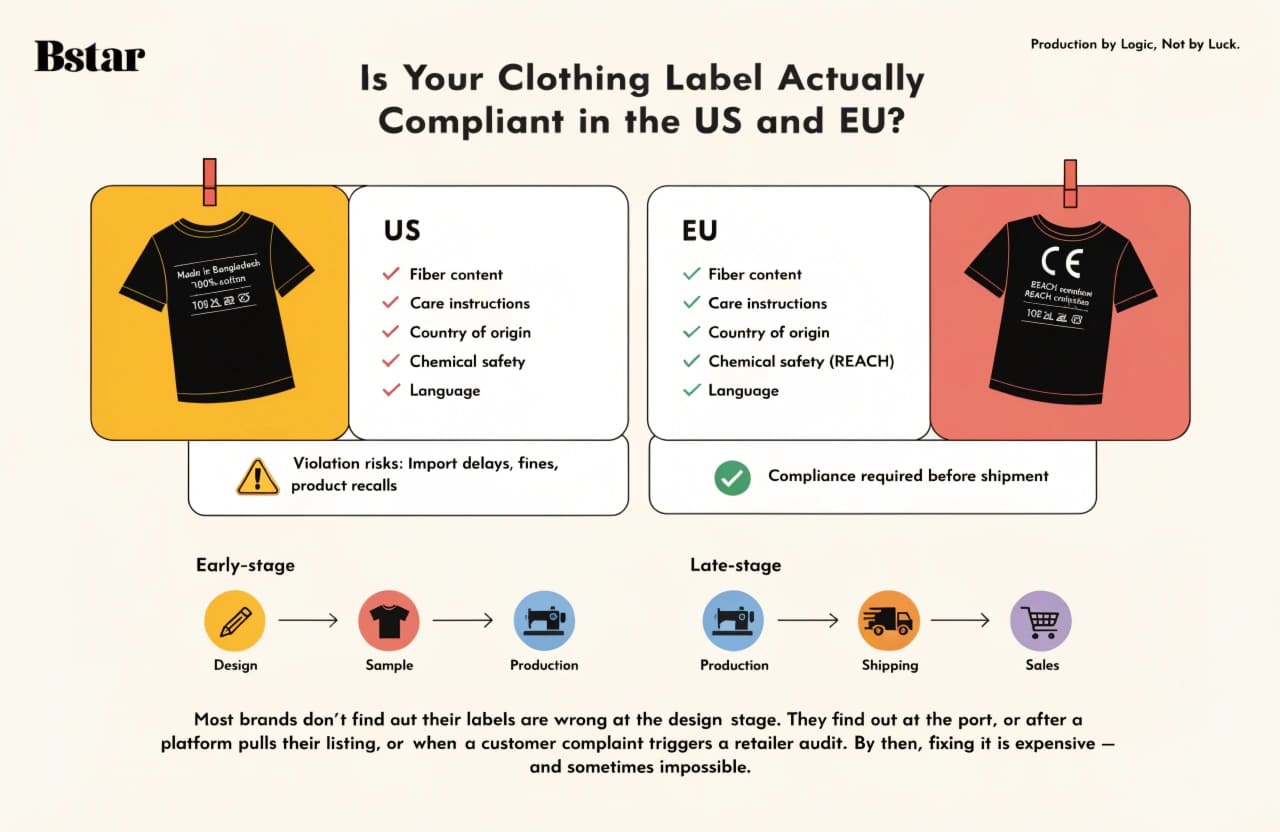
In our experience working with DTC brands and traditional buyers across both markets, labeling gaps are one of the most common surprises that come up late in the sourcing process. Not because brands don’t care — they do. But because it’s easy to assume the manufacturer has a template, or that a certification covers more than it actually does. This article breaks down what you actually need to think about, and when.
Are US Labeling Rules Really That Different From EU Rules?
A lot of brands treat US and EU compliance as roughly the same thing with minor regional differences. That assumption has caused real problems for real shipments.
The US and EU run separate labeling frameworks. The US is governed primarily by FTC rules [verify current version] and CPSC regulations. The EU operates under the Textile Labelling Regulation (EU) No 1007/2011 [verify current version] and related consumer protection directives. Fiber content thresholds, care symbol systems, language requirements, and country-of-origin rules all differ between the two.
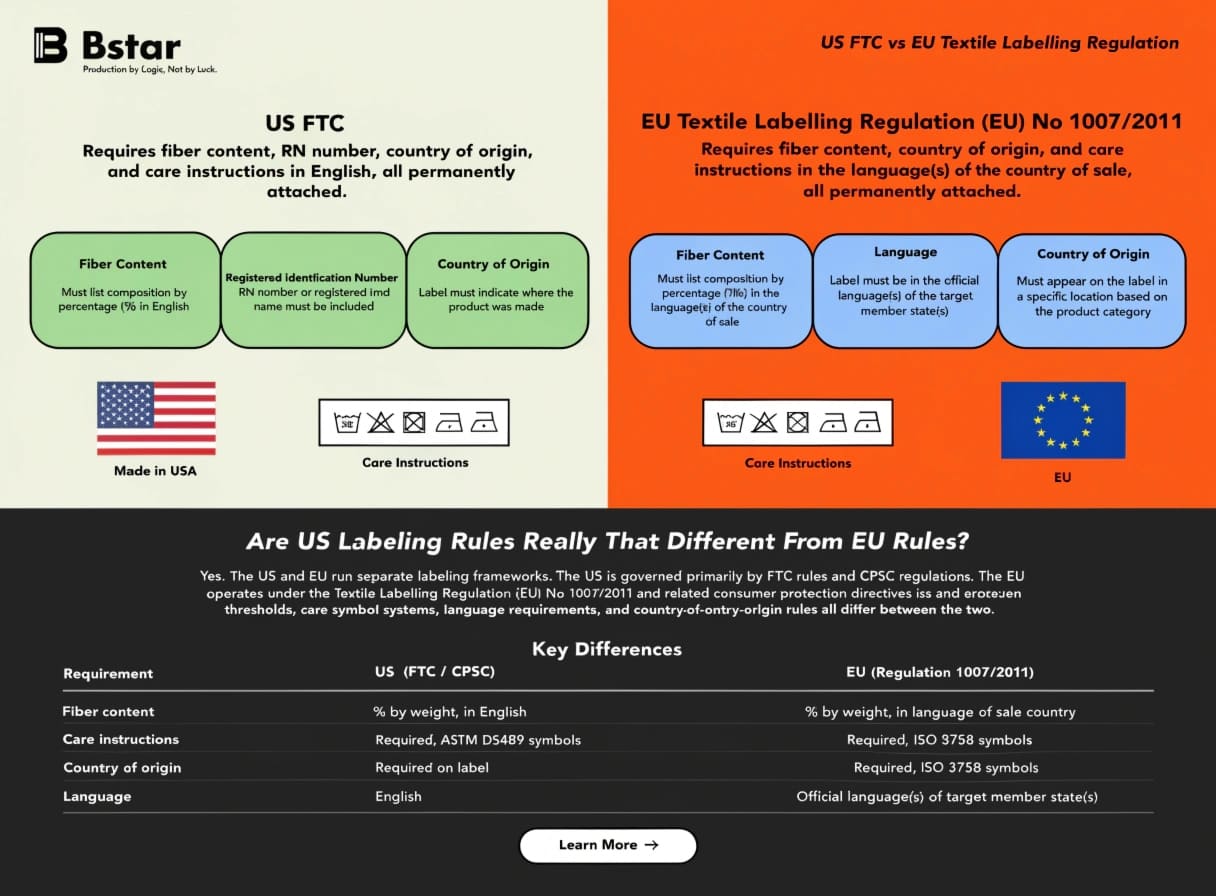
The US FTC requires fiber content disclosure by percentage, a registered identification number (RN or WPL) or brand name, country of origin, and care instructions — all in English, all permanently attached. The EU requires fiber content in the official language(s) of the country of sale, which means a product sold in France, Germany, and the Netherlands needs label content in French, German, and Dutch. One English label does not cover that.
Care instruction symbols are also different. The US follows ASTM D5489 [verify current version]. The EU follows ISO 3758 [verify current version]. The symbols look similar but are not identical, and mixing them up on a label is a real issue we’ve seen flagged during buyer review.
Here’s a basic comparison of where the two systems differ most:
| Requirement | US (FTC / CPSC) | EU (Regulation 1007/2011) |
|---|---|---|
| Fiber content | % by weight, in English | % by weight, in language of sale country |
| Care instructions | Required, ASTM D5489 symbols | Required, ISO 3758 symbols |
| Country of origin | Required on label | Required, specific placement rules apply |
| Language | English | Official language(s) of target member state(s) |
| Label durability | Must be legible for product life | Must be permanent and legible |
The key point here is not just that the rules are different — it’s that the failure mode is different in each market. In the US, a missing RN number or an incorrect care symbol can trigger an FTC enforcement action. In the EU, a label in only English when selling in Spain can result in customs hold or retailer rejection. Neither of these is a hypothetical. One thing we flag early in every brief is which markets the product is going to — because that single answer changes the entire label spec.
Does Having OEKO-TEX or GOTS Mean Your Label Is Compliant?
This is probably the most common misconception we run into. A brand asks about compliance, we mention our certifications, and they say "great, so we’re covered." Not exactly.
Certifications like OEKO-TEX®, GOTS, and BSCI verify material safety, organic fiber sourcing, and factory social responsibility standards. They do not satisfy the label language, placement, format, or durability requirements set by US FTC rules or EU consumer protection law. These are different things.
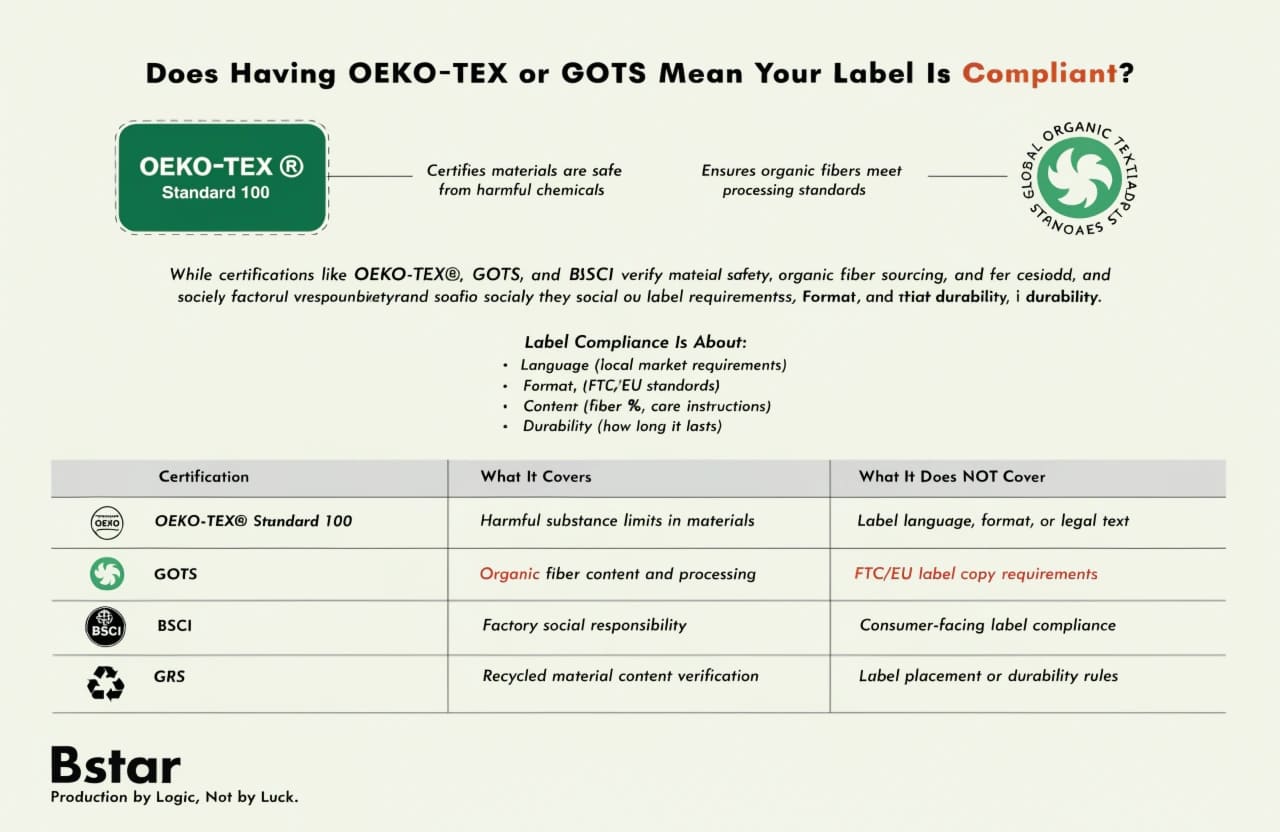
Let me be direct about what our certifications actually mean. When we say our yarns are OEKO-TEX certified, that means the materials have been tested and verified to be free from harmful substances at the production stage. When we say we hold BSCI certification, that refers to our factory’s social and ethical compliance. These credentials matter — especially to buyers who need to demonstrate supply chain responsibility to their retail partners.
But none of them tell you whether your care label is in the right language for the German market. None of them confirm that your fiber content declaration meets FTC percentage thresholds. None of them approve the placement or durability of the label on the finished garment.
Here’s a simple breakdown of what each certification covers — and what it doesn’t:
| Certification | What It Covers | What It Does NOT Cover |
|---|---|---|
| OEKO-TEX® Standard 100 | Harmful substance limits in materials | Label language, format, or legal text |
| GOTS | Organic fiber content and processing | FTC/EU label copy requirements |
| BSCI | Factory social responsibility | Consumer-facing label compliance |
| GRS | Recycled material content verification | Label placement or durability rules |
The reason this matters is that buyers who conflate certification with labeling compliance often skip the label spec conversation entirely. They assume the manufacturer’s standard template is legally sufficient for their target market. Sometimes it is. Often, it isn’t — and the gap doesn’t surface until a retailer review or customs check.
Our role as a manufacturer is to surface these variables early and execute the label spec accurately once the brand has confirmed it. Final sign-off on label copy should come from the brand’s legal counsel or a compliance consultant. We flag the questions. The brand provides the answers.
What Do REACH, CPSIA, and Flammability Standards Actually Mean for Your Label?
Chemical safety and flammability compliance add another layer — one that is separate from fiber content or care instruction rules, but that also feeds directly into label requirements.
REACH (EU) [verify current version] restricts specific hazardous chemicals in textiles sold in Europe. CPSIA (US) [verify current version] sets safety standards for children’s products, including fiber content and flammability labeling. Products that fail these standards face import refusal, recall, or retail platform suspension.
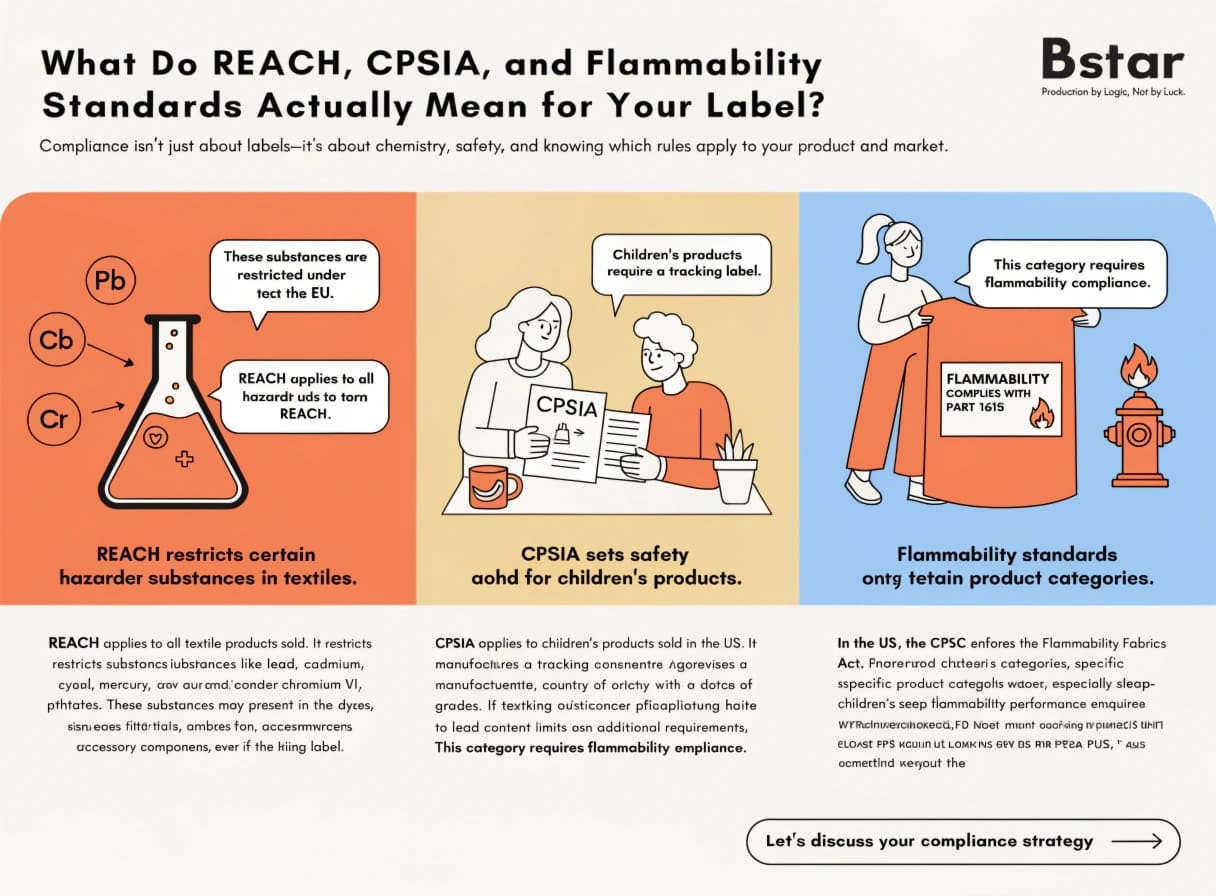
REACH affects products sold anywhere in the EU. If restricted substances are detected in the finished garment — in the dye, the yarn finish, or the accessory components — the product can be pulled from sale regardless of what the label says. This is why material sourcing matters before label design even begins.
CPSIA is especially relevant for brands selling children’s apparel in the US. It requires specific tracking label information — including manufacturer name, production location, date of manufacture, and batch number — on children’s products. This is not optional, and it is not covered by a generic care label template.
Flammability is another area where many brands underestimate the specificity of the requirements. In the US, the CPSC enforces the Flammability Fabrics Act [verify current version]. Specific product categories — children’s sleepwear in particular — have strict flammability performance requirements, and the label must reflect compliance language accordingly.
Here’s where the decision risk is real:
| Standard | Market | Who It Affects | Label Impact |
|---|---|---|---|
| REACH | EU | All textile products | Restricted substance compliance; no specific label text but affects material sourcing |
| CPSIA | US | Children’s products | Tracking label required; age grade affects additional requirements |
| ASTM F963 [verify] | US | Children’s products | Safety standard; labeling requirements tied to product type |
| Flammability Fabrics Act [verify] | US | All apparel, especially children’s sleepwear | Specific label compliance language required |
One thing we do consistently is use dyes and yarns that meet international chemical safety standards across our supply chain. That doesn’t make us a compliance authority — it means the material baseline is clean. The brand still needs to confirm that their specific product, for their specific market, meets the applicable standard. We help them understand what questions to ask before they go to sample.
What Actually Happens When Labels Are Wrong?
Let’s talk about the real consequences — not as a scare tactic, but because understanding the failure mode helps you see why the intervention point matters.
Non-compliant labels can result in customs seizure, forced destruction of inventory, retailer rejection, e-commerce platform suspension, and FTC or EU regulatory penalties. For DTC brands without a dedicated compliance function, a single shipment hold can create cash flow and reputational damage that takes months to recover from.
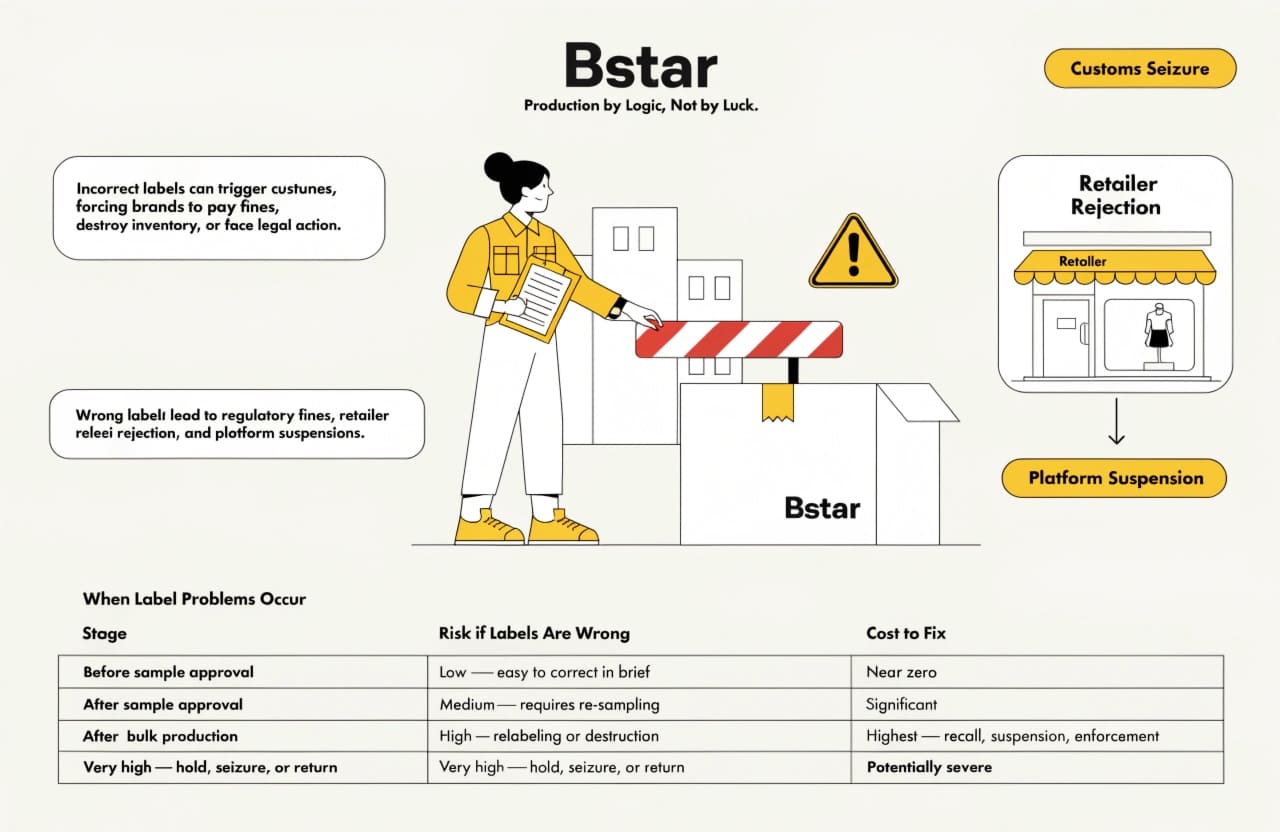
In our experience, small and newer brands are the most exposed. They often don’t have an in-house compliance team. They rely on the manufacturer’s standard label template, assume it’s good enough, and move on. The problem is that a manufacturer’s template is built around what that factory produces most — it is not built around your specific product category, your target market, or your distribution channel.
A DTC brand selling direct to US consumers through Shopify has different label exposure than a traditional brand selling through a German department store chain. Both need compliant labels, but the specific requirements, the audit triggers, and the enforcement mechanisms are different.
Here’s what the risk looks like at each stage of the process:
| Stage | Risk if Labels Are Wrong | Cost to Fix |
|---|---|---|
| Before sample approval | Low — easy to correct in brief | Near zero |
| After sample approval | Medium — requires re-sampling | Moderate |
| After bulk production | High — relabeling or destruction | Significant |
| At customs / port of entry | Very high — hold, seizure, or return | Very high + delays |
| After retail or platform listing | Highest — recall, suspension, enforcement | Potentially severe |
The table above makes the point plainly. The earlier you catch a label problem, the cheaper it is. This is why one thing we flag early in every brief is the target market and distribution channel — not because we’re running a compliance check, but because those two answers determine which label requirements even apply.
We’ve had clients come to us mid-production asking whether their label works for both the US and EU markets. Sometimes the answer is yes, with minor adjustments. Sometimes the answer is that they need two different label sets. Catching that question after bulk production has already started is a much harder conversation than catching it at brief stage.
Conclusion
US and EU label compliance are different systems with real financial consequences when confused. Certifications help but don’t replace correct label specs. Catch the gaps before sample approval — not at the port.