Modal vs Bamboo vs Tencel Underwear: Which One Actually Holds Up to Compliance Scrutiny?
If you’re building a sustainable underwear brand, picking the "right" fabric feels like the most important decision. But the wrong choice doesn’t just affect comfort — it can expose your brand to greenwashing claims.
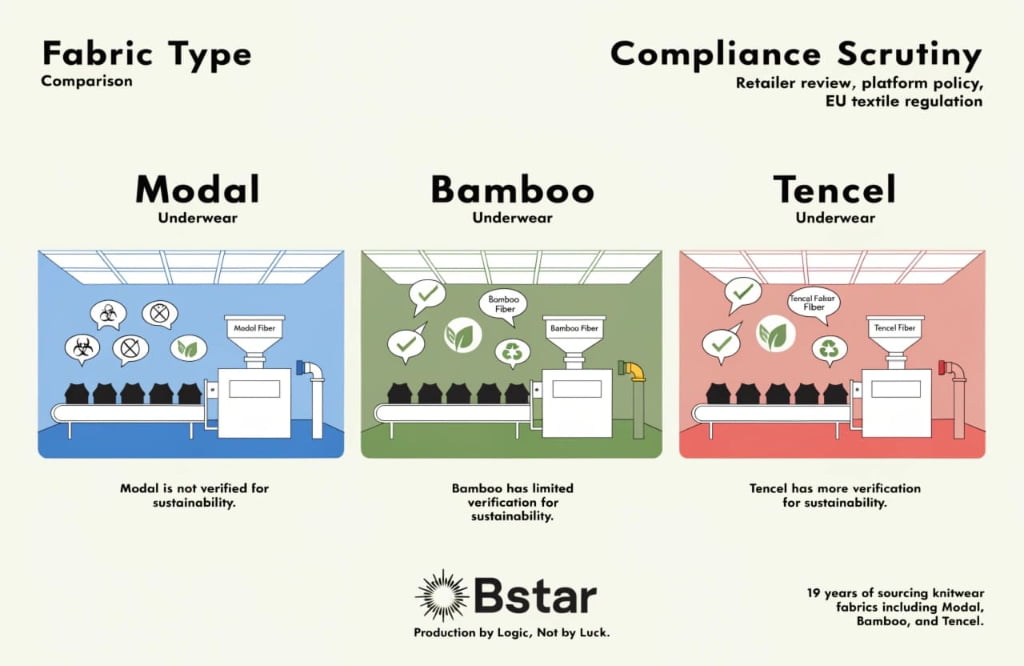
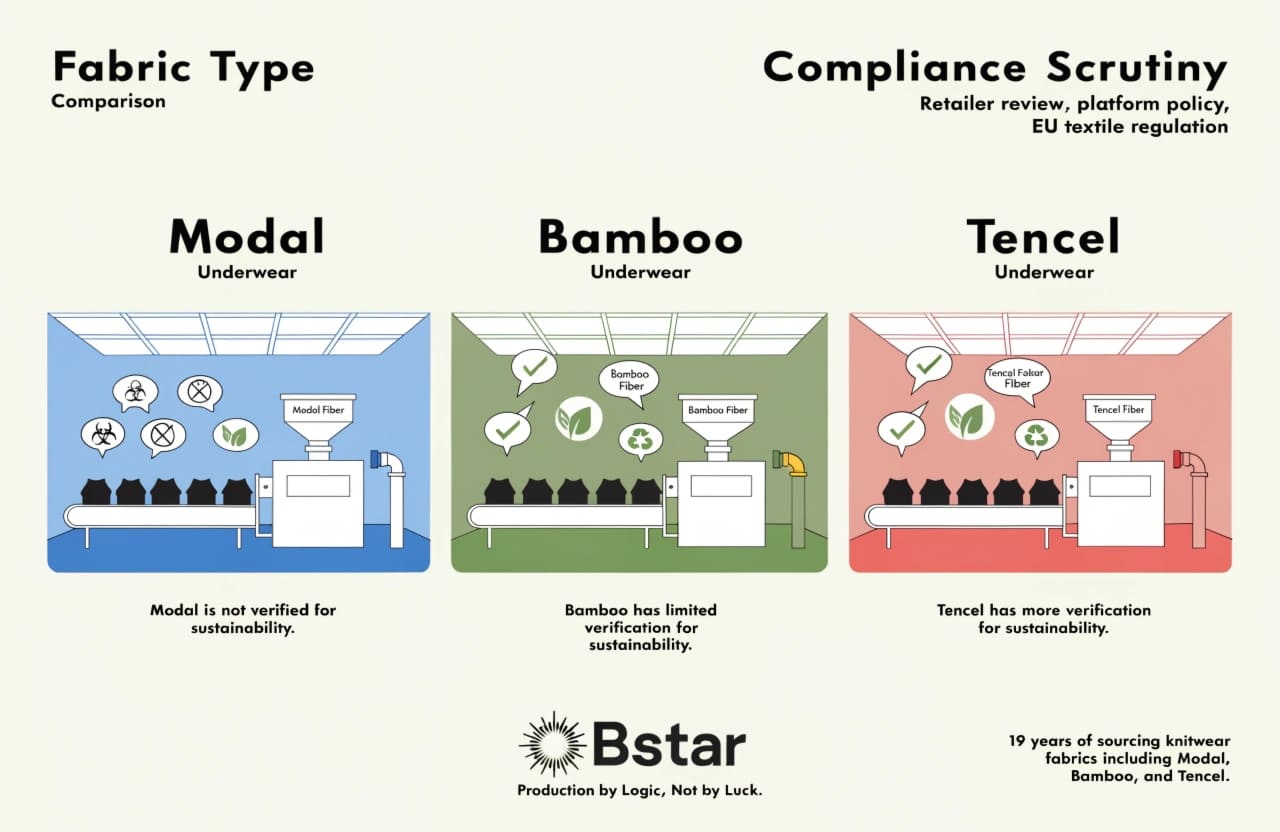
Modal, Bamboo, and Tencel all come from plant-based sources, but they are not equally verifiable as sustainable. The real difference is not texture or moisture performance — it’s which fabric gives your brand a certification claim that holds up to retailer review, platform policy, and EU textile regulation.
I’ve spent 19 years at BSTAR producing knitwear in all three of these fabrics. I’ve sourced the raw materials, reviewed the supplier documentation, and sat in conversations with DTC brand founders who were trying to figure out exactly what their fabric label could legally say. This article is built from that experience — not from a lab report.
Where Does Each Fiber Actually Come From — and Why Does That Change Everything?
Most people assume "plant-based" means the production process is clean. That’s where the problem starts.
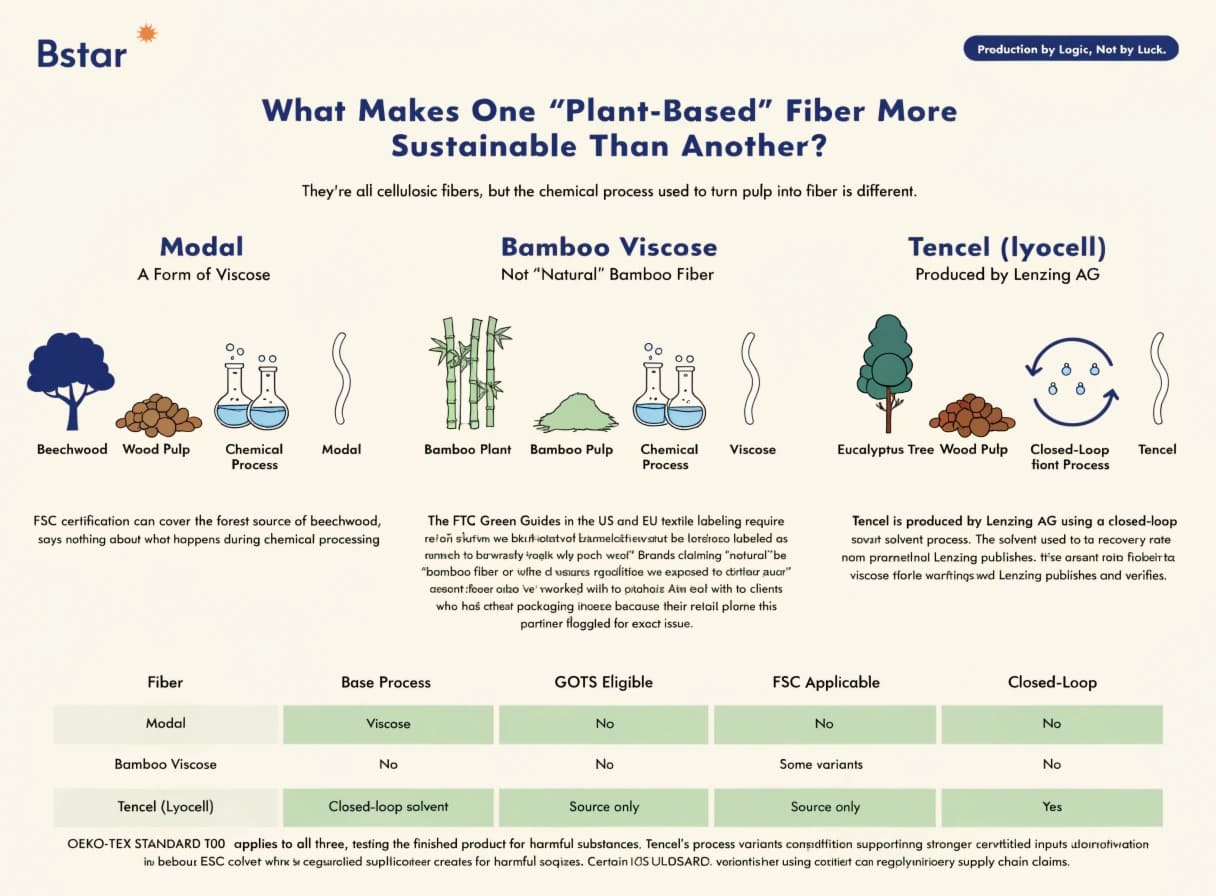
Modal comes from beechwood pulp, Bamboo fabric in apparel is almost always viscose made from bamboo pulp, and Tencel (lyocell) comes from eucalyptus pulp. All three are cellulosic fibers — but the chemical process used to turn that pulp into fiber is completely different, and that difference determines what you can certifiably claim.
Here’s what I see consistently when we source these fabrics and review supplier documentation:
Beechwood → Modal
Modal is a form of viscose. The production process uses chemical solvents to dissolve wood pulp and regenerate it as fiber. The fiber quality is high — it’s soft, stable, and knits well for underwear. But the process is not closed-loop. Chemicals used in production are not fully recovered. This is relevant because GOTS (Global Organic Textile Standard) does not certify conventional viscose, which includes most Modal. FSC certification can cover the forest source of the beechwood, but FSC says nothing about what happens during chemical processing. If a brand wants to make a GOTS-backed sustainability claim and they’ve chosen standard Modal, that claim is not available to them.
Bamboo Pulp → Bamboo Viscose (not "natural bamboo fiber")
This is the one I want to spend the most time on, because it’s where I’ve seen brands get into real trouble. When clients come to us asking for "bamboo fabric," 95% of what’s available on the market is bamboo viscose — chemically processed, same general method as Modal. The bamboo plant itself grows fast and without pesticides, which is genuinely positive. But once it enters a viscose production line, the "natural" story gets complicated. The FTC Green Guides in the US and EU textile labeling regulations both require that bamboo viscose be labeled as such — not as "bamboo fiber" or "natural bamboo." Brands that label it as "natural bamboo" without that qualifier are exposed to greenwashing claims. We’ve worked with clients who had to reprint packaging because their retail partner flagged this exact issue.
This does not mean bamboo viscose is a bad choice. It means the marketing claim has to match what the production process actually is.
Eucalyptus Pulp → Tencel (Lyocell)
Tencel is produced by Lenzing AG using a closed-loop solvent process. That means the solvent used to dissolve the pulp is captured and reused at a recovery rate that Lenzing publishes and verifies. This is a measurable, auditable environmental metric — not a general claim. That’s the specific reason Tencel-branded lyocell is eligible for a broader range of certification claims. OEKO-TEX STANDARD 100 applies to all three fabrics (it tests the finished product for harmful substances). But Tencel’s process footprint creates documentation that supports stronger supply chain claims, and certain Tencel variants using organic-certified inputs can qualify for GOTS.
| Fiber | Base Process | GOTS Eligible | FSC Applicable | Closed-Loop |
|---|---|---|---|---|
| Modal | Viscose | No | Source only | No |
| Bamboo Viscose | Viscose | No | No | No |
| Tencel (Lyocell) | Closed-loop solvent | Some variants | Source only | Yes |
What Do Performance Metrics Actually Mean for Underwear Manufacturing?
Every article about these three fabrics covers softness and moisture wicking. I’m not going to repeat that. What matters for a manufacturer — and for a brand making product decisions — is how these fabrics behave in production and how they hold up after multiple washes.
Tencel has a smoother fiber surface that can affect how it bonds with elastic in waistbands and hems. Modal is forgiving in knitting and finishes well. Bamboo viscose varies by supplier — and that variance is the part brands underestimate.
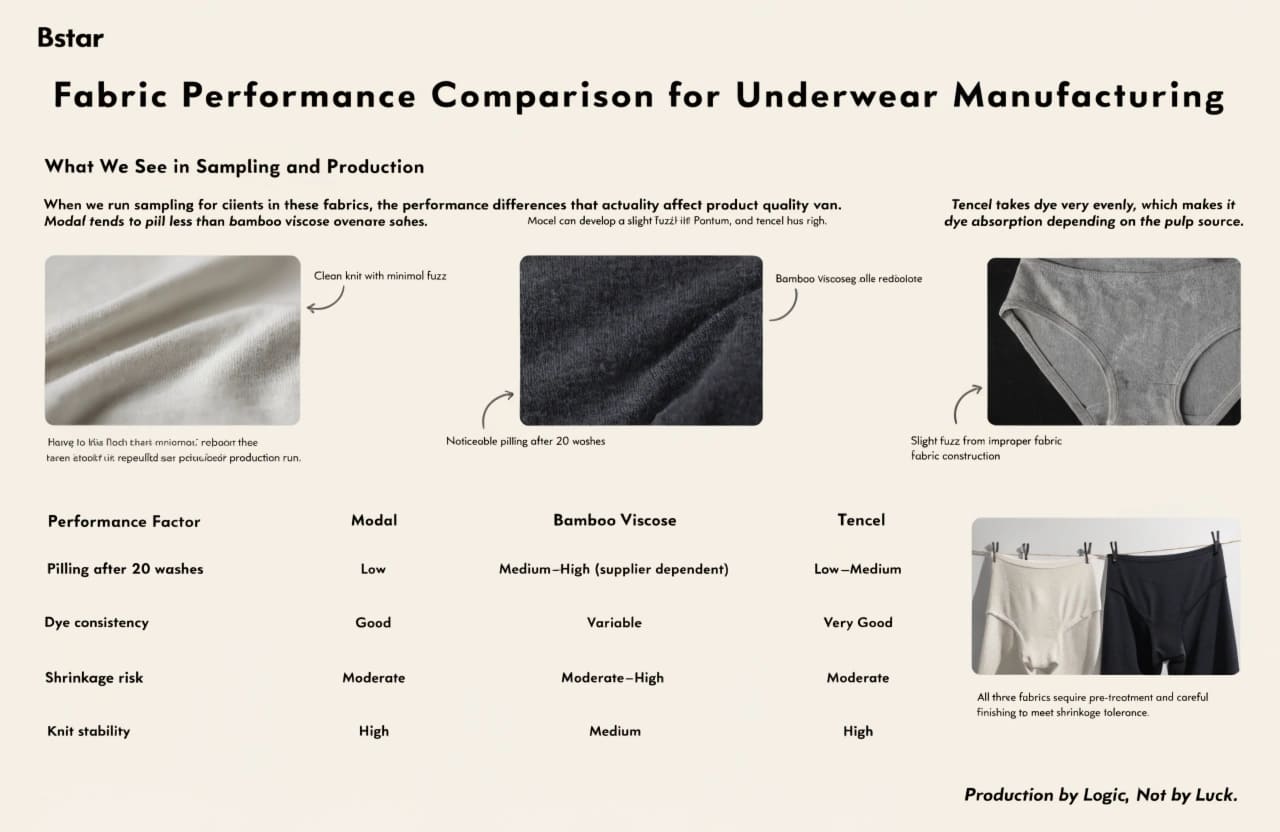
What We See in Sampling and Production
When we run sampling for clients in these fabrics, the performance differences that actually affect product quality are:
Pilling and wash durability
Modal tends to pill less than bamboo viscose over repeated washes, in our production experience. Tencel can develop a slight fuzz if the fabric construction isn’t right — circular knit at the right GSM matters here. We typically sample at 180–220 GSM for underwear depending on the end market.
Dye uptake and color consistency
Tencel takes dye very evenly, which makes it easier to hit Pantone targets across a production run. Bamboo viscose can have inconsistent dye absorption depending on the pulp source — this is something we check at the raw material intake stage.
Shrinkage control
All three fabrics require pre-treatment and careful finishing to meet shrinkage tolerance. We’ve seen brands come to us with bamboo viscose underwear that shrank beyond tolerance after three washes because the finishing step at a previous supplier wasn’t controlled. AQL inspection at the finished goods stage catches garment-level issues, but shrinkage problems usually trace back to yarn or fabric prep.
| Performance Factor | Modal | Bamboo Viscose | Tencel |
|---|---|---|---|
| Pilling after 20 washes | Low | Medium–High (supplier dependent) | Low–Medium |
| Dye consistency | Good | Variable | Very Good |
| Shrinkage risk | Moderate | Moderate–High | Moderate |
| Knit stability | High | Medium | High |
Certifications: What Each Label Actually Covers — and What It Doesn’t
This is the part of the conversation that most brands haven’t had with their manufacturer yet. And it’s the part that matters most if you’re building a sustainability claim.
OEKO-TEX STANDARD 100, GOTS, FSC, and GRS do not cover the same things. A fabric can have one of these certifications and still not support the marketing claim your brand wants to make.
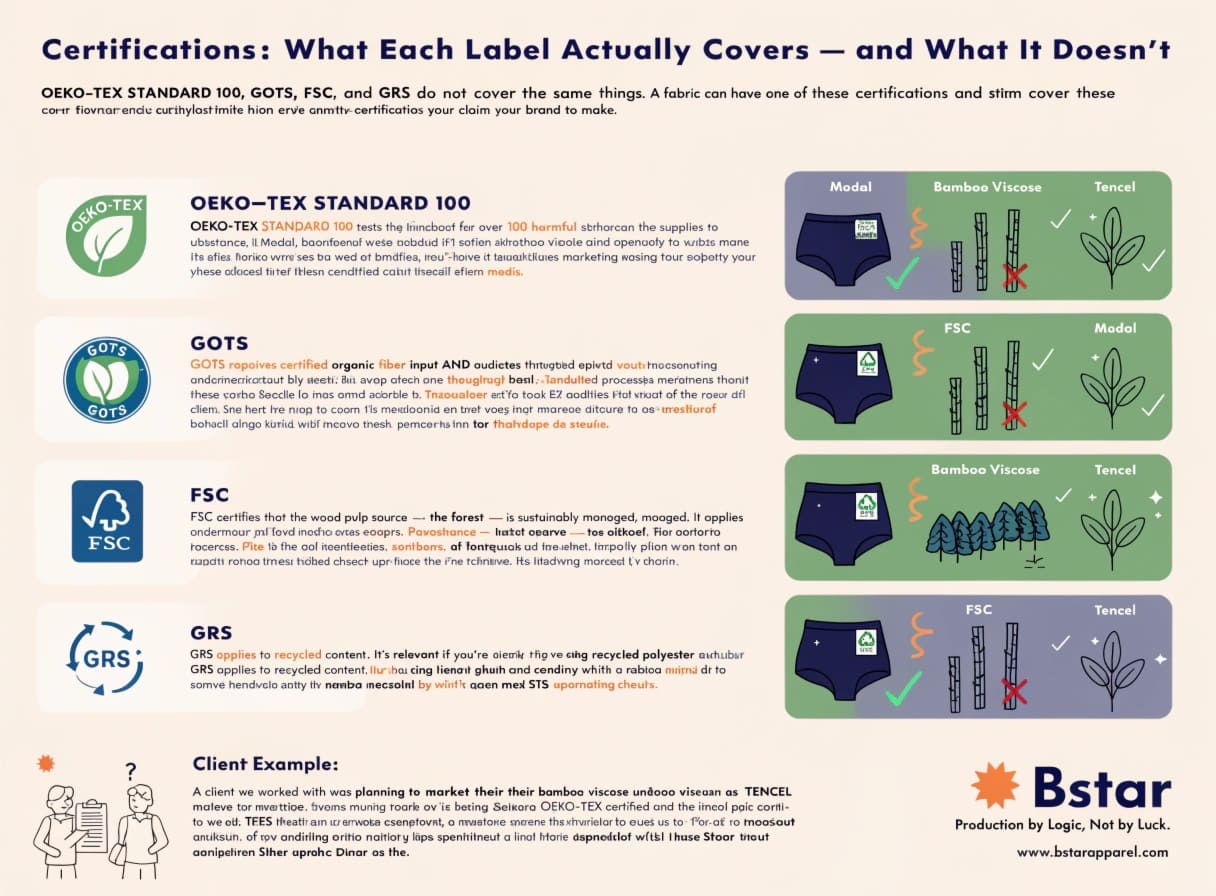
How Certification Scope Actually Works
OEKO-TEX STANDARD 100
This tests the finished product for over 100 harmful substances. It applies to Modal, bamboo viscose, and Tencel. It tells the consumer the garment is safe to wear. It does not say anything about how the fiber was produced or whether the process was environmentally responsible. This is the most commonly misrepresented certification — brands use it to support environmental claims when it only supports product safety claims.
GOTS (Global Organic Textile Standard)
GOTS requires certified organic fiber input AND audited processing conditions throughout the supply chain. Standard Modal and bamboo viscose do not meet the fiber input requirement. Certain Tencel variants that use organic-certified eucalyptus pulp can qualify — but this depends on the specific fiber source and supplier documentation. When clients ask us about GOTS for underwear, the honest answer is: it’s achievable for specific Tencel pathways, but not for most Modal or bamboo viscose products.
FSC (Forest Stewardship Council)
FSC certifies that the wood pulp source — the forest — is sustainably managed. It applies to the raw material stage only. It does not follow the fiber through chemical processing. An FSC-certified beechwood forest can supply Modal production that uses non-closed-loop chemical processes. FSC is a meaningful sourcing claim but not a full supply chain sustainability claim.
GRS (Global Recycled Standard)
GRS applies to recycled content. It’s relevant if you’re using recycled polyester or recycled nylon blended with these fabrics, but it doesn’t apply to virgin cellulosic fibers.
A client we worked with was planning to market their bamboo viscose underwear as "OEKO-TEX certified and sustainably sourced." The OEKO-TEX part was accurate. The "sustainably sourced" claim had no certification backing it — and their EU retail partner flagged it during onboarding review. They switched to a Tencel option with FSC-covered pulp source and OEKO-TEX on the finished product, which gave them two verifiable, specific claims instead of one accurate and one vague.
Supply Chain Availability and Cost: What to Expect When You’re Sourcing
Choosing a fabric based on certification strategy only works if the supply chain can actually deliver it at your volume and timeline.
Tencel and Modal are widely available through established yarn suppliers in China. Bamboo viscose supply is broad but quality is inconsistent, and verifiable certification documentation from tier-2 suppliers can be harder to obtain than brands expect.
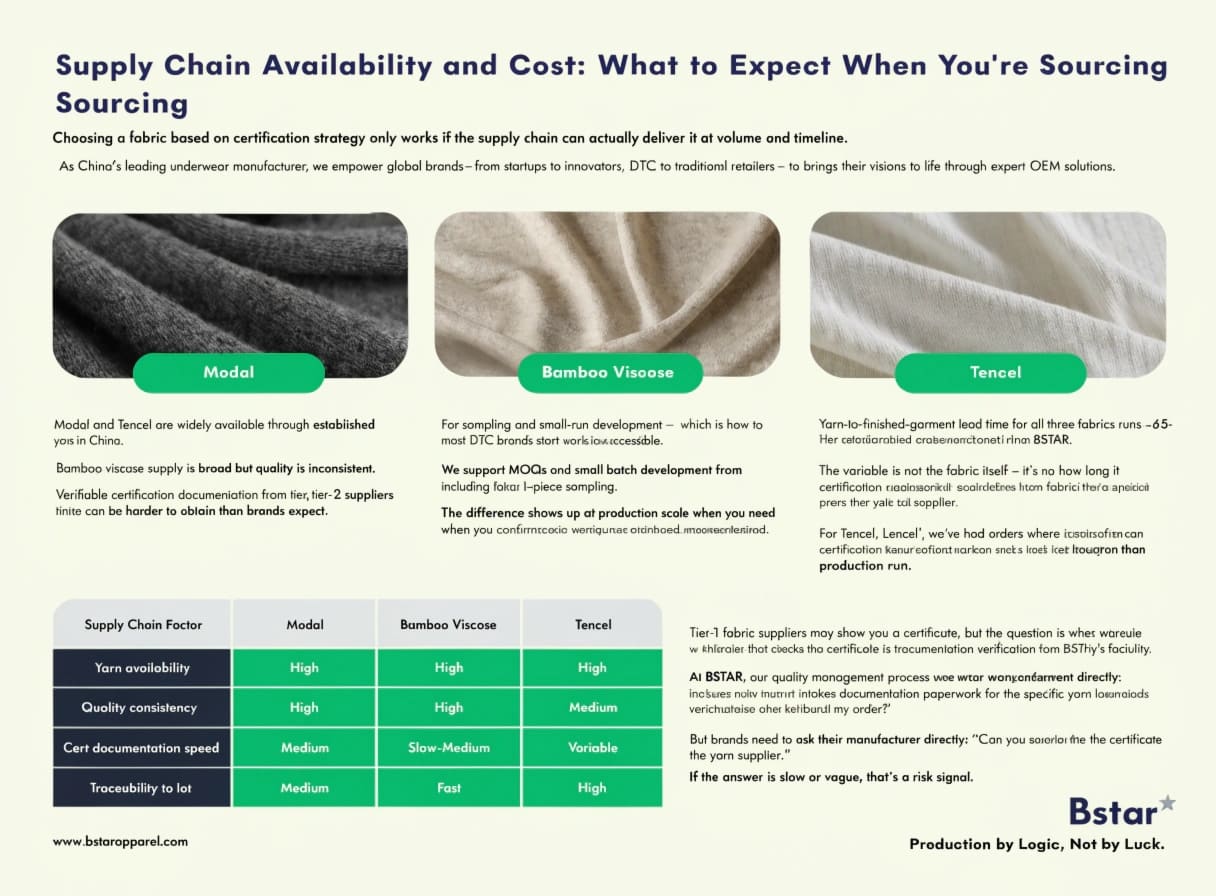
What We See in Practice at BSTAR
MOQs and small batch development
For sampling and small-run development — which is how most DTC brands start — all three fabrics are accessible. We support 1-piece sampling. The difference shows up at production scale when you need consistent yarn lots with full certification documentation across multiple batches.
Lead times
Yarn-to-finished-garment lead time for all three fabrics runs 45–75 days for a standard production order from our facility. The variable is not the fabric itself — it’s how long it takes to confirm certification documentation from the yarn supplier. For Tencel, Lenzing’s supply chain documentation is standardized and fast to obtain. For bamboo viscose, we’ve had orders where tracing certification paperwork back to the fiber stage took longer than the production run itself.
Supplier documentation risk
This is the practical reality of sourcing these fabrics in China: the tier-1 fabric supplier can show you a certificate, but the question is whether that certificate is traceable to the actual yarn lot in your order. At BSTAR, our quality management process includes raw material intake checks and documentation verification at 6 quality control points. But brands need to ask their manufacturer directly: "Can you show me the certification paperwork for the specific yarn lot used in my order?" If the answer is slow or vague, that’s a risk signal.
| Supply Chain Factor | Modal | Bamboo Viscose | Tencel |
|---|---|---|---|
| Yarn availability | High | High | High |
| Quality consistency | High | Medium | High |
| Cert documentation speed | Medium | Slow–Medium | Fast |
| Traceability to lot | Medium | Variable | High |
Conclusion
The right fabric for your underwear brand is not the softest or the most marketed as "natural" — it’s the one whose certification chain you can actually document and defend when a retailer or regulator asks.
Discussion & questions 0 comments