
Private Label Men’s Boxer Briefs: Where Does Your Product Actually Get Decided?
Most DTC founders think the hard part is finding a good factory. It is not. By the time you pick a supplier, the real decisions have already been made — or missed.
The fate of a private label boxer brief is decided at the design and production stage: fabric composition, pattern construction, and sampling iteration. These three variables determine whether your product reaches shelves or gets scrapped after three rounds of failed fit review.
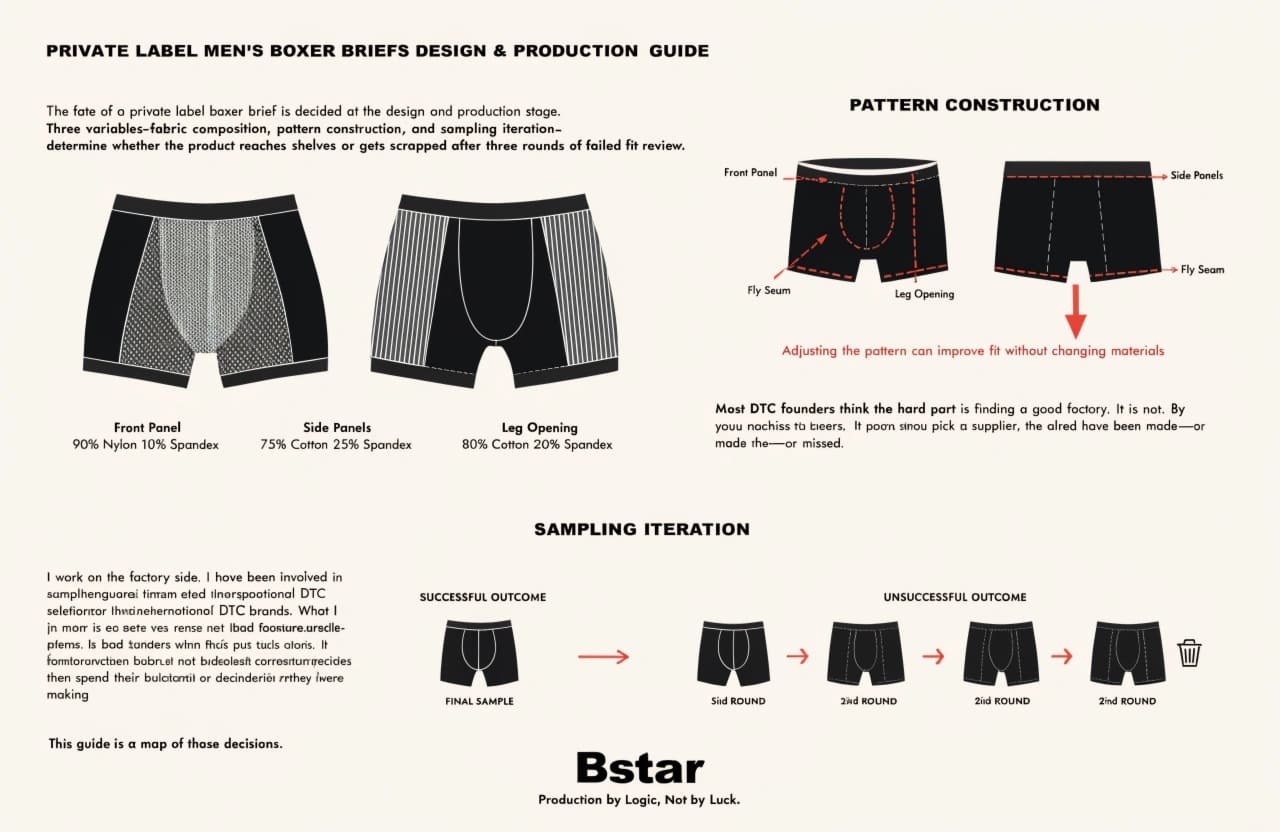
I work on the factory side. I have been involved in sampling, pattern-making, and fabric selection for international DTC brands for years. What I see most often is not bad factories. It is founders who arrive at sampling with underspecified briefs and then spend their budget correcting decisions they did not know they were making. This guide is a map of those decisions.
Defining Your Brand Identity: Who Is Wearing This, and What Does That Actually Change?
A lot of founders treat this section as a marketing exercise. It is not. The answer to "who is your target wearer" directly changes the pattern, the fabric weight, and the construction method.
Your target demographic defines your technical specifications. A 35-year-old gym-active male in Australia has different fit expectations than a 28-year-old urban commuter in Europe. These differences show up in waistband tension, rise length, and fabric stretch recovery — not just colorways or logo placement.
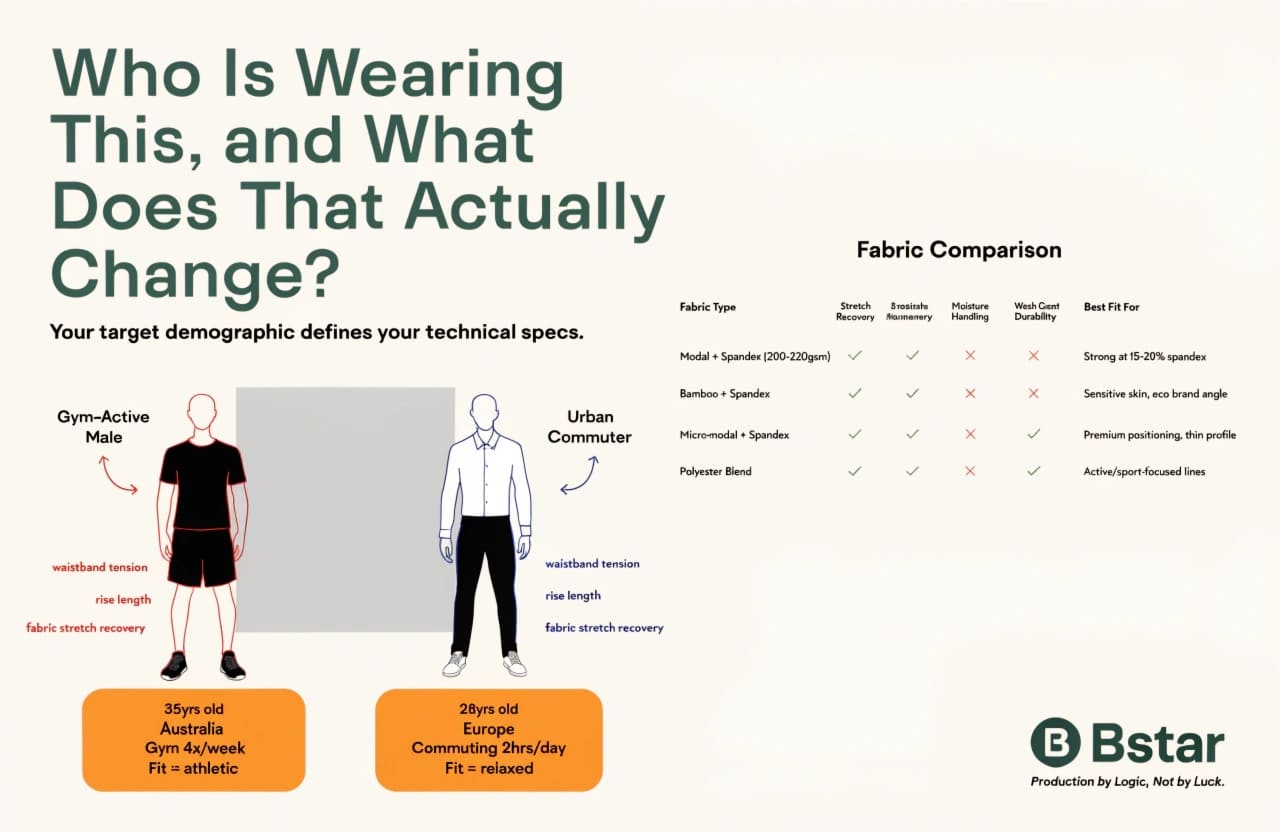
Here is where most first-time buyers get tripped up: they over-index on GSM. Fabric weight in grams per square meter is easy to compare on a spec sheet, so it feels like a quality signal. It is not. It is a proxy. A 200gsm modal-spandex blend with the right spandex ratio will hold its shape after 50 wash cycles. A 280gsm fabric with a lower recovery rate will sag by wash 20. The difference is not the weight — it is the fiber structure and how the spandex content interacts with the base yarn under repeated tension and heat.
Let me break this down by the fabrics we work with most often:
| Fabric Type | Stretch Recovery | Moisture Handling | Wash Durability | Best Fit For |
|---|---|---|---|---|
| Modal + Spandex (200–220gsm) | High | Good | Strong at 15–20% spandex | Everyday wear, DTC positioning |
| Bamboo + Spandex | Moderate | Excellent | Moderate | Sensitive skin, eco brand angle |
| Micro-modal + Spandex | Very High | Very Good | Strong | Premium positioning, thin profile |
| Polyester Blend | High | Moderate | Very Strong | Active/sport-focused lines |
The question to answer at this stage is not "what fabric sounds good." It is: what is the wearer doing in this garment, how often are they washing it, and what does failure look like for them? That answer builds your spec. The spec tells us which blend and which GSM range to develop against.
Ergonomic Pattern Engineering: Why You Cannot Just Copy a Reference Garment?
This is the most common cause of failed first samples in our production process. A client sends us a reference garment — usually something they like the feel of — and expects us to replicate it. The problem is that a pattern is not transferable. It has to be rebuilt.
When we receive a reference garment, the first thing we check is the fabric construction and the market it was made for. A pattern graded for European sizing in a woven fabric behaves completely differently when rebuilt in a 4-way stretch knit for an Australian or American market. Crotch curve, rise, and waistband tension all change.
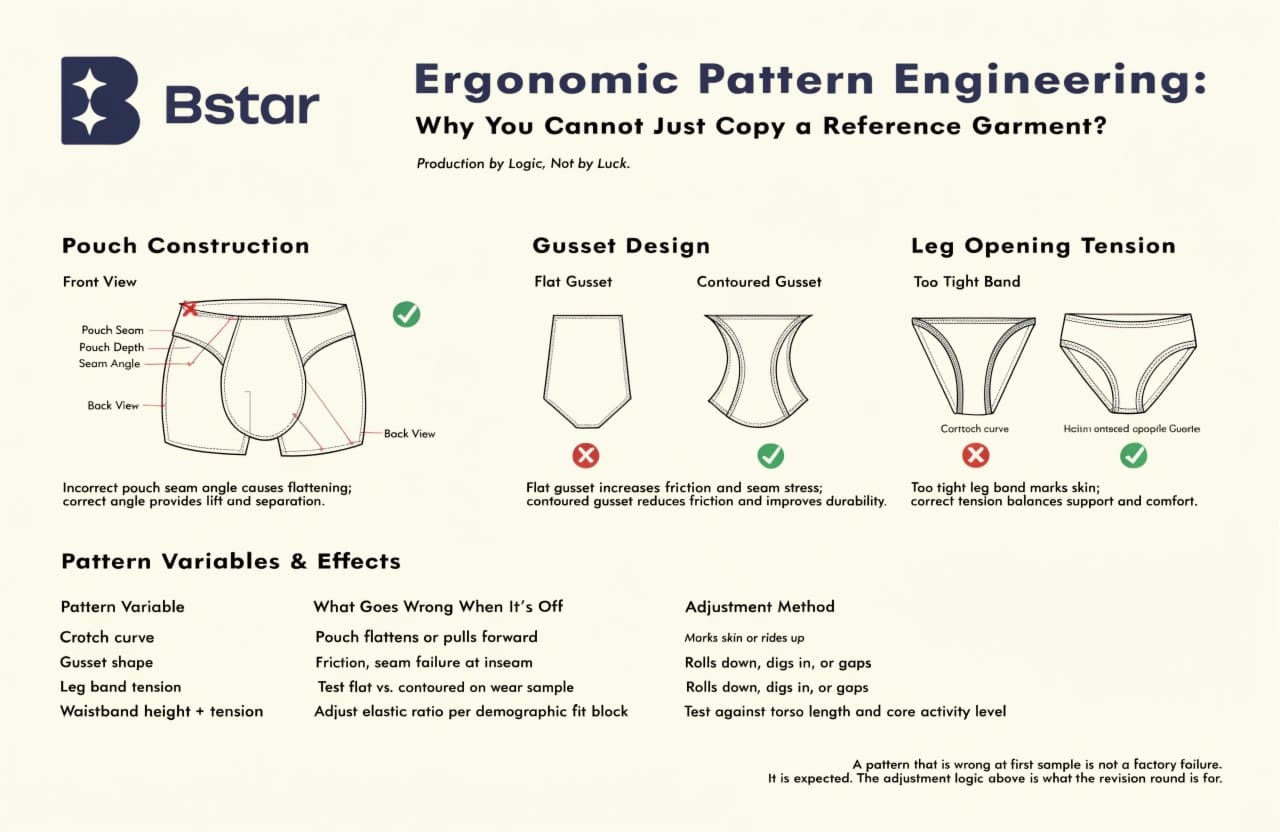
Here is the specific adjustment logic we work through at the pattern stage:
Pouch construction is the highest-stakes area. The shaping that creates lift and separation in a pouch is achieved through a combination of seam placement and fabric cut angle. If the fabric you are using has different stretch direction ratios than the original reference, the pouch will either flatten out or over-extend. We adjust the crotch curve depth and the side seam angle based on the actual stretch test of the fabric in production, not the reference garment.
Gusset design matters for comfort and durability. A flat gusset may look clean on a sample but causes friction and seam stress during movement. A curved or contoured gusset adds one more cut piece and one more seam operation — it adds cost — but it directly affects wear experience and return rate. The decision depends on your price positioning and who is wearing the product.
Leg opening tension is easy to overlook. Too tight and the garment marks the skin. Too loose and it rides up. The tension is controlled by the elastic specification and the ratio of elastic to fabric in the band construction. This has to be tested against the actual body measurements of your target demographic, not a standard size chart.
| Pattern Variable | What Goes Wrong When It’s Off | Adjustment Method |
|---|---|---|
| Crotch curve | Pouch flattens or pulls forward | Rebuild curve against fabric stretch ratio |
| Gusset shape | Friction, seam failure at inseam | Test flat vs. contoured on wear sample |
| Leg band tension | Marks skin or rides up | Adjust elastic ratio per demographic fit block |
| Waistband height + tension | Rolls down, digs in, or gaps | Test against torso length and core activity level |
A pattern that is wrong at first sample is not a factory failure. It is expected. The adjustment logic above is what the revision round is for.
Quality Assurance and Manufacturing: What Does a Real Testing Protocol Look Like?
This is where the sampling arc becomes concrete. Understanding what gets tested and when tells you how to read your sample feedback — and how many revision rounds to expect.
A proper QA process for boxer briefs covers seam durability, shrinkage after wash, and colorfastness across the full production run — not just the sample. The sample is a fit and construction check. Bulk QA is a consistency check. These are different problems.
In our sampling process we have seen first samples fail fit review for reasons that had nothing to do with the pattern — the fabric from the sampling roll behaved differently from the bulk fabric because the GSM tolerance was wider than specified. This is why we run fabric tests on the actual production roll before cutting bulk, not just on the sample swatch.
Here is a realistic development arc based on projects we have run with DTC clients:
Stage 1 — First sample (7–15 days): Construction sample based on your tech pack or reference garment. This round identifies pattern and fabric fit issues. Expect to find 2–4 modification points. This is normal.
Stage 2 — Revised sample: Corrections from Stage 1 are applied. Most projects resolve the major fit issues here. Some clients need one more round if the first sample had significant pattern problems.
Stage 3 — Pre-production sample / bulk confirmation: Final fabric, final trims, final construction. This is the sign-off point before cutting the full run.
Two to three rounds of revision is a standard quality process. It is not a red flag. It is how you avoid shipping a product that fails fit review in your customer’s hands instead of your sampling room.
Key test points we run before bulk confirmation:
| Test | What It Catches | When It’s Run |
|---|---|---|
| Seam strength (AQL standard) | Seam failure under tension and movement | Pre-bulk and inline |
| Wash shrinkage (5-cycle test) | Size change after consumer washing | Fabric stage + finished sample |
| Colorfastness (wet + dry rub) | Dye transfer and fade | Fabric stage |
| Elastic recovery | Waistband and leg band sag | Sample + bulk roll check |
| Label compliance check | Missing or incorrect regulatory content | Pre-bulk |
Conclusion
Before you place a sample order, you should be able to answer three questions: who is the exact wearer, what fabric construction fits their use case, and how many revision rounds is your timeline and budget prepared to absorb.