Label & Hang Tag Compliance: US FTC & EU Textile Regulations — What Do You Actually Need to Tell Your Factory?
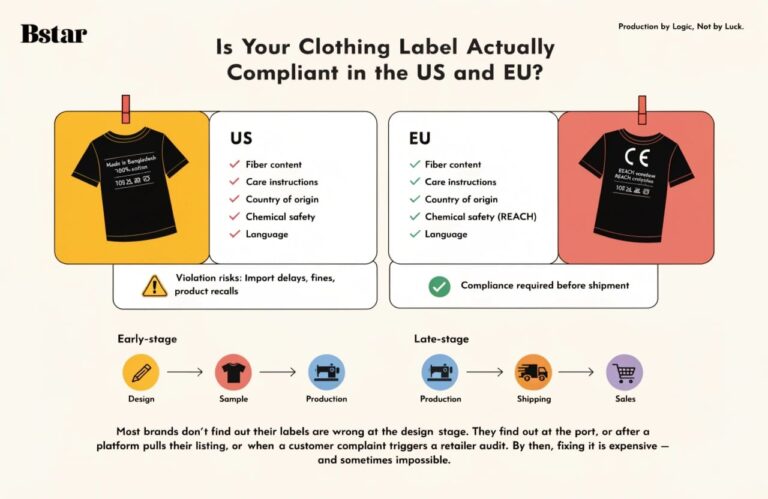
Most brands discover label problems after production ends. By then, your options are rework, relabeling, or shipping and hoping. None of those are good.
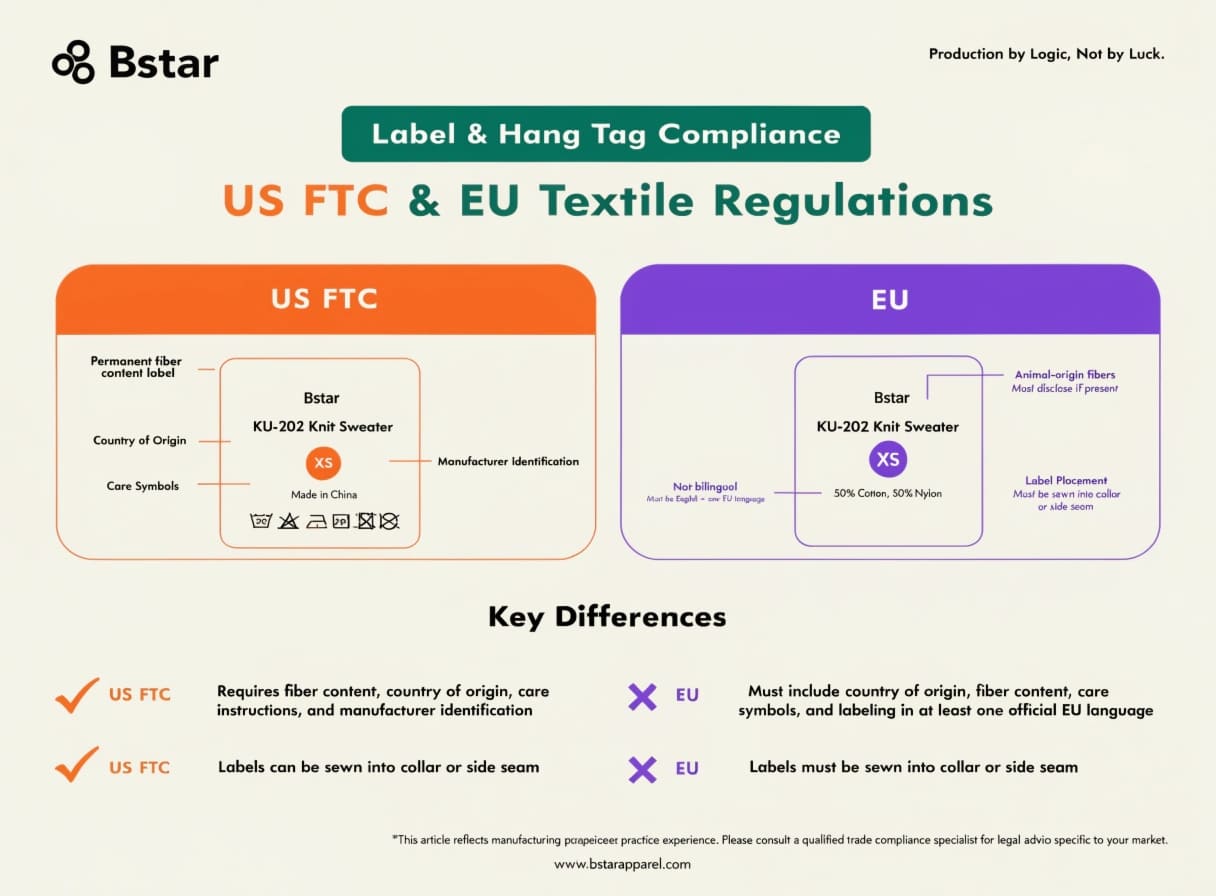
Label compliance failures are almost always a pre-order information problem. Under US FTC rules, a garment label in most cases needs fiber content, country of origin, care instructions, and manufacturer identification — permanently attached. EU rules add language requirements, animal-origin disclosures, and stricter placement rules. Getting these details to your factory before production starts is what prevents delays.
I’ve been making knitwear for brands across the US, EU, and Australia for 19 years. The rework situations I see most often don’t come from factory mistakes. They come from order briefs that arrive with missing label information. This article is not a legal guide. It’s a practical breakdown of what to include in your label spec before you send it to your manufacturer.
This article reflects manufacturing practice experience. Please consult a qualified trade compliance specialist for legal advice specific to your market.
Decoding the US FTC "Big 3": Fiber Content, Country of Origin, and Manufacturer Identity — What Exactly Does Your Factory Need From You?
Many DTC founders read about FTC requirements and think, "Got it, I need a label." But knowing the rule and supplying the right information are two different things.
Under FTC’s Textile and Wool Acts, most garments sold in the US need a permanently attached label stating: fiber content by percentage, country of origin, and either the manufacturer’s name or an RN/WPL registration number. The fiber content must reflect the full garment composition, and percentages must add up to 100%.

Here’s where the execution gap shows up. When we receive an order brief without complete fiber percentages — for example, "cotton blend" with no breakdown — we have to pause and ask. That pause costs days. If it happens mid-production, it costs more.
What this means for your label brief
Before you place an order for US market garments, you need to confirm and supply the following to your factory:
| Label Field | What Your Factory Needs From You |
|---|---|
| Fiber Content | Exact percentages (e.g., 92% Cotton, 8% Spandex) — must total 100% |
| Country of Origin | Confirm "Made in China" or applicable country text |
| Brand / Manufacturer ID | Your registered RN number, or your full legal brand name |
| Care Instructions | Specific wash, dry, iron, bleach instructions — not just "gentle wash" |
One thing that surprises new brands: FTC guidance also indicates that fiber content claims in online product listings — your Shopify page, Amazon listing, brand website — should match what’s on the physical label. If you write "100% cotton" in your copy and the label says "95% cotton, 5% elastane," that’s a mismatch worth fixing. FTC guidance indicates this is a compliance surface most e-commerce sellers overlook. We can’t catch this on the factory side. That’s your copy to manage.
Brands expanding from the US into the EU often assume one label spec covers both. It doesn’t. The EU Textile Regulation (No 1007/2011) has specific requirements that go beyond what FTC asks for.
EU regulations in most cases require that fiber names come from an approved list, that the label appears in the official language of the target EU member state, and that any animal-origin fibers — like wool, down, or cashmere — are explicitly identified. A label that works for the US market will often need changes before it’s EU-compliant.
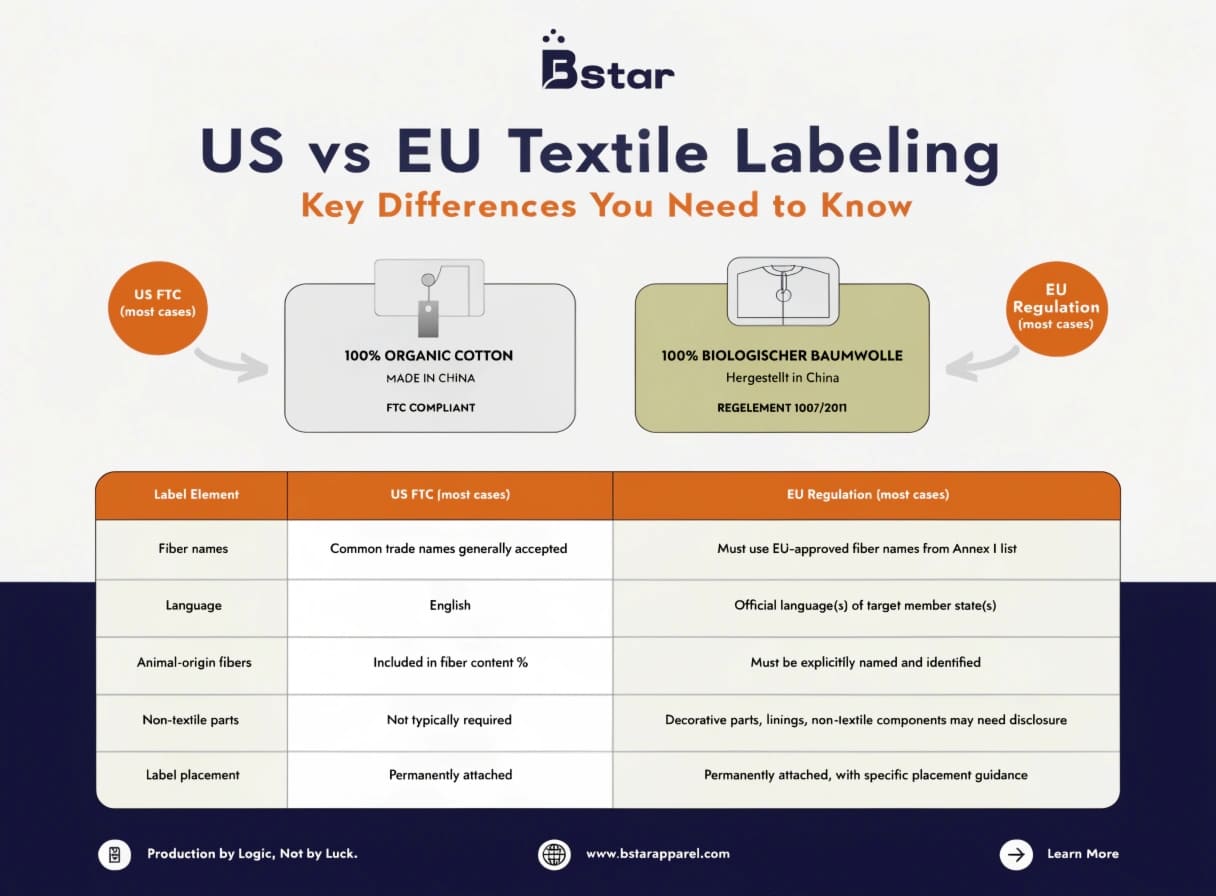
US vs. EU: Side-by-side label differences
This is the comparison I walk through with brands who are adding an EU channel to their existing US business:
| Label Element | US FTC (most cases) | EU Regulation (most cases) |
|---|---|---|
| Fiber names | Common trade names generally accepted | Must use EU-approved fiber names from Annex I list |
| Language | English | Official language(s) of target member state(s) |
| Animal-origin fibers | Included in fiber content % | Must be explicitly named and identified |
| Non-textile parts | Not typically required | Decorative parts, linings, non-textile components may need disclosure |
| Label placement | Permanently attached | Permanently attached, with specific placement guidance |
The most common issue I see from brands entering Germany, France, or the Netherlands: the label is in English only. EU rules in most cases require the label to be in the local official language — or at minimum, the language of the country where the product is sold. If you’re selling across multiple EU markets, you may need multilingual labels or market-specific label versions.
When you send your order brief, tell your factory which EU market(s) you’re targeting. That single piece of information changes the language on the label, which changes the print file, which affects the production timeline if it comes in late.
Care Labeling Protocols: Aligning US Care Instructions with European Expectations — Why the Symbol Standard Matters More Than You Think?
Care labels look simple. They’re not. The US and EU use different symbol systems, and getting this wrong is one of the most common labeling errors I see in cross-border orders.
The US primarily follows ASTM D5489 care symbols. The EU and most of the rest of the world uses GINETEX symbols (the international standard). The symbols look similar but are not identical. If you’re selling into both markets, you need to specify which standard — or both — when you brief your factory.
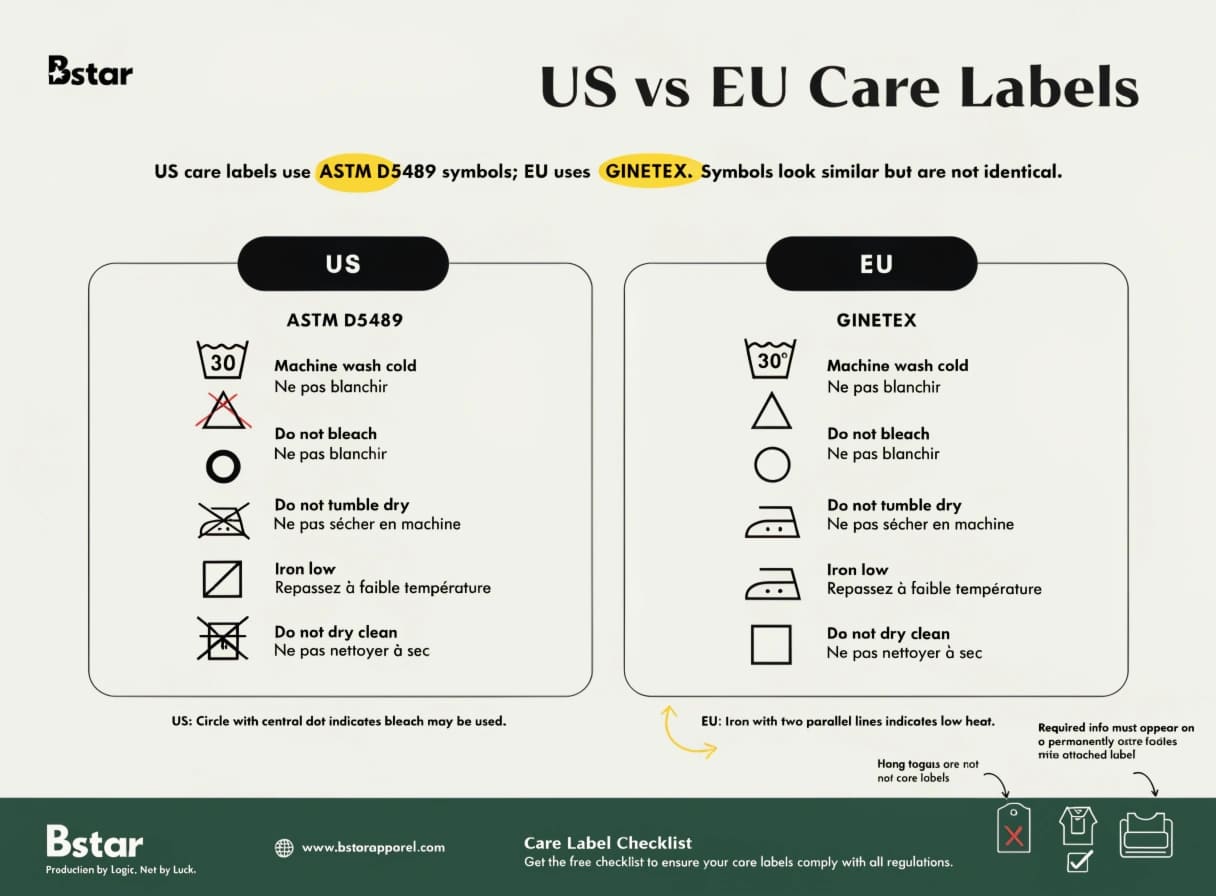
What to include in your care label brief
When brands send us a care label spec, the most useful briefs include:
- Wash temperature (e.g., 30°C / cold, 40°C / warm)
- Machine wash or hand wash only
- Tumble dry: yes, low heat, or no
- Ironing: yes, low heat, no steam, or no iron
- Bleach: non-chlorine only, or do not bleach
- Dry clean: yes or no
- Symbol standard: ASTM, GINETEX, or both
If you’re building a combined US+EU label, the cleanest approach is to print both the text instruction (in the required language) and the applicable symbol set. That way you’re covered regardless of where the garment is sold or inspected.
One point I want to make clearly: hang tags are not care labels. I see this misunderstanding often with DTC brands who are new to private label manufacturing. A hang tag with fiber content and wash instructions on it does not meet FTC or EU requirements. Required information must appear on a permanently attached label — meaning sewn in, not clipped on. Hang tags can be removed. Compliance labels cannot be.
Future-Proofing Your Labels: Are You Ready for the EU Digital Product Passport and Anti-Greenwashing Rules?
If you’re selling into the EU now or planning to, there are two upcoming regulatory changes worth knowing about before you finalize your label strategy.
The EU Digital Product Passport (DPP), expected to roll out for textiles from 2026 onward, will in most cases require products to carry a data carrier — like a QR code — linking to information about materials, origin, repairability, and end-of-life options. Separately, the EU’s Green Claims Directive is moving to restrict vague sustainability language on labels and product pages.
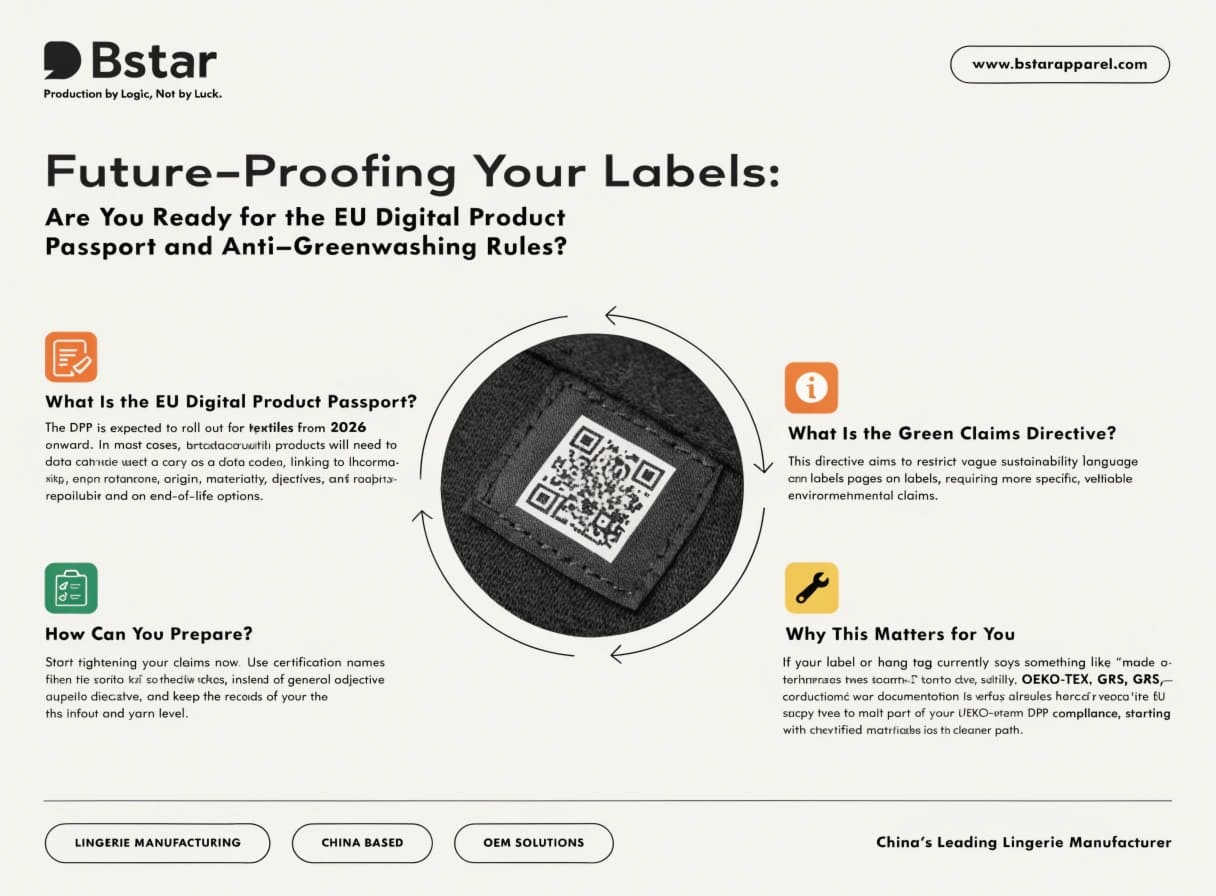
What this means in practical terms right now
These regulations are not fully in force today, but the decisions you make now affect how much rework you’ll face later. Here’s a simple way to think about it:
| Action Now | Why It Matters Later |
|---|---|
| Document your fiber sourcing with certified materials (OEKO-TEX, GOTS, GRS) | DPP will likely require traceable material data |
| Avoid vague claims like "eco-friendly" or "sustainable" without supporting data | EU Green Claims Directive will restrict unverified environmental claims |
| Design physical labels with space for a QR code | Retrofitting labels after tooling is set up adds cost |
| Keep records of your supply chain at the fabric and yarn level | DPP data requirements will likely trace back to raw material origin |
On the anti-greenwashing side: if your label or hang tag currently says something like "made with sustainable fibers" without a specific certification backing it up, the EU’s incoming directive is likely to flag that. Start tightening your claims now. Use certification names (GOTS, GRS, OEKO-TEX) instead of general adjectives.
We work with clients who supply certified yarn and fabric from the start — OEKO-TEX, GRS, GOTS. That documentation is already part of our production file. If you’re building toward EU DPP compliance, starting with certified raw materials is the cleaner path.
Conclusion
Label compliance is a factory handoff problem. Supply your manufacturer with complete fiber percentages, target market language, care symbol standards, and origin text before production starts — and you avoid most of the costly issues.