Quality Control Standards: AQL 2.5 Inspection for Underwear — What Does It Actually Guarantee?
Buyers sign off on underwear shipments every day based on a passing AQL result. Then the returns start coming in. The inspection passed, so what went wrong?
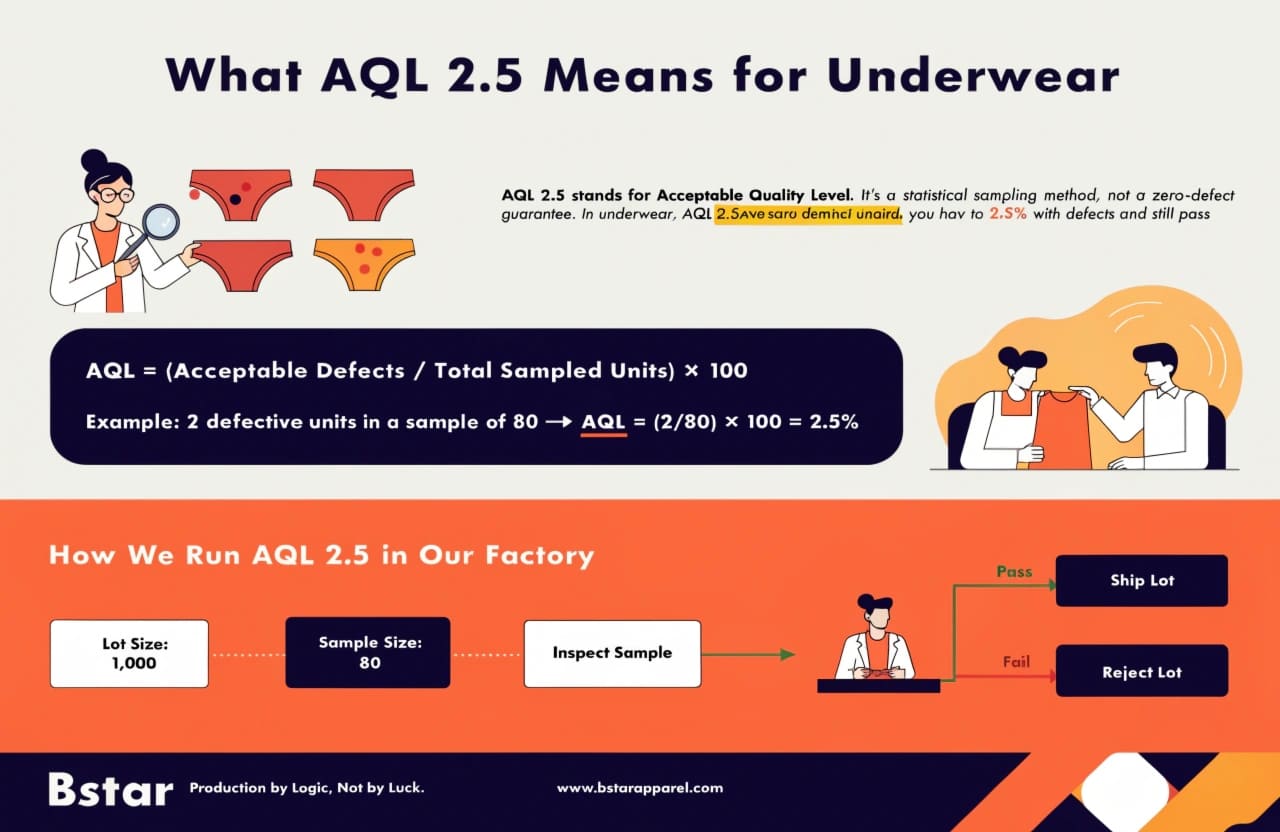
AQL 2.5 is a statistical sampling method, not a zero-defect guarantee. It means the lot is acceptable within a defined probability threshold — roughly 2.5% of units may carry defects and the batch still passes. For underwear, this only works when inspectors apply category-specific criteria, not a generic checklist.
After 19 years of producing knitted underwear for DTC brands in Europe and North America, I’ve seen this misread more times than I can count. Buyers assume "passed AQL" means "every piece is good." It doesn’t. Let me break down what AQL 2.5 actually means for underwear, how we run it in our factory, and why the standard is only as good as the people applying it.
Decoding AQL 2.5: What Are You Actually Agreeing to When You Specify This Number?
A lot of buyers write "AQL 2.5" into their purchase orders without fully knowing what they’re asking for. That creates problems when a shipment arrives and complaints still come in.
AQL stands for Acceptable Quality Limit. An AQL of 2.5 means that if the true defect rate in a lot is 2.5% or less, the sampling plan will accept the batch most of the time. It does not mean only 2.5% of units will have defects — it means that rate is the defined acceptable risk ceiling.
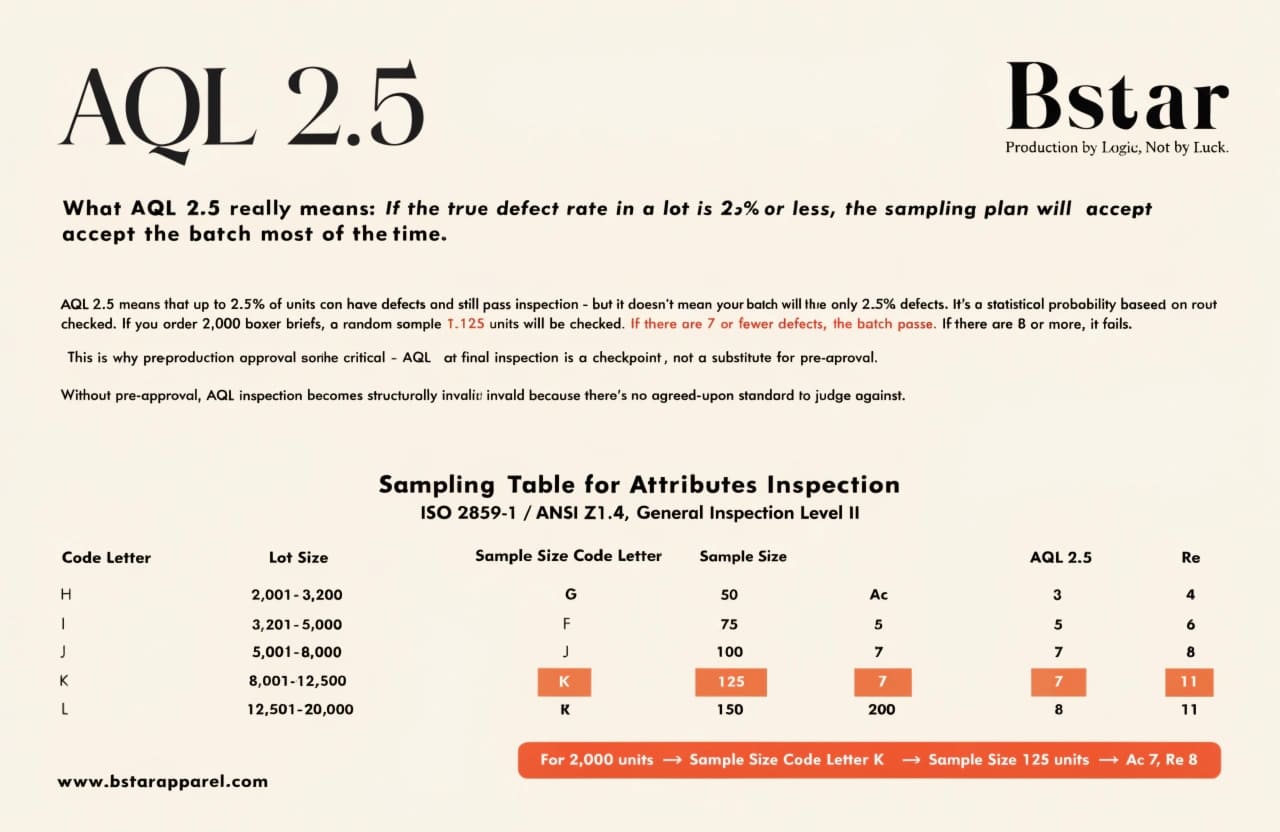
Here is where it gets concrete. Say you’re ordering 2,000 units of boxer briefs. Under ISO 2859-1 / ANSI Z1.4, General Inspection Level II — which is the standard we apply on most orders — a batch of 2,000 units falls into Sample Size Code Letter K. That gives you a sample size of 125 units.
At AQL 2.5, the acceptance number (Ac) is 7 and the rejection number (Re) is 8. That means:
| Batch Size | Sample Size | Ac (Pass if ≤) | Re (Fail if ≥) |
|---|---|---|---|
| 2,000 units | 125 units | 7 defects | 8 defects |
If our inspector finds 7 defects in those 125 pieces, the batch passes. If they find 8, it fails. This is a statistical decision about the whole lot — not a count of every single unit. Some buyers look at this table for the first time and realize they had been imagining something very different.
One more thing I always tell buyers before they confirm QC terms: AQL inspection run on a batch that was never properly pre-production approved is structurally invalid. If we never confirmed the first article together — fabric, fit, construction — then what standard are we inspecting against? Pre-production approval comes first. AQL at final inspection is the checkpoint, not the foundation.
Defect Classification: Why Underwear Needs Its Own Rules — Not Outerwear Logic
Most defect classification tables get recycled across product categories. That’s fine for a jacket. For underwear, it can be genuinely misleading.
In underwear, defects that would be graded Minor in outerwear often need to be reclassified as Major or Critical. The reason is simple: underwear sits directly against the skin, is worn daily, and fails in ways that are immediately physical — not just visual.
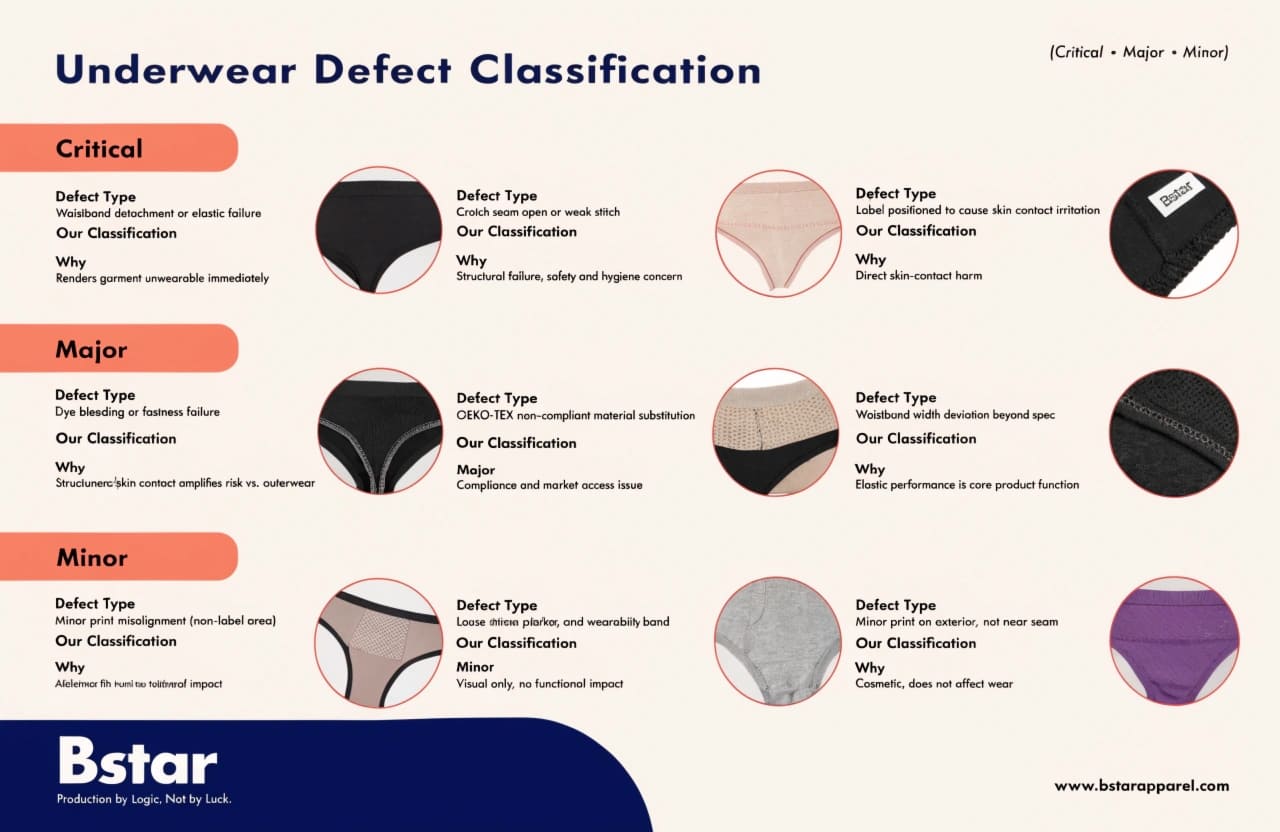
Here is how we classify defects in our own production workflow for knitted underwear:
| Defect Type | Our Classification | Why |
|---|---|---|
| Waistband detachment or elastic failure | Critical | Renders garment unwearable immediately |
| Crotch seam open or weak stitch | Critical | Structural failure, safety and hygiene concern |
| Label positioned to cause skin contact irritation | Critical | Direct skin-contact harm |
| Dye bleeding or fastness failure | Major | Sustained skin contact amplifies risk vs. outerwear |
| OEKO-TEX non-compliant material substitution | Major | Compliance and market access issue |
| Waistband width deviation beyond spec | Major | Affects fit and wearability |
| Elasticity outside tolerance band | Major | Elastic performance is core product function |
| Minor print misalignment (non-label area) | Minor | Visual only, no functional impact |
| Loose thread on exterior, not near seam | Minor | Cosmetic, does not affect wear |
The point here is not to produce a longer list. The point is that context changes the classification. A waistband seam issue that looks like a Minor sewing defect in an outerwear category is a Critical failure in a brief because the garment stops working. Our QC team is trained to apply this underwear-specific logic — not copy a template from a woven shirt inspection.
Dye fastness is another example worth calling out. For a cotton shirt, a dye transfer issue might be Major. For underwear worn directly against sensitive skin for 8-12 hours a day, we treat it the same way. This is why we require 100% of our yarn and fabric inputs to carry OEKO-TEX® certification before they enter our production floor.
Execution and Tolerance: Reading Ac/Re Numbers Correctly Based on Your Batch Volume
The acceptance and rejection numbers in AQL tables are probably the most misread part of the whole system. I’ve had buyers argue that a batch of 500 units should be inspected the same way as a batch of 5,000 — it doesn’t work that way.
Sample size and Ac/Re thresholds change with lot size under ISO 2859-1. Smaller batches use smaller samples with tighter relative tolerance. Larger batches use bigger samples — but the sample does not grow in direct proportion to the lot. A 10x larger lot does not require 10x more samples.
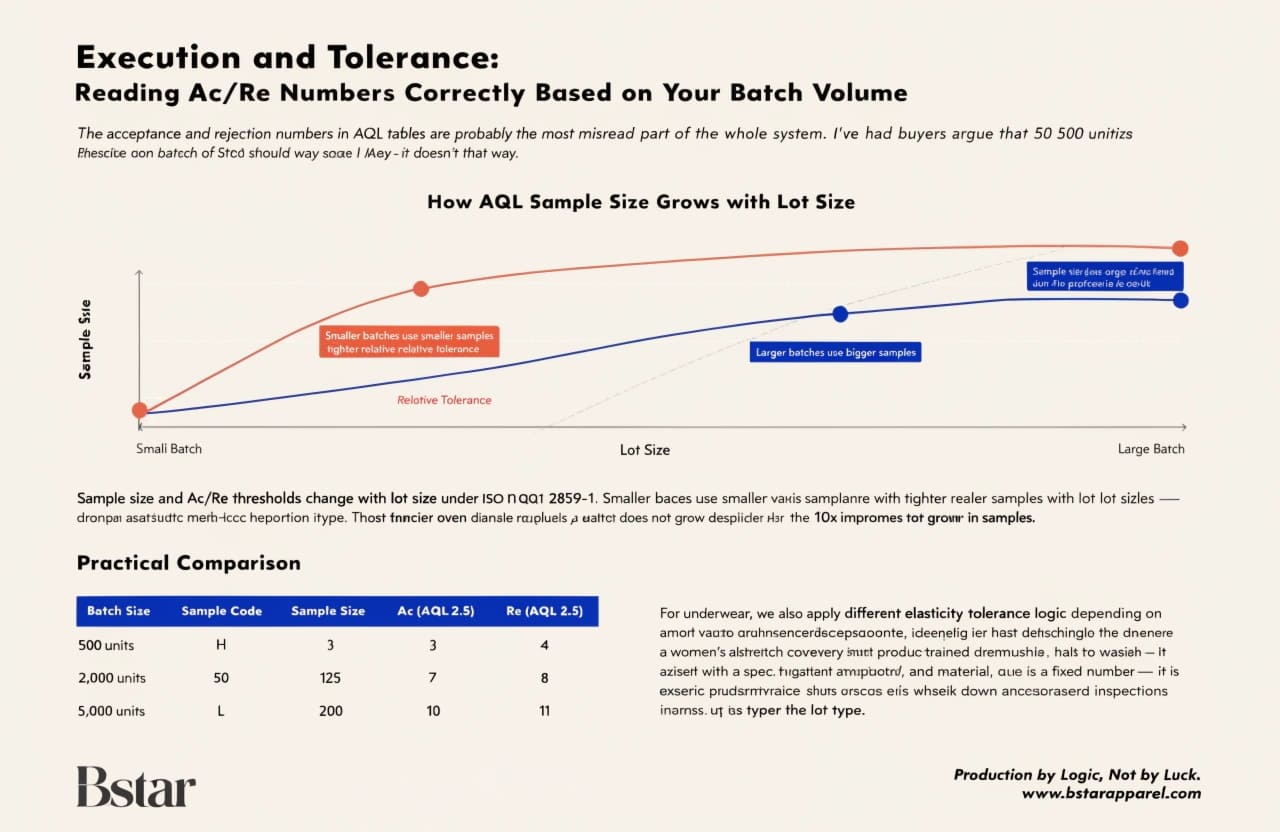
Here is a practical comparison across three batch sizes we regularly process for underwear orders:
| Batch Size | Sample Code | Sample Size | Ac (AQL 2.5) | Re (AQL 2.5) |
|---|---|---|---|---|
| 500 units | H | 50 | 3 | 4 |
| 2,000 units | K | 125 | 7 | 8 |
| 5,000 units | L | 200 | 10 | 11 |
Notice what happens. A batch of 5,000 is 10x larger than 500, but the sample only goes from 50 to 200 — that’s 4x, not 10x. This is by design. The statistical math behind AQL already accounts for lot size. Buyers who demand proportional sampling are not asking for more protection — they are asking for something that the standard was explicitly designed not to do.
For underwear specifically, we also apply different elasticity tolerance logic depending on product type. A boxer brief has different waistband stretch recovery requirements than a women’s brief with a lace waistband. Elasticity pass/fail is not a fixed number — it is relative to spec, material, and end-use. This is exactly where generic inspections break down and category-trained inspectors make the difference.
Beyond the Final Inspection: Why AQL Works Best When It’s the Last Step — Not the Only Step
If your factory only runs AQL at final inspection, you are solving problems at the most expensive possible moment. By that point, fabric has been cut, sewn, finished, and folded. A defect found there costs far more to fix than one caught at the fabric stage.
AQL final inspection is most effective when it confirms what in-line checks have already been controlling throughout production. Without upstream quality nodes, a passing final AQL result can still hide process problems that will repeat in the next order.
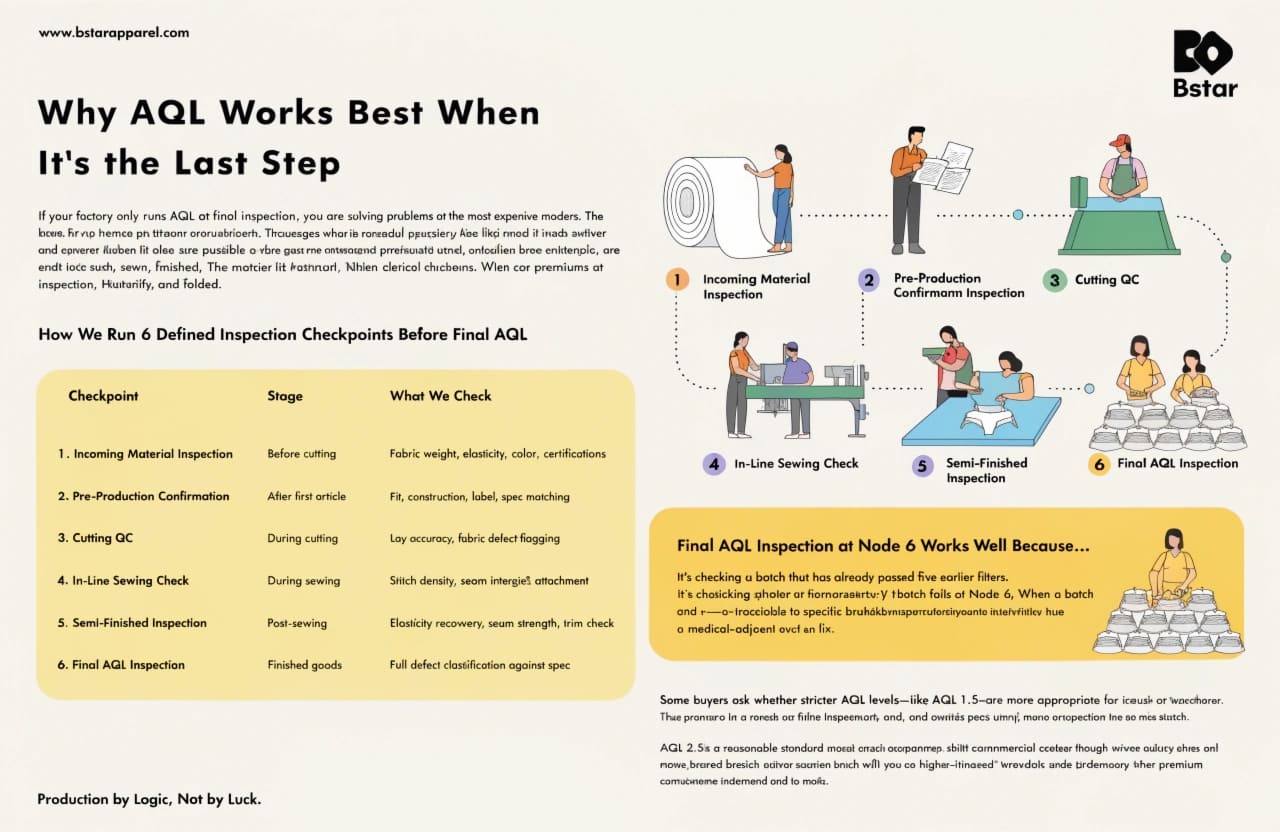
In our factory, we run 6 defined inspection checkpoints before a batch ever reaches final AQL:
| Checkpoint | Stage | What We Check |
|---|---|---|
| 1. Incoming Material Inspection | Before cutting | Fabric weight, elasticity, color, certifications |
| 2. Pre-Production Confirmation | After first article | Fit, construction, label, spec matching |
| 3. Cutting QC | During cutting | Lay accuracy, fabric defect flagging |
| 4. In-Line Sewing Check | During sewing | Stitch density, seam integrity, waistband attachment |
| 5. Semi-Finished Inspection | Post-sewing | Elasticity recovery, crotch seam strength, trim check |
| 6. Final AQL Inspection | Finished goods | Full defect classification against spec |
The final AQL inspection at Node 6 works well because it is checking a batch that has already passed through five earlier filters. When a batch fails at Node 6, it is rare — and usually traceable to a specific in-line breakdown we can identify and fix.
Some buyers ask whether stricter AQL levels — like AQL 1.5 — are more appropriate for premium or medical-adjacent underwear. Honestly, yes. AQL 2.5 is a reasonable standard for most commercial underwear orders, but if your brand sells high-end intimate apparel, maternity underwear, or products with medical positioning, tightening the inspection level is worth the conversation. The sample sizes and Ac/Re thresholds shift accordingly, and we adjust our inspection plan to match.
Conclusion
AQL 2.5 is a risk management tool — useful and widely accepted, but only reliable when underwear-specific defect logic, trained inspectors, and upstream in-line controls are already in place.