
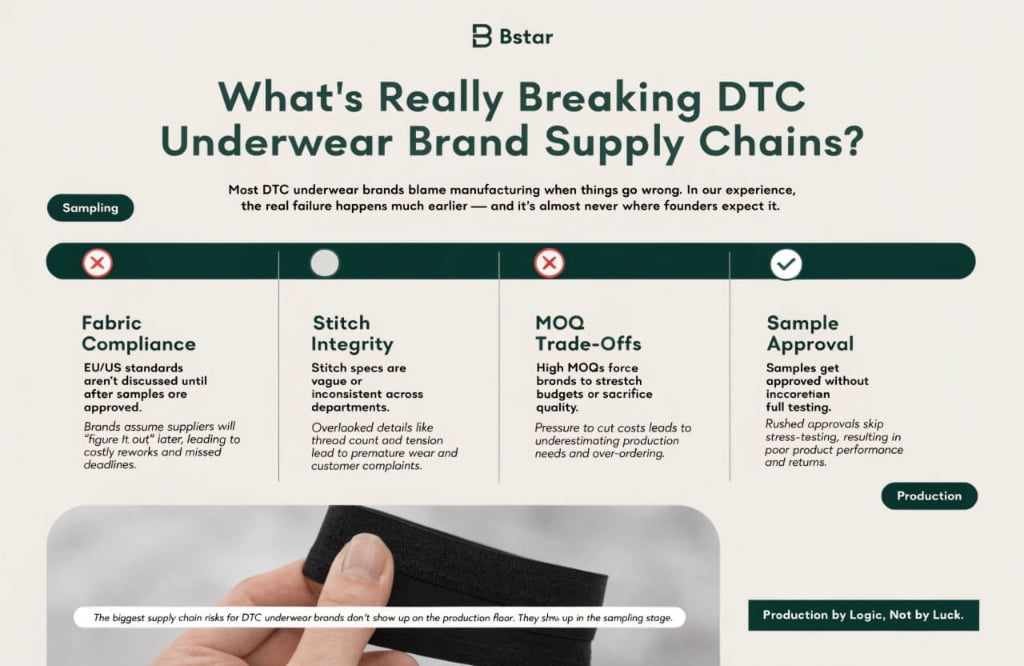
What’s Really Breaking DTC Underwear Brand Supply Chains?
Most DTC underwear brands blame manufacturing when things go wrong. In our experience, the real failure happens much earlier — and it’s almost never where founders expect it.
The biggest supply chain risks for DTC underwear brands don’t show up on the production floor. They show up in the sampling stage. Fabric compliance gaps, unverified stitch integrity, and MOQ trade-offs that nobody discussed — these are the decisions that quietly determine whether your launch succeeds or falls apart.
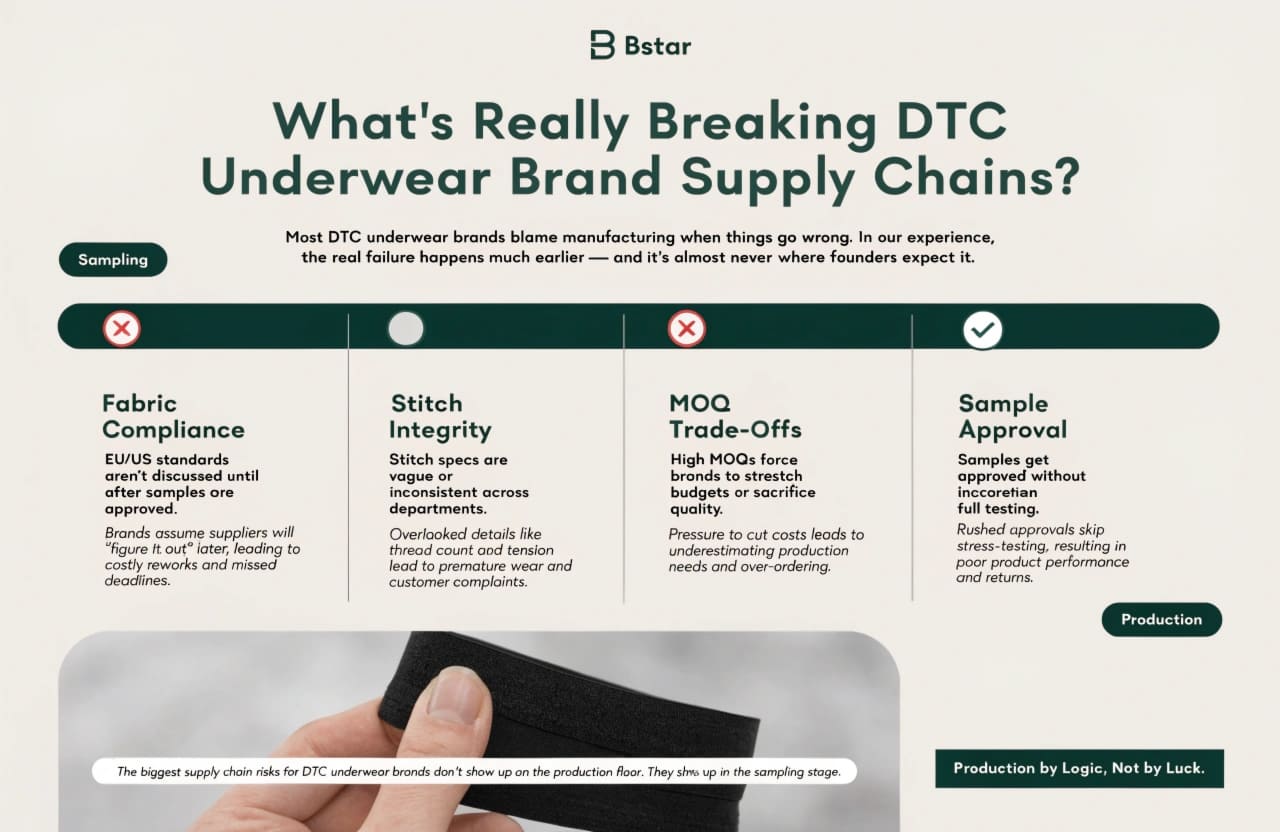
I’ve spent years working directly with DTC underwear brands at the factory side. Early-stage startups, brands scaling from small batches, brands moving into the EU and US markets for the first time. I’ve seen the same problems surface again and again. And almost every time, the root cause was a decision made during sampling — not during production.
Let me walk you through the four areas where we see brands get into real trouble.
Are Low MOQs Actually Helping Your Brand — or Just Hiding the Real Trade-offs?
Low minimum order quantities feel like a win. You test the market, limit your upfront commitment, and move fast. That logic makes sense. But in our experience, brands that fixate on hitting the lowest possible MOQ often don’t ask what that number actually costs them elsewhere.
A low MOQ doesn’t just mean a smaller order. It often means compressed quality controls, fewer fabric options, and a factory that has to prioritize larger clients ahead of yours. The real question isn’t "what’s your MOQ?" — it’s "what trade-offs does this MOQ create for my fabric sourcing, lead time, and QC coverage?"
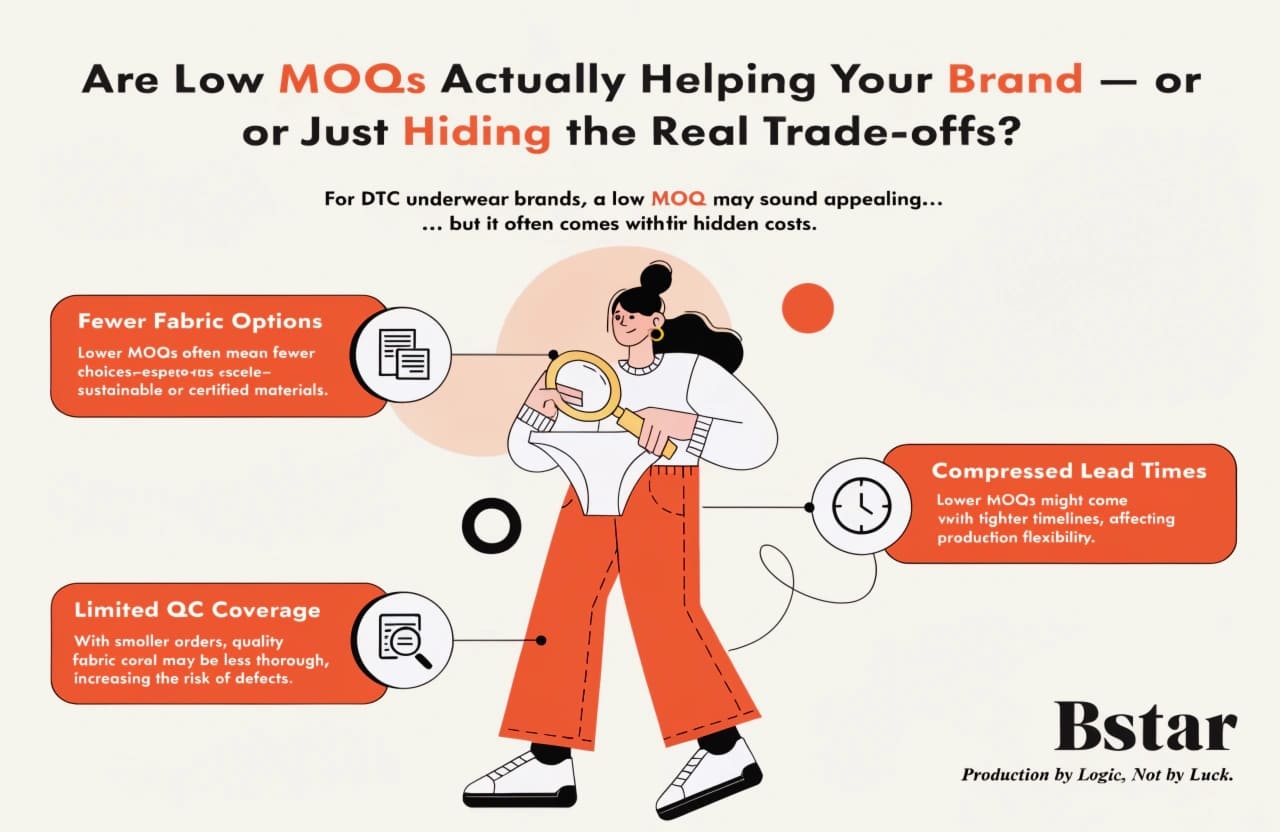
Here’s what we’ve seen happen in practice. A brand comes in wanting 200 units per colorway. That’s fine — we support small-batch development, and there’s genuine value in testing before scaling. But at that quantity, certain certified fabric options become harder to access. Dye lots are smaller, which affects color consistency if you reorder. And the QC process that works well at 2,000 units can’t always be applied with the same density at 200.
None of this means low MOQ is bad. It means it comes with conditions that brands need to understand before they commit.
What changes as MOQ shifts
| MOQ Range | Fabric Options | QC Checkpoint Density | Lead Time Buffer |
|---|---|---|---|
| 100–300 units | Limited certified options | Reduced | Shorter, less flexible |
| 500–1,000 units | More options available | Standard | Moderate |
| 1,500+ units | Full certified range | Full AQL coverage | More predictable |
The brands that handle this well are the ones who come in knowing what they need from the supply chain — not just what they want to spend. They ask about trade-offs upfront. That one habit saves a lot of problems downstream.
Does a Passed Sample Actually Mean Your Product Is Production-Ready?
This is probably the most common misread we see. A brand approves a sample, the aesthetics look great, the fit feels right — and everyone moves forward assuming the hard work is done. In reality, a passed sample often leaves the most important questions completely unanswered.
Sampling approval confirms aesthetics and fit. It does not automatically verify fabric compliance, stitch integrity under stretch, or waistband durability over time. These gaps don’t show up in a sample review — they show up after production, or after delivery, when fixing them is expensive.
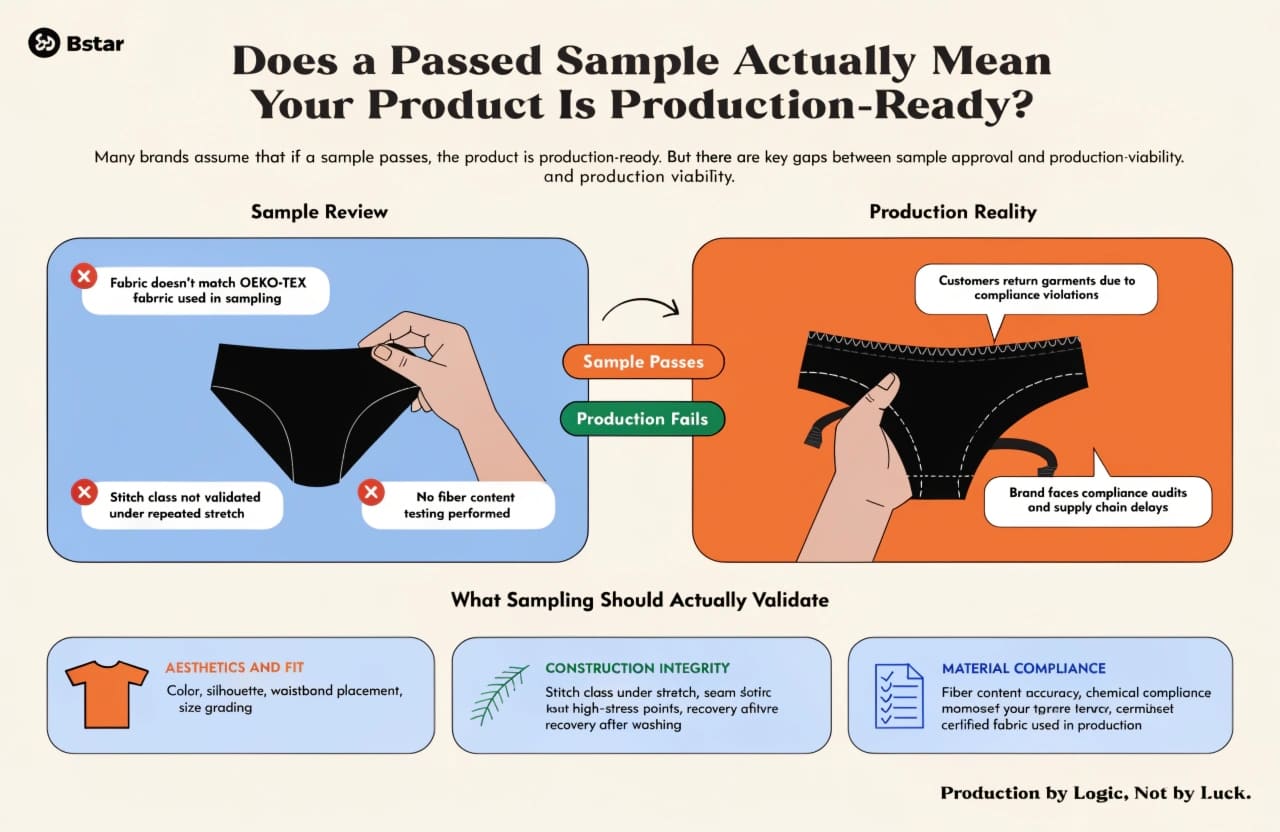
We’ve worked with brands who came to us after a previous manufacturer relationship broke down. A recurring scenario: the sample looked perfect. But the fabric hadn’t been tested for fiber content accuracy, the stitch class hadn’t been validated under repeated stretch1, and no one had confirmed OEKO-TEX compliance on the actual production fabric. The sample passed. The production run created problems that hit customer returns and compliance documentation at the same time.
What sampling should actually validate
There are three layers that a proper sampling process needs to cover. Most brands only check one.
Aesthetics and fit — this is what most brands review. Color, silhouette, waistband placement, size grading. Important, but it’s the surface layer.
Construction integrity — this includes stitch class under stretch, seam strength at high-stress points (gusset, waistband join), and recovery after washing. These are things you have to test, not just look at.
Material compliance — fiber content accuracy, chemical compliance for your target market2, and whether the certified fabric used in sampling is the same fabric that will be used in production. This is where EU and US market brands get caught most often.
When a brand skips the second and third layers during sampling, they’re essentially approving a prototype, not validating a production-ready product. The difference matters a lot when you’re committing to a launch timeline.
How Do You Actually Maintain Fabric Quality When You Scale from 200 to 2,000 Units?
Brands that run a successful small-batch test often assume the scale-up is just a bigger version of the same thing. In our experience, that assumption causes more quality drift than almost anything else.
Scaling from 200 to 2,000 units is a different supply chain, not just a bigger order. Fabric lots change, subcontractor involvement increases, and QC checkpoint density shifts. Brands that don’t plan for this transition inherit quality problems they didn’t see coming.
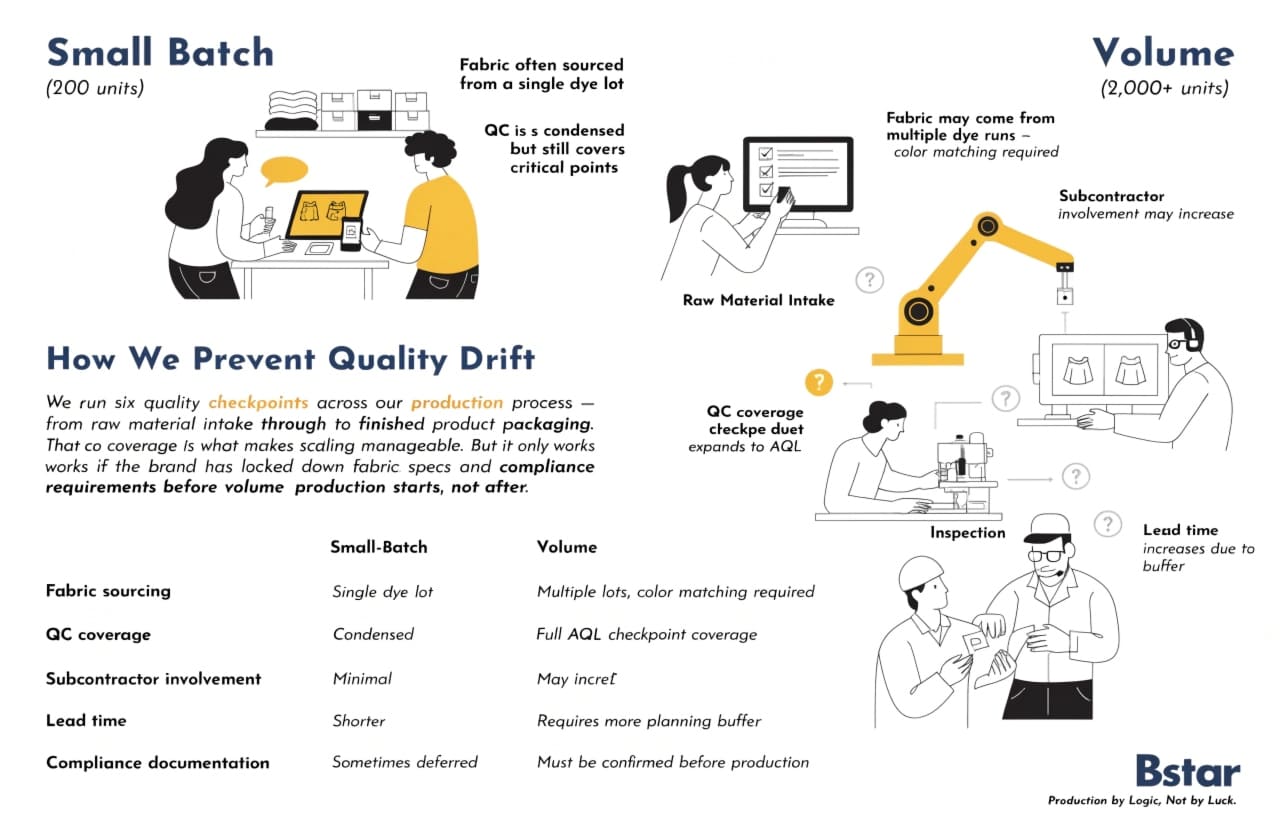
Here’s what actually changes when you scale. At small batch, fabric often comes from a single lot. At volume, it may come from multiple dye runs — which affects color consistency. At small batch, construction stays in-house. At volume, some processes may involve subcontractors, which means QC has to extend further up the chain.
We run six quality checkpoints across our production process — from raw material intake through to finished product packaging. That coverage is what makes scaling manageable. But it only works if the brand has locked down fabric specs and compliance requirements before volume production starts, not after.
Key differences between small-batch and volume production
| Stage | Small-Batch (200 units) | Volume (2,000+ units) |
|---|---|---|
| Fabric sourcing | Single dye lot | Multiple lots, color matching required |
| QC coverage | Condensed | Full AQL checkpoint coverage3 |
| Subcontractor involvement | Minimal | May increase |
| Lead time | Shorter | Requires more planning buffer |
| Compliance documentation | Sometimes deferred | Must be confirmed before production |
The brands that scale successfully are the ones who treat the small-batch run as a technical validation, not just a market test. They use it to confirm specs, lock down certified materials, and identify any construction issues before committing to volume.
Can Your Supply Chain Actually Support the Ethical Sourcing Claims Your Customers Expect?
DTC brands are selling directly to consumers who ask questions. Where is this made? What’s in the fabric? Is the factory audited? These aren’t just marketing concerns — they’re supply chain questions, and the answers have to be real.
Consumer expectations for ethical sourcing are real, but for DTC underwear brands, the supply chain risk is specific: fabric-level certifications (OEKO-TEX, GOTS4, GRS5) must be confirmed at the material sourcing stage, not added as documentation after production is priced and scheduled.
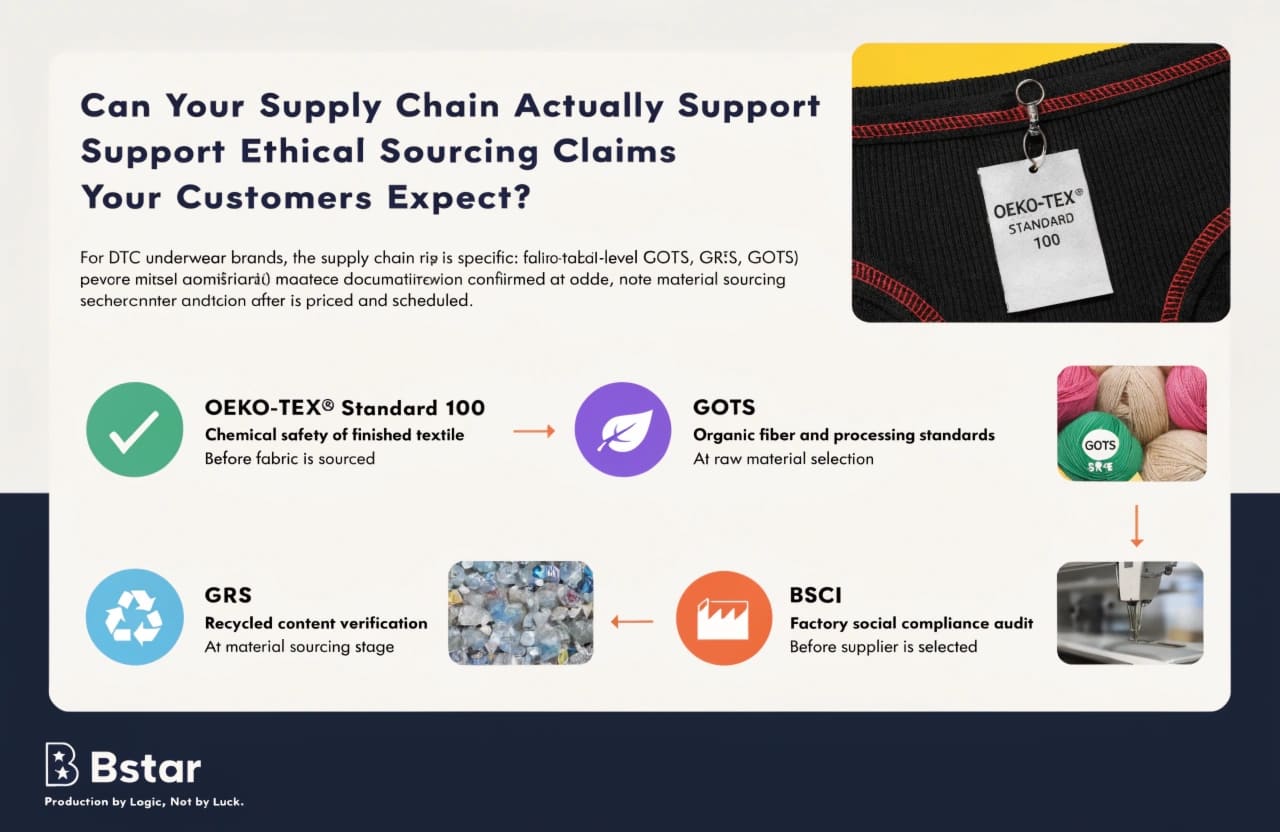
We’ve seen this pattern repeatedly. A brand plans to market their product as sustainable or OEKO-TEX compliant. They approve samples. They confirm pricing. Then, weeks later, they ask about certification documentation — and that’s the first time anyone in the supply chain has actually checked whether the production fabric meets the standard.
At BSTAR, our materials carry OEKO-TEX, GOTS, GRS, and FSC certifications where applicable. But the key point isn’t which certifications we hold — it’s when you confirm them. Certification decisions belong at the fabric sourcing stage, before sampling, not after pricing is locked.
What to confirm — and when
| Certification | What It Covers | When to Confirm |
|---|---|---|
| OEKO-TEX® Standard 1006 | Chemical safety of finished textile | Before fabric is sourced |
| GOTS | Organic fiber and processing standards | At raw material selection |
| GRS | Recycled content verification | At material sourcing stage |
| BSCI7 | Factory social compliance audit | Before supplier is selected |
If you’re selling into the EU or US, compliance isn’t optional. The brands that handle this well ask about certifications in the first supplier conversation — not after they’ve fallen in love with a sample.
Conclusion
Most DTC underwear supply chain problems are sampling-stage decisions made without enough information. Ask about trade-offs early, validate beyond aesthetics, plan for scale from day one, and confirm certifications before production is priced.
-
"[PDF] Journal of Textile Engineering and Fashion Technology", https://www.opastpublishers.com/open-access-articles/industrial-sewing-stitch-classification-a-technical-review-aligned-with-iso-4915-and-astm-d6193-standards.pdf. ISO 4915 classifies stitch types and their structural properties, with industry testing protocols such as ASTM D1683 providing standardized methods for measuring seam strength; stitch classes designed for woven fabrics are documented to perform poorly under the cyclic stretch loads characteristic of knit underwear. Evidence role: definition; source type: institution. Supports: That stitch class selection is a technically defined variable with measurable consequences for seam performance under stretch, governed by international standards.. Scope note: Standards define test conditions rather than prescribing which stitch class is appropriate for a given end use; the link between skipped validation and downstream defect rates is inferential rather than directly measured by these standards. ↩
-
"Threading Your Way Through the Labeling Requirements Under the …", https://www.ftc.gov/business-guidance/resources/threading-your-way-through-labeling-requirements-under-textile-wool-acts. In the United States, the Textile Fiber Products Identification Act (15 U.S.C. § 70) requires accurate fiber content labeling on all textile apparel; in the European Union, Regulation (EU) No 1007/2011 mandates fiber composition labeling, while REACH Regulation (EC) No 1907/2006 restricts hazardous chemical substances in textile articles placed on the market. Evidence role: historical_context; source type: government. Supports: That fiber content accuracy and chemical safety are legally mandated disclosure and compliance requirements for textile products sold in the US and EU.. Scope note: Specific restricted substance thresholds and enforcement mechanisms differ between jurisdictions; brands must consult current regulatory texts as requirements are periodically updated. ↩
-
"[PDF] ISO 2859-1 – UNT Chemistry", https://chemistry.unt.edu/~tgolden/courses/iso2859-1.pdf. ISO 2859-1 defines Acceptable Quality Level (AQL) as the quality level that is the worst tolerable process average when a continuing series of lots is submitted for acceptance sampling; in apparel manufacturing, AQL 2.5 is the widely adopted industry benchmark for general defects, with sample sizes and acceptance numbers determined by lot size according to standardized inspection level tables. Evidence role: definition; source type: institution. Supports: That AQL is a statistically defined sampling standard used in manufacturing quality control to determine acceptable defect rates and required sample sizes relative to lot size.. Scope note: AQL sampling is a probabilistic method that accepts a defined risk of passing non-conforming lots; it does not guarantee defect-free production and is less effective for very small lot sizes where sample sizes become statistically insufficient. ↩
-
"GOTS – Wikipedia", https://en.wikipedia.org/wiki/GOTS. The Global Organic Textile Standard (GOTS), governed by four international organizations including the Organic Trade Association and the Soil Association, requires a minimum of 70% certified organic natural fibers and sets ecological processing criteria—including restrictions on chemical inputs—and social criteria aligned with ILO conventions, applicable at every stage from fiber to finished product. Evidence role: definition; source type: institution. Supports: That GOTS is a comprehensive supply chain standard covering both organic fiber content and ecological and social criteria for textile processing.. Scope note: GOTS certification must be held by each facility in the supply chain; a brand’s use of GOTS-certified fabric does not automatically confer GOTS status on the finished product unless the manufacturing facility is also certified. ↩
-
"Recycled Claim Standard (RCS) + Global Recycled Standard (GRS)", https://textileexchange.org/recycled-claim-global-recycled-standard/. The Global Recycled Standard (GRS), administered by Textile Exchange, establishes chain-of-custody requirements for verifying recycled input materials and sets social, environmental, and chemical requirements for processing; a product must contain a minimum of 20% recycled content to use the GRS label, with 50% required for full certification claims. Evidence role: definition; source type: institution. Supports: That the Global Recycled Standard provides third-party verification of recycled content claims in textile and apparel products through chain-of-custody certification.. Scope note: GRS verifies the recycled content of input materials but does not assess the overall environmental impact of the finished product or the energy intensity of the recycling process. ↩
-
"Oeko-Tex – Wikipedia", https://en.wikipedia.org/wiki/Oeko-Tex. OEKO-TEX Standard 100, administered by the OEKO-TEX Association, tests every component of a textile article—including threads, buttons, and prints—against a list of over 100 harmful substances, with certification classes scaled to the sensitivity of the intended end use, Class I covering products for infants and Class II for items in direct skin contact such as underwear. Evidence role: definition; source type: institution. Supports: That OEKO-TEX Standard 100 is an independently administered certification verifying that textile products have been tested for harmful substances.. Scope note: Certification applies to the tested lot and production conditions at the time of audit; it does not guarantee ongoing compliance if production inputs change between certification cycles. ↩
-
"amfori BSCI Certification & BSCI Audit Services | TÜV SÜD", https://www.tuvsud.com/en-us/services/auditing-and-system-certification/amfori-business-social-compliance-initiative. The Business Social Compliance Initiative (BSCI), rebranded as amfori BSCI, is a supply chain management program used by over 2,500 member companies; audits assess factories against eleven performance areas derived from international labor conventions including ILO standards, covering fair remuneration, working hours, occupational health and safety, and freedom of association. Evidence role: definition; source type: institution. Supports: That BSCI (now operating under the amfori brand) is a widely used industry-led social compliance audit program assessing factory working conditions against defined labor standards.. Scope note: BSCI is an industry self-regulatory program rather than an independent third-party certification; critics have noted that audit-based compliance systems may not reliably detect systemic labor violations, and audit results are shared among members rather than made fully public. ↩
Discussion & questions 0 comments