Custom Hoodie MOQ: What Brands Should Confirm Before Ordering
Ordering custom hoodies without confirming the right MOQ details is one way a product launch stalls before it starts. Many brands ask "what’s your minimum order?" and treat the answer as a fixed number. It isn’t always. And that misunderstanding costs real time and money.
Custom hoodie MOQ is not necessarily a single number — it’s a set of minimums that may apply per style, per color, per technique, and sometimes per size run. Before placing any order, brands should confirm how their supplier calculates MOQ across each of those variables, what changes at reorder, and whether their specific customization method carries its own separate minimum. Getting clear on this upfront helps avoid an order that meets the total quantity but cannot proceed as specified.
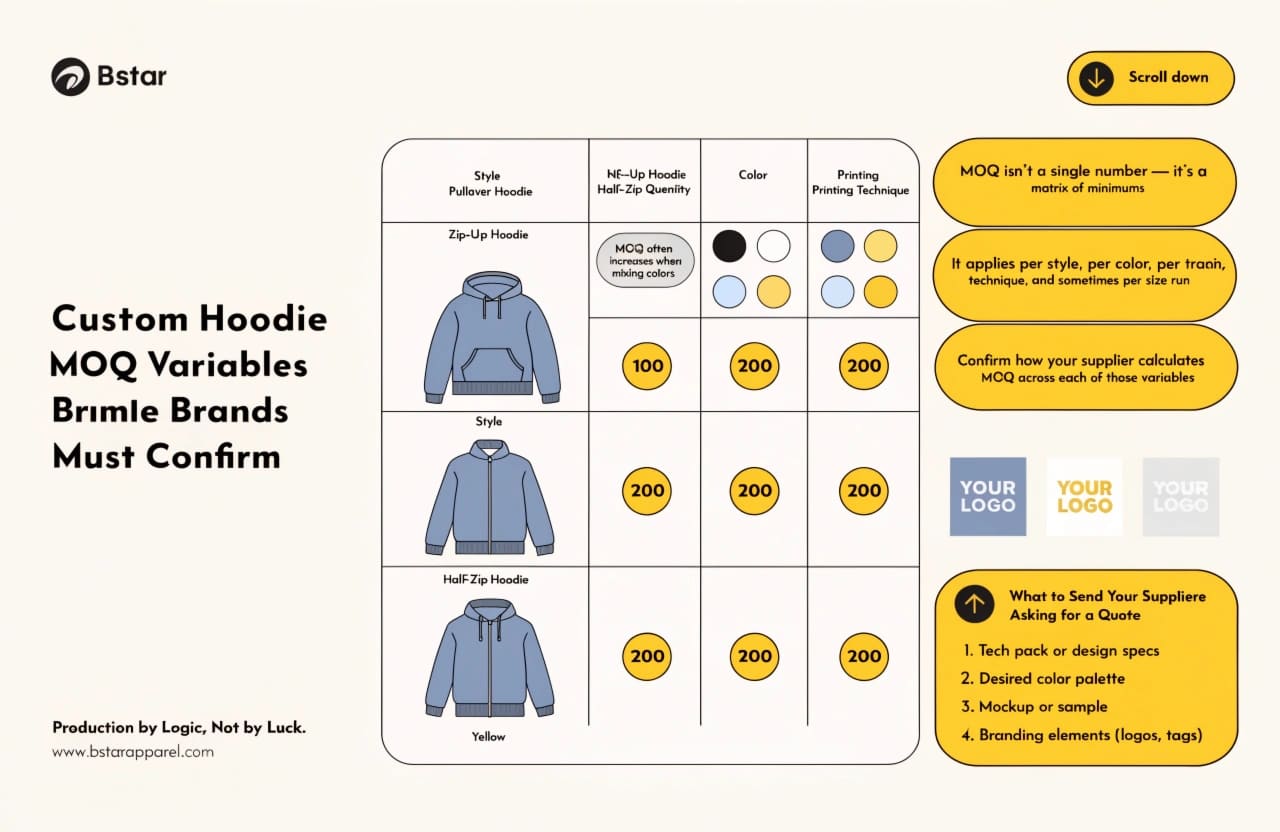
Illustration note: This is a concept illustration. Its numbers are not BSTAR’s hoodie MOQ or a quotation; some embedded wording is inaccurate. Use the written breakdown below and the supplier’s confirmed terms.
There’s a lot more to unpack here than many brands expect. The sections below walk through each variable — style splits, fabric choices, trims, branding, and what to send a supplier before you even ask for a quote. For the product options behind these decisions, see BSTAR’s custom hoodie manufacturing page.
How Should Brands Split a Hoodie Order by Style, Color and Size?
A brand plans an order for 500 units across two styles and three colors. That sounds like a reasonable quantity. But if the supplier’s MOQ per color per style is 150 units, that order falls short in every style-color combination in the example below. The problem needs to be flagged before sampling or production planning, not discovered afterward.
Some suppliers set MOQ per color per style, rather than per total order. A 500-unit order split across six style-color combinations averages about 83 units per combination. Whether that works depends on the agreed minimum. A SKU usually identifies a specific style, color and size; six style-color combinations are not just six SKUs when each includes several sizes.
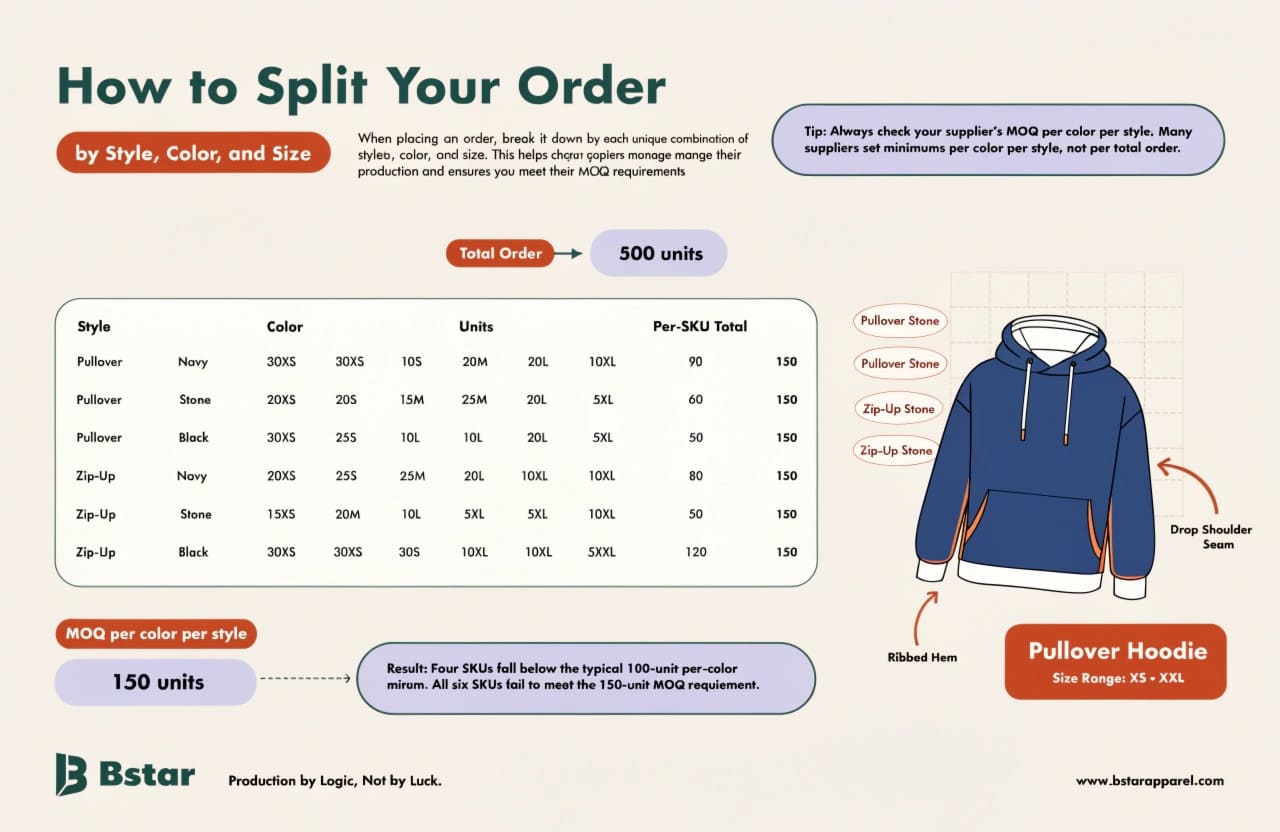
Illustration correction: The image’s size allocations and totals contain inconsistencies. The text table below is the corrected example. Its 100- and 150-unit thresholds are hypothetical, not industry standards or BSTAR minimums.
Here’s where brands need to think clearly before entering any supplier conversation.
Why Suppliers May Set MOQ Per Style and Color, Not Per Order
A factory may be able to sew several small colorways, yet still face separate fabric, dyeing or trim purchasing conditions. Dyeing equipment comes in different capacities, but a machine’s rated capacity does not establish a universal commercial MOQ.1 The relevant questions are which materials require a separate run, what setup is needed, and whether the quoted garment quantity covers those purchases.
In our experience handling initial inquiries from European and North American brands, a common early-stage mismatch happens exactly here. A brand has done its market research, projected sell-through by color and size, and the totals look healthy. But they haven’t mapped those projections against the supplier’s style, color and size conditions.
BSTAR’s MOQ and order planning overview explains the distinction between garment and material minimums. Hoodie quantities still need their own project review; an underwear MOQ should not be carried across to a hoodie order.
An Illustrative Order Split
Consider a brand ordering a pullover hoodie and a zip-up hoodie, each in three colors — navy, stone, and black — and each in a size run from XS to XXL. These quantities are for planning only, not a completed customer order.
| Style | Color | Units across all sizes | At an illustrative 100-unit minimum per style/color |
|---|---|---|---|
| Pullover | Navy | 90 | Below minimum |
| Pullover | Stone | 60 | Below minimum |
| Pullover | Black | 100 | Meets minimum |
| Zip-Up | Navy | 80 | Below minimum |
| Zip-Up | Stone | 50 | Below minimum |
| Zip-Up | Black | 120 | Meets minimum |
| Total | 500 | 4 of 6 combinations below minimum |
That’s 500 units total. But four of the six style-color combinations fall below the illustrative 100-unit minimum. If the agreed threshold were 150 units per color per style, all six would fall short. The size quantities within each row still need to be listed and checked separately.
What to Do Before You Ask for a Quote
- Map your planned units by style, color, and size run before you contact a supplier.
- Ask specifically: "What is your MOQ per color, per style?" — not just "what’s your MOQ?"
- Ask whether individual sizes or size runs have their own conditions, including extended sizes.
- Decide in advance which style-color combinations you’re willing to consolidate or drop if minimums aren’t met.
Brands that arrive with this breakdown ready can reduce repeated clarification during quotation. Keep reference images, material details, measurements and revisions together so both sides work from the same information; a tech pack is one way to organize it.2 That does not mean every founder must arrive with a finished technical document.
How Do Stock Fabrics and Custom-Dyed Fabrics Affect MOQ?
Choosing between an available stock fabric and a custom-dyed or custom-developed fabric changes your MOQ conversation entirely. Many brands don’t realize this until they’re already in sampling.
Stock fabrics — materials available from a mill, stockist or the garment supplier in an existing color — may avoid a new dyeing run. Availability, usable quantity and the garment supplier’s own minimum still need checking. Custom dyeing can introduce a separate fabric purchase minimum.
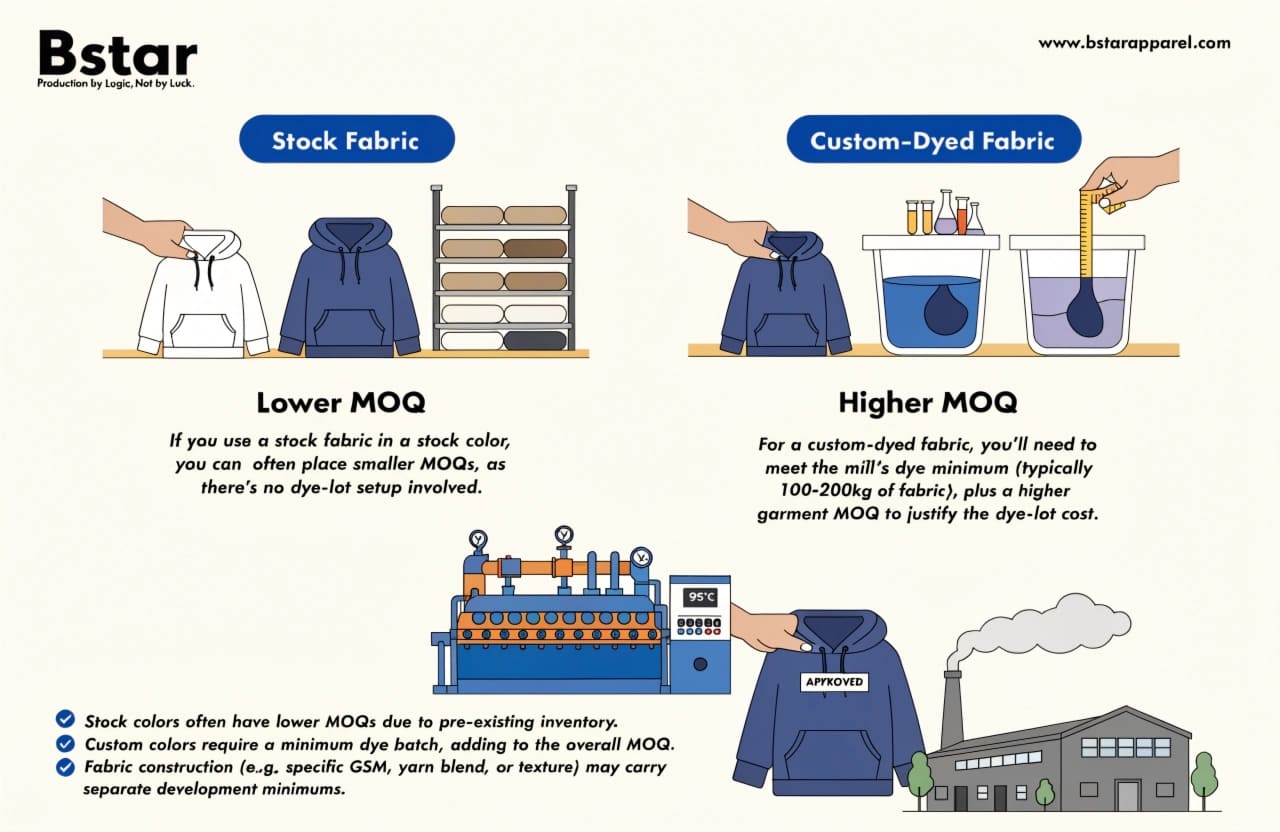
Illustration correction: The pictured 100–200 kg range is not a verified universal dye minimum. Confirm the actual mill’s conditions. Stock fabric may support a smaller order, but it does not guarantee a lower garment MOQ.
Stock Fabric vs. Custom Fabric: What Changes
When a brand selects a stock fabric in an available color, the supplier can check the existing quantity instead of arranging a new dye run. This may reduce development steps, but stock can sell out, and a later replenishment may come from a different lot.
When a brand wants a specific color — say, a brand PANTONE reference or an approved physical swatch — the supplier needs to agree on a color approval route:
- Match the color through lab dips on the intended material and obtain approval before bulk dyeing; lab-dip formulation and validation are distinct stages in textile color development.3
- Confirm the mill’s actual batch or purchase minimum, including its unit of measurement — kilograms, meters or rolls.
- Review the bulk fabric against the agreed color reference before cutting.
That fabric minimum may require a larger purchase than the original garment plan uses. Ask for the conversion to garment quantities based on the approved fabric weight, usable width, size mix, cutting consumption and allowance for loss. Kilograms of fabric do not translate into a fixed number of hoodies.
What This Means for Your SKU Plan
- A custom color can add a separate minimum. Pool quantities across styles only if the mill and garment supplier agree they can use the same approved material and dye lot.
- If you want three custom colors, ask about each color separately. Brands sometimes solve this by consolidating to one or two custom colors and using available stock colors for the rest.
- Custom fabric constructions — a particular yarn blend, texture or unavailable GSM — may require development beyond color matching. Check existing options first; specifying a fabric weight does not automatically mean a new knitting run. Our French terry vs. brushed fleece guide covers the fabric decisions to settle before comparing quotes.
- Certification requirements should be raised early so the supplier can check suitable materials and documentation. GOTS and OEKO-TEX® STANDARD 100 are different schemes; a fabric certificate alone does not make a finished hoodie certified. Neither scheme supplies the garment MOQ for your order.4
One pattern we see fairly often: a brand specifies a custom color in their initial brief, gets a preliminary quote, and only discovers the dye minimum later when it forces them to increase order volume or reformulate their SKU structure. Confirming fabric choice and color source before requesting a formal quote avoids that reset.
Which Trims Can Create Separate Minimums for Pullover and Zip-Up Hoodies?
The body of the hoodie is only part of what a supplier is producing. Trims — zippers, drawcords, cuffs, labels, and decorative hardware — may have their own purchasing conditions from upstream suppliers.
Brands that fully specify their trims upfront get more accurate quotes. Brands that treat trims as details to decide later can hit separate MOQ walls during material sourcing.
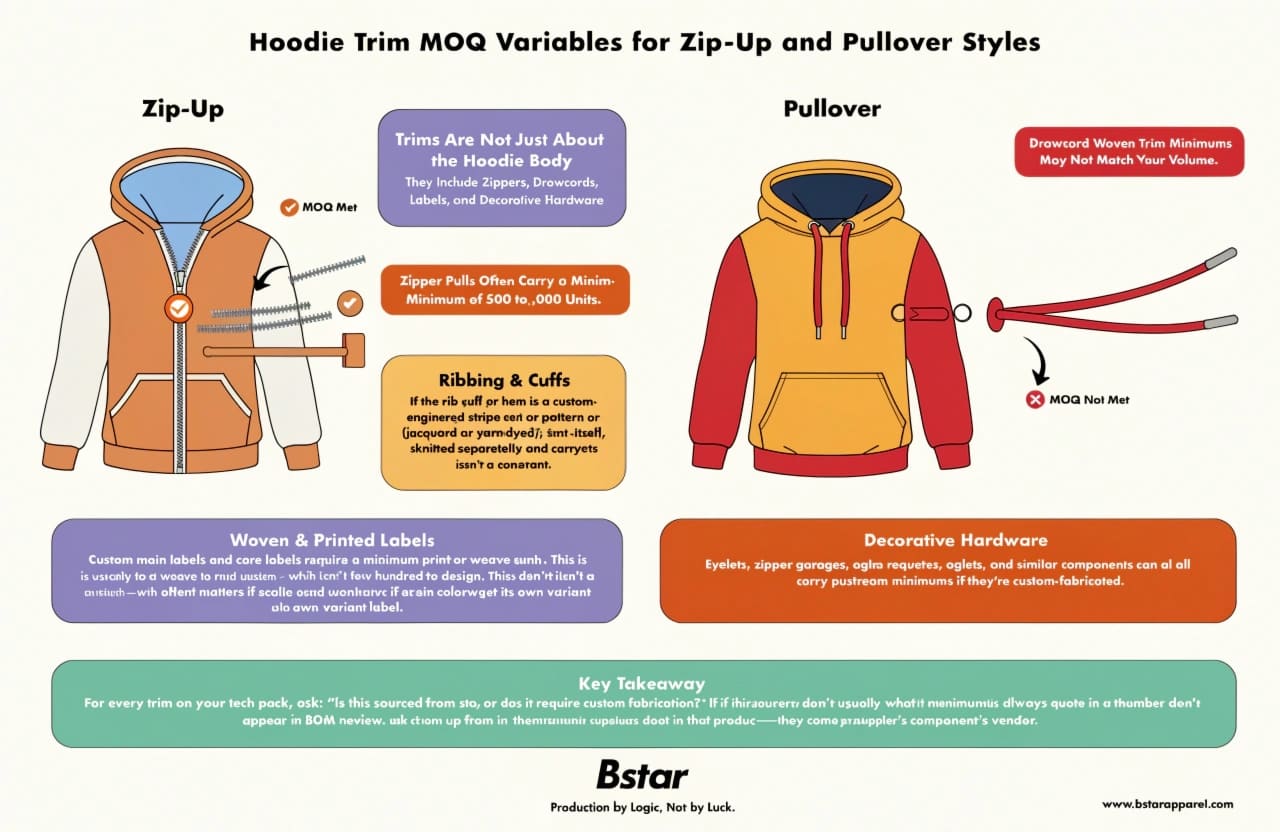
Illustration correction: The trim quantities printed in this image are not confirmed supplier or BSTAR requirements. Review each component separately using the questions below.
Common Trims and Their MOQ Implications
Zippers (zip-up hoodies specifically):
Custom zipper pulls with branded engravings or unique finishes may carry separate quantities and tooling charges. Component suppliers publish their own terms; there is no single 500–1,000-piece rule for all zipper pulls.5 Confirm zipper length, tape color, slider compatibility and whether a stock pull can meet the design before committing to custom tooling.
Drawcords:
Custom-woven or printed drawcords with brand logos may require a separate production run. A stock cord can avoid custom fabrication, but available colors, lengths and purchasing quantities still need checking. If logo placement on the drawcord is a design priority, confirm whether that’s achievable at your volume. For children’s styles, also confirm suitability for the intended age group and destination market before selecting cords or hardware.
Ribbing and cuffs:
If the rib cuff or hem is a custom-engineered stripe or pattern, the rib may require its own knitting and dyeing run. Plain ribbing is not automatically free of minimums either: check available stock, composition, weight and color matching to the body fabric.
Woven and printed labels:
Custom main labels and care labels may have minimum runs per artwork, size or color variant. Ask the label supplier for the actual quantities instead of assuming a few hundred or a thousand units.
Settle required wording before ordering those labels. For hoodies intended for the U.S. market, FTC guidance explains the fiber-content, country-of-origin and responsible-business identification requirements for most covered textile products.6 Its separate care-labeling guidance requires a reasonable basis for care instructions.7 These are labeling obligations, not evidence for label or drawcord MOQs.
Decorative hardware:
Eyelets, aglets, branded badges and similar components can carry upstream minimums if they’re custom-fabricated. Standard off-the-shelf hardware may avoid tooling, but still needs availability and purchase-quantity checks. A zipper garage is generally a garment construction detail, so confirm its material and sewing requirements rather than treating it automatically as custom metal hardware.
The Practical Question to Ask
For every trim on your tech pack or reference brief, ask: "Is this sourced from stock, or does it require custom fabrication?" If it requires custom fabrication, ask what the minimum is from that supplier’s component vendor. These numbers don’t always appear in the initial product quote — they need to be checked when the bill of materials, or BOM, is reviewed.
Also ask who pays for and owns any surplus trims, where they will be stored, and whether they can be used on a later order. Buying extra trims is not the same as committing to extra finished hoodies.
How Do Branding and Packaging Affect Order Minimums?
Embroidery, screen print, heat transfer, and woven patches are common customization methods for hoodies. Each has different setup and purchasing considerations. Brands that specify a technique before checking the actual terms sometimes discover they’ve briefed a design that isn’t viable at their volume.
Packaging — polybags, hangtags, custom boxes — introduces a parallel set of considerations.
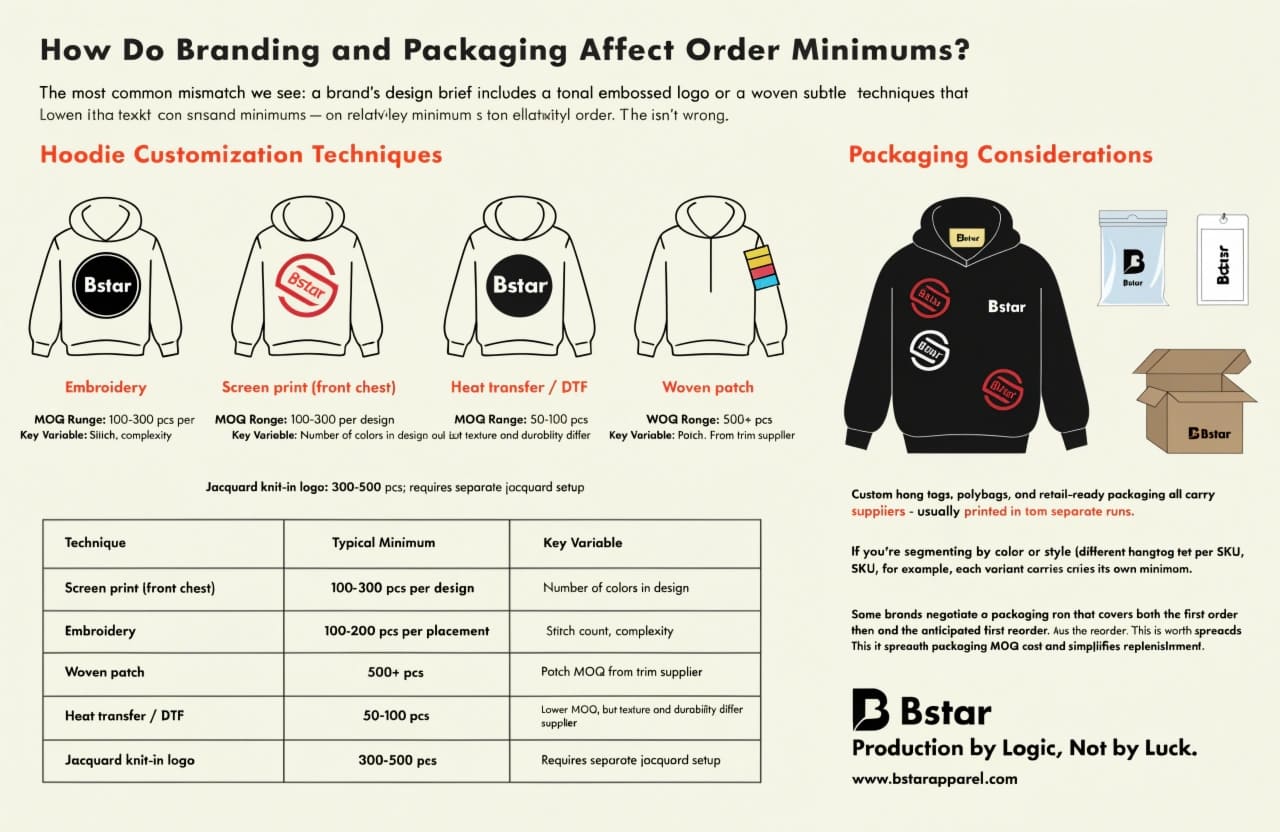
Illustration correction: The printed MOQ ranges are not verified industry thresholds and should not be used for ordering. The table below replaces those ranges with the points to confirm in a project quotation.
Customization Techniques and Their MOQ Conditions
| Technique | Minimum or fee to confirm | Key variable |
|---|---|---|
| Screen print (front chest) | Decorator’s minimum per artwork/colorway; screen and setup charges | Ink colors, print size and placements; multicolor artwork generally needs separate screens.8 |
| Embroidery | Minimum per design/placement; digitizing and production charges | Finished logo size, stitch count, fabric support and complexity.9 |
| Woven patch | Patch supplier’s minimum per design; application cost on the garment | Patch size, colors, edge finish and backing.10 |
| Heat transfer / DTF | Transfer supplier’s purchasing unit or minimum; application charges | Artwork area, sheet use, fabric compatibility and wash performance |
| Jacquard knit-in logo | Whether the design needs a custom knitted panel or rib; its development and production terms | This changes the knitted component itself; it is not simply a print applied to a finished hoodie |
A common mismatch we see: a brand’s design brief includes a tonal embossed logo or a woven chest label — details that look subtle but can involve separate setup or component purchases — on a relatively small pilot order. The technique isn’t wrong. The timing may be.
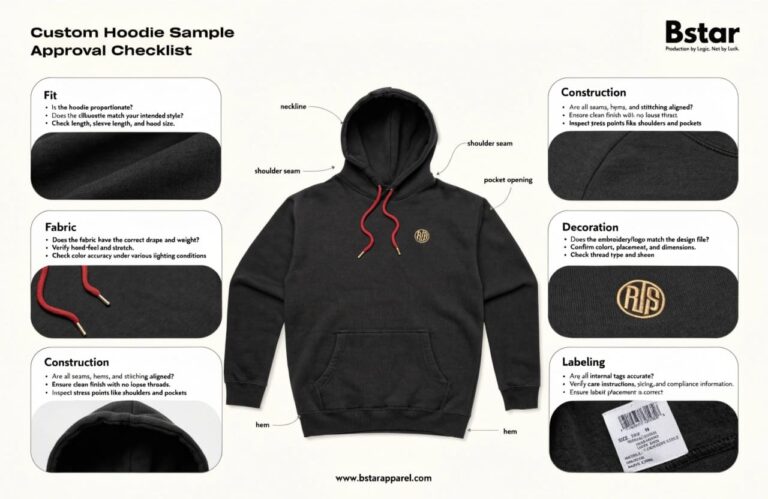
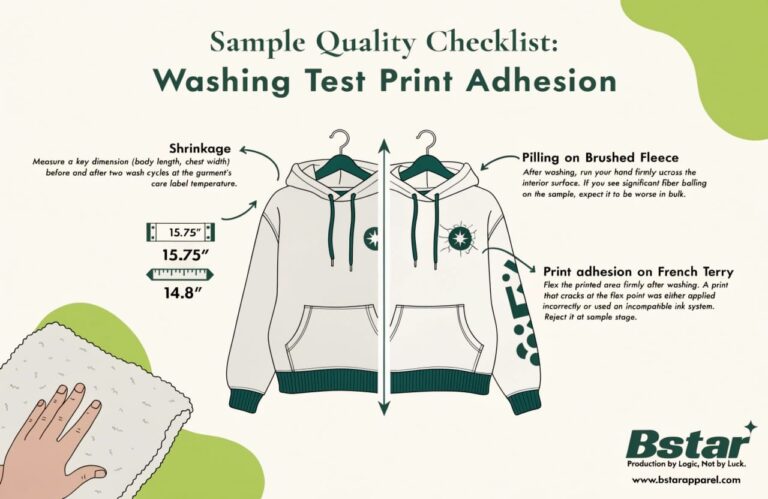
A practical approach: If you’re placing a pilot or first-season order, compare the actual total costs of the available methods and choose a finish you can approve at your volume. More complex methods can follow at scale if they suit the product. A lower minimum alone is not enough: review appearance, hand feel and wash behavior on the actual hoodie fabric using the hoodie sample approval checklist.
Packaging Minimums
Custom hangtags, polybags, and retail-ready packaging may carry minimums from their own suppliers, often produced in separate runs. If you’re segmenting by color or style — different hangtag text per variant, for example — ask whether each version has its own minimum, or whether a shared design with a variable sticker is workable.
First-order vs. reorder packaging: Some brands arrange a packaging run that covers both the first order and an anticipated reorder. This is worth exploring if your packaging design is stable. Confirm the upfront payment, surplus quantity, ownership, storage period and release conditions; expected reorders are not guaranteed purchases.
What Should a Brand Send to Get a Clear Hoodie MOQ and Quotation?
The quality of the information you send directly affects the quality of the quote you receive. Vague inquiries produce ballpark numbers. Specific inquiries make it easier to identify what can be quoted and what still needs development.
One pattern we see consistently: brands that arrive with clear information need fewer rounds of clarification. If you only have an idea and reference images, start there. BSTAR can review those by email, help clarify the missing details and record the agreed requirements before sampling. Our sampling and prototyping overview explains that specification-and-review approach; hoodie scope, charges and timing are confirmed separately.
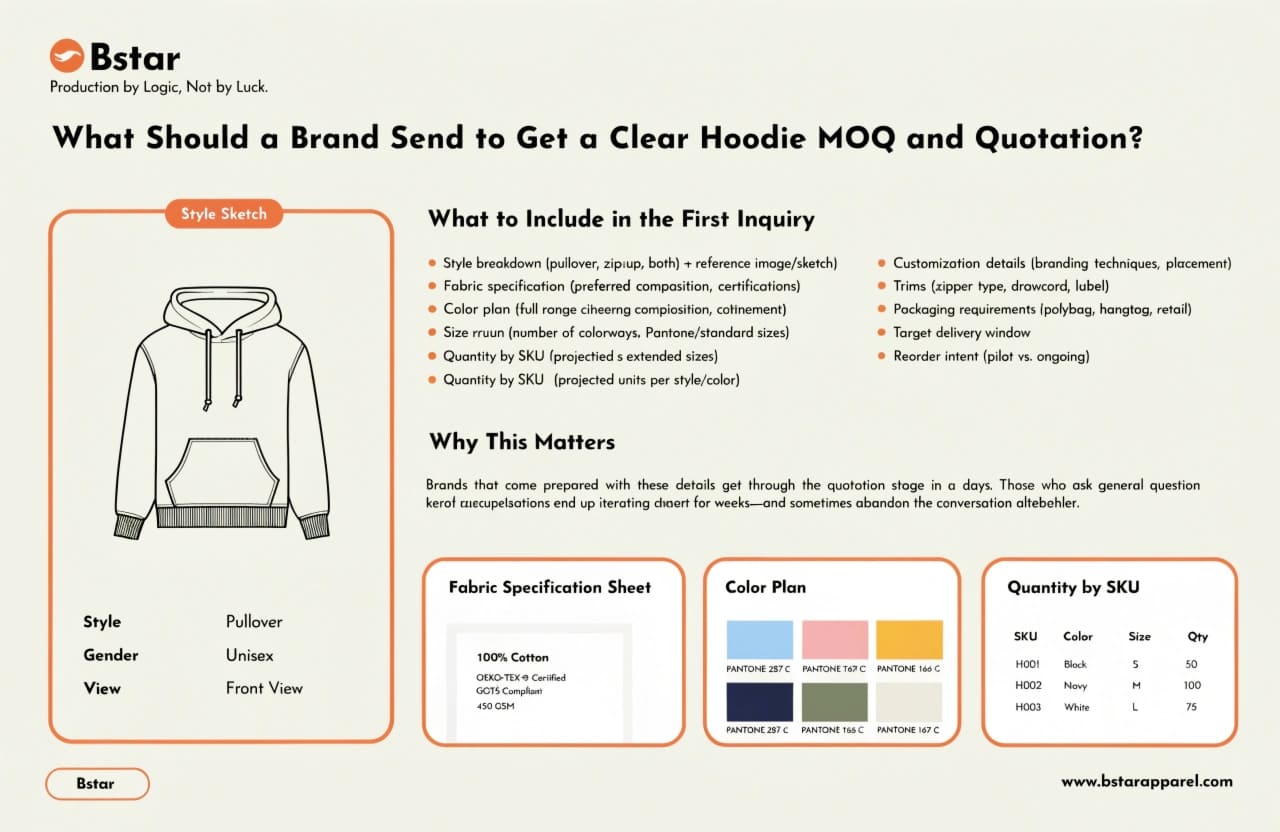
Illustration note: This is a brief-planning example, not a BSTAR production record. The shown composition, GSM, colors and quantities are examples. Its certification wording does not establish certification for BSTAR or a finished hoodie, and the pictured response times are not a service commitment.
What to Include in Your First Inquiry
- Style breakdown — pullover, zip-up, or both. Include a reference image or sketch and identify adult or children’s styles.
- Fabric preference — composition, French terry or brushed fleece, and target weight or feel if known. Include any certification requirement, with its intended product scope. If unsure, say what you’re trying to achieve.
- Color plan — number of colorways, whether you can use available stock colors or need custom matching to a PANTONE reference or physical swatch.
- Size run — full range you need, including any extended sizes, and a size chart or fit reference if available.
- Quantity breakdown — projected units per style and color, then by size. Keep these levels separate so the MOQ basis is clear.
- Customization details — every branding technique you’re considering (embroidery, print, patch, etc.), artwork, approximate size and placement.
- Trims — zipper type (for zip-ups), drawcord preference, label type and any custom hardware.
- Packaging requirements — polybag, hangtag, retail packaging needs and the market where you plan to sell.
- Target delivery window — distinguish the date goods need to leave the factory from the date they need to arrive.
- Reorder intent — whether this is a pilot order or the beginning of an ongoing program. Label forecasts as forecasts.
That last point matters. A realistic reorder plan can help both sides discuss material reservation and surplus trims, but it does not guarantee MOQ flexibility. Ask the supplier to separate confirmed first-order terms from any future assumptions in writing. A reference brief in an email or a simple table is enough to begin; the information can become more detailed as the sample develops.
Frequently Asked Questions
Can I mix pullover and zip-up quantities to reach a custom hoodie MOQ?
Sometimes, but not always. A pullover and a zip-up may have separate garment minimums even if they share fabric. Confirm whether quantities can be combined for the garment order, the fabric purchase, or both. Sharing a material does not automatically combine every production condition.
Does a lower MOQ always mean a higher unit price?
Not always. Smaller runs can leave fewer garments to absorb setup costs, but available fabric, decoration choices and separately charged fees also affect the result. Compare the full cost at your actual quantity, including sampling, setup, surplus materials, production and shipping — and duties or other import costs when relevant.
How is first-order MOQ different from reorder MOQ?
It depends on the supplier’s terms and what remains unchanged. A trial-order concession may not apply again; equally, usable reserved fabric or trims may help a reorder. Confirm both at the start. A change in color, fabric, artwork, zipper or size range may introduce new purchasing conditions even when the garment looks similar.
Do certifications like GOTS or OEKO-TEX® affect custom hoodie MOQ?
The need for appropriately documented materials and processing can affect which options are available. The schemes do not set a universal hoodie order quantity. Confirm the exact requirement, certificate holder, validity, product scope and any supply-chain or labeling conditions, then ask for the MOQ of that verified option. Do not assume that certified fabric makes the finished garment certified.4
What happens if one SKU falls below MOQ?
First clarify whether the minimum actually applies to an individual size SKU or to the whole style-color combination. Options may include adjusting the size split, reducing colorways, selecting an available stock material, paying an agreed small-run charge or holding surplus materials for later use. Two colors being in the same "dye family" does not automatically allow their dye quantities to be combined. Get the workable option confirmed before sampling.
Conclusion
Custom hoodie MOQ is a matrix, not just a number. Before any order moves forward, brands should confirm minimums per style, per color, per customization technique, and per trim component — and ask separately about reorder terms. This preparation helps both sides catch purchasing and production mismatches before money is committed.
If you’re sourcing custom hoodies and want to check whether your quantity plan and design brief work together, send BSTAR your style breakdown and reference images. We’ll review the available information and identify the details needed to confirm project-specific minimums and a quotation.
-
Thies, iMaster H₂O. The equipment maker lists different machine sizes and chamber configurations. This illustrates equipment variation; rated capacity is not a mill’s minimum load or a garment supplier’s MOQ. ↩
-
Techpacker, How to create Tech Packs. Covers organizing design information, attached reference files, material/measurement tables and document versions. It does not establish a fixed number of days saved during quotation. ↩
-
Datacolor, Textile Lab Manager. Describes dye-recipe formulation, lab correction and measurement validation in the lab-dip workflow. It does not establish a universal dye-batch MOQ or imply that BSTAR uses this software. ↩
-
Global Standard, Conditions for the Use of Signs (GOTS), Version 4.0, section 4.1, and OEKO-TEX®, Labelling and Greenwashing. These distinguish component/input certification from eligible finished-product claims. They do not establish project MOQs or certify BSTAR by being cited here. ↩ ↩
-
Sienna Pacific, Custom Zipper Pulls. A component supplier’s description of its own materials, finishes and order terms. Supplier-specific terms are not an industry-wide minimum or BSTAR’s purchasing terms. ↩
-
U.S. Federal Trade Commission, Threading Your Way Through the Labeling Requirements Under the Textile and Wool Acts. Guidance on U.S. textile labeling, including fiber content, origin and responsible-business identification; not a source for drawcord or label MOQs. ↩
-
U.S. Federal Trade Commission, Clothes Captioning: Complying with the Care Labeling Rule. Explains care-label obligations for covered clothing and the need for a reasonable basis for instructions. It does not set label-manufacturing minimums. ↩
-
ScreenPrinting.com / Ryonet, How to Screen Print T-Shirts. Explains color separation, individual screens and press setup. The screen-setup principle is relevant to garment decoration, but this source does not establish a hoodie printing MOQ. ↩
-
Wilcom, Generate estimates. Describes stitch-count, design-size, production-cost and digitizing estimates. These are quoting variables, not a universal embroidery minimum. ↩
-
Sienna Pacific, Custom Woven Patches. Describes woven-patch options and supplier-specific ordering conditions. It does not establish a 500-piece minimum for all woven patches or for BSTAR garments. ↩
Discussion & questions 0 comments