
French Terry vs Brushed Fleece for Custom Hoodies: What Should Buyers Specify?
You’re sourcing custom hoodies for the first time — or recovering from a bad sample round. You specified "French Terry" or "Brushed Fleece," the factory confirmed it, and the samples arrived feeling nothing like what you imagined. French Terry vs Brushed Fleece confusion is a recurring issue we see in hoodie development, and it often comes down to details buyers and manufacturers have not defined together.
French Terry usually has a smooth outer face and visible loops on the reverse. Brushed sweatshirt fleece has a raised, fibrous reverse created during finishing; its outer face can also be smooth.1 For custom hoodies, specify the structure, GSM, fiber composition and desired feel, then check decoration on the chosen fabric. GSM measures mass per unit area, so it cannot by itself establish warmth, breathability or quality.
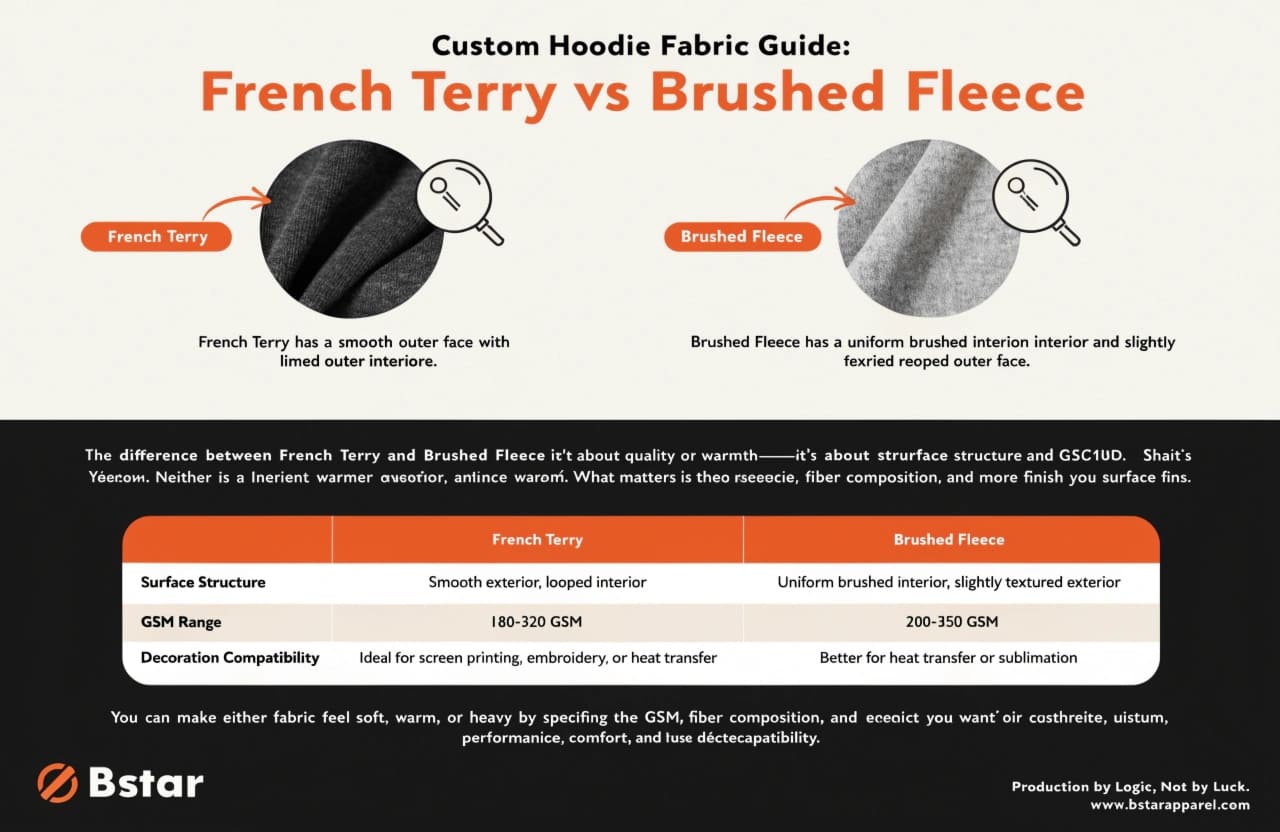
Illustration note: Both fabrics can have smooth outer faces. The GSM ranges and decoration suggestions in this graphic are illustrative, not fixed rules for either fabric.
Understanding those parameters changes how you write your spec sheet, what you ask for in a sample, and how you evaluate what comes back. Let me break each one down in a way that is useful before you send your next inquiry. You can also review our custom hoodie development options alongside your fabric brief.
What Is the Difference Between French Terry and Brushed Fleece?
You searched the term, got ten different answers, and now you’re more confused than before. That is a problem when an RFQ leaves the fabric open to interpretation: another round of clarification, sourcing or sampling may be needed.
Classic French Terry is a loopback knit with a smooth jersey face. Brushed sweatshirt fleece has a raised reverse, often produced by brushing the back yarns of a sweatshirt-knit construction. This article compares those hoodie fabrics, rather than treating every material sold as "fleece" as the same construction. A swatch showing both sides is more useful than the name alone.
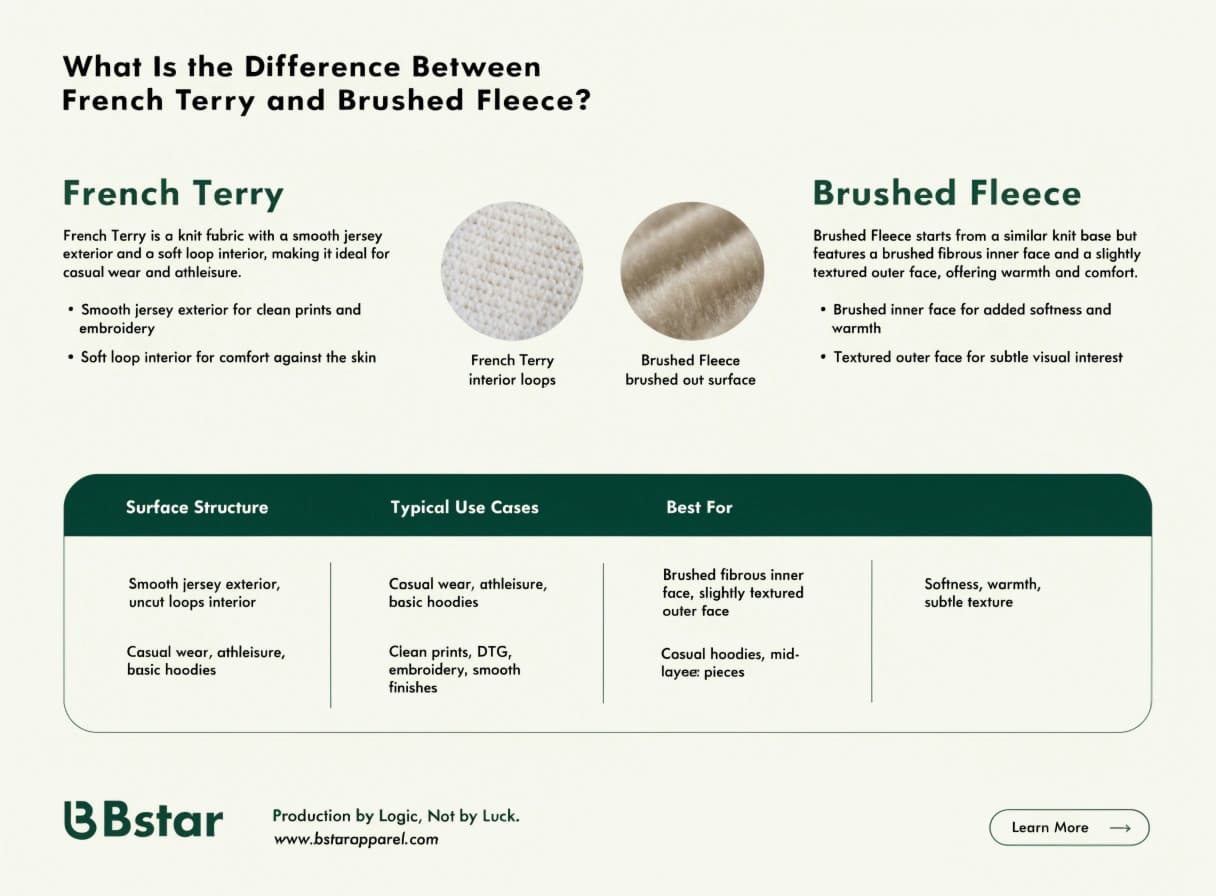
Illustration note: Focus on the loopback versus brushed reverse. A textured outer face is not a defining requirement of brushed sweatshirt fleece; decoration needs a trial on the selected fabric.
Those surface differences matter downstream — for decoration, how the inside feels and how the finished garment looks on your customer. Here is what buyers in our experience most often miss.
The Two-Face Problem With French Terry
French Terry has a distinct face and reverse. The smooth face can be used for screen print, DTG or heat transfer, but the result also depends on the fiber blend, dyes, finishes, decoration system and application settings.
The looped reverse normally faces the body. Exposed loops at a cuff, hem or panel can be an intentional design detail rather than a manufacturing error.
What buyers miss: a reversed, loop-side-out design is a possible option.2 We have seen inquiries leave the intended face unclear. If you want the classic smooth exterior, say so explicitly and identify the face on your reference swatch.
Why Brushed Fleece Naming Gets Messy
Here is a real issue we see in buyer inquiries regularly. The terms Brushed Fleece, Polar Fleece and Sherpa get used interchangeably in RFQs. They are not the same thing.
| Term | Surface Structure | Typical Use Case |
|---|---|---|
| Brushed sweatshirt fleece | Sweatshirt knit with a raised reverse; the outer face may be smooth | Casual hoodies, sweatshirts and mid-layers |
| Polar fleece | Usually a polyester-based pile knit, often raised on both sides; constructions vary | Fleece jackets, layers and some linings |
| Sherpa | A relatively deep, textured pile resembling shearling | Jacket linings, outerwear and trim |
If you write "fleece hoodie" and mean a 300gsm cotton-poly brushed sweatshirt, say exactly that. The word "fleece" alone can send the factory in different directions.
Which Fabric Suits Your Target Customer, Climate and Hoodie Style?
Buyers often come to us with one question: which fabric is better? They suit different end-use profiles. A well-made hoodie can still disappoint if its weight, warmth or feel does not match the intended customer.
French Terry is worth sampling for a loopback feel and layering styles. Brushed sweatshirt fleece is worth sampling when the customer wants a soft, raised interior. Raising can increase loft and insulating air, but the result depends on the actual construction. At equal GSM, neither fabric is lighter per unit area; compare thickness, drape, air permeability and finished-garment comfort as well.
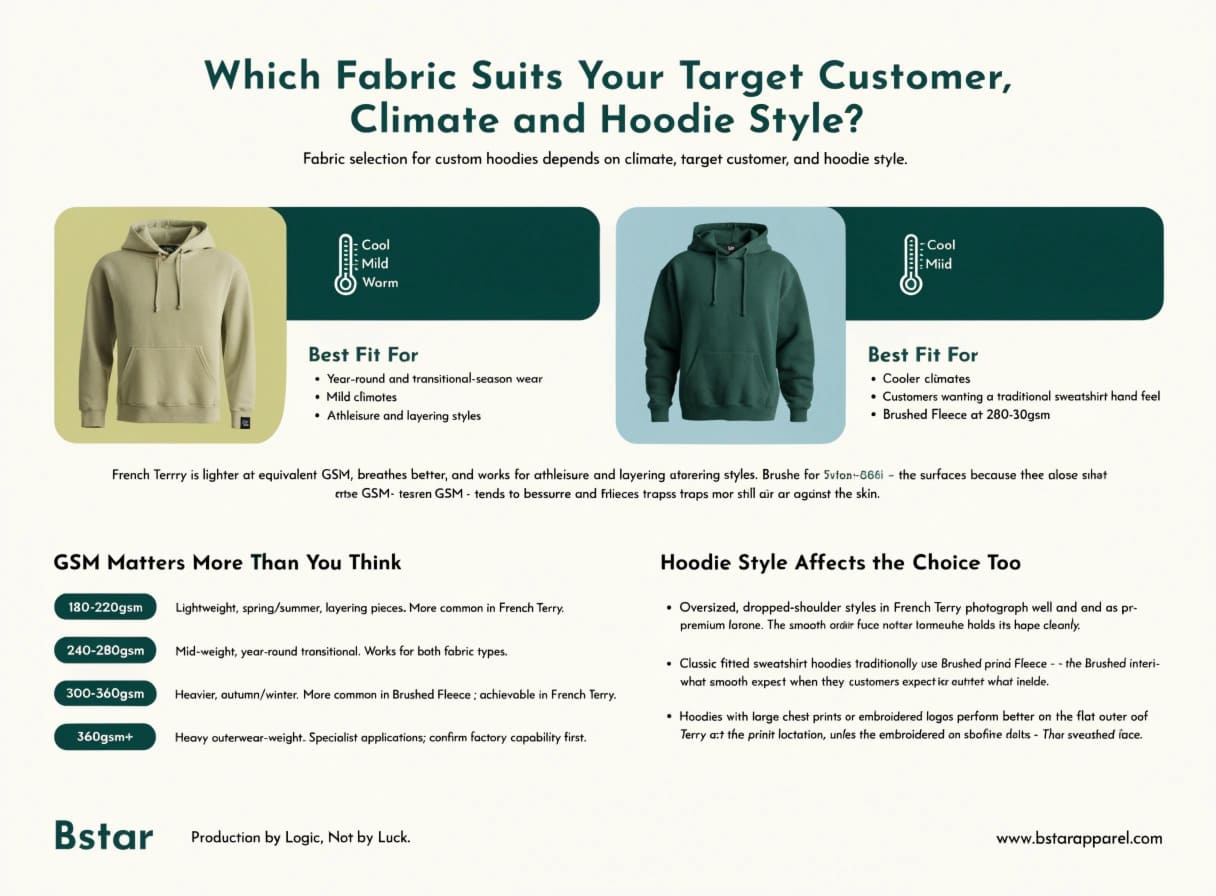
Illustration note: At the same GSM, the fabrics have the same mass per unit area. The graphic’s seasonal suggestions are starting points; they do not establish warmth or breathability.
The GSM comparison still matters. Let me show you why, without treating weight as a complete performance specification.
GSM Matters More Than You Think
In our sampling experience, one of the common buyer surprises is this: a 350gsm French Terry hoodie arrives feeling heavier and more substantial than a 280gsm Brushed Fleece — even though the buyer expected the opposite.
GSM means grams per square metre: a higher number means more fabric mass over the same area. Our guide to understanding fabric GSM explains that measurement. It does not tell you how much insulating air the fabric holds or how a finished hoodie will feel in use.
Research comparing three-thread fleece constructions also found differences in weight, shrinkage and pilling when the structural arrangement changed.3 That supports checking the construction alongside GSM; it does not establish a universal warmth ranking.
Directional guide for discussing swatches, not a performance guarantee or stock list:
- 180–220gsm: A lightweight starting point for layering concepts; check coverage and body on the finished sample.
- 240–280gsm: A middle-weight starting point; compare loopback and brushed options against the intended use.
- 300–360gsm: A heavier starting point where the customer wants more substance; both constructions can be considered.
- 360gsm+: A heavier development brief; confirm material availability, drape, sewing details and finished-garment weight.
Set a target weight and surface structure together, then assess swatches against the intended use. Neither value should stand alone.
Hoodie Style Affects the Choice Too
The cut and construction of the hoodie should influence which fabric you choose.
- Oversized, dropped-shoulder styles: Review body, drape and recovery. French Terry and brushed fleece can both work; neither name guarantees a structured or premium appearance.
- Classic sweatshirt hoodies: If a soft, brushed interior is part of the customer’s expectation, include it in the brief and compare the feel after washing.
- Hoodies with large chest prints or embroidered logos: Check the actual outer face, its stretch and finish. Both fabrics can have a smooth face; neither automatically produces a better decoration result.
How Should Buyers Specify GSM, Composition and Fabric Feel?
This is the section most buyers skip, and it is the one that causes rework. When a spec sheet arrives with only a fabric name and no further detail, we have to clarify the missing information. Sometimes the first interpretation matches buyer expectations. Sometimes it does not.
Before sampling, agree three core fabric details: a target GSM with a mutually accepted tolerance, fiber composition by percentage, and surface feel — including which side is brushed or looped. Add a swatch or reference where possible. If something is undecided, mark it as a question for development rather than leaving the factory to assume it.
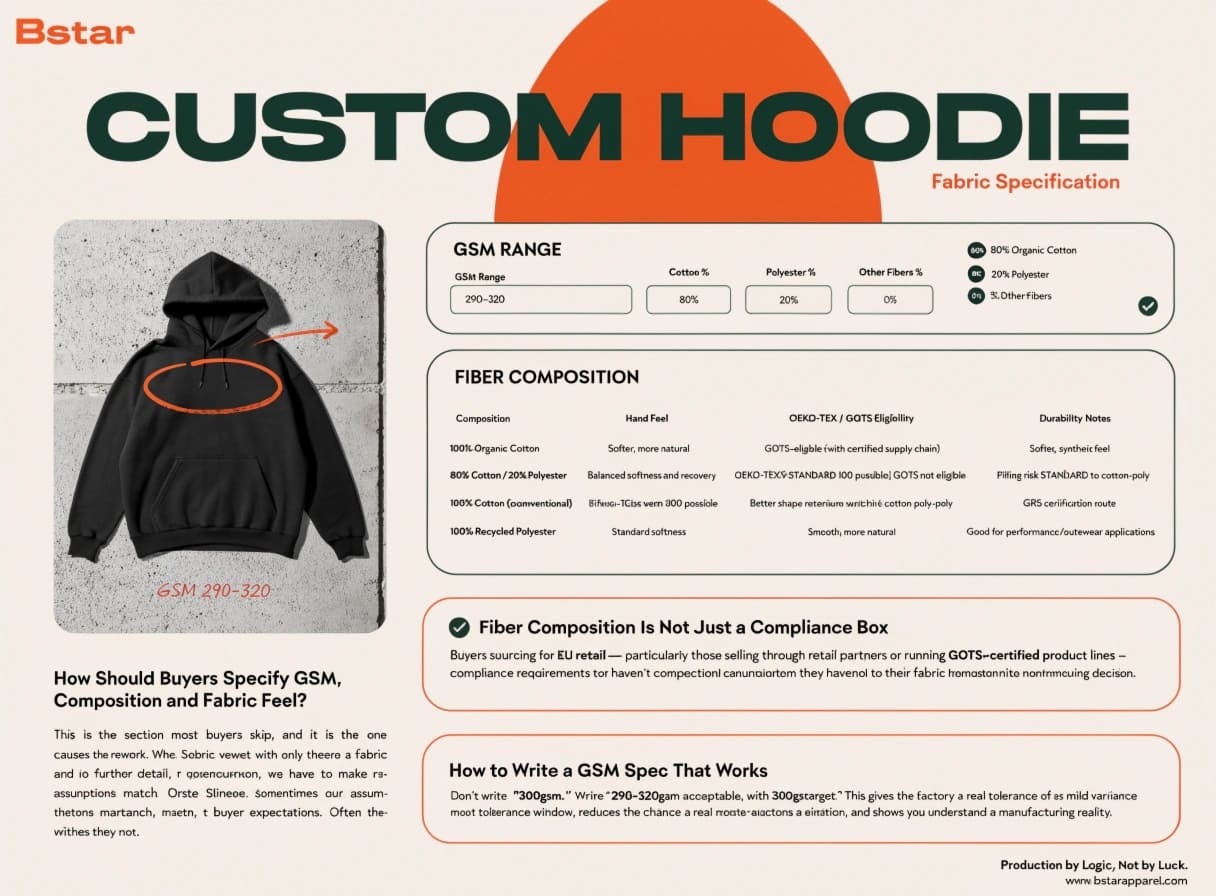
Illustration note: The certification classifications in this graphic are not an eligibility guide. Use the corrected table below: organic content, permitted additional fibers and certified processing all matter.
Fiber Composition Is Not Just a Compliance Box
Buyers sourcing for EU retail — particularly those selling through retail partners or developing a certified organic product line — often have documentation requirements they have not connected to their fabric decision.
The table below separates material choices from certification claims. OEKO-TEX® STANDARD 100 concerns testing for harmful substances in the certified article; it does not establish organic content or garment durability.4
| Composition | Hand Feel | Certification / Documentation Check | Durability Notes |
|---|---|---|---|
| 100% Organic Cotton | Depends on yarn, knit and finish; organic status alone does not determine softness | A possible GOTS route requires the appropriate certified processing chain and product scope | Check shrinkage, pilling and recovery on the selected fabric |
| 80% Cotton / 20% Polyester | Depends on the yarns, construction and finishing | STANDARD 100 may apply within a valid certificate scope. GOTS depends on certified organic content and the permitted type and share of additional fibers | Polyester content alone does not guarantee recovery or resistance to pilling |
| 100% Cotton (conventional) | Depends on yarn and finishing | STANDARD 100 may apply; conventional cotton does not become organic through testing | Compare dimensional stability and surface changes after the agreed care procedure |
| 100% Recycled Polyester | Can be smooth or raised, depending on construction and finishing | Request appropriate recycled-content documentation, such as GRS or RCS, where required5 | Recycled content alone does not establish moisture management or durability |
GOTS has different organic-content label grades, with requirements for other fibers and the processing chain. A cotton-poly blend is not automatically eligible, but blends are not categorically excluded either.6
For a BSTAR inquiry, tell us which documentation you need before fabric sourcing begins. Check the certificate holder, scope, validity and relevance to your order. A supplier’s material certificate does not automatically certify BSTAR or the finished hoodie.
How to Write a GSM Spec That Works
Don’t stop at "300gsm." For example, write "300gsm target; proposed acceptance range 290–310gsm, to be agreed before sampling." This is an example for discussion, not a universal tolerance. Confirm the measurement basis and whether the weight refers to the finished fabric before using it as an acceptance requirement.
If you have a reference garment — a competitor’s hoodie or a previous sample — send it with written notes on what to keep or change. A physical reference is most useful when the measurements, material expectations and approval comments are recorded alongside it.
What Should Buyers Check During Sampling and After Washing?
The sample arrived. It looks right on the hanger. But there are checkpoints buyers often overlook that can surface problems only after the product has been worn and washed.
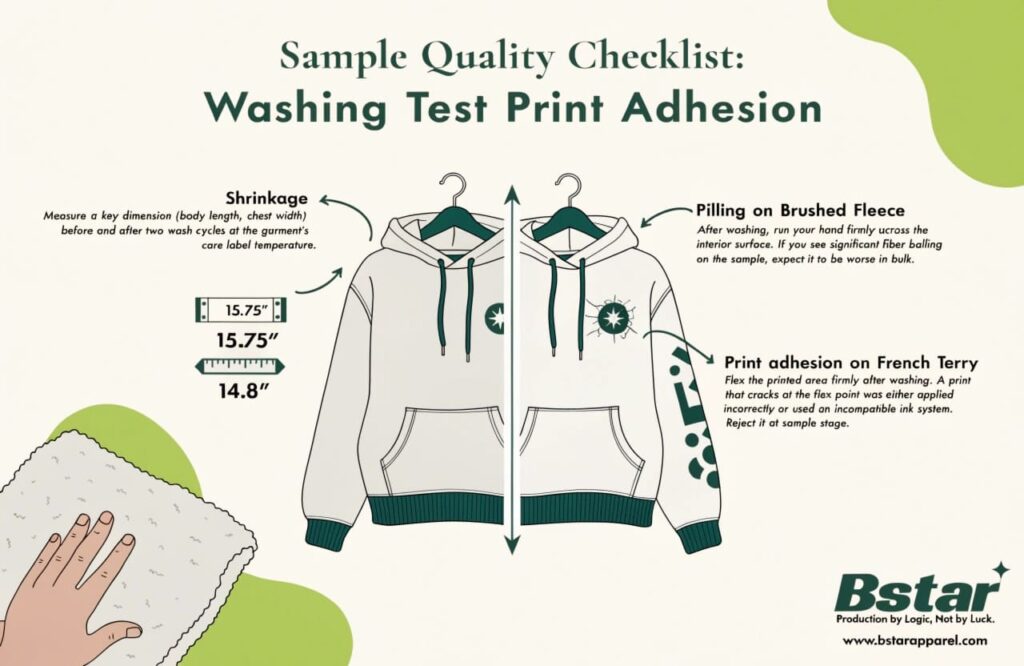
During sample development, review feel and fit on the intended wearer, dimensional change under an agreed care procedure, and decoration after washing. Agree the wash and dry conditions, cycle count, measurement points and acceptance criteria before sign-off. Two washes can be an initial screen if agreed; they are not a universal durability qualification. Our sampling and prototyping page explains how references and sample feedback feed into development; the requirements still need to be set for the hoodie project.
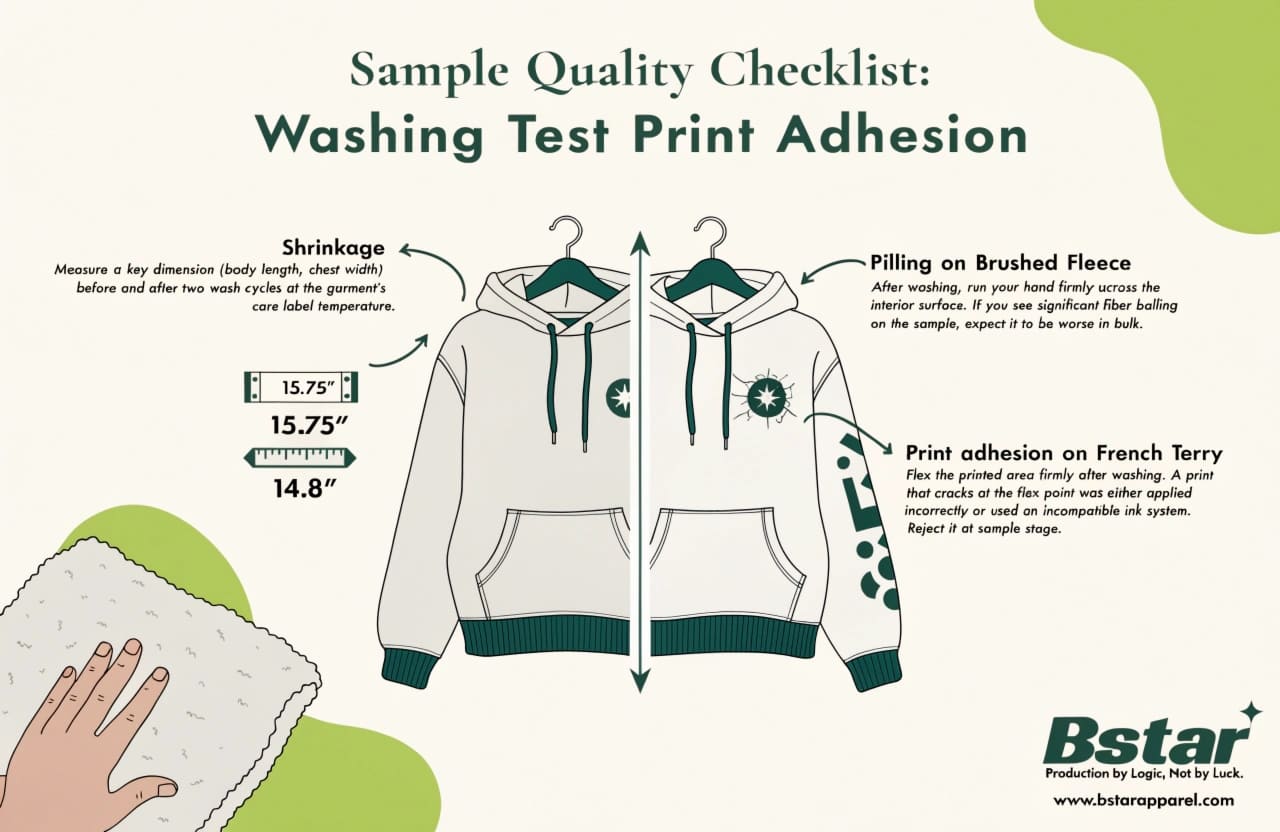
Illustration note: The wash count and measurements shown are examples. Agree the actual care procedure, measurement points, cycles and acceptance limits; this graphic does not set a pass/fail standard.
The Wash Test Is Not Optional
In our experience, buyers who skip wash checks can end up discussing pilling, shrinkage or print cracking only after bulk delivery. It is more useful to agree those checks while a sample can still be reviewed and changed.
What to wash-test:
- Dimensional change: Record body length, chest width and other agreed measurements before and after the specified wash and dry procedure. Set acceptable changes for the product; do not treat 3–5% as a universal allowance. AATCC TM150 describes garment dimensional-change testing under defined laundering conditions, rather than setting one acceptance limit for every hoodie.7
- Pilling and shedding: Inspect both sides, including friction areas. Washing and hand rubbing can flag concerns, but do not replace a specified pilling test. Agree the method, test conditions and rating required before judging acceptance.
- Print and embroidery integrity: Inspect cracking, lifting, puckering, stitch coverage and color changes after the agreed care procedure. If a decoration fails the agreed requirement, investigate the fabric, decoration system and process before approval; one visual defect does not identify a single cause.
- Color change: Compare a retained unwashed reference with the washed sample under consistent lighting. Agree the expected colorfastness assessment and limit instead of assuming that a visible change is always acceptable or always a failure.
Hand Feel Evaluation on a Hanger vs. Against Skin
This sounds obvious but it is missed. French Terry can feel comfortable in the hand yet feel stiff at the collar or cuff if the finish, construction or weight does not suit the garment. The same applies to a brushed fabric that feels soft initially but changes after care. Include an appropriate fit and wear review before sign-off, alongside the measurement and wash checks.
What Information Should Brands Send to Their Hoodie Manufacturer?
A complete, well-structured inquiry saves both sides time. Incomplete inquiries generate back-and-forth that delays your timeline and increases the chance of miscommunication.
A useful hoodie inquiry includes the fabric and surface preference, target GSM, composition, reference, decoration, intended market and planned quantities. State documentation requirements early and mark any unknowns. You do not need every answer before contacting the factory; you do need to distinguish confirmed details from decisions that still need help.
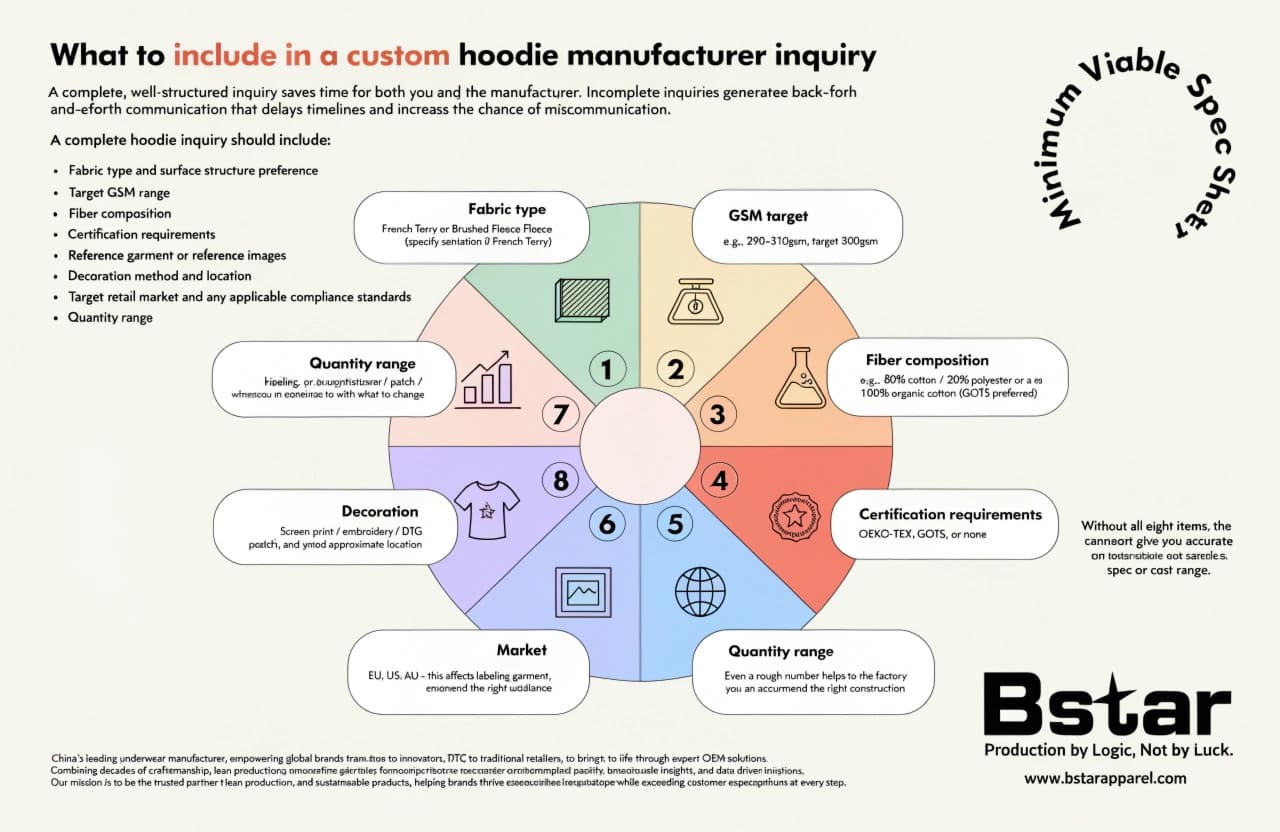
Illustration note: This is an inquiry outline, not proof of certification or production approval. Send planned quantities by style, color and size, and identify any undecided details.
The Minimum Viable Spec Sheet
You don’t need a 20-page technical document. You need this:
- Fabric type: French Terry or brushed sweatshirt fleece; identify the intended outer face and inside feel.
- GSM target: For example, "300gsm target; 290–310gsm proposed range, subject to agreement."
- Fiber composition: For example, "80% cotton / 20% polyester," with organic or recycled requirements stated separately.
- Documentation requirements: Name the scheme and the scope you need — material, finished product or supply-chain documentation — or ask for help deciding.
- Decoration: Screen print, embroidery, patch or DTG; include the artwork, approximate size and location where available.
- Reference: Photos, a competitor garment or a previous sample, with fit, size-range and measurement notes on what to keep or change.
- Market: EU, US, AU or another destination, plus intended wearer and sales channel, so applicable requirements can be reviewed.
- Planned quantities: An estimate by style, color and size. The manufacturer then confirms the relevant garment, fabric and decoration minimums.
Sending those details in your first message gives the factory a clearer basis for questions, material suggestions and a quotation. An initial email with references and clearly marked unknowns is enough to start the discussion.
Frequently Asked Questions
Is French Terry warmer than Brushed Fleece?
There is no universal ranking. A raised reverse can provide more loft, while a higher GSM means more mass per unit area. Thickness, construction, fiber blend, air movement and garment fit also affect comfort. A 350gsm French Terry can feel heavier than a 240gsm fleece without necessarily being warmer. Compare actual swatches and finished samples for the intended conditions.
Can I use GOTS-certified fabric for a cotton-polyester blend hoodie?
Potentially, if the product meets the relevant organic-content grade, permitted additional-fiber rules and certified-chain requirements. GOTS does not require every product to be 100% organic cotton: its label grades start at 70% or 95% certified organic fibers. An ordinary cotton/polyester blend is not automatically eligible. Ask the certifier to confirm the exact composition, polyester type, applicable standard version and intended finished-product claim.6
Why did my Brushed Fleece sample pill after the first wash?
Pilling has several possible contributors: fiber characteristics, blend, yarn, knit construction and finishing. The ASTM Martindale pilling method notes this complexity; a first-wash observation alone cannot identify the cause.8 Flag the issue before bulk approval and ask the supplier to review the fabric and agreed test result. Our fabric pilling test guide uses underwear examples, but its explanation of agreeing a method and rating is also useful when planning a hoodie-fabric assessment.
What is the minimum order quantity for custom hoodies in French Terry or Brushed Fleece?
MOQ varies with the garment, fabric availability, custom color and decoration. Ask for the minimum for your specific composition, GSM, construction and quantity breakdown. Our MOQ and order-planning guide explains the material and customization factors to discuss; the actual hoodie terms need a project-specific quotation.
Does the fabric type affect embroidery quality?
The actual surface and stability matter more than the fabric name. French Terry and brushed sweatshirt fleece can both have a smooth outer face, and both may need backing chosen for the fabric and stitch design.9 If embroidery is placed on an exposed pile or raised surface, an appropriate topping can help keep stitches visible; topping and backing serve different purposes.10 Include the artwork and location in the initial inquiry and approve a decorated sample before bulk production.
Conclusion
French Terry vs Brushed Fleece is a specification decision. Treating the fabric name as a complete spec leaves important choices unresolved. Define the three core fabric parameters — GSM, fiber composition and surface structure — then confirm decoration compatibility and the checks needed for the finished hoodie.
Buyers who define those details give the sampling discussion a clearer starting point. If you’re preparing your first hoodie inquiry or rewriting a spec sheet after a bad sample round, use the reference, agreed requirements and sample feedback together.
If you’d like to discuss fabric specs for your next custom hoodie project, send BSTAR your references and current brief. Tell us your intended wearer, market, quantities and undecided details so the next steps can be reviewed.
-
Nooteboom Textiles, French Terry fabric guide. Describes the looped reverse, smooth face and the raised finish of brushed variants; supplier terminology and actual qualities vary. ↩
-
Nooteboom Textiles, French Terry fabric guide: which side faces out. Notes that the loop side may be used externally as a design choice. It does not establish how often factories misinterpret RFQs. ↩
-
Kaikobad et al., Evaluation of physical and mechanical characteristics of three-thread fleece knit fabric for their structural changes, Heliyon (2023). The study compares structural effects on properties including fabric weight, dimensional change and pilling; it does not test thermal resistance. ↩
-
OEKO-TEX®, STANDARD 100. Certification concerns harmful-substance testing of the article within its scope, not proof of organic origin or performance. ↩
-
Textile Exchange, Standards FAQs, recycled standards section. GRS and RCS address recycled-content verification and chain of custody; certification and permitted product claims require the relevant scope and documentation. ↩
-
Global Standards, GOTS key features and GOTS Version 7.0 release information. Organic-content grades, additional-fiber restrictions and certified processing all apply. Confirm the standard version and intended claim with an approved certifier. ↩ ↩
-
AATCC, TM150: Dimensional Changes of Garments after Home Laundering. The official summary describes defined laundering options and measurement of garment dimensional change; product acceptance limits require separate agreement. ↩
-
ASTM International, D4970/D4970M: Pilling Resistance and Other Related Surface Changes of Textile Fabrics — Martindale Tester, significance and use. Pilling is affected by fiber, yarn, construction and finishing; the applicable method and acceptance rating must be specified for the product. ↩
-
Madeira, Embroidery backings. Backing selection depends on fabric stability, stretch and the embroidery design. ↩
-
Madeira, Embroidery toppings and speciality materials. Toppings can prevent stitches sinking into nap or pile; they do not replace the backing’s stabilizing function. ↩
Discussion & questions 0 comments