
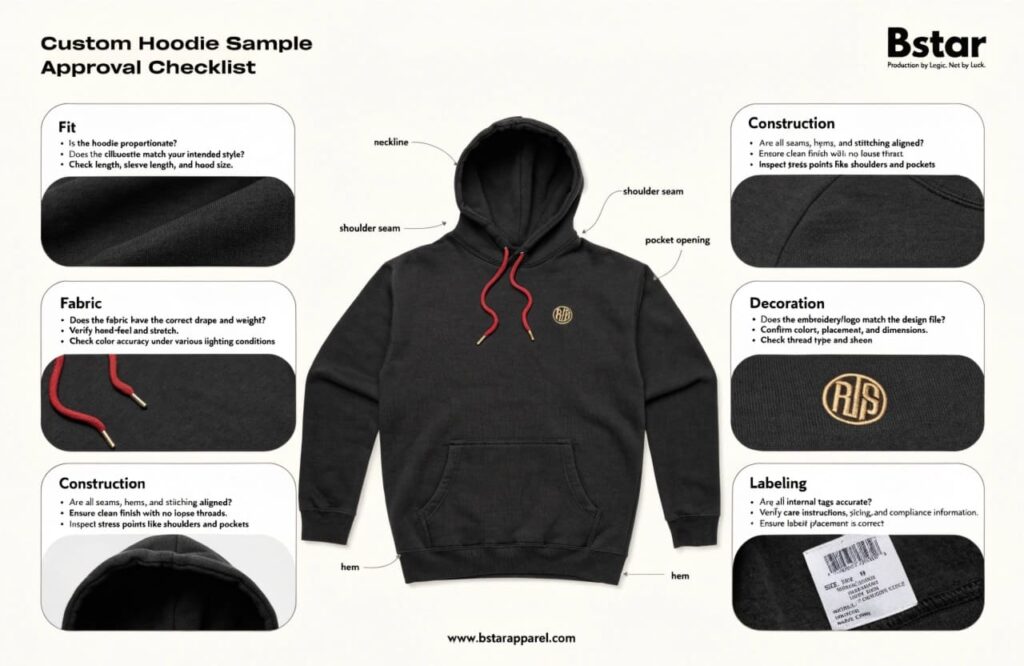
Custom Hoodie Sample Approval Checklist Before Bulk Production
Approving a custom hoodie sample is one of the most important decisions in your production timeline — and also one of the most misunderstood. Many brands treat sample approval as a visual check. They hold up the hoodie, think "this looks great," and move straight to bulk. That instinct can be expensive.
A custom hoodie sample approval checklist gives your brand a structured way to evaluate fit, fabric, construction, decoration, and labeling before committing to bulk production. Review the sample against agreed specifications, check it on the intended wearer, review wash results, and record what is approved and what remains open. The approved sample is a physical reference alongside the written specifications and order terms; it does not automatically become a complete legal or quality standard on its own.
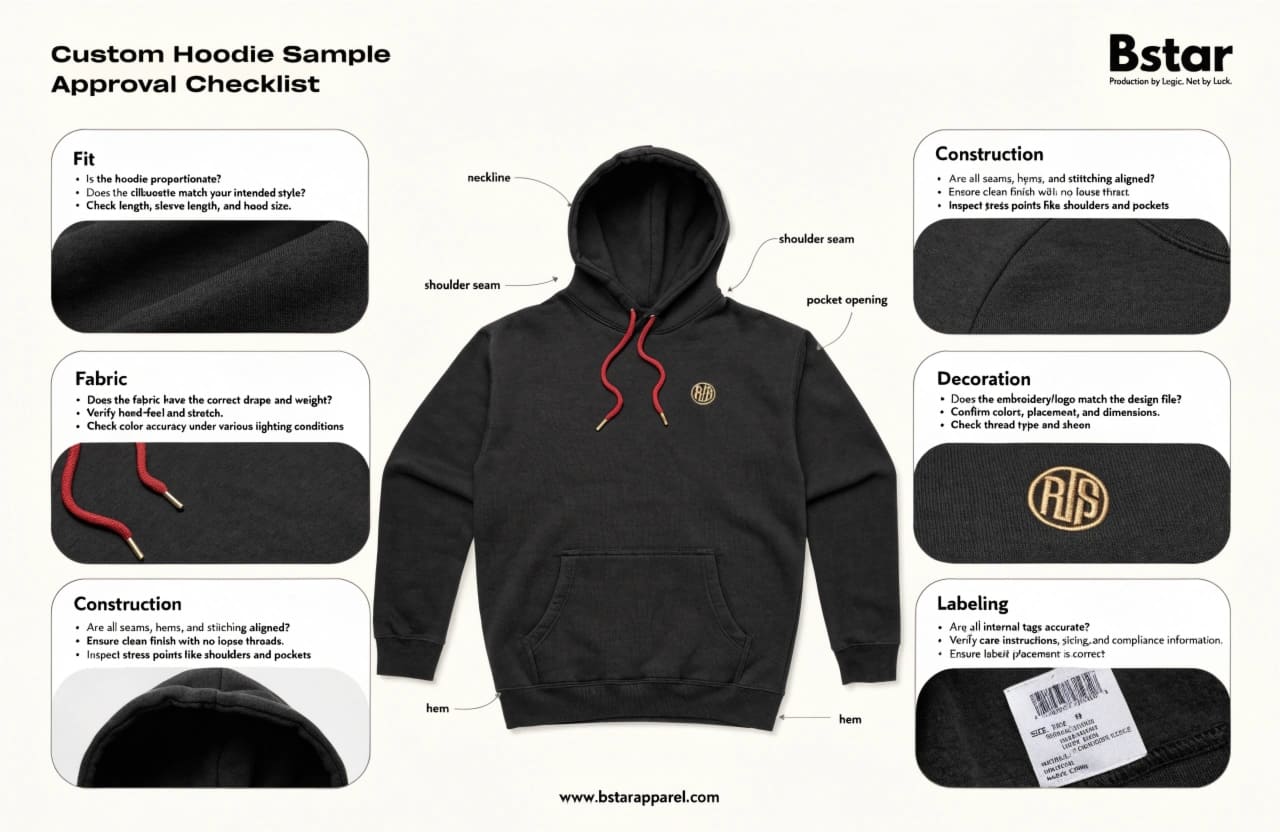
Illustration note: This is a checklist illustration, not a report of a specific BSTAR order or test. The pictured design and details are examples, not requirements for every hoodie.
Knowing what to approve is only part of the picture. Knowing how to record your approval — and what to do when something isn’t right — is what gives both sides a useful reference once bulk production starts. For custom pullover and zip-up hoodie development, let’s work through each stage.
Which Hoodie Specifications Should Be Confirmed Before Reviewing the Sample?
Most approval problems start before the sample even arrives. Brands send over a mood board and a logo file, receive a sample, and then realize mid-review that nobody confirmed the fabric weight, rib composition, or drawcord material upfront.
Before reviewing a custom hoodie sample, confirm its purpose, version, base size, and the specifications it is meant to represent. These include fabric composition and GSM, cuff and hem rib, any drawcord or zipper, intended fit, and a size chart with measuring methods and tolerances. If the sample uses substitute materials or unfinished details, identify them before deciding what can be approved.
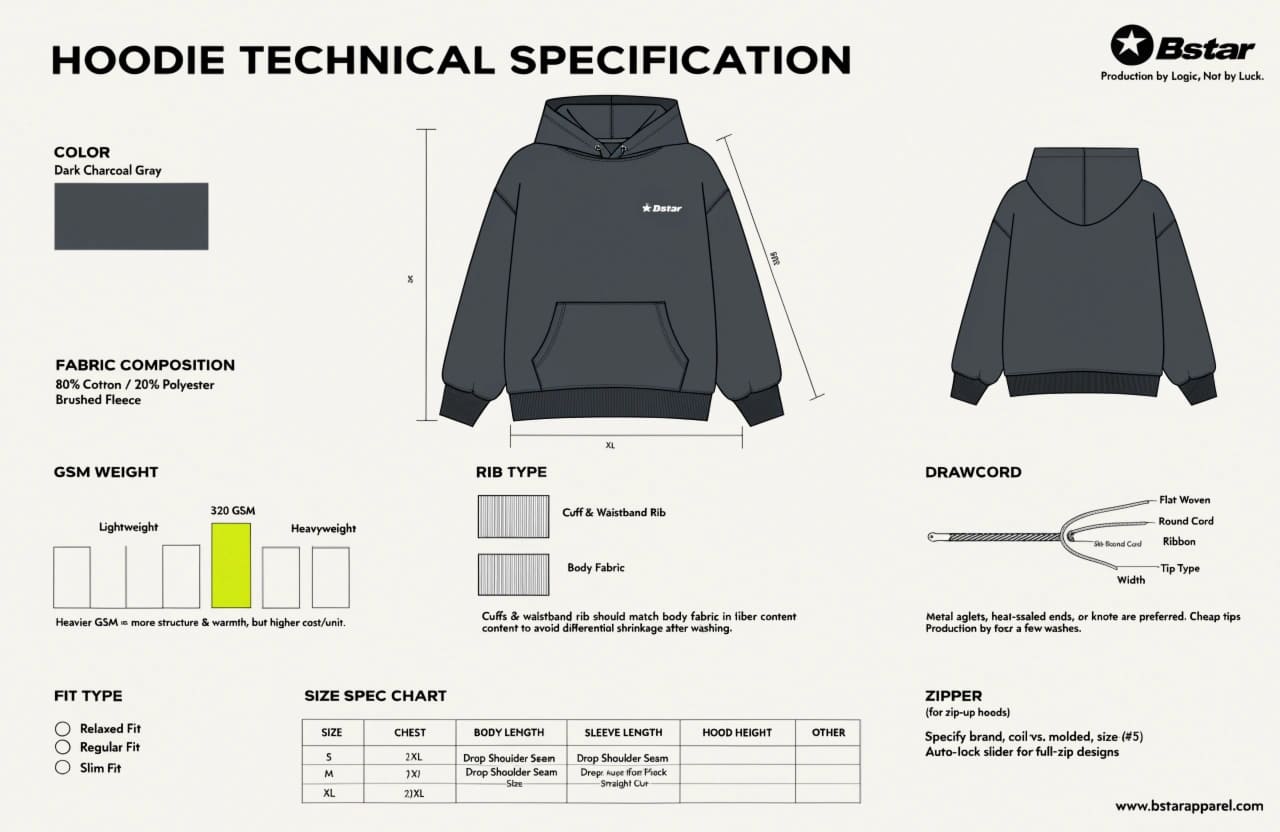
Illustration note: The specifications shown are examples. Rib does not have to match the body fiber ratio; GSM alone does not establish warmth or cost. The small chart and drawcord details are not production instructions or a children’s safety specification.
Think of pre-confirmed specs as your baseline. Without them, you have nothing reliable to compare the sample against. You are just guessing whether what arrived is what you asked for.
You do not need to arrive with a complete technical pack. If you only have reference pictures and an idea, start there. At BSTAR, the practical sequence is email discussion, sales staff organizing the agreed information for sampling, then buyer feedback and revisions. Our sampling and prototyping overview explains that discussion; the actual specifications and review points still need to be confirmed for your hoodie.
What to Confirm in Advance
Here is what I recommend clarifying before the sample ships:
- Fabric composition and GSM — e.g., 80% cotton / 20% polyester, 320 GSM. These are example specifications, not a stock offer. GSM describes mass per unit area; structure, finish, and garment design also affect warmth, feel, and cost.
- Rib composition — Confirm the cuff and hem rib’s composition, dimensions, stretch, recovery, and wash compatibility with the body. The fiber ratio may differ intentionally; matching it does not by itself prevent differential shrinkage.
- Fleece type — Confirm the actual reverse surface and finish. French terry commonly has a visible loopback; brushed fleece has a raised reverse. Use a physical reference rather than treating every supplier’s fabric name as identical. Our French terry vs brushed fleece guide covers the fabric-selection questions separately.
- Drawcord, if specified — Confirm material, width, length, ends, and attachment. Do not copy an adult hood cord or metal tip into a children’s style without checking the applicable requirements. For example, U.S. CPSC guidance identifies hood and neck drawstrings in children’s upper outerwear sizes 2T–12 or equivalent as a substantial product hazard.1
- Zipper, if specified — Confirm supplier or brand, coil vs. molded construction, size, length, finish, and slider function. Include auto-lock performance where an auto-lock slider is specified.
- Fit type — Relaxed, regular, slim, or a defined oversized silhouette. Connect this to the intended wearer, body measurements, layering, and garment measurements rather than just "medium."
- Size spec chart — List finished garment measurements, including chest, body length, sleeve length, hood dimensions, and relevant rib or pocket details. State the base size, measuring method, and tolerance for each point.
If something is missing, ask for clarification. An early development sample can still be useful for discussing shape, but approval of that shape does not also approve an unconfirmed fabric, label, or bulk specification.
How Should Brands Check Hoodie Fit, Measurements and Hood Shape?
Fit is a costly place to discover a problem late. A hoodie that photographs well can still fit badly on a real body — and by the time customer returns confirm this, you may already have shipped the bulk order.
To check hoodie fit and measurements, measure the sample flat against the agreed chart at every listed point. Then have a fit model or person in your target size try it on. Evaluate shoulder position for the intended silhouette, sleeve and body length, movement, armhole comfort, and hood drape on and off the head. Compare deviations with the agreed point-specific tolerances rather than applying one universal 1 cm limit.
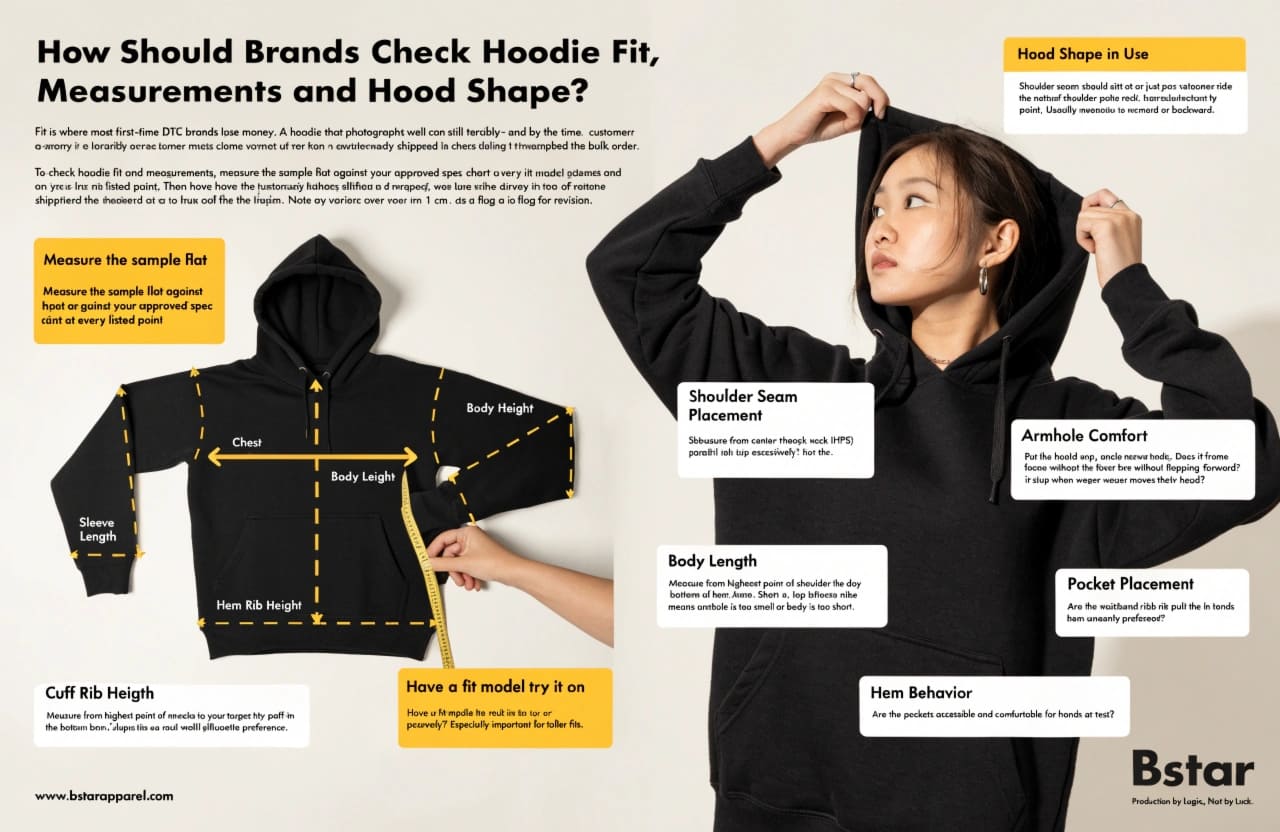
Illustration note: Use the written measurement method and agreed tolerances, not the graphic’s universal 1 cm trigger. Shoulder position depends on the intended fit, including dropped shoulders; diagram arrows are illustrative.
Measuring the Sample Flat
Flat measurements are your first check. Use a tape measure without stretching the garment and follow the same method each time. Measuring the chest 1 inch below the armhole is one possible agreed point, not a rule for every design. Inconsistent measuring is a common source of disagreement between brands and suppliers. Agree on the method upfront, and document it.
Key measurement points for a hoodie include:
| Measurement Point | What to Watch For |
|---|---|
| Chest width at the agreed point, e.g., 1" below armhole | State whether this is flat half-chest or full circumference; compare with the target and tolerance |
| Body length, e.g., HPS to hem | Define the high point shoulder and whether the measurement includes the hem rib |
| Sleeve length | Use the chart’s method: center-back neck to cuff and shoulder-seam to cuff are different measurements |
| Shoulder width | Check the intended regular or dropped-shoulder silhouette rather than forcing one shoulder position |
| Hood height and depth at defined points | Compare with the chart, then assess coverage, face opening, balance, and movement on the wearer |
| Cuff rib height | Check the specified finished height and consistency between sleeves |
| Hem rib height | Check finished height and its contribution to overall body length |
Try-On Evaluation
Flat measurements tell you what was produced. A try-on tells you how it actually behaves.
When someone puts the hoodie on, check:
- Shoulder seam position — Does it suit the intended silhouette without unwanted twisting or imbalance?
- Armhole comfort — Raise both arms and reach forward. Record restriction or excessive body lift. Armhole shape, sleeve angle, chest ease, fabric behavior, and body length can all contribute; diagnose before choosing a pattern change.
- Hood shape in use — Put the hood up. Does it frame the face as intended without obstructing vision or pulling uncomfortably at the neck? Check movement as well as appearance.
- Pocket placement — Are the pockets accessible and comfortable for hands at rest?
- Hem behavior — Does the waistband rib pull in the hem unevenly?
I have seen samples that measured perfectly on paper but felt restrictive in the armhole the moment someone raised their arms. That kind of feedback only comes from a real try-on.
What Should Buyers Inspect on Zippers, Pockets, Cuffs and Hem?
Hardware and construction details are easy to overlook when you are focused on the bigger picture. But these are exactly the items that can generate customer complaints after bulk delivery.
Test the specified zipper function, check pocket placement and usable depth, evaluate cuff and hem stretch and recovery without overstretching them, and examine stitching for consistency, tension, and seam alignment. Review these details before and after the agreed wash checks. A quick hand inspection can reveal problems, but it does not establish long-term durability.
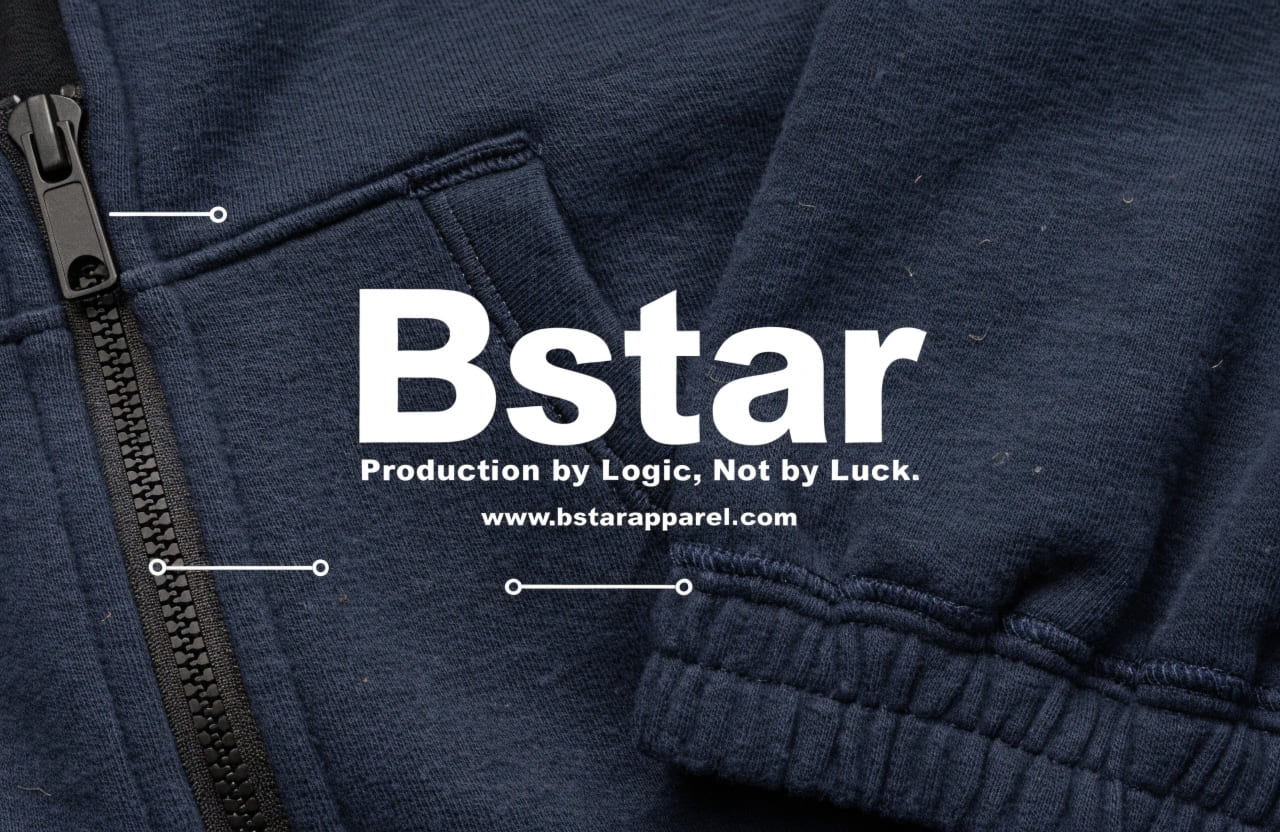
Illustration note: This close-up shows detail areas to inspect. Appearance alone does not verify zipper durability, seam strength, or rib recovery.
Zippers
For a zip style, open and close the zipper repeatedly. Ten cycles can be a simple initial screen, but that number is not a durability test standard or a substitute for an agreed test. Check:
- Does it glide without snagging the fabric near the stops or facing?
- If an auto-lock slider is specified, does it hold as intended when released?
- Is the zipper tape color matched to the approved reference?
- Are the stops and, for a separating zipper, the pin and box secure and functional?
We work with established zipper manufacturers because consistent sourcing matters. The brand name alone is not enough: the selected zipper and its installation still need to suit the garment and be checked in the sample.
Pockets
- Measure pocket placement from agreed reference points on both sides. Use the specified symmetry tolerance rather than a universal 3–5 mm allowance.
- Reach inside each pocket. Check usable depth and opening against the intended wearer and design; 15 cm is not a minimum for every adult or children’s style.
- Apply a reasonable handling load at the opening and inspect the stitching. A formal strength requirement needs its own agreed method and limit.
- If there is a separate pocket bag, check its hand feel, seam finish, and compatibility with the body fabric. Not every kangaroo pocket has a separate bag.
Cuffs and Hem
- Extend and release the cuffs to an agreed, realistic amount. Compare recovery rather than pulling the rib to its limit.
- Check both cuffs for consistent dimensions, feel, stretch, and recovery, including after washing.
- Check the hem rib for even seam joining — the point where the rib meets itself should suit the approved construction without unwanted bulk or twisting.
Stitching
- Look at the main body seams. Stitching should suit the construction, with consistent stitch formation and no unintended puckering or skipped stitches.
- Check the specified reinforcement at pocket corners, drawcord exits, and zipper attachments. Bartacks are one option, not a universal requirement or a guarantee against tearing.
- Turn the hoodie inside out. Inspect seam allowances, overlock coverage, loose threads, and edges that should be secured.
How Should Wash Results, Decoration and Labels Be Reviewed?
A hoodie sample that arrives looking great may tell a different story after washing. Decoration and labeling are also areas where small deviations from brand standards can affect how the finished product reads to customers.
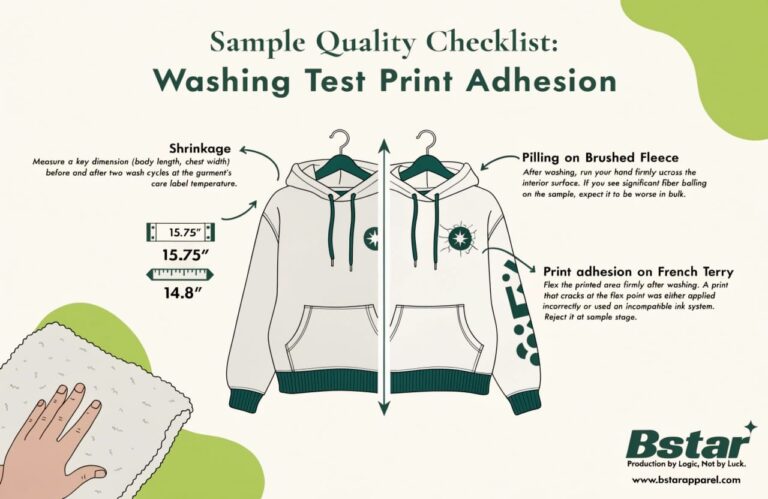
Before final approval, review wash results using an agreed wash and drying procedure, cycle count, measuring method, and acceptance criteria. Check dimensional change, fabric appearance, rib behavior, and decoration. Confirm that label content and placement match the finished garment and destination-market requirements. One or two washes alone are not a universal release rule.
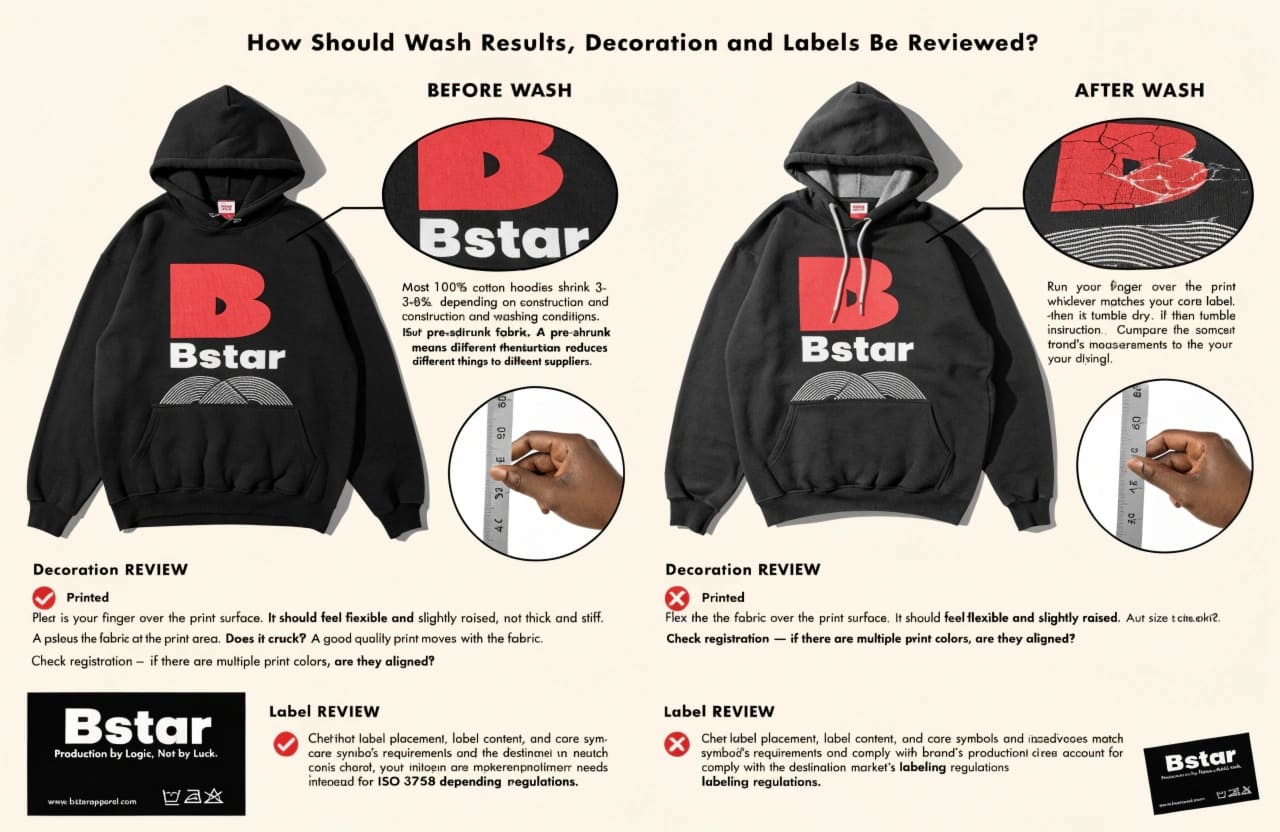
Illustration note: The graphic’s 3–8% shrinkage range is not a universal result or acceptance limit. Wash settings and cycle counts must be agreed; an example dimensional change does not automatically justify changing size grading. Label instructions must account for the whole garment.
Wash Testing the Sample
Wash review matters for cotton and cotton-blend fleece as well as other constructions. Shrinkage varies with fabric construction, finishing, rib, garment assembly, and care conditions. "Pre-shrunk" is not a promise of zero further dimensional change.
Use the intended care procedure — for example, 30°C or 40°C only where that is the proposed instruction — and the specified drying method. Record the actual settings and number of cycles. Re-measure after the garment has dried and rested or been conditioned as required by the agreed method. Compare before-and-after measurements at the same points. AATCC TM150 provides a method for garment dimensional change after home laundering; the buyer and supplier still need to agree the applicable programme and acceptance limits.2
If the chest width changes by 2 cm, record the original measurement and calculate the change against it. Investigate the material, finish, rib compatibility, pattern allowance, and measurement consistency before deciding on a correction. Do not automatically add 2 cm to every size or treat shrinkage allowance as the same thing as grading.
Also check:
- Does the fabric surface pill, bobble, or feel rougher?
- Does the color shift or transfer onto other areas?
- Does the rib recover its shape after drying?
A home wash check is useful development feedback. Do not describe it as a standardized laboratory test unless the required procedure was actually followed.
Decoration Review
For screen print:
- Compare the hand feel and appearance with the approved decoration reference. A flexible raised print may be intended, but not every screen-print process should feel the same.
- Flex the fabric to a realistic extent at the print area and inspect it after the agreed wash checks for cracking, lifting, fading, or distortion.
- Check registration — if there are multiple print colors, are they aligned? Check the whole graphic’s position separately.
For embroidery:
- Check coverage and puckering against the approved design. Density, backing, fabric, digitizing, and machine settings all affect the result.
- Examine the back for secure stitching, suitable backing, unwanted loose threads, and rough contact areas.
- Check thread colors against the approved physical thread or color reference under agreed lighting. A photo or Pantone number alone may not resolve a cross-material shade difference.
For heat transfers and bonded badges:
- Inspect adhesion, edges, appearance, and fabric distortion after application and washing.
- Use our heat-transfer label testing guide for the review questions. Its examples use underwear; application settings and acceptance criteria must be confirmed on the actual hoodie fabric and transfer.
For sewn woven labels or badges, inspect stitch security, position, edges, and comfort instead. A sewn label does not need to pass a bonded-edge check unless it also uses adhesive.
Label Review
Labels are a compliance and brand issue. Check:
- Care instructions and any symbols are appropriate for the whole garment, including decoration and trims, and accepted in the destination market. For U.S. sales, the FTC requires a reasonable basis for the instructions; fiber content alone is not enough.3
- Country of origin is accurate.
- Fiber descriptions and percentages match the relevant materials and applicable labeling rules.
- Size label matches the garment and the agreed size system.
- Brand label placement matches your spec, such as center back neck or side seam.
For most textile apparel sold in the U.S., FTC requirements also cover fiber content, country of origin, and the identity of the manufacturer or another responsible business.4 Confirm the actual product and market requirements; this sample checklist is not a complete legal-compliance review, especially for children’s products.
How Should Sample Revisions and Final Approval Be Recorded?
This is where many brands make a costly mistake. They approve the sample verbally or with a quick email saying "looks good" — and then discover that the factory understood the approval differently.
Record approval in writing with the style, sample version, size, color, approved specifications, required revisions, and supporting photos. State whether you are approving fit only, another limited element, or release for bulk production. An email can do this; it does not require a complicated new system. Identify every open item and how it will be verified before the affected production proceeds.
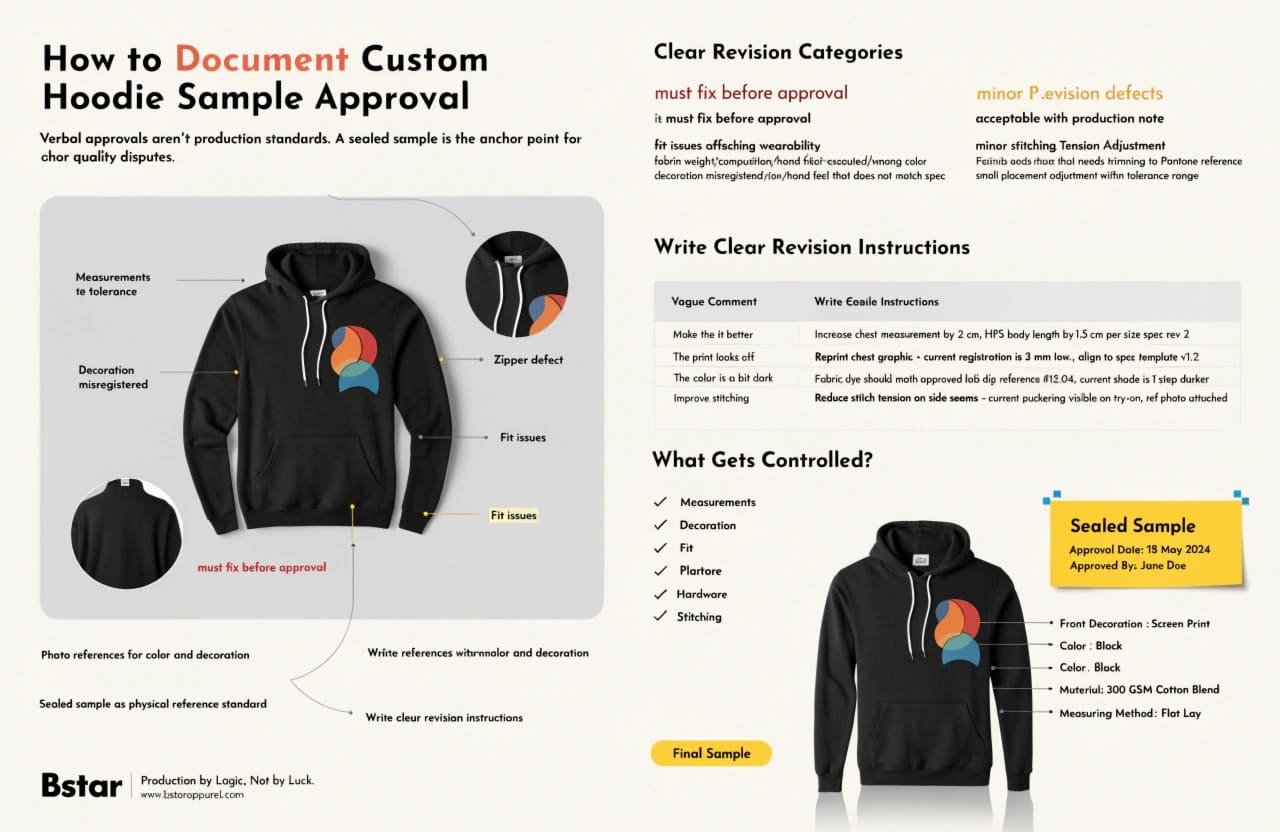
Illustration note: The sample tags, dates, and revision values are examples, not a real approval record. Thread tension, color, and placement changes are not automatically acceptable without verification; the graphic’s "1 step darker" is not a defined shade standard.
Separating Revision Types
Not every issue requires a new sample. Some items may be verified with revised artwork, a measurement record, a close-up, or another agreed check. The key is being explicit about the issue, the verification needed, and who can release the affected work.
Resolve and verify before approving the affected requirement:
- Measurements outside tolerance.
- Fit issues affecting wearability.
- Decoration that is misregistered, poorly executed, or the wrong color.
- Fabric weight, composition, or hand feel that does not match the agreed spec.
- Zipper, hardware, safety, or required-label defects.
Items that may be handled with a written production note and agreed verification:
- A clearly defined thread or finishing change that does not alter fit, seam performance, or safety.
- A decoration placement adjustment with a revised drawing and a confirmed first-piece check before continuing the affected operation.
- An administrative label-layout correction, provided mandatory content and the final artwork are verified before application.
Do not use "approved with comments" as a blanket release. If a change could affect fit, wash behavior, strength, safety, or legal labeling, agree whether a revised sample or additional testing is needed.
Writing Clear Revision Comments
Replace vague comments with specific instructions. These are illustrative examples, not measurements or results from a BSTAR order:
| Vague Comment | Clear Revision Instruction |
|---|---|
| "Make the fit better" | "For the base-size sample, increase finished flat half-chest by 2 cm and HPS body length by 1.5 cm against size spec rev 2; confirm revised values and other sizes separately." |
| "The print looks off" | "Move the whole chest graphic up 3 mm to match placement template v1.2. Check alignment between print colors separately." |
| "The color is a bit dark" | "Compare the submitted shade with approved physical lab dip #LB-04 under the agreed lighting and resubmit for shade approval; see the marked comparison photo." |
| "Improve stitching" | "Remove the unwanted side-seam puckering shown in the attached try-on photo. Investigate the cause, confirm the correction, and provide a revised sample or agreed evidence." |
Sealing the Approved Sample
Once the required revisions are verified and the sample is accepted, identify the retained physical reference with the approval date, approver, style, size, colorway, and sample version. Keep it linked to the final email and specification revision. Where practical, the buyer and factory should retain matching references. If a substituted detail remains on the physical sample, tag it clearly and state the approved bulk requirement separately.
At BSTAR, this can follow the existing email-and-sample workflow: the buyer confirms the accepted sample and any final conditions, sales staff pass the consolidated information to production, and bulk production follows the approved reference after the order is confirmed. The checklist makes that handover clearer; it does not mean every order needs a new approval platform.
I will be honest — no sealed sample guarantees that every bulk unit will be identical. Natural fiber variation, dye lot shifts, and machine adjustments can introduce variation. That is why both sides need agreed tolerances, inspection criteria, and a clear record of changes after approval, alongside the physical reference.
Frequently Asked Questions
How many samples should a brand request before bulk production?
There is no fixed number of rounds. An early sample may establish design and fit direction; a later sample may verify the final material, construction, or decoration. If the first sample already represents the agreed requirements, avoid ordering another just to satisfy a round count. If important changes remain, verify them before approving the affected production.
What tolerance is acceptable for hoodie measurements?
Agree tolerances for each measurement point, size range, and material, using a shared measuring method. Chest width, body length, pocket placement, and rib height do not necessarily need the same allowance. Do not treat ±1 cm, or another number from a generic checklist, as an automatic industry pass limit.
Can the approved sample be used as the bulk quality inspection standard?
Yes — it can be a physical reference for style, color, construction, and decoration alongside the written measurement chart and inspection requirements. QIMA describes comparing garment style and colors with an approved sample as part of garment inspection.5 Keep the sample identifiable and accessible, and ensure the inspector has the correct written specification version. The reference does not replace an agreed inspection plan or establish legal remedies on its own.
What certifications should buyers check for custom hoodie production?
Ask for documents that support the actual product, claims, and purchasing requirements rather than collecting logos:
- OEKO-TEX® STANDARD 100 concerns textiles tested for harmful substances. Check the certificate holder, validity, and covered article or material; a fabric certificate does not automatically cover the finished decorated hoodie.6
- GOTS concerns organic textiles and certified processing and supply-chain requirements. Verify the applicable certified product scope and chain; an organic-fiber claim or a raw-material certificate alone does not establish that the finished hoodie can carry a GOTS claim.7
- amfori BSCI and Sedex SMETA concern social auditing and improvement at production sites. They are not hoodie product certifications, and Sedex membership alone is not evidence of a completed SMETA audit. Review the actual site, report date, findings, and corrective actions.8
- FSC is relevant where you request an FSC claim for forest-based packaging. Check the packaging claim and supply-chain documentation; it is not evidence of hoodie fit or textile performance.9
These voluntary schemes do not replace destination-market legal requirements. None of this list means every BSTAR material, garment, or factory automatically holds all of these credentials.
What happens if bulk production doesn’t match the approved sample?
Raise the issue promptly with photos, sample identification, measurements taken by the agreed method, and the relevant written requirement. Identify the affected lot and keep disputed units available for review. Agree the investigation and next action with the supplier under the order terms. A clear approval record gives both parties a better basis for comparison than a general statement that the goods "look different."
Conclusion
A custom hoodie sample approval checklist is practical risk control. Confirm the sample’s purpose and specifications, measure and try it on, inspect construction and hardware, review wash results, and record the approval scope with clear revision instructions. A useful record can be a well-organized email linked to the sample and specification sheet.
The brands that handle sample approval well treat the sample as a reference for an agreed product, not just a preview. If you are preparing a custom hoodie order, send BSTAR your reference images, sample comments, and open questions. We can work through the information needed for the next sampling or approval step together.
-
U.S. Consumer Product Safety Commission, Drawstrings in Children’s Upper Outerwear. Covers hood/neck and waist/bottom drawstring hazards and the relevant size ranges. Check the actual garment classification and requirements before approving a children’s design. ↩
-
AATCC, TM150: Dimensional Changes of Garments after Home Laundering. Official method scope for garment length and width changes under specified laundering procedures. The public summary is not the full method or a universal acceptance specification. ↩
-
U.S. Federal Trade Commission, Clothes Captioning: Complying with the Care Labeling Rule. Care instructions need a reasonable basis for the garment as a whole, including its components. ↩
-
U.S. Federal Trade Commission, Threading Your Way Through the Labeling Requirements Under the Textile and Wool Acts. Official U.S. guidance on fiber content, country of origin, and responsible-business identification, including scope and exceptions. ↩
-
QIMA, Garment Quality Control & Inspection Procedures. Describes checking garment style and colors against an approved sample, alongside measurement, workmanship, and other inspection checks. It does not make a sealed sample a standalone legal standard. ↩
-
OEKO-TEX®, STANDARD 100. Official overview of harmful-substance testing and certification for textile articles; verify the certificate and its actual product scope. ↩
-
Global Standards, GOTS key features. Explains organic textile criteria, processing requirements, and certification across the relevant supply chain. A finished-product claim requires the applicable certification scope, not simply organic fiber sourcing. ↩
-
UL Solutions, amfori BSCI Social Audit Program, and Sedex, SMETA audit. These primary service and methodology sources describe social-audit systems and site assessments, not certifications of hoodie quality or a guarantee of ongoing compliance. ↩
-
Forest Stewardship Council, Paper & Packaging. Official guidance on FSC-certified forest-based packaging and relevant chain-of-custody arrangements; this is separate from garment performance testing. ↩
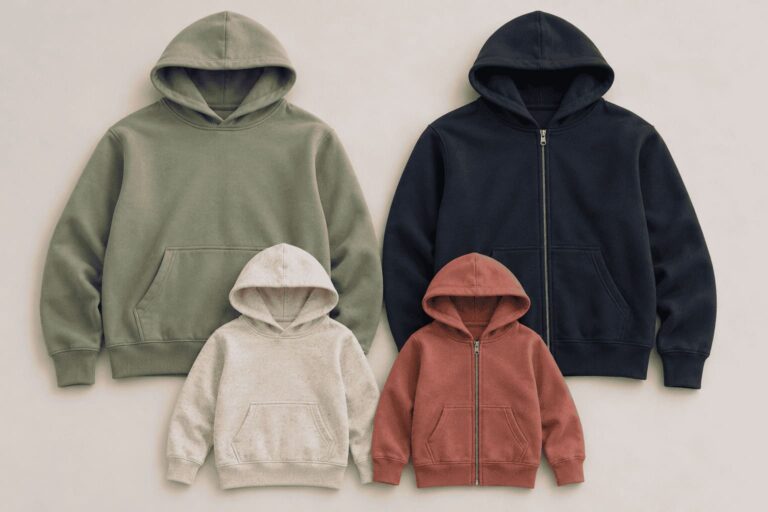
[…] A practical approach: If you’re placing a pilot or first-season order, compare the actual total costs of the available methods and choose a finish you can approve at your volume. More complex methods can follow at scale if they suit the product. A lower minimum alone is not enough: review appearance, hand feel and wash behavior on the actual hoodie fabric using the hoodie sample approval checklist. […]