
How to Approve T-Shirt Samples Before Bulk Production
A costly T-shirt production mistake can start before bulk production begins. Sample approval feels like a small step, but rushing it is one way sizing complaints, color mismatches, and costly rework start. Getting this right helps protect your brand before a single unit ships.
Approving a T-shirt sample before bulk production means checking fit and measurements, fabric, color, decoration, labels, workmanship and wash performance against agreed specifications, then recording the decision in writing. Identify the sample version, what is approved, any unresolved changes and which production activities are authorized. Keep an approved physical reference alongside the current specification; a visual sign-off alone leaves too much open to interpretation.
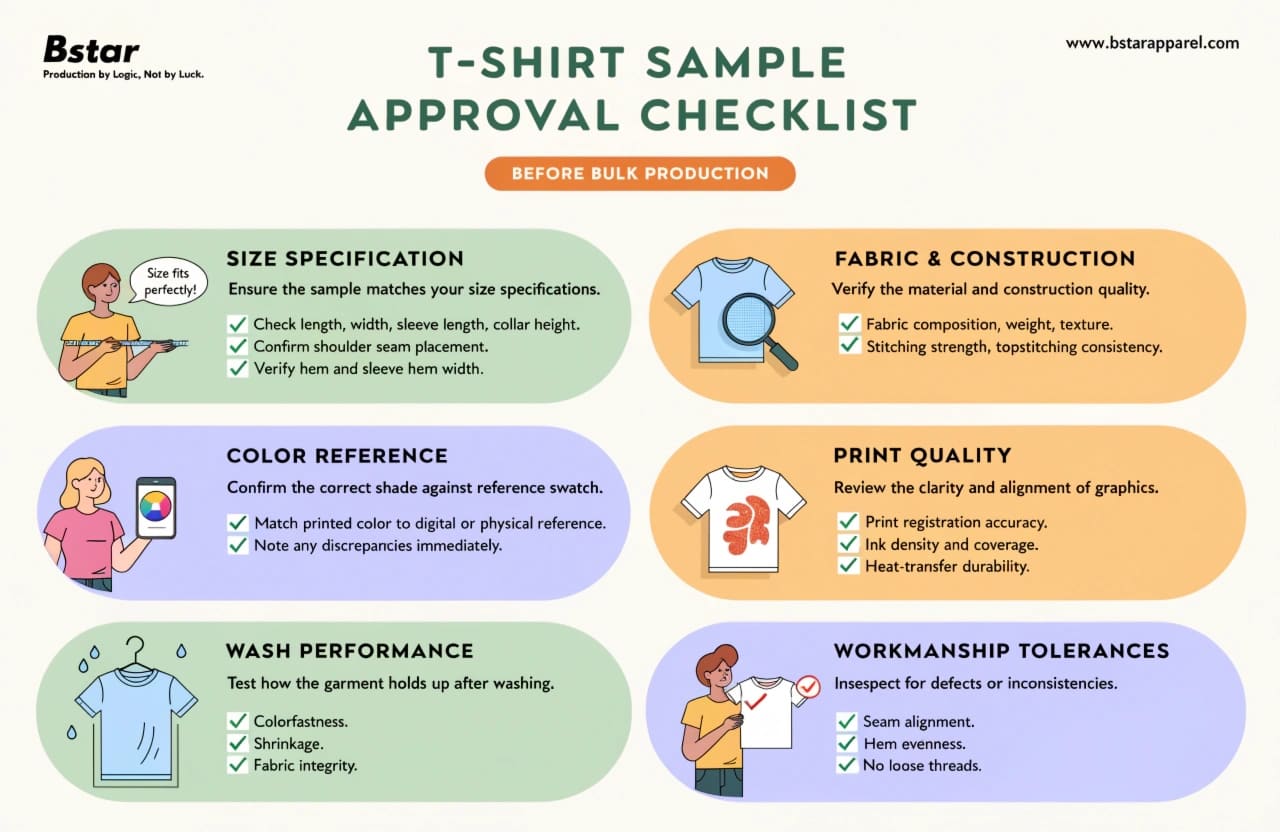
Illustration note: this is a review checklist, not a completed test record. Use an agreed physical color reference and viewing conditions for final shade approval; a phone-screen image alone is not a reliable color standard.
There is a lot more to approving samples for a custom T-shirt project than trying on the shirt and saying "looks good." The sections below walk through each layer of the approval process — what it controls, why it matters, and what I have personally seen go wrong when buyers skip a step.
What Are Pre-Production Samples?
Buyers often receive a sample and treat it like a preview. That framing misses an important distinction. An early development sample helps you decide what to change; a pre-production sample helps document what you intend to manufacture. The sample and written order specifications need to work together.
A pre-production sample, or PP sample, is a garment reviewed before the agreed bulk-production stage. It should use the intended bulk fabric, trims, construction and decoration so buyers can confirm the product against the current specifications. If anything is substituted, record the difference and what remains to be approved. A fit sample is a separate development stage, and one approved PP sample does not prove that every bulk unit will conform.
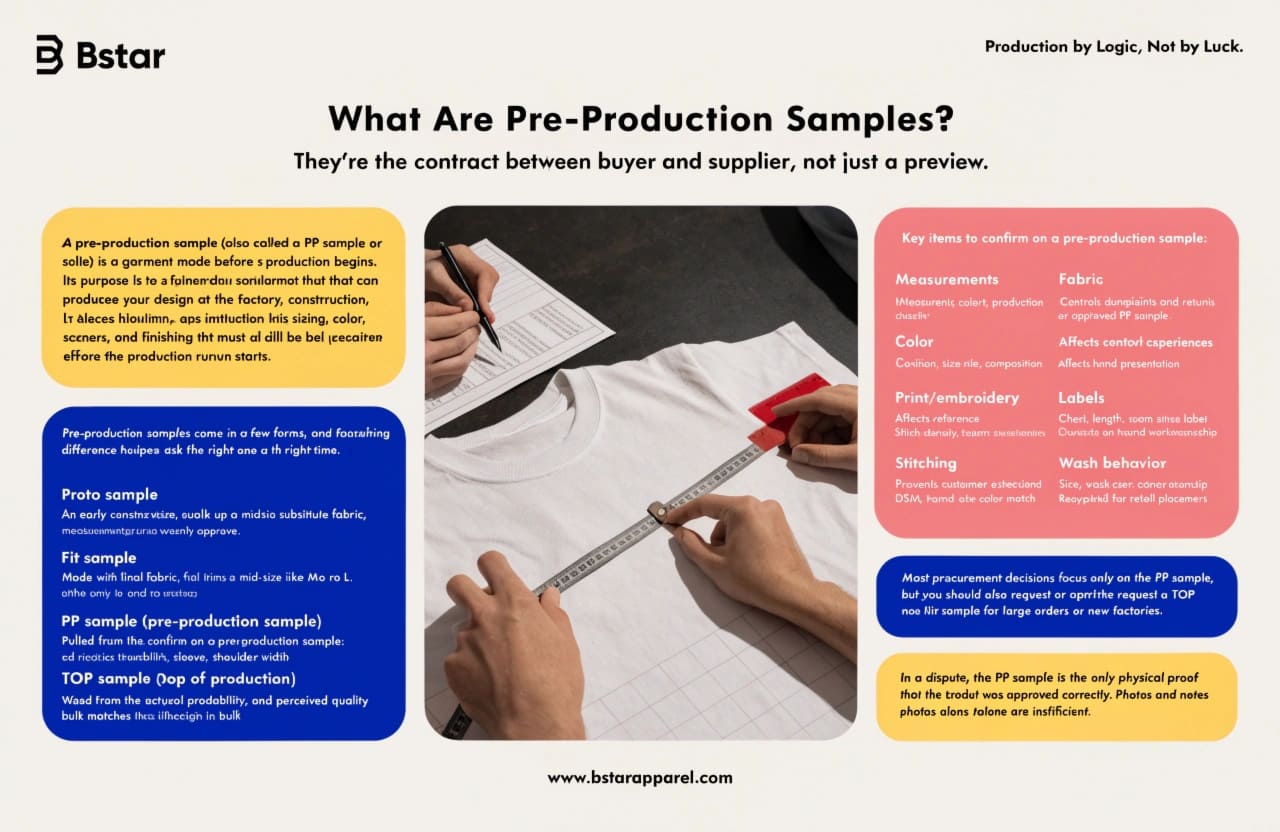
Clarification: a PP sample and a fit sample are different stages. A PP sample is a production reference alongside the written specifications, not automatically a legal contract or the only evidence in a dispute. Follow the stage definitions and approval record in the text; the original graphic contains simplified wording.
During development and production, buyers may encounter several sample stages. Understanding the difference helps you ask for the right one at the right time.
Types of Samples You May Encounter
- Proto sample: An early construction mock-up. Often uses substitute fabric. Good for testing silhouette and fit direction, not final approval.
- Fit sample: Used to check measurements, silhouette and wearing experience in an agreed base size. It may use substitute materials, so confirm whether its fabric and trims represent the intended bulk product.
- PP sample (pre-production sample): Intended to represent the bulk product, with final fabric, trims, construction and decoration. Record any outstanding exception rather than treating a substituted component as approved.
- TOP sample (top of production): Pulled from the first bulk-production output to compare with the approved reference. Agree how early it will be reviewed and whether further production must wait for that review.
- Size-set sample: Used to check grading across the agreed size range. Approval of one base-size fit sample does not approve every graded size.
For a large order or a new factory, consider an early TOP review and agree the response procedure before production starts. Sample-stage names can vary between suppliers: define the actual deliverable, materials and approval scope in your sampling and prototyping plan.
Why Pre-Production Samples Matter More Than You Think
Here is a scenario I have seen more than once: a buyer approves a sample based on photos and a quick try-on, then asks us to start bulk. The bulk arrives, and the chest measurement is 2 cm wider than expected because no written measurement record was confirmed. The buyer is frustrated. The factory is confused. Everyone loses time.
The PP sample approval step exists to prevent exactly this. It creates a shared reference that both buyer and supplier can point to. Keep the physical sample, measurement record and approved specification together, and state which document governs if they differ. Without that agreement, "correct" can become a matter of opinion.
Key items to confirm on a pre-production sample:
| Category | What to Check | Why It Matters |
|---|---|---|
| Measurements | Chest, body length, sleeve and shoulder; neck opening and rib shape; measurement method and point-specific tolerances | Helps control fit consistency |
| Fabric | Composition, GSM, knit structure, finish, hand feel and material reference | Defines the intended material |
| Color | Approved physical swatch or lab dip; agreed viewing conditions and acceptance basis | Creates a shared shade reference |
| Print/embroidery | Artwork version, method, position, size, color, hand feel and wash behavior | Defines the approved decoration |
| Stitching | Stitch type and density, seam appearance, skipped stitches, neck and hem finish; required seam tests | Defines workmanship checks |
| Labels | Brand, size and care artwork; required market information and placement; packing reference | Helps prevent labeling and packing errors |
| Wash behavior | Agreed washing and drying procedure; dimensional change, twisting, color and decoration appearance | Records performance under defined conditions |
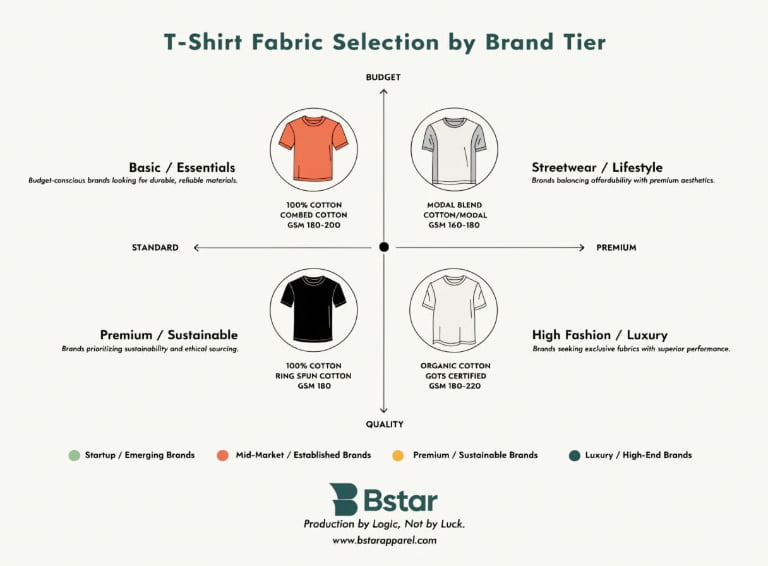
For fabric decisions that are still open, use the private-label T-shirt fabric guide before treating a PP sample as the final material reference.
What to Put in the Written Sample Approval
One short approval record is more useful than scattered comments in several messages. Attach the measured specification, dated photos and any test report, and retain matching reference samples with the buyer and factory where practical.
| Record | What to Write Down |
|---|---|
| Product and version | Style/order reference, sample ID, size and color, date, and current tech-pack/artwork revision |
| Review evidence | Actual measurements, agreed tolerances, physical color reference, wash procedure and results, and decoration/label checks |
| Decision | Approved for the stated production stage, revision required, or approval subject to explicitly listed conditions |
| Exceptions and responsibility | Each unresolved point, required action, responsible person, due date and whether a replacement sample or other evidence is needed |
| Production release | Exactly what may proceed: for example, material booking, cutting or sewing; state any hold points |
| Acknowledgment | Buyer approval and supplier acknowledgment, including how subsequent specification changes will be controlled |
If an exception could affect fit, color, labeling or wash performance, hold the affected work until it is resolved. "Approved, please fix the neck later" leaves too much room for different interpretations. If the reference sample conflicts with the specification, resolve and record that conflict before release.
An approval record supports production control. It does not replace the purchase order or guarantee a particular legal remedy.
How Does Sample Approval Protect T-Shirt Printing Profitability?
Buyers evaluating custom T-shirt production often ask about profitability from a business planning angle. Sample approval affects that calculation because an avoidable production error can consume the margin you expected to earn.
T-shirt printing profitability depends on the actual selling price, landed product cost, sales channel and operating expenses. There is no single margin range that applies to every private-label T-shirt order. Calculate gross margin percentage as (net sales revenue minus cost of goods sold) divided by net sales revenue, multiplied by 100, using a consistent cost basis. Then assess marketing, fulfillment, returns and overhead separately; gross margin is not net profit.
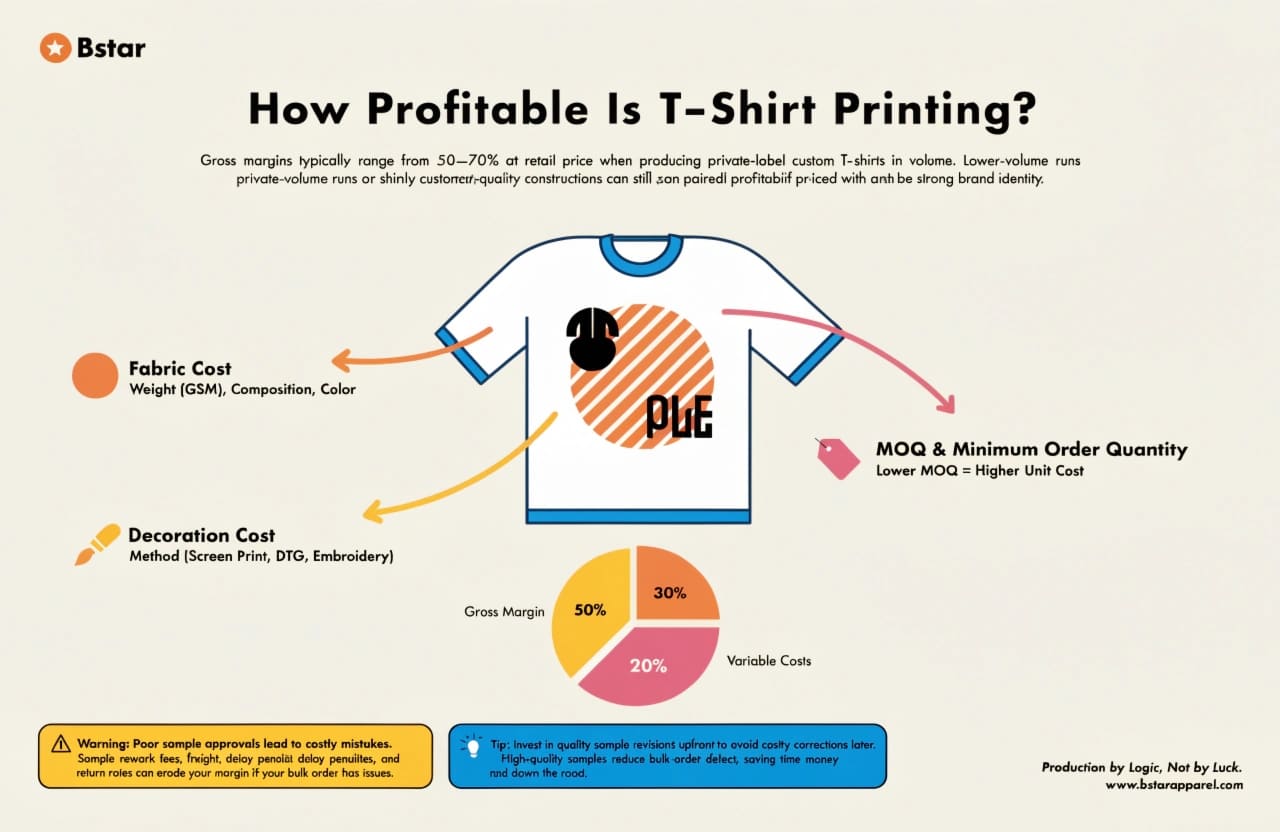
Correction to the graphic: the displayed 50–70% margin range and pie chart are not verified benchmarks for your order. Use actual selling revenue and a defined cost basis; gross margin is different from net profit. The graphic illustrates cost categories only.
Profitability is not just a finance question — it connects directly to sample approval decisions.
The Real Cost of a Poor Sample Approval
When a sample is approved incorrectly and bulk production goes wrong, possible costs include:
- Rework fees from the factory
- Freight costs for returning or reshipping goods
- Delay penalties or missed sales where your contracts and launch arrangements create that exposure
- Customer returns and handling costs if defective products reach market
- Brand damage that is hard to quantify but very real
I have seen brands think they saved time by rushing approval — only to spend three times as long managing the aftermath.
What Affects Your T-Shirt Production Cost?
Understanding cost drivers helps you make smarter decisions about where to invest in quality and where flexibility is acceptable.
- Fabric weight (GSM): More fabric mass can affect material consumption, but composition, width, yield and finishing also matter. GSM alone does not establish retail value, opacity or durability.
- Decoration method: Screen printing has screen/setup costs that may be spread over a longer run; DTG can suit short runs and detailed artwork without screen preparation.1 Compare quotes for your actual design, quantity and fabric. Embroidery cost also depends on stitch count, size, backing and placement.
- MOQ (minimum order quantity): A smaller run may spread development and setup costs over fewer pieces. Confirm garment, fabric and decoration minimums separately in your MOQ and order plan before approving a sample for a trial order.
- Certification and testing requirements: Specify any customer-required certification, supporting documents or additional tests at the quotation stage. Their availability, scope and cost need to be checked for the particular product; they are not universal requirements for every European retailer.
Profitability is protected not only by keeping production costs low, but by identifying avoidable defect costs before release. Include the agreed specifications and approval stages in your custom T-shirt RFQ so the sample and bulk quote cover the same product.
How to Make T-Shirts in Bulk?
Understanding how bulk production works makes you a better sample reviewer. You cannot evaluate production risk if you do not understand what the factory is actually doing.
Making T-shirts in bulk involves fabric sourcing and testing, pattern grading across sizes, cutting, sewing, decoration, finishing, quality inspection and packing. The sequence varies by construction and decoration method. The approval process should establish the current specifications and release conditions before the affected work begins; approved changes must still be recorded and communicated.
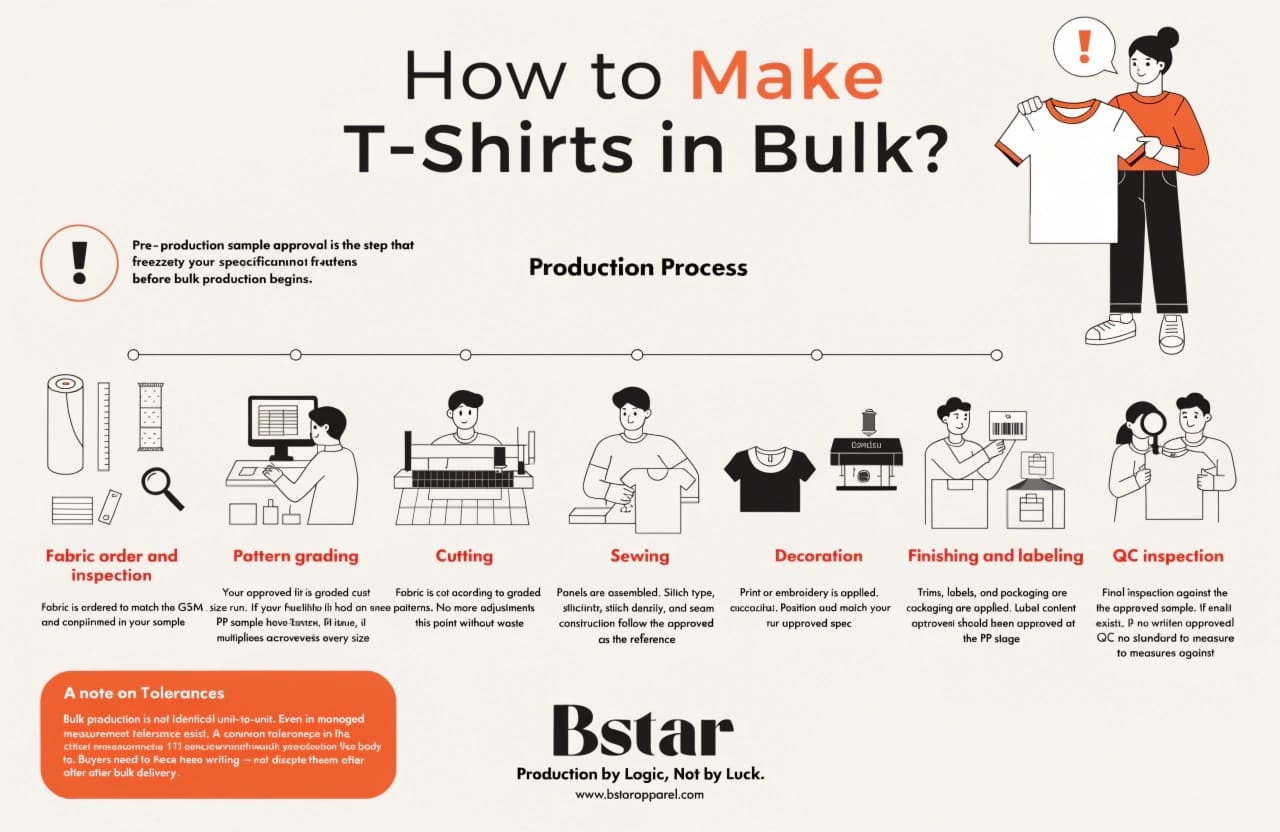
Clarification: production order varies; some decoration takes place before sewing, and material commitments may precede PP approval. Set tolerances for each measurement point and define inspection criteria in writing; the graphic is not a universal workflow or acceptance standard.
How the Production Flow Connects to Sample Approval
Here is a simplified production flow for custom T-shirts:
- Fabric order and inspection — Confirm the composition, GSM, construction, finish and approved shade reference. Some fabric commitments may be needed to make a representative PP sample; agree those commitments and inspect the incoming bulk material.
- Pattern grading — Review the base-size fit and agreed size set. Grading does not correct an unresolved fit issue, and approval of one size does not establish fit across the full range.
- Cutting — Release the current pattern and fabric version. A change after cutting may require recutting or other corrective work; agree the consequence before proceeding.
- Sewing — Panels are assembled. Stitch type, stitch density, and seam construction follow the approved sample as the reference.
- Decoration — Match the approved artwork, placement, method and color reference. Some designs are decorated on cut panels before sewing; others are applied to assembled garments. Review the sample in the intended production sequence.
- Finishing and labeling — Trims, labels, and packaging are applied. Label content and placement should have been approved at the PP stage.
- QC inspection — Use the approved specification, retained sample and agreed inspection criteria for material, in-line and final checks. A PP sample does not replace bulk inspection, and a final inspection should not be the first point at which variation is checked.
What "Tolerance" Means in Bulk Production
Bulk production is not identical unit-to-unit. Even in well-managed factories, measurements vary. Agree a tolerance for each point of measurement, along with how the garment is laid flat, whether the figure is a half or full measurement, whether tension is applied, and whether it is assessed before or after washing. There is no single ±1–2 cm rule suitable for every T-shirt dimension: a neck opening and a body length need different review.
If you need tighter tolerances, discuss feasibility and cost before production starts. Review actual measurements against the agreed limit, rather than relying on "same as sample." Specify the bulk inspection plan separately; sample approval alone does not define how many pieces will be inspected or how a batch will be accepted.
Can I Put My Own Label on Wholesale Clothing?
This is a common question from DTC brand founders and buyers who are sourcing finished goods or private-label products for the first time.
Yes, private-label manufacturing can include your brand label, size labels, care information and packaging from the start. For wholesale finished goods, first confirm that the supplier permits private labeling and that you have the necessary rights to use the branding and artwork. Re-labeling must not remove or misstate required product information. These details belong in sample approval rather than being added after production.

Brand-label illustration: review the actual artwork, attachment and required market information on the physical sample. This image does not establish product compliance or document a completed approval.
What to Confirm About Labels During Sample Approval
Labels are often treated as a minor detail during sample review. They are not. Labels carry legal compliance requirements in most markets, and they also affect brand presentation and consumer trust.
Label types to review on your PP sample:
- Brand label: Placement (usually center back neck), size, fabric, print quality. Does it match your brand identity?
- Size label: Does it match the approved brand size chart and the measured garment? Agree the size designation and grading instead of assuming that an M or L has the same dimensions across brands or markets.
- Care and required product information: For most covered clothing sold in the US, check fiber content, country of origin and the responsible business identity, plus care instructions supported by a reasonable basis.2 For the EU, confirm fiber-composition labeling and the applicable language requirements; the EU textile-labeling rules are not the same as the US care-labeling rules.3 Check other requirements for the actual destination and product type.
- Compliance documents and claims: Confirm which chemical-compliance information, test reports and certification claims apply to the order. REACH obligations can concern substances in garments or accessories, including Candidate List communication duties in specified circumstances; this is not a generic requirement to sew a "REACH declaration" onto every T-shirt.4 Keep any requested supporting documents with the order records.
Private Labeling vs. Wholesale Reselling
There is a meaningful difference between putting your label on a custom-manufactured garment (where you have controlled the fabric, fit, and construction from the start) and simply re-labeling a wholesale finished product.
If you are working with a custom manufacturer, your label specifications go into the production order from day one. If you are sourcing finished wholesale goods and adding your label, independently verify the product and market requirements and agree responsibilities with the supplier. In the US, replacing labels must preserve required information and meet the FTC’s applicable identification and recordkeeping rules.2
For DTC brands building long-term brand equity, custom manufacturing with controlled sample approval is worth the extra lead time. The label on the neck is a promise to your customer. The sample approval process is how you make sure the product behind that promise is consistent.
Frequently Asked Questions
How many rounds of sample revision are normal before bulk approval?
There is no universal number. A familiar fit block with clear specifications may need fewer revisions than a new silhouette, fabric or decoration process. Repeated revisions can result from an unclear brief, factory execution, material changes or new buyer decisions; the count alone does not identify who is at fault. Define the review scope and required evidence for each stage before the first sample.
Can I approve a T-shirt sample based on photos only?
Photos are useful for discussing visible details and approximate placement, but screen color is not a reliable final shade reference. They cannot establish hand feel, fabric mass, measurements or wash performance on their own. For a new style or supplier, review a physical sample and the agreed measurement/test records. If remote approval is necessary, record exactly what the evidence covers and what remains open.
What happens if bulk production doesn’t match the approved sample?
Compare the bulk findings with the approved specification, sample version, tolerance and inspection criteria. Record the affected quantity and evidence, ask the supplier to investigate, and agree containment and corrective action before further shipment where practical. Rework, replacement, credit or other remedies depend on the contract, responsibility for the deviation and applicable law; a sample approval does not automatically establish a remedy.
Should I wash the sample before approving it?
Yes, when washing is part of the intended care. Agree the washing and drying procedure, number of cycles, sample preparation and acceptance criteria before the test. Measure and record dimensions before and after; review twisting, color change, staining, neck/hem shape and decoration appearance. Where specified, ISO 6330 provides domestic wash/dry procedures, ISO 5077 addresses dimensional change, and ISO 16322-3 addresses garment spirality after laundering.5 A casual home wash can help development, but it is not automatically a standards-compliant laboratory test, and these method references do not supply one universal pass limit.
What certifications should I ask a supplier to verify?
Ask for documents that match the customer requirement and intended claim, rather than requesting the same list for every order:
- OEKO-TEX® STANDARD 100: Check the certified article, certificate holder, validity and product class. It addresses testing for harmful substances, not overall fit or wash durability.6
- GOTS: If an organic textile claim is required, verify the applicable certified supply chain and product scope, plus the documentation and label permission for the intended claim. A certified fabric does not automatically make a finished T-shirt GOTS-certified.7
- amfori BSCI: Review the actual production-site audit report, date, rating and follow-up status through the appropriate channel. BSCI is a social-compliance due-diligence/audit programme, not a product certificate.8
- FSC: Where paper packaging carries an FSC claim, check the relevant packaging supply chain and permitted claim. It does not certify the T-shirt’s textile performance.9
These documents answer different questions and do not replace product testing or legal compliance. For BSTAR, GOTS-related material sourcing must be checked with appropriately certified suppliers for the particular project; do not assume that every material, factory stage or finished garment is covered.
Conclusion
Approving T-shirt samples before bulk production is an important production-control decision. Done properly, it records your sizing, fabric, color, decoration, workmanship and labeling requirements in a shared reference. Done carelessly, it leaves more questions to resolve after production has already started.
The key takeaways: measure the sample against a written specification, check fabric and decoration after the agreed wash test, confirm point-specific tolerances and market labeling requirements, and record the approval scope and production release. Retain the physical reference and manage later changes in writing. The approved sample supports the order specification; it is not automatically the entire production contract.
If you are preparing to launch a custom T-shirt line or reviewing your sample approval process, we are happy to walk through what a structured pre-bulk confirmation looks like from our side. You can review BSTAR’s company and manufacturing background, then discuss your T-shirt sample requirements with the current specification and any unresolved sample comments.
-
Epson, DTG and DTF Printing, FAQ on DTG versus screen printing. Used for the screen-setup/design/run-length distinction; it does not establish a universal break-even quantity or a profit-margin benchmark. ↩
-
US Federal Trade Commission, Threading Your Way Through the Labeling Requirements Under the Textile and Wool Acts and Clothes Captioning: Complying with the Care Labeling Rule. Covers applicable fiber, origin and responsible-business disclosures, label replacement/records, and care-instruction obligations and substantiation for covered US products. Check applicability and exemptions for the product. ↩ ↩
-
European Union, Your Europe, Textile Label. Covers fiber-composition labeling and relevant language requirements. This guidance does not turn US care/origin rules into identical EU-wide requirements or exhaust all other product obligations. ↩
-
European Chemicals Agency, Summary of obligations resulting from inclusion of SVHCs in the Candidate List. Article 33 communication obligations apply in the specified circumstances, including Candidate List substances above 0.1% by weight in articles. They are distinct from restrictions and other duties, and are not a generic sewn-in garment-label requirement. ↩
-
International Organization for Standardization: ISO 6330:2021 — Domestic washing and drying procedures for textile testing; ISO 5077:2007 — Determination of dimensional change in washing and drying; ISO 16322-3:2021 — Determination of spirality after laundering, Part 3: Woven and knitted garments. Public catalogue scopes identify these methods; use the applicable full procedure and agreed acceptance criteria for testing. These are method references, not one universal T-shirt pass threshold. ↩
-
OEKO-TEX®, STANDARD 100. Harmful-substance testing and certification are tied to the certified article and scope; check the actual certificate and intended use. This is not a BSTAR blanket-certification claim. ↩
-
Global Standard, GOTS key features. Covers organic-fiber processing, environmental and social criteria, certification through the applicable chain, and traceability. Verify the product and claim scope; certified input fabric alone does not establish finished-product certification. ↩
-
amfori, amfori BSCI, including the FAQ distinguishing its audit programme from certification. The audit concerns the assessed site and working conditions; it does not certify a T-shirt or guarantee product performance. ↩
-
Forest Stewardship Council, Chain of Custody Certification. Relevant to substantiated forest-based material/product claims, such as applicable paper packaging; not a textile-performance certificate. ↩
Discussion & questions 0 comments